
Factors affecting absorption
Krishan Kumar Verma, Assistant Professor
Ram-Eesh Institute of Vocational & Technical Education
Learning Outcomes:
• The learners will be able to understand:
• Chromophores & Auxochromes
• Types of absorption shifts
• Effect of solvent
• Effect of conjugation
Chromophores
In Greek: Chroma = colour ; phoros = bearer
• Any isolated covalently bonded group that shows a characteristic
absorption in the uv/visible region. e.g. C=C, C=O or NO2
• Any substance or groups that absorbs radiation at particular wave
length can be considered as chromophore whether it may or may not
impart color to the compound.
• A molecule containing a chromophore is called as chromogen.
• Mainly exhibit n-π* and π –π* transitions.
• chromophores function by altering the energy in the delocalized
electron cloud of the dye, and this alteration results in the compounds
absorbing radiation from the visible light.
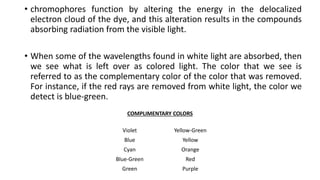
• When some of the wavelengths found in white light are absorbed, then
we see what is left over as colored light. The color that we see is
referred to as the complementary color of the color that was removed.
For instance, if the red rays are removed from white light, the color we
detect is blue‐green.
COMPLIMENTARY COLORS
Violet Yellow-Green
Blue Yellow
Cyan Orange
Blue-Green Red
Green Purple
• Conjugated double bonds interact with each other in chromophores and
due to this interaction between the double bonds, partial delocalization
of the bonding electrons is observed. Therefore, the electrons are
distributed over a larger area.
• Types of chromophores: 1. independent
2. dependent
Independent chromophore: If one chromophore is required to impart
color to the compound. e.g. azo (-N=N-), Nitroso (-N=O)
Dependent chromophore: if more than one chromophore is required
to impart color to the compound. e.g. Acetone having one ketone group is
colorless whereas diacetyl having two ketone groups is yellow.
Group Structure Wavelength (nm)
Carbonyl C=O 280
Azo -N=N- 339
Nitro -NO2 280
Thioketone C=S 330
Nitrite -ONO 230
Conjugated Diene C=C-C=C 268
Conjugated Triene C=C-C=C=C 315
Benzene 261
Auxochromes
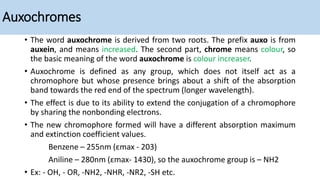
• The word auxochrome is derived from two roots. The prefix auxo is from
auxein, and means increased. The second part, chrome means colour, so
the basic meaning of the word auxochrome is colour increaser.
• Auxochrome is defined as any group, which does not itself act as a
chromophore but whose presence brings about a shift of the absorption
band towards the red end of the spectrum (longer wavelength).
• The effect is due to its ability to extend the conjugation of a chromophore
by sharing the nonbonding electrons.
• The new chromophore formed will have a different absorption maximum
and extinction coefficient values.
Benzene – 255nm (εmax - 203)
Aniline – 280nm (εmax- 1430), so the auxochrome group is – NH2
• Ex: - OH, - OR, -NH2, -NHR, -NR2, -SH etc.
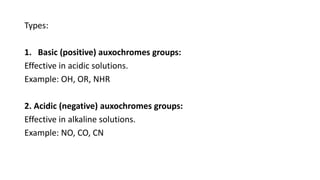
Types:
1. Basic (positive) auxochromes groups:
Effective in acidic solutions.
Example: OH, OR, NHR
2. Acidic (negative) auxochromes groups:
Effective in alkaline solutions.
Example: NO, CO, CN
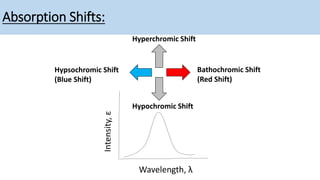
Absorption Shifts:
Intensity,ε
Wavelength, λ
Bathochromic Shift
(Red Shift)
Hyperchromic Shift
Hypochromic Shift
Hypsochromic Shift
(Blue Shift)
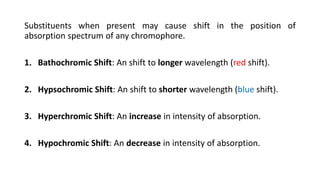
Substituents when present may cause shift in the position of
absorption spectrum of any chromophore.
1. Bathochromic Shift: An shift to longer wavelength (red shift).
2. Hypsochromic Shift: An shift to shorter wavelength (blue shift).
3. Hyperchromic Shift: An increase in intensity of absorption.
4. Hypochromic Shift: An decrease in intensity of absorption.
Bathochromic Shift:
• Also known as red shift.
• Shift in the position of absorption maximum to the longer wavelength.
• Change of solvent polarity (low)/ auxochromes/conjugation may cause
bathochromic shift.
• Example; π- π* in ethylene : λmax= 165 nm
π- π* in 1,3-butadiene : λmax= 217 nm
Hypsochromic Shift:
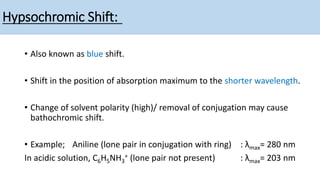
• Also known as blue shift.
• Shift in the position of absorption maximum to the shorter wavelength.
• Change of solvent polarity (high)/ removal of conjugation may cause
bathochromic shift.
• Example; Aniline (lone pair in conjugation with ring) : λmax= 280 nm
In acidic solution, C6H5NH3
+ (lone pair not present) : λmax= 203 nm
Hyperchromic Shift:
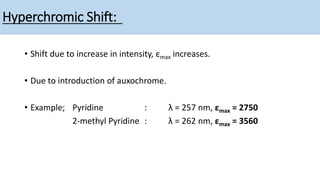
• Shift due to increase in intensity, εmax increases.
• Due to introduction of auxochrome.
• Example; Pyridine : λ = 257 nm, εmax = 2750
2-methyl Pyridine : λ = 262 nm, εmax = 3560
Hypochromic Shift:
• Shift due to decrease in intensity, εmax decreases.
• Due to introduction of any substituent that may cause distortion in
molecular geometry.
• Example; Biphenyl : λ = 250 nm, εmax = 19000
2-methyl biphenyl : λ = 237 nm, εmax = 10250
Solvent Effects
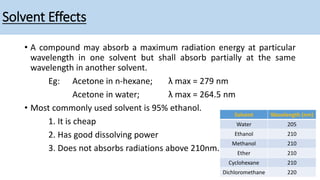
• A compound may absorb a maximum radiation energy at particular
wavelength in one solvent but shall absorb partially at the same
wavelength in another solvent.
Eg: Acetone in n-hexane; λ max = 279 nm
Acetone in water; λ max = 264.5 nm
• Most commonly used solvent is 95% ethanol.
1. It is cheap
2. Has good dissolving power
3. Does not absorbs radiations above 210nm.
Solvent Wavelength (nm)
Water 205
Ethanol 210
Methanol 210
Ether 210
Cyclohexane 210
Dichloromethane 220
Effect of solvent polarity
• Polarity plays an important role in the position and intensity of
absorption maximum of a particular chromophore.
a) In case of non-polar solvents e.g. Iodine solution (purple
color) the absorption maxima occurs at almost the same
wavelength as in iodine vapor (5180 A0)
b) In case of polar solvents , a brownish color is obtained instead
of purple color , because the absorption occurs at shorter
wavelengths.
Effect of solvent polarity
• Many analyte exhibit fine structures when measured in low dipole
moments.
• Solute-solvent interactions are greater when strong dipole forces are
involved.
• Solvent effects help in recognizing bands due to n-π* and π- π*
transitions.
• The non bonding electrons can interact strongly with polar solvents
and results in characteristic shift to shorter wavelength
(hypsochromic shift), whereas, those of π- π* transitions are shifted
to higher wavelengths (bathochromic shift).
Why n-π* transitions causes hypsochromic shift whereas π -π*
transition causes bathochromic shift in polar solvents?
The energy of the nonbonding orbital is lowered by H-bonding in polar
solvents, and thereby increase the energy of n-π* transition (short λ).
The energy of π* orbital is decreased relative to the π orbital and
therefore, energy of π-π* transition is decreased (long λ).
Molarabsorptivity,ε
Wavelength, λ
CHCl3
C2H5OH
Absorption spectrum of iodine in a polar and a non polar solvents
Effect of conjugation:
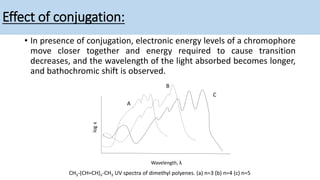
• In presence of conjugation, electronic energy levels of a chromophore
move closer together and energy required to cause transition
decreases, and the wavelength of the light absorbed becomes longer,
and bathochromic shift is observed.
logε
Wavelength, λ
A
B
C
CH3-(CH=CH)n-CH3 UV spectra of dimethyl polyenes. (a) n=3 (b) n=4 (c) n=5
THANK YOU

Factors affecting absorption

  • 1.
    Factors affecting absorption KrishanKumar Verma, Assistant Professor Ram-Eesh Institute of Vocational & Technical Education
  • 2.
    Learning Outcomes: • Thelearners will be able to understand: • Chromophores & Auxochromes • Types of absorption shifts • Effect of solvent • Effect of conjugation
  • 3.
    Chromophores In Greek: Chroma= colour ; phoros = bearer • Any isolated covalently bonded group that shows a characteristic absorption in the uv/visible region. e.g. C=C, C=O or NO2 • Any substance or groups that absorbs radiation at particular wave length can be considered as chromophore whether it may or may not impart color to the compound. • A molecule containing a chromophore is called as chromogen. • Mainly exhibit n-π* and π –π* transitions.
  • 4.
    • chromophores functionby altering the energy in the delocalized electron cloud of the dye, and this alteration results in the compounds absorbing radiation from the visible light. • When some of the wavelengths found in white light are absorbed, then we see what is left over as colored light. The color that we see is referred to as the complementary color of the color that was removed. For instance, if the red rays are removed from white light, the color we detect is blue‐green. COMPLIMENTARY COLORS Violet Yellow-Green Blue Yellow Cyan Orange Blue-Green Red Green Purple
  • 5.
    • Conjugated doublebonds interact with each other in chromophores and due to this interaction between the double bonds, partial delocalization of the bonding electrons is observed. Therefore, the electrons are distributed over a larger area. • Types of chromophores: 1. independent 2. dependent Independent chromophore: If one chromophore is required to impart color to the compound. e.g. azo (-N=N-), Nitroso (-N=O) Dependent chromophore: if more than one chromophore is required to impart color to the compound. e.g. Acetone having one ketone group is colorless whereas diacetyl having two ketone groups is yellow.
  • 6.
    Group Structure Wavelength(nm) Carbonyl C=O 280 Azo -N=N- 339 Nitro -NO2 280 Thioketone C=S 330 Nitrite -ONO 230 Conjugated Diene C=C-C=C 268 Conjugated Triene C=C-C=C=C 315 Benzene 261
  • 7.
    Auxochromes • The wordauxochrome is derived from two roots. The prefix auxo is from auxein, and means increased. The second part, chrome means colour, so the basic meaning of the word auxochrome is colour increaser. • Auxochrome is defined as any group, which does not itself act as a chromophore but whose presence brings about a shift of the absorption band towards the red end of the spectrum (longer wavelength). • The effect is due to its ability to extend the conjugation of a chromophore by sharing the nonbonding electrons. • The new chromophore formed will have a different absorption maximum and extinction coefficient values. Benzene – 255nm (εmax - 203) Aniline – 280nm (εmax- 1430), so the auxochrome group is – NH2 • Ex: - OH, - OR, -NH2, -NHR, -NR2, -SH etc.
  • 8.
    Types: 1. Basic (positive)auxochromes groups: Effective in acidic solutions. Example: OH, OR, NHR 2. Acidic (negative) auxochromes groups: Effective in alkaline solutions. Example: NO, CO, CN
  • 9.
    Absorption Shifts: Intensity,ε Wavelength, λ BathochromicShift (Red Shift) Hyperchromic Shift Hypochromic Shift Hypsochromic Shift (Blue Shift)
  • 10.
    Substituents when presentmay cause shift in the position of absorption spectrum of any chromophore. 1. Bathochromic Shift: An shift to longer wavelength (red shift). 2. Hypsochromic Shift: An shift to shorter wavelength (blue shift). 3. Hyperchromic Shift: An increase in intensity of absorption. 4. Hypochromic Shift: An decrease in intensity of absorption.
  • 11.
    Bathochromic Shift: • Alsoknown as red shift. • Shift in the position of absorption maximum to the longer wavelength. • Change of solvent polarity (low)/ auxochromes/conjugation may cause bathochromic shift. • Example; π- π* in ethylene : λmax= 165 nm π- π* in 1,3-butadiene : λmax= 217 nm
  • 12.
    Hypsochromic Shift: • Alsoknown as blue shift. • Shift in the position of absorption maximum to the shorter wavelength. • Change of solvent polarity (high)/ removal of conjugation may cause bathochromic shift. • Example; Aniline (lone pair in conjugation with ring) : λmax= 280 nm In acidic solution, C6H5NH3 + (lone pair not present) : λmax= 203 nm
  • 13.
    Hyperchromic Shift: • Shiftdue to increase in intensity, εmax increases. • Due to introduction of auxochrome. • Example; Pyridine : λ = 257 nm, εmax = 2750 2-methyl Pyridine : λ = 262 nm, εmax = 3560
  • 14.
    Hypochromic Shift: • Shiftdue to decrease in intensity, εmax decreases. • Due to introduction of any substituent that may cause distortion in molecular geometry. • Example; Biphenyl : λ = 250 nm, εmax = 19000 2-methyl biphenyl : λ = 237 nm, εmax = 10250
  • 15.
    Solvent Effects • Acompound may absorb a maximum radiation energy at particular wavelength in one solvent but shall absorb partially at the same wavelength in another solvent. Eg: Acetone in n-hexane; λ max = 279 nm Acetone in water; λ max = 264.5 nm • Most commonly used solvent is 95% ethanol. 1. It is cheap 2. Has good dissolving power 3. Does not absorbs radiations above 210nm. Solvent Wavelength (nm) Water 205 Ethanol 210 Methanol 210 Ether 210 Cyclohexane 210 Dichloromethane 220
  • 16.
    Effect of solventpolarity • Polarity plays an important role in the position and intensity of absorption maximum of a particular chromophore. a) In case of non-polar solvents e.g. Iodine solution (purple color) the absorption maxima occurs at almost the same wavelength as in iodine vapor (5180 A0) b) In case of polar solvents , a brownish color is obtained instead of purple color , because the absorption occurs at shorter wavelengths.
  • 17.
    Effect of solventpolarity • Many analyte exhibit fine structures when measured in low dipole moments. • Solute-solvent interactions are greater when strong dipole forces are involved. • Solvent effects help in recognizing bands due to n-π* and π- π* transitions. • The non bonding electrons can interact strongly with polar solvents and results in characteristic shift to shorter wavelength (hypsochromic shift), whereas, those of π- π* transitions are shifted to higher wavelengths (bathochromic shift).
  • 18.
    Why n-π* transitionscauses hypsochromic shift whereas π -π* transition causes bathochromic shift in polar solvents? The energy of the nonbonding orbital is lowered by H-bonding in polar solvents, and thereby increase the energy of n-π* transition (short λ). The energy of π* orbital is decreased relative to the π orbital and therefore, energy of π-π* transition is decreased (long λ). Molarabsorptivity,ε Wavelength, λ CHCl3 C2H5OH Absorption spectrum of iodine in a polar and a non polar solvents
  • 19.
    Effect of conjugation: •In presence of conjugation, electronic energy levels of a chromophore move closer together and energy required to cause transition decreases, and the wavelength of the light absorbed becomes longer, and bathochromic shift is observed. logε Wavelength, λ A B C CH3-(CH=CH)n-CH3 UV spectra of dimethyl polyenes. (a) n=3 (b) n=4 (c) n=5
  • 20.