Electron spin resonance (ESR) spectroscopy
is also known as Electron paramagnetic
resonance (EPR)
It is absorption spectroscopy similar to NMR,
possible only with molecules having unpaired
electrons
Instead of Radiowaves in NMR, Microwaves
is used in ESR
The phenomenon of electron spin resonance
(ESR) is based on the fact that an electron is a
charged particle
It spins around its axis and this causes it to act
like a tiny bar magnet
Contd…
When a molecule or compound with an
unpaired electron is placed in a strong
magnetic field
The spin of the unpaired electron can align in
two different ways creating two spin states
ms = ± ½
Contd…
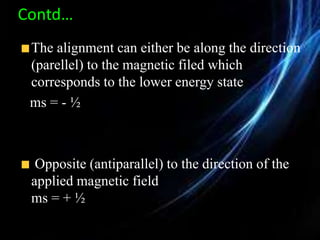
The alignment can either be along the direction
(parellel) to the magnetic filed which
corresponds to the lower energy state
ms = - ½
Opposite (antiparallel) to the direction of the
applied magnetic field
ms = + ½
Contd…
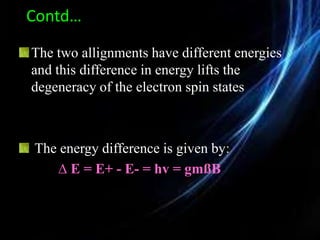
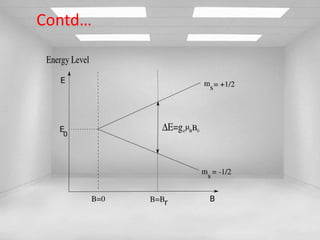
The two allignments have different energies
and this difference in energy lifts the
degeneracy of the electron spin states
The energy difference is given by:
∆ E = E+ - E- = hv = gmßB
Contd…
Contd…
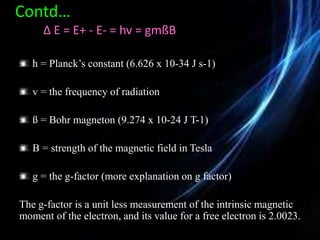
∆ E = E+ - E- = hv = gmßB
h = Planck’s constant (6.626 x 10⁻³⁴ J s-1)
v = the frequency of radiation
ß = Bohr magneton (9.274 x 10⁻²⁴ J T-1)
B = strength of the magnetic field in Tesla
g = the g-factor (more explanation on g factor)
The g-factor is a unit less measurement of the intrinsic magnetic
moment of the electron, and its value for a free electron is 2.0023.
Hyperfine splitting
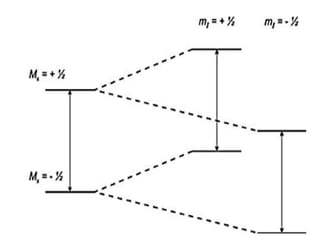
The esr signal is due to transition of
electrons from the spin state ms =-1/2 to
the spin state ms = +1/2 . – spin flip
This spin state may interact with magnetic
moment of nuclei, with which the unpaired
electron may be partially or wholly
associated
This interaction may lead to splitting of
resonance signals in to several lines. This is
Hyperfine splitting
KLYSTRONS
Klystron tube acts as the source of radiation
It is stabilized against temperature fluctuation by
immersion in an oil bath or by forced air cooling
The frequency of the monochromatic radiation is
determined by the voltage applied to klystron
It is kept a fixed frequency by an automatic control
circuit and provides a power output of about 300 milli
watts
WAVE GUIDE OR WAVEMETER
The wave meter is put in between the oscillator and
attenuator
To know the frequency of microwaves produced by
klystron oscillator
The wave meter is usually calibrated in frequency unit
(megahertz) instead of wavelength
Wave guide is a hollow, rectangular brass tube
It is used to convey the wave radiation to the sample and
crystal.
ATTENUATORS
The power propagated down the wave guide may
be continuously decreased by inserting a piece of
resistive material into the wave guide
This piece is called variable attenuator
It is used in varying the power of the sample
from the full power of klystron to one attenuated
by a force 100 or more.
ISOLATORS
It’s device which minimizes vibrations in the frequency
of microwaves produced by klystron oscillator
Isolators are used to prevent the reflection of
microwave power back into the radiation source
It is a strip of ferrite material which allows micro
waves in one direction only
It also stabilizes the frequency of the klystron.
SAMPLE CAVITIES
The heart of the ESR spectrometer is the resonant cavity
containing the sample
The sample is contained in a resonance cavity
Rectangular TE120 cavity and cylindrical TE011 cavity have
widely been used
In most of the ESR spectrometers, dual sample cavities are
generally used This is done for simultaneous observation of a
sample and a reference material
Since magnetic field interacts with the sample to cause spin
resonance the sample is placed where the intensity of magnetic
field is greatest
COUPLERS AND MATCHING SCREWS
The various components of the micro wave assembly to
be coupled together by making use of irises or slots of
various sizes
CRYSTAL DETECTORS
A Silicon crystal detectors, which converts the radiation
in D.C has widely been used as a detector of microwave
radiation
MAGNET SYSTEM
The resonant cavity is placed between the poles pieces of an
electromagnet
The field should be stable and uniform over the sample
volume
The stability of field is achieved by energizing the magnet with
a highly regulated power supply
The ESR spectrum is recorded by slowly varying the magnetic
field through the resonance condense by sweeping the current
supplied to the magnet by the power supply
MODULATION COIL
The modulation of the signal at a frequency
consistent with good signal noise ratio in the
crystal detector is accomplished by a small
alternating variation of the magnetic field
The variation is produced by supplying an A.C.
signal to modulation coil oriented with respect
the sample in the same direction as the magnetic
field
Contd…..
If the modulation is of low frequency (400
cycles/sec or less), the coils can be mounted
outside the cavity and even on the magnet pole
pieces
For higher modulation frequencies,
modulation coils must be mounted inside the
resonant cavity or cavities constructed of a
non-metallic material e.g., Quartz with a tin
silvered plating
DISPLAY DEVICES
In order to observe the signal a system is
connected (pc)
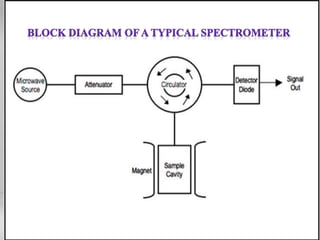
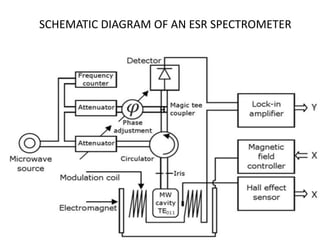
SCHEMATIC DIAGRAM OF AN ESR SPECTROMETER
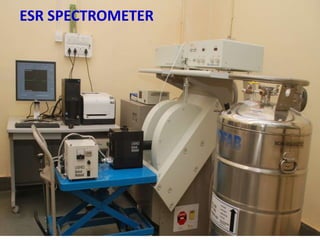
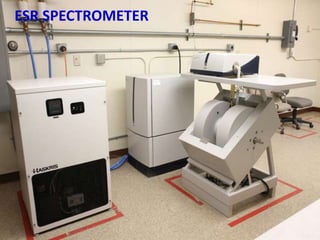
ESR SPECTROMETER
ESR SPECTROMETER
APPLICATIONS OF ESR
Cont……
Only direct method to detect the presence of free
radicals and to identify the paramagnetic species
Provides information on :
Molecular structure near the unpaired electron
EPR spectra lineshape gives insight to
dynamic processes molecular motions or
fluidity.
Probes the structure of “active sites” in
metalloproteins
Dose measurements for sterilization of
medical goods and foods
Detection of irradiated foods
Enzymes catalysed biological redox
reactions can be studied
Used to study transition metal complexes
To study N- type semiconductions
To study the presence of organic and
inorganic radicals
1. http://epr.cm.utexas.edu/WhatIsEPR.html
2. http://www.uottawa.ca/publications/interscientia/inte
r.2/spin.html
3. http://hyperphysics.phyastr.gsu.edu/hbase/molecule/
esr.html
ELECTRON SPIN RESONANCE SPECTROSCOPY

ELECTRON SPIN RESONANCE SPECTROSCOPY

  • 2.
    Electron spin resonance(ESR) spectroscopy is also known as Electron paramagnetic resonance (EPR) It is absorption spectroscopy similar to NMR, possible only with molecules having unpaired electrons Instead of Radiowaves in NMR, Microwaves is used in ESR
  • 3.
    The phenomenon ofelectron spin resonance (ESR) is based on the fact that an electron is a charged particle It spins around its axis and this causes it to act like a tiny bar magnet
  • 4.
    Contd… When a moleculeor compound with an unpaired electron is placed in a strong magnetic field The spin of the unpaired electron can align in two different ways creating two spin states ms = ± ½
  • 5.
    Contd… The alignment caneither be along the direction (parellel) to the magnetic filed which corresponds to the lower energy state ms = - ½ Opposite (antiparallel) to the direction of the applied magnetic field ms = + ½
  • 6.
    Contd… The two allignmentshave different energies and this difference in energy lifts the degeneracy of the electron spin states The energy difference is given by: ∆ E = E+ - E- = hv = gmßB
  • 7.
  • 8.
    Contd… ∆ E =E+ - E- = hv = gmßB h = Planck’s constant (6.626 x 10⁻³⁴ J s-1) v = the frequency of radiation ß = Bohr magneton (9.274 x 10⁻²⁴ J T-1) B = strength of the magnetic field in Tesla g = the g-factor (more explanation on g factor) The g-factor is a unit less measurement of the intrinsic magnetic moment of the electron, and its value for a free electron is 2.0023.
  • 9.
    Hyperfine splitting The esrsignal is due to transition of electrons from the spin state ms =-1/2 to the spin state ms = +1/2 . – spin flip This spin state may interact with magnetic moment of nuclei, with which the unpaired electron may be partially or wholly associated
  • 10.
    This interaction maylead to splitting of resonance signals in to several lines. This is Hyperfine splitting
  • 12.
    KLYSTRONS Klystron tube actsas the source of radiation It is stabilized against temperature fluctuation by immersion in an oil bath or by forced air cooling The frequency of the monochromatic radiation is determined by the voltage applied to klystron It is kept a fixed frequency by an automatic control circuit and provides a power output of about 300 milli watts
  • 13.
    WAVE GUIDE ORWAVEMETER The wave meter is put in between the oscillator and attenuator To know the frequency of microwaves produced by klystron oscillator The wave meter is usually calibrated in frequency unit (megahertz) instead of wavelength Wave guide is a hollow, rectangular brass tube It is used to convey the wave radiation to the sample and crystal.
  • 14.
    ATTENUATORS The power propagateddown the wave guide may be continuously decreased by inserting a piece of resistive material into the wave guide This piece is called variable attenuator It is used in varying the power of the sample from the full power of klystron to one attenuated by a force 100 or more.
  • 16.
    ISOLATORS It’s device whichminimizes vibrations in the frequency of microwaves produced by klystron oscillator Isolators are used to prevent the reflection of microwave power back into the radiation source It is a strip of ferrite material which allows micro waves in one direction only It also stabilizes the frequency of the klystron.
  • 17.
    SAMPLE CAVITIES The heartof the ESR spectrometer is the resonant cavity containing the sample The sample is contained in a resonance cavity Rectangular TE120 cavity and cylindrical TE011 cavity have widely been used In most of the ESR spectrometers, dual sample cavities are generally used This is done for simultaneous observation of a sample and a reference material Since magnetic field interacts with the sample to cause spin resonance the sample is placed where the intensity of magnetic field is greatest
  • 18.
    COUPLERS AND MATCHINGSCREWS The various components of the micro wave assembly to be coupled together by making use of irises or slots of various sizes CRYSTAL DETECTORS A Silicon crystal detectors, which converts the radiation in D.C has widely been used as a detector of microwave radiation
  • 19.
    MAGNET SYSTEM The resonantcavity is placed between the poles pieces of an electromagnet The field should be stable and uniform over the sample volume The stability of field is achieved by energizing the magnet with a highly regulated power supply The ESR spectrum is recorded by slowly varying the magnetic field through the resonance condense by sweeping the current supplied to the magnet by the power supply
  • 20.
    MODULATION COIL The modulationof the signal at a frequency consistent with good signal noise ratio in the crystal detector is accomplished by a small alternating variation of the magnetic field The variation is produced by supplying an A.C. signal to modulation coil oriented with respect the sample in the same direction as the magnetic field
  • 21.
    Contd….. If the modulationis of low frequency (400 cycles/sec or less), the coils can be mounted outside the cavity and even on the magnet pole pieces For higher modulation frequencies, modulation coils must be mounted inside the resonant cavity or cavities constructed of a non-metallic material e.g., Quartz with a tin silvered plating
  • 22.
    DISPLAY DEVICES In orderto observe the signal a system is connected (pc)
  • 23.
    SCHEMATIC DIAGRAM OFAN ESR SPECTROMETER
  • 24.
  • 25.
  • 26.
  • 27.
    Cont…… Only direct methodto detect the presence of free radicals and to identify the paramagnetic species Provides information on : Molecular structure near the unpaired electron EPR spectra lineshape gives insight to dynamic processes molecular motions or fluidity.
  • 28.
    Probes the structureof “active sites” in metalloproteins Dose measurements for sterilization of medical goods and foods Detection of irradiated foods Enzymes catalysed biological redox reactions can be studied
  • 29.
    Used to studytransition metal complexes To study N- type semiconductions To study the presence of organic and inorganic radicals
  • 30.