COUPLING
CONSTANT
p. harshini Yada
m. pharmacy
17p91s030
svec
DEFINITION:
 The distance between the centres of the two
adjacent peaks in a multiplet is usually constant
and is called as coupling constant the
 Value of coupling constant is independent of the
external magnetic field.
 It is measured in hertz (hz) (or) in cycles per
second (cps).It is denoted by the letter (j )
Coupling constant
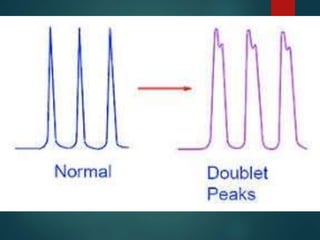
 From the value of J we can
distinguish between two singlets and
one doublet ; two doublets from one
quartert.
 This can be done by simply recording
the spectrum at two different radio
frequencies.
 The value of J generally lies between
0 and 20 hertz.
examples
 Methane CH4
 Ethyl bromide
CH3-CH2-Br
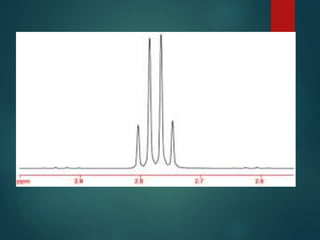
Here under the influence of two
equivalent protons of a the signal of
protons for b will appear as a
quartert.
 According to (n+1) rule.
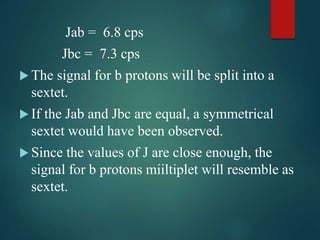
Jab = 6.8 cps
Jbc = 7.3 cps
 The signal for b protons will be split into a
sextet.
 If the Jab and Jbc are equal, a symmetrical
sextet would have been observed.
 Since the values of J are close enough, the
signal for b protons miiltiplet will resemble as
sextet.
 And by the help of coupling contant we can
distinguish between cis and trans form.
 Eg : CH3CH2Cl ( ethyl chloride )
cis – J = 10 Hz
trans – J = 15Hz
 It is clearly noted that the value of coupling
constant depends partly on the number of
covalent bonds through which protons may
interact and also upon the structural
relationships between the coupled protons.
 They are:
1. Geminal coupling
2. Vicinal coupling
3. Substituent effects
4. Long range coupling
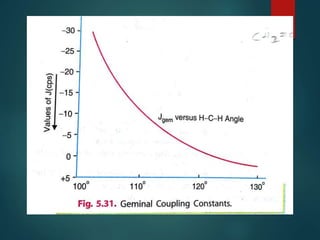
1.) Geminal coupling : in the case of geminal
protons, the protons are attached to the same
carbon atoms. Where the protons are in different
environment. Here the value of J depends on the
bond angle.
 Eg: 2,2-dimethyl 3-trimethoxy silyl butane.
 Here the two protons are attached to the same
carbon atom.
 And the double bond is present. Where the
different groups are attached to this double
bond.
 The protons are located in the different
environment. And they are not chemically
equivalent
 They couple with each other.
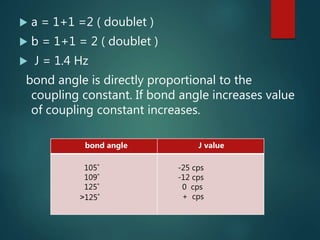
 a = 1+1 =2 ( doublet )
 b = 1+1 = 2 ( doublet )
 J = 1.4 Hz
bond angle is directly proportional to the
coupling constant. If bond angle increases value
of coupling constant increases.
bond angle J value
105˚
109˚
125˚
˃125˚
-25 cps
-12 cps
0 cps
+ cps
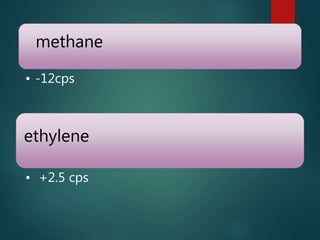
methane
• -12cps
ethylene
• +2.5 cps
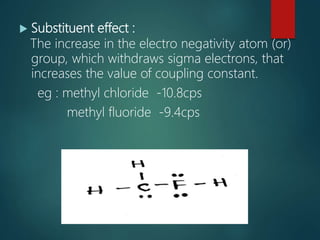
 Substituent effect :
The increase in the electro negativity atom (or)
group, which withdraws sigma electrons, that
increases the value of coupling constant.
eg : methyl chloride -10.8cps
methyl fluoride -9.4cps
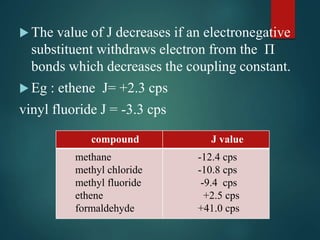
 The value of J decreases if an electronegative
substituent withdraws electron from the П
bonds which decreases the coupling constant.
 Eg : ethene J= +2.3 cps
vinyl fluoride J = -3.3 cps
compound J value
methane
methyl chloride
methyl fluoride
ethene
formaldehyde
-12.4 cps
-10.8 cps
-9.4 cps
+2.5 cps
+41.0 cps
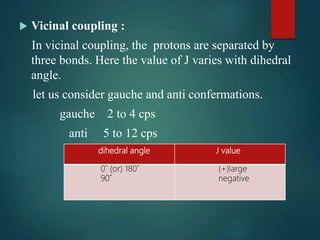
 Vicinal coupling :
In vicinal coupling, the protons are separated by
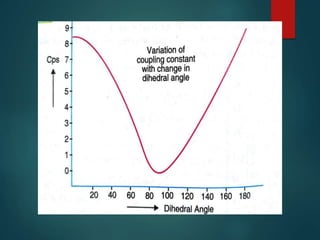
three bonds. Here the value of J varies with dihedral
angle.
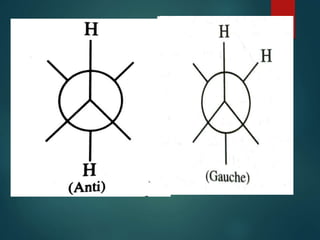
let us consider gauche and anti confermations.
gauche 2 to 4 cps
anti 5 to 12 cps
dihedral angle J value
0˚ (or) 180˚
90˚
(+)large
negative
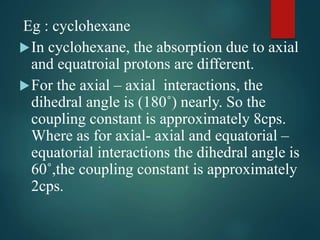
Eg : cyclohexane
In cyclohexane, the absorption due to axial
and equatroial protons are different.
For the axial – axial interactions, the
dihedral angle is (180˚) nearly. So the
coupling constant is approximately 8cps.
Where as for axial- axial and equatorial –
equatorial interactions the dihedral angle is
60˚,the coupling constant is approximately
2cps.
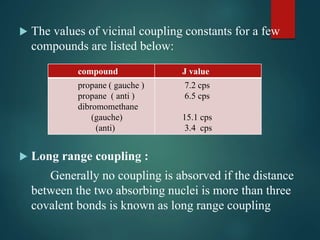
 The values of vicinal coupling constants for a few
compounds are listed below:
 Long range coupling :
Generally no coupling is absorved if the distance
between the two absorbing nuclei is more than three
covalent bonds is known as long range coupling
compound J value
propane ( gauche )
propane ( anti )
dibromomethane
(gauche)
(anti)
7.2 cps
6.5 cps
15.1 cps
3.4 cps
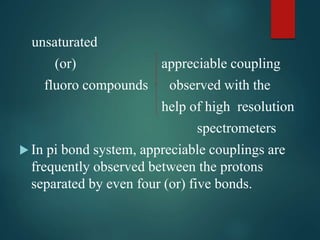
unsaturated
(or) appreciable coupling
fluoro compounds observed with the
help of high resolution
spectrometers
 In pi bond system, appreciable couplings are
frequently observed between the protons
separated by even four (or) five bonds.
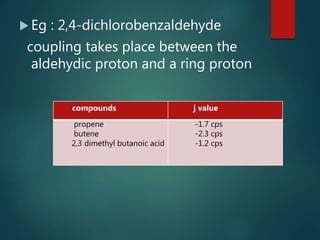
 Eg : 2,4-dichlorobenzaldehyde
coupling takes place between the
aldehydic proton and a ring proton
compounds j value
propene
butene
2,3 dimethyl butanoic acid
-1.7 cps
-2.3 cps
-1.2 cps
REFERENCES :
Elementary organic spectroscopy (
principles and chemical applications ) –
sharma
J.B. Leane and R.E.Rechards, Trans . Faraday
soc.55,518 (1959 )
Coupling constant

Coupling constant

  • 1.
  • 2.
    DEFINITION:  The distancebetween the centres of the two adjacent peaks in a multiplet is usually constant and is called as coupling constant the  Value of coupling constant is independent of the external magnetic field.  It is measured in hertz (hz) (or) in cycles per second (cps).It is denoted by the letter (j )
  • 4.
    Coupling constant  Fromthe value of J we can distinguish between two singlets and one doublet ; two doublets from one quartert.  This can be done by simply recording the spectrum at two different radio frequencies.  The value of J generally lies between 0 and 20 hertz.
  • 5.
    examples  Methane CH4 Ethyl bromide CH3-CH2-Br Here under the influence of two equivalent protons of a the signal of protons for b will appear as a quartert.  According to (n+1) rule.
  • 6.
    Jab = 6.8cps Jbc = 7.3 cps  The signal for b protons will be split into a sextet.  If the Jab and Jbc are equal, a symmetrical sextet would have been observed.  Since the values of J are close enough, the signal for b protons miiltiplet will resemble as sextet.
  • 7.
     And bythe help of coupling contant we can distinguish between cis and trans form.  Eg : CH3CH2Cl ( ethyl chloride ) cis – J = 10 Hz trans – J = 15Hz  It is clearly noted that the value of coupling constant depends partly on the number of covalent bonds through which protons may interact and also upon the structural relationships between the coupled protons.
  • 8.
     They are: 1.Geminal coupling 2. Vicinal coupling 3. Substituent effects 4. Long range coupling 1.) Geminal coupling : in the case of geminal protons, the protons are attached to the same carbon atoms. Where the protons are in different environment. Here the value of J depends on the bond angle.
  • 9.
     Eg: 2,2-dimethyl3-trimethoxy silyl butane.  Here the two protons are attached to the same carbon atom.  And the double bond is present. Where the different groups are attached to this double bond.  The protons are located in the different environment. And they are not chemically equivalent  They couple with each other.
  • 11.
     a =1+1 =2 ( doublet )  b = 1+1 = 2 ( doublet )  J = 1.4 Hz bond angle is directly proportional to the coupling constant. If bond angle increases value of coupling constant increases. bond angle J value 105˚ 109˚ 125˚ ˃125˚ -25 cps -12 cps 0 cps + cps
  • 13.
  • 14.
     Substituent effect: The increase in the electro negativity atom (or) group, which withdraws sigma electrons, that increases the value of coupling constant. eg : methyl chloride -10.8cps methyl fluoride -9.4cps
  • 15.
     The valueof J decreases if an electronegative substituent withdraws electron from the П bonds which decreases the coupling constant.  Eg : ethene J= +2.3 cps vinyl fluoride J = -3.3 cps compound J value methane methyl chloride methyl fluoride ethene formaldehyde -12.4 cps -10.8 cps -9.4 cps +2.5 cps +41.0 cps
  • 16.
     Vicinal coupling: In vicinal coupling, the protons are separated by three bonds. Here the value of J varies with dihedral angle. let us consider gauche and anti confermations. gauche 2 to 4 cps anti 5 to 12 cps dihedral angle J value 0˚ (or) 180˚ 90˚ (+)large negative
  • 19.
    Eg : cyclohexane Incyclohexane, the absorption due to axial and equatroial protons are different. For the axial – axial interactions, the dihedral angle is (180˚) nearly. So the coupling constant is approximately 8cps. Where as for axial- axial and equatorial – equatorial interactions the dihedral angle is 60˚,the coupling constant is approximately 2cps.
  • 20.
     The valuesof vicinal coupling constants for a few compounds are listed below:  Long range coupling : Generally no coupling is absorved if the distance between the two absorbing nuclei is more than three covalent bonds is known as long range coupling compound J value propane ( gauche ) propane ( anti ) dibromomethane (gauche) (anti) 7.2 cps 6.5 cps 15.1 cps 3.4 cps
  • 21.
    unsaturated (or) appreciable coupling fluorocompounds observed with the help of high resolution spectrometers  In pi bond system, appreciable couplings are frequently observed between the protons separated by even four (or) five bonds.
  • 22.
     Eg :2,4-dichlorobenzaldehyde coupling takes place between the aldehydic proton and a ring proton compounds j value propene butene 2,3 dimethyl butanoic acid -1.7 cps -2.3 cps -1.2 cps
  • 23.
    REFERENCES : Elementary organicspectroscopy ( principles and chemical applications ) – sharma J.B. Leane and R.E.Rechards, Trans . Faraday soc.55,518 (1959 )