THE CHROMOPHORE CONCEPT,
ABSORPTION LAWS AND
LIMITATIONS.
1
CONTENTS
1.
• ABSORPTION LAWS
a)BEERS LAW b)LAMBERTS
LAW
2.
• CHROMOPHORE
2
INTRODUCTION
 BEERS LAW
 LAMBERTS LAW
 DEVIATIONS
3
ABSORPTION LAWS
BEERS LAW
 When a beam of monochromatic radiation is passed through a
solution of an absorbing substance, the rate of decrease of
intensity of radiation with thickness of the absorbing solution is
proportional to the intensity of incident radiation as well as the
concentration of the solution.
 - di / dt  I c - di / dt = K’I c

 I = Intensity of incident radiation passing through a
thickness of “ t “ of the medium.
 di = decrease in intensity of radiation
 - di / dt = rate of decrease of intensity of radiation with
thickness of the absorbing medium.
 K’ = molar absorption coefficient.
 c = Concentration of the solution in moles/litre .
4
LAMBERTS LAW
 Lamberts law – when a beam of monochromatic radiation passes
through a homogenous absorbing medium, the rate of decrease of
intensity of radiation with the thickness of the absorbing medium
is proportional to the intensity of incident radiation.
- di / dt  I - di / dt = KI
I = Intensity of incident radiation passing through a thickness of “ t
“ of the medium.
di = decrease in intensity of radiation
- di / dt = rate of decrease of intensity of radiation with thickness
of the absorbing medium.
K = propionate constant or absorption coefficient.
5
 Let, Io be the intensity of the incident radiation
 I be the intensity of the radiation after
passing through the medium.
 The intensity of the absorbed radiation can be
given as Iabs
 Iabs= Io - I
 I = Io 10
-a’cx
, where a = extinction coefficient
of the absorbing medium.
 a
,
= k’ / 2.303
6
Deviations of Absorption laws
AbsorptionVs Concentration Straight line
Positive deviation
Negative deviation
Concentration
Absorbance
7
DEVIATIONS:
 When a non linear curve is obtained, the
system is said to undergo deviation.
 The two types of deviations are positive and
negative deviations.
 Positive deviation results in when a small
change in concentration produces a greater
change in absorbance.
 Negative deviation results when a large
change in concentration produces smaller
change in absorbance.
8
 Instrumental deviations – stray
radiation, improper slit width,
fluctuations in single beam and
monochromatic light is not used.
 Physiochemical changes in solutions –
factors like association, dissociation,
ionization (change in pH), faulty
development of colour (incompletion of
reaction).
9
Reasons
CHROMOPHORE CONCEPT
10
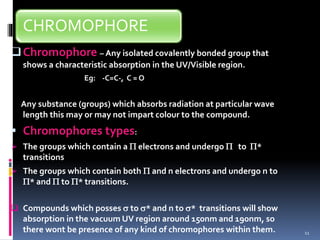
CHROMOPHORE
Chromophore – Any isolated covalently bonded group that
shows a characteristic absorption in the UV/Visible region.
Eg: -C=C-, C = O
Any substance (groups) which absorbs radiation at particular wave
length this may or may not impart colour to the compound.
 Chromophores types:
 The groups which contain a  electrons and undergo  to *
transitions
 The groups which contain both  and n electrons and undergo n to
* and  to * transitions.
 Compounds which posses  to * and n to * transitions will show
absorption in the vacuum UV region around 150nm and 190nm, so
there wont be presence of any kind of chromophores within them. 11
 With respect to the Chromophore concept and
electronic transition the following points can be
noted:
 Spectrum with a band near 300 nm may contain 2 – 3
conjugated units.
 Absorption bands near 270 – 350 nm with a very low
intensity of εmax 10 – 100 are due to n - * transition of
the carbonyl groups.
 Simple conjugated chromophores such as ,  -
unsaturated ketones have high εmax values from 10,
000 – 20, 000.
 The absorption with εmax value between 100 – 10,000
consists of an aromatic system.
12
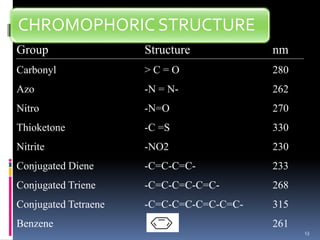
CHROMOPHORIC STRUCTURE
13
Group Structure nm
Carbonyl > C = O 280
Azo -N = N- 262
Nitro -N=O 270
Thioketone -C =S 330
Nitrite -NO2 230
Conjugated Diene -C=C-C=C- 233
Conjugated Triene -C=C-C=C-C=C- 268
Conjugated Tetraene -C=C-C=C-C=C-C=C- 315
Benzene 261
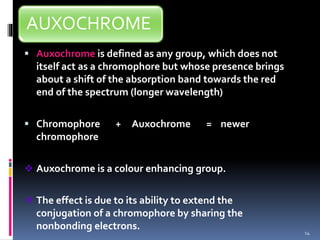
AUXOCHROME
 Auxochrome is defined as any group, which does not
itself act as a chromophore but whose presence brings
about a shift of the absorption band towards the red
end of the spectrum (longer wavelength)
 Chromophore + Auxochrome = newer
chromophore
 Auxochrome is a colour enhancing group.
 The effect is due to its ability to extend the
conjugation of a chromophore by sharing the
nonbonding electrons. 14
The new chromophore that is formed is of have a
different value of absorption maximum as well as the
extinction coefficient.
Benzene – 255nm (εmax - 203)
Aniline – 280nm (εmax- 1430), so the auxochrome group
is – NH2
Ex: - OH, - OR, -NH2, -NHR, -NR2, -SH etc.,
15
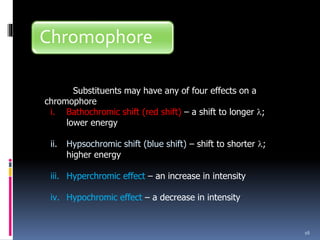
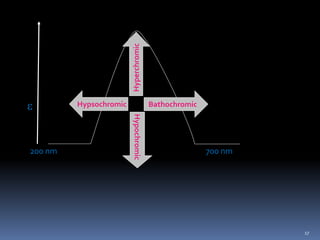
Substituents may have any of four effects on a
chromophore
i. Bathochromic shift (red shift) – a shift to longer l;
lower energy
ii. Hypsochromic shift (blue shift) – shift to shorter l;
higher energy
iii. Hyperchromic effect – an increase in intensity
iv. Hypochromic effect – a decrease in intensity
Chromophore
16
200 nm 700 nm
e
Hypochromic
Hypsochromic
Hyperchromic
Bathochromic
17
Absorption and intensity shifts
 Bathochromic shift:
- Absorption shifted towards longer
wavelength
- Change of solvent/ auxochrome
-Red shift/ bathochromic shift
- n to * transition for carbonyl
compounds experiences bathochromic
shift when the polarity of the solvent is
decreased.
18
 Hypsochromic shift or effect:
- Shift towards shorter wavelength
- Blue shift/ hypsochromic shift
- Change of solvent towards higher polarity or
removal of conjugation
- Aniline – 280 nm (conjugation of pair of electrons
of nitrogen with benzene ring)
- In acidic solution it will form
- NH+
3 , due to the removal of
- conjugation or removal of lone pair of electrons,
the absorption takes place at lower wavelength
203nm – this is called Hypsochromic shift.
19
 Hyperchromic shift:
- Shift due to increase in intensity- εmax increase
- Due to the introduction of auxochrome
- Ex: Pyridine - 257 nm and εmax is 2750; 2 – methyl pyridine
262 nm and εmax is 3560
 Hypochromic shift:
- Inverse of hyperchromic shift – i.e., decrease of intensity
- introduction of any group to the compounds which is
going to alter the molecular pattern of the compound
results in a hypochromic shifts.
- ex: biphenyl absorption is at 250 nm and 19000 εmax
- Whereas 2 –methyl biphenyl has an absorption of 237 nm
and 10250 εmax
20
APPLICATIONS OF UV
Qualitative analysis
Detection of impurities
Quantitative analysis
Molecular weight determination
Dissociation constant
Chemical kinetics
Tautomeric equilibrium
21
Pharmaceutical/Clinical/Cosmetic Field
Biochemical/Genetic field
Analytical Chemistry
Dye/Ink/Paint industry
Environment/Agriculture
Metals/Films
Petrochemical sector
22
REFERENCES
 Instrumental Analysis by SKOOG.
 Instrumental Methods of Chemical Analysis
by CHATWAL.
 Instrumental analysis by BRAUN.
 Elementary Organic Spectroscopy by
Y.R.SHARMA
23
24

Chromophore

  • 1.
    THE CHROMOPHORE CONCEPT, ABSORPTIONLAWS AND LIMITATIONS. 1
  • 2.
    CONTENTS 1. • ABSORPTION LAWS a)BEERSLAW b)LAMBERTS LAW 2. • CHROMOPHORE 2
  • 3.
    INTRODUCTION  BEERS LAW LAMBERTS LAW  DEVIATIONS 3 ABSORPTION LAWS
  • 4.
    BEERS LAW  Whena beam of monochromatic radiation is passed through a solution of an absorbing substance, the rate of decrease of intensity of radiation with thickness of the absorbing solution is proportional to the intensity of incident radiation as well as the concentration of the solution.  - di / dt  I c - di / dt = K’I c   I = Intensity of incident radiation passing through a thickness of “ t “ of the medium.  di = decrease in intensity of radiation  - di / dt = rate of decrease of intensity of radiation with thickness of the absorbing medium.  K’ = molar absorption coefficient.  c = Concentration of the solution in moles/litre . 4
  • 5.
    LAMBERTS LAW  Lambertslaw – when a beam of monochromatic radiation passes through a homogenous absorbing medium, the rate of decrease of intensity of radiation with the thickness of the absorbing medium is proportional to the intensity of incident radiation. - di / dt  I - di / dt = KI I = Intensity of incident radiation passing through a thickness of “ t “ of the medium. di = decrease in intensity of radiation - di / dt = rate of decrease of intensity of radiation with thickness of the absorbing medium. K = propionate constant or absorption coefficient. 5
  • 6.
     Let, Iobe the intensity of the incident radiation  I be the intensity of the radiation after passing through the medium.  The intensity of the absorbed radiation can be given as Iabs  Iabs= Io - I  I = Io 10 -a’cx , where a = extinction coefficient of the absorbing medium.  a , = k’ / 2.303 6
  • 7.
    Deviations of Absorptionlaws AbsorptionVs Concentration Straight line Positive deviation Negative deviation Concentration Absorbance 7
  • 8.
    DEVIATIONS:  When anon linear curve is obtained, the system is said to undergo deviation.  The two types of deviations are positive and negative deviations.  Positive deviation results in when a small change in concentration produces a greater change in absorbance.  Negative deviation results when a large change in concentration produces smaller change in absorbance. 8
  • 9.
     Instrumental deviations– stray radiation, improper slit width, fluctuations in single beam and monochromatic light is not used.  Physiochemical changes in solutions – factors like association, dissociation, ionization (change in pH), faulty development of colour (incompletion of reaction). 9 Reasons
  • 10.
  • 11.
    CHROMOPHORE Chromophore – Anyisolated covalently bonded group that shows a characteristic absorption in the UV/Visible region. Eg: -C=C-, C = O Any substance (groups) which absorbs radiation at particular wave length this may or may not impart colour to the compound.  Chromophores types:  The groups which contain a  electrons and undergo  to * transitions  The groups which contain both  and n electrons and undergo n to * and  to * transitions.  Compounds which posses  to * and n to * transitions will show absorption in the vacuum UV region around 150nm and 190nm, so there wont be presence of any kind of chromophores within them. 11
  • 12.
     With respectto the Chromophore concept and electronic transition the following points can be noted:  Spectrum with a band near 300 nm may contain 2 – 3 conjugated units.  Absorption bands near 270 – 350 nm with a very low intensity of εmax 10 – 100 are due to n - * transition of the carbonyl groups.  Simple conjugated chromophores such as ,  - unsaturated ketones have high εmax values from 10, 000 – 20, 000.  The absorption with εmax value between 100 – 10,000 consists of an aromatic system. 12
  • 13.
    CHROMOPHORIC STRUCTURE 13 Group Structurenm Carbonyl > C = O 280 Azo -N = N- 262 Nitro -N=O 270 Thioketone -C =S 330 Nitrite -NO2 230 Conjugated Diene -C=C-C=C- 233 Conjugated Triene -C=C-C=C-C=C- 268 Conjugated Tetraene -C=C-C=C-C=C-C=C- 315 Benzene 261
  • 14.
    AUXOCHROME  Auxochrome isdefined as any group, which does not itself act as a chromophore but whose presence brings about a shift of the absorption band towards the red end of the spectrum (longer wavelength)  Chromophore + Auxochrome = newer chromophore  Auxochrome is a colour enhancing group.  The effect is due to its ability to extend the conjugation of a chromophore by sharing the nonbonding electrons. 14
  • 15.
    The new chromophorethat is formed is of have a different value of absorption maximum as well as the extinction coefficient. Benzene – 255nm (εmax - 203) Aniline – 280nm (εmax- 1430), so the auxochrome group is – NH2 Ex: - OH, - OR, -NH2, -NHR, -NR2, -SH etc., 15
  • 16.
    Substituents may haveany of four effects on a chromophore i. Bathochromic shift (red shift) – a shift to longer l; lower energy ii. Hypsochromic shift (blue shift) – shift to shorter l; higher energy iii. Hyperchromic effect – an increase in intensity iv. Hypochromic effect – a decrease in intensity Chromophore 16
  • 17.
    200 nm 700nm e Hypochromic Hypsochromic Hyperchromic Bathochromic 17
  • 18.
    Absorption and intensityshifts  Bathochromic shift: - Absorption shifted towards longer wavelength - Change of solvent/ auxochrome -Red shift/ bathochromic shift - n to * transition for carbonyl compounds experiences bathochromic shift when the polarity of the solvent is decreased. 18
  • 19.
     Hypsochromic shiftor effect: - Shift towards shorter wavelength - Blue shift/ hypsochromic shift - Change of solvent towards higher polarity or removal of conjugation - Aniline – 280 nm (conjugation of pair of electrons of nitrogen with benzene ring) - In acidic solution it will form - NH+ 3 , due to the removal of - conjugation or removal of lone pair of electrons, the absorption takes place at lower wavelength 203nm – this is called Hypsochromic shift. 19
  • 20.
     Hyperchromic shift: -Shift due to increase in intensity- εmax increase - Due to the introduction of auxochrome - Ex: Pyridine - 257 nm and εmax is 2750; 2 – methyl pyridine 262 nm and εmax is 3560  Hypochromic shift: - Inverse of hyperchromic shift – i.e., decrease of intensity - introduction of any group to the compounds which is going to alter the molecular pattern of the compound results in a hypochromic shifts. - ex: biphenyl absorption is at 250 nm and 19000 εmax - Whereas 2 –methyl biphenyl has an absorption of 237 nm and 10250 εmax 20
  • 21.
    APPLICATIONS OF UV Qualitativeanalysis Detection of impurities Quantitative analysis Molecular weight determination Dissociation constant Chemical kinetics Tautomeric equilibrium 21
  • 22.
    Pharmaceutical/Clinical/Cosmetic Field Biochemical/Genetic field AnalyticalChemistry Dye/Ink/Paint industry Environment/Agriculture Metals/Films Petrochemical sector 22
  • 23.
    REFERENCES  Instrumental Analysisby SKOOG.  Instrumental Methods of Chemical Analysis by CHATWAL.  Instrumental analysis by BRAUN.  Elementary Organic Spectroscopy by Y.R.SHARMA 23
  • 24.