Concept of Quality
Quality is a subjective term for which each person has his or
her own definition.
It is a matter of feeling and the definition varies from person to
person depending on the perspective in which defined.
Quality– conformance to standards or specifications;
fitness for use;
meeting customer’s expectations;
delighting the customer etc.
Quality is the totality of features and characteristics of a
product that bears on its ability to satisfy the stated or
implied needs.
In other words, product or service free from deficiencies.
• The process of building quality starts much before the
purchase of materials and equipments and goes beyond the
manufacturing activities till getting feedback from
customers.
• Building quality into the product also involve having
controls at every stage of manufacturing on all input
resources like facilities, equipment, materials, processes and
testing.
• Quality never happens by accident, it is always the result of
an intelligent effort and therefore it has to be managed.
• Quality can be achieved through a quality management
system, which must involve everyone in the process
throughout the organization.
• A quality management system organizes overall activities of
the company in such a way that the technical, administrative
and human factors affecting the quality of product or service
are under control.
• All such controls are oriented towards reduction,
elimination and prevention of quality deficiencies.
• The quality for a product or service has two aspects:
– The first relates to the features and attributes of the product or
service.
– The second aspect concerns the absence of deficiencies in the
product.
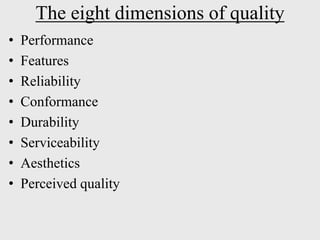
The eight dimensions of quality
• Performance
• Features
• Reliability
• Conformance
• Durability
• Serviceability
• Aesthetics
• Perceived quality
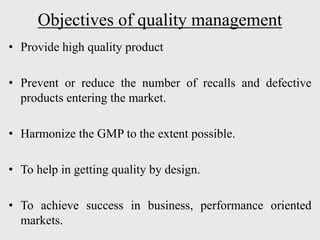
Objectives of quality management
• Provide high quality product
• Prevent or reduce the number of recalls and defective
products entering the market.
• Harmonize the GMP to the extent possible.
• To help in getting quality by design.
• To achieve success in business, performance oriented
markets.
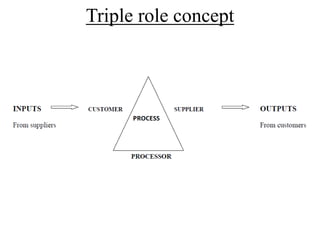
Triple role concept
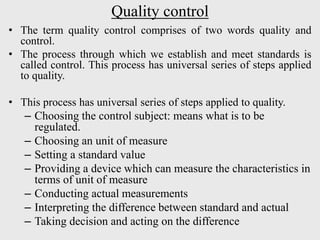
Quality control
• The term quality control comprises of two words quality and
control.
• The process through which we establish and meet standards is
called control. This process has universal series of steps applied
to quality.
• This process has universal series of steps applied to quality.
– Choosing the control subject: means what is to be
regulated.
– Choosing an unit of measure
– Setting a standard value
– Providing a device which can measure the characteristics in
terms of unit of measure
– Conducting actual measurements
– Interpreting the difference between standard and actual
– Taking decision and acting on the difference
• According to WHO, “ QC is the part of GMP concerned with
sampling, specifications, testing, with the organization,
documentation and release procedures which ensures that the
necessary and relevant test are actually carried out and that
materials are neither released for use, nor products released for
sale or supply, until their quality has been satisfactory. QC is
not confined to laboratory operations but must be involved in all
decisions concerning the quality of the product”.
• According to MCC South Africa, “QC is that part of GMP
which is concerned with the organization, documentation and
release procedures which ensure that necessary and relevant
tests are actually carried out that materials are not released
for use, nor products released for sale or supply, until their
quantity has been judged to be satisfactory”.
Components of Quality control
• Adequate facilities, trained personnel and approved procedures
must be available for sampling, inspecting of starting materials,
packaging materials, and intermediate bulk and finished products.
• QC lab should have minimum following facilities-
– Chemical testing laboratory supported with chemical, glassware
and reagent stores.
– Instrumental analysis lab with all required instruments such as
HPLC, UV spectrophotometer, GC, FTIR, AAS etc.
– Provisions for retained samples, stability samples etc.
– Documentation room
– Required books and pharmacopoeias
• QC lab should have trained personnel with appropriate
qualification.
• QC lab should have SOPs
• Sampling of materials: QC should have SOP for sampling of raw
materials, intermediates and finished products. Persons should be
well trained in doing sampling work.
• The methods must be validated: all methods used by QC such as
sampling, testing and other activities must be validated.
• Records must be made demonstrating that all sampling, inspecting,
testing procedures have actually been carried out and that any
deviation have been recorded and investigated.
• The basic concept of GMP is- “Do as you have written and write
what you have done”
• No batch of product to be released for sale or supply prior to
certification by the authorized persons.
• Sufficient samples of starting material and finished products must
be retained to permit further examination of the product if
necessary.
Other activities of QC
• Establish, validate and implement all QC procedures, maintain
sufficient standards and reagents.
• Evaluate, maintain and store reference and working standards for
substances.
• Ensure the correct labeling of containers of materials and products.
• Ensure that stability of API and product is monitored.
• Participate in environmental monitoring.
• Assess the final product after evaluation.
Quality Assurance
• Quality assurance is a management tool and must assure the
management that the activities are being performed as designed in
all areas of operations within the organization.
• Quality Assurance (QA) activities include a planned system of
review procedures conducted by personnel not directly involved in
the process.
• Reviews, preferably by independent third parties, should be
performed upon a finalized inventory following the implementation
of QC procedures.
• All parts of the quality assurance system should be adequately
staffed with competent personnel, and should have suitable and
sufficient premises, equipment, and facilities.
• The system of quality assurance should ensure that:
(a) Pharmaceutical products are designed and developed in a way that
takes account of the requirements of GMP and other associated
codes such as those of good laboratory practice (GLP) and good
clinical practice (GCP)
(b) Production and control operations are clearly specified in a written
form.
(c) Managerial responsibilities are clearly specified in job descriptions.
(d) All necessary controls on starting materials, intermediate products,
and bulk products and other in-process controls, calibrations, and
validations are carried out;
(f) The finished product is correctly processed and checked, according
to the defined procedures;
(g) Pharmaceutical products are not sold or supplied before the
authorized persons have certified that each production.
(h) Deviations are reported, investigated and recorded.
QUALITY AUDITS
• Quality audit is defined as a systematic and independent
examination to determine whether quality activities and related
results comply with planned arrangements and whether these
arrangements are implemented effectively and are suitable to
achieve objective.
• An audit is an information gathering activity so that the need for
improvement or corrective action may be evaluated.
• Audits may be internal or external / announced or unannounced.
• First party audit is an audit carried out by an organization on itself.
• Second party audit is an audit by one organization, working on its
own behalf, on another.
• Third party audit is an audit by an independent organization on a
supplier. This may be done at the request of a group of customers.
Types of audits
• Adequacy audit/ document review: This is also known as a system
or management audit and is normally an office exercise.
• Compliance audit/ on site audit: This audit seeks to establish the
extent to which the documented system is implemented and observed
by the workforce, i.e. are the people complying with the system?
• External audit: This is an audit that is performed by a company on
its own suppliers or subcontractors. It may be an adequacy and/or a
compliance audit.
• Internal audit: This is the most important of all audits, which
requires company to look in on its own systems, procedures and
activities. It provides management with information on whether or not
their policies are being met.
• Product/ process audit: This may be considered a vertical audit, i.e.
looking at all the systems that went into the production of a specific
product or service.
Why auditing is necessary?
• To determine conformity or non-conformity of the quality system
elements with specific requirements.
• To determine the effectiveness of the implemented quality system
in meeting specified quality objectives.
• To afford an opportunity to improve the quality system.
• To provide managers with information.
The audit life cycle
• Planning
• Conducting the audit
• Analysis of results
• Reports and corrective actions
CONCEPT OF ISO 9000
• The International Standards Organization (ISO) is a worldwide
federation of national standards bodies. The work of preparing
international standards is carried out through ISO technical
committees.
• There are five quality management standards which are referred to as
the ISO 9000 series.
• Each of the five standards (9000 to 9004) addresses a different areas.
• ISO 9001 standard is directed at the development of a quality product
or service.
• ISO 9002 is used for production and installation. It is the standard that
governs the manufacture of a product.
• ISO 9003 is the standard directed at the final test and inspection of
products.
• ISO 9004 is for internal use only and lists the components that
compose quality systems
• The objective of the ISO 9000 series of standards is to certify that an
organization has quality manufacturing processes.
• If the ISO 9000 auditors determine that the company's processes are
in compliance with the standards, they issue a certificate good for
three years, subject to annual validation that nothing has changed.
• The ISO 9000 audit is heavily focused on evaluation of
documentation.
• Four tiers of quality system documentation are required:
First tier- the quality manual.
Second tier- quality management procedures.
Third tier- area work instructions (i.e., sop’s, test methods,
calibration methods).
Fourth tier- forms, records, books, and files.
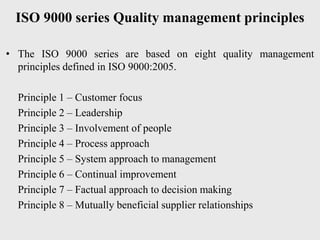
ISO 9000 series Quality management principles
• The ISO 9000 series are based on eight quality management
principles defined in ISO 9000:2005.
Principle 1 – Customer focus
Principle 2 – Leadership
Principle 3 – Involvement of people
Principle 4 – Process approach
Principle 5 – System approach to management
Principle 6 – Continual improvement
Principle 7 – Factual approach to decision making
Principle 8 – Mutually beneficial supplier relationships
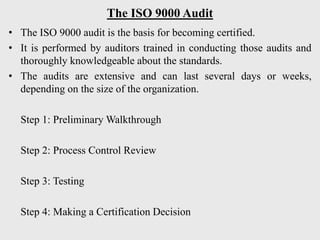
The ISO 9000 Audit
• The ISO 9000 audit is the basis for becoming certified.
• It is performed by auditors trained in conducting those audits and
thoroughly knowledgeable about the standards.
• The audits are extensive and can last several days or weeks,
depending on the size of the organization.
Step 1: Preliminary Walkthrough
Step 2: Process Control Review
Step 3: Testing
Step 4: Making a Certification Decision
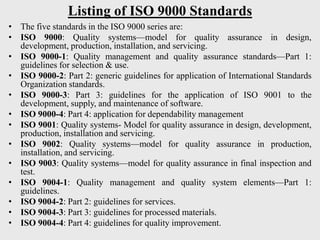
Listing of ISO 9000 Standards
• The five standards in the ISO 9000 series are:
• ISO 9000: Quality systems—model for quality assurance in design,
development, production, installation, and servicing.
• ISO 9000-1: Quality management and quality assurance standards—Part 1:
guidelines for selection & use.
• ISO 9000-2: Part 2: generic guidelines for application of International Standards
Organization standards.
• ISO 9000-3: Part 3: guidelines for the application of ISO 9001 to the
development, supply, and maintenance of software.
• ISO 9000-4: Part 4: application for dependability management
• ISO 9001: Quality systems- Model for quality assurance in design, development,
production, installation and servicing.
• ISO 9002: Quality systems—model for quality assurance in production,
installation, and servicing.
• ISO 9003: Quality systems—model for quality assurance in final inspection and
test.
• ISO 9004-1: Quality management and quality system elements—Part 1:
guidelines.
• ISO 9004-2: Part 2: guidelines for services.
• ISO 9004-3: Part 3: guidelines for processed materials.
• ISO 9004-4: Part 4: guidelines for quality improvement.
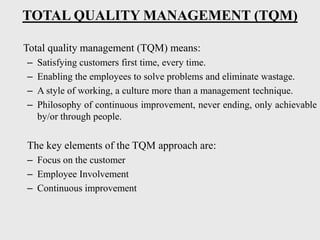
TOTAL QUALITY MANAGEMENT (TQM)
Total quality management (TQM) means:
– Satisfying customers first time, every time.
– Enabling the employees to solve problems and eliminate wastage.
– A style of working, a culture more than a management technique.
– Philosophy of continuous improvement, never ending, only achievable
by/or through people.
The key elements of the TQM approach are:
– Focus on the customer
– Employee Involvement
– Continuous improvement
• According to Joseph Juran, quality begins at the stage of designing
and ends after satisfactory services are provided to the customers.
• His famous definition for quality is ‘fitness for use’.
• He recommends a set of four important stages as:
– Establish specific goals to be reached.
– Establish plan for reaching goals (development of structured process to
achieve this).
– Assign clear responsibility for reaching goals.
– Give rewards/awards on the basis of result achieved (development of
feedback system, utilization of lessons learned from feedbacks etc).
• Quality achievement, according to Juran, is possible through various
initiatives that are the based on his famous quality trilogy:
– Quality planning
– Quality control
– Quality improvement
The initiatives under the above three categories may be enlisted as
follows:
• Build awareness of the need and given an opportunity for improvement
• Set goals for improvements
• Organize to teach the goals (identify problems, select project, appoint
teams, designate facilitators)
• Provide training
• Carry out projects to solve problems.
• Report progress
• Give recognition
• Communicate results
• Keep score
• Maintain momentum by making annual improvement part of the
regular systems and processes of the company.
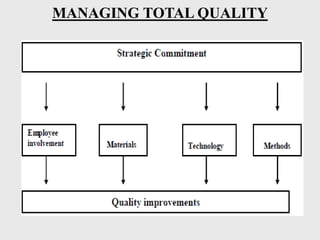
MANAGING TOTAL QUALITY
DOCUMENTATION
• Good documentation is an essential part of the QA system and as such
should be related to all aspects of GMP.
• It defines the specifications for all materials and methods of manufacture
and control.
• Documentation ensures that all personnel concerned with manufacture know,
what to do? How to do? When to do? etc.
• Good documentation also ensures that authorized persons have all the
necessary information to decide whether or not to release the batch for
distribution.
• Documents should not be hand written. Any correction made in a document
should be signed and dated and correction should permit the reading of the
original information.
• Documents should be kept up to date. Any amendments should be formally
authorized before the document is used.
The objectives of thorough documentation can be listed as follow:
– Define the manufacturers system of information and control.
– To minimize the risk of misinterpretation and errors inherent in
oral or casual written communication.
– To provide confirmation of performance of a task.
– To allow calculations to be checked.
– To all tracing of the batch history of any product.
Each document should indicate or include
• The user’s company name.
• Purpose and title of document.
• Document identity number.
• Date of authorization.
• Date of expiry or review.
• Signature of authorized personnel.
• Page numbers.
• Reference used for preparation of document, if any.
Retention of documents and records
• Except where legislation require longer retention periods, the
complete records pertaining to each batch, including original data
such as laboratory note books, should be retained for at least one year
after the expiry date of the batch or where there is no expiry date, for
six years after the date of manufacture of the batch.
• Master documents should be properly secured against theft loss or
alteration of information.
• Records may be retained by computer storing system by the
procedures and checks should be followed.
Storage disposal of documents
• All documents should be stored in the department in such a manner
that their retrieval is easy.
• A total alphabetical list of documents should be made.
• Completed batch production records must always be kept under
lock under control of QA.
• The expired documents must be destroyed by QA with proper
record and authorization by proper method such as shredding or
burning.
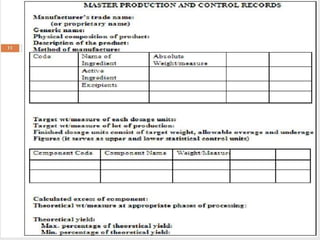
MASTER FORMULA RECORD
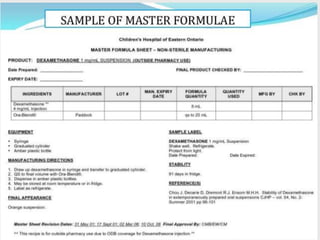
• also known as MASTER PRODUCTION AND CONTROL
RECORD (MPCR).
• The purpose of this document is to assure uniformity from batch to
batch.
• This document should be prepared for each product, including each
batch size thereof. It should be dated and signed by one person and
independently checked, dated and signed by a second person.
• There should be a detailed S.O.P. for the preparation of M.P.C.R.
Master formula record should contain the following things:
1. The name and strength of the product and description of the dosage form,
for example-Calpol 500 mg Tablets.
2. The name and weight or measure of each active ingredient per dosage unit
or per unit of weight or measure of the drug product, and a statement of the
total weight or measure of any dosage unit. For example-
– Each tablet contains 500 mg of paracetamol.
– Or each 5 ml contains…….. mg of active ingredient
– Or each 1 gm contains ……. mg of active ingredient
3. A complete list of components designated by names or codes sufficiently
specific to indicate any special quality characteristics. E.g. particle size,
color, form.
4. An accurate statement of the weight or measure of each component, using
the same weight system for each component.
5. A statement concerning any calculated excess of component e.g. overages
added in case of certain vitamins.
6. A statement of theoretical weight or measure at appropriate phases of
processing. E.g. end of granulation, end of compression, end of filling
ampoules etc.
7. A statement of theoretical yield including the maximum and minimum
percentage of theoretical yield beyong which investigation is required.
8. A description of the drug product containers, closures and packaging
materials, including a specimen or copy of each label and all other labeling
signed and dated by the person responsible for approval of such labeling.
9. Complete manufacturing and control instructions, sampling and testing
procedures, specifications and precautions to be taken.
10. A statement of processing location and principal equipment to be used.
11. The methods or reference to methods to be used for preparing the critical
equipment including cleaning, assembling, calibrating and sterilizing.
12. The requirements of storage conditions of the products, including the
container, labeling and special storage conditions where applicable.
13. Details of in process controls with instructions for sampling and
acceptance.
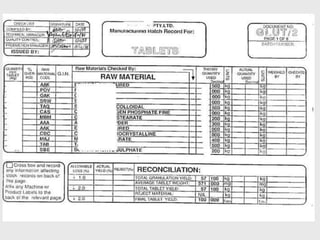
BATCH PRODUCTION RECORD
• This document is also known as BATCH PRODUCTION AND
CONTROL RECORD and BATCH MANUFACTURING RECORD.
• BPCR is a recurring document and gives complete history of the batch
produced. BPCR is primarily a replica of the MPCR and gives actual
process record of the batch produced and helps in maintaining the complete
production and control history of the batch.
The summary of the contents of this document is given below:
• Dates and times of all the activities, which are carried out regarding
production and control of the batch.
• Identification of individual major equipment and line used. Identification
od specific rooms/ locations should also be included.
• Specific identification of each batch of components or in process materials
used.
• Weights and measures of components used in the course of processing.
• In process and laboratory control results.
• Inspection of packaging and labeling area before and after use.
• A statement of the actual yield and a statement of the percentage of
theoretical yield at appropriate phase of processing e.g. granulation,
compression, coating, filling etc.
• Complete labeling control record, including specimens or copies of all
labeling used.
• Description of drug product containers and closures. This should include
primary, secondary and printed packing materials.
• Any sampling performed, during the production and packaging activities.
• Identifications of persons performing and supervising or checking each
step in the operation.
• Any investigation made regarding any unexplained discrepancies.
• Results of examinations made.
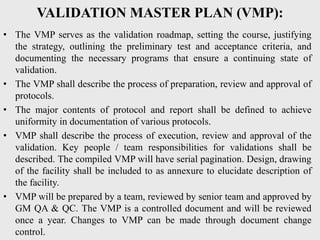
VALIDATION MASTER PLAN (VMP):
• The VMP serves as the validation roadmap, setting the course, justifying
the strategy, outlining the preliminary test and acceptance criteria, and
documenting the necessary programs that ensure a continuing state of
validation.
• The VMP shall describe the process of preparation, review and approval of
protocols.
• The major contents of protocol and report shall be defined to achieve
uniformity in documentation of various protocols.
• VMP shall describe the process of execution, review and approval of the
validation. Key people / team responsibilities for validations shall be
described. The compiled VMP will have serial pagination. Design, drawing
of the facility shall be included to as annexure to elucidate description of
the facility.
• VMP will be prepared by a team, reviewed by senior team and approved by
GM QA & QC. The VMP is a controlled document and will be reviewed
once a year. Changes to VMP can be made through document change
control.
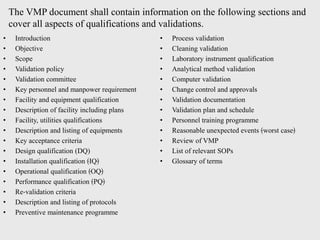
• Introduction
• Objective
• Scope
• Validation policy
• Validation committee
• Key personnel and manpower requirement
• Facility and equipment qualification
• Description of facility including plans
• Facility, utilities qualifications
• Description and listing of equipments
• Key acceptance criteria
• Design qualification (DQ)
• Installation qualification ﴾IQ﴿
• Operational qualification ﴾OQ﴿
• Performance qualification ﴾PQ﴿
• Re‐validation criteria
• Description and listing of protocols
• Preventive maintenance programme
• Process validation
• Cleaning validation
• Laboratory instrument qualification
• Analytical method validation
• Computer validation
• Change control and approvals
• Validation documentation
• Validation plan and schedule
• Personnel training programme
• Reasonable unexpected events ﴾worst case﴿
• Review of VMP
• List of relevant SOPs
• Glossary of terms
The VMP document shall contain information on the following sections and
cover all aspects of qualifications and validations.
Validation
• It is a process of establishing documentary evidence demonstrating
that a procedure, process, or activity carried out in production or
testing maintains the desired level of compliance at all stages.
• In Pharmaceutical Industry it is very important apart from final
testing and compliance of product with standard that the process
adapted to produce itself must assure that process will consistently
produce the expected results.
• Qualification of systems and equipment is therefore a part of
process of validation.
• It is a requirement of food and drug, pharmaceutical regulating
agencies like FDA's good manufacturing practices guidelines.
Planning for Validation
• All validation activities should be planned.
• The key elements of a validation programme should be clearly
defined and documented in a validation master plan (VMP) or
equivalent documents.
• The VMP should be a summary document, which is brief, concise
and clear.
• A written protocol should be established that specifies how
qualification and validation will be conducted.
• The protocol should be reviewed and approved.
• The protocol should specify critical steps and acceptance criteria.
TYPES OF VALIDATION
1. Prospective validation
• It is defined as the established documented evidence that a system
does what it purports to do based on a pre-planned protocol.
• This validation usually carried out prior to distribution either of a
new product or a product made under a revised manufacturing
process.
• Performed on at least three successive production-size (Consecutive
batches).
• In Prospective Validation, the validation protocol is executed before
the process is put into commercial use.
• During the product development phase, the production process
should be categorized into individual steps. Each step should be
evaluated on the basis of experience or theoretical considerations to
determine the critical parameters that may affect the quality of the
finished product.
Prospective validation should include, but not be limited to the
following:
• Short description of the process.
• Summary of the critical processing steps to be investigated.
• List of the equipment/facilities to be used (including measuring,
monitoring/recording equipment) together with its calibration status.
• Finished product specifications for release.
• List of analytical methods, as appropriate.
• Proposed in-process controls with acceptance criteria.
• Additional testing to be carried out, with acceptance criteria and
analytical validation, as appropriate.
• Sampling plan.
• Methods for recording and evaluating results.
• Functions and responsibilities.
• Proposed timetable.
2. Concurrent Validation:
• It is similar to prospective, except the operating firm will sell the
product during the qualification runs, to the public at its market price,
and also similar to retrospective validation.
• This validation involves in-process monitoring of critical processing
steps and product testing. This helps to generate and documented
evidence to show that the production process is in a state of control.
• The decision to carry out concurrent validation must be justified,
documented and approved by authorized personnel.
• Documentation requirements for concurrent validation are the same as
specified for prospective validation.
3. Retrospective Validation
• It is defined as the established documented evidence that a system does
what it purports to do on the review and analysis of historical information.
• This is achieved by the review of the historical manufacturing testing data
to prove that the process has always remained in control.
• This type of validation of a process for a product already in distribution.
• Retrospective validation is only acceptable for well-established processes
and will be inappropriate where there have been recent changes in the
composition of the product, operating procedures or equipment. Validation
of such processes should be based on historical data.
• The steps involved require the preparation of a specific protocol and the
reporting of the results of the data review, leading to a conclusion and a
recommendation. The source of data for this validation should include, but
not be limited to batch processing and packaging records, process control
charts, maintenance logbooks, records of personnel changes, process
capability studies, finished product data, including trend cards and storage
stability results.
• For retrospective validation, generally data from ten to thirty consecutive
batches should be examined.
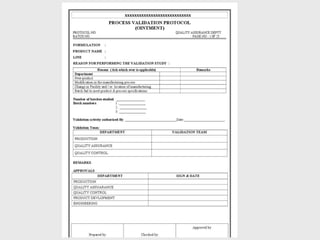
PROCESS VALIDATION
According to FDA, “Process validation is establishing documented
evidence which provides a high degree of assurance that a specific
process will consistently produce a product meeting its predetermined
specifications and quality characteristics”.
BASIC CONCEPT OF PROCESS VALIDATION:
• Calibration, verification and maintenance of process equipment.
• Prequalification or revalidation.
• Establishing specifications and performance characteristics.
• Selection of methods, process and equipment to ensure the product meets
specifications.
• Qualification or validation of process and equipment.
• Testing the final product, using validated analytical methods, in order to
meet specifications.
• Challenging, auditing, monitoring or sampling the recognised critical key
steps of the process.
Phases in process validation
Phase 1
Pre-validation phase or the Qualification phase, which covers all
activities relating to product research and development, formulation, pilot
batch studies, scale-up studies, transfer of technology to commercial scale
batches, establishing stability conditions, storage and handling of in-
process and finished dosage forms, Equipment qualification, Installation
qualification, master production documents, Operational qualification,
Process capability.
Phase 2
Process validation phase (Process Qualification phase) designed to
verify that all established limits of the critical process parameters are
valid and that satisfactory products can be produced even under the
“worst case” conditions.
Phase 3:
Validation Maintenance phase requiring frequent review of all
process related documents, including validation audit reports to
assure that there have been no changes, deviations, failures,
modifications to the production process, and that all SOPs have been
followed, including change control procedures. At this stage the
Validation Team also assures that there have been no
changes/deviations that should have resulted in requalification and
revalidation.
REVALIDATION
• Re-validation provides the evidence that changes in a process
and/or the process environment that are introduced do not
adversely affect process characteristics and product quality.
• Documentation requirements will be the same as for the initial
validation of the process. Facilities, systems, equipment and
processes, including cleaning, should be periodically evaluated to
confirm that they remain valid.
• Where no significant changes have been made to the validated
status, a review with evidence that facilities, systems, equipment
and processes meet the prescribed requirements fulfils the need for
revalidation.
•
Some of the changes that require validation are as follows:
• Changes in raw materials (physical properties such as density,
viscosity, particle size distribution and moisture etc. that may affect
the process or product).
• Changes in the source of active raw material manufacturer.
• Changes in packaging material (primary container/closure system)
• Changes in the process (e.g., mixing time, drying temperatures and
batch size)
• Changes in the equipment (e.g., addition of automatic detection
system)
• Changes of equipment which involve the replacement of equipment
on a “like for like” basis would not normally require re-validation
except that this new equipment must be qualified.
• Changes in the plant/facility.
BASIC PRNCIPLE FOR PROCESS VALIDATION
The basic principle for validation may be stated as follows:
• Installation Qualification (IQ): establishing by objective evidence that
all key aspects of the process equipment and ancillary system installation
adhere to the manufacturer’s approved specification and that the
recommendation of the supplier of the equipment are suitably
considered.
• Operational Qualification (OQ): Establishing byobjective evidence
process control limits andaction levels which result in product those
allpredetermined requirements.
• Performance Qualification (PQ): establishingby objective evidence
that the process, underanticipated conditions, consistently produces
aproduct which meets all predetermined requirements.
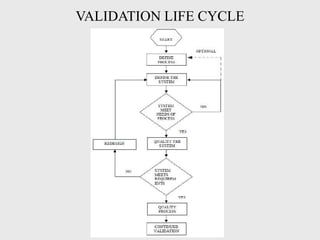
VALIDATION LIFE CYCLE
VALIDATION PROTOCOL
• A written plan of actions stating how process validation will be conducted,
it will specify who will conduct the various tasks and define testing
parameters, sampling plans, testing methods and specifications, will
specify product characteristics, and equipment to be used. It must be
specify the minimum number of batches to be used for validation studies, it
must specify the acceptance criteria and who will sign  approve 
disapprove the conclusions derived from such a scientific study.
The validation protocol should contain the following elements:
 Short description of the process
 Summary of critical processing steps to be investigated.
 In process, finished product specification for release
 Sampling plans
 Departmental responsibility
 Proposed timetable
 Approval of protocol
THE VALIDATION REPORT
A written report should be available after completion
of the validation, if found acceptable it should be
approved and authorized. The report should include
at least the following:
 Title and objective of study.
 Reference to protocol.
 Details of material.
 Equipment.
 Programs and cycles used.
 Details of procedures and test methods.
 Result.
IMPORTANCE OF PROCESS VALIDATION:
• Assurance of Quality
• Process Optimization
• Reduction of quality costs

Quality Assurance and validation

  • 1.
    Concept of Quality Qualityis a subjective term for which each person has his or her own definition. It is a matter of feeling and the definition varies from person to person depending on the perspective in which defined. Quality– conformance to standards or specifications; fitness for use; meeting customer’s expectations; delighting the customer etc. Quality is the totality of features and characteristics of a product that bears on its ability to satisfy the stated or implied needs. In other words, product or service free from deficiencies.
  • 2.
    • The processof building quality starts much before the purchase of materials and equipments and goes beyond the manufacturing activities till getting feedback from customers. • Building quality into the product also involve having controls at every stage of manufacturing on all input resources like facilities, equipment, materials, processes and testing. • Quality never happens by accident, it is always the result of an intelligent effort and therefore it has to be managed. • Quality can be achieved through a quality management system, which must involve everyone in the process throughout the organization.
  • 3.
    • A qualitymanagement system organizes overall activities of the company in such a way that the technical, administrative and human factors affecting the quality of product or service are under control. • All such controls are oriented towards reduction, elimination and prevention of quality deficiencies. • The quality for a product or service has two aspects: – The first relates to the features and attributes of the product or service. – The second aspect concerns the absence of deficiencies in the product.
  • 4.
    The eight dimensionsof quality • Performance • Features • Reliability • Conformance • Durability • Serviceability • Aesthetics • Perceived quality
  • 5.
    Objectives of qualitymanagement • Provide high quality product • Prevent or reduce the number of recalls and defective products entering the market. • Harmonize the GMP to the extent possible. • To help in getting quality by design. • To achieve success in business, performance oriented markets.
  • 6.
  • 7.
    Quality control • Theterm quality control comprises of two words quality and control. • The process through which we establish and meet standards is called control. This process has universal series of steps applied to quality. • This process has universal series of steps applied to quality. – Choosing the control subject: means what is to be regulated. – Choosing an unit of measure – Setting a standard value – Providing a device which can measure the characteristics in terms of unit of measure – Conducting actual measurements – Interpreting the difference between standard and actual – Taking decision and acting on the difference
  • 8.
    • According toWHO, “ QC is the part of GMP concerned with sampling, specifications, testing, with the organization, documentation and release procedures which ensures that the necessary and relevant test are actually carried out and that materials are neither released for use, nor products released for sale or supply, until their quality has been satisfactory. QC is not confined to laboratory operations but must be involved in all decisions concerning the quality of the product”. • According to MCC South Africa, “QC is that part of GMP which is concerned with the organization, documentation and release procedures which ensure that necessary and relevant tests are actually carried out that materials are not released for use, nor products released for sale or supply, until their quantity has been judged to be satisfactory”.
  • 9.
    Components of Qualitycontrol • Adequate facilities, trained personnel and approved procedures must be available for sampling, inspecting of starting materials, packaging materials, and intermediate bulk and finished products. • QC lab should have minimum following facilities- – Chemical testing laboratory supported with chemical, glassware and reagent stores. – Instrumental analysis lab with all required instruments such as HPLC, UV spectrophotometer, GC, FTIR, AAS etc. – Provisions for retained samples, stability samples etc. – Documentation room – Required books and pharmacopoeias • QC lab should have trained personnel with appropriate qualification.
  • 10.
    • QC labshould have SOPs • Sampling of materials: QC should have SOP for sampling of raw materials, intermediates and finished products. Persons should be well trained in doing sampling work. • The methods must be validated: all methods used by QC such as sampling, testing and other activities must be validated. • Records must be made demonstrating that all sampling, inspecting, testing procedures have actually been carried out and that any deviation have been recorded and investigated. • The basic concept of GMP is- “Do as you have written and write what you have done” • No batch of product to be released for sale or supply prior to certification by the authorized persons. • Sufficient samples of starting material and finished products must be retained to permit further examination of the product if necessary.
  • 11.
    Other activities ofQC • Establish, validate and implement all QC procedures, maintain sufficient standards and reagents. • Evaluate, maintain and store reference and working standards for substances. • Ensure the correct labeling of containers of materials and products. • Ensure that stability of API and product is monitored. • Participate in environmental monitoring. • Assess the final product after evaluation.
  • 12.
    Quality Assurance • Qualityassurance is a management tool and must assure the management that the activities are being performed as designed in all areas of operations within the organization. • Quality Assurance (QA) activities include a planned system of review procedures conducted by personnel not directly involved in the process. • Reviews, preferably by independent third parties, should be performed upon a finalized inventory following the implementation of QC procedures. • All parts of the quality assurance system should be adequately staffed with competent personnel, and should have suitable and sufficient premises, equipment, and facilities.
  • 13.
    • The systemof quality assurance should ensure that: (a) Pharmaceutical products are designed and developed in a way that takes account of the requirements of GMP and other associated codes such as those of good laboratory practice (GLP) and good clinical practice (GCP) (b) Production and control operations are clearly specified in a written form. (c) Managerial responsibilities are clearly specified in job descriptions. (d) All necessary controls on starting materials, intermediate products, and bulk products and other in-process controls, calibrations, and validations are carried out; (f) The finished product is correctly processed and checked, according to the defined procedures; (g) Pharmaceutical products are not sold or supplied before the authorized persons have certified that each production. (h) Deviations are reported, investigated and recorded.
  • 14.
    QUALITY AUDITS • Qualityaudit is defined as a systematic and independent examination to determine whether quality activities and related results comply with planned arrangements and whether these arrangements are implemented effectively and are suitable to achieve objective. • An audit is an information gathering activity so that the need for improvement or corrective action may be evaluated. • Audits may be internal or external / announced or unannounced. • First party audit is an audit carried out by an organization on itself. • Second party audit is an audit by one organization, working on its own behalf, on another. • Third party audit is an audit by an independent organization on a supplier. This may be done at the request of a group of customers.
  • 15.
    Types of audits •Adequacy audit/ document review: This is also known as a system or management audit and is normally an office exercise. • Compliance audit/ on site audit: This audit seeks to establish the extent to which the documented system is implemented and observed by the workforce, i.e. are the people complying with the system? • External audit: This is an audit that is performed by a company on its own suppliers or subcontractors. It may be an adequacy and/or a compliance audit. • Internal audit: This is the most important of all audits, which requires company to look in on its own systems, procedures and activities. It provides management with information on whether or not their policies are being met. • Product/ process audit: This may be considered a vertical audit, i.e. looking at all the systems that went into the production of a specific product or service.
  • 16.
    Why auditing isnecessary? • To determine conformity or non-conformity of the quality system elements with specific requirements. • To determine the effectiveness of the implemented quality system in meeting specified quality objectives. • To afford an opportunity to improve the quality system. • To provide managers with information.
  • 17.
    The audit lifecycle • Planning • Conducting the audit • Analysis of results • Reports and corrective actions
  • 18.
    CONCEPT OF ISO9000 • The International Standards Organization (ISO) is a worldwide federation of national standards bodies. The work of preparing international standards is carried out through ISO technical committees. • There are five quality management standards which are referred to as the ISO 9000 series. • Each of the five standards (9000 to 9004) addresses a different areas. • ISO 9001 standard is directed at the development of a quality product or service. • ISO 9002 is used for production and installation. It is the standard that governs the manufacture of a product. • ISO 9003 is the standard directed at the final test and inspection of products. • ISO 9004 is for internal use only and lists the components that compose quality systems
  • 19.
    • The objectiveof the ISO 9000 series of standards is to certify that an organization has quality manufacturing processes. • If the ISO 9000 auditors determine that the company's processes are in compliance with the standards, they issue a certificate good for three years, subject to annual validation that nothing has changed. • The ISO 9000 audit is heavily focused on evaluation of documentation. • Four tiers of quality system documentation are required: First tier- the quality manual. Second tier- quality management procedures. Third tier- area work instructions (i.e., sop’s, test methods, calibration methods). Fourth tier- forms, records, books, and files.
  • 20.
    ISO 9000 seriesQuality management principles • The ISO 9000 series are based on eight quality management principles defined in ISO 9000:2005. Principle 1 – Customer focus Principle 2 – Leadership Principle 3 – Involvement of people Principle 4 – Process approach Principle 5 – System approach to management Principle 6 – Continual improvement Principle 7 – Factual approach to decision making Principle 8 – Mutually beneficial supplier relationships
  • 21.
    The ISO 9000Audit • The ISO 9000 audit is the basis for becoming certified. • It is performed by auditors trained in conducting those audits and thoroughly knowledgeable about the standards. • The audits are extensive and can last several days or weeks, depending on the size of the organization. Step 1: Preliminary Walkthrough Step 2: Process Control Review Step 3: Testing Step 4: Making a Certification Decision
  • 22.
    Listing of ISO9000 Standards • The five standards in the ISO 9000 series are: • ISO 9000: Quality systems—model for quality assurance in design, development, production, installation, and servicing. • ISO 9000-1: Quality management and quality assurance standards—Part 1: guidelines for selection & use. • ISO 9000-2: Part 2: generic guidelines for application of International Standards Organization standards. • ISO 9000-3: Part 3: guidelines for the application of ISO 9001 to the development, supply, and maintenance of software. • ISO 9000-4: Part 4: application for dependability management • ISO 9001: Quality systems- Model for quality assurance in design, development, production, installation and servicing. • ISO 9002: Quality systems—model for quality assurance in production, installation, and servicing. • ISO 9003: Quality systems—model for quality assurance in final inspection and test. • ISO 9004-1: Quality management and quality system elements—Part 1: guidelines. • ISO 9004-2: Part 2: guidelines for services. • ISO 9004-3: Part 3: guidelines for processed materials. • ISO 9004-4: Part 4: guidelines for quality improvement.
  • 23.
    TOTAL QUALITY MANAGEMENT(TQM) Total quality management (TQM) means: – Satisfying customers first time, every time. – Enabling the employees to solve problems and eliminate wastage. – A style of working, a culture more than a management technique. – Philosophy of continuous improvement, never ending, only achievable by/or through people. The key elements of the TQM approach are: – Focus on the customer – Employee Involvement – Continuous improvement
  • 24.
    • According toJoseph Juran, quality begins at the stage of designing and ends after satisfactory services are provided to the customers. • His famous definition for quality is ‘fitness for use’. • He recommends a set of four important stages as: – Establish specific goals to be reached. – Establish plan for reaching goals (development of structured process to achieve this). – Assign clear responsibility for reaching goals. – Give rewards/awards on the basis of result achieved (development of feedback system, utilization of lessons learned from feedbacks etc). • Quality achievement, according to Juran, is possible through various initiatives that are the based on his famous quality trilogy: – Quality planning – Quality control – Quality improvement
  • 25.
    The initiatives underthe above three categories may be enlisted as follows: • Build awareness of the need and given an opportunity for improvement • Set goals for improvements • Organize to teach the goals (identify problems, select project, appoint teams, designate facilitators) • Provide training • Carry out projects to solve problems. • Report progress • Give recognition • Communicate results • Keep score • Maintain momentum by making annual improvement part of the regular systems and processes of the company.
  • 26.
  • 27.
    DOCUMENTATION • Good documentationis an essential part of the QA system and as such should be related to all aspects of GMP. • It defines the specifications for all materials and methods of manufacture and control. • Documentation ensures that all personnel concerned with manufacture know, what to do? How to do? When to do? etc. • Good documentation also ensures that authorized persons have all the necessary information to decide whether or not to release the batch for distribution. • Documents should not be hand written. Any correction made in a document should be signed and dated and correction should permit the reading of the original information. • Documents should be kept up to date. Any amendments should be formally authorized before the document is used.
  • 28.
    The objectives ofthorough documentation can be listed as follow: – Define the manufacturers system of information and control. – To minimize the risk of misinterpretation and errors inherent in oral or casual written communication. – To provide confirmation of performance of a task. – To allow calculations to be checked. – To all tracing of the batch history of any product.
  • 29.
    Each document shouldindicate or include • The user’s company name. • Purpose and title of document. • Document identity number. • Date of authorization. • Date of expiry or review. • Signature of authorized personnel. • Page numbers. • Reference used for preparation of document, if any.
  • 30.
    Retention of documentsand records • Except where legislation require longer retention periods, the complete records pertaining to each batch, including original data such as laboratory note books, should be retained for at least one year after the expiry date of the batch or where there is no expiry date, for six years after the date of manufacture of the batch. • Master documents should be properly secured against theft loss or alteration of information. • Records may be retained by computer storing system by the procedures and checks should be followed.
  • 31.
    Storage disposal ofdocuments • All documents should be stored in the department in such a manner that their retrieval is easy. • A total alphabetical list of documents should be made. • Completed batch production records must always be kept under lock under control of QA. • The expired documents must be destroyed by QA with proper record and authorization by proper method such as shredding or burning.
  • 32.
    MASTER FORMULA RECORD •also known as MASTER PRODUCTION AND CONTROL RECORD (MPCR). • The purpose of this document is to assure uniformity from batch to batch. • This document should be prepared for each product, including each batch size thereof. It should be dated and signed by one person and independently checked, dated and signed by a second person. • There should be a detailed S.O.P. for the preparation of M.P.C.R.
  • 33.
    Master formula recordshould contain the following things: 1. The name and strength of the product and description of the dosage form, for example-Calpol 500 mg Tablets. 2. The name and weight or measure of each active ingredient per dosage unit or per unit of weight or measure of the drug product, and a statement of the total weight or measure of any dosage unit. For example- – Each tablet contains 500 mg of paracetamol. – Or each 5 ml contains…….. mg of active ingredient – Or each 1 gm contains ……. mg of active ingredient 3. A complete list of components designated by names or codes sufficiently specific to indicate any special quality characteristics. E.g. particle size, color, form. 4. An accurate statement of the weight or measure of each component, using the same weight system for each component. 5. A statement concerning any calculated excess of component e.g. overages added in case of certain vitamins.
  • 34.
    6. A statementof theoretical weight or measure at appropriate phases of processing. E.g. end of granulation, end of compression, end of filling ampoules etc. 7. A statement of theoretical yield including the maximum and minimum percentage of theoretical yield beyong which investigation is required. 8. A description of the drug product containers, closures and packaging materials, including a specimen or copy of each label and all other labeling signed and dated by the person responsible for approval of such labeling. 9. Complete manufacturing and control instructions, sampling and testing procedures, specifications and precautions to be taken. 10. A statement of processing location and principal equipment to be used. 11. The methods or reference to methods to be used for preparing the critical equipment including cleaning, assembling, calibrating and sterilizing. 12. The requirements of storage conditions of the products, including the container, labeling and special storage conditions where applicable. 13. Details of in process controls with instructions for sampling and acceptance.
  • 37.
    BATCH PRODUCTION RECORD •This document is also known as BATCH PRODUCTION AND CONTROL RECORD and BATCH MANUFACTURING RECORD. • BPCR is a recurring document and gives complete history of the batch produced. BPCR is primarily a replica of the MPCR and gives actual process record of the batch produced and helps in maintaining the complete production and control history of the batch. The summary of the contents of this document is given below: • Dates and times of all the activities, which are carried out regarding production and control of the batch. • Identification of individual major equipment and line used. Identification od specific rooms/ locations should also be included. • Specific identification of each batch of components or in process materials used. • Weights and measures of components used in the course of processing. • In process and laboratory control results.
  • 38.
    • Inspection ofpackaging and labeling area before and after use. • A statement of the actual yield and a statement of the percentage of theoretical yield at appropriate phase of processing e.g. granulation, compression, coating, filling etc. • Complete labeling control record, including specimens or copies of all labeling used. • Description of drug product containers and closures. This should include primary, secondary and printed packing materials. • Any sampling performed, during the production and packaging activities. • Identifications of persons performing and supervising or checking each step in the operation. • Any investigation made regarding any unexplained discrepancies. • Results of examinations made.
  • 40.
    VALIDATION MASTER PLAN(VMP): • The VMP serves as the validation roadmap, setting the course, justifying the strategy, outlining the preliminary test and acceptance criteria, and documenting the necessary programs that ensure a continuing state of validation. • The VMP shall describe the process of preparation, review and approval of protocols. • The major contents of protocol and report shall be defined to achieve uniformity in documentation of various protocols. • VMP shall describe the process of execution, review and approval of the validation. Key people / team responsibilities for validations shall be described. The compiled VMP will have serial pagination. Design, drawing of the facility shall be included to as annexure to elucidate description of the facility. • VMP will be prepared by a team, reviewed by senior team and approved by GM QA & QC. The VMP is a controlled document and will be reviewed once a year. Changes to VMP can be made through document change control.
  • 41.
    • Introduction • Objective •Scope • Validation policy • Validation committee • Key personnel and manpower requirement • Facility and equipment qualification • Description of facility including plans • Facility, utilities qualifications • Description and listing of equipments • Key acceptance criteria • Design qualification (DQ) • Installation qualification ﴾IQ﴿ • Operational qualification ﴾OQ﴿ • Performance qualification ﴾PQ﴿ • Re‐validation criteria • Description and listing of protocols • Preventive maintenance programme • Process validation • Cleaning validation • Laboratory instrument qualification • Analytical method validation • Computer validation • Change control and approvals • Validation documentation • Validation plan and schedule • Personnel training programme • Reasonable unexpected events ﴾worst case﴿ • Review of VMP • List of relevant SOPs • Glossary of terms The VMP document shall contain information on the following sections and cover all aspects of qualifications and validations.
  • 43.
    Validation • It isa process of establishing documentary evidence demonstrating that a procedure, process, or activity carried out in production or testing maintains the desired level of compliance at all stages. • In Pharmaceutical Industry it is very important apart from final testing and compliance of product with standard that the process adapted to produce itself must assure that process will consistently produce the expected results. • Qualification of systems and equipment is therefore a part of process of validation. • It is a requirement of food and drug, pharmaceutical regulating agencies like FDA's good manufacturing practices guidelines.
  • 44.
    Planning for Validation •All validation activities should be planned. • The key elements of a validation programme should be clearly defined and documented in a validation master plan (VMP) or equivalent documents. • The VMP should be a summary document, which is brief, concise and clear. • A written protocol should be established that specifies how qualification and validation will be conducted. • The protocol should be reviewed and approved. • The protocol should specify critical steps and acceptance criteria.
  • 45.
    TYPES OF VALIDATION 1.Prospective validation • It is defined as the established documented evidence that a system does what it purports to do based on a pre-planned protocol. • This validation usually carried out prior to distribution either of a new product or a product made under a revised manufacturing process. • Performed on at least three successive production-size (Consecutive batches). • In Prospective Validation, the validation protocol is executed before the process is put into commercial use. • During the product development phase, the production process should be categorized into individual steps. Each step should be evaluated on the basis of experience or theoretical considerations to determine the critical parameters that may affect the quality of the finished product.
  • 46.
    Prospective validation shouldinclude, but not be limited to the following: • Short description of the process. • Summary of the critical processing steps to be investigated. • List of the equipment/facilities to be used (including measuring, monitoring/recording equipment) together with its calibration status. • Finished product specifications for release. • List of analytical methods, as appropriate. • Proposed in-process controls with acceptance criteria. • Additional testing to be carried out, with acceptance criteria and analytical validation, as appropriate. • Sampling plan. • Methods for recording and evaluating results. • Functions and responsibilities. • Proposed timetable.
  • 47.
    2. Concurrent Validation: •It is similar to prospective, except the operating firm will sell the product during the qualification runs, to the public at its market price, and also similar to retrospective validation. • This validation involves in-process monitoring of critical processing steps and product testing. This helps to generate and documented evidence to show that the production process is in a state of control. • The decision to carry out concurrent validation must be justified, documented and approved by authorized personnel. • Documentation requirements for concurrent validation are the same as specified for prospective validation.
  • 48.
    3. Retrospective Validation •It is defined as the established documented evidence that a system does what it purports to do on the review and analysis of historical information. • This is achieved by the review of the historical manufacturing testing data to prove that the process has always remained in control. • This type of validation of a process for a product already in distribution. • Retrospective validation is only acceptable for well-established processes and will be inappropriate where there have been recent changes in the composition of the product, operating procedures or equipment. Validation of such processes should be based on historical data. • The steps involved require the preparation of a specific protocol and the reporting of the results of the data review, leading to a conclusion and a recommendation. The source of data for this validation should include, but not be limited to batch processing and packaging records, process control charts, maintenance logbooks, records of personnel changes, process capability studies, finished product data, including trend cards and storage stability results. • For retrospective validation, generally data from ten to thirty consecutive batches should be examined.
  • 49.
    PROCESS VALIDATION According toFDA, “Process validation is establishing documented evidence which provides a high degree of assurance that a specific process will consistently produce a product meeting its predetermined specifications and quality characteristics”. BASIC CONCEPT OF PROCESS VALIDATION: • Calibration, verification and maintenance of process equipment. • Prequalification or revalidation. • Establishing specifications and performance characteristics. • Selection of methods, process and equipment to ensure the product meets specifications. • Qualification or validation of process and equipment. • Testing the final product, using validated analytical methods, in order to meet specifications. • Challenging, auditing, monitoring or sampling the recognised critical key steps of the process.
  • 50.
    Phases in processvalidation Phase 1 Pre-validation phase or the Qualification phase, which covers all activities relating to product research and development, formulation, pilot batch studies, scale-up studies, transfer of technology to commercial scale batches, establishing stability conditions, storage and handling of in- process and finished dosage forms, Equipment qualification, Installation qualification, master production documents, Operational qualification, Process capability. Phase 2 Process validation phase (Process Qualification phase) designed to verify that all established limits of the critical process parameters are valid and that satisfactory products can be produced even under the “worst case” conditions.
  • 51.
    Phase 3: Validation Maintenancephase requiring frequent review of all process related documents, including validation audit reports to assure that there have been no changes, deviations, failures, modifications to the production process, and that all SOPs have been followed, including change control procedures. At this stage the Validation Team also assures that there have been no changes/deviations that should have resulted in requalification and revalidation.
  • 52.
    REVALIDATION • Re-validation providesthe evidence that changes in a process and/or the process environment that are introduced do not adversely affect process characteristics and product quality. • Documentation requirements will be the same as for the initial validation of the process. Facilities, systems, equipment and processes, including cleaning, should be periodically evaluated to confirm that they remain valid. • Where no significant changes have been made to the validated status, a review with evidence that facilities, systems, equipment and processes meet the prescribed requirements fulfils the need for revalidation. •
  • 53.
    Some of thechanges that require validation are as follows: • Changes in raw materials (physical properties such as density, viscosity, particle size distribution and moisture etc. that may affect the process or product). • Changes in the source of active raw material manufacturer. • Changes in packaging material (primary container/closure system) • Changes in the process (e.g., mixing time, drying temperatures and batch size) • Changes in the equipment (e.g., addition of automatic detection system) • Changes of equipment which involve the replacement of equipment on a “like for like” basis would not normally require re-validation except that this new equipment must be qualified. • Changes in the plant/facility.
  • 54.
    BASIC PRNCIPLE FORPROCESS VALIDATION The basic principle for validation may be stated as follows: • Installation Qualification (IQ): establishing by objective evidence that all key aspects of the process equipment and ancillary system installation adhere to the manufacturer’s approved specification and that the recommendation of the supplier of the equipment are suitably considered. • Operational Qualification (OQ): Establishing byobjective evidence process control limits andaction levels which result in product those allpredetermined requirements. • Performance Qualification (PQ): establishingby objective evidence that the process, underanticipated conditions, consistently produces aproduct which meets all predetermined requirements.
  • 55.
  • 56.
    VALIDATION PROTOCOL • Awritten plan of actions stating how process validation will be conducted, it will specify who will conduct the various tasks and define testing parameters, sampling plans, testing methods and specifications, will specify product characteristics, and equipment to be used. It must be specify the minimum number of batches to be used for validation studies, it must specify the acceptance criteria and who will sign approve disapprove the conclusions derived from such a scientific study. The validation protocol should contain the following elements:  Short description of the process  Summary of critical processing steps to be investigated.  In process, finished product specification for release  Sampling plans  Departmental responsibility  Proposed timetable  Approval of protocol
  • 57.
    THE VALIDATION REPORT Awritten report should be available after completion of the validation, if found acceptable it should be approved and authorized. The report should include at least the following:  Title and objective of study.  Reference to protocol.  Details of material.  Equipment.  Programs and cycles used.  Details of procedures and test methods.  Result.
  • 58.
    IMPORTANCE OF PROCESSVALIDATION: • Assurance of Quality • Process Optimization • Reduction of quality costs