Cognitive Development
Piaget’s Theory, Vygotsky’s Sociocultural Viewpoint, Information-
Processing Perspectives, Intelligence
• The way in which the thinking process
changes with age and experience
• Changes occur in mental activities such as
attending, perceiving, learning, thinking,
and remembering
• Adolescents gain a better understanding
and control of their own mental processes
Cognitive
Development
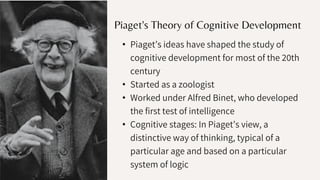
Piaget's Theory of Cognitive Development
• Piaget’s ideas have shaped the study of
cognitive development for most of the 20th
century
• Started as a zoologist
• Worked under Alfred Binet, who developed
the first test of intelligence
• Cognitive stages: In Piaget’s view, a
distinctive way of thinking, typical of a
particular age and based on a particular
system of logic
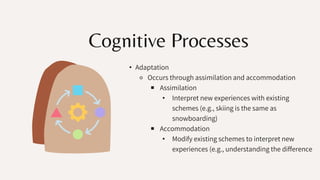
Cognitive Processes
• Adaptation
⚬ Occurs through assimilation and accommodation
■ Assimilation
• Interpret new experiences with existing
schemes (e.g., skiing is the same as
snowboarding)
■ Accommodation
• Modify existing schemes to interpret new
experiences (e.g., understanding the difference
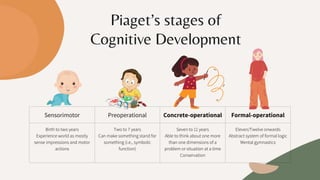
Sensorimotor Preoperational Concrete-operational Formal-operational
Birth to two years
Experience world as mostly
sense impressions and motor
actions
Two to 7 years
Can make something stand for
something (i.e., symbolic
function)
Seven to 11 years
Able to think about one more
than one dimensions of a
problem or situation at a time
Conservation
Eleven/Twelve onwards
Abstract system of formal logic
Mental gymnastics
Piaget’s stages of
Cognitive Development
Formal Operations
• One of the central elements in formal operations is
hypthetico-deductive reasoning
⚬ a way of reasoning in which a person makes a
logical prediction based on some supposition, and
then checks the prediction against reality
⚬ reasoning from a hypothesis or premise to a
deduction or conclusion
• Closely relate to research approach
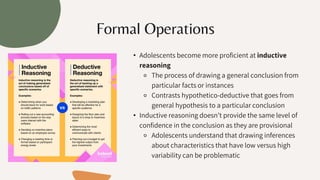
• Adolescents become more proficient at inductive
reasoning
⚬ The process of drawing a general conclusion from
particular facts or instances
⚬ Contrasts hypothetico-deductive that goes from
general hypothesis to a particular conclusion
• Inductive reasoning doesn’t provide the same level of
confidence in the conclusion as they are provisional
⚬ Adolescents understand that drawing inferences
about characteristics that have low versus high
variability can be problematic
Formal Operations
Piaget and everyday life
• Considering implications of
hypothetical alternatives
⚬ “What if I’d been born into a
different family?”
• Understanding multiple meanings
⚬ Metaphor and sarcasm
■ “Nice jacket”
• Piaget posited that children experience egocentrism
⚬ The process of assuming that other people’s points of
view are the same as one’s own
• Formal operations make it easier for adolescents to think
about their own thinking
⚬ This can lead to a mood of self-absorption and self-
consciousness
• They may have trouble distinguishing thoughts about
their own thinking versus others
• They develop their own form of egocentrism (albeit, more
complex than a child’s)
Adolescent
egocentrism
Adolescent
egocentrism
• David Elkind expanded on adolescent
egocentrism, and described two major
ways it might reveal itself
⚬ Imaginary audience (everyone is
staring at your pimple)
⚬ Personal fable (no one understands
me!!!)
THINK ABOUT IT
What would you say are the most important developments in
adolescent thinking from the perspective of Piaget's work? How do
these developments show themselves? Give examples.
Critiques of Piaget
• Some parts have not held up as well as others
(even Piaget has questioned some things!)
• Piaget thought adolescents reached formal
operations at the same age
• Adolescents may not use their formal
operation capabilities
Vygotsky’s Sociocultural Theory
• Lev Vygotsky’s sociocultural theory
⚬ Social interactions are much more important to
development
⚬ Everyday concepts vs scientific concepts
⚬ Cognitive development is driven by collaborative
dialogues with more knowledgeable members of
society (e.g., interactions with parents, teachers
etc)
⚬ May vary from culture to culture
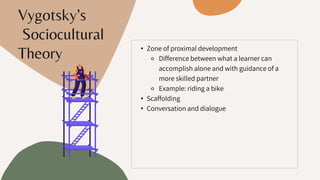
• Zone of proximal development
⚬ Difference between what a learner can
accomplish alone and with guidance of a
more skilled partner
⚬ Example: riding a bike
• Scaffolding
• Conversation and dialogue
Vygotsky’s
Sociocultural
Theory
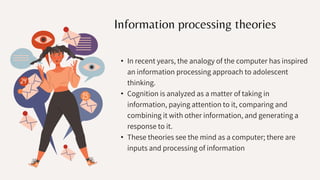
• In recent years, the analogy of the computer has inspired
an information processing approach to adolescent
thinking.
• Cognition is analyzed as a matter of taking in
information, paying attention to it, comparing and
combining it with other information, and generating a
response to it.
• These theories see the mind as a computer; there are
inputs and processing of information
Information processing theories
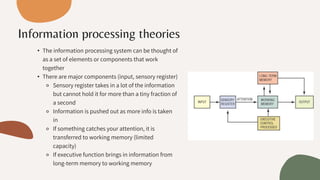
• The information processing system can be thought of
as a set of elements or components that work
together
• There are major components (input, sensory register)
⚬ Sensory register takes in a lot of the information
but cannot hold it for more than a tiny fraction of
a second
⚬ Information is pushed out as more info is taken
in
⚬ If something catches your attention, it is
transferred to working memory (limited
capacity)
⚬ If executive function brings in information from
long-term memory to working memory
Information processing theories
• Adolescents have better selective attention and divided attention
⚬ Selective attention: Concentrating on one task or experience while
blocking out awareness of others
⚬ Divided attention: the ability to do more than one thing at once
improves from childhood to adolescence
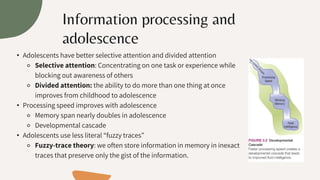
• Processing speed improves with adolescence
⚬ Memory span nearly doubles in adolescence
⚬ Developmental cascade
• Adolescents use less literal “fuzzy traces”
⚬ Fuzzy-trace theory: we often store information in memory in inexact
traces that preserve only the gist of the information.
Information processing and
adolescence
THINK ABOUT IT
When can fuzzy trace memories be useful? When can they be risky?
• Binet developed measures of future
school success in early 20th century
• Binet’s test scored as “mental age”
⚬ IQ: ratio of mental age to
chronological age
• IQ tests designed to give average of 100
• IQ scores form normal (bell curve)
distribution
Intelligence in
adolescence
Intelligence and adolescence
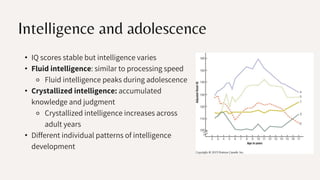
• IQ scores stable but intelligence varies
• Fluid intelligence: similar to processing speed
⚬ Fluid intelligence peaks during adolescence
• Crystallized intelligence: accumulated
knowledge and judgment
⚬ Crystallized intelligence increases across
adult years
• Different individual patterns of intelligence
development
Intelligence and adolescence
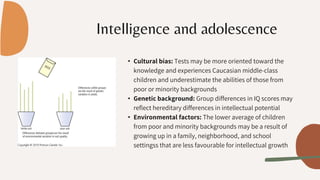
• Cultural bias: Tests may be more oriented toward the
knowledge and experiences Caucasian middle-class
children and underestimate the abilities of those from
poor or minority backgrounds
• Genetic background: Group differences in IQ scores may
reflect hereditary differences in intellectual potential
• Environmental factors: The lower average of children
from poor and minority backgrounds may be a result of
growing up in a family, neighborhood, and school
settingss that are less favourable for intellectual growth
Gardner’s Theory Of
Multiple Intelligences
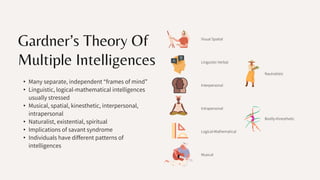
• Many separate, independent “frames of mind”
• Linguistic, logical-mathematical intelligences
usually stressed
• Musical, spatial, kinesthetic, interpersonal,
intrapersonal
• Naturalist, existential, spiritual
• Implications of savant syndrome
• Individuals have different patterns of
intelligences
Visual Spatial
Linguistic-Verbal
Interpersonal
Intrapersonal
Logical-Mathematical
Musical
Bodily-Kinesthetic
Nautralistic
THINK ABOUT IT
Does education focus on specific intelligence? How do you think
schools have begun to adapt to students’ multiple intelligences?
Understanding Knowledge
• Metacognition: thinking about how to think
• Self-regulated learning as an acquired skill
• Personal epistemology: what is knowledge? Why
does it matter?
• Children believe knowledge is objective
• For early adolescents, knowledge is relative
• Late adolescents rationally evaluate knowledge
Understanding knowledge
• Purposeful thinking transforms knowledge
• Conceptual flexibility makes connections among
concepts
• Reflective thinking evaluates new and old ideas
• Cognitive self-regulation keeps track of progress
• Adolescence is a vital time to develop critical thinking
THINK ABOUT IT
Are there steps that schools could take to encourage metacognition, self-regulated learning, and
critical thinking in their adolescent students?
How could the teacher interact with the students?
How would they lecture?
What assignments/tests would there be?

Cognitive Development Adolescence Psychology

  • 1.
    Cognitive Development Piaget’s Theory,Vygotsky’s Sociocultural Viewpoint, Information- Processing Perspectives, Intelligence
  • 2.
    • The wayin which the thinking process changes with age and experience • Changes occur in mental activities such as attending, perceiving, learning, thinking, and remembering • Adolescents gain a better understanding and control of their own mental processes Cognitive Development
  • 3.
    Piaget's Theory ofCognitive Development • Piaget’s ideas have shaped the study of cognitive development for most of the 20th century • Started as a zoologist • Worked under Alfred Binet, who developed the first test of intelligence • Cognitive stages: In Piaget’s view, a distinctive way of thinking, typical of a particular age and based on a particular system of logic
  • 4.
    Cognitive Processes • Adaptation ⚬Occurs through assimilation and accommodation ■ Assimilation • Interpret new experiences with existing schemes (e.g., skiing is the same as snowboarding) ■ Accommodation • Modify existing schemes to interpret new experiences (e.g., understanding the difference
  • 5.
    Sensorimotor Preoperational Concrete-operationalFormal-operational Birth to two years Experience world as mostly sense impressions and motor actions Two to 7 years Can make something stand for something (i.e., symbolic function) Seven to 11 years Able to think about one more than one dimensions of a problem or situation at a time Conservation Eleven/Twelve onwards Abstract system of formal logic Mental gymnastics Piaget’s stages of Cognitive Development
  • 6.
    Formal Operations • Oneof the central elements in formal operations is hypthetico-deductive reasoning ⚬ a way of reasoning in which a person makes a logical prediction based on some supposition, and then checks the prediction against reality ⚬ reasoning from a hypothesis or premise to a deduction or conclusion • Closely relate to research approach
  • 7.
    • Adolescents becomemore proficient at inductive reasoning ⚬ The process of drawing a general conclusion from particular facts or instances ⚬ Contrasts hypothetico-deductive that goes from general hypothesis to a particular conclusion • Inductive reasoning doesn’t provide the same level of confidence in the conclusion as they are provisional ⚬ Adolescents understand that drawing inferences about characteristics that have low versus high variability can be problematic Formal Operations
  • 8.
    Piaget and everydaylife • Considering implications of hypothetical alternatives ⚬ “What if I’d been born into a different family?” • Understanding multiple meanings ⚬ Metaphor and sarcasm ■ “Nice jacket”
  • 9.
    • Piaget positedthat children experience egocentrism ⚬ The process of assuming that other people’s points of view are the same as one’s own • Formal operations make it easier for adolescents to think about their own thinking ⚬ This can lead to a mood of self-absorption and self- consciousness • They may have trouble distinguishing thoughts about their own thinking versus others • They develop their own form of egocentrism (albeit, more complex than a child’s) Adolescent egocentrism
  • 10.
    Adolescent egocentrism • David Elkindexpanded on adolescent egocentrism, and described two major ways it might reveal itself ⚬ Imaginary audience (everyone is staring at your pimple) ⚬ Personal fable (no one understands me!!!)
  • 11.
    THINK ABOUT IT Whatwould you say are the most important developments in adolescent thinking from the perspective of Piaget's work? How do these developments show themselves? Give examples.
  • 12.
    Critiques of Piaget •Some parts have not held up as well as others (even Piaget has questioned some things!) • Piaget thought adolescents reached formal operations at the same age • Adolescents may not use their formal operation capabilities
  • 13.
    Vygotsky’s Sociocultural Theory •Lev Vygotsky’s sociocultural theory ⚬ Social interactions are much more important to development ⚬ Everyday concepts vs scientific concepts ⚬ Cognitive development is driven by collaborative dialogues with more knowledgeable members of society (e.g., interactions with parents, teachers etc) ⚬ May vary from culture to culture
  • 14.
    • Zone ofproximal development ⚬ Difference between what a learner can accomplish alone and with guidance of a more skilled partner ⚬ Example: riding a bike • Scaffolding • Conversation and dialogue Vygotsky’s Sociocultural Theory
  • 15.
    • In recentyears, the analogy of the computer has inspired an information processing approach to adolescent thinking. • Cognition is analyzed as a matter of taking in information, paying attention to it, comparing and combining it with other information, and generating a response to it. • These theories see the mind as a computer; there are inputs and processing of information Information processing theories
  • 16.
    • The informationprocessing system can be thought of as a set of elements or components that work together • There are major components (input, sensory register) ⚬ Sensory register takes in a lot of the information but cannot hold it for more than a tiny fraction of a second ⚬ Information is pushed out as more info is taken in ⚬ If something catches your attention, it is transferred to working memory (limited capacity) ⚬ If executive function brings in information from long-term memory to working memory Information processing theories
  • 17.
    • Adolescents havebetter selective attention and divided attention ⚬ Selective attention: Concentrating on one task or experience while blocking out awareness of others ⚬ Divided attention: the ability to do more than one thing at once improves from childhood to adolescence • Processing speed improves with adolescence ⚬ Memory span nearly doubles in adolescence ⚬ Developmental cascade • Adolescents use less literal “fuzzy traces” ⚬ Fuzzy-trace theory: we often store information in memory in inexact traces that preserve only the gist of the information. Information processing and adolescence
  • 18.
    THINK ABOUT IT Whencan fuzzy trace memories be useful? When can they be risky?
  • 19.
    • Binet developedmeasures of future school success in early 20th century • Binet’s test scored as “mental age” ⚬ IQ: ratio of mental age to chronological age • IQ tests designed to give average of 100 • IQ scores form normal (bell curve) distribution Intelligence in adolescence
  • 20.
    Intelligence and adolescence •IQ scores stable but intelligence varies • Fluid intelligence: similar to processing speed ⚬ Fluid intelligence peaks during adolescence • Crystallized intelligence: accumulated knowledge and judgment ⚬ Crystallized intelligence increases across adult years • Different individual patterns of intelligence development
  • 21.
    Intelligence and adolescence •Cultural bias: Tests may be more oriented toward the knowledge and experiences Caucasian middle-class children and underestimate the abilities of those from poor or minority backgrounds • Genetic background: Group differences in IQ scores may reflect hereditary differences in intellectual potential • Environmental factors: The lower average of children from poor and minority backgrounds may be a result of growing up in a family, neighborhood, and school settingss that are less favourable for intellectual growth
  • 22.
    Gardner’s Theory Of MultipleIntelligences • Many separate, independent “frames of mind” • Linguistic, logical-mathematical intelligences usually stressed • Musical, spatial, kinesthetic, interpersonal, intrapersonal • Naturalist, existential, spiritual • Implications of savant syndrome • Individuals have different patterns of intelligences Visual Spatial Linguistic-Verbal Interpersonal Intrapersonal Logical-Mathematical Musical Bodily-Kinesthetic Nautralistic
  • 23.
    THINK ABOUT IT Doeseducation focus on specific intelligence? How do you think schools have begun to adapt to students’ multiple intelligences?
  • 24.
    Understanding Knowledge • Metacognition:thinking about how to think • Self-regulated learning as an acquired skill • Personal epistemology: what is knowledge? Why does it matter? • Children believe knowledge is objective • For early adolescents, knowledge is relative • Late adolescents rationally evaluate knowledge
  • 25.
    Understanding knowledge • Purposefulthinking transforms knowledge • Conceptual flexibility makes connections among concepts • Reflective thinking evaluates new and old ideas • Cognitive self-regulation keeps track of progress • Adolescence is a vital time to develop critical thinking
  • 26.
    THINK ABOUT IT Arethere steps that schools could take to encourage metacognition, self-regulated learning, and critical thinking in their adolescent students? How could the teacher interact with the students? How would they lecture? What assignments/tests would there be?