Environmental Clearance
by
Asst Prof. Mirza Salman Baig
AIKTC School of Pharmacy
Acts in India
• The Environment (Protection) Act 1986
• The Air (prevention and control of pollution) Act
• The Water (prevention and control of pollution) Act
• The Wildlife protection Act
• Forest conservation Act
Environmental Clearance,
Consent & Authorization Mechanism
• Normally the SPCB's No Objection Certificate in
the form of combined Consent to establishment
under Water Act, Air Act & Hazardous wastes
Rules would be required for setting up of an
industrial unit.
• In regard to 39 specified industrial and
infrastructure projects,environmental clearance
from the MoEF, Govt. of India and State
Environment Department are also required as per
Environmental Impact Assessment Notification
dtd.14/09/2006
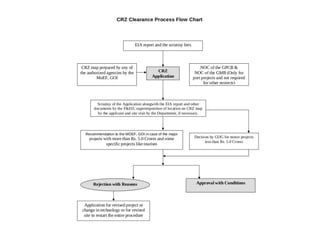
• For the industrial units, other developmental
activities located on the coastal stretches of bays,
estuaries, creeks, rivers )Notification on
19.2.1991clearance also is required
Purpose
• The main purpose behind
environmental clearance is to assess
the impact of the proposed/
upcoming project on the
environment and people and, in turn,
to try to abate/ minimize the same to
the maximum extent possible.
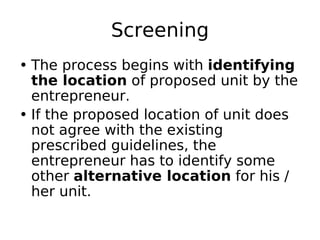
Screening
• The process begins with identifying
the location of proposed unit by the
entrepreneur.
• If the proposed location of unit does
not agree with the existing
prescribed guidelines, the
entrepreneur has to identify some
other alternative location for his /
her unit.
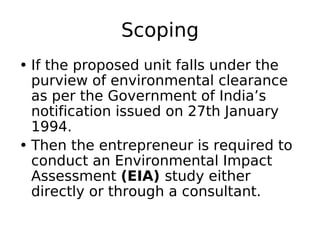
Scoping
• If the proposed unit falls under the
purview of environmental clearance
as per the Government of India’s
notification issued on 27th January
1994.
• Then the entrepreneur is required to
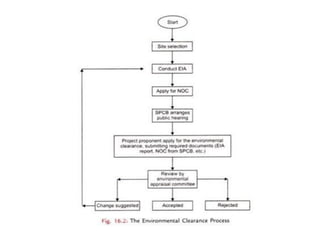
conduct an Environmental Impact
Assessment (EIA) study either
directly or through a consultant.
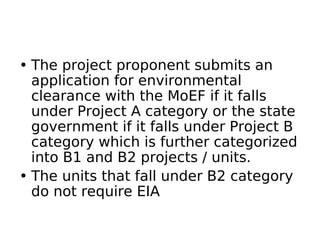
• The project proponent submits an
application for environmental
clearance with the MoEF if it falls
under Project A category or the state
government if it falls under Project B
category which is further categorized
into B1 and B2 projects / units.
• The units that fall under B2 category
do not require EIA
Environmental statements
• All units seeking environmental clearance under the
Water or Air Acts or Authorisation under the
Hazardous Wastes (Management & Handling) Rules,
beginning 1993, are required to submit duly filled in
environmental statements for the period ending
31 March on or before 30 September every year to
the concerned State Pollution Control Board (SPCB)
• The Central and State Pollution Control Boards are
responsible for enforcing legal action against the
industrial units that are found environment polluters
Public hearing
• Public hearing is conducted prior to the issue
of NOC from SPCB.
• Public hearing provides a legal space for
people of an area to come face-to-face with
the project proponent and the government.
• They express their concerns about the
impact of proposed unit on them
• The District Collector is the chairperson of
the public hearing committee
Contd...
• The hearing committee hears the
objections/suggestions from the
public and after inserting certain
clauses it is passed on to the next
stage of approval, i.e. Ministry of
Environment and Forest (MoEF).
Contd...
• The SPCB evaluates and assesses the
quantity and quality of effluents likely to
be generated by the proposed unit as well
as the efficacy of the control measures
proposed by the entrepreneur to meet the
prescribed standards.
• If the SPCB is satisfied that the proposed
unit will meet all the prescribed effluent
and emissions standards, it issues its
environmental clearance called "No
Objection Certificat" to establish the
proposed unit.
Evaluation
• The documents submitted by an
entrepreneur are first scrutinized by a
multi-disciplinary staff functioning in
the Ministry of Environment and Forests.
• The proposals are placed before specially
constituted committees, known as
‘Environmental Appraisal Committees’
• Appraisal Committees make their
recommendations for approval or rejection
of particular projects.

Environmental clearance

  • 1.
    Environmental Clearance by Asst Prof.Mirza Salman Baig AIKTC School of Pharmacy
  • 2.
    Acts in India •The Environment (Protection) Act 1986 • The Air (prevention and control of pollution) Act • The Water (prevention and control of pollution) Act • The Wildlife protection Act • Forest conservation Act
  • 3.
    Environmental Clearance, Consent &Authorization Mechanism • Normally the SPCB's No Objection Certificate in the form of combined Consent to establishment under Water Act, Air Act & Hazardous wastes Rules would be required for setting up of an industrial unit. • In regard to 39 specified industrial and infrastructure projects,environmental clearance from the MoEF, Govt. of India and State Environment Department are also required as per Environmental Impact Assessment Notification dtd.14/09/2006 • For the industrial units, other developmental activities located on the coastal stretches of bays, estuaries, creeks, rivers )Notification on 19.2.1991clearance also is required
  • 5.
    Purpose • The mainpurpose behind environmental clearance is to assess the impact of the proposed/ upcoming project on the environment and people and, in turn, to try to abate/ minimize the same to the maximum extent possible.
  • 6.
    Screening • The processbegins with identifying the location of proposed unit by the entrepreneur. • If the proposed location of unit does not agree with the existing prescribed guidelines, the entrepreneur has to identify some other alternative location for his / her unit.
  • 7.
    Scoping • If theproposed unit falls under the purview of environmental clearance as per the Government of India’s notification issued on 27th January 1994. • Then the entrepreneur is required to conduct an Environmental Impact Assessment (EIA) study either directly or through a consultant.
  • 9.
    • The projectproponent submits an application for environmental clearance with the MoEF if it falls under Project A category or the state government if it falls under Project B category which is further categorized into B1 and B2 projects / units. • The units that fall under B2 category do not require EIA
  • 10.
    Environmental statements • Allunits seeking environmental clearance under the Water or Air Acts or Authorisation under the Hazardous Wastes (Management & Handling) Rules, beginning 1993, are required to submit duly filled in environmental statements for the period ending 31 March on or before 30 September every year to the concerned State Pollution Control Board (SPCB) • The Central and State Pollution Control Boards are responsible for enforcing legal action against the industrial units that are found environment polluters
  • 11.
    Public hearing • Publichearing is conducted prior to the issue of NOC from SPCB. • Public hearing provides a legal space for people of an area to come face-to-face with the project proponent and the government. • They express their concerns about the impact of proposed unit on them • The District Collector is the chairperson of the public hearing committee
  • 12.
    Contd... • The hearingcommittee hears the objections/suggestions from the public and after inserting certain clauses it is passed on to the next stage of approval, i.e. Ministry of Environment and Forest (MoEF).
  • 13.
    Contd... • The SPCBevaluates and assesses the quantity and quality of effluents likely to be generated by the proposed unit as well as the efficacy of the control measures proposed by the entrepreneur to meet the prescribed standards. • If the SPCB is satisfied that the proposed unit will meet all the prescribed effluent and emissions standards, it issues its environmental clearance called "No Objection Certificat" to establish the proposed unit.
  • 14.
    Evaluation • The documentssubmitted by an entrepreneur are first scrutinized by a multi-disciplinary staff functioning in the Ministry of Environment and Forests. • The proposals are placed before specially constituted committees, known as ‘Environmental Appraisal Committees’ • Appraisal Committees make their recommendations for approval or rejection of particular projects.