ENVIRONMENTAL IMPACT
     ASSESSMENT

                     Prepared by
               Prof. B. Mohanty
 Department of Civil Engineering
         SALITER, Ahmedabad
Introduction…
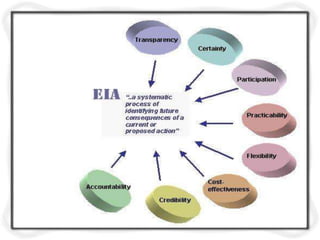
Defined as the systematic identification and
evaluation of potential impacts of proposed
projects, plans or actions on physical,
chemical, biological, cultural and socio-
economic components of environment.
 EIA planning tool, helps planner in predicting
  future impacts of different developments.

 EIA must be conducted for projects like
  highways, airports, canals, dams, power plants
  etc. which disturb environment.

 Applicable for developmental activities which
  involves plans, programmes and policies.
Need of EIA
 When a project undertaken it disturb
  environmental equilibrium.

 To maintain quality of environment it is essential
  to study impacts of project on environment.

 This also suggest remedial measures for
  development of projects.
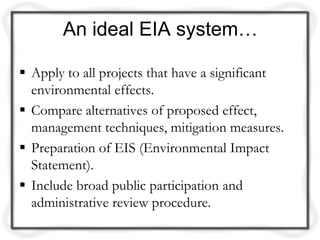
An ideal EIA system…

 Apply to all projects that have a significant
  environmental effects.
 Compare alternatives of proposed effect,
  management techniques, mitigation measures.
 Preparation of EIS (Environmental Impact
  Statement).
 Include broad public participation and
  administrative review procedure.
 Be timed to provide information for decision
  making.

 Be enforceable.

 Include monitoring and feedback procedures.
Goals of EIA

   Resources conservation
   Waste minimization
   Recovery of by product
   Efficient use of equipments
   Sustainable development
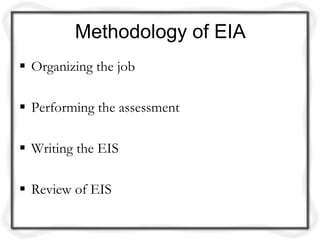
Methodology of EIA
 Organizing the job

 Performing the assessment

 Writing the EIS

 Review of EIS
Organizing the job
 Interdisciplinary team is constituted to conduct
  analysis of impacts on environment.

 Consists of a group of geologists, agronomists,
  chemists, ecologists, hydrologists, engineers, etc.

 Decide whether project is required or not.
Performing the assessment

   Site visit
   Identification and evaluation
   Discussion of alternatives
   Preparation of checklist
   Measurement of environmental impact due to
    project
Preparation of EIS
 EIS is conclusion of EIA
 It is a written statement to ensure that policies and
  goals of NEPA (National Environment Policy Act)
  included in ongoing project.
 It contains following items:

1. Description of site
2. Description of proposed project, purpose of action,
   goals and objectives.
3. Environmental impact of proposed project
4. Alternatives of activity
5. Relationship of proposed activity to the existing
    land use plans
6. Relationship between local short term uses and
    long term productivity of resources involved
7. Indentifying measures that can be taken in order
    to minimize adverse effects
8. Incorporating the modifications in proposed
    project
Review of EIS
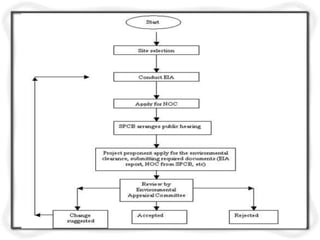
 After completion of EIA report, public must be
  informed and consulted on proposed project.

 Anyone likely to be affected by the project is
  entitled to have access to the executive summary
  of the EIA.
 The affected person may include:
Bonafide local residents
Local associations
Environmental groups active in area
Other person located at project sites
 They have to give suggestion
 One month given for public inspection
 After final review decision is taken either
  approve or reject of proposed project.
EIA in India
 Formal legislation for EIA. It has been enacted
  by making an amendment in the Environment
  Protection Act 1986.

 Limited involvement of public and government
  agencies in the initial phases.

 No provision in place to cover landscape and
  visual impacts in the Indian EIA regulations.
 Earlier scoping was done by consultant or
  proponent with an inclination towards meeting
  pollution control requirements, rather than
  addressing the full range of potential
  environmental.

 Most reports in English and not in the local
  language. In some case, executive summary is
  translated into local language.
Limitations of EIA
1. Should undertaken at policy and planning level
   rather than the project level.
2. Possible alternatives is often small
3. There is no criteria to decide what types of
   projects undergo EIA. Because many projects
   do not require in depth EIA.
4. Lack of comprehensive environmental
   information, base limitations of time,
   manpower, financial resources.
5. More research and development of improved
   methodologies required to overcome limitations
   relating in data.
6. EIA report too academic, bureaucratic and
   lengthy. Difficult to understand for common
   people.
7. In actual, EIA ends immediately after project
   clearance, no follow up taken.
Critical issues in EIA guidelines
 Can local environment cope with additional
  waste and pollution that the project will
  produce?
 Will project location conflict with nearby land
  use?
 Can project operates safely without serious risk
  of accidents or long term health hazards?
 Is there sufficient infrastructure to support the
  project?
 How much resources will project consume and
  are adequate supplies of these resources
  available?

 What kind of human resources will it require or
  replace and what will be its social impacts?

 What damage will it cause to national/regional
  assets such as natural resources, tourist areas or
  historic or cultural sites etc?
Introduction
 Main aim to quantify environmental
  performance and position of an
  industry/organization.
 It is done for improving performance and
  position.
 Act as tool for achieving sustainable
  development.
 According to USEPA, EA is a systematic,
  documented, periodic and objective review by a
  regulated entity of facility operations and
  practices related to meeting environmental
  requirements.

 Govt. of India march 13, 1992 made mandatory
  for all industries to provide annual
  environmental audit reports of their operations.
 EA provide answers to the following questions:

What are we doing ? Are we compliance with
 govt. regulations, guidelines, code of practice,
 permit conditions ?

Can we do it better ? Are there non regulated
 areas where operations can be improved to
 minimize the impact on environment ?
Components of EA
I. Assessment :

 Provides expert judgment/opinion on hazards,
  associated risks and management and control
  measures.

 It provides basis for recommendations to
  improve the organization’s management
  systems and environmental performance.
II. Verification :

It determines and document performance by
 evaluating the application of and adherence to
 policies and procedures.

It certifies validity of data and reports, evaluates
 the effectiveness of management systems.
Basic steps in audit process

 Pre-audit activities

 Audit process

 Post audit activities
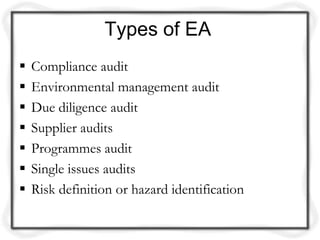
Types of EA
   Compliance audit
   Environmental management audit
   Due diligence audit
   Supplier audits
   Programmes audit
   Single issues audits
   Risk definition or hazard identification
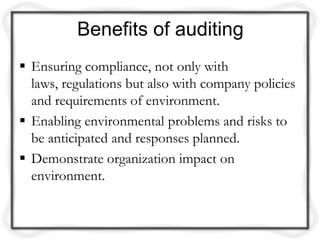
Benefits of auditing
 Ensuring compliance, not only with
  laws, regulations but also with company policies
  and requirements of environment.
 Enabling environmental problems and risks to
  be anticipated and responses planned.
 Demonstrate organization impact on
  environment.
 Increase management and employee awareness
  of environmental issues.
 More efficient resources use and financial
  savings.
 Promotes “Good Practice”.
 Providing better private and public image and
  security to top management.
ASSIGNMENT NO. - 3
1. Discuss various air pollution controlling equipments with
   their advantages and disadvantages.
2. Enlist different air pollutants with their sources and
   effects.
3. Explain the effects of air pollutants on human, plants and
   materials.
4. What are the different effects of noise pollution on
   human, animals and plants and to control the noise
   pollution?
5. Write a note on EIA.
6. Briefly explain environmental audit?

Environmental impact assessment m5

  • 1.
    ENVIRONMENTAL IMPACT ASSESSMENT Prepared by Prof. B. Mohanty Department of Civil Engineering SALITER, Ahmedabad
  • 2.
    Introduction… Defined as thesystematic identification and evaluation of potential impacts of proposed projects, plans or actions on physical, chemical, biological, cultural and socio- economic components of environment.
  • 3.
     EIA planningtool, helps planner in predicting future impacts of different developments.  EIA must be conducted for projects like highways, airports, canals, dams, power plants etc. which disturb environment.  Applicable for developmental activities which involves plans, programmes and policies.
  • 4.
    Need of EIA When a project undertaken it disturb environmental equilibrium.  To maintain quality of environment it is essential to study impacts of project on environment.  This also suggest remedial measures for development of projects.
  • 5.
    An ideal EIAsystem…  Apply to all projects that have a significant environmental effects.  Compare alternatives of proposed effect, management techniques, mitigation measures.  Preparation of EIS (Environmental Impact Statement).  Include broad public participation and administrative review procedure.
  • 6.
     Be timedto provide information for decision making.  Be enforceable.  Include monitoring and feedback procedures.
  • 8.
    Goals of EIA  Resources conservation  Waste minimization  Recovery of by product  Efficient use of equipments  Sustainable development
  • 9.
    Methodology of EIA Organizing the job  Performing the assessment  Writing the EIS  Review of EIS
  • 11.
    Organizing the job Interdisciplinary team is constituted to conduct analysis of impacts on environment.  Consists of a group of geologists, agronomists, chemists, ecologists, hydrologists, engineers, etc.  Decide whether project is required or not.
  • 12.
    Performing the assessment  Site visit  Identification and evaluation  Discussion of alternatives  Preparation of checklist  Measurement of environmental impact due to project
  • 13.
    Preparation of EIS EIS is conclusion of EIA  It is a written statement to ensure that policies and goals of NEPA (National Environment Policy Act) included in ongoing project.  It contains following items: 1. Description of site 2. Description of proposed project, purpose of action, goals and objectives. 3. Environmental impact of proposed project
  • 14.
    4. Alternatives ofactivity 5. Relationship of proposed activity to the existing land use plans 6. Relationship between local short term uses and long term productivity of resources involved 7. Indentifying measures that can be taken in order to minimize adverse effects 8. Incorporating the modifications in proposed project
  • 15.
    Review of EIS After completion of EIA report, public must be informed and consulted on proposed project.  Anyone likely to be affected by the project is entitled to have access to the executive summary of the EIA.
  • 16.
     The affectedperson may include: Bonafide local residents Local associations Environmental groups active in area Other person located at project sites  They have to give suggestion  One month given for public inspection  After final review decision is taken either approve or reject of proposed project.
  • 17.
    EIA in India Formal legislation for EIA. It has been enacted by making an amendment in the Environment Protection Act 1986.  Limited involvement of public and government agencies in the initial phases.  No provision in place to cover landscape and visual impacts in the Indian EIA regulations.
  • 18.
     Earlier scopingwas done by consultant or proponent with an inclination towards meeting pollution control requirements, rather than addressing the full range of potential environmental.  Most reports in English and not in the local language. In some case, executive summary is translated into local language.
  • 19.
    Limitations of EIA 1.Should undertaken at policy and planning level rather than the project level. 2. Possible alternatives is often small 3. There is no criteria to decide what types of projects undergo EIA. Because many projects do not require in depth EIA. 4. Lack of comprehensive environmental information, base limitations of time, manpower, financial resources.
  • 20.
    5. More researchand development of improved methodologies required to overcome limitations relating in data. 6. EIA report too academic, bureaucratic and lengthy. Difficult to understand for common people. 7. In actual, EIA ends immediately after project clearance, no follow up taken.
  • 21.
    Critical issues inEIA guidelines  Can local environment cope with additional waste and pollution that the project will produce?  Will project location conflict with nearby land use?  Can project operates safely without serious risk of accidents or long term health hazards?  Is there sufficient infrastructure to support the project?
  • 22.
     How muchresources will project consume and are adequate supplies of these resources available?  What kind of human resources will it require or replace and what will be its social impacts?  What damage will it cause to national/regional assets such as natural resources, tourist areas or historic or cultural sites etc?
  • 24.
    Introduction  Main aimto quantify environmental performance and position of an industry/organization.  It is done for improving performance and position.  Act as tool for achieving sustainable development.
  • 25.
     According toUSEPA, EA is a systematic, documented, periodic and objective review by a regulated entity of facility operations and practices related to meeting environmental requirements.  Govt. of India march 13, 1992 made mandatory for all industries to provide annual environmental audit reports of their operations.
  • 26.
     EA provideanswers to the following questions: What are we doing ? Are we compliance with govt. regulations, guidelines, code of practice, permit conditions ? Can we do it better ? Are there non regulated areas where operations can be improved to minimize the impact on environment ?
  • 27.
    Components of EA I.Assessment :  Provides expert judgment/opinion on hazards, associated risks and management and control measures.  It provides basis for recommendations to improve the organization’s management systems and environmental performance.
  • 28.
    II. Verification : Itdetermines and document performance by evaluating the application of and adherence to policies and procedures. It certifies validity of data and reports, evaluates the effectiveness of management systems.
  • 29.
    Basic steps inaudit process  Pre-audit activities  Audit process  Post audit activities
  • 30.
    Types of EA  Compliance audit  Environmental management audit  Due diligence audit  Supplier audits  Programmes audit  Single issues audits  Risk definition or hazard identification
  • 31.
    Benefits of auditing Ensuring compliance, not only with laws, regulations but also with company policies and requirements of environment.  Enabling environmental problems and risks to be anticipated and responses planned.  Demonstrate organization impact on environment.
  • 32.
     Increase managementand employee awareness of environmental issues.  More efficient resources use and financial savings.  Promotes “Good Practice”.  Providing better private and public image and security to top management.
  • 34.
    ASSIGNMENT NO. -3 1. Discuss various air pollution controlling equipments with their advantages and disadvantages. 2. Enlist different air pollutants with their sources and effects. 3. Explain the effects of air pollutants on human, plants and materials. 4. What are the different effects of noise pollution on human, animals and plants and to control the noise pollution? 5. Write a note on EIA. 6. Briefly explain environmental audit?