SEMINAR 2019-2020
TOPIC – ENVIRONMENTAL IMPACT ASSESSMENT.
Submitted by:
Onkar Ashok Solshe (BE CIVIL)
Walchand Institute Of Technology, Solapur.
19/10/2019 Walchand Institute Of Technology 1
CONTENT
Introduction.
History & Evolution.
Objectives.
Process.
Environmental Impact Assessment (EIA) in India.
Case study-1.
Case study-2.
Benefits.
Challenges.
Conclusion.
19/10/2019 Walchand Institute Of Technology 2
ENVIRONMENTAL IMPACT ASSESSMENT.
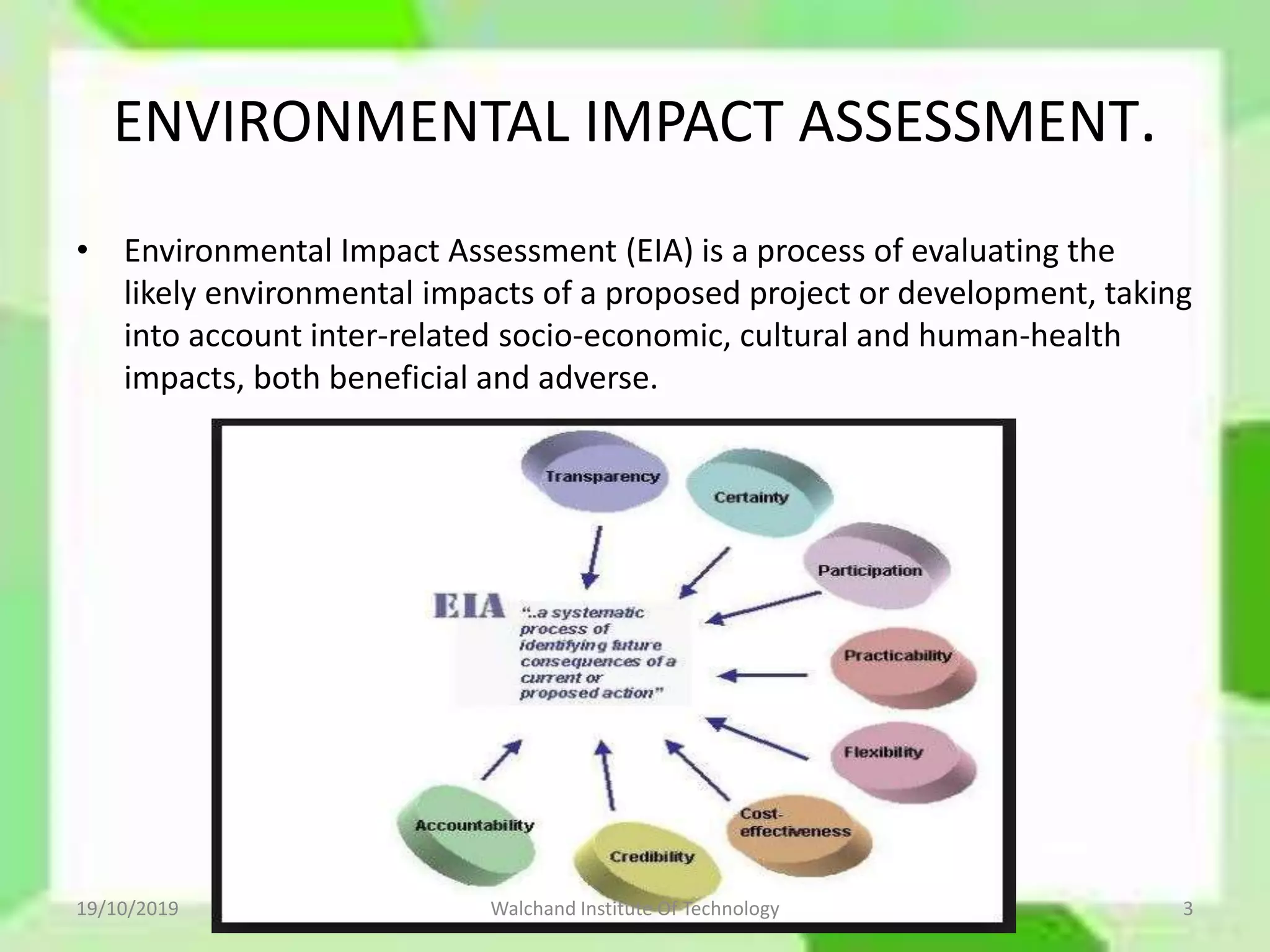
• Environmental Impact Assessment (EIA) is a process of evaluating the
likely environmental impacts of a proposed project or development, taking
into account inter-related socio-economic, cultural and human-health
impacts, both beneficial and adverse.
19/10/2019 Walchand Institute Of Technology 3
EVOLUTION AND HISTORY OF EIA:-
• Environmental Impact Assessment started as a mandatory
regulatory procedure originated in the early 1970’s with the
implementation of the National Environmental Policy Act
(NEPA) 1969 in the US.
• The EIA process really took off after the mid-1980s. In 1989,
the World Bank adopted EIA for major development projects.
• Now, EIA is a formal process in more than 100 countries.
19/10/2019 Walchand Institute Of Technology 4
OBJECTIVES OF EIA:-
• To encourage productive and enjoyable harmony between man and his
environment.
• To improve environmental design of the proposal.
• To ensure that resources are used appropriately and efficiently.
• To safeguard valuable resources, natural areas and ecosystem
components.
• To LOOK before you LEAP!
19/10/2019 Walchand Institute Of Technology 5
Main steps in EIAs process:-
• Screening: First stage of EIA, which determines whether the
proposed project, requires an EIA and if it does, then the level
of assessment required.
• Scoping: This stage identifies the key issues and impacts that
should be further investigated. This stage also defines the
boundary and time limit of the study.
• Impact analysis: This stage of EIA identifies and predicts the
likely environmental and social impact of the proposed project
and evaluates the significance.
19/10/2019 Walchand Institute Of Technology 6
Main steps in EIAs proces
(contd…):-
• Reporting: This stage presents the result of EIA in a form of a
report to the decision-making body and other interested
parties.
• Review of EIA: It examines the adequacy and effectiveness of
the EIA report and provides the information necessary for
decision-making.
• Decision-making: It decides whether the project is rejected,
approved or needs further change.
• Post monitoring: This stage comes into play once the project
is commissioned. It checks to ensure that the impacts of the
project do not exceed the legal standards and implementation
of the mitigation measures are in the manner as described in
the EIA report.
19/10/2019 Walchand Institute Of Technology 7
IMPACT ANALYSIS
Air:
• Changes in the ambient level and the ground level concentrations due to emissions.
Noise:
• Changes in the ambient level due to noise generated from equipment and movement of
vehicles.
Water:
• Changes in the quality.
• Availabilty to competing users.
Land:
• Changes in the land use and drainage pattern.
• Changes in the land quality including effects of waste disposal.
Biological:
• Deforestation and shrinkage of animal habitat.
• Impact on flora and fauna due to pollutants.
Socio-Economic:
• Impact on economic status.
• Impact on human health.
19/10/2019 Walchand Institute Of Technology 8
19/10/2019 Walchand Institute Of Technology 9
EIA IN INDIA.
• The Ministry of Environment, Forests and Climate
Change (MoEFCC) of India has been in a great effort in
Environmental Impact Assessment in India.
• The main laws in action are:
 The Water Act(1974).
 The Indian Wildlife (Protection) Act (1972).
 The Air (Prevention and Control of Pollution) Act (1981).
 The Environment (Protection) Act (1986).
 Biological Diversity Act(2002).
19/10/2019 Walchand Institute Of Technology 10
CASE STUDY 1:- ACC CEMENT PLANT,
CHATTISGARH.
• This study scrutinizes the environmental impact due to
cement production process in ACC cement plant of
Chhattisgarh state, India.
• The plant production adopted the dry processes which
include simply of raw materials, clinker burning and grinding
process from which dust is emitted due to the kiln feed,
crushers, grinding clinker cookers and material handling
equipments.
• Table 1 shows various activities of crusher unit, aspects and
associated impacts.
19/10/2019 Walchand Institute Of Technology 11
19/10/2019 Walchand Institute Of Technology 12
CONCLUSION:- ACC CEMENT PLANT
PROJECT
• Fugitive dust emission, stack emission and noise have been
identified as significant aspects during activities like receipt of
limestone, primary crushing, screening.
• These significant aspects are imparting very much impact on
the human health like respiratory disorderness, hearing
impairment, etc.
• Thus there arises a need for developing a strategy for
reducing the impacts and this require more attention to be
emphasized on the aspects.
19/10/2019 Walchand Institute Of Technology 13
CASE STUDY 2:- LAVASA CITY.
19/10/2019 Walchand Institute Of Technology 14
19/10/2019 Walchand Institute Of Technology 15
PHOTOGRAPHS OF LAVSA CITY
PROJECT.
• Lavasa is an independent India’s first planned hill city
located 65 km from Pune in the Mose Valley and the
backwaters of the calm Warasgaon dam area.
• Ministry of Environment and Forests found Lavasa to be
violating the rules and regulations under the
Environment protection act 1986. According to MOEF,
LCL (Lavasa Corporation Ltd) is in violation of
 The EIA Notification, 1994;
 The EIA Notification, as amended in 2004; and
 The EIA Notification of 2006.
19/10/2019 Walchand Institute Of Technology 16
ENVIRONMENTAL IMPACT ASSESSMENT:-
LAVASA CITY.
OBSERVATIONS- LAVASA CITY PROJECT.
• Land belongs to Adivasi (Tribal) Land which can’t be sold
or bought without the permission of the District
administration . Hence land has been acquires either by
cheating or using muscule power.
• The back water of the dams were filled with stone
crushing material and also that the villagers expressed
that the project has adversely impacted their life and
they are not willing to part with their land for any of the
project activities.
19/10/2019 Walchand Institute Of Technology 17
CONCLUSION:- LAVASA CITY PROJECT.
• The committee has recorded that Lavasa has caused
massive destruction of the ecology of the area, especially
causing grave damages to hills, flora-fauna, water body,
etc.
• With all the above observations carried out by the
government constituted committee, the green signal to
Phase-I of Lavasa by the Union Ministry of Environment
and Forests (MoEF) given on the November 9th , 2011
was widely condemned by many intellectual groups and
was declared as a blot on the democratic process.
19/10/2019 Walchand Institute Of Technology 18
CHALLENGES IN INDIA.
 It is being found that the team formed for conducting EIA
studies is lacking the expertise in various fields such as
anthropologists and social activists or even wild life experts.
 There is a lack of exhaustive ecological and socio-economic
indicators for impact assessment.
 Public comments are not taken into account at the early
stage, which often leads to conflict at the later stage of
project clearance.
 There is always a lack of reliable data sources.
 Details regarding the effectiveness and implementation of
mitigation measures are often not provided.
19/10/2019 Walchand Institute Of Technology 19
BENEFITS OF EIA.
• Lower project costs in the long-term.
• EIA Identifies feasible alternatives.
• EIA enables the decision makers to analyse the effect of
developmental activities on the environment well before the
developmental project is implemented.
• EIA encourages the adaptation of mitigation strategies in the
developmental plan.
• Predicts significant adverse impacts.
19/10/2019 Walchand Institute Of Technology 20
CONCLUSION.
• Environment Impact Assessment is a very beneficial step to
check, whether the project is environment friendly or not.
• Despite these small setbacks, environmental impact
assessment has become an integral part of project planning
one, which is continually being improved for posterity.
• Since economic development is result of interaction between
natural resources and technology designed for people, so all
human activity should be economic, social and environment
friendly.
19/10/2019 Walchand Institute Of Technology 21
THANK YOU.
19/10/2019 Walchand Institute Of Technology 22
“I don’t want to protect
environment. I want to
create a world where the
environment doesn’t need
protection.”
REFERENCES:-
• https://www.ukessays.com/essays/environmental-
sciences/lavasa-a-case-study-synopsis-environmental-
sciences-essay.php
• JOURNAL OF ENVIRONMENTAL RESEARCH AND
DEVELOPMENT VOL.7 No.2
• https://en.wikipedia.org/wiki/Environmental_impact_assess
ment
• AN INDIA CASE STUDY ON COMPREHENSIVE ERA OF THERMAL
POWER PLANT.
• CENTRE FOR SCIENCE AND EVNIRONMENT:
https://www.cseindia.org/understanding-eia-383
19/10/2019 Walchand Institute Of Technology 23

ENVIRONMENTAL IMPACT ASSESSMENT (EIA) .

  • 1.
    SEMINAR 2019-2020 TOPIC –ENVIRONMENTAL IMPACT ASSESSMENT. Submitted by: Onkar Ashok Solshe (BE CIVIL) Walchand Institute Of Technology, Solapur. 19/10/2019 Walchand Institute Of Technology 1
  • 2.
    CONTENT Introduction. History & Evolution. Objectives. Process. EnvironmentalImpact Assessment (EIA) in India. Case study-1. Case study-2. Benefits. Challenges. Conclusion. 19/10/2019 Walchand Institute Of Technology 2
  • 3.
    ENVIRONMENTAL IMPACT ASSESSMENT. •Environmental Impact Assessment (EIA) is a process of evaluating the likely environmental impacts of a proposed project or development, taking into account inter-related socio-economic, cultural and human-health impacts, both beneficial and adverse. 19/10/2019 Walchand Institute Of Technology 3
  • 4.
    EVOLUTION AND HISTORYOF EIA:- • Environmental Impact Assessment started as a mandatory regulatory procedure originated in the early 1970’s with the implementation of the National Environmental Policy Act (NEPA) 1969 in the US. • The EIA process really took off after the mid-1980s. In 1989, the World Bank adopted EIA for major development projects. • Now, EIA is a formal process in more than 100 countries. 19/10/2019 Walchand Institute Of Technology 4
  • 5.
    OBJECTIVES OF EIA:- •To encourage productive and enjoyable harmony between man and his environment. • To improve environmental design of the proposal. • To ensure that resources are used appropriately and efficiently. • To safeguard valuable resources, natural areas and ecosystem components. • To LOOK before you LEAP! 19/10/2019 Walchand Institute Of Technology 5
  • 6.
    Main steps inEIAs process:- • Screening: First stage of EIA, which determines whether the proposed project, requires an EIA and if it does, then the level of assessment required. • Scoping: This stage identifies the key issues and impacts that should be further investigated. This stage also defines the boundary and time limit of the study. • Impact analysis: This stage of EIA identifies and predicts the likely environmental and social impact of the proposed project and evaluates the significance. 19/10/2019 Walchand Institute Of Technology 6
  • 7.
    Main steps inEIAs proces (contd…):- • Reporting: This stage presents the result of EIA in a form of a report to the decision-making body and other interested parties. • Review of EIA: It examines the adequacy and effectiveness of the EIA report and provides the information necessary for decision-making. • Decision-making: It decides whether the project is rejected, approved or needs further change. • Post monitoring: This stage comes into play once the project is commissioned. It checks to ensure that the impacts of the project do not exceed the legal standards and implementation of the mitigation measures are in the manner as described in the EIA report. 19/10/2019 Walchand Institute Of Technology 7
  • 8.
    IMPACT ANALYSIS Air: • Changesin the ambient level and the ground level concentrations due to emissions. Noise: • Changes in the ambient level due to noise generated from equipment and movement of vehicles. Water: • Changes in the quality. • Availabilty to competing users. Land: • Changes in the land use and drainage pattern. • Changes in the land quality including effects of waste disposal. Biological: • Deforestation and shrinkage of animal habitat. • Impact on flora and fauna due to pollutants. Socio-Economic: • Impact on economic status. • Impact on human health. 19/10/2019 Walchand Institute Of Technology 8
  • 9.
  • 10.
    EIA IN INDIA. •The Ministry of Environment, Forests and Climate Change (MoEFCC) of India has been in a great effort in Environmental Impact Assessment in India. • The main laws in action are:  The Water Act(1974).  The Indian Wildlife (Protection) Act (1972).  The Air (Prevention and Control of Pollution) Act (1981).  The Environment (Protection) Act (1986).  Biological Diversity Act(2002). 19/10/2019 Walchand Institute Of Technology 10
  • 11.
    CASE STUDY 1:-ACC CEMENT PLANT, CHATTISGARH. • This study scrutinizes the environmental impact due to cement production process in ACC cement plant of Chhattisgarh state, India. • The plant production adopted the dry processes which include simply of raw materials, clinker burning and grinding process from which dust is emitted due to the kiln feed, crushers, grinding clinker cookers and material handling equipments. • Table 1 shows various activities of crusher unit, aspects and associated impacts. 19/10/2019 Walchand Institute Of Technology 11
  • 12.
  • 13.
    CONCLUSION:- ACC CEMENTPLANT PROJECT • Fugitive dust emission, stack emission and noise have been identified as significant aspects during activities like receipt of limestone, primary crushing, screening. • These significant aspects are imparting very much impact on the human health like respiratory disorderness, hearing impairment, etc. • Thus there arises a need for developing a strategy for reducing the impacts and this require more attention to be emphasized on the aspects. 19/10/2019 Walchand Institute Of Technology 13
  • 14.
    CASE STUDY 2:-LAVASA CITY. 19/10/2019 Walchand Institute Of Technology 14
  • 15.
    19/10/2019 Walchand InstituteOf Technology 15 PHOTOGRAPHS OF LAVSA CITY PROJECT.
  • 16.
    • Lavasa isan independent India’s first planned hill city located 65 km from Pune in the Mose Valley and the backwaters of the calm Warasgaon dam area. • Ministry of Environment and Forests found Lavasa to be violating the rules and regulations under the Environment protection act 1986. According to MOEF, LCL (Lavasa Corporation Ltd) is in violation of  The EIA Notification, 1994;  The EIA Notification, as amended in 2004; and  The EIA Notification of 2006. 19/10/2019 Walchand Institute Of Technology 16 ENVIRONMENTAL IMPACT ASSESSMENT:- LAVASA CITY.
  • 17.
    OBSERVATIONS- LAVASA CITYPROJECT. • Land belongs to Adivasi (Tribal) Land which can’t be sold or bought without the permission of the District administration . Hence land has been acquires either by cheating or using muscule power. • The back water of the dams were filled with stone crushing material and also that the villagers expressed that the project has adversely impacted their life and they are not willing to part with their land for any of the project activities. 19/10/2019 Walchand Institute Of Technology 17
  • 18.
    CONCLUSION:- LAVASA CITYPROJECT. • The committee has recorded that Lavasa has caused massive destruction of the ecology of the area, especially causing grave damages to hills, flora-fauna, water body, etc. • With all the above observations carried out by the government constituted committee, the green signal to Phase-I of Lavasa by the Union Ministry of Environment and Forests (MoEF) given on the November 9th , 2011 was widely condemned by many intellectual groups and was declared as a blot on the democratic process. 19/10/2019 Walchand Institute Of Technology 18
  • 19.
    CHALLENGES IN INDIA. It is being found that the team formed for conducting EIA studies is lacking the expertise in various fields such as anthropologists and social activists or even wild life experts.  There is a lack of exhaustive ecological and socio-economic indicators for impact assessment.  Public comments are not taken into account at the early stage, which often leads to conflict at the later stage of project clearance.  There is always a lack of reliable data sources.  Details regarding the effectiveness and implementation of mitigation measures are often not provided. 19/10/2019 Walchand Institute Of Technology 19
  • 20.
    BENEFITS OF EIA. •Lower project costs in the long-term. • EIA Identifies feasible alternatives. • EIA enables the decision makers to analyse the effect of developmental activities on the environment well before the developmental project is implemented. • EIA encourages the adaptation of mitigation strategies in the developmental plan. • Predicts significant adverse impacts. 19/10/2019 Walchand Institute Of Technology 20
  • 21.
    CONCLUSION. • Environment ImpactAssessment is a very beneficial step to check, whether the project is environment friendly or not. • Despite these small setbacks, environmental impact assessment has become an integral part of project planning one, which is continually being improved for posterity. • Since economic development is result of interaction between natural resources and technology designed for people, so all human activity should be economic, social and environment friendly. 19/10/2019 Walchand Institute Of Technology 21
  • 22.
    THANK YOU. 19/10/2019 WalchandInstitute Of Technology 22 “I don’t want to protect environment. I want to create a world where the environment doesn’t need protection.”
  • 23.
    REFERENCES:- • https://www.ukessays.com/essays/environmental- sciences/lavasa-a-case-study-synopsis-environmental- sciences-essay.php • JOURNALOF ENVIRONMENTAL RESEARCH AND DEVELOPMENT VOL.7 No.2 • https://en.wikipedia.org/wiki/Environmental_impact_assess ment • AN INDIA CASE STUDY ON COMPREHENSIVE ERA OF THERMAL POWER PLANT. • CENTRE FOR SCIENCE AND EVNIRONMENT: https://www.cseindia.org/understanding-eia-383 19/10/2019 Walchand Institute Of Technology 23