ENVIRONMENTAL IMPACT ASSESSMENT
1
CONTENTS
• INTRODUCTION
• EIA DIRECTIVE
• HISTORY OF EIA
• AIMS OF EIA
• PROJECTS UNDERGOING EIA
• PROCESS OF EIA
→SCREENING
→INITIAL ENVIRONMENT EXAMINATION
→SCOPING
→EIA OVERVIEW
→DECISION MAKING
→MONITORING AND AUDIT EVALUATION
• USES OF EIA
• CONCLUSION
• REFERENCE
INTRODUCTION
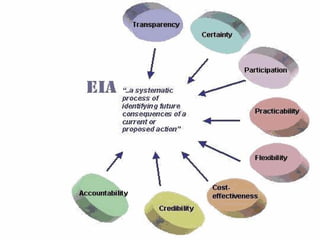
Environmental Impact Assessment (EIA) is a process which
ensures that all environmental matters are taken into account
quite early in the project at planning process itself.
It takes into consideration not only technical and economic
considerations but also, traditional aspects like impact on
local people, biodiversity etc.
EIA is intended to prevent or minimize potentially
adverse environmental impacts and enhance the
overall quality of a project. The main benefits
and advantages of EIA are:
Lower project costs in the long-term
Increased project acceptance
Improved project design
WHY EIA?
The EIA Directive requires projects likely to
have significant effects on the Environment
by virtue of their nature, size or location to
undergo an environmental assessment before
the competent authority in question grants
consent.
The EIA Directive defines a project as the
execution of construction works or of other
installations or schemes,
other interventions in the natural
surroundings and landscape including those
involving the extraction of mineral resources.
THE EIA DIRECTIVE
The EIA should identify, describe and assess
the direct and indirect effects of a project on
the following factors:
Human beings
Fauna and flora
Soil, Water & Air
Climate and the landscape
Material Assets
Cultural Heritage
Interaction between all above factors
EIA therefore should have a very strong social
dimension
Started in 1976-77, when Planning Commission asked
Department of Science & Technology to examine River
Valley Projects from environmental angle
Till 1994, Environmental Clearance from Central
Government was an administrative decision which lacked
legislative support.
On 27th
January 1994, Union Ministry of Environment &
Forests, GOI under Environment (Protection) Act 1986,
promulgated EIA notification making Environment
clearance mandatory for expansion or modernization of
any activity or for setting up new projects listed in
Schedule one of the notification, which have been
amended more than 12 times.
HISTORY OF EIA IN INDIA
9
PROJECTS UNDERGOING EIA
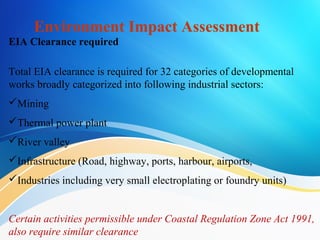
Environment Impact Assessment
EIA Clearance required
Total EIA clearance is required for 32 categories of developmental
works broadly categorized into following industrial sectors:
Mining
Thermal power plant
River valley
Infrastructure (Road, highway, ports, harbour, airports,
Industries including very small electroplating or foundry units)
Certain activities permissible under Coastal Regulation Zone Act 1991,
also require similar clearance
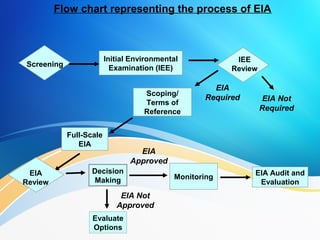
Flow chart representing the process of EIA
Screening
Initial Environmental
Examination (IEE)
EIA Not
Required
EIA
Required
Monitoring
EIA Audit and
Evaluation
IEE
Review
Scoping/
Terms of
Reference
Full-Scale
EIA
Evaluate
Options
EIA Not
Approved
EIA
Review
Decision
Making
EIA
Approved
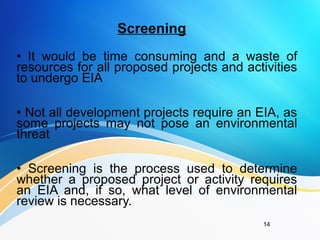
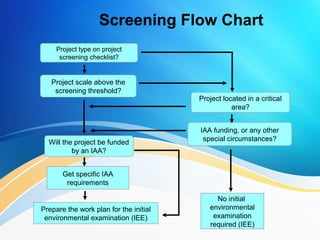
Screening
• It would be time consuming and a waste of
resources for all proposed projects and activities
to undergo EIA
• Not all development projects require an EIA, as
some projects may not pose an environmental
threat
• Screening is the process used to determine
whether a proposed project or activity requires
an EIA and, if so, what level of environmental
review is necessary.
14
Prepare the work plan for the initial
environmental examination (IEE)
Project type on project
screening checklist?
Get specific IAA
requirements
Project scale above the
screening threshold?
Project located in a critical
area?
IAA funding, or any other
special circumstances?
NO
No initial
environmental
examination
required (IEE)
Screening Flow Chart
Will the project be funded
by an IAA?
Initial Environment ExaminationEnvironment Examination
 Initial environmental examination (IEE) is
intended as a low-cost environmental evaluation
that makes use of information already available.
It boost up the process of EIA and lead the
matter to further assistance.
IEE in the Overall EIA Process
Project
Screening
Identifies projects that
typically contain potential
significant issues
Initial Environmental Examination
1. Identifies potential significant
environmental issues associated
with a project
2. Grades effects and identifies actual
Significant Environmental Issues
(SEIs)
3. Resolves simple SEIs
4. Recommends further action for
resolving outstanding SEIs
Full-Scale EIA or Other
Additional Study
Resolves any remaining
significant environmental issues
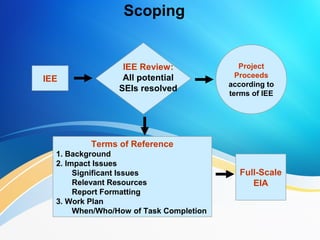
Scoping
 A process of interaction between government
agencies and project proponents
 Identifies:
– spatial and temporal boundaries for the EIA
– important issues and concern
– information necessary for decision making
– significant effects and factors to be considered
– Establishes terms for reference of full scale
EIA
Scoping
IEE
Project
Proceeds
according to
terms of IEE
Terms of Reference
1. Background
2. Impact Issues
Significant Issues
Relevant Resources
Report Formatting
3. Work Plan
When/Who/How of Task Completion
Full-Scale
EIA
IEE Review:
All potential
SEIs resolved
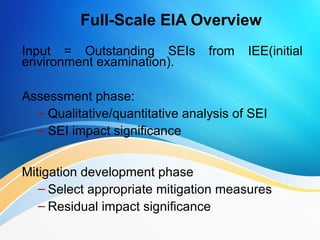
Full-Scale EIA Overview
Input = Outstanding SEIs from IEE(initial
environment examination).
Assessment phase:
– Qualitative/quantitative analysis of SEI
– SEI impact significance
Mitigation development phase:
– Select appropriate mitigation measures
– Residual impact significance
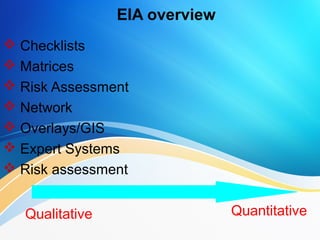
EIA overview
Qualitative Quantitative
 Checklists
 Matrices
 Risk Assessment
 Network
 Overlays/GIS
 Expert Systems
 Risk assessment
Decision Making
• The challenge of making the final decision on
implementing a project is observed.
• Decision are taken at all stages during the EIA
process and the outcome will be based on these
decisions.
• If a large scale project falls under the jurisdiction
of countries with comparable national EIA
procedures,it should be feasible to be more
ambitious in organising EIA Transboundary..
Monitoring
 In legislation there is a often demand for
environmental reporting when treating
permits to activities with large EIA.
 This stage involves improvement and
mitigational measures to put forward EIA.
 It also involves elements of assessing
risks and hazard management.
Audit and Evaluation
• This is the final stage of EIA.
• Audit consists opinions and corrections of
the report which are submitted in front of
decision making committee.
• It also reveals that whether EIA is
necessary or not for the report submitted,if
necessary what are the measures taken in
order to overcome the drawbacks and
hazards..
Uses of EIA
 Systematic evaluation of a eco friendly
project.
 Risk and hazard assessment.
 Impact identification.
 Monitoring of impact and advice.
 Development control
 Project development
 SEA(strategic environmental
assessment) and permit.
CONCLUSION
 EIA is an important tool in assuring that
projects and plans will not give adverse
impact on the environment.
 The use of EIA has developed
throughout the world and may different
applications exists.
 EIA process thus could not only prevent
costs due to environmental aspects but also
prevent possible public opinions and protest
against a project.
Reference
• Arya,D.S:1991,Trends of urbanisation and
its impact on environment.
•Arya,D.S.and Abbasi,S.A:1992 A new
software package as aid in Environmental
Management proceedings of ENVIPRO-
92.
27
T H A N K Y O U

environmental impact assessment

  • 1.
  • 2.
    CONTENTS • INTRODUCTION • EIADIRECTIVE • HISTORY OF EIA • AIMS OF EIA • PROJECTS UNDERGOING EIA • PROCESS OF EIA →SCREENING →INITIAL ENVIRONMENT EXAMINATION →SCOPING →EIA OVERVIEW →DECISION MAKING →MONITORING AND AUDIT EVALUATION • USES OF EIA • CONCLUSION • REFERENCE
  • 3.
    INTRODUCTION Environmental Impact Assessment(EIA) is a process which ensures that all environmental matters are taken into account quite early in the project at planning process itself. It takes into consideration not only technical and economic considerations but also, traditional aspects like impact on local people, biodiversity etc.
  • 5.
    EIA is intendedto prevent or minimize potentially adverse environmental impacts and enhance the overall quality of a project. The main benefits and advantages of EIA are: Lower project costs in the long-term Increased project acceptance Improved project design WHY EIA?
  • 6.
    The EIA Directiverequires projects likely to have significant effects on the Environment by virtue of their nature, size or location to undergo an environmental assessment before the competent authority in question grants consent. The EIA Directive defines a project as the execution of construction works or of other installations or schemes, other interventions in the natural surroundings and landscape including those involving the extraction of mineral resources. THE EIA DIRECTIVE
  • 7.
    The EIA shouldidentify, describe and assess the direct and indirect effects of a project on the following factors: Human beings Fauna and flora Soil, Water & Air Climate and the landscape Material Assets Cultural Heritage Interaction between all above factors EIA therefore should have a very strong social dimension
  • 8.
    Started in 1976-77,when Planning Commission asked Department of Science & Technology to examine River Valley Projects from environmental angle Till 1994, Environmental Clearance from Central Government was an administrative decision which lacked legislative support. On 27th January 1994, Union Ministry of Environment & Forests, GOI under Environment (Protection) Act 1986, promulgated EIA notification making Environment clearance mandatory for expansion or modernization of any activity or for setting up new projects listed in Schedule one of the notification, which have been amended more than 12 times. HISTORY OF EIA IN INDIA
  • 9.
  • 10.
  • 12.
    Environment Impact Assessment EIAClearance required Total EIA clearance is required for 32 categories of developmental works broadly categorized into following industrial sectors: Mining Thermal power plant River valley Infrastructure (Road, highway, ports, harbour, airports, Industries including very small electroplating or foundry units) Certain activities permissible under Coastal Regulation Zone Act 1991, also require similar clearance
  • 13.
    Flow chart representingthe process of EIA Screening Initial Environmental Examination (IEE) EIA Not Required EIA Required Monitoring EIA Audit and Evaluation IEE Review Scoping/ Terms of Reference Full-Scale EIA Evaluate Options EIA Not Approved EIA Review Decision Making EIA Approved
  • 14.
    Screening • It wouldbe time consuming and a waste of resources for all proposed projects and activities to undergo EIA • Not all development projects require an EIA, as some projects may not pose an environmental threat • Screening is the process used to determine whether a proposed project or activity requires an EIA and, if so, what level of environmental review is necessary. 14
  • 15.
    Prepare the workplan for the initial environmental examination (IEE) Project type on project screening checklist? Get specific IAA requirements Project scale above the screening threshold? Project located in a critical area? IAA funding, or any other special circumstances? NO No initial environmental examination required (IEE) Screening Flow Chart Will the project be funded by an IAA?
  • 16.
    Initial Environment ExaminationEnvironmentExamination  Initial environmental examination (IEE) is intended as a low-cost environmental evaluation that makes use of information already available. It boost up the process of EIA and lead the matter to further assistance.
  • 17.
    IEE in theOverall EIA Process Project Screening Identifies projects that typically contain potential significant issues Initial Environmental Examination 1. Identifies potential significant environmental issues associated with a project 2. Grades effects and identifies actual Significant Environmental Issues (SEIs) 3. Resolves simple SEIs 4. Recommends further action for resolving outstanding SEIs Full-Scale EIA or Other Additional Study Resolves any remaining significant environmental issues
  • 18.
    Scoping  A processof interaction between government agencies and project proponents  Identifies: – spatial and temporal boundaries for the EIA – important issues and concern – information necessary for decision making – significant effects and factors to be considered – Establishes terms for reference of full scale EIA
  • 19.
    Scoping IEE Project Proceeds according to terms ofIEE Terms of Reference 1. Background 2. Impact Issues Significant Issues Relevant Resources Report Formatting 3. Work Plan When/Who/How of Task Completion Full-Scale EIA IEE Review: All potential SEIs resolved
  • 20.
    Full-Scale EIA Overview Input= Outstanding SEIs from IEE(initial environment examination). Assessment phase: – Qualitative/quantitative analysis of SEI – SEI impact significance Mitigation development phase: – Select appropriate mitigation measures – Residual impact significance
  • 21.
    EIA overview Qualitative Quantitative Checklists  Matrices  Risk Assessment  Network  Overlays/GIS  Expert Systems  Risk assessment
  • 22.
    Decision Making • Thechallenge of making the final decision on implementing a project is observed. • Decision are taken at all stages during the EIA process and the outcome will be based on these decisions. • If a large scale project falls under the jurisdiction of countries with comparable national EIA procedures,it should be feasible to be more ambitious in organising EIA Transboundary..
  • 23.
    Monitoring  In legislationthere is a often demand for environmental reporting when treating permits to activities with large EIA.  This stage involves improvement and mitigational measures to put forward EIA.  It also involves elements of assessing risks and hazard management.
  • 24.
    Audit and Evaluation •This is the final stage of EIA. • Audit consists opinions and corrections of the report which are submitted in front of decision making committee. • It also reveals that whether EIA is necessary or not for the report submitted,if necessary what are the measures taken in order to overcome the drawbacks and hazards..
  • 25.
    Uses of EIA Systematic evaluation of a eco friendly project.  Risk and hazard assessment.  Impact identification.  Monitoring of impact and advice.  Development control  Project development  SEA(strategic environmental assessment) and permit.
  • 26.
    CONCLUSION  EIA isan important tool in assuring that projects and plans will not give adverse impact on the environment.  The use of EIA has developed throughout the world and may different applications exists.  EIA process thus could not only prevent costs due to environmental aspects but also prevent possible public opinions and protest against a project.
  • 27.
    Reference • Arya,D.S:1991,Trends ofurbanisation and its impact on environment. •Arya,D.S.and Abbasi,S.A:1992 A new software package as aid in Environmental Management proceedings of ENVIPRO- 92. 27
  • 28.
    T H AN K Y O U

Editor's Notes

  • #18 SLIDE 2 NOTES FLOW CHART LINKING THE FUNCTIONS OF PROJECT SCREENING INITIAL ENVIRONMENTAL EXAMINATION AND ENVIRONMENTAL IMPACT ASSESSMENT 1. OVERVIEW This slide shows the functional linkage between these three steps in the Environmental Impact Assessment process. 2. PROJECT SCREENING Project screening identifies the projects that typically contain potential Significant Environmental Issues. The projects are identified, or selected, using screening criteria based on project type, size, and location. Projects that are selected must pass through an Initial Environmental Examination (IEE) so that Significant Environmental Issues (SEIs) may be identified, and when possible, resolved. 3. INITIAL ENVIRONMENTAL EXAMINATION The IEE performs four important functions. 1) It identifies the potential SEIs associated with a project. These potential SEIs are effects on environmental resources that may result from various components of a project. They may be related to the design, the construction, or the operation phase of the project. 2) It determines the actual environmental issues for the specific project and grades them according to their significance and whether or not they may be resolved within the scope of the IEE. 3) The SEIs that are simple enough to be resolved within the scope of the IEE are pursued. Environmental protection measures and an environmental management plan are developed. Projects for which all issues have been resolved in the IEE use the IEE in place of an EIA. 4) For SEIs that cannot be resolved within the scope of the IEE, recommendations are made for the work required for resolution. 4. THE EIA The EIA is used to resolve complex environmental issues. The IEE is very important for the EIA because it focuses the tasks to be performed in the study on specific complex issues, and develops the background on these issues. The EIA is a much more efficient study when it can draw on the work of the IEE.
  • #20 SLIDE 1.1 NOTES FLOW CHART OF TERMS OF REFERENCE, INITIAL ENVIRONMENTAL EXAMINATION, AND FULL-SCALE EIA 1. OVERVIEW This slide shows the inter-relation between the Initial Environmental Examination, the Terms of Reference, and the Environmental Impact Assessment. Through this process, the significant environmental issues which remain unresolved in the IEE are linked to the study area resources which may be impacted. The research and analysis of resource impacts are the tasks to be performed in the EIA. THE TOR: 1) Delineates the study area; 2) Lists the significant issues and the related resources to be investigated and describes how the findings will be presented; 3) Details a work plan for the EIA so that the process will run smoothly, on time and within budget.