By
K. Vigneshwar
1
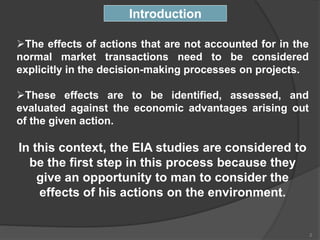
The effects of actions that are not accounted for in the
normal market transactions need to be considered
explicitly in the decision-making processes on projects.
These effects are to be identified, assessed, and
evaluated against the economic advantages arising out
of the given action.
In this context, the EIA studies are considered to
be the first step in this process because they
give an opportunity to man to consider the
effects of his actions on the environment.
Introduction
2
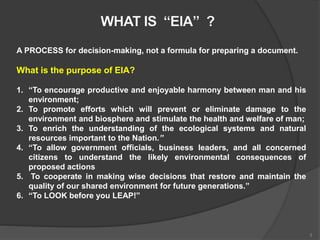
A PROCESS for decision-making, not a formula for preparing a document.
What is the purpose of EIA?
1. “To encourage productive and enjoyable harmony between man and his
environment;
2. To promote efforts which will prevent or eliminate damage to the
environment and biosphere and stimulate the health and welfare of man;
3. To enrich the understanding of the ecological systems and natural
resources important to the Nation.”
4. “To allow government officials, business leaders, and all concerned
citizens to understand the likely environmental consequences of
proposed actions
5. To cooperate in making wise decisions that restore and maintain the
quality of our shared environment for future generations.”
6. “To LOOK before you LEAP!”
3
EIA was made mandatory in 1994 under the
environmental protection Act of 1986 with the
following four objectives:
 Predict environmental impact of projects;
 Find ways and means to reduce adverse impacts;
 Shape the projects to suit local environment;
 Present the predictions and options to the decision-
makers.
4
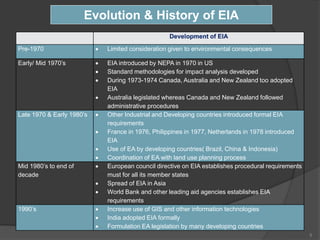
Evolution & History of EIA
Development of EIA
Pre-1970  Limited consideration given to environmental consequences
Early/ Mid 1970’s  EIA introduced by NEPA in 1970 in US
 Standard methodologies for impact analysis developed
 During 1973-1974 Canada, Australia and New Zealand too adopted
EIA
 Australia legislated whereas Canada and New Zealand followed
administrative procedures
Late 1970 & Early 1980’s  Other Industrial and Developing countries introduced formal EIA
requirements
 France in 1976, Philippines in 1977, Netherlands in 1978 introduced
EIA
 Use of EA by developing countries( Brazil, China & Indonesia)
 Coordination of EA with land use planning process
Mid 1980’s to end of
decade
 European council directive on EIA establishes procedural requirements
must for all its member states
 Spread of EIA in Asia
 World Bank and other leading aid agencies establishes EIA
requirements
1990’s  Increase use of GIS and other information technologies
 India adopted EIA formally
 Formulation EA legislation by many developing countries
5
 Project Proponent
 Environment Consultant
 State Pollution Control Board/Pollution
Control Committee
 Public Law
 Impact Assessment Agency
6
1. Human health and safety
2. Flora, fauna, ecosystems and
biodiversity
3. Soil, water, air, climate and
landscape
4. Use of land, natural resources
and raw materials
5. Protected areas and sites of
special significance
6. Heritage, recreation and amenity
assets
7. Livelihood, lifestyle and well
being of affected communities
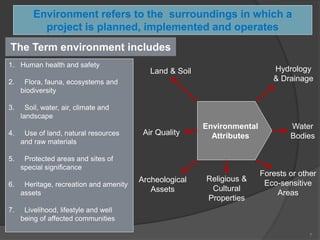
Environment refers to the surroundings in which a
project is planned, implemented and operates
The Term environment includes
Environmental
Attributes
Land & Soil
Archeological
Assets
Religious &
Cultural
Properties
Forests or other
Eco-sensitive
Areas
Water
Bodies
Hydrology
& Drainage
Air Quality
7
1. Start with a COOPERATIVE attitude: your goal is to HELP the persons
responsible to use the EIA process to benefit BOTH environment and
development.
2. LEARN as much as possible about the proposal before forming your
opinions; IDENTIFY the responsible persons and agencies; ASK them for all
available information so that you are well-informed.
3. IDENTIFY yourself and your organization; tell officials that you want to
participate in the EIA process as soon as it begins—also tell them WHY you
want to participate and HOW you can contribute to making the process
USEFUL for them.
4. Be polite, but also be persistent—the new EIA law gives you both the RIGHT
and the RESPONSIBILITY to be a participant.
5. Do not claim to be an expert on complex issues if you are not—try to
CONSULT OTHERS who have special knowledge and skills.
6. Whenever you raise an environmental PROBLEM, offer a possible
SOLUTION —an alternative strategy, or location, or design, etc.
7. Provide officials with specific COMMENTS and RECOMMENDATIONS from
your NGO in writing, as EARLY in the decision process as possible.
8. STAY INVOLVED in the process, even if your position and your
recommendations are not initially accepted. Continue to make your
concerns known to all in a RESPECTFUL but PERSUASIVE manner.
8
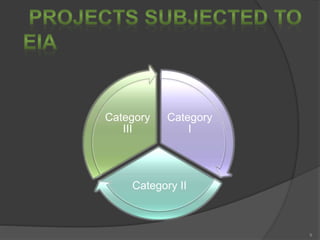
Category
I
Category II
Category
III
9
 Projects where EIA is mandatory and requires
clearance from Central government.
 As of now, EIA clearance is required for 30 categories
of industries from the central government which can be
broadly categorized under sectors of-
 Industries,
 Mining,
 Thermal power plants,
 River valley, ports, harbors
and airports,
Communication,
Atomic energy,
Transport (rail, road,
highway),
Tourism (including
hotels, beach resorts)
10
 Projects where EIA is mandatory and requires
clearance from State Governments.
 Projects coming under this category are thermal power
plants namely;
 all capacity cogeneration plants,
 captive coal and gas/naphtha based power plants up to 250
MW,
 coal based power plants up to 250 MW using conventional
technologies,
 coal based plants up to 500 MW using fluidized bed
technology
 gas/naphtha based plants up to 500 MW require
environmental clearance from the state government.
11
 For these projects EIA is not necessary:
 Some of the projects that come under this category include-
 defense related road construction projects in border areas,
 production of bulk drugs based on genetically engineered
organisms
 Construction activities related to the projects of Department of
Atomic Energy
 laying of pipelines, conveying systems including transmission lines;
 Exploration and extraction of oil and natural gas is also permitted
between Low Tide Line (LTL) and High Tide Line (HTL) in areas,
which are not ecologically sensitive,
 pipeline projects;
 Facilities for receipt and storage of Liquefied Natural Gas (LNG) and
facilities for its re-gasification.
12
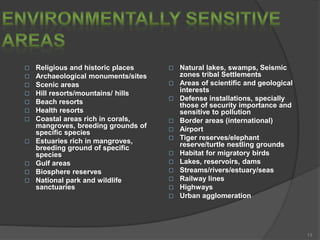
 Religious and historic places
 Archaeological monuments/sites
 Scenic areas
 Hill resorts/mountains/ hills
 Beach resorts
 Health resorts
 Coastal areas rich in corals,
mangroves, breeding grounds of
specific species
 Estuaries rich in mangroves,
breeding ground of specific
species
 Gulf areas
 Biosphere reserves
 National park and wildlife
sanctuaries
 Natural lakes, swamps, Seismic
zones tribal Settlements
 Areas of scientific and geological
interests
 Defense installations, specially
those of security importance and
sensitive to pollution
 Border areas (international)
 Airport
 Tiger reserves/elephant
reserve/turtle nestling grounds
 Habitat for migratory birds
 Lakes, reservoirs, dams
 Streams/rivers/estuary/seas
 Railway lines
 Highways
 Urban agglomeration
13
Physical components:
 Land
 Air
 Water
 Energy
Bio-Cultural components:
Nature
Culture
People
Access
14
List of projects requiring environmental clearance
1. Nuclear power and related projects such as heavy water plants, nuclear fuel complex, rare
earths.
2. River valley projects including hydro power, major irrigation and their combination
including flood control (even if investment is less than 100 cr but command area is
more than 10,000 ha).
3. Ports, harbours and airports (except minor ports and harbours).
4. Petroleum refineries including crude and product pipelines.
5. Chemical fertilizers (nitrogenous and phosphatic other than single super phosphate).
6. Pesticides (technical) and intermediates.
7. Petrochemical complexes (both Olefinic and Aromatic) and petro-chemical intermediates
such as DMT, Caprolactam, LAB, etc., and production of basic plastics such as LLDPE,
HDPE, PP, PVC.
8. Bulk drugs and pharmaceuticals and intermediates.
9. Exploration for oil and gas and their production, transportation and storage.
10. Synthetic rubber.
11. Asbestos and asbestos products.
12. Hydrocyanic acid and its derivatives.
13. (a) Primary metallurgical industries (such as production of Iron and Steel, Aluminum,
Copper, Zinc, Lead and Ferro Alloys), (b) Electric arc furnaces (Mini steel plants).
14. Chloral alkali industry.
15. Integrated paint complex including manufacture of resins and basic raw materials required
in the manufacture of paints.
16. Viscose staple fibred and filament yarn.
15
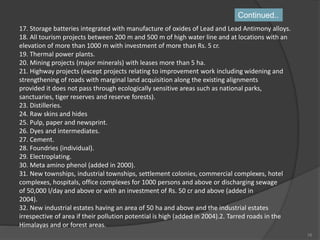
17. Storage batteries integrated with manufacture of oxides of Lead and Lead Antimony alloys.
18. All tourism projects between 200 m and 500 m of high water line and at locations with an
elevation of more than 1000 m with investment of more than Rs. 5 cr.
19. Thermal power plants.
20. Mining projects (major minerals) with leases more than 5 ha.
21. Highway projects (except projects relating to improvement work including widening and
strengthening of roads with marginal land acquisition along the existing alignments
provided it does not pass through ecologically sensitive areas such as national parks,
sanctuaries, tiger reserves and reserve forests).
23. Distilleries.
24. Raw skins and hides
25. Pulp, paper and newsprint.
26. Dyes and intermediates.
27. Cement.
28. Foundries (individual).
29. Electroplating.
30. Meta amino phenol (added in 2000).
31. New townships, industrial townships, settlement colonies, commercial complexes, hotel
complexes, hospitals, office complexes for 1000 persons and above or discharging sewage
of 50,000 l/day and above or with an investment of Rs. 50 cr and above (added in
2004).
32. New industrial estates having an area of 50 ha and above and the industrial estates
irrespective of area if their pollution potential is high (added in 2004).2. Tarred roads in the
Himalayas and or forest areas.
Continued..
16
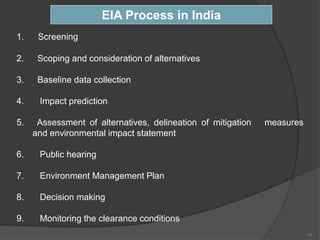
1. Screening
2. Scoping and consideration of alternatives
3. Baseline data collection
4. Impact prediction
5. Assessment of alternatives, delineation of mitigation measures
and environmental impact statement
6. Public hearing
7. Environment Management Plan
8. Decision making
9. Monitoring the clearance conditions
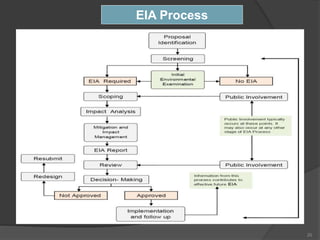
EIA Process in India
17
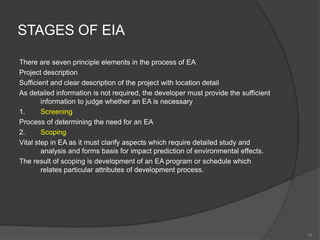
STAGES OF EIA
There are seven principle elements in the process of EA
Project description
Sufficient and clear description of the project with location detail
As detailed information is not required, the developer must provide the sufficient
information to judge whether an EA is necessary
1. Screening
Process of determining the need for an EA
2. Scoping
Vital step in EA as it must clarify aspects which require detailed study and
analysis and forms basis for impact prediction of environmental effects.
The result of scoping is development of an EA program or schedule which
relates particular attributes of development process.
18
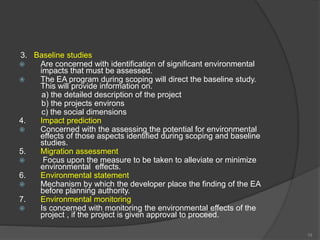
3. Baseline studies
 Are concerned with identification of significant environmental
impacts that must be assessed.
 The EA program during scoping will direct the baseline study.
This will provide information on.
a) the detailed description of the project
b) the projects environs
c) the social dimensions
4. Impact prediction
 Concerned with the assessing the potential for environmental
effects of those aspects identified during scoping and baseline
studies.
5. Migration assessment
 Focus upon the measure to be taken to alleviate or minimize
environmental effects.
6. Environmental statement
 Mechanism by which the developer place the finding of the EA
before planning authority.
7. Environmental monitoring
 Is concerned with monitoring the environmental effects of the
project , if the project is given approval to proceed.
19
EIA Process
20
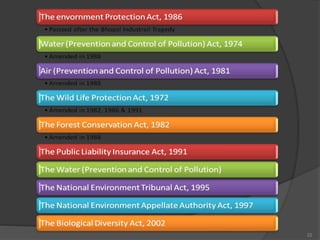
 Acts Related to Environment in India-
21
22
Thank you & Queries
23

EIA

  • 1.
  • 2.
    The effects ofactions that are not accounted for in the normal market transactions need to be considered explicitly in the decision-making processes on projects. These effects are to be identified, assessed, and evaluated against the economic advantages arising out of the given action. In this context, the EIA studies are considered to be the first step in this process because they give an opportunity to man to consider the effects of his actions on the environment. Introduction 2
  • 3.
    A PROCESS fordecision-making, not a formula for preparing a document. What is the purpose of EIA? 1. “To encourage productive and enjoyable harmony between man and his environment; 2. To promote efforts which will prevent or eliminate damage to the environment and biosphere and stimulate the health and welfare of man; 3. To enrich the understanding of the ecological systems and natural resources important to the Nation.” 4. “To allow government officials, business leaders, and all concerned citizens to understand the likely environmental consequences of proposed actions 5. To cooperate in making wise decisions that restore and maintain the quality of our shared environment for future generations.” 6. “To LOOK before you LEAP!” 3
  • 4.
    EIA was mademandatory in 1994 under the environmental protection Act of 1986 with the following four objectives:  Predict environmental impact of projects;  Find ways and means to reduce adverse impacts;  Shape the projects to suit local environment;  Present the predictions and options to the decision- makers. 4
  • 5.
    Evolution & Historyof EIA Development of EIA Pre-1970  Limited consideration given to environmental consequences Early/ Mid 1970’s  EIA introduced by NEPA in 1970 in US  Standard methodologies for impact analysis developed  During 1973-1974 Canada, Australia and New Zealand too adopted EIA  Australia legislated whereas Canada and New Zealand followed administrative procedures Late 1970 & Early 1980’s  Other Industrial and Developing countries introduced formal EIA requirements  France in 1976, Philippines in 1977, Netherlands in 1978 introduced EIA  Use of EA by developing countries( Brazil, China & Indonesia)  Coordination of EA with land use planning process Mid 1980’s to end of decade  European council directive on EIA establishes procedural requirements must for all its member states  Spread of EIA in Asia  World Bank and other leading aid agencies establishes EIA requirements 1990’s  Increase use of GIS and other information technologies  India adopted EIA formally  Formulation EA legislation by many developing countries 5
  • 6.
     Project Proponent Environment Consultant  State Pollution Control Board/Pollution Control Committee  Public Law  Impact Assessment Agency 6
  • 7.
    1. Human healthand safety 2. Flora, fauna, ecosystems and biodiversity 3. Soil, water, air, climate and landscape 4. Use of land, natural resources and raw materials 5. Protected areas and sites of special significance 6. Heritage, recreation and amenity assets 7. Livelihood, lifestyle and well being of affected communities Environment refers to the surroundings in which a project is planned, implemented and operates The Term environment includes Environmental Attributes Land & Soil Archeological Assets Religious & Cultural Properties Forests or other Eco-sensitive Areas Water Bodies Hydrology & Drainage Air Quality 7
  • 8.
    1. Start witha COOPERATIVE attitude: your goal is to HELP the persons responsible to use the EIA process to benefit BOTH environment and development. 2. LEARN as much as possible about the proposal before forming your opinions; IDENTIFY the responsible persons and agencies; ASK them for all available information so that you are well-informed. 3. IDENTIFY yourself and your organization; tell officials that you want to participate in the EIA process as soon as it begins—also tell them WHY you want to participate and HOW you can contribute to making the process USEFUL for them. 4. Be polite, but also be persistent—the new EIA law gives you both the RIGHT and the RESPONSIBILITY to be a participant. 5. Do not claim to be an expert on complex issues if you are not—try to CONSULT OTHERS who have special knowledge and skills. 6. Whenever you raise an environmental PROBLEM, offer a possible SOLUTION —an alternative strategy, or location, or design, etc. 7. Provide officials with specific COMMENTS and RECOMMENDATIONS from your NGO in writing, as EARLY in the decision process as possible. 8. STAY INVOLVED in the process, even if your position and your recommendations are not initially accepted. Continue to make your concerns known to all in a RESPECTFUL but PERSUASIVE manner. 8
  • 9.
  • 10.
     Projects whereEIA is mandatory and requires clearance from Central government.  As of now, EIA clearance is required for 30 categories of industries from the central government which can be broadly categorized under sectors of-  Industries,  Mining,  Thermal power plants,  River valley, ports, harbors and airports, Communication, Atomic energy, Transport (rail, road, highway), Tourism (including hotels, beach resorts) 10
  • 11.
     Projects whereEIA is mandatory and requires clearance from State Governments.  Projects coming under this category are thermal power plants namely;  all capacity cogeneration plants,  captive coal and gas/naphtha based power plants up to 250 MW,  coal based power plants up to 250 MW using conventional technologies,  coal based plants up to 500 MW using fluidized bed technology  gas/naphtha based plants up to 500 MW require environmental clearance from the state government. 11
  • 12.
     For theseprojects EIA is not necessary:  Some of the projects that come under this category include-  defense related road construction projects in border areas,  production of bulk drugs based on genetically engineered organisms  Construction activities related to the projects of Department of Atomic Energy  laying of pipelines, conveying systems including transmission lines;  Exploration and extraction of oil and natural gas is also permitted between Low Tide Line (LTL) and High Tide Line (HTL) in areas, which are not ecologically sensitive,  pipeline projects;  Facilities for receipt and storage of Liquefied Natural Gas (LNG) and facilities for its re-gasification. 12
  • 13.
     Religious andhistoric places  Archaeological monuments/sites  Scenic areas  Hill resorts/mountains/ hills  Beach resorts  Health resorts  Coastal areas rich in corals, mangroves, breeding grounds of specific species  Estuaries rich in mangroves, breeding ground of specific species  Gulf areas  Biosphere reserves  National park and wildlife sanctuaries  Natural lakes, swamps, Seismic zones tribal Settlements  Areas of scientific and geological interests  Defense installations, specially those of security importance and sensitive to pollution  Border areas (international)  Airport  Tiger reserves/elephant reserve/turtle nestling grounds  Habitat for migratory birds  Lakes, reservoirs, dams  Streams/rivers/estuary/seas  Railway lines  Highways  Urban agglomeration 13
  • 14.
    Physical components:  Land Air  Water  Energy Bio-Cultural components: Nature Culture People Access 14
  • 15.
    List of projectsrequiring environmental clearance 1. Nuclear power and related projects such as heavy water plants, nuclear fuel complex, rare earths. 2. River valley projects including hydro power, major irrigation and their combination including flood control (even if investment is less than 100 cr but command area is more than 10,000 ha). 3. Ports, harbours and airports (except minor ports and harbours). 4. Petroleum refineries including crude and product pipelines. 5. Chemical fertilizers (nitrogenous and phosphatic other than single super phosphate). 6. Pesticides (technical) and intermediates. 7. Petrochemical complexes (both Olefinic and Aromatic) and petro-chemical intermediates such as DMT, Caprolactam, LAB, etc., and production of basic plastics such as LLDPE, HDPE, PP, PVC. 8. Bulk drugs and pharmaceuticals and intermediates. 9. Exploration for oil and gas and their production, transportation and storage. 10. Synthetic rubber. 11. Asbestos and asbestos products. 12. Hydrocyanic acid and its derivatives. 13. (a) Primary metallurgical industries (such as production of Iron and Steel, Aluminum, Copper, Zinc, Lead and Ferro Alloys), (b) Electric arc furnaces (Mini steel plants). 14. Chloral alkali industry. 15. Integrated paint complex including manufacture of resins and basic raw materials required in the manufacture of paints. 16. Viscose staple fibred and filament yarn. 15
  • 16.
    17. Storage batteriesintegrated with manufacture of oxides of Lead and Lead Antimony alloys. 18. All tourism projects between 200 m and 500 m of high water line and at locations with an elevation of more than 1000 m with investment of more than Rs. 5 cr. 19. Thermal power plants. 20. Mining projects (major minerals) with leases more than 5 ha. 21. Highway projects (except projects relating to improvement work including widening and strengthening of roads with marginal land acquisition along the existing alignments provided it does not pass through ecologically sensitive areas such as national parks, sanctuaries, tiger reserves and reserve forests). 23. Distilleries. 24. Raw skins and hides 25. Pulp, paper and newsprint. 26. Dyes and intermediates. 27. Cement. 28. Foundries (individual). 29. Electroplating. 30. Meta amino phenol (added in 2000). 31. New townships, industrial townships, settlement colonies, commercial complexes, hotel complexes, hospitals, office complexes for 1000 persons and above or discharging sewage of 50,000 l/day and above or with an investment of Rs. 50 cr and above (added in 2004). 32. New industrial estates having an area of 50 ha and above and the industrial estates irrespective of area if their pollution potential is high (added in 2004).2. Tarred roads in the Himalayas and or forest areas. Continued.. 16
  • 17.
    1. Screening 2. Scopingand consideration of alternatives 3. Baseline data collection 4. Impact prediction 5. Assessment of alternatives, delineation of mitigation measures and environmental impact statement 6. Public hearing 7. Environment Management Plan 8. Decision making 9. Monitoring the clearance conditions EIA Process in India 17
  • 18.
    STAGES OF EIA Thereare seven principle elements in the process of EA Project description Sufficient and clear description of the project with location detail As detailed information is not required, the developer must provide the sufficient information to judge whether an EA is necessary 1. Screening Process of determining the need for an EA 2. Scoping Vital step in EA as it must clarify aspects which require detailed study and analysis and forms basis for impact prediction of environmental effects. The result of scoping is development of an EA program or schedule which relates particular attributes of development process. 18
  • 19.
    3. Baseline studies Are concerned with identification of significant environmental impacts that must be assessed.  The EA program during scoping will direct the baseline study. This will provide information on. a) the detailed description of the project b) the projects environs c) the social dimensions 4. Impact prediction  Concerned with the assessing the potential for environmental effects of those aspects identified during scoping and baseline studies. 5. Migration assessment  Focus upon the measure to be taken to alleviate or minimize environmental effects. 6. Environmental statement  Mechanism by which the developer place the finding of the EA before planning authority. 7. Environmental monitoring  Is concerned with monitoring the environmental effects of the project , if the project is given approval to proceed. 19
  • 20.
  • 21.
     Acts Relatedto Environment in India- 21
  • 22.
  • 23.
    Thank you &Queries 23

Editor's Notes

  • #3 Decision making is the process of finding better solution by analyzing the effects