WHAT IS EIA?
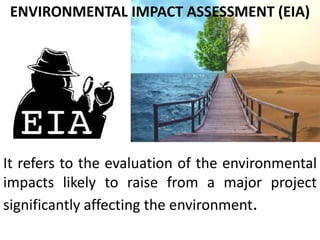
ENVIRONMENTAL IMPACT ASSESSMENT (EIA)
It refers to the evaluation of the environmental
impacts likely to raise from a major project
significantly affecting the environment.
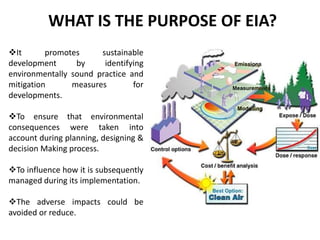
WHAT IS THE PURPOSE OF EIA?
It promotes sustainable
development by identifying
environmentally sound practice and
mitigation measures for
developments.
To ensure that environmental
consequences were taken into
account during planning, designing &
decision Making process.
To influence how it is subsequently
managed during its implementation.
The adverse impacts could be
avoided or reduce.
Environmental Impact Assessment emerged in the United
States as a response to the rise of environmental
movements of the 1960s that raised awareness of the
serious environmental effects of human activities which
were inadequately controlled by existing planning
regulation and pollution control measures. 4
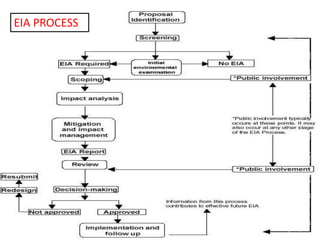
EIA PROCESS
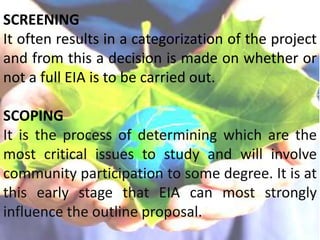
SCREENING
It often results in a categorization of the project
and from this a decision is made on whether or
not a full EIA is to be carried out.
SCOPING
It is the process of determining which are the
most critical issues to study and will involve
community participation to some degree. It is at
this early stage that EIA can most strongly
influence the outline proposal.
PREDICTION AND MITIGATION
Detailed prediction and mitigation studies follow scoping and
are carried out in parallel with feasibility studies.
MANAGING AND MONITORING
The main output report is called an Environmental Impact
Statement, and contains a detailed plan for managing and
monitoring environmental impacts both during and after
implementation.
AUDIT /REVIEW
Finally, an audit of the EIA process is carried out
some time after implementation. The audit
serves a useful feedback and learning function.
EXTERNALITIES OF EIA
Positive Externalities:
1. New jobs generated, economic growth
stimulated.
2. Growth of local business enterprises
supported.
3. Development of supporting and
complementary industries.
4. Influx of capital and disposable income.
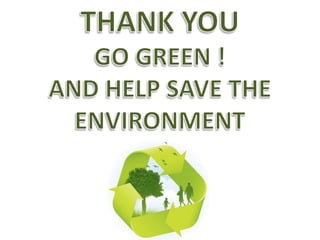
Negative Externalities:
• Social impacts:
1. Impacts on health of local population.
2. Increase in crime and deviant behaviour.
3. Additional pressure on the existing physical
infrastructure (sewage, water supply etc.).
4. Changed cultural values.
•Environmental impacts:
1. Depletion of natural resources.
2. Destruction of habitats.
3. Change in ph, oxygen level, toxicity of
water.
4. Global warming.
5. Ozone depletion.
CONCLUSION
Environment Impact Assessment is a very beneficial
step to check, whether the project is environment
friendly or not.
Since economic development is result of interaction
between natural resources and technology supported
by designed for people, so all human activity should
be economic, social and environment friendly.
Environmental Impact Assessment

Environmental Impact Assessment

  • 1.
  • 2.
    ENVIRONMENTAL IMPACT ASSESSMENT(EIA) It refers to the evaluation of the environmental impacts likely to raise from a major project significantly affecting the environment.
  • 3.
    WHAT IS THEPURPOSE OF EIA? It promotes sustainable development by identifying environmentally sound practice and mitigation measures for developments. To ensure that environmental consequences were taken into account during planning, designing & decision Making process. To influence how it is subsequently managed during its implementation. The adverse impacts could be avoided or reduce.
  • 4.
    Environmental Impact Assessmentemerged in the United States as a response to the rise of environmental movements of the 1960s that raised awareness of the serious environmental effects of human activities which were inadequately controlled by existing planning regulation and pollution control measures. 4
  • 5.
  • 6.
    SCREENING It often resultsin a categorization of the project and from this a decision is made on whether or not a full EIA is to be carried out. SCOPING It is the process of determining which are the most critical issues to study and will involve community participation to some degree. It is at this early stage that EIA can most strongly influence the outline proposal.
  • 7.
    PREDICTION AND MITIGATION Detailedprediction and mitigation studies follow scoping and are carried out in parallel with feasibility studies. MANAGING AND MONITORING The main output report is called an Environmental Impact Statement, and contains a detailed plan for managing and monitoring environmental impacts both during and after implementation.
  • 8.
    AUDIT /REVIEW Finally, anaudit of the EIA process is carried out some time after implementation. The audit serves a useful feedback and learning function.
  • 9.
    EXTERNALITIES OF EIA PositiveExternalities: 1. New jobs generated, economic growth stimulated. 2. Growth of local business enterprises supported. 3. Development of supporting and complementary industries. 4. Influx of capital and disposable income.
  • 10.
    Negative Externalities: • Socialimpacts: 1. Impacts on health of local population. 2. Increase in crime and deviant behaviour. 3. Additional pressure on the existing physical infrastructure (sewage, water supply etc.). 4. Changed cultural values. •Environmental impacts: 1. Depletion of natural resources. 2. Destruction of habitats. 3. Change in ph, oxygen level, toxicity of water. 4. Global warming. 5. Ozone depletion.
  • 11.
    CONCLUSION Environment Impact Assessmentis a very beneficial step to check, whether the project is environment friendly or not. Since economic development is result of interaction between natural resources and technology supported by designed for people, so all human activity should be economic, social and environment friendly.