E N V I R O N M E N T A L I M P A C T
A S S E S S M E N T
2 0 2 0
K U L V E N D R A P A T E L
2 K 1 9 / E N E / 0 5
Delhi Technological University
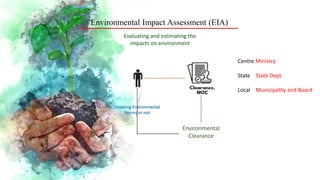
Environmental Impact Assessment (EIA)
Evaluating and estimating the
impacts on environment
Environmental
Clearance
Violating Environmental
Norms or not
Centre Ministry
State State Dept.
Local Municipality and Board
EIA
• It is a process of evaluating the likely environmental impacts of a proposed project or development, taking
into account inter-related socio-economic, cultural and human-health impacts, both beneficial and adverse.
• EIA is basically a tool used to assess the positive and negative environmental, economic and social impacts
of a project.
• This is used to predict the environmental impacts of a project in the pre-planning stage itself so that
decisions can be taken to reduce the adverse impacts.
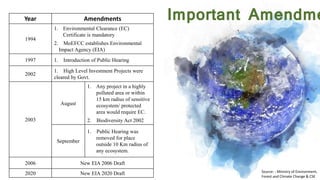
Year Amendments
1994
1. Environmental Clearance (EC)
Certificate is mandatory
2. MoEFCC establishes Environmental
Impact Agency (EIA)
1997 1. Introduction of Public Hearing
2002
1. High Level Investment Projects were
cleared by Govt.
2003
August
1. Any project in a highly
polluted area or within
15 km radius of sensitive
ecosystem/ protected
area would require EC.
2. Biodiversity Act 2002
September
1. Public Hearing was
removed for place
outside 10 Km radius of
any ecosystem.
2006 New EIA 2006 Draft
2020 New EIA 2020 Draft
Important Amendme
Source: - Ministry of Environment,
Forest and Climate Change & CSE
EIA 2020 Draft
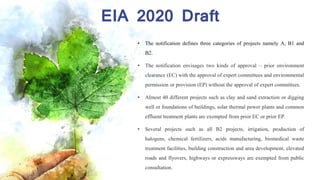
• The notification defines three categories of projects namely A, B1 and
B2.
• The notification envisages two kinds of approval – prior environment
clearance (EC) with the approval of expert committees and environmental
permission or provision (EP) without the approval of expert committees.
• Almost 40 different projects such as clay and sand extraction or digging
well or foundations of buildings, solar thermal power plants and common
effluent treatment plants are exempted from prior EC or prior EP.
• Several projects such as all B2 projects, irrigation, production of
halogens, chemical fertilizers, acids manufacturing, biomedical waste
treatment facilities, building construction and area development, elevated
roads and flyovers, highways or expressways are exempted from public
consultation.
What’s the Debate
About?
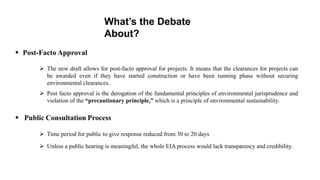
 Post-Facto Approval
 The new draft allows for post-facto approval for projects. It means that the clearances for projects can
be awarded even if they have started construction or have been running phase without securing
environmental clearances.
 Post facto approval is the derogation of the fundamental principles of environmental jurisprudence and
violation of the “precautionary principle,” which is a principle of environmental sustainability.
 Public Consultation Process
 Time period for public to give response reduced from 30 to 20 days
 Unless a public hearing is meaningful, the whole EIA process would lack transparency and credibility.
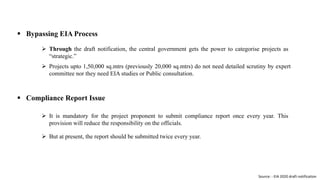
 Bypassing EIA Process
 Through the draft notification, the central government gets the power to categorise projects as
“strategic.”
 Projects upto 1,50,000 sq.mtrs (previously 20,000 sq.mtrs) do not need detailed scrutiny by expert
committee nor they need EIA studies or Public consultation.
 Compliance Report Issue
 It is mandatory for the project proponent to submit compliance report once every year. This
provision will reduce the responsibility on the officials.
 But at present, the report should be submitted twice every year.
Source: - EIA 2020 draft notification
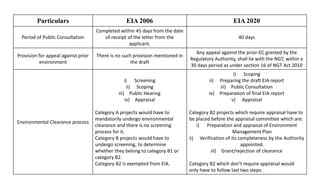
Particulars EIA 2006 EIA 2020
Period of Public Consultation
Completed within 45 days from the date
of receipt of the letter from the
applicant.
40 days
Provision for appeal against prior
environment
There is no such provision mentioned in
the draft
Any appeal against the prior-EC granted by the
Regulatory Authority, shall lie with the NGT, within a
30 days period as under section 16 of NGT Act 2010
Environmental Clearance process
i) Screening
ii) Scoping
iii) Public Hearing
iv) Appraisal
Category A projects would have to
mandatorily undergo environmental
clearance and there is no screening
process for it.
Category B projects would have to
undergo screening, to determine
whether they belong to category B1 or
category B2.
Category B2 is exempted from EIA.
i) Scoping
ii) Preparing the draft EIA report
iii) Public Consultation
iv) Preparation of final EIA report
v) Appraisal
Category B2 projects which require appraisal have to
be placed before the appraisal committee which are:
i) Preparation and appraisal of Environment
Management Plan
ii) Verification of its completeness by the Authority
appointed.
iii) Grant/rejection of clearance
Category B2 which don’t require appraisal would
only have to follow last two steps.
Thank You

Eia 2020 kulvendra patel

  • 1.
    E N VI R O N M E N T A L I M P A C T A S S E S S M E N T 2 0 2 0 K U L V E N D R A P A T E L 2 K 1 9 / E N E / 0 5 Delhi Technological University
  • 2.
    Environmental Impact Assessment(EIA) Evaluating and estimating the impacts on environment Environmental Clearance Violating Environmental Norms or not Centre Ministry State State Dept. Local Municipality and Board
  • 3.
    EIA • It isa process of evaluating the likely environmental impacts of a proposed project or development, taking into account inter-related socio-economic, cultural and human-health impacts, both beneficial and adverse. • EIA is basically a tool used to assess the positive and negative environmental, economic and social impacts of a project. • This is used to predict the environmental impacts of a project in the pre-planning stage itself so that decisions can be taken to reduce the adverse impacts.
  • 4.
    Year Amendments 1994 1. EnvironmentalClearance (EC) Certificate is mandatory 2. MoEFCC establishes Environmental Impact Agency (EIA) 1997 1. Introduction of Public Hearing 2002 1. High Level Investment Projects were cleared by Govt. 2003 August 1. Any project in a highly polluted area or within 15 km radius of sensitive ecosystem/ protected area would require EC. 2. Biodiversity Act 2002 September 1. Public Hearing was removed for place outside 10 Km radius of any ecosystem. 2006 New EIA 2006 Draft 2020 New EIA 2020 Draft Important Amendme Source: - Ministry of Environment, Forest and Climate Change & CSE
  • 5.
    EIA 2020 Draft •The notification defines three categories of projects namely A, B1 and B2. • The notification envisages two kinds of approval – prior environment clearance (EC) with the approval of expert committees and environmental permission or provision (EP) without the approval of expert committees. • Almost 40 different projects such as clay and sand extraction or digging well or foundations of buildings, solar thermal power plants and common effluent treatment plants are exempted from prior EC or prior EP. • Several projects such as all B2 projects, irrigation, production of halogens, chemical fertilizers, acids manufacturing, biomedical waste treatment facilities, building construction and area development, elevated roads and flyovers, highways or expressways are exempted from public consultation.
  • 6.
    What’s the Debate About? Post-Facto Approval  The new draft allows for post-facto approval for projects. It means that the clearances for projects can be awarded even if they have started construction or have been running phase without securing environmental clearances.  Post facto approval is the derogation of the fundamental principles of environmental jurisprudence and violation of the “precautionary principle,” which is a principle of environmental sustainability.  Public Consultation Process  Time period for public to give response reduced from 30 to 20 days  Unless a public hearing is meaningful, the whole EIA process would lack transparency and credibility.
  • 7.
     Bypassing EIAProcess  Through the draft notification, the central government gets the power to categorise projects as “strategic.”  Projects upto 1,50,000 sq.mtrs (previously 20,000 sq.mtrs) do not need detailed scrutiny by expert committee nor they need EIA studies or Public consultation.  Compliance Report Issue  It is mandatory for the project proponent to submit compliance report once every year. This provision will reduce the responsibility on the officials.  But at present, the report should be submitted twice every year. Source: - EIA 2020 draft notification
  • 8.
    Particulars EIA 2006EIA 2020 Period of Public Consultation Completed within 45 days from the date of receipt of the letter from the applicant. 40 days Provision for appeal against prior environment There is no such provision mentioned in the draft Any appeal against the prior-EC granted by the Regulatory Authority, shall lie with the NGT, within a 30 days period as under section 16 of NGT Act 2010 Environmental Clearance process i) Screening ii) Scoping iii) Public Hearing iv) Appraisal Category A projects would have to mandatorily undergo environmental clearance and there is no screening process for it. Category B projects would have to undergo screening, to determine whether they belong to category B1 or category B2. Category B2 is exempted from EIA. i) Scoping ii) Preparing the draft EIA report iii) Public Consultation iv) Preparation of final EIA report v) Appraisal Category B2 projects which require appraisal have to be placed before the appraisal committee which are: i) Preparation and appraisal of Environment Management Plan ii) Verification of its completeness by the Authority appointed. iii) Grant/rejection of clearance Category B2 which don’t require appraisal would only have to follow last two steps.
  • 10.