4.6 Enterobacteriaceae


Enteric Gram negative aerobes rods
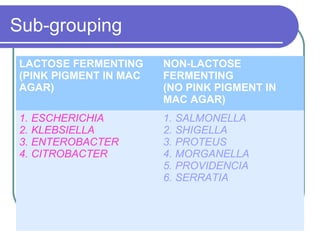
Sub-grouping
LACTOSE FERMENTING     NON-LACTOSE
(PINK PIGMENT IN MAC   FERMENTING
AGAR)                  (NO PINK PIGMENT IN
                       MAC AGAR)
1. ESCHERICHIA         1. SALMONELLA
2. KLEBSIELLA          2. SHIGELLA
3. ENTEROBACTER        3. PROTEUS
4. CITROBACTER         4. MORGANELLA
                       5. PROVIDENCIA
                       6. SERRATIA
Morphology

  Belongs to Gamma Proteobacteria
  Gram negative
  Rods
  1-4 X 0.6µm
  Non-sporing
  Have simple nutrition requirements
  Facultative anaerobes
 Important   bacterial group, they are called enteric
  bacteria as it reflects the fact that they inhabit the
  intestinal tracts of humans and other animals.

 Differentiation is based on biochemical reactions and
  differences in antigenic structure
Motility
   Mostly surrounded by flagella (peritrichous) and are
    motile
   Non-motile enterobacteriaceae are Shigella and Klebsiella
   In Escherichia and Morganella, most of the strain are
    motile, but some are non-motile
   Special case like Yersinia, contain species that are motile
    at 25oC but non-motile at 35 – 37oC.
Klebsiella   E.coli
Culture
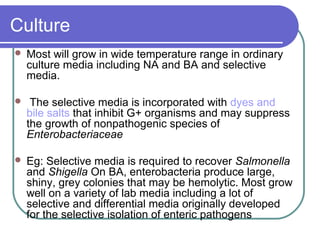
   Most will grow in wide temperature range in ordinary
    culture media including NA and BA and selective
    media.

    The selective media is incorporated with dyes and
    bile salts that inhibit G+ organisms and may suppress
    the growth of nonpathogenic species of
    Enterobacteriaceae

   Eg: Selective media is required to recover Salmonella
    and Shigella On BA, enterobacteria produce large,
    shiny, grey colonies that may be hemolytic. Most grow
    well on a variety of lab media including a lot of
    selective and differential media originally developed
    for the selective isolation of enteric pathogens
Enterobacteriaceae

     Many   are differential on the basis of whether or
      not the organisms ferment lactose and/or
      produce H2S. Species that produce hydrogen
      sulphide often show a green colour around the
      subsurface colonies (Klebsiella) and capsulated
      strains (Escherichia) produce large mucoid
      colonies.
     Catalase reaction vary among
      Enterobactericeae
E.coli
In nutrient agar   In MacConkey agar
Klebsiella sp
In macconkey agar   In blood agar
Salmonella sp
In ss agar      In xld agar
Toxin production

  Exotoxin (enterotoxin) is produced by
   Shigella dysenteriae and toxigenic strain
   of Escherichia coli (ETEC)
  When lysed, enterobacteria will release
   endotoxin from their cell wall
 *The feature above is applied to all Gram
   negative rods
Enterobacteriaceae
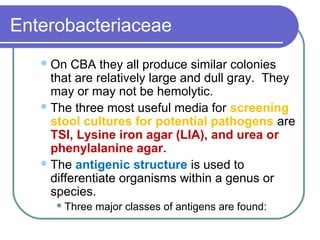
    On  CBA they all produce similar colonies
     that are relatively large and dull gray. They
     may or may not be hemolytic.
    The three most useful media for screening
     stool cultures for potential pathogens are
     TSI, Lysine iron agar (LIA), and urea or
     phenylalanine agar.
    The antigenic structure is used to
     differentiate organisms within a genus or
     species.
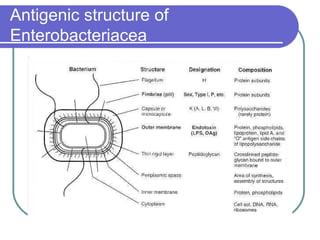
      Three   major classes of antigens are found:
Enterobacteriaceae
        Somatic O antigens – these are the heat stable
         polysaccharide part of the LPS.
             Variation from smooth to rough colonial forms is
              accompanied by progressive loss of smooth O Antigen.
      Flagellar H antigens – are heat labile
      Envelope or capsule K antigens – overlay the surface O

       antigen and may block agglutination by O specific
       antisera.
             Boiling for 15 minutes will destroy the K antigen and unmask
              O antigens.
             The K antigen is called the Vi (virulence) antigen in
              Salmonella typhi.
Antigenic Structure of
Enterobacteriaceae
Antigenic structure of
Enterobacteriacea
Assignments

    Prepare notes on each of genus under
    enterobacteriaceae group. (10 genus)
  All the notes should have the following
    criteria:
 a) morphology,b)culture, c)biochemical
    tests d) serology test
  Submit on 3rd of September 2012
4.7 BRUCELLA
Main species

  Brucella melintensis
  Brucella abortus
  Brucella suis
Normal habitat
  Obligate   intracellular pathogens of
   animals
  B. melitensis mainly found in goat and
   sheep
  B. abotus infects cattle
  B. suis found in pigs and occasionally in
   goat
  Other animal including horse, camel,
   eland and wild rodents
Routes of infection

  Mosquitoes  helps in transfer Brucella
   from animal to human
  Also by ingesting unpastuerized milk,
   meat or milk products, enter damaged
   skin or eyes, inhaled in airborne particles
   or aerosols and close contact with
   secretions.
Microscopic observation
  Non-motile
  Gram  negative
  Coccobacili
  Show bipolar staining
  Rarely found in direct smear from
   uncultured specimen
  On Gram stain they appear as dense
   clumps of Gram-negative coccobacilli
   and are exceedingly difficult to see.
Culture characteristics
    Mostly cultured from blood of high fever patient(Brucellosis)
    Isolation is extremely rare in chronic brucellosis
    In all blood culture, they need carbon dioxide
    Blood culture should be kept in 4 – 6 weeks before result as no
     organisms isolated
    To reduce the risk of contamination, use the diphasic medium
     such as Castaneda or tryptic soy broth or agar
    Brucellae are aerobic with enriched of carbon dioxide
Biochemical tests Serology
tests
  Urease  and              Possess    two
   hydrogen sulphide         antigens called A
   production                and M
  All brucella strains    Famous test serum:
   are catalase positive    Rapid slide
                             agglutination test
                            Tube agglutination
                             titration test
Serology test

  Itis crucial to be able to differentiate
   Brucella from Salmonella which could
   also be isolated from blood cultures and
   are Gram-negative. Testing for urease
   would successfully accomplish the task;
   as it is positive for the Brucella and
   negative for the Salmonella.

Enterobacteriaceae & Brucella

  • 1.
  • 2.
    Sub-grouping LACTOSE FERMENTING NON-LACTOSE (PINK PIGMENT IN MAC FERMENTING AGAR) (NO PINK PIGMENT IN MAC AGAR) 1. ESCHERICHIA 1. SALMONELLA 2. KLEBSIELLA 2. SHIGELLA 3. ENTEROBACTER 3. PROTEUS 4. CITROBACTER 4. MORGANELLA 5. PROVIDENCIA 6. SERRATIA
  • 3.
    Morphology  Belongsto Gamma Proteobacteria  Gram negative  Rods  1-4 X 0.6µm  Non-sporing  Have simple nutrition requirements  Facultative anaerobes
  • 4.
     Important bacterial group, they are called enteric bacteria as it reflects the fact that they inhabit the intestinal tracts of humans and other animals.  Differentiation is based on biochemical reactions and differences in antigenic structure
  • 5.
    Motility Mostly surrounded by flagella (peritrichous) and are motile  Non-motile enterobacteriaceae are Shigella and Klebsiella  In Escherichia and Morganella, most of the strain are motile, but some are non-motile  Special case like Yersinia, contain species that are motile at 25oC but non-motile at 35 – 37oC.
  • 6.
  • 7.
    Culture  Most will grow in wide temperature range in ordinary culture media including NA and BA and selective media.  The selective media is incorporated with dyes and bile salts that inhibit G+ organisms and may suppress the growth of nonpathogenic species of Enterobacteriaceae  Eg: Selective media is required to recover Salmonella and Shigella On BA, enterobacteria produce large, shiny, grey colonies that may be hemolytic. Most grow well on a variety of lab media including a lot of selective and differential media originally developed for the selective isolation of enteric pathogens
  • 8.
    Enterobacteriaceae  Many are differential on the basis of whether or not the organisms ferment lactose and/or produce H2S. Species that produce hydrogen sulphide often show a green colour around the subsurface colonies (Klebsiella) and capsulated strains (Escherichia) produce large mucoid colonies.  Catalase reaction vary among Enterobactericeae
  • 9.
    E.coli In nutrient agar In MacConkey agar
  • 10.
    Klebsiella sp In macconkeyagar In blood agar
  • 11.
    Salmonella sp In ssagar In xld agar
  • 12.
    Toxin production Exotoxin (enterotoxin) is produced by Shigella dysenteriae and toxigenic strain of Escherichia coli (ETEC)  When lysed, enterobacteria will release endotoxin from their cell wall *The feature above is applied to all Gram negative rods
  • 13.
    Enterobacteriaceae  On CBA they all produce similar colonies that are relatively large and dull gray. They may or may not be hemolytic.  The three most useful media for screening stool cultures for potential pathogens are TSI, Lysine iron agar (LIA), and urea or phenylalanine agar.  The antigenic structure is used to differentiate organisms within a genus or species.  Three major classes of antigens are found:
  • 14.
    Enterobacteriaceae  Somatic O antigens – these are the heat stable polysaccharide part of the LPS.  Variation from smooth to rough colonial forms is accompanied by progressive loss of smooth O Antigen.  Flagellar H antigens – are heat labile  Envelope or capsule K antigens – overlay the surface O antigen and may block agglutination by O specific antisera.  Boiling for 15 minutes will destroy the K antigen and unmask O antigens.  The K antigen is called the Vi (virulence) antigen in Salmonella typhi.
  • 15.
  • 16.
  • 17.
    Assignments  Prepare notes on each of genus under enterobacteriaceae group. (10 genus)  All the notes should have the following criteria: a) morphology,b)culture, c)biochemical tests d) serology test  Submit on 3rd of September 2012
  • 18.
  • 19.
    Main species Brucella melintensis  Brucella abortus  Brucella suis
  • 20.
    Normal habitat Obligate intracellular pathogens of animals  B. melitensis mainly found in goat and sheep  B. abotus infects cattle  B. suis found in pigs and occasionally in goat  Other animal including horse, camel, eland and wild rodents
  • 21.
    Routes of infection  Mosquitoes helps in transfer Brucella from animal to human  Also by ingesting unpastuerized milk, meat or milk products, enter damaged skin or eyes, inhaled in airborne particles or aerosols and close contact with secretions.
  • 22.
    Microscopic observation Non-motile  Gram negative  Coccobacili  Show bipolar staining  Rarely found in direct smear from uncultured specimen  On Gram stain they appear as dense clumps of Gram-negative coccobacilli and are exceedingly difficult to see.
  • 23.
    Culture characteristics  Mostly cultured from blood of high fever patient(Brucellosis)  Isolation is extremely rare in chronic brucellosis  In all blood culture, they need carbon dioxide  Blood culture should be kept in 4 – 6 weeks before result as no organisms isolated  To reduce the risk of contamination, use the diphasic medium such as Castaneda or tryptic soy broth or agar  Brucellae are aerobic with enriched of carbon dioxide
  • 24.
    Biochemical tests Serology tests  Urease and  Possess two hydrogen sulphide antigens called A production and M  All brucella strains Famous test serum: are catalase positive  Rapid slide agglutination test  Tube agglutination titration test
  • 25.
    Serology test Itis crucial to be able to differentiate Brucella from Salmonella which could also be isolated from blood cultures and are Gram-negative. Testing for urease would successfully accomplish the task; as it is positive for the Brucella and negative for the Salmonella.