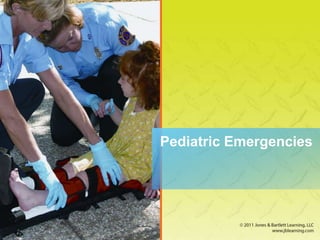
Pediatric Emergencies
National EMS Education
Standard Competencies
Pediatrics
• Upper airway obstruction
• Lower airway reactive disease
• Respiratory distress/failure/arrest
National EMS Education
Standard Competencies
Pediatrics (cont’d)
• Shock
• Seizures
• Sudden infant death syndrome
National EMS Education
Standard Competencies
Pediatrics (cont’d)
• Upper airway obstruction
• Lower airway reactive disease
• Respiratory distress/failure/arrest
• Shock
National EMS Education
Standard Competencies
Pediatrics (cont’d)
• Seizures
• Sudden infant death syndrome
• Gastrointestinal disease
National EMS Education
Standard Competencies
Patients With Special Challenges
• Recognizing and reporting abuse and
neglect
• Health care implications of:
– Abuse
– Neglect
Communication With the
Patient and the Family
• You may have more than one patient.
– Caregiver may need help and support.
• A calm parent contributes to a calm child.
– An agitated parent means child will act same
way.
• Remain calm, efficient, professional, and
sensitive.
Growth and Development
• Between birth and adulthood, many
changes occur.
• Thoughts and behaviors:
– Infancy: first year of life
– Toddler: 1 to 3 years
– Preschool-age: 3 to 6 years
– School-age: 6 to 12 years
– Adolescence: 12 to 18 years
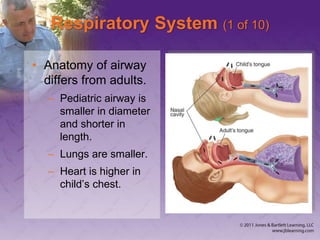
Respiratory System (1 of 10)
• Anatomy of airway
differs from adults.
– Pediatric airway is
smaller in diameter
and shorter in
length.
– Lungs are smaller.
– Heart is higher in
child’s chest.
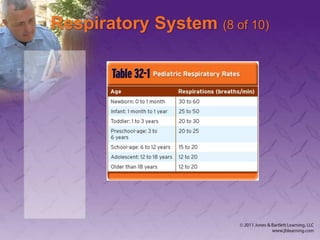
Respiratory System (8 of 10)
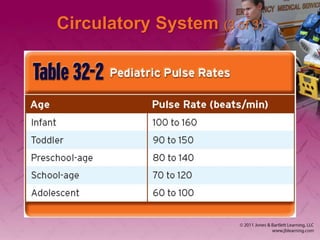
Circulatory System (3 of 3)
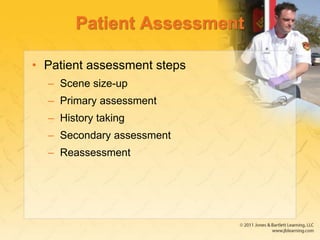
Patient Assessment
• Patient assessment steps
– Scene size-up
– Primary assessment
– History taking
– Secondary assessment
– Reassessment
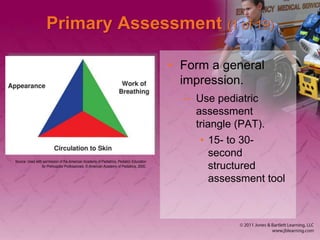
Primary Assessment (1 of 19)
• Form a general
impression.
– Use pediatric
assessment
triangle (PAT).
• 15- to 30-
second
structured
assessment tool
Source: Used with permission of the American Academy of Pediatrics, Pediatric Education
for Prehospital Professionals, © American Academy of Pediatrics, 2000.
Primary Assessment (7 of 19)
• Hands-on ABCs
– For pediatric patient you will now perform a
hands-on ABCs assessment.
• Airway
• Breathing
• Circulation
• Disability
• Exposure
Respiratory Emergencies and
Management (2 of 5)
• Signs and symptoms of increased work of
breathing:
– Nasal flaring
– Grunting respirations
– Wheezing, stridor, other abnormal sounds
– Accessory muscle use
– Retractions/movements of child’s flexible rib
cage
– In older children, tripod position
Respiratory Emergencies and
Management (3 of 5)
• As the patient progresses to possible
respiratory failure.
– Efforts to breathe decrease.
– Chest rises less with inspiration.
– Body has used up all available energy stores
and cannot continue to support extra work of
breathing.
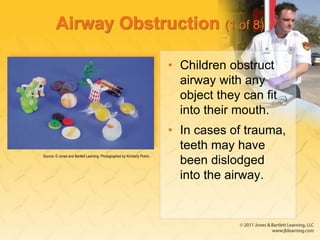
Airway Obstruction (1 of 8)
• Children obstruct
airway with any
object they can fit
into their mouth.
• In cases of trauma,
teeth may have
been dislodged
into the airway.
Source: © Jones and Bartlett Learning. Photographed by Kimberly Potvin.
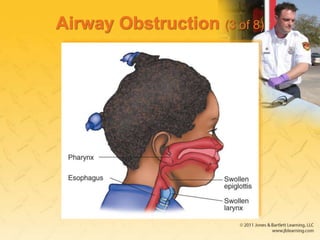
Airway Obstruction (2 of 8)
• Blood, vomitus, or other secretions can
cause severe airway obstruction.
• Infections can cause obstruction.
– Croup is an infection in the airway below the
level of the vocal cords.
• Usually caused by a virus
– Epiglottitis is an infection of the soft tissue
above the level of the vocal cords.
Airway Obstruction (3 of 8)
Cardiopulmonary Arrest
• Cardiac arrest in pediatric patients is
associated with respiratory failure and
arrest.
– Children are affected differently by decreasing
oxygen concentration.
• Adults become hypoxic, heart gets irritable,
and sudden cardiac death comes from
arrhythmia.
• Children become hypoxic and their hearts
slow down, becoming more bradycardic.
Shock (1 of 12)
• A condition that develops when the
circulatory system is unable to deliver a
sufficient amount of blood to the organs
– Results in organ failure and eventually
cardiopulmonary arrest
• Compensated shock is the early stage of
shock.
• Decompensated shock is the later stage of
shock.
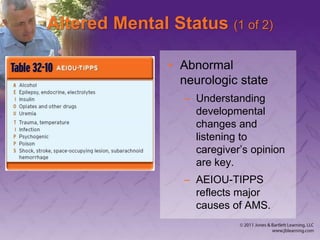
Altered Mental Status (1 of 2)
• Abnormal
neurologic state
– Understanding
developmental
changes and
listening to
caregiver’s opinion
are key.
– AEIOU-TIPPS
reflects major
causes of AMS.
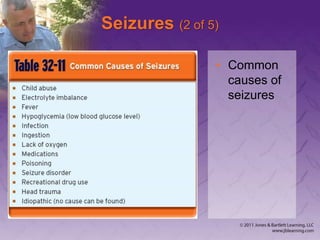
Seizures (2 of 5)
• Common
causes of
seizures
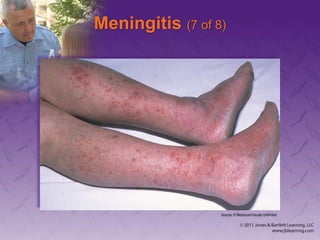
Meningitis (7 of 8)
Source: © Mediscan/Visuals Unlimited
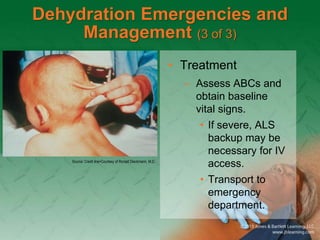
Dehydration Emergencies and
Management (3 of 3)
• Treatment
– Assess ABCs and
obtain baseline
vital signs.
• If severe, ALS
backup may be
necessary for IV
access.
• Transport to
emergency
department.
Source: Credit line>Courtesy of Ronald Dieckmann, M.D.
Fever Emergencies and
Management (3 of 4)
• Accurate body temperature is important for
pediatric patients.
– Rectal temperature is most accurate for infants
and toddlers.
– Under tongue or arm will work for older children.
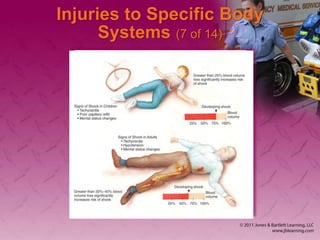
Injuries to Specific Body
Systems (7 of 14)
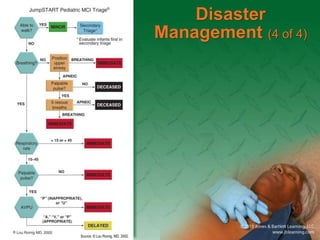
Disaster Management (1 of 4)
• JumpSTART triage system
– Intended for patients younger than 8 years and
weighing less than 100 lb
– Four triage categories
• Green
• Yellow
• Red
• Black
Disaster
Management (4 of 4)
Source: © Lou Romig, MD, 2002.
Child Abuse and Neglect
• Any improper or excessive action that
injures or otherwise harms a child
– Includes physical abuse, sexual abuse, neglect,
and emotional abuse
– More than 2 million cases reported annually
• Many children suffer life-threatening injuries.
• If abuse is not reported, likely to happen
again.
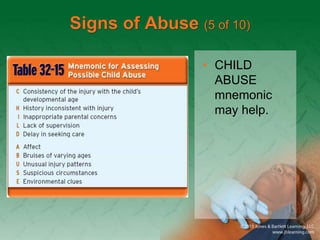
Signs of Abuse (5 of 10)
• CHILD
ABUSE
mnemonic
may help.
Signs of Abuse (10 of 10)
• Shaken baby syndrome (cont’d)
– Shaking tears blood vessels in the brain,
resulting in bleeding around the brain.
• Pressure from blood results in an increase in
cranial pressure leading to coma and/or
death.
• Neglect
– Refusal or failure to provide life necessities
• Examples are water, clothing, shelter,
personal hygiene, medicine, comfort,
personal safety.
Sudden Infant Death Syndrome
(1 of 2)
• Unexplained death after complete autopsy
• Leading cause of death in infants younger
than 1 year
• Most cases occur in infants younger than 6
months.
• Impossible to predict

EMR pediatrics

  • 1.
  • 2.
    National EMS Education StandardCompetencies Pediatrics • Upper airway obstruction • Lower airway reactive disease • Respiratory distress/failure/arrest
  • 3.
    National EMS Education StandardCompetencies Pediatrics (cont’d) • Shock • Seizures • Sudden infant death syndrome
  • 4.
    National EMS Education StandardCompetencies Pediatrics (cont’d) • Upper airway obstruction • Lower airway reactive disease • Respiratory distress/failure/arrest • Shock
  • 5.
    National EMS Education StandardCompetencies Pediatrics (cont’d) • Seizures • Sudden infant death syndrome • Gastrointestinal disease
  • 6.
    National EMS Education StandardCompetencies Patients With Special Challenges • Recognizing and reporting abuse and neglect • Health care implications of: – Abuse – Neglect
  • 7.
    Communication With the Patientand the Family • You may have more than one patient. – Caregiver may need help and support. • A calm parent contributes to a calm child. – An agitated parent means child will act same way. • Remain calm, efficient, professional, and sensitive.
  • 8.
    Growth and Development •Between birth and adulthood, many changes occur. • Thoughts and behaviors: – Infancy: first year of life – Toddler: 1 to 3 years – Preschool-age: 3 to 6 years – School-age: 6 to 12 years – Adolescence: 12 to 18 years
  • 9.
    Respiratory System (1of 10) • Anatomy of airway differs from adults. – Pediatric airway is smaller in diameter and shorter in length. – Lungs are smaller. – Heart is higher in child’s chest.
  • 10.
  • 11.
  • 12.
    Patient Assessment • Patientassessment steps – Scene size-up – Primary assessment – History taking – Secondary assessment – Reassessment
  • 13.
    Primary Assessment (1of 19) • Form a general impression. – Use pediatric assessment triangle (PAT). • 15- to 30- second structured assessment tool Source: Used with permission of the American Academy of Pediatrics, Pediatric Education for Prehospital Professionals, © American Academy of Pediatrics, 2000.
  • 14.
    Primary Assessment (7of 19) • Hands-on ABCs – For pediatric patient you will now perform a hands-on ABCs assessment. • Airway • Breathing • Circulation • Disability • Exposure
  • 15.
    Respiratory Emergencies and Management(2 of 5) • Signs and symptoms of increased work of breathing: – Nasal flaring – Grunting respirations – Wheezing, stridor, other abnormal sounds – Accessory muscle use – Retractions/movements of child’s flexible rib cage – In older children, tripod position
  • 16.
    Respiratory Emergencies and Management(3 of 5) • As the patient progresses to possible respiratory failure. – Efforts to breathe decrease. – Chest rises less with inspiration. – Body has used up all available energy stores and cannot continue to support extra work of breathing.
  • 17.
    Airway Obstruction (1of 8) • Children obstruct airway with any object they can fit into their mouth. • In cases of trauma, teeth may have been dislodged into the airway. Source: © Jones and Bartlett Learning. Photographed by Kimberly Potvin.
  • 18.
    Airway Obstruction (2of 8) • Blood, vomitus, or other secretions can cause severe airway obstruction. • Infections can cause obstruction. – Croup is an infection in the airway below the level of the vocal cords. • Usually caused by a virus – Epiglottitis is an infection of the soft tissue above the level of the vocal cords.
  • 19.
  • 20.
    Cardiopulmonary Arrest • Cardiacarrest in pediatric patients is associated with respiratory failure and arrest. – Children are affected differently by decreasing oxygen concentration. • Adults become hypoxic, heart gets irritable, and sudden cardiac death comes from arrhythmia. • Children become hypoxic and their hearts slow down, becoming more bradycardic.
  • 21.
    Shock (1 of12) • A condition that develops when the circulatory system is unable to deliver a sufficient amount of blood to the organs – Results in organ failure and eventually cardiopulmonary arrest • Compensated shock is the early stage of shock. • Decompensated shock is the later stage of shock.
  • 22.
    Altered Mental Status(1 of 2) • Abnormal neurologic state – Understanding developmental changes and listening to caregiver’s opinion are key. – AEIOU-TIPPS reflects major causes of AMS.
  • 23.
    Seizures (2 of5) • Common causes of seizures
  • 24.
    Meningitis (7 of8) Source: © Mediscan/Visuals Unlimited
  • 25.
    Dehydration Emergencies and Management(3 of 3) • Treatment – Assess ABCs and obtain baseline vital signs. • If severe, ALS backup may be necessary for IV access. • Transport to emergency department. Source: Credit line>Courtesy of Ronald Dieckmann, M.D.
  • 26.
    Fever Emergencies and Management(3 of 4) • Accurate body temperature is important for pediatric patients. – Rectal temperature is most accurate for infants and toddlers. – Under tongue or arm will work for older children.
  • 27.
    Injuries to SpecificBody Systems (7 of 14)
  • 28.
    Disaster Management (1of 4) • JumpSTART triage system – Intended for patients younger than 8 years and weighing less than 100 lb – Four triage categories • Green • Yellow • Red • Black
  • 29.
    Disaster Management (4 of4) Source: © Lou Romig, MD, 2002.
  • 30.
    Child Abuse andNeglect • Any improper or excessive action that injures or otherwise harms a child – Includes physical abuse, sexual abuse, neglect, and emotional abuse – More than 2 million cases reported annually • Many children suffer life-threatening injuries. • If abuse is not reported, likely to happen again.
  • 31.
    Signs of Abuse(5 of 10) • CHILD ABUSE mnemonic may help.
  • 32.
    Signs of Abuse(10 of 10) • Shaken baby syndrome (cont’d) – Shaking tears blood vessels in the brain, resulting in bleeding around the brain. • Pressure from blood results in an increase in cranial pressure leading to coma and/or death. • Neglect – Refusal or failure to provide life necessities • Examples are water, clothing, shelter, personal hygiene, medicine, comfort, personal safety.
  • 33.
    Sudden Infant DeathSyndrome (1 of 2) • Unexplained death after complete autopsy • Leading cause of death in infants younger than 1 year • Most cases occur in infants younger than 6 months. • Impossible to predict