#2 Lecture Outline
I. Introduction
A. As a paramedic, you must develop a strong working knowledge of medical terminology.
1. International language of medicine and health care
2. Used to describe and record every aspect of patient care, including:
a. Medical history
b. Assessment results
c. Treatment
d. Outcomes
#3 Lecture Outline
3. You should understand the origin of medical terms, the components, and the guidelines for forming words.
4. Incorrect use of medical terminology can cause:
a. Administration of ineffective or harmful treatment
b. Patient could lose trust in the paramedic’s ability
#4 Lecture Outline
5. For effective communication and documentation, you must comprehend:
a. Key terms
b. Acronyms
c. Symbols
d. Abbreviations
#5 Lecture Outline
6. Understanding medical terminology requires you to:
a. Break down each word into its components and have a good working knowledge of the parts
b. Learn the accepted terms in your local area
c. Determine if your emergency medical services (EMS) system has lists of approved medical abbreviations and terms
7. You should also have a working knowledge of common slang terms
#6 Lecture Outline
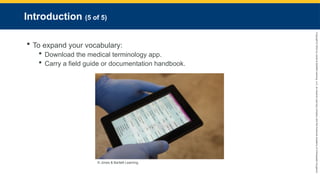
8. To expand your vocabulary to be able to deliver better care:
a. Download the medical terminology app.
b. Carry a field guide or documentation handbook.
#7 Lecture Outline
II. Origins
A. Understanding the origins of medical terms helps you decipher the meanings of terms.
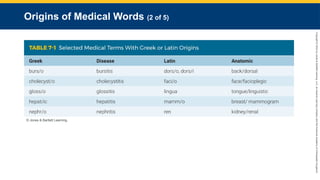
1. Most medical terms have Greek or Latin origins.
a. Words that refer to diseases are derived from Greek words.
b. Words that refer to anatomic structures are derived from Latin words.
#8 This table shows selected terms with Greek and Latin origins.
#9 Lecture Outline
B. Eponyms
1. Names of diseases, devices, procedures, or drugs that are based on the person who invented, discovered, or first described them
a. “Diesel engine” named for its German inventor, Rudolf Diesel.
#10 Lecture Outline
2. Sometimes appear in the possessive form
a. Hodgkin’s disease or Hodgkin disease
#11 Lecture Outline
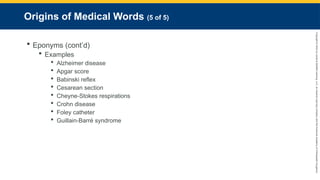
3. Often include the name of the physician or surgeon first associated in some way with them:
a. Alzheimer disease
b. Apgar score
c. Babinski reflex
d. Cesarean section
e. Cheyne-Stokes respirations
f. Crohn disease
g. Foley catheter
h. Guillain-Barré syndrome
i. Levine sign
j. Marfan syndrome
k. McBurney point
4. Thorough knowledge of anatomy and an understanding of context in which each term is used can help you to determine the correct word to use.
#12 Lecture Outline
III. Medical Term Components
A. When you encounter an unfamiliar word, break it up into its component parts.
1. Medical terms are composed of distinct parts that perform specific functions:
#13 Lecture Outline
a. Word root
b. Prefix
c. Suffix
d. Combining form
#14 Lecture Outline
2. The way in which the parts of a word are combined determines its meaning.
Changing or deleting any portion of a term can alter its content.
Refer to the set of master tables at the end of the chapter.
#15 Lecture Outline
B. Word roots
1. Main part of word (sometimes called the root word)
a. Establishes the basic meaning of the word
b. Some are complete words by themselves; others are not.
#16 Lecture Outline
2. Changing the prefix or suffix will change the meaning of the term.
3. Consider the context of a word before assigning its meaning.
a. The same word root may have different meanings in different fields of study.
4. Several word roots describe color.
a. Used frequently to describe patient presentation and other key concepts
#17 Lecture Outline
C. Prefixes
1. Appear at the beginning of a word and generally describe the location or intensity of a word root that follows
2. Change the meaning of a medical term by describing the what, how, why, or when of the word root
a. Cutaneous means skin.
b. Add the prefix sub, and it means “below the skin.”
#18 Lecture Outline
3. Learn to understand words by breaking apart prefixes and word roots.
a. Apnea, means “without breath.”
b. Recognize that prefix a- means “without or lack of,” and the word root -pnea means “breath.”
#19 Lecture Outline
4. Numerical prefixes are used to indicate:
a. Number of sides, limbs, or sensory organs affected (eg, “monocular vision”)
b. Time (eg, octogenarian—a person between 80 and 89 years of age)
c. Quantities that are uncountable (eg, semicomatose)
#20 Lecture Outline
D. Suffixes
1. Components added to the ends of word roots that change or add to the word’s meaning or provide further definition
2. In medical terminology, a suffix usually specifies a procedure, condition, disease, or part of speech.
a. -ase indicates an enzyme
b. lip- (fat) plus -ase = lipase (an enzyme that digests fats)
3. Suffixes are able to change the medical term to a noun or adjective as needed.
#21 Lecture Outline
E. Combining forms and vowels
1. Combining vowels facilitates the formation of new, more complex terms.
a. Often consist of an o added to a word root
#22 Lecture Outline
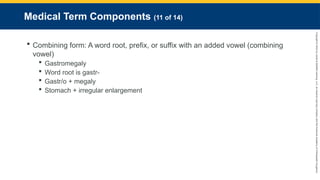
2. Combining form: Word root, prefix, or suffix with an added vowel (combining vowel)
a. Example: Osteopathic
i. Word root is osteon
ii. Oste/o + pathic
iii. Bone + disease
b. Example: Gastromegaly
i. Word root is gastr-
ii. Gastr/o + megaly
iii. Stomach + irregular enlargement
#23 Lecture Outline
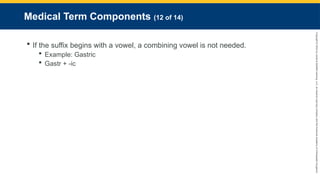
3. If the suffix begins with a vowel, a combining vowel is not needed.
a. Gastr- + -ic = gastric
#24 Lecture Outline
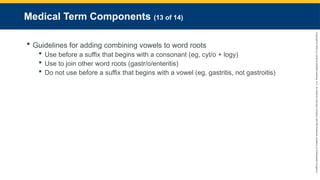
4. Follow these guidelines when adding combining vowels to root words:
a. Use a combining vowel before a suffix that begins with a consonant (eg, cyt/o + logy).
b. Use a combining vowel to join other word roots (eg, gastr/o/enteritis).
c. Do not use a combining vowel before a suffix that begins with a vowel (eg, gastritis, not gastroitis).
#25 Lecture Outline
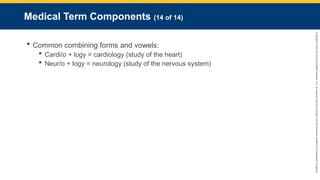
5. Common combining forms and vowels:
a. cardi/o + logy = cardiology (study of the heart)
b. neur/o + logy = neurology (study of the nervous system)
#26 Lecture Outline
IV. Plural Endings
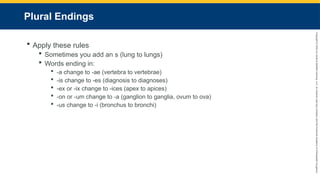
A. To change a term from singular to plural form, certain rules apply.
1. Sometimes you can simply add an s (lung becomes lungs), but some rules are more complicated.
2. Singular words that end in -a change to -ae when plural.
a. Example: Vertebra becomes vertebrae.
3. Singular words that end in -is change to -es when plural.
a. Example: Diagnosis becomes diagnoses.
4. Singular words that end in -ex or -ix change to -ices.
a. Example: Apex becomes apices.
5. Singular words that end in -on or -um change to -a.
a. Examples: Ganglion becomes ganglia; ovum becomes ova.
6. Singular words that end in -us change to -i.
a. Example: Bronchus becomes bronchi.
#27 Lecture Outline
V. Compound Words
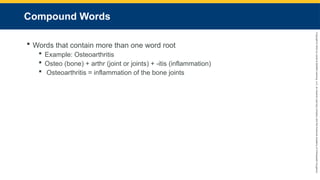
A. Compound words contain more than one word root.
1. Each word root retains its basic meaning.
2. Simple examples containing two word roots:
a. Electrocardiogram
b. Thermometer
3. More complicated:
a. Osteoarthritis
b. Ost (bone) + arthr- (means joint or joints) + -itis (means inflammation)
c. Osteoarthritis means inflammation of the bone joints.
#28 Lecture Outline
B. Homonyms
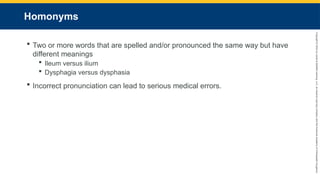
1. Two or more words that are spelled and/or pronounced the same way but have different meanings
a. Example: Ileum (the last anatomic portion of the small intestine) versus ilium (the largest bone of the pelvis)
b. Example: Dysphagia (difficulty eating or swallowing) versus dysphasia (difficulty speaking)
2. Incorrect pronunciation of medical terms can lead to misdiagnosis or other serious medical errors.
#29 Lecture Outline
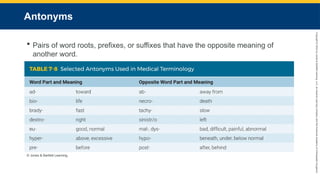
C. Antonyms
1. Pairs of word roots, prefixes, or suffixes that have the opposite meaning of another word.
#30 Lecture Outline
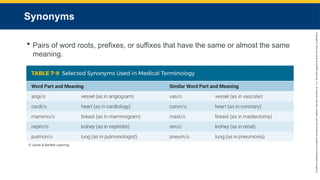
D. Synonyms
1. Pairs of word roots, prefixes, or suffixes that have the same or almost the same meaning.
#31 Lecture Outline
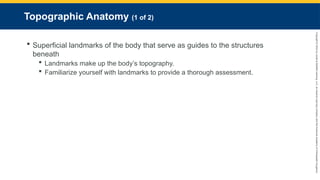
VI. Topographic Anatomy
A. Superficial landmarks of the body that serve as guides to the structures that lie beneath them
1. These features make up the body’s topography.
2. Familiarize yourself with these landmarks to perform a thorough assessment.
#32 Lecture Outline
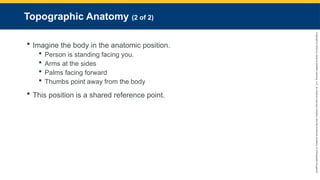
3. Imagine the body in the anatomic position to describe topography accurately.
a. Person is standing, facing you, arms at the sides, with palms facing forward, and thumbs pointing away from the body.
b. The position is a shared reference point, so the meanings of various directional terms stays constant, regardless of body position or movement.
#33 Lecture Outline
B. Anatomic planes and axes of the body
1. Anatomic plane of the body: Imaginary flat surfaces dividing the body horizontally and vertically into sections
2. Axis: An imaginary line that divides the body equally and creates a point of rotation
#34 Lecture Outline
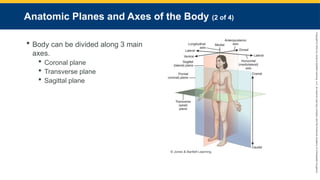
3. Body can be divided along three main axes to create the following planes:
a. Coronal plane
i. Slices the body vertically, from ear to ear, dividing it into front (ventral) and back (dorsal) portions
ii. Also called the frontal plane
iii. “Corona” means head
b. Transverse plane
i. Passes horizontally through the body at the waist, creating top and bottom portions
ii. Also called the axial plane
c. Sagittal (lateral) plane
i. Divides body vertically, slicing it from front to back
ii. Also called the lateral plane
iii. “Sagitta” is Latin for arrow
iv. Midsagittal plane (midline): Divides the body into equal left and right halves
#35 Lecture Outline
4. The three axes along which the body can be divided are:
a. Anteroposterior axis: Runs perpendicular to the coronal plane
b. Longitudinal axis: Runs perpendicular to the transverse plane
c. Horizontal axis: Also called the mediolateral axis, runs perpendicular to the sagittal plane
#36 Lecture Outline
5. These planes and axes help to:
a. Identify the location of internal structures
b. Understand the relationships between and among the organs
6. Cross section: Slicing across an object perpendicular to its long axis
7. Longitudinal section: A view of an object cut along its long axis
#37 Lecture Outline
C. Specific areas of the body
1. Many body structures have specific names.
2. To describe an injury’s location, paramedics rely on:
Anatomic planes
Body surfaces
Imaginary lines
3. Familiarizing yourself with these regions will help you to:
a. Communicate with other professionals
b. Break down other terms
#38 Lecture Outline
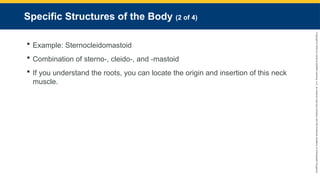
i. Example: Sternocleidomastoid: A combination of sterno-, cleido-, and -mastoid, which refers to the sternum, clavicle, and mastoid process
ii. If you understand the roots, you will be able to locate the origin and insertion of this large neck muscle.
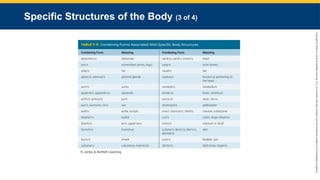
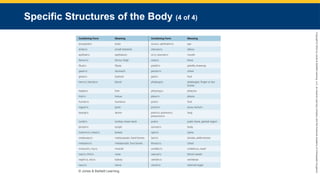
#39 This table shows combining forms associated with specific body structures.
#40 This table shows combining forms associated with specific body structures.
#41 Lecture Outline
D. Body cavities
1. The human body’s cavities contain various organs and other structures.
2. These cavities can be grouped into two categories: dorsal (posterior) and ventral (anterior).
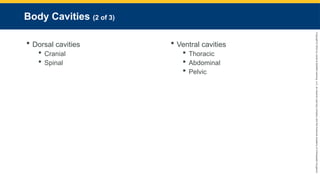
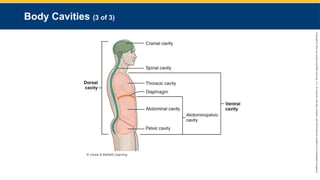
#42 Lecture Outline
a. Dorsal cavities (posterior)
i. Cranial cavity
ii. Spinal cavity
b. Ventral cavities (anterior)
i. Thoracic cavity
ii. Abdominal cavity
iii. Pelvic cavity
3. The abdominal and pelvic cavities can be referred to together as the abdominopelvic cavity.
4. The retroperitoneal cavity is separate from and lies posterior to the abdominal cavity and contains different organs, most notably the kidneys.
#44 Lecture Outline
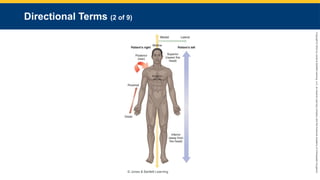
E. Directional terms
1. Describe relative positions of body parts and imaginary anatomic divisions
2. Use the correct directional terms to describe the location of pain or injury.
#46 Lecture Outline
3. Directional terms in medicine tend to occur in pairs because every direction has an opposite:
Superior and inferior
Lateral and medical
Proximal and distal
Superficial and deep
Anterior and posterior
Palmar and plantar
Apex
#47 Lecture Outline
4. Superior and inferior
a. Superior part of any body part is the portion closest to the head.
b. The part closest to the feet is the inferior portion.
c. Also used to describe the relationship of one structure to another
#48 Lecture Outline
5. Lateral and medial
a. Parts of the body that lie farther from the midline are described as lateral.
b. The parts that lie closer to the midline are described as medial.
#49 Lecture Outline
6. Proximal and distal
a. Proximal describes structures that are closer to the body.
b. Distal indicates structures that are farther from the trunk or nearer to the free end of the extremity.
#50 Lecture Outline
7. Superficial and deep
a. Superficial means closer to or on the surface of the skin.
b. Deep means farther inside the body and away from the skin.
#51 Lecture Outline
8. Anterior and posterior
a. Anterior (or ventral) refers to the belly side of the body.
b. Posterior (or dorsal) refers to the spinal side of the body, including the back of the hand.
c. In human medicine, use “anterior” and “posterior”; ventral and dorsal are more common in veterinary and zoologic sciences.
#52 Lecture Outline
9. Palmar and plantar
a. The front region of the hand is referred to as the palm or palmar (or volar) surface.
b. The bottom of the foot is referred to as the plantar (or volar) surface.
10. Apex
a. The apex (plural apices or apexes) is the tip(s) of a structure.
#53 Lecture Outline
F. Movement and positional terms
1. An accepted set of terms describes body movement.
a. Particularly useful in explaining mechanism of injury
2. Range of motion: The full distance that a joint can be moved
#54 Lecture Outline
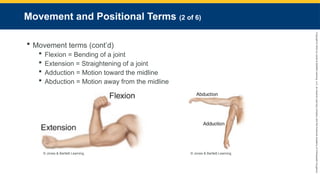
a. Flexion: Moving the distal point of an extremity toward the trunk while in the anatomic position
b. Dorsiflexion: Movement of the foot toward the dorsal aspect
c. Plantar flexion: Movement of the foot toward the sole
d. Extension: The return of a body part from a flexed position to the anatomic position
e. Abduction is movement away from the midline.
f. Adduction is movement toward the midline.
#55 Lecture Outline
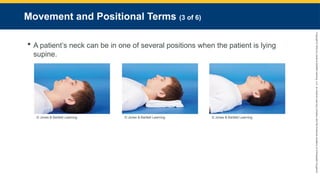
3. A patient’s neck can be in one of several positions when the patient is lying supine.
#56 Lecture Outline
4. The prefix hyper- is added to the terms flexion or extension to indicate mechanism of injury.
a. Hyper: Indicates normal range of motion for the particular joint was maximized or exceeded
b. Hyperflexion: Maximum flexion or flexion beyond the normal range of motion
c. Hyperextension: Maximum extension or extension beyond the normal range of motion
#57 Lecture Outline
5. Wrist injuries can also be described using the terms supination and pronation.
a. Supination: Turning the palms upward
b. Pronation: Turning the palms downward
#58 Lecture Outline
6. Rotational deformities
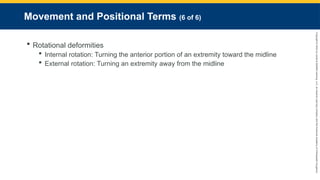
a. Internal rotation: Turning the anterior portion of an extremity toward the midline
b. External rotation: Turning an extremity away from the midline
#59 Lecture Outline
G. Other directional terms
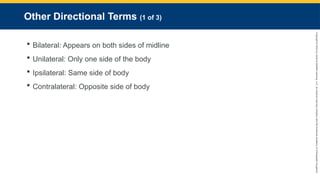
1. Bilateral: A body part or condition that appears on both sides of the midline
2. Unilateral: Structures that appear on only one side of the body
3. Unilateral and bilateral can also describe the location of pain, numbness, itching, or other phenomena.
4. Ipsilateral: Refers to the same side of the body
5. Contralateral: Refers to the opposite side of the body
#60 Lecture Outline
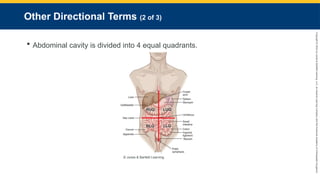
6. You must be able to describe the exact location of areas of the abdomen.
a. The abdominal cavity is divided into four equal quadrants.
b. The quadrants are formed from two lines intersecting at the umbilicus.
#61 Lecture Outline
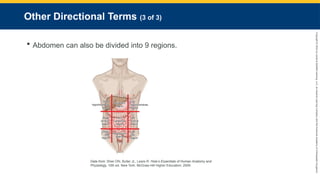
c. To describe location even more specifically, the abdomen can also be divided into nine regions.
#62 Lecture Outline
H. Position of the patient
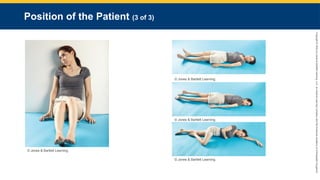
1. Use specific terms to describe the patient’s position.
a. Prone: Lying face down
b. Supine: Lying face up
c. Fowler position: Patient is sitting straight up, with the knees either bent or straight
d. Semi-Fowler position: Patient sits at a 45° angle; generally a position of comfort for those who do not need spinal motion restriction
#63 Lecture Outline
2. Recovery position: Helps maintain a clear airway in an unresponsive patient and prevents aspiration of vomitus
a. Also referred to as left lateral recumbent position
#65 Lecture Outline
VII. Abbreviations, Acronyms, and Symbols
A. Medical abbreviations, acronyms, and symbols are a type of shorthand used to communicate in the medical world.
1. Developed to allow us to communicate faster
a. Do not trade speed for accuracy.
b. Use only commonly understood acronyms and abbreviations to minimize misinterpretations and errors.
#66 Lecture Outline
2. All acronyms are abbreviations, but not all abbreviations are acronyms.
3. When you use an abbreviation, pronounce each letter of the abbreviation separately and distinctly.
4. Acronyms form shortened words from the initials of several words to produce a new word or phrase.
a. Example: “Urban Search and Rescue” becomes USAR (pronounced “U-sar”).
#67 Lecture Outline
5. An abbreviation is still considered an acronym if it’s pronounced as a word, even if the word formed isn’t part of the English language.
a. Example: HIPAA (“Health Insurance Portability and Accountability Act”) is an acronym because it’s pronounced as “hippa.”
b. Example: DEA is not an acronym because it’s spelled out like “D-E-A.”
B. Medical abbreviations
1. Abbreviations take the place of words to shorten documentation.
2. Ensure that the medical abbreviations you use are consistent with those approved in your EMS system.
#68 Lecture Outline
C. Error-prone abbreviations
1. The Joint Commission and the Institute for Safe Medication Practices (ISMP) have each published do not use lists of abbreviations.
2. Serious errors can occur when an abbreviation is not interpreted as intended.
a. HS on a prescription can mean either “hours of sleep” or “half-strength.”
3. To avoid errors, some agencies limit use of abbreviations or do not allow their use.
#69 Lecture Outline
4. Trailing zeros and naked decimals
a. Trailing zeros: Zeros after the decimal point
i. To avoid errors, always include a zero before the decimal, but leave it off after.
ii. Write “5 mg” not “5.0 mg” and “0.5 mg” not “.5 mg”
#70 Lecture Outline
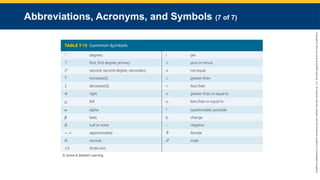
D. Symbols
1. Like abbreviations, symbols are sometimes used as a shortcut in documentation and other communication.
2. As with abbreviations, it is important to only use symbols that are widely understood and accepted.
3. Each EMS system should also keep a list of approved medical abbreviations for reporting and documentation purposes.
a. Learn which abbreviations are acceptable in your service area.
b. When in doubt, write out the term in full.
#72 Lecture Outline
VIII. Medical Terminology Related to Pharmacology
A. A paramedic must be familiar with terminology related to medications and medication administration, such as:
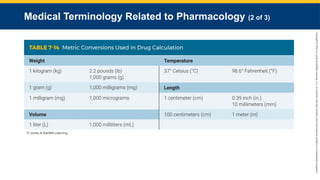
1. Metric conversions used in drug calculation
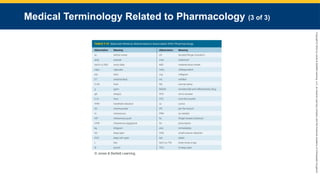
2. Selected medical abbreviations associated with pharmacology
IX. Master Tables
A. Tables 7-16 through 7-17 provide reference lists of selected prefixes, suffixes, combining forms, and abbreviations.
#73 This table shows metric conversions used in drug calculation.
#74 This table shows selected medical abbreviations associated with pharmacology.