Pediatric Assessment
Objectives
j
• Distinguish the three components of
the PAT.
• Assess pediatric-specific features of
initial assessment.
• Integrate findings to form a general
impression.
• Describe the focused history and PE.
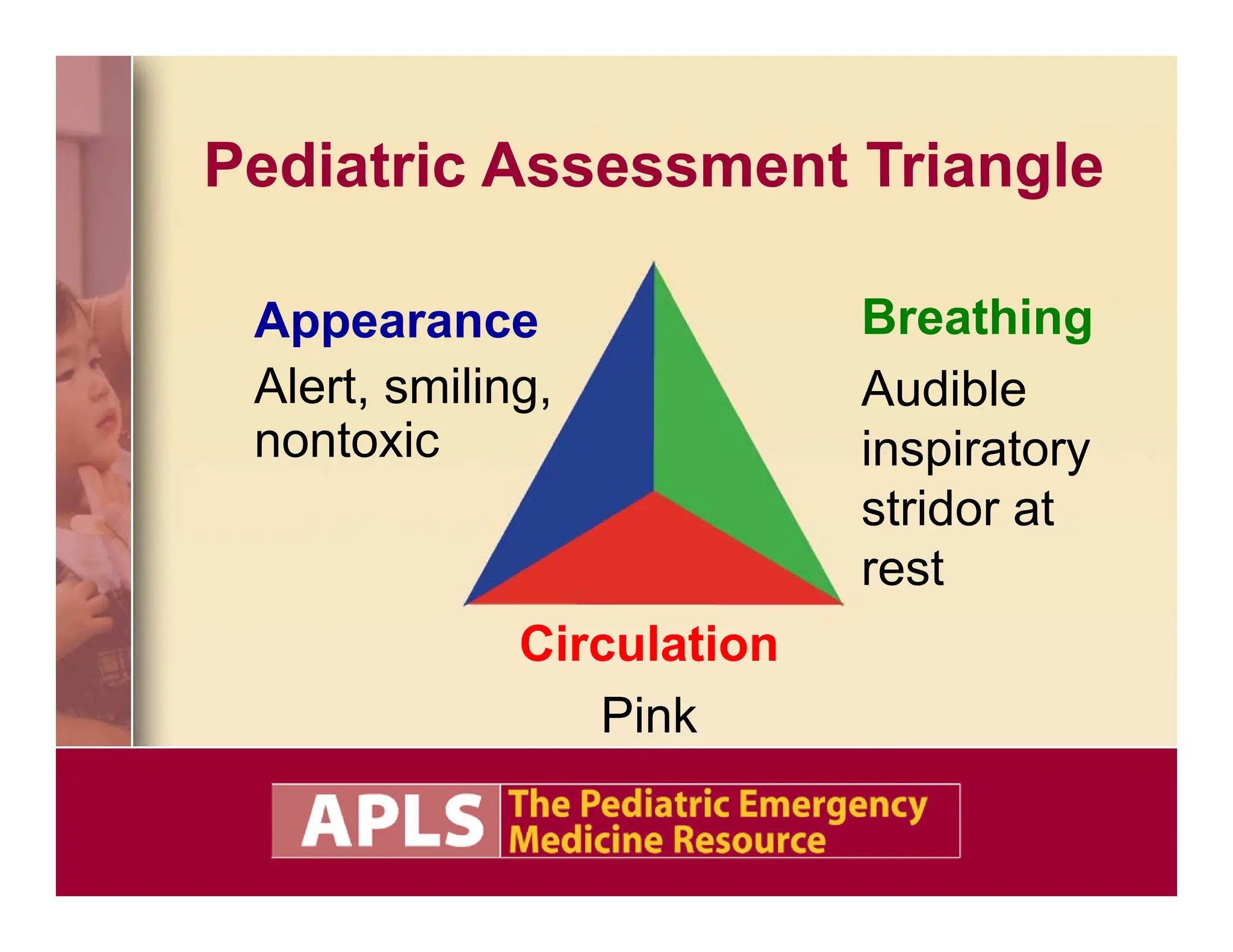
Pediatric Assessment Triangle
Appearance Breathing
Circulation
Circulation
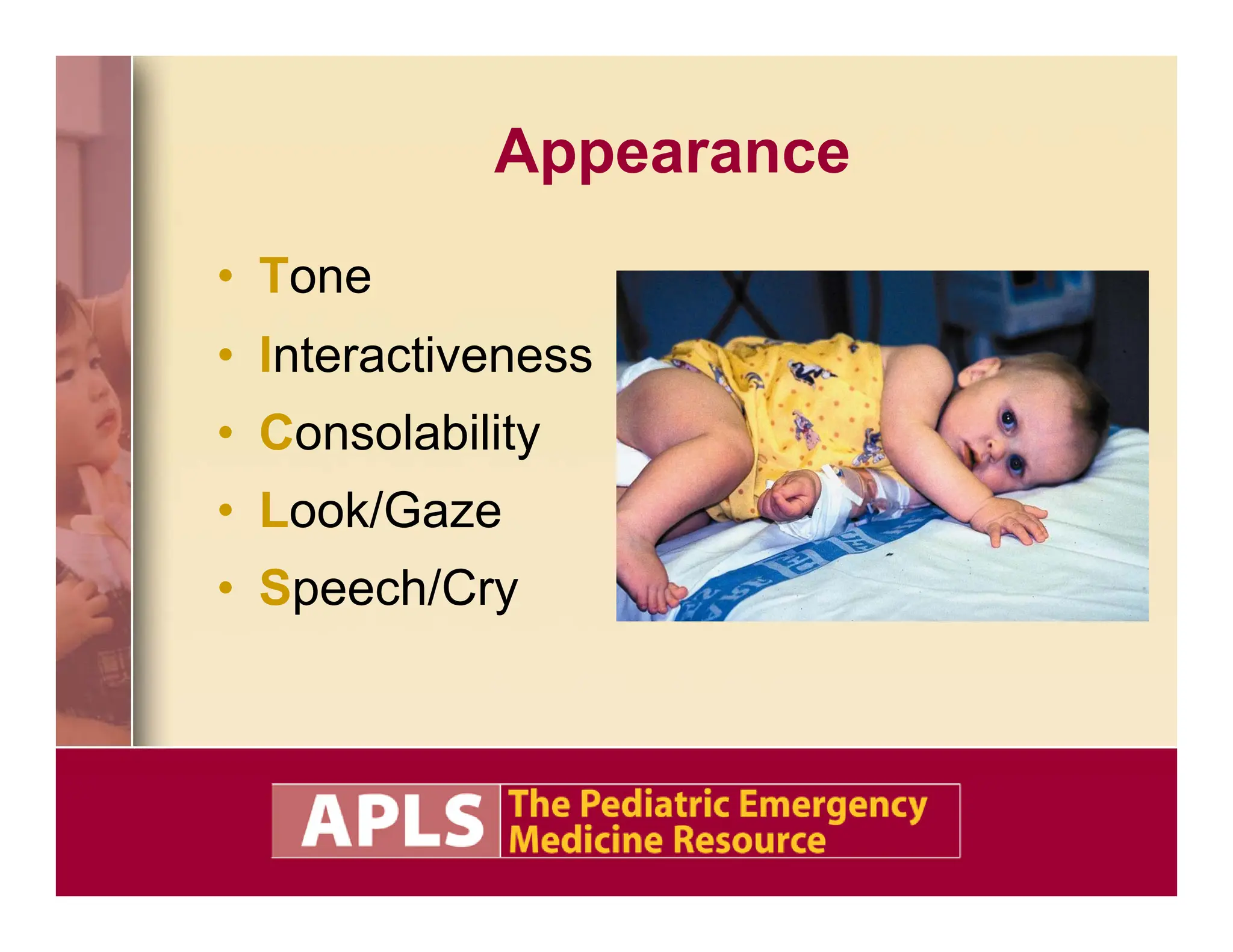
Appearance
pp
• Tone
• Interactiveness
C l bilit
• Consolability
• Look/Gaze
• Speech/Cry
Work of Breathing
g
• Abnormal airway
y
sounds
• Abnormal
Abnormal
positioning
• Retractions
• Retractions
• Nasal flaring
• Head bobbing
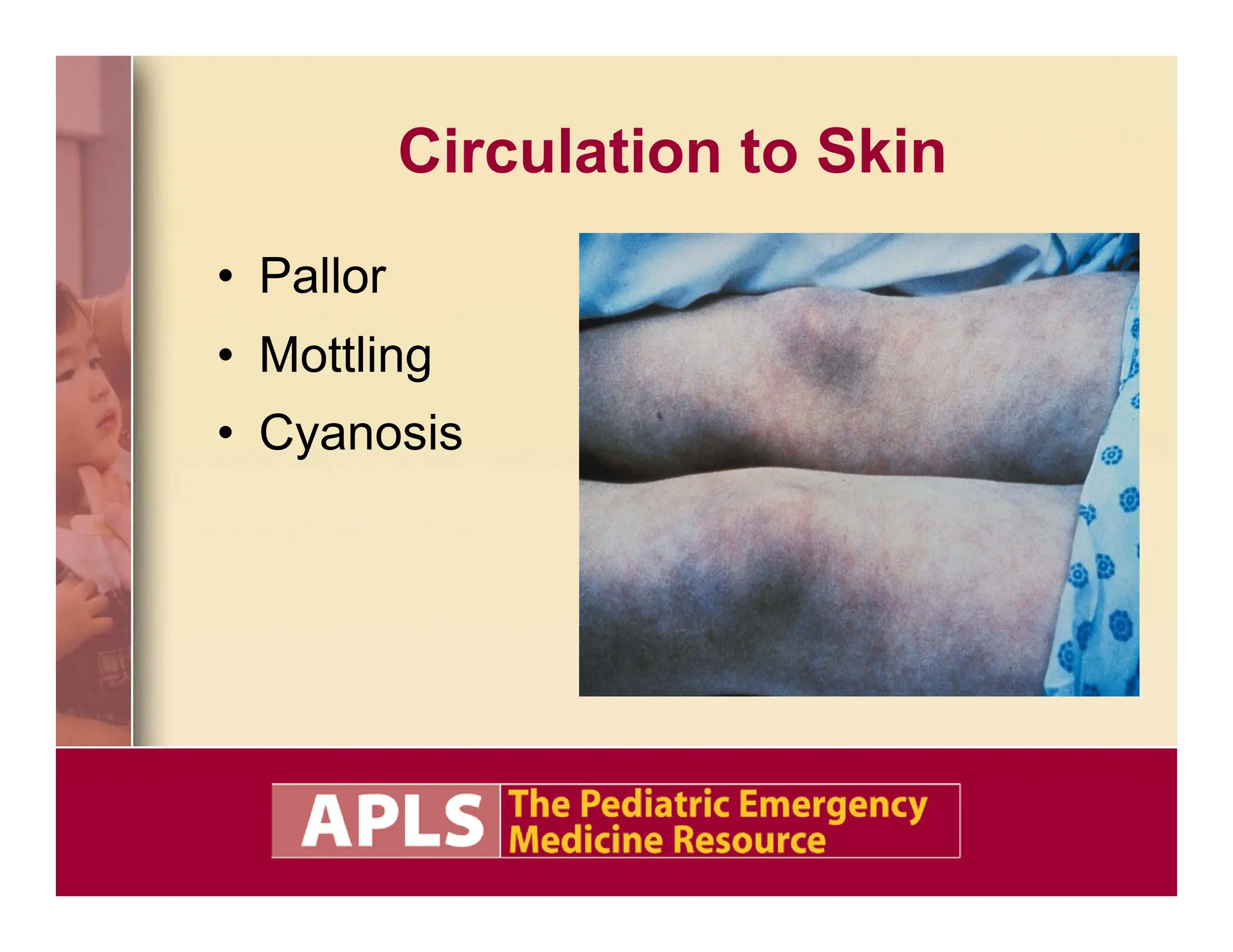
Circulation to Skin
• Pallor
• Mottling
C i
• Cyanosis
Case Study 1:
“Cough, Difficulty Breathing”
• One-year-old boy presents with
complaint of cough, difficulty breathing.
• Past history is unremarkable. He has
had nasal congestion, low grade fever
for 2 days.
Pediatric Assessment Triangle
Breathing
Audible
Appearance
Alert, smiling,
inspiratory
stridor at
nontoxic
Circulation
rest
Circulation
Pink
Questions
Q
What information does the PAT tell you
y
about this patient?
What is your general impression?
Pediatric Assessment Triangle:
Respiratory Distress
Appearance
Normal
Breathing
Abnormal
Normal Abnormal
Circulation
Circulation
Normal
General Impression
p
• Stable
• Respiratory distress
R i t f il
• Respiratory failure
• Shock
• Central nervous system dysfunction
• Cardiopulmonary failure/arrest
Cardiopulmonary failure/arrest
Case Progression/Outcome
g
• Initial assessment: Respiratory distress
p y
with upper airway obstruction
• Initial treatment priorities:
Initial treatment priorities:
– Leave in a position of comfort.
– Obtain oxygen saturation
– Obtain oxygen saturation.
– Provide oxygen as needed.
Begin specific therapy
– Begin specific therapy.
Case Study 2:
“S Diffi lt B thi ”
“Severe Difficulty Breathing”
• 3-month-old girl presents with severe
3 month old girl presents with severe
difficulty breathing.
• Seen in ED two days earlier; sent
home with a diagnosis of bronchiolitis
Her difficulty breathing has increased
• Her difficulty breathing has increased.
What further information would you like?
Pediatric Assessment Triangle
g
Breathing
Appearance g
Marked sternal and
intercostal
retractions rapid
pp
Lethargic,
glassy stare,
retractions, rapid
and shallow
respirations
g y ,
poor muscle
tone
Circulation
Circulation
Pale with circumoral cyanosis
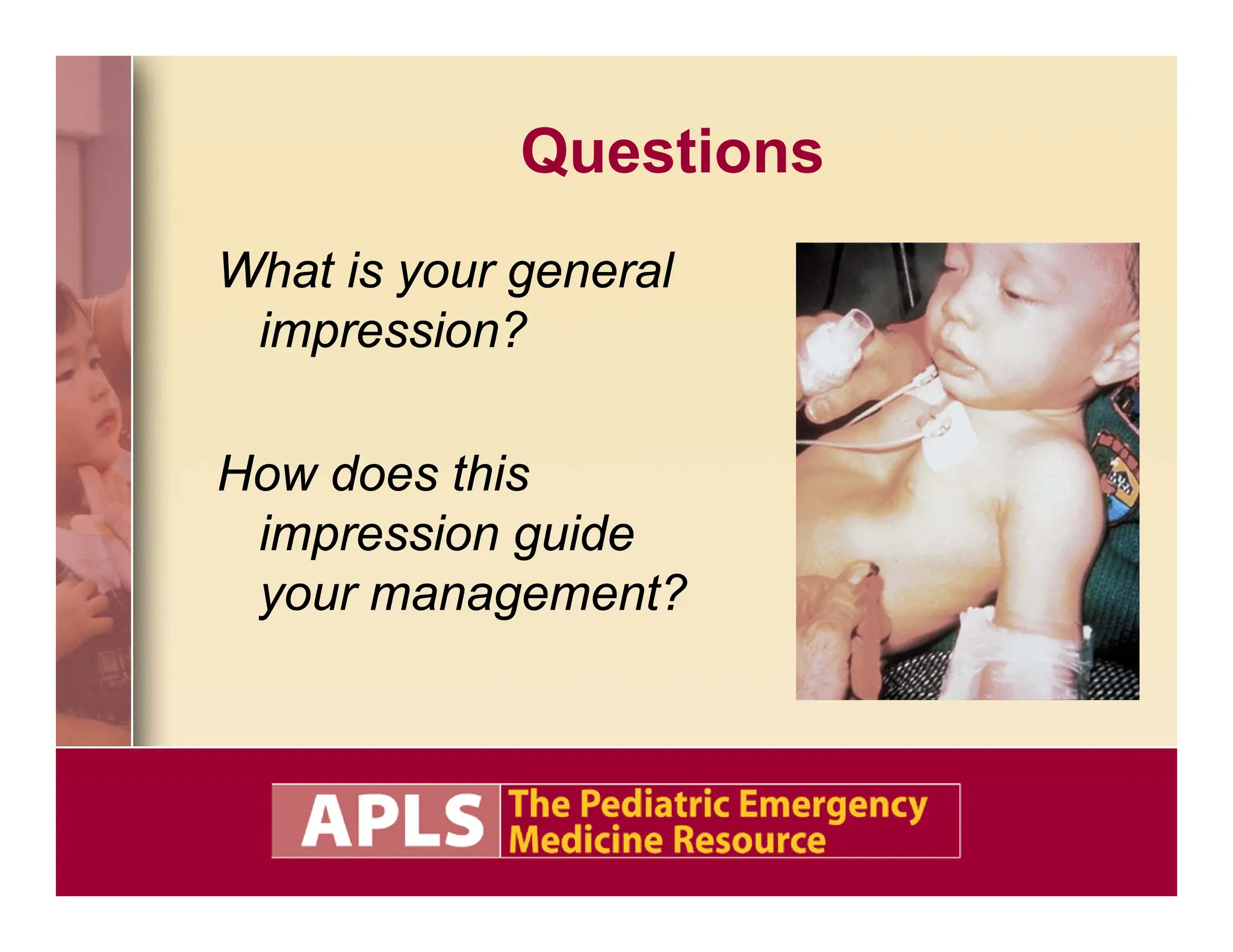
Questions
Q
What is your general
y g
impression?
How does this
impression guide
impression guide
your management?
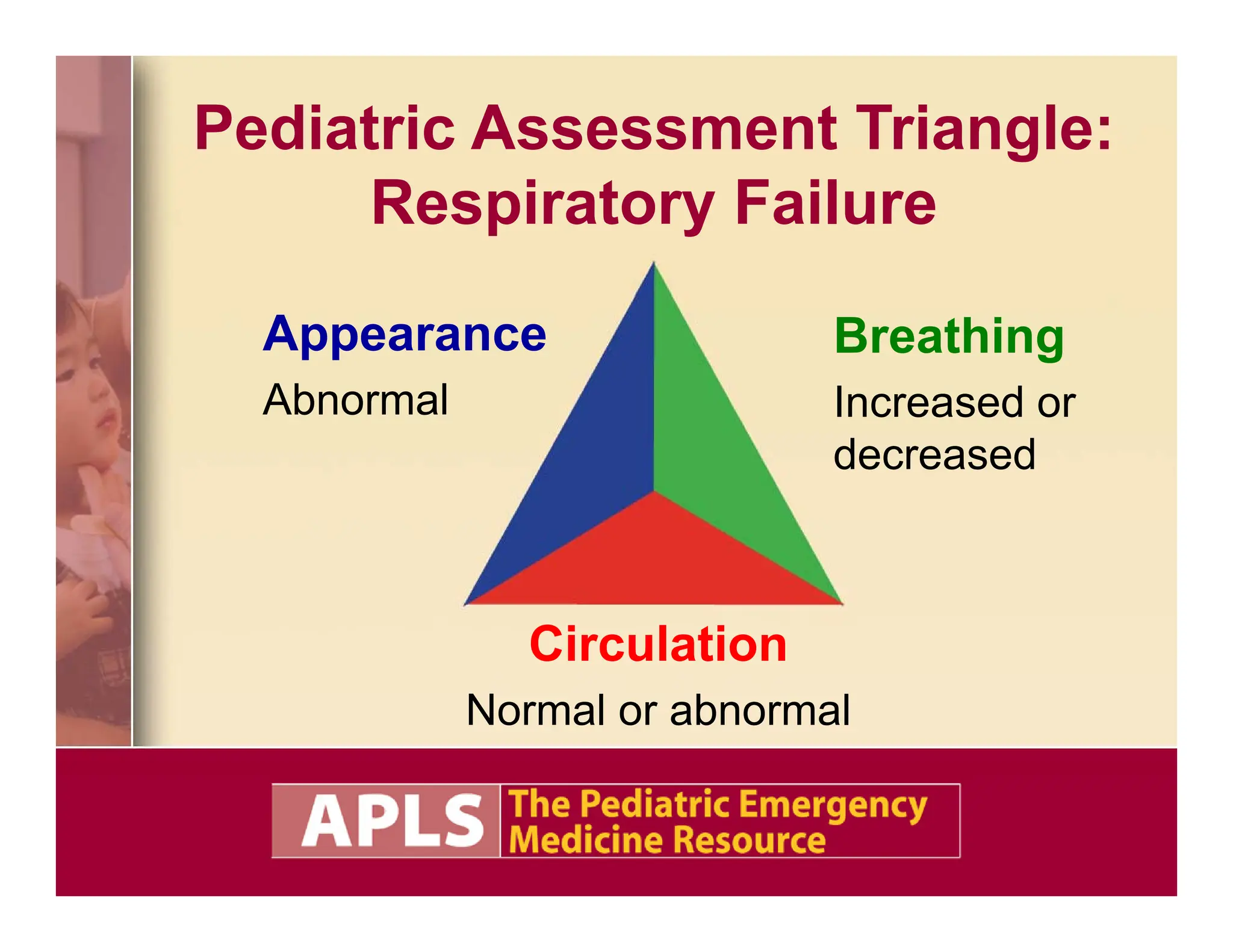
Pediatric Assessment Triangle:
Respiratory Failure
Breathing
Increased or
Appearance
Abnormal Increased or
decreased
Circulation
Circulation
Normal or abnormal
Case Progression/Outcome
g
• General impression: Respiratory failure or
cardiopulmonary failure
• Management priorities:
– Support oxygenation and ventilation with bag
mask; prepare for endotracheal intubation.
Assess cardiac function vascular access
– Assess cardiac function, vascular access.
– Continually reassess after each intervention.
Case Study 3: “Vomiting”
y g
• 15-month-old boy with 24-hour history
y y
of vomiting, diarrhea.
• Diarrhea is watery with blood and pus.
Diarrhea is watery with blood and pus.
• Attempts at oral rehydration by mom
were unsuccessful
were unsuccessful.
• Called ambulance when child became
listless and ref sed feedings
listless and refused feedings.
Pediatric Assessment Triangle
Appearance Breathing
Appearance
Listless,
responds poorly
Breathing
Effortless
tachypnea no
responds poorly
to environment
tachypnea, no
retractions
Circulation
Pale face and trunk, mottled extremities
Case Progression/Outcome
g
• Initial impression: Shock
• Management considerations
– Provide oxygen by mask.
– Obtain quick vascular access.
– Administer volume-expanding crystalloid
(NS or LR) in 20 mL/kg increments.
– Continuous reassessment and complete
exam
exam.
Pediatric Assessment Triangle:
Shock
Appearance
Abnormal
Breathing
Normal
Abnormal Normal
Circulation
Circulation
Abnormal
Case Study 4: “Lethargy”
y gy
• 6-month-old girl brought to ED by
g g y
mother after “falling from the bed” onto
carpeted floor.
p
• Mother states infant is “sleepy,” was
worried when there was no
improvement in mental status after
three hours of observation.
Pediatric Assessment Triangle
Appearance
Lethargic, poorly
i t
Breathing
Normal
responsive to
environment
Circulation
Circulation
Normal
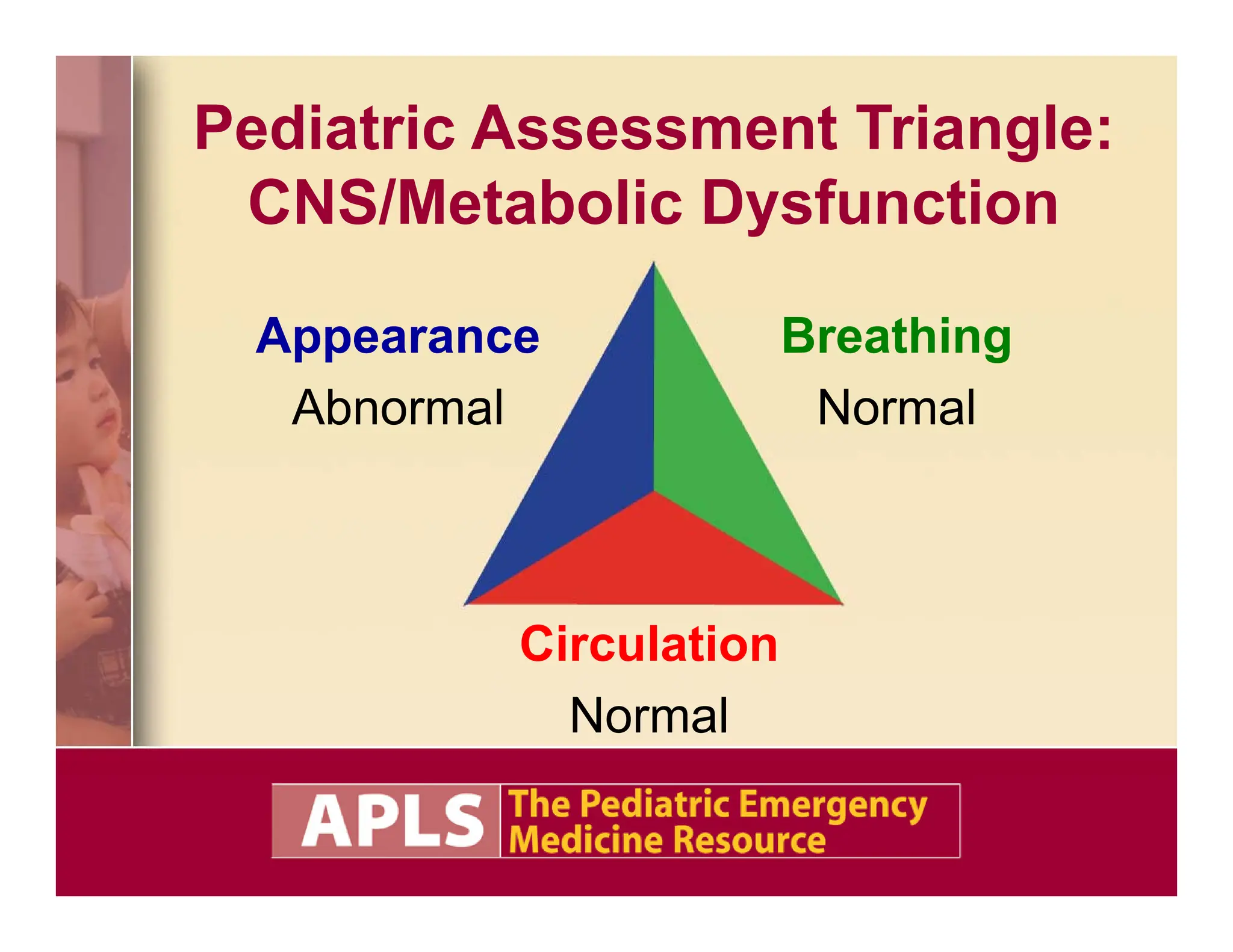
Pediatric Assessment Triangle:
CNS/Metabolic Dysfunction
Appearance
Abnormal
Breathing
Normal
Abnormal Normal
Circulation
Circulation
Normal
Case Progression
g
• General impression: Primary CNS or
metabolic dysfunction
• Management priorities:
– Provide oxygen, closely monitor ventilation.
– Obtain vascular access, rapid glucose screen.
Perform further physical assessment
– Perform further physical assessment.
– Obtain blood for labs, cultures, metabolic studies.
– Obtain CT of head radiographs
Obtain CT of head, radiographs.
General Impression
p
• Pediatric Assessment Triangle
g
• Hands-on assessment of ABCDEs
– Pediatric differences
Pediatric differences
Airway
y
• Manual airway opening maneuvers: Head
tilt-chin lift, jaw thrust
• Suction: Can result in dramatic improvement
in infants
• Age-specific obstructed airway support:
– <1 year: Back blow/chest thrust
– >1 year: Abdominal thrust
Ad d i t h i
• Advanced airway techniques
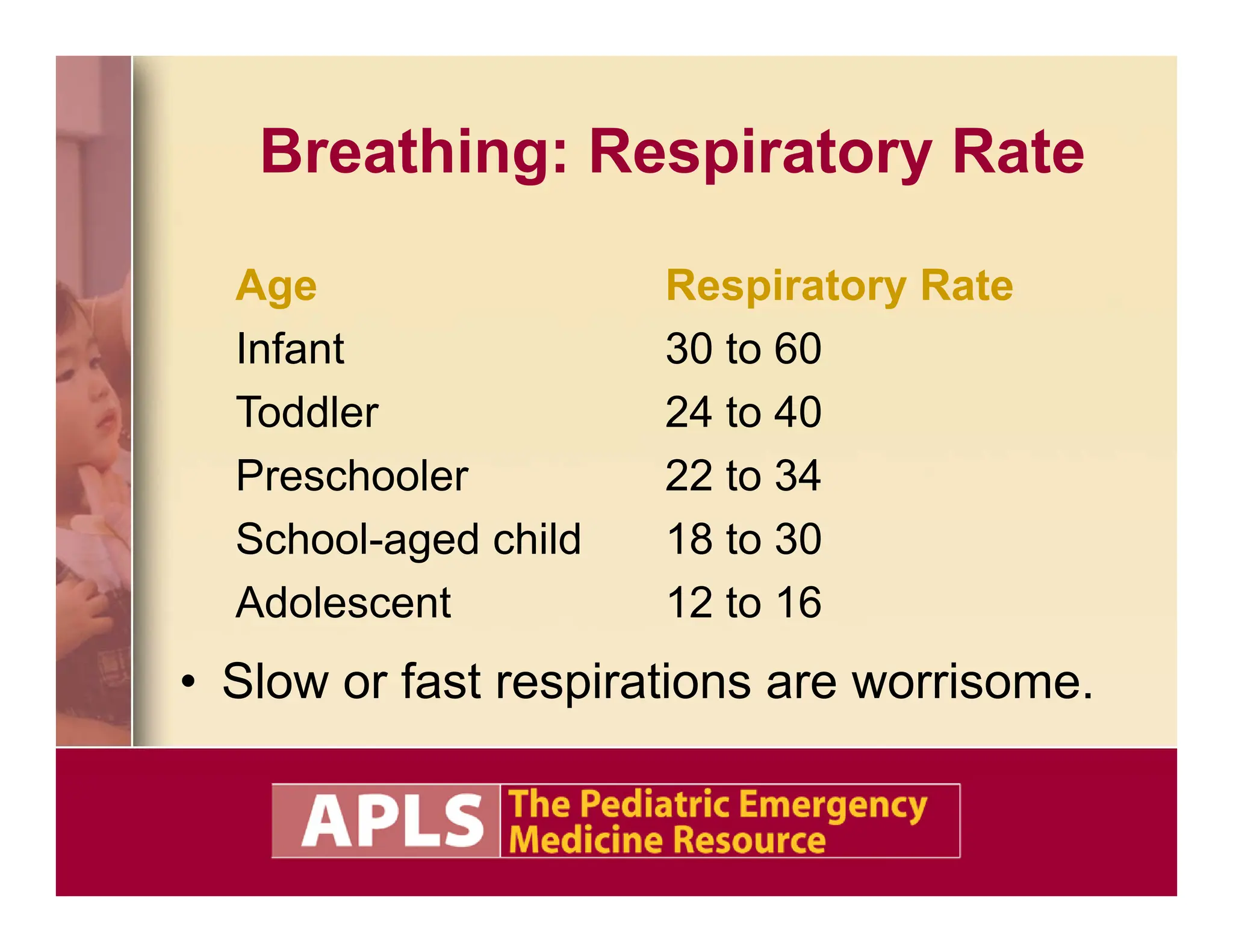
Breathing: Respiratory Rate
g p y
Age Respiratory Rate
Infant 30 to 60
Toddler 24 to 40
Toddler 24 to 40
Preschooler 22 to 34
School aged child 18 to 30
School-aged child 18 to 30
Adolescent 12 to 16
• Slow or fast respirations are worrisome.
Breathing: Auscultation
g
• Listen with stethoscope over midaxillary line
and above sternal notch
– Stridor: Upper airway obstruction
Wh i L i b i
– Wheezing: Lower airway obstruction
– Grunting: Poor oxygenation; pneumonia,
drowning pulmonary contusion
drowning, pulmonary contusion
– Crackles: Fluid, mucus, blood in airway
– Decreased/absent breath sounds: Obstruction
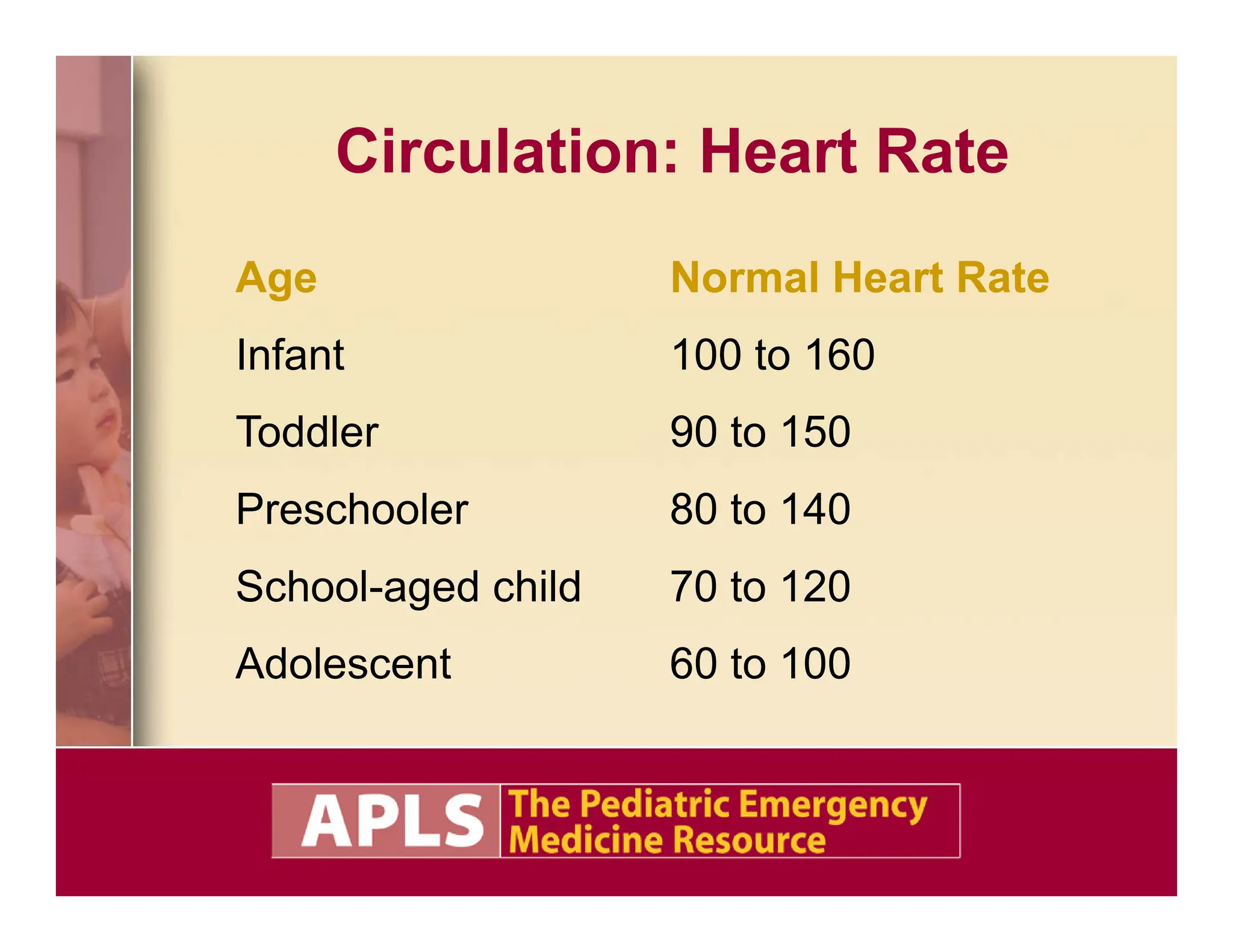
Circulation: Heart Rate
Age Normal Heart Rate
g
Infant 100 to 160
T ddl 90 1 0
Toddler 90 to 150
Preschooler 80 to 140
School-aged child 70 to 120
Adolescent 60 to 100
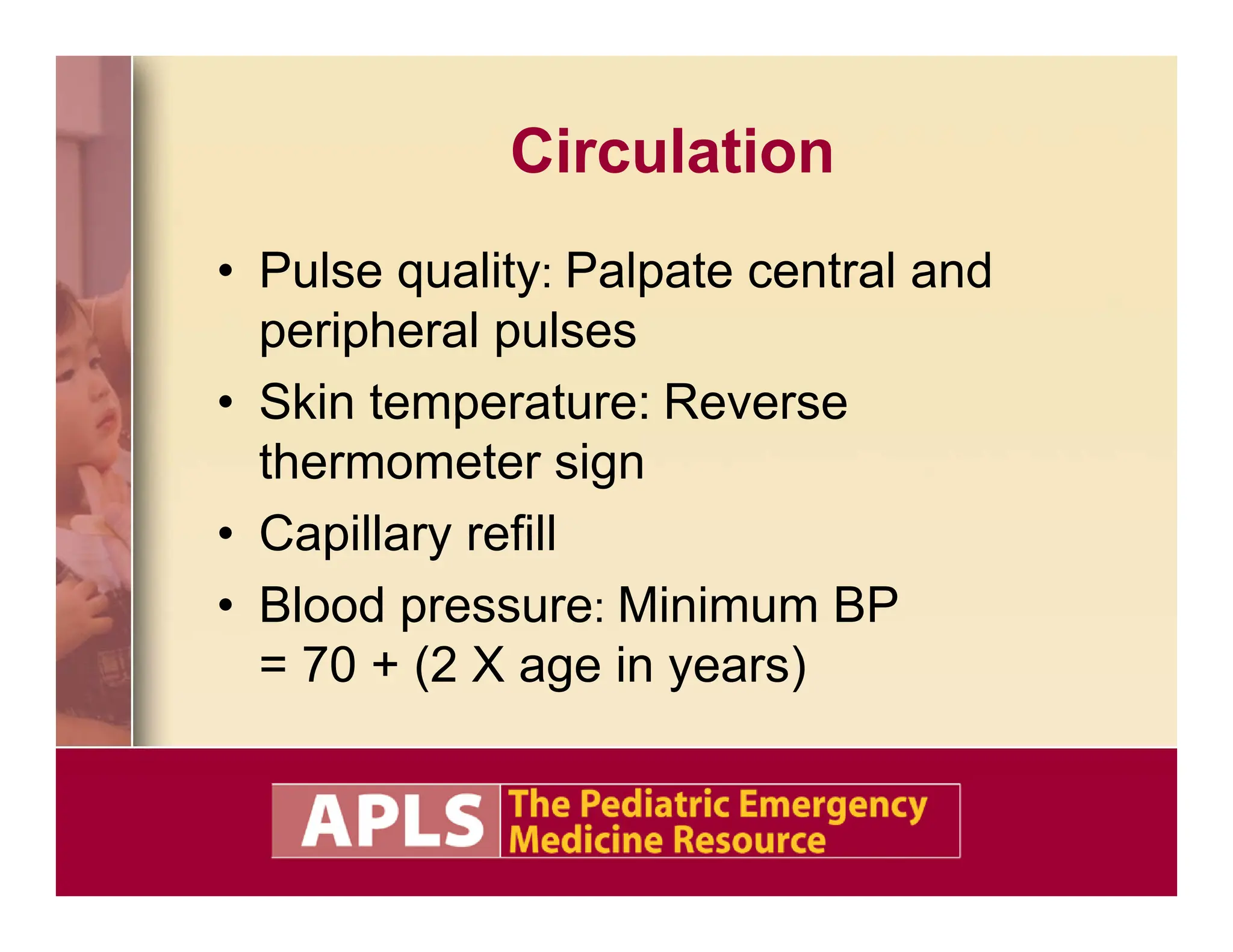
Circulation
• Pulse quality: Palpate central and
q y p
peripheral pulses
• Skin temperature: Reverse
Skin temperature: Reverse
thermometer sign
• Capillary refill
• Capillary refill
• Blood pressure: Minimum BP
70 + (2 X age in ears)
= 70 + (2 X age in years)
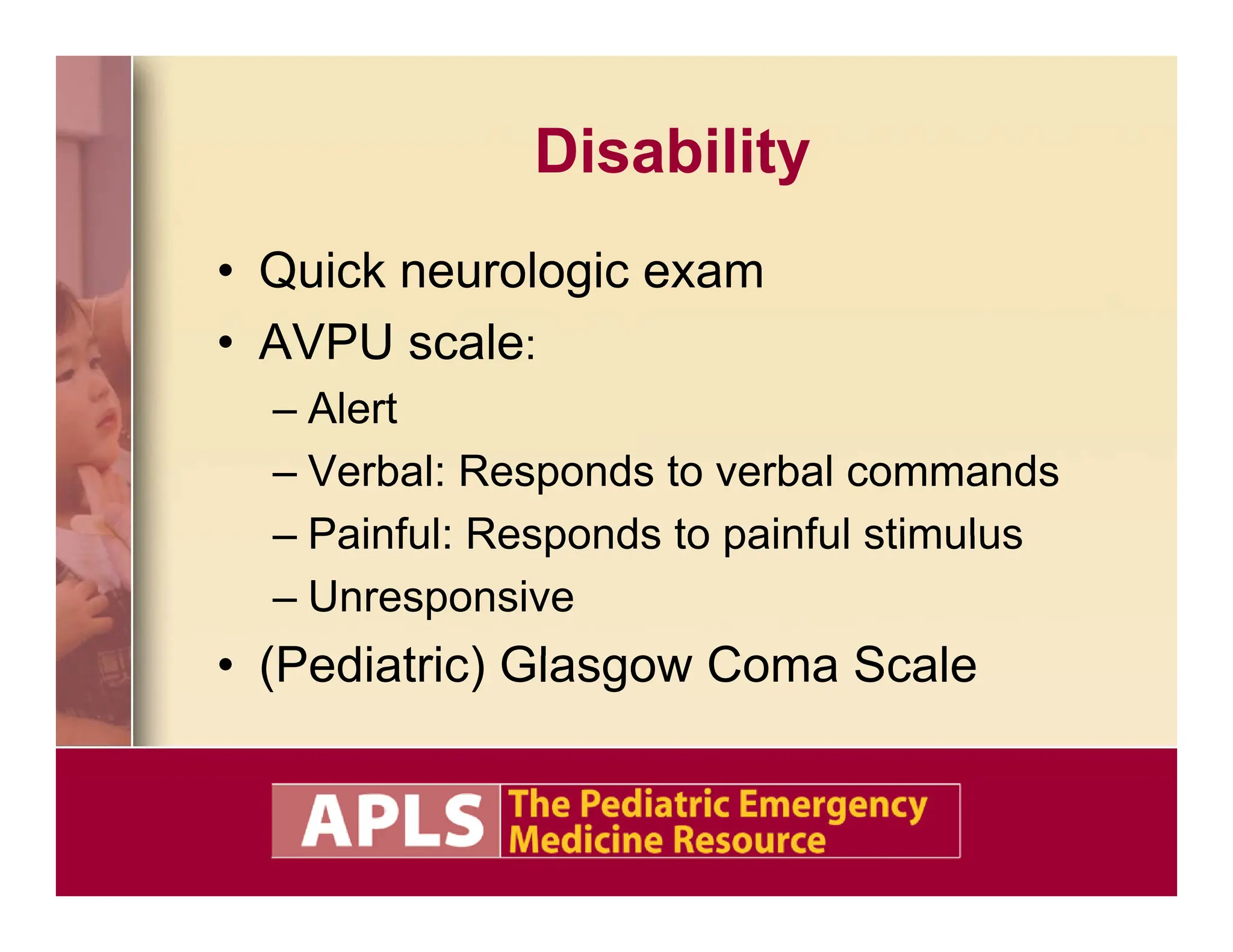
Disability
y
• Quick neurologic exam
g
• AVPU scale:
– Alert
Alert
– Verbal: Responds to verbal commands
Painful: Responds to painful stimulus
– Painful: Responds to painful stimulus
– Unresponsive
(Pediatric) Glasgo Coma Scale
• (Pediatric) Glasgow Coma Scale
Exposure
p
• Proper exposure is necessary to
p p y
evaluate physiologic function and
identify anatomic abnormalities.
y
• Maintain warm ambient environment
and minimize heat loss.
• Monitor temperature.
Warm IV fl ids
• Warm IV fluids.
Initial Assessment
• A: Gurgling upper airway sounds
B I l i ti
• B: Irregular respirations
• C: Infant is pale.
• D: Responds to painful stimuli. Pupils
are equal, but react sluggishly to
li ht
light.
• E: Shows signs of trauma.
What are your management priorities?
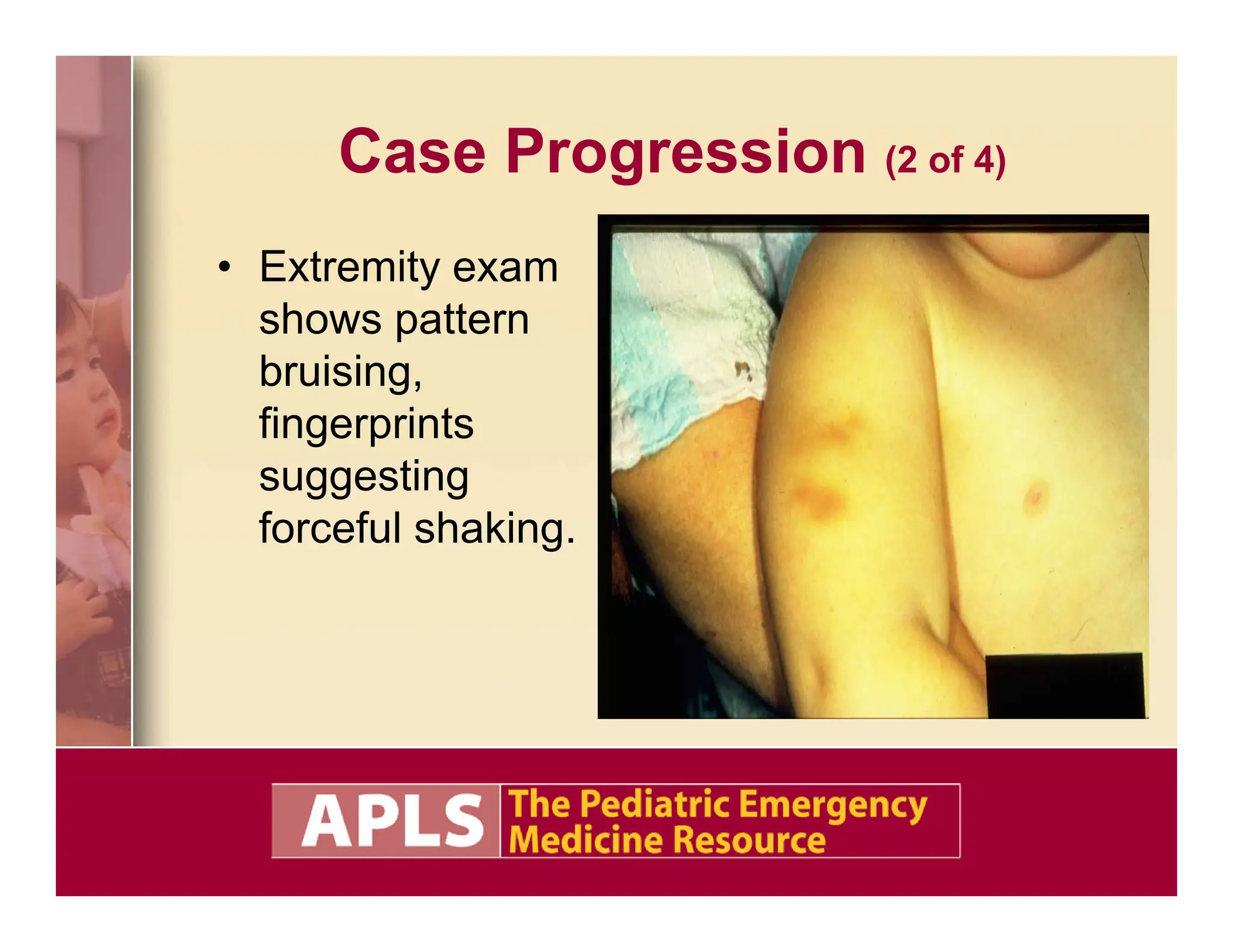
Case Progression (2 of 4)
g ( )
• Extremity exam
shows pattern
bruising,
fingerprints
fingerprints
suggesting
forceful shaking
forceful shaking.
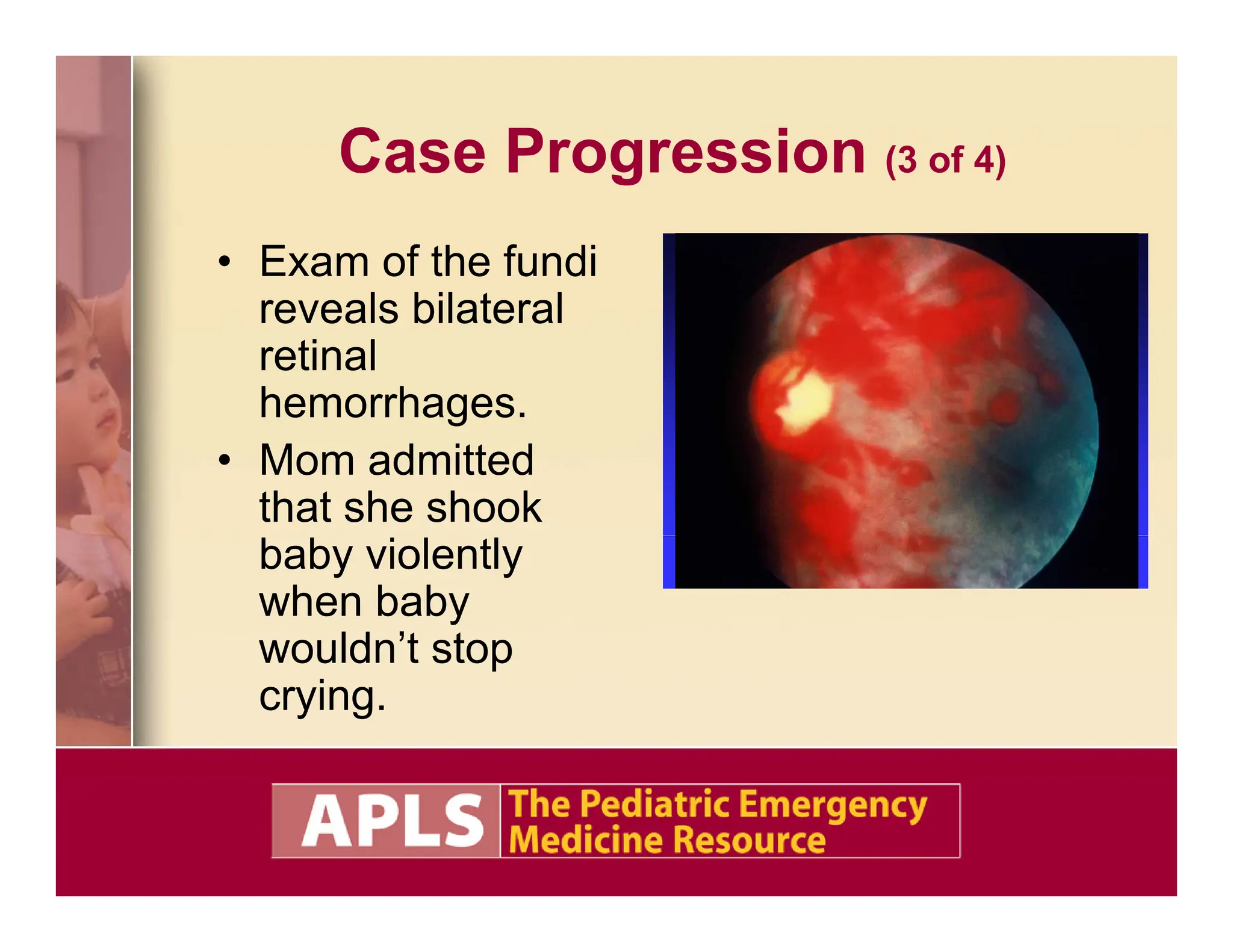
Case Progression (3 of 4)
g ( )
• Exam of the fundi
l bil t l
reveals bilateral
retinal
hemorrhages.
hemorrhages.
• Mom admitted
that she shook
baby violently
when baby
wouldn’t stop
APLS: The Pediatric Emergency Medicine Resource
wouldn t stop
crying.
Case Progression (4 of 4)
g ( )
• Vascular access is obtained, screening
g
blood glucose is 86 mg/dL, infant is
placed on oxygen by mask.
p yg y
Based on the two parts of the initial
assessment, what are your
management priorities now?
Management Priorities
g
• RSI, secure airway using drugs to blunt
increases in intracranial pressure.
• Deliver 100% oxygen.
• Monitor end tidal CO2 and oxygen
saturation.
P id i t l di
• Provide intravenous volume-expanding
crystalloid fluids.
• Perform CT of head and neurosurgical
consultation.
Developmental Issues and
th PAT
the PAT
What does a
What does a
normal PAT look
like in a 2 week
like in a 2-week-
old?
A 2 th ld?
A 2-month-old?
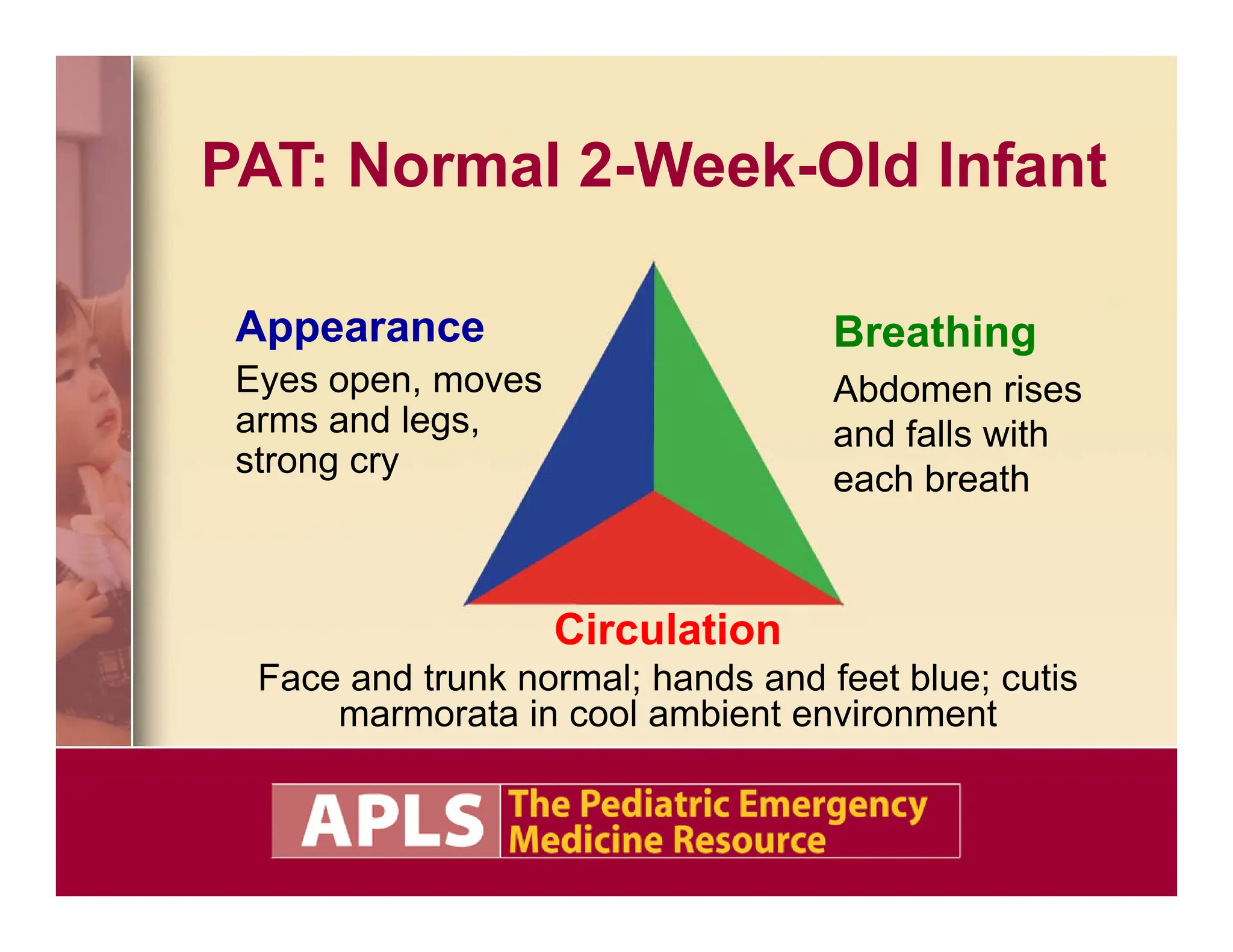
PAT: Normal 2-Week-Old Infant
PAT: Normal 2 Week Old Infant
Breathing
Abdomen rises
Appearance
Eyes open, moves
arms and legs and falls with
each breath
arms and legs,
strong cry
Circulation
Face and trunk normal; hands and feet blue; cutis
marmorata in cool ambient environment
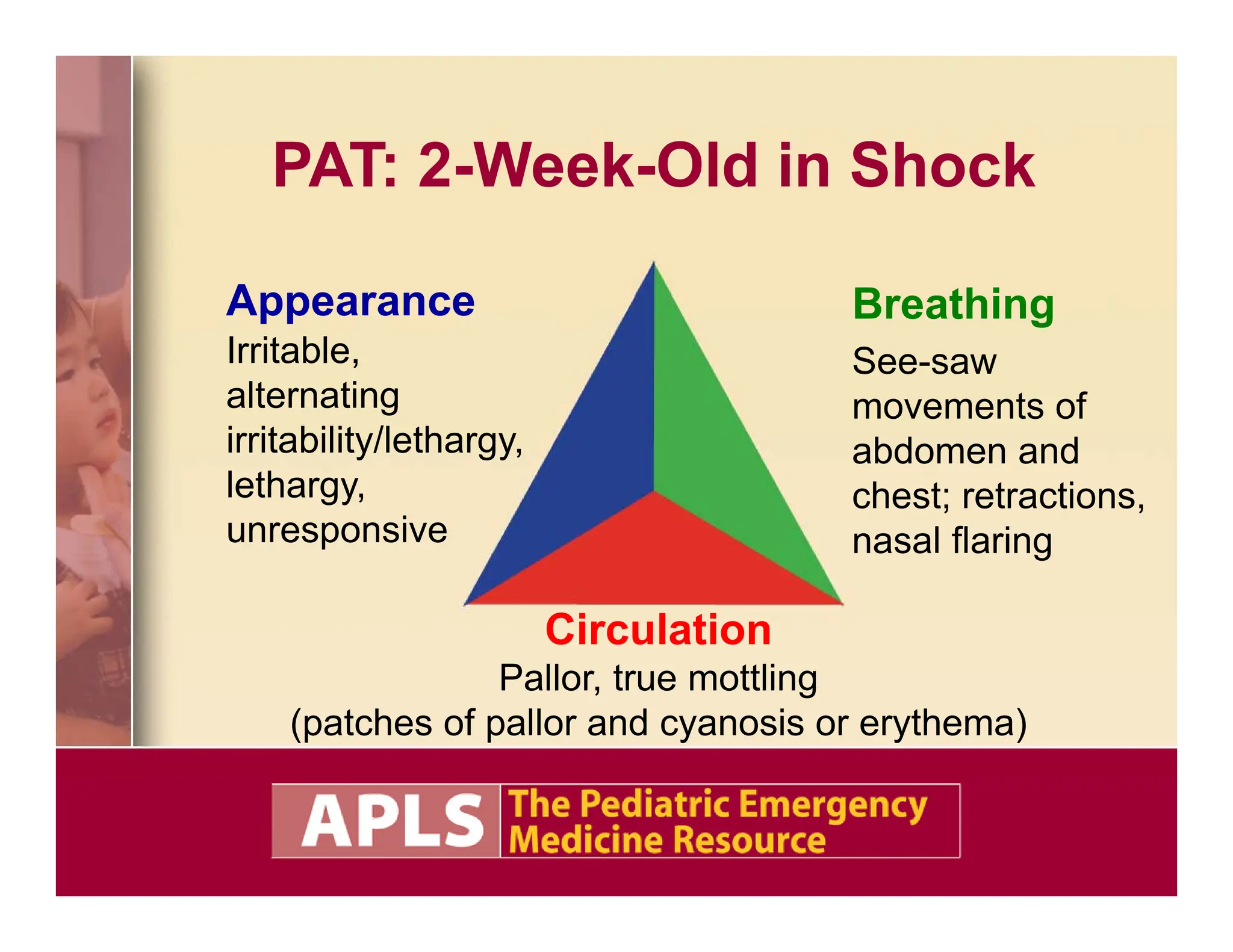
PAT: 2-Week-Old in Shock
PAT: 2 Week Old in Shock
Breathing
Appearance Breathing
See-saw
movements of
Appearance
Irritable,
alternating movements of
abdomen and
chest; retractions,
nasal flaring
irritability/lethargy,
lethargy,
unresponsive
Circulation
nasal flaring
unresponsive
Pallor, true mottling
(patches of pallor and cyanosis or erythema)
Assessment:
L Th 2 M th Old
Less Than 2 Months Old
• Consoled when held, gently rocked
, g y
• Brief awake periods
• Little or no eye contact
• No “social smile”
D t i t
• Does not recognize parents vs.
strangers
Limited beha ioral repertoire
• Limited behavioral repertoire
Assessment: 2-6 Months Old
• Social smile
• Recognizes caregivers
• Tracks light, faces
g ,
• Strong cry, increasing vocalization
• Rolls over sits with support
Rolls over, sits with support
• When possible, do much of the exam
in caretaker’s lap/arms
in caretaker s lap/arms.
Assessment: 6-12 Months Old
• Socially interactive, babbles
y
• Sits without support, increased mobility
• Everything goes in mouth
• Stranger/separation anxiety
• Sit or squat to get at eye level when
examining, use “toe-to-head”
approach.
Assessment: 1-3 Years Old
• “Terrible twos”
• Increased mobility
• Curious about everything, no fear
y g,
• Egocentric, very strong opinions
• Not swayed by logic
Not swayed by logic
• Language comprehension is greater
than expression
than expression.
Assessment: 4-10 Years Old
• Analytical, understands cause and
effect
• Cooperative, “age of reason”
• But:
– Many misconceptions about the body
– May overestimate implications of
illness/injury, and misinterpret information
– Independence may crumble when sick.
Assessment: Adolescent
• Similar to “toddlers”:
– Risk-takers, no fear of danger, don’t anticipate
consequences. Not swayed by common sense.
Dependence shifts from family to peers
– Dependence shifts from family to peers.
• Techniques for assessment:
Respect privacy provide concrete explanations
– Respect privacy, provide concrete explanations.
– Talk to the teen, not the parents.
– Do not succumb to provocation.
Do not succumb to provocation.
Focused History
y
• Complete history including mechanism
p y g
of injury or circumstances of illness
• Use SAMPLE mnemonic:
Use SAMPLE mnemonic:
– Signs/Symptoms
– Allergies
– Past medical
problems
– Allergies
– Medications
problems
– Last food or liquid
– Events leading to
g
injury or illness
Detailed Physical Exam
y
• Establish a clinical diagnosis.
g
• Plan sequence of laboratory testing
and imaging.
and imaging.
Ongoing Assessment
g g
• Systematic review of assessment points:
y p
– Pediatric Assessment Triangle
– ABCDEs
– Repeat vital signs
– Reassessment of positive anatomic findings, and
h i l i d t
physiologic derangements
– Review of effectiveness and safety of treatment
The Bottom Line
• Begin with PAT followed by ABCDEs.
• Form a general impression to guide
management priorities.
Treat respiratory distress failure and shock
• Treat respiratory distress, failure, and shock
when recognized.
• Focused history and detailed PE
Focused history and detailed PE.
• Perform ongoing assessment throughout ED
stay.
y
Pediatric Assessment Triangle in Children. pdf

Pediatric Assessment Triangle in Children. pdf

  • 1.
  • 2.
    Objectives j • Distinguish thethree components of the PAT. • Assess pediatric-specific features of initial assessment. • Integrate findings to form a general impression. • Describe the focused history and PE.
  • 3.
    Pediatric Assessment Triangle PediatricAssessment Triangle Appearance Breathing Circulation Circulation
  • 4.
    Appearance pp • Tone • Interactiveness Cl bilit • Consolability • Look/Gaze • Speech/Cry
  • 5.
    Work of Breathing g •Abnormal airway y sounds • Abnormal Abnormal positioning • Retractions • Retractions • Nasal flaring • Head bobbing
  • 6.
    Circulation to Skin •Pallor • Mottling C i • Cyanosis
  • 7.
    Case Study 1: “Cough,Difficulty Breathing” • One-year-old boy presents with complaint of cough, difficulty breathing. • Past history is unremarkable. He has had nasal congestion, low grade fever for 2 days.
  • 8.
    Pediatric Assessment Triangle PediatricAssessment Triangle Breathing Audible Appearance Alert, smiling, inspiratory stridor at nontoxic Circulation rest Circulation Pink
  • 9.
    Questions Q What information doesthe PAT tell you y about this patient? What is your general impression?
  • 10.
    Pediatric Assessment Triangle: RespiratoryDistress Appearance Normal Breathing Abnormal Normal Abnormal Circulation Circulation Normal
  • 11.
    General Impression p • Stable •Respiratory distress R i t f il • Respiratory failure • Shock • Central nervous system dysfunction • Cardiopulmonary failure/arrest Cardiopulmonary failure/arrest
  • 12.
    Case Progression/Outcome g • Initialassessment: Respiratory distress p y with upper airway obstruction • Initial treatment priorities: Initial treatment priorities: – Leave in a position of comfort. – Obtain oxygen saturation – Obtain oxygen saturation. – Provide oxygen as needed. Begin specific therapy – Begin specific therapy.
  • 13.
    Case Study 2: “SDiffi lt B thi ” “Severe Difficulty Breathing” • 3-month-old girl presents with severe 3 month old girl presents with severe difficulty breathing. • Seen in ED two days earlier; sent • Seen in ED two days earlier; sent home with a diagnosis of bronchiolitis Her difficulty breathing has increased • Her difficulty breathing has increased. What further information would you like?
  • 14.
    Pediatric Assessment Triangle g Breathing Appearanceg Marked sternal and intercostal retractions rapid pp Lethargic, glassy stare, retractions, rapid and shallow respirations g y , poor muscle tone Circulation Circulation Pale with circumoral cyanosis
  • 15.
    Questions Q What is yourgeneral y g impression? How does this impression guide impression guide your management?
  • 16.
    Pediatric Assessment Triangle: RespiratoryFailure Breathing Increased or Appearance Abnormal Increased or decreased Circulation Circulation Normal or abnormal
  • 17.
    Case Progression/Outcome g • Generalimpression: Respiratory failure or cardiopulmonary failure • Management priorities: – Support oxygenation and ventilation with bag mask; prepare for endotracheal intubation. Assess cardiac function vascular access – Assess cardiac function, vascular access. – Continually reassess after each intervention.
  • 18.
    Case Study 3:“Vomiting” y g • 15-month-old boy with 24-hour history y y of vomiting, diarrhea. • Diarrhea is watery with blood and pus. Diarrhea is watery with blood and pus. • Attempts at oral rehydration by mom were unsuccessful were unsuccessful. • Called ambulance when child became listless and ref sed feedings listless and refused feedings.
  • 19.
    Pediatric Assessment Triangle PediatricAssessment Triangle Appearance Breathing Appearance Listless, responds poorly Breathing Effortless tachypnea no responds poorly to environment tachypnea, no retractions Circulation Pale face and trunk, mottled extremities
  • 20.
    Case Progression/Outcome g • Initialimpression: Shock • Management considerations – Provide oxygen by mask. – Obtain quick vascular access. – Administer volume-expanding crystalloid (NS or LR) in 20 mL/kg increments. – Continuous reassessment and complete exam exam.
  • 21.
  • 22.
    Case Study 4:“Lethargy” y gy • 6-month-old girl brought to ED by g g y mother after “falling from the bed” onto carpeted floor. p • Mother states infant is “sleepy,” was worried when there was no worried when there was no improvement in mental status after three hours of observation. three hours of observation.
  • 23.
    Pediatric Assessment Triangle PediatricAssessment Triangle Appearance Lethargic, poorly i t Breathing Normal responsive to environment Circulation Circulation Normal
  • 24.
    Pediatric Assessment Triangle: CNS/MetabolicDysfunction Appearance Abnormal Breathing Normal Abnormal Normal Circulation Circulation Normal
  • 25.
    Case Progression g • Generalimpression: Primary CNS or metabolic dysfunction • Management priorities: – Provide oxygen, closely monitor ventilation. – Obtain vascular access, rapid glucose screen. Perform further physical assessment – Perform further physical assessment. – Obtain blood for labs, cultures, metabolic studies. – Obtain CT of head radiographs Obtain CT of head, radiographs.
  • 26.
    General Impression p • PediatricAssessment Triangle g • Hands-on assessment of ABCDEs – Pediatric differences Pediatric differences
  • 27.
    Airway y • Manual airwayopening maneuvers: Head tilt-chin lift, jaw thrust • Suction: Can result in dramatic improvement in infants • Age-specific obstructed airway support: – <1 year: Back blow/chest thrust – >1 year: Abdominal thrust Ad d i t h i • Advanced airway techniques
  • 28.
    Breathing: Respiratory Rate gp y Age Respiratory Rate Age Respiratory Rate Infant 30 to 60 Toddler 24 to 40 Toddler 24 to 40 Preschooler 22 to 34 School aged child 18 to 30 School-aged child 18 to 30 Adolescent 12 to 16 • Slow or fast respirations are worrisome.
  • 29.
    Breathing: Auscultation g • Listenwith stethoscope over midaxillary line and above sternal notch – Stridor: Upper airway obstruction Wh i L i b i – Wheezing: Lower airway obstruction – Grunting: Poor oxygenation; pneumonia, drowning pulmonary contusion drowning, pulmonary contusion – Crackles: Fluid, mucus, blood in airway – Decreased/absent breath sounds: Obstruction
  • 30.
    Circulation: Heart Rate AgeNormal Heart Rate g Infant 100 to 160 T ddl 90 1 0 Toddler 90 to 150 Preschooler 80 to 140 School-aged child 70 to 120 Adolescent 60 to 100 Adolescent 60 to 100
  • 31.
    Circulation • Pulse quality:Palpate central and q y p peripheral pulses • Skin temperature: Reverse Skin temperature: Reverse thermometer sign • Capillary refill • Capillary refill • Blood pressure: Minimum BP 70 + (2 X age in ears) = 70 + (2 X age in years)
  • 32.
    Disability y • Quick neurologicexam g • AVPU scale: – Alert Alert – Verbal: Responds to verbal commands Painful: Responds to painful stimulus – Painful: Responds to painful stimulus – Unresponsive (Pediatric) Glasgo Coma Scale • (Pediatric) Glasgow Coma Scale
  • 33.
    Exposure p • Proper exposureis necessary to p p y evaluate physiologic function and identify anatomic abnormalities. y • Maintain warm ambient environment and minimize heat loss. and minimize heat loss. • Monitor temperature. Warm IV fl ids • Warm IV fluids.
  • 34.
    Initial Assessment • A:Gurgling upper airway sounds B I l i ti • B: Irregular respirations • C: Infant is pale. • D: Responds to painful stimuli. Pupils are equal, but react sluggishly to li ht light. • E: Shows signs of trauma. What are your management priorities?
  • 35.
    Case Progression (2of 4) g ( ) • Extremity exam shows pattern bruising, fingerprints fingerprints suggesting forceful shaking forceful shaking.
  • 36.
    Case Progression (3of 4) g ( ) • Exam of the fundi l bil t l reveals bilateral retinal hemorrhages. hemorrhages. • Mom admitted that she shook baby violently when baby wouldn’t stop APLS: The Pediatric Emergency Medicine Resource wouldn t stop crying.
  • 37.
    Case Progression (4of 4) g ( ) • Vascular access is obtained, screening g blood glucose is 86 mg/dL, infant is placed on oxygen by mask. p yg y Based on the two parts of the initial Based on the two parts of the initial assessment, what are your management priorities now? management priorities now?
  • 38.
    Management Priorities g • RSI,secure airway using drugs to blunt increases in intracranial pressure. • Deliver 100% oxygen. • Monitor end tidal CO2 and oxygen saturation. P id i t l di • Provide intravenous volume-expanding crystalloid fluids. • Perform CT of head and neurosurgical • Perform CT of head and neurosurgical consultation.
  • 39.
    Developmental Issues and thPAT the PAT What does a What does a normal PAT look like in a 2 week like in a 2-week- old? A 2 th ld? A 2-month-old?
  • 40.
    PAT: Normal 2-Week-OldInfant PAT: Normal 2 Week Old Infant Breathing Abdomen rises Appearance Eyes open, moves arms and legs and falls with each breath arms and legs, strong cry Circulation Face and trunk normal; hands and feet blue; cutis marmorata in cool ambient environment
  • 41.
    PAT: 2-Week-Old inShock PAT: 2 Week Old in Shock Breathing Appearance Breathing See-saw movements of Appearance Irritable, alternating movements of abdomen and chest; retractions, nasal flaring irritability/lethargy, lethargy, unresponsive Circulation nasal flaring unresponsive Pallor, true mottling (patches of pallor and cyanosis or erythema)
  • 42.
    Assessment: L Th 2M th Old Less Than 2 Months Old • Consoled when held, gently rocked , g y • Brief awake periods • Little or no eye contact • Little or no eye contact • No “social smile” D t i t • Does not recognize parents vs. strangers Limited beha ioral repertoire • Limited behavioral repertoire
  • 43.
    Assessment: 2-6 MonthsOld • Social smile • Recognizes caregivers • Tracks light, faces g , • Strong cry, increasing vocalization • Rolls over sits with support Rolls over, sits with support • When possible, do much of the exam in caretaker’s lap/arms in caretaker s lap/arms.
  • 44.
    Assessment: 6-12 MonthsOld • Socially interactive, babbles y • Sits without support, increased mobility • Everything goes in mouth • Everything goes in mouth • Stranger/separation anxiety • Sit or squat to get at eye level when examining, use “toe-to-head” approach.
  • 45.
    Assessment: 1-3 YearsOld • “Terrible twos” • Increased mobility • Curious about everything, no fear y g, • Egocentric, very strong opinions • Not swayed by logic Not swayed by logic • Language comprehension is greater than expression than expression.
  • 46.
    Assessment: 4-10 YearsOld • Analytical, understands cause and effect • Cooperative, “age of reason” • But: – Many misconceptions about the body – May overestimate implications of illness/injury, and misinterpret information – Independence may crumble when sick.
  • 47.
    Assessment: Adolescent • Similarto “toddlers”: – Risk-takers, no fear of danger, don’t anticipate consequences. Not swayed by common sense. Dependence shifts from family to peers – Dependence shifts from family to peers. • Techniques for assessment: Respect privacy provide concrete explanations – Respect privacy, provide concrete explanations. – Talk to the teen, not the parents. – Do not succumb to provocation. Do not succumb to provocation.
  • 48.
    Focused History y • Completehistory including mechanism p y g of injury or circumstances of illness • Use SAMPLE mnemonic: Use SAMPLE mnemonic: – Signs/Symptoms – Allergies – Past medical problems – Allergies – Medications problems – Last food or liquid – Events leading to g injury or illness
  • 49.
    Detailed Physical Exam y •Establish a clinical diagnosis. g • Plan sequence of laboratory testing and imaging. and imaging.
  • 50.
    Ongoing Assessment g g •Systematic review of assessment points: y p – Pediatric Assessment Triangle – ABCDEs – Repeat vital signs – Reassessment of positive anatomic findings, and h i l i d t physiologic derangements – Review of effectiveness and safety of treatment
  • 51.
    The Bottom Line •Begin with PAT followed by ABCDEs. • Form a general impression to guide management priorities. Treat respiratory distress failure and shock • Treat respiratory distress, failure, and shock when recognized. • Focused history and detailed PE Focused history and detailed PE. • Perform ongoing assessment throughout ED stay. y