Emergency Medical ResponderEmergency Medical Responder
First on SceneFirst on Scene
CHAPTER
TENTH EDITION
Copyright © 2016, 2011, 2009
by Pearson Education, Inc.
All Rights Reserved
Emergency Medical Responder: First on Scene, 10/e
Christopher J. Le Baudour | J. David Bergeron
Introduction to Medical
Terminology, Human
Anatomy, and Lifespan
Development
4
Copyright © 2016, 2011, 2009
by Pearson Education, Inc.
All Rights Reserved
Emergency Medical Responder: First on Scene, 10/e
Christopher J. Le Baudour | J. David Bergeron
Objectives
1. Define the following terms:
a. Common prefixes and suffixes:
• Arterio-
• Brady-
• Cardio-
• Hemo-
• Hyper-
• Hypo-
• Naso-
continued on next slide
Copyright © 2016, 2011, 2009
by Pearson Education, Inc.
All Rights Reserved
Emergency Medical Responder: First on Scene, 10/e
Christopher J. Le Baudour | J. David Bergeron
Objectives
1. Define the following terms:
a. Common prefixes and suffixes:
• Neuro-
• Oro-
• Tachy-
• Thermo-
• Vaso-
• -ectom
• -graphy/graph
continued on next slide
Copyright © 2016, 2011, 2009
by Pearson Education, Inc.
All Rights Reserved
Emergency Medical Responder: First on Scene, 10/e
Christopher J. Le Baudour | J. David Bergeron
Objectives
1. Define the following terms:
a. Common prefixes and suffixes:
• -gram
• -itis
• -ology/ologist
• -osis
• -ostomy
• -otomy
• -scopy/scopic
continued on next slide
Copyright © 2016, 2011, 2009
by Pearson Education, Inc.
All Rights Reserved
Emergency Medical Responder: First on Scene, 10/e
Christopher J. Le Baudour | J. David Bergeron
Objectives
1. Define the following terms:
b. abdominal cavity
c. abdominal quadrants
d. anatomical position
e. anatomy
f. anterior
g. diaphragm
h. distal
i. inferior continued on next slide
Copyright © 2016, 2011, 2009
by Pearson Education, Inc.
All Rights Reserved
Emergency Medical Responder: First on Scene, 10/e
Christopher J. Le Baudour | J. David Bergeron
Objectives
1. Define the following terms:
j. lateral
k. lateral recumbent
l. medial
m.midline
n. palpate
o. pelvic cavity
p. physiology
continued on next slide
Copyright © 2016, 2011, 2009
by Pearson Education, Inc.
All Rights Reserved
Emergency Medical Responder: First on Scene, 10/e
Christopher J. Le Baudour | J. David Bergeron
Objectives
1. Define the following terms:
q. posterior
r. prone
s. proximal
t. recovery position
u. superior
v. supine
w. thoracic cavity
continued on next slide
Copyright © 2016, 2011, 2009
by Pearson Education, Inc.
All Rights Reserved
Emergency Medical Responder: First on Scene, 10/e
Christopher J. Le Baudour | J. David Bergeron
MEDICAL TERMINOLOGY
Copyright © 2016, 2011, 2009
by Pearson Education, Inc.
All Rights Reserved
Emergency Medical Responder: First on Scene, 10/e
Christopher J. Le Baudour | J. David Bergeron
Medical Terminology
• Two categories of medical terms
 Descriptive
• Terms describe shape, size, color and
function
 Eponyms
• Three parts to terms
 Root
 Prefix
 Suffix
Copyright © 2016, 2011, 2009
by Pearson Education, Inc.
All Rights Reserved
Emergency Medical Responder: First on Scene, 10/e
Christopher J. Le Baudour | J. David Bergeron
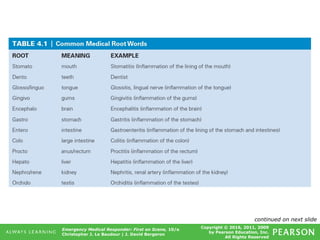
Table 4.1 Common Medical Root Words
continued on next slide
Copyright © 2016, 2011, 2009
by Pearson Education, Inc.
All Rights Reserved
Emergency Medical Responder: First on Scene, 10/e
Christopher J. Le Baudour | J. David Bergeron
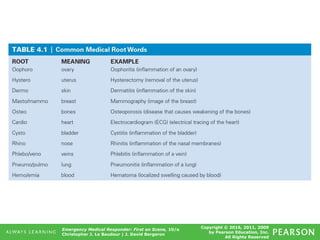
Table 4.1 (continued) Common Medical Root Words
Copyright © 2016, 2011, 2009
by Pearson Education, Inc.
All Rights Reserved
Emergency Medical Responder: First on Scene, 10/e
Christopher J. Le Baudour | J. David Bergeron
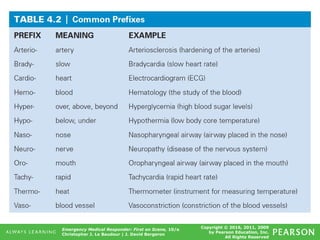
Table 4.2 Common Prefixes
Copyright © 2016, 2011, 2009
by Pearson Education, Inc.
All Rights Reserved
Emergency Medical Responder: First on Scene, 10/e
Christopher J. Le Baudour | J. David Bergeron
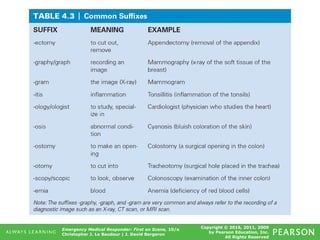
Table 4.3 Common Suffixes
Copyright © 2016, 2011, 2009
by Pearson Education, Inc.
All Rights Reserved
Emergency Medical Responder: First on Scene, 10/e
Christopher J. Le Baudour | J. David Bergeron
Think About It
• Why is it useful to learn medical root
words, prefixes and suffixes?
• You have a patient with a history of
endocarditis. What do you think this
condition involves?
• What might cholecystectomy involve?
Copyright © 2016, 2011, 2009
by Pearson Education, Inc.
All Rights Reserved
Emergency Medical Responder: First on Scene, 10/e
Christopher J. Le Baudour | J. David Bergeron
POSITIONAL AND
DIRECTIONAL TERMS
Copyright © 2016, 2011, 2009
by Pearson Education, Inc.
All Rights Reserved
Emergency Medical Responder: First on Scene, 10/e
Christopher J. Le Baudour | J. David Bergeron
Positional and Directional Terms
• Anatomy
 Study of body structure
• Anatomical position
 Standard reference position for body in
study of anatomy
Copyright © 2016, 2011, 2009
by Pearson Education, Inc.
All Rights Reserved
Emergency Medical Responder: First on Scene, 10/e
Christopher J. Le Baudour | J. David Bergeron
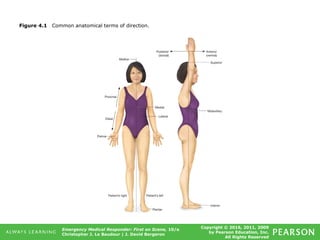
Figure 4.1 Common anatomical terms of direction.
Copyright © 2016, 2011, 2009
by Pearson Education, Inc.
All Rights Reserved
Emergency Medical Responder: First on Scene, 10/e
Christopher J. Le Baudour | J. David Bergeron
Positional and Directional Terms
• Anterior
 Front of body or body part
• Posterior
 Back of body or body part
• Midline
 Imaginary vertical line used to divide
body into right and left halves
• Medial
 Toward the midline of body
Copyright © 2016, 2011, 2009
by Pearson Education, Inc.
All Rights Reserved
Emergency Medical Responder: First on Scene, 10/e
Christopher J. Le Baudour | J. David Bergeron
Positional and Directional Terms
• Lateral
 Away from midline of body
• Superior
 Toward top of the head
• Inferior
 Toward the feet
• Proximal
 Closer to the torso
Copyright © 2016, 2011, 2009
by Pearson Education, Inc.
All Rights Reserved
Emergency Medical Responder: First on Scene, 10/e
Christopher J. Le Baudour | J. David Bergeron
Positional and Directional Terms
• Distal
 Farther away from torso
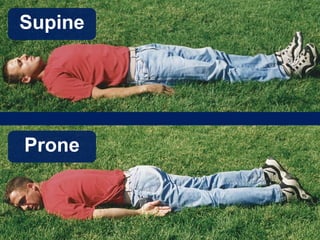
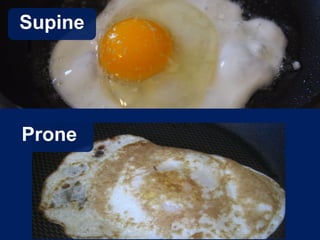
• Supine
 Lying face up
• Prone
 Lying face down
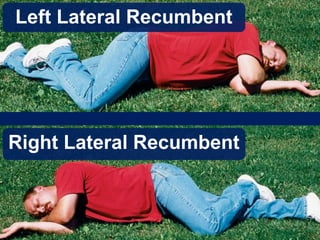
• Recovery position (lateral recumbent)
 Lying on one's side
Copyright © 2016, 2011, 2009
by Pearson Education, Inc.
All Rights Reserved
Emergency Medical Responder: First on Scene, 10/e
Christopher J. Le Baudour | J. David Bergeron
Positional and Directional Terms
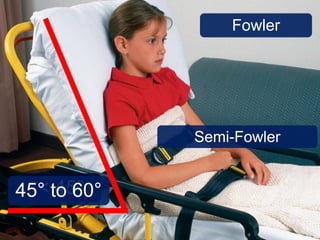
• Semi-Fowler's position
 Patient sitting up at an angle
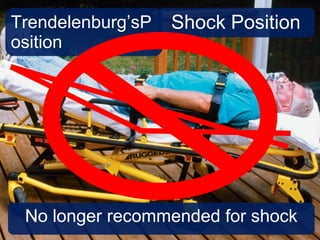
• Trendelenburg position
 Patient supine at an angle with feet
elevated
Supine
Prone
Supine
Prone
Left Lateral Recumbent
Right Lateral Recumbent
Fowler
Semi-Fowler
< 45°45° to 60°
Trendelenburg’sP
osition
Shock Position
No longer recommended for shock
Copyright © 2016, 2011, 2009
by Pearson Education, Inc.
All Rights Reserved
Emergency Medical Responder: First on Scene, 10/e
Christopher J. Le Baudour | J. David Bergeron
Think About It
• Why might the use of positional and
directional terms be important?
• When might using simple terms be
more appropriate than medical
terminology?
Copyright © 2016, 2011, 2009
by Pearson Education, Inc.
All Rights Reserved
Emergency Medical Responder: First on Scene, 10/e
Christopher J. Le Baudour | J. David Bergeron
OVERVIEW OF THE HUMAN
BODY
Copyright © 2016, 2011, 2009
by Pearson Education, Inc.
All Rights Reserved
Emergency Medical Responder: First on Scene, 10/e
Christopher J. Le Baudour | J. David Bergeron
Overview of the Human Body
• Physiology
 Function of body and its many systems
• Regions of the body
 Major internal structures and general
location of each
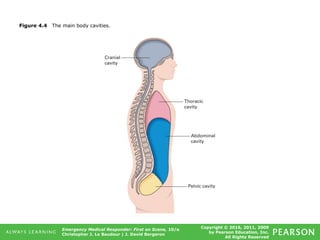
• Four major body cavities
 Cranial, thoracic, abdominal, and pelvic
Copyright © 2016, 2011, 2009
by Pearson Education, Inc.
All Rights Reserved
Emergency Medical Responder: First on Scene, 10/e
Christopher J. Le Baudour | J. David Bergeron
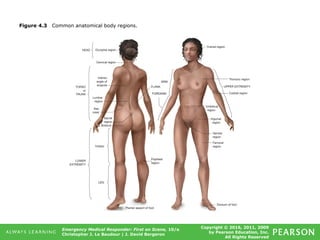
Figure 4.3 Common anatomical body regions.
Copyright © 2016, 2011, 2009
by Pearson Education, Inc.
All Rights Reserved
Emergency Medical Responder: First on Scene, 10/e
Christopher J. Le Baudour | J. David Bergeron
Figure 4.4 The main body cavities.
Copyright © 2016, 2011, 2009
by Pearson Education, Inc.
All Rights Reserved
Emergency Medical Responder: First on Scene, 10/e
Christopher J. Le Baudour | J. David Bergeron
Overview of the Human Body
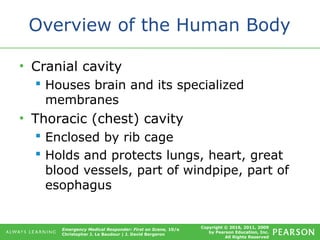
• Cranial cavity
 Houses brain and its specialized
membranes
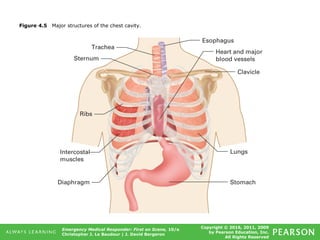
• Thoracic (chest) cavity
 Enclosed by rib cage
 Holds and protects lungs, heart, great
blood vessels, part of windpipe, part of
esophagus
Copyright © 2016, 2011, 2009
by Pearson Education, Inc.
All Rights Reserved
Emergency Medical Responder: First on Scene, 10/e
Christopher J. Le Baudour | J. David Bergeron
Figure 4.5 Major structures of the chest cavity.
Copyright © 2016, 2011, 2009
by Pearson Education, Inc.
All Rights Reserved
Emergency Medical Responder: First on Scene, 10/e
Christopher J. Le Baudour | J. David Bergeron
Overview of the Human Body
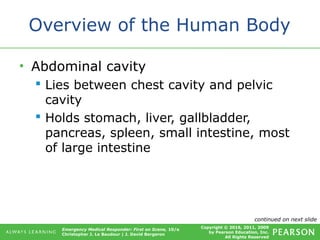
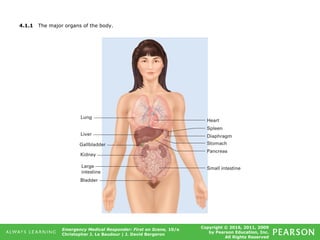
• Abdominal cavity
 Lies between chest cavity and pelvic
cavity
 Holds stomach, liver, gallbladder,
pancreas, spleen, small intestine, most
of large intestine
continued on next slide
Copyright © 2016, 2011, 2009
by Pearson Education, Inc.
All Rights Reserved
Emergency Medical Responder: First on Scene, 10/e
Christopher J. Le Baudour | J. David Bergeron
Overview of the Human Body
• Diaphragm
 Muscle used in breathing
 Separates chest cavity from abdominal
cavity
continued on next slide
Copyright © 2016, 2011, 2009
by Pearson Education, Inc.
All Rights Reserved
Emergency Medical Responder: First on Scene, 10/e
Christopher J. Le Baudour | J. David Bergeron
Overview of the Human Body
• Pelvic cavity
 Protected by bones of pelvic girdle
 Houses urinary bladder, portions of large
intestine, internal reproductive organs
Copyright © 2016, 2011, 2009
by Pearson Education, Inc.
All Rights Reserved
Emergency Medical Responder: First on Scene, 10/e
Christopher J. Le Baudour | J. David Bergeron
4.1.1 The major organs of the body.
Copyright © 2016, 2011, 2009
by Pearson Education, Inc.
All Rights Reserved
Emergency Medical Responder: First on Scene, 10/e
Christopher J. Le Baudour | J. David Bergeron
Overview of the Human Body
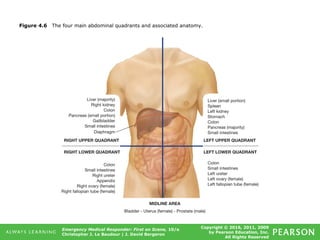
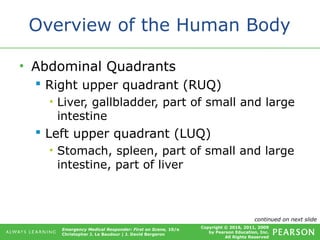
• Abdominal Quadrants
 Right upper quadrant (RUQ)
• Liver, gallbladder, part of small and large
intestine
 Left upper quadrant (LUQ)
• Stomach, spleen, part of small and large
intestine, part of liver
continued on next slide
Copyright © 2016, 2011, 2009
by Pearson Education, Inc.
All Rights Reserved
Emergency Medical Responder: First on Scene, 10/e
Christopher J. Le Baudour | J. David Bergeron
Overview of the Human Body
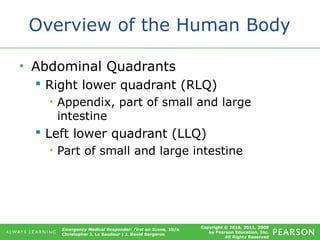
• Abdominal Quadrants
 Right lower quadrant (RLQ)
• Appendix, part of small and large
intestine
 Left lower quadrant (LLQ)
• Part of small and large intestine
Copyright © 2016, 2011, 2009
by Pearson Education, Inc.
All Rights Reserved
Emergency Medical Responder: First on Scene, 10/e
Christopher J. Le Baudour | J. David Bergeron
Figure 4.6 The four main abdominal quadrants and associated anatomy.
Copyright © 2016, 2011, 2009
by Pearson Education, Inc.
All Rights Reserved
Emergency Medical Responder: First on Scene, 10/e
Christopher J. Le Baudour | J. David Bergeron
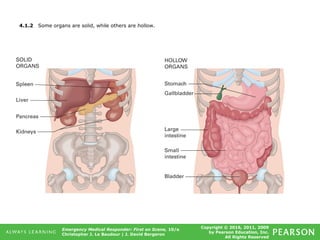
4.1.2 Some organs are solid, while others are hollow.
Copyright © 2016, 2011, 2009
by Pearson Education, Inc.
All Rights Reserved
Emergency Medical Responder: First on Scene, 10/e
Christopher J. Le Baudour | J. David Bergeron
BODY SYSTEMS
Copyright © 2016, 2011, 2009
by Pearson Education, Inc.
All Rights Reserved
Emergency Medical Responder: First on Scene, 10/e
Christopher J. Le Baudour | J. David Bergeron
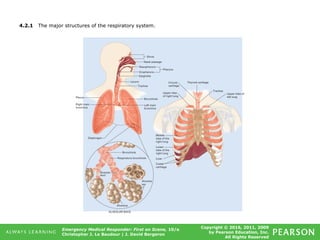
4.2.1 The major structures of the respiratory system.
Copyright © 2016, 2011, 2009
by Pearson Education, Inc.
All Rights Reserved
Emergency Medical Responder: First on Scene, 10/e
Christopher J. Le Baudour | J. David Bergeron
Body Systems
• Respiratory System
 Functions
• Gas exchange
• Warms, filters, and moisturizes air
• Minimizes possible aspiration
continued on next slide
Copyright © 2016, 2011, 2009
by Pearson Education, Inc.
All Rights Reserved
Emergency Medical Responder: First on Scene, 10/e
Christopher J. Le Baudour | J. David Bergeron
Body Systems
• Respiratory System
 Complications
• Perfusion adversely affected if patient is
not breathing adequately or stops
breathing
• Diseases and injury disrupt delivery of
oxygen
Copyright © 2016, 2011, 2009
by Pearson Education, Inc.
All Rights Reserved
Emergency Medical Responder: First on Scene, 10/e
Christopher J. Le Baudour | J. David Bergeron
Body Systems
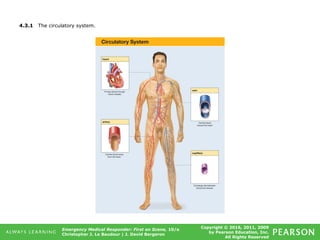
• Circulatory System
 Primary Structures
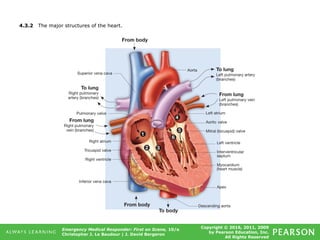
• Heart
• Blood vessels
• Blood
continued on next slide
Copyright © 2016, 2011, 2009
by Pearson Education, Inc.
All Rights Reserved
Emergency Medical Responder: First on Scene, 10/e
Christopher J. Le Baudour | J. David Bergeron
4.3.1 The circulatory system.
Copyright © 2016, 2011, 2009
by Pearson Education, Inc.
All Rights Reserved
Emergency Medical Responder: First on Scene, 10/e
Christopher J. Le Baudour | J. David Bergeron
4.3.2 The major structures of the heart.
Copyright © 2016, 2011, 2009
by Pearson Education, Inc.
All Rights Reserved
Emergency Medical Responder: First on Scene, 10/e
Christopher J. Le Baudour | J. David Bergeron
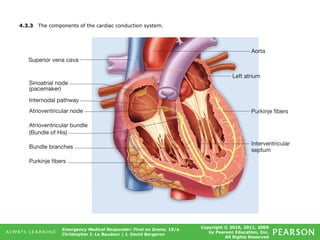
4.3.3 The components of the cardiac conduction system.
Copyright © 2016, 2011, 2009
by Pearson Education, Inc.
All Rights Reserved
Emergency Medical Responder: First on Scene, 10/e
Christopher J. Le Baudour | J. David Bergeron
Body Systems
• Musculoskeletal System
 Primary Structures
• Bones
• Muscles
• Tendons
• Ligaments
continued on next slide
Copyright © 2016, 2011, 2009
by Pearson Education, Inc.
All Rights Reserved
Emergency Medical Responder: First on Scene, 10/e
Christopher J. Le Baudour | J. David Bergeron
Body Systems
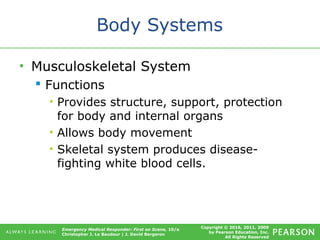
• Musculoskeletal System
 Functions
• Provides structure, support, protection
for body and internal organs
• Allows body movement
• Skeletal system produces disease-
fighting white blood cells.
Copyright © 2016, 2011, 2009
by Pearson Education, Inc.
All Rights Reserved
Emergency Medical Responder: First on Scene, 10/e
Christopher J. Le Baudour | J. David Bergeron
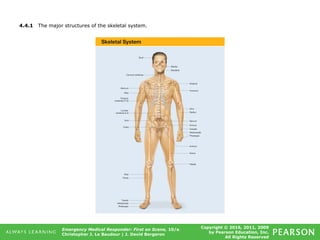
4.4.1 The major structures of the skeletal system.
Copyright © 2016, 2011, 2009
by Pearson Education, Inc.
All Rights Reserved
Emergency Medical Responder: First on Scene, 10/e
Christopher J. Le Baudour | J. David Bergeron
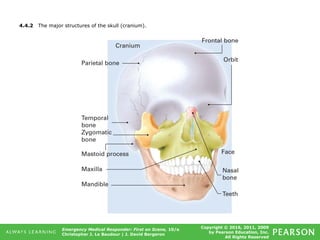
4.4.2 The major structures of the skull (cranium).
Copyright © 2016, 2011, 2009
by Pearson Education, Inc.
All Rights Reserved
Emergency Medical Responder: First on Scene, 10/e
Christopher J. Le Baudour | J. David Bergeron
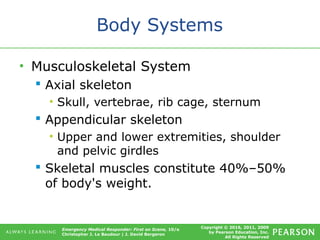
Body Systems
• Musculoskeletal System
 Axial skeleton
• Skull, vertebrae, rib cage, sternum
 Appendicular skeleton
• Upper and lower extremities, shoulder
and pelvic girdles
 Skeletal muscles constitute 40%–50%
of body's weight.
Copyright © 2016, 2011, 2009
by Pearson Education, Inc.
All Rights Reserved
Emergency Medical Responder: First on Scene, 10/e
Christopher J. Le Baudour | J. David Bergeron
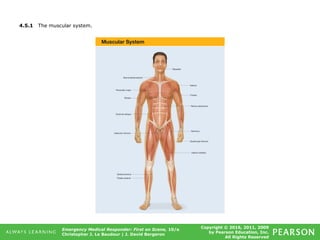
4.5.1 The muscular system.
Copyright © 2016, 2011, 2009
by Pearson Education, Inc.
All Rights Reserved
Emergency Medical Responder: First on Scene, 10/e
Christopher J. Le Baudour | J. David Bergeron
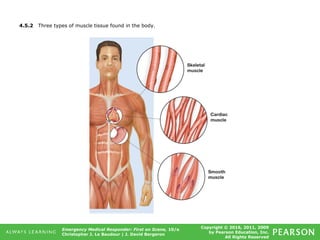
4.5.2 Three types of muscle tissue found in the body.
Copyright © 2016, 2011, 2009
by Pearson Education, Inc.
All Rights Reserved
Emergency Medical Responder: First on Scene, 10/e
Christopher J. Le Baudour | J. David Bergeron
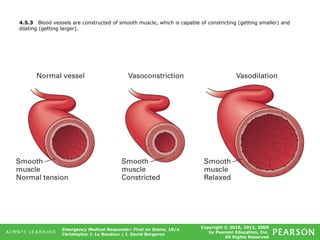
4.5.3 Blood vessels are constructed of smooth muscle, which is capable of constricting (getting smaller) and
dilating (getting larger).
Copyright © 2016, 2011, 2009
by Pearson Education, Inc.
All Rights Reserved
Emergency Medical Responder: First on Scene, 10/e
Christopher J. Le Baudour | J. David Bergeron
Body Systems
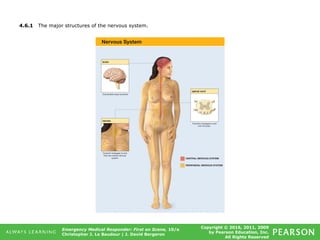
• Nervous System
 Primary Structures
• Brain
• Spinal cord
• Nerves
continued on next slide
Copyright © 2016, 2011, 2009
by Pearson Education, Inc.
All Rights Reserved
Emergency Medical Responder: First on Scene, 10/e
Christopher J. Le Baudour | J. David Bergeron
4.6.1 The major structures of the nervous system.
Copyright © 2016, 2011, 2009
by Pearson Education, Inc.
All Rights Reserved
Emergency Medical Responder: First on Scene, 10/e
Christopher J. Le Baudour | J. David Bergeron
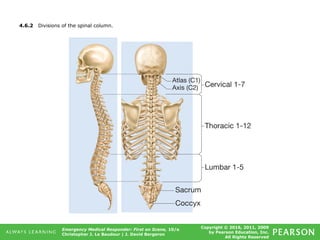
4.6.2 Divisions of the spinal column.
Copyright © 2016, 2011, 2009
by Pearson Education, Inc.
All Rights Reserved
Emergency Medical Responder: First on Scene, 10/e
Christopher J. Le Baudour | J. David Bergeron
Body Systems
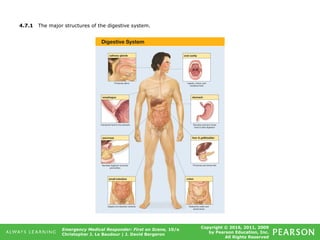
• Digestive System
 Structures
• Esophagus
• Stomach
• Small intestines
• Large intestines
continued on next slide
Copyright © 2016, 2011, 2009
by Pearson Education, Inc.
All Rights Reserved
Emergency Medical Responder: First on Scene, 10/e
Christopher J. Le Baudour | J. David Bergeron
Body Systems
• Digestive System
 Functions
• Breaks down food for energy
• Removal of waste products
Copyright © 2016, 2011, 2009
by Pearson Education, Inc.
All Rights Reserved
Emergency Medical Responder: First on Scene, 10/e
Christopher J. Le Baudour | J. David Bergeron
4.7.1 The major structures of the digestive system.
Copyright © 2016, 2011, 2009
by Pearson Education, Inc.
All Rights Reserved
Emergency Medical Responder: First on Scene, 10/e
Christopher J. Le Baudour | J. David Bergeron
Body Systems
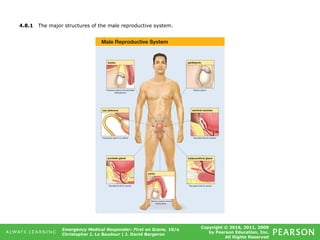
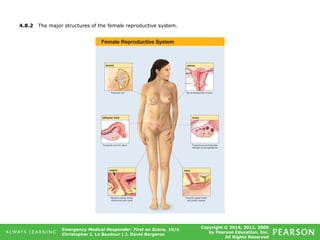
• Reproductive System
 Structures
• Male
• Testes and penis
• Female
• Ovaries, fallopian tubes, uterus, and
vagina
continued on next slide
Copyright © 2016, 2011, 2009
by Pearson Education, Inc.
All Rights Reserved
Emergency Medical Responder: First on Scene, 10/e
Christopher J. Le Baudour | J. David Bergeron
Body Systems
• Reproductive System
 Functions
• Hormone production
• Gestation and development
Copyright © 2016, 2011, 2009
by Pearson Education, Inc.
All Rights Reserved
Emergency Medical Responder: First on Scene, 10/e
Christopher J. Le Baudour | J. David Bergeron
4.8.1 The major structures of the male reproductive system.
Copyright © 2016, 2011, 2009
by Pearson Education, Inc.
All Rights Reserved
Emergency Medical Responder: First on Scene, 10/e
Christopher J. Le Baudour | J. David Bergeron
4.8.2 The major structures of the female reproductive system.
Copyright © 2016, 2011, 2009
by Pearson Education, Inc.
All Rights Reserved
Emergency Medical Responder: First on Scene, 10/e
Christopher J. Le Baudour | J. David Bergeron
Body Systems
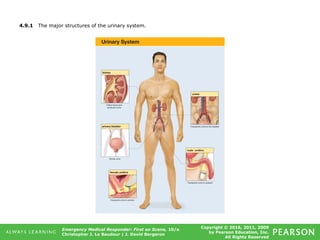
• Urinary System
 Structures
• Kidneys
• Ureters
• Bladder
• Urethra
continued on next slide
Copyright © 2016, 2011, 2009
by Pearson Education, Inc.
All Rights Reserved
Emergency Medical Responder: First on Scene, 10/e
Christopher J. Le Baudour | J. David Bergeron
4.9.1 The major structures of the urinary system.
Copyright © 2016, 2011, 2009
by Pearson Education, Inc.
All Rights Reserved
Emergency Medical Responder: First on Scene, 10/e
Christopher J. Le Baudour | J. David Bergeron
Body Systems
• Integumentary System
 Structures
• Skin
• Nails
• Hair
• Sweat glands
• Oil glands
• Mammary glands
continued on next slide
Copyright © 2016, 2011, 2009
by Pearson Education, Inc.
All Rights Reserved
Emergency Medical Responder: First on Scene, 10/e
Christopher J. Le Baudour | J. David Bergeron
Body Systems
• Integumentary System
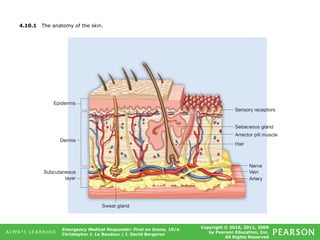
 Skin
• Largest organ of the body
• Three layers
• Epidermis
• Dermis
• Subcutaneous
• Houses the other structures of the
integumentary system
continued on next slide
Copyright © 2016, 2011, 2009
by Pearson Education, Inc.
All Rights Reserved
Emergency Medical Responder: First on Scene, 10/e
Christopher J. Le Baudour | J. David Bergeron
Body Systems
• Integumentary System
 Skin
• Functions
• Protection
• Regulation of body temperature
• Sensations temperature and senses heat,
cold, touch, pain, and pressure
• Regulation of body fluids
Copyright © 2016, 2011, 2009
by Pearson Education, Inc.
All Rights Reserved
Emergency Medical Responder: First on Scene, 10/e
Christopher J. Le Baudour | J. David Bergeron
4.10.1 The anatomy of the skin.
Copyright © 2016, 2011, 2009
by Pearson Education, Inc.
All Rights Reserved
Emergency Medical Responder: First on Scene, 10/e
Christopher J. Le Baudour | J. David Bergeron
Body Systems
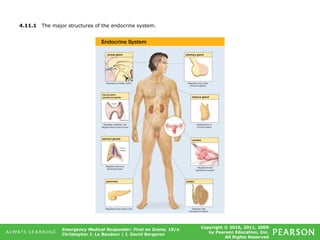
• Endocrine System
 Primary Structures
• Thyroid
• Pituitary
• Adrenal
• Epinephrine
• Pancreas
• Insulin
• Gonads
continued on next slide
Copyright © 2016, 2011, 2009
by Pearson Education, Inc.
All Rights Reserved
Emergency Medical Responder: First on Scene, 10/e
Christopher J. Le Baudour | J. David Bergeron
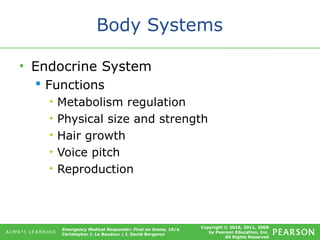
Body Systems
• Endocrine System
 Functions
• Metabolism regulation
• Physical size and strength
• Hair growth
• Voice pitch
• Reproduction
Copyright © 2016, 2011, 2009
by Pearson Education, Inc.
All Rights Reserved
Emergency Medical Responder: First on Scene, 10/e
Christopher J. Le Baudour | J. David Bergeron
4.11.1 The major structures of the endocrine system.
Copyright © 2016, 2011, 2009
by Pearson Education, Inc.
All Rights Reserved
Emergency Medical Responder: First on Scene, 10/e
Christopher J. Le Baudour | J. David Bergeron
LIFESPAN DEVELOPMENT
Copyright © 2016, 2011, 2009
by Pearson Education, Inc.
All Rights Reserved
Emergency Medical Responder: First on Scene, 10/e
Christopher J. Le Baudour | J. David Bergeron
Lifespan Development
• Developmental Stages
 Neonate (birth to 28 days old)
 Infant (birth up to 1 year old)
 Toddler (1–3 years old)
 Preschooler (3–6 years old)
 School-age children (6–12 years old)
Copyright © 2016, 2011, 2009
by Pearson Education, Inc.
All Rights Reserved
Emergency Medical Responder: First on Scene, 10/e
Christopher J. Le Baudour | J. David Bergeron
Figure 4.7 It is common for a single family to extend to several generations of living members.
Copyright © 2016, 2011, 2009
by Pearson Education, Inc.
All Rights Reserved
Emergency Medical Responder: First on Scene, 10/e
Christopher J. Le Baudour | J. David Bergeron
Lifespan Development
• Developmental Stages
 Adolescent (12–18 years old)
 Early adulthood (20–30 years old)
 Middle adulthood (31–60 years old)
 Late adulthood (60 to the end of life)
continued on next slide
Copyright © 2016, 2011, 2009
by Pearson Education, Inc.
All Rights Reserved
Emergency Medical Responder: First on Scene, 10/e
Christopher J. Le Baudour | J. David Bergeron
Lifespan Development
• Neonates/Infants (birth up to one year
old)
 Sensitive to cold temperatures
 Separation anxiety
 Visual assessments most productive
• Toddlers (1–3 years old)
 Sense of independence
 Stranger anxiety
 Separation anxiety
Copyright © 2016, 2011, 2009
by Pearson Education, Inc.
All Rights Reserved
Emergency Medical Responder: First on Scene, 10/e
Christopher J. Le Baudour | J. David Bergeron
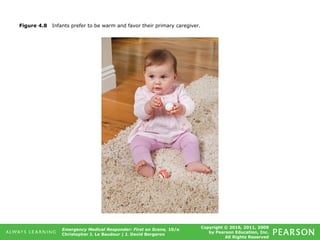
Figure 4.8 Infants prefer to be warm and favor their primary caregiver.
Copyright © 2016, 2011, 2009
by Pearson Education, Inc.
All Rights Reserved
Emergency Medical Responder: First on Scene, 10/e
Christopher J. Le Baudour | J. David Bergeron
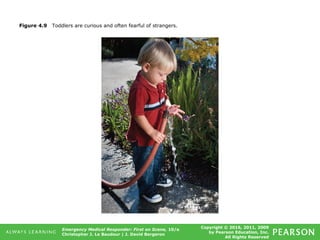
Figure 4.9 Toddlers are curious and often fearful of strangers.
Copyright © 2016, 2011, 2009
by Pearson Education, Inc.
All Rights Reserved
Emergency Medical Responder: First on Scene, 10/e
Christopher J. Le Baudour | J. David Bergeron
Lifespan Development
• Preschoolers (3–6 years old)
 Developed concrete thinking skills
 Need reassurance
• Respond well to simple explanations
 Separation anxiety
 Toe to head assessment
 Typically quite modest
Copyright © 2016, 2011, 2009
by Pearson Education, Inc.
All Rights Reserved
Emergency Medical Responder: First on Scene, 10/e
Christopher J. Le Baudour | J. David Bergeron
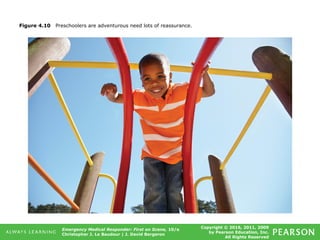
Figure 4.10 Preschoolers are adventurous need lots of reassurance.
Copyright © 2016, 2011, 2009
by Pearson Education, Inc.
All Rights Reserved
Emergency Medical Responder: First on Scene, 10/e
Christopher J. Le Baudour | J. David Bergeron
Lifespan Development
• School-Aged Children (6–12 years old)
 Basic understanding of body and its
function
 Able to communicate and understand
more complex ideas
 Very literal
 Are aware and afraid of death and dying
as well as pain
Copyright © 2016, 2011, 2009
by Pearson Education, Inc.
All Rights Reserved
Emergency Medical Responder: First on Scene, 10/e
Christopher J. Le Baudour | J. David Bergeron
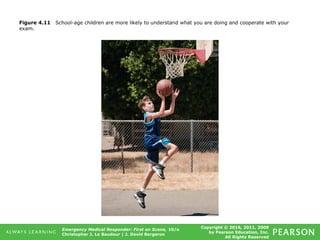
Figure 4.11 School-age children are more likely to understand what you are doing and cooperate with your
exam.
Copyright © 2016, 2011, 2009
by Pearson Education, Inc.
All Rights Reserved
Emergency Medical Responder: First on Scene, 10/e
Christopher J. Le Baudour | J. David Bergeron
Lifespan Development
• Adolescents (12–18 years old)
 Understand anatomy and physiology
 Able to process, express complex ideas
 Risk takers
• Poor judges of consequence
 Afraid of disfigurement, permanent
injury
 Believe they are immortal, indestructible
 Want to be treated as adults
Copyright © 2016, 2011, 2009
by Pearson Education, Inc.
All Rights Reserved
Emergency Medical Responder: First on Scene, 10/e
Christopher J. Le Baudour | J. David Bergeron
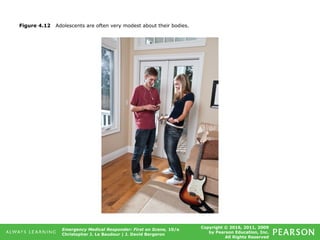
Figure 4.12 Adolescents are often very modest about their bodies.
Copyright © 2016, 2011, 2009
by Pearson Education, Inc.
All Rights Reserved
Emergency Medical Responder: First on Scene, 10/e
Christopher J. Le Baudour | J. David Bergeron
Lifespan Development
• Early Adulthood (20–30 years old)
 Peak health
• Very active
 Majority of those involved in traumatic
injuries and accidents
Copyright © 2016, 2011, 2009
by Pearson Education, Inc.
All Rights Reserved
Emergency Medical Responder: First on Scene, 10/e
Christopher J. Le Baudour | J. David Bergeron
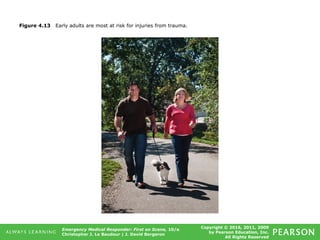
Figure 4.13 Early adults are most at risk for injuries from trauma.
Copyright © 2016, 2011, 2009
by Pearson Education, Inc.
All Rights Reserved
Emergency Medical Responder: First on Scene, 10/e
Christopher J. Le Baudour | J. David Bergeron
Lifespan Development
• Middle Adulthood (31–60 years old)
 Decrease in ability to see and hear well
 Decrease in height
 Hair begins to turn gray
 Permanent wrinkles appear in skin
Copyright © 2016, 2011, 2009
by Pearson Education, Inc.
All Rights Reserved
Emergency Medical Responder: First on Scene, 10/e
Christopher J. Le Baudour | J. David Bergeron
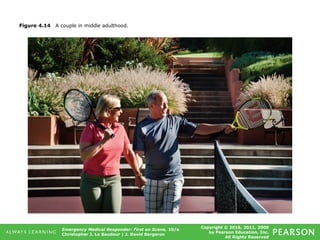
Figure 4.14 A couple in middle adulthood.
Copyright © 2016, 2011, 2009
by Pearson Education, Inc.
All Rights Reserved
Emergency Medical Responder: First on Scene, 10/e
Christopher J. Le Baudour | J. David Bergeron
Lifespan Development
• Late Adulthood (60 to the end of life)
 Decline in ability to see, hear, taste,
smell
 Mobility difficult for some
 Awareness of mortality present
 Decrease in ability to perceive pain
 Common overlapping illnesses, multiple
medications
Copyright © 2016, 2011, 2009
by Pearson Education, Inc.
All Rights Reserved
Emergency Medical Responder: First on Scene, 10/e
Christopher J. Le Baudour | J. David Bergeron
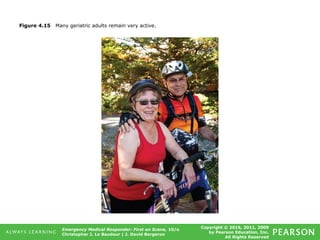
Figure 4.15 Many geriatric adults remain very active.
Copyright © 2016, 2011, 2009
by Pearson Education, Inc.
All Rights Reserved
Emergency Medical Responder: First on Scene, 10/e
Christopher J. Le Baudour | J. David Bergeron
Please visit
www.bradybooks.com
and follow the Resource Central
links to access content for this
text.