Disaster Triage
START/JUMPSTART
Finger Lakes Regional TrainingFinger Lakes Regional Training
CenterCenter
Kathee Tyo, MS, RNKathee Tyo, MS, RN
Coordinator/EducatorCoordinator/Educator
Objectives:
 Define a Mass Casualty Incident and the
unique challenges of an MCI
 Understand the differences between day-
to-day triage and triage during an MCI
 Increase the region’s healthcare
providers’ awareness of disaster triage
What is the Goal of MCI
Management?
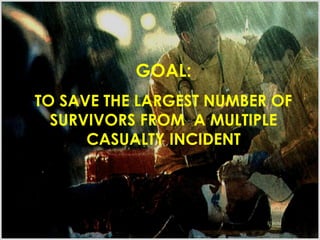
GOAL:
TO SAVE THE LARGEST NUMBER OF
SURVIVORS FROM A MULTIPLE
CASUALTY INCIDENT
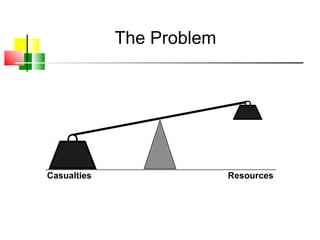
The Problem
Casualties Resources
Considerations During an MCI
Response
 Supply vs. Demand
 Resource Allocation
 Coordination
 Medical Management
 Ethics
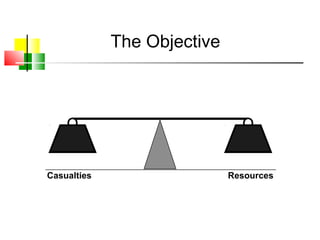
Casualties Resources
The Objective
What Could Be an MCI For
You?
 Transportation
Accident
 Fire
 Hospital
Overloading
 Hospital Evacuation
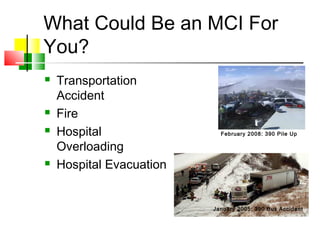
February 2008: 390 Pile Up
January 2005: 390 Bus Accident
What Could Be an MCI For You?What Could Be an MCI For You?
 Sporting EventSporting Event
 Hazmat IncidentHazmat Incident
 Loss of PowerLoss of Power
 Severe WeatherSevere Weather
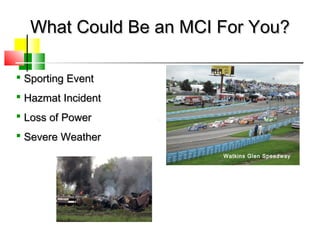
Watkins Glen Speedway
Managing Hospital Incidents
 Would any of those situations lead to
shortage of personnel & equipment
resources?
 Would decisions and changes need to
be made in how you do business?
 Altered Standards of Care
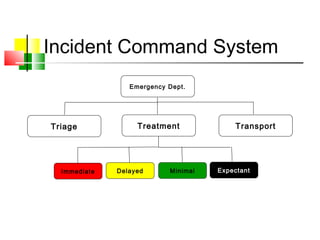
Incident Command System
Emergency Dept.
TreatmentTriage Transport
Immediate Delayed Minimal Expectant
Disaster Triage
START/JUMPSTART
Types of Triage
 Primary
 On scene prior to movement or at hospital
(self transports)
 Secondary
 Incident dependent, probably prior to or
during transport or upon arrival to hospital
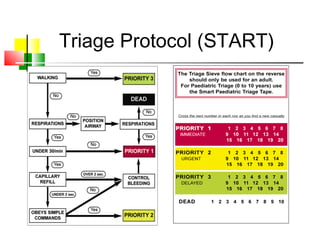
Triage Protocol (START)
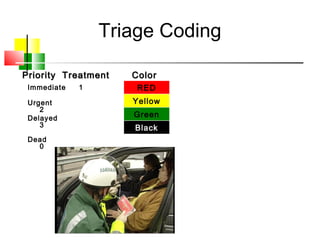
Triage Coding
Immediate 1
Urgent
2
Delayed
3
Dead
0
RED
Yellow
Green
Black
ColorColorPriority TreatmentPriority Treatment
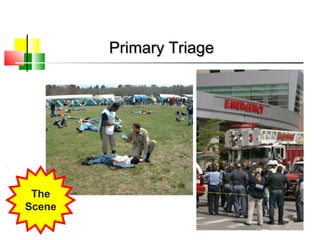
Primary TriagePrimary Triage
The
Scene
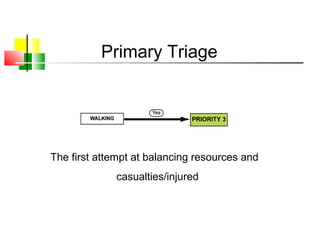
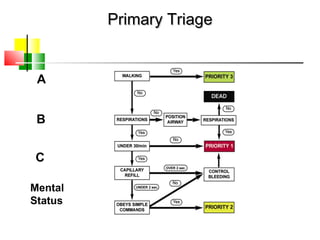
Primary Triage
The first attempt at balancing resources and
casualties/injured
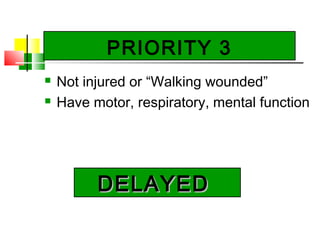
PRIORITY 3
 Not injured or “Walking wounded”
 Have motor, respiratory, mental function
DELAYEDDELAYED
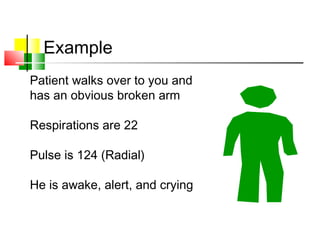
Example
Patient walks over to you and
has an obvious broken arm
Respirations are 22
Pulse is 124 (Radial)
He is awake, alert, and crying
Primary TriagePrimary Triage
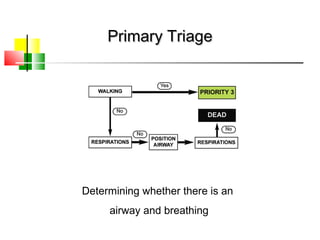
Determining whether there is an
airway and breathing
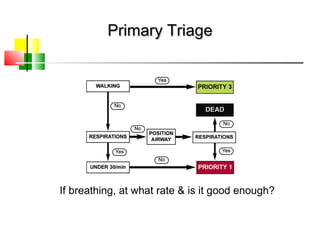
Primary TriagePrimary Triage
If breathing, at what rate & is it good enough?
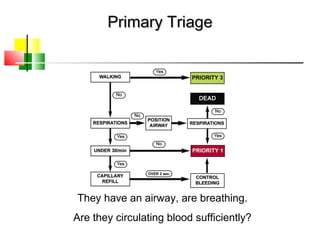
Primary TriagePrimary Triage
They have an airway, are breathing.
Are they circulating blood sufficiently?
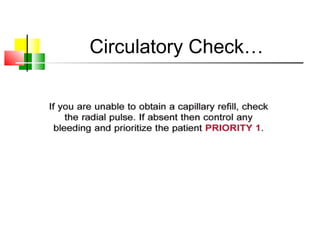
Circulatory Check…
Primary TriagePrimary Triage
A
B
C
Mental
Status
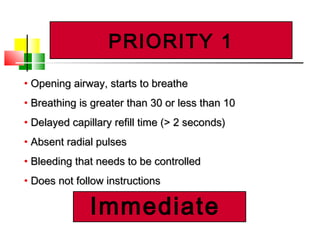
PRIORITY 1
Immediate
• Opening airway, starts to breatheOpening airway, starts to breathe
• Breathing is greater than 30 or less than 10Breathing is greater than 30 or less than 10
• Delayed capillary refill time (> 2 seconds)Delayed capillary refill time (> 2 seconds)
• Absent radial pulsesAbsent radial pulses
• Bleeding that needs to be controlledBleeding that needs to be controlled
• Does not follow instructionsDoes not follow instructions
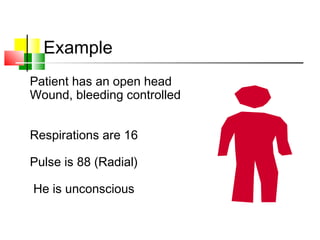
Example
Patient has an open head
Wound, bleeding controlled
Respirations are 16
Pulse is 88 (Radial)
He is unconscious
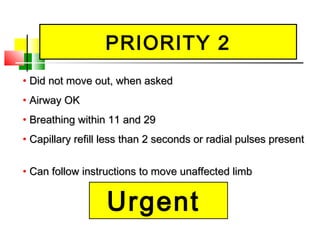
PRIORITY 2
Urgent
• Did not move out, when askedDid not move out, when asked
• Airway OKAirway OK
• Breathing within 11 and 29Breathing within 11 and 29
• Capillary refill less than 2 seconds or radial pulses presentCapillary refill less than 2 seconds or radial pulses present
• Can follow instructions to move unaffected limbCan follow instructions to move unaffected limb
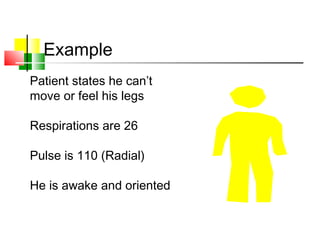
Example
Patient states he can’t
move or feel his legs
Respirations are 26
Pulse is 110 (Radial)
He is awake and oriented
EXPECTANT/DEAD
 Still require resources
 Focus of care is comfort
 Psychologically most challenging for healthcare
providers
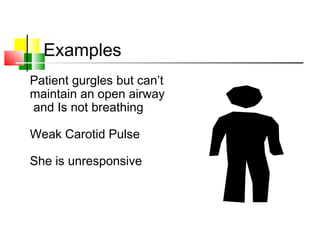
Examples
Patient gurgles but can’t
maintain an open airway
and Is not breathing
Weak Carotid Pulse
She is unresponsive
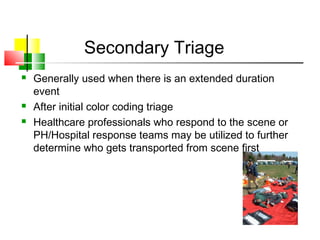
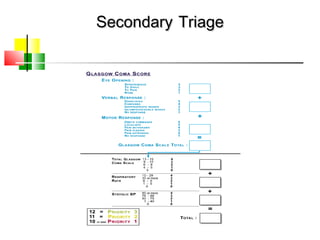
Secondary Triage
 Generally used when there is an extended duration
event
 After initial color coding triage
 Healthcare professionals who respond to the scene or
PH/Hospital response teams may be utilized to further
determine who gets transported from scene first
SecondarySecondary TriageTriage
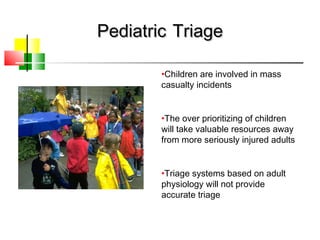
PediatricPediatric TriageTriage
•Children are involved in mass
casualty incidents
•The over prioritizing of children
will take valuable resources away
from more seriously injured adults
•Triage systems based on adult
physiology will not provide
accurate triage
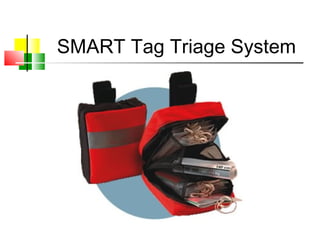
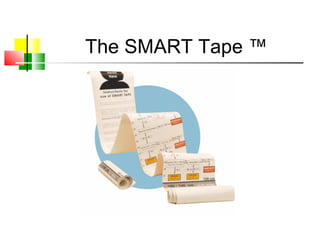
The SMART Tape ™
SMART Tag Triage System
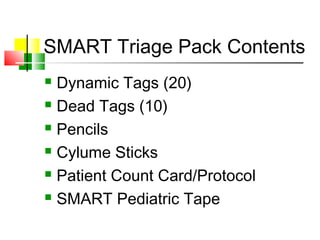
SMART Triage Pack Contents
 Dynamic Tags (20)
 Dead Tags (10)
 Pencils
 Cylume Sticks
 Patient Count Card/Protocol
 SMART Pediatric Tape
When Patients Arrive at Your Door
 Transition from the EMS patient to
hospital patient
 Dealing with self presenting patients
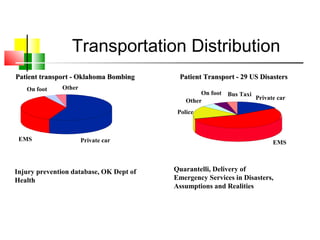
Transportation Distribution
Patient transport - Oklahoma BombingPatient transport - Oklahoma Bombing
Private carEMS
On foot Other
Injury prevention database, OK Dept of
Health
Patient Transport - 29 US DisastersPatient Transport - 29 US Disasters
EMS
Private car
Police
Other
On foot Bus Taxi
Quarantelli, Delivery of
Emergency Services in Disasters,
Assumptions and Realities
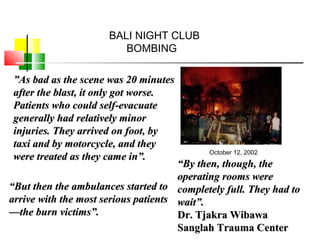
””As bad as the scene was 20 minutesAs bad as the scene was 20 minutes
after the blast, it only got worse.after the blast, it only got worse.
Patients who could self-evacuatePatients who could self-evacuate
generally had relatively minorgenerally had relatively minor
injuries. They arrived on foot, byinjuries. They arrived on foot, by
taxi and by motorcycle, and theytaxi and by motorcycle, and they
were treated as they came in”.were treated as they came in”.
““But then the ambulances started toBut then the ambulances started to
arrive with the most serious patientsarrive with the most serious patients
—the burn victims”.—the burn victims”.
““By then, though, theBy then, though, the
operating rooms wereoperating rooms were
completely full. They had tocompletely full. They had to
wait”.wait”.
Dr. Tjakra WibawaDr. Tjakra Wibawa
Sanglah Trauma CenterSanglah Trauma Center
BALI NIGHT CLUB
BOMBING
October 12, 2002
Scenarios
Scenario #1
An improvised explosive device is
detonated at a large outdoor sporting
event. At least 50 people are confirmed
injured. EMS is on scene, but patients
begin to arrive at your hospital before
EMS.
Triage and “Tag” the following patients.
Patient #1
Apneic
Pulse-less
Missing LUE
Patient #1
Apneic
Pulse-less
Missing LUE
Patient #2
Eviscerated bowel
Multiple penetrating
wounds to chest &
head
Brain matter exposed
Unresponsive to tactile
stimuli
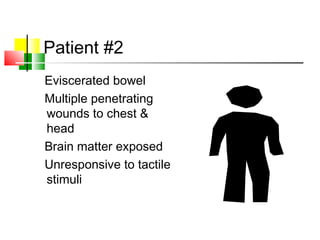
Patient #2
Eviscerated bowel
Multiple penetrating
wounds to chest &
head
Brain matter exposed
Unresponsive to tactile
stimuli
Patient #3
Abd. Tenderness and
minor penetrating
trauma
Ambulating
A & O x 3
RR 24
Strong radial pulse
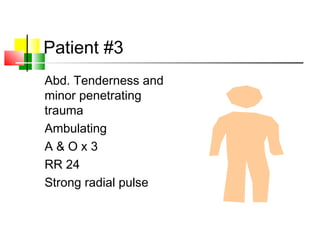
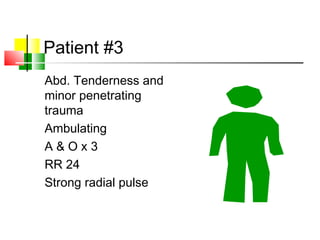
Patient #3
Abd. Tenderness and
minor penetrating
trauma
Ambulating
A & O x 3
RR 24
Strong radial pulse
Patient #4
Multiple penetrating
injuries, blood in
ears
Responds only to
pain
Airway clear
RR 20
Strong Radial pulse
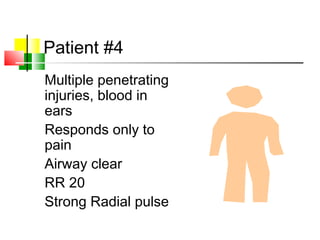
Patient #4
Multiple penetrating
injuries, blood in
ears
Responds only to
pain
Airway clear
RR 20
Strong Radial pulse
Patient #5
Extremity fractures,
blood in ears
A & O x 3
RR 26
Strong radial pulse
Patient #5
Extremity fractures,
blood in ears
A & O x 3
RR 26
Strong radial pulse
Patient #6
Child, screaming
Minor lacs, blood in
ears
RR 30
Moving all
extremities
Patient #6
Child, screaming
Minor lacs, blood in
ears
RR 30
Moving all
extremities
Patient #7
Amputated fingers,
head injury
A & O x 3
Dizzy
RR 24
Smells like beer
Patient #7
Amputated fingers,
head injury
A & O x 3
Dizzy
RR 24
Smells like beer
Patient #8
Chest pain, SOB
No trauma noted
RR 34
Shallow
Weak radial pulse
Patient #8
Chest pain, SOB
No trauma noted
RR 34
Shallow
Weak radial pulse
Patient #9
Blood in nose,
mouth and ears
Not breathing
Patient #9
Blood in nose,
mouth and ears
Not breathing
What would you do?
Patient #9
Blood in nose,
mouth and ears
Not breathing
RR 10 with manual
opening
Patient #10
Some penetrating
trauma
Unresponsive
Apneic
No radial pulse
Carotid 130/min
Patient #10
Some penetrating
trauma
Unresponsive
Apneic
No radial pulse
Carotid 130/min
Patient #11
Arterial bleed from
leg
Responsive to pain
RR 34
No radial pulse
Carotid 130/min
Patient #11
Arterial bleed from
leg
Responsive to pain
RR 34
No radial pulse
Carotid 130/min
Patient #12
Minor lacs
Crying
Ambulatory
RR 24
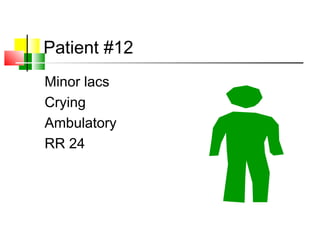
Patient #12
Minor lacs
Crying
Ambulatory
RR 24
Patient #13
Deviate trachea
RR 40
Weak radial pulse
+JVD
Cyanosis
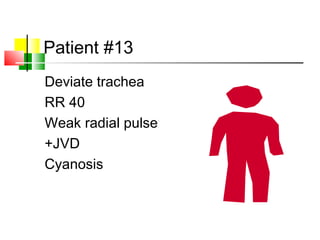
Patient #13
Deviate trachea
RR 40
Weak radial pulse
+JVD
Cyanosis
Patient #14
Open fracture of
RUE
Non-ambulatory
A & O x 3
RR 26
Strong radial pulse
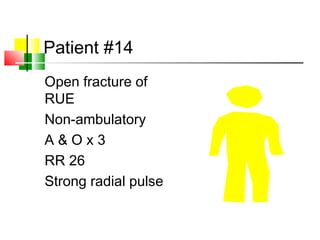
Patient #14
Open fracture of
RUE
Non-ambulatory
A & O x 3
RR 26
Strong radial pulse
Patient #15
100% TBS burns
(partial and full)
A & O x 2
RR 36
Coughing
Strong radial pulse
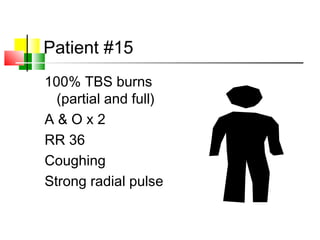
Patient #15
100% TBS burns
(partial and full)
A & O x 2
RR 36
Coughing
Strong radial pulse
Patient #16
CP, SOB
Slurred speech
R sided weakness
A & O x 1
RR 24
Strong radial pulse
Patient #16
CP, SOB
Slurred speech
R sided weakness
A & O x 1
RR 24
Strong radial pulse
Patient #17
Avulsion RUE
Arterial bleed
A & O x 2
RR 30
“I’m thirsty”
Patient #17
Avulsion RUE
Arterial bleed
A & O x 2
RR 30
“I’m thirsty”
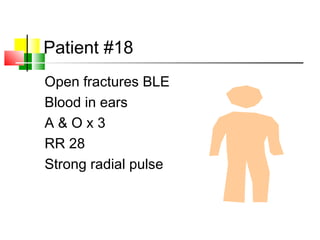
Patient #18
Open fractures BLE
Blood in ears
A & O x 3
RR 28
Strong radial pulse
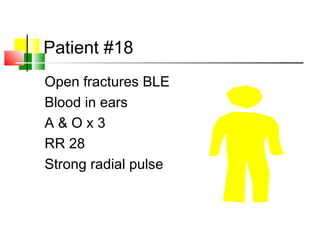
Patient #18
Open fractures BLE
Blood in ears
A & O x 3
RR 28
Strong radial pulse
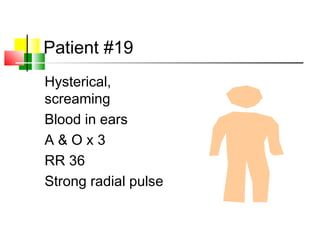
Patient #19
Hysterical,
screaming
Blood in ears
A & O x 3
RR 36
Strong radial pulse
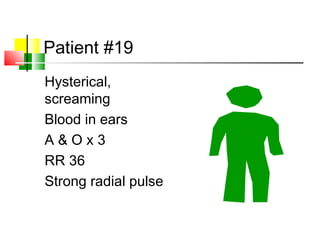
Patient #19
Hysterical,
screaming
Blood in ears
A & O x 3
RR 36
Strong radial pulse
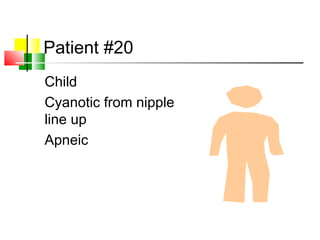
Patient #20
Child
Cyanotic from nipple
line up
Apneic
Patient #20
Child
Cyanotic from nipple
line up
Apneic
 Increase familiarity/proficiency of the
START and Jump START triage
methodologies
 Increase familiarity with the SMART Tag
Triage System
 Train with a standardized methodology
and system
What is the goal of Disaster
Triage training?
Questions???
Thank You!
Kathee Tyo, MS, RNKathee Tyo, MS, RN
585-758-7640585-758-7640
Kathee_tyo@urmc.rochester.eduKathee_tyo@urmc.rochester.edu

Start triage-training-presentation

Editor's Notes

  • #39 Teaching point Understand the concepts of self evacuation and its impact 1. Discuss each diagram 2. Summarise that there are two scenes. 3 Other Summary
  • #40 Teaching point Use of confirm point of last slide. 1. 2. 3 Other Summary