#2 Lecture Outline
I. Introduction
A. Medical professionals provide care under a set of laws affecting how patients must be treated.
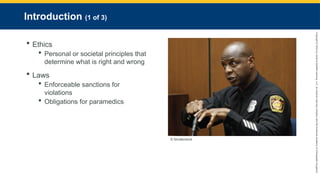
1. Ethics: principles—personal or societal—that determine what is right and wrong
2. Laws
a. Have sanctions for violations that are enforceable
b. Define the obligations of paramedics
c. Protect our rights and the rights of others
#3 Lecture Outline
3. Paramedics work within a framework of several types of laws set down by either the federal and/or state government, including:
a. Motor vehicle laws
b. Emergency medical services (EMS) legislation
c. Medical licensing statutes and regulations
d. Civil and criminal statutes
Confidentiality laws (eg, Health Insurance Portability and Accountability Act [HIPAA])
4. Basic understanding of laws and ethics applicable to prehospital emergency care
a. Failing to perform your job within the law can result in civil or criminal liability.
b. Practicing outside the law can result in regulatory action within your state (eg, a disciplinary hearing) or action by your agency and medical director.
c. An EMS provider can be prosecuted in any or all of the jurisdictions for the same case.
#4 Lecture Outline
5. Ethics
a. Deals with the study of the distinction between right and wrong and the way these concepts are applied
b. Applied ethics refers to the use of ethical values.
c. Ethics and morality are synonymous.
6. Text as a framework to help you develop legal understanding
a. Laws and legal obligations differ among states.
b. Contact an attorney who specializes in representing medical professionals if you need legal advice.
#5 Lecture Outline
II. Medical Ethics
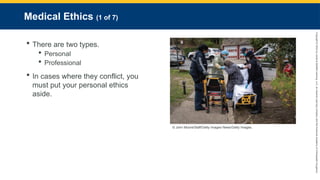
A. Personal ethics are the product of your upbringing, family, community, religion, and conscience.
B. Professional ethics arise out of the standards and practices of your profession, the Code of Professional Conduct, and state/federal laws.
C. In cases where your personal ethics conflict with professional ethical standards, you must temporarily set your personal ethics aside.
D. As a paramedic, the interests of your patient should take precedence over your personal beliefs and standards.
#6 Lecture Outline
E. Sometimes called bioethics, medical ethics are related to the practice and delivery of health care.
1. Many ethical codes for health care professionals have existed throughout history.
#7 Lecture Outline
a. The Declaration of Geneva
i. Drafted by the World Medical Association in 1948
ii. Oath taken by medical students upon completion of their studies, when admitted to the medical profession
b. The Code of Ethics for EMS Practitioners
i. Issued by the National Association of Emergency Medical Technicians (NAEMT) in 1978
ii. Still in use today
iii. Under this code, the emergency medical technician pledges to:
(a) Conserve life, alleviate suffering, promote health, do no harm, and encourage the quality and equal availability of emergency medical care.
(b) Provide services based on human need, with compassion and respect for human dignity, unrestricted by considerations of nationality, race, creed, color, or status; to not judge the merits of the patient’s request for service, nor allow the patient’s socioeconomic status to influence our demeanor or the care that we provide.
(c) Not use professional knowledge and skills in any enterprise detrimental to the public well-being.
(d) Respect and hold in confidence all information of a confidential nature obtained in the course of professional service unless required by law to divulge such information.
(e) Use social media in a responsible and professional manner that does not discredit, dishonor, or embarrass an EMS organization, coworkers, other health care practitioners, patients, individuals, or the community at large.
(f) Maintain professional competence, striving always for clinical excellence in the delivery of patient care.
(g) Assume responsibility in upholding standards of professional practice and education.
(h) Assume responsibility for individual professional actions and judgment, both in dependent and independent emergency functions, and to know and uphold the laws which affect the practice of EMS.
(i) Be aware of and participate in matters of legislation and regulation affecting EMS.
(j) Work cooperatively with EMS associates and other allied health care professionals in the best interest of our patients.
(k) Refuse to participate in unethical procedures, and assume responsibility to expose incompetence or unethical conduct in others to the appropriate authority.
#8 Lecture Outline
iv. Varying codes of ethics, policies, rules, or regulations for EMS professionals by state, service, or company
c. The ICARE program
i. Developed by a group of EMS students and educators
ii. Incorporates many of the finest qualities of EMS professionals
iii. ICARE: integrity, compassion, accountability, respect, and empathy
iv. Incorporate “ICARE” into the care you provide to your patients.
2. These codes stem from a concern for patient welfare.
#9 Lecture Outline
F. Apply three basic ethical concepts when making a decision.
1. To do no harm
2. To act in good faith
3. To act in the patient’s best interest
#10 Lecture Outline
G. Paramedics must be accountable for their actions at all times.
1. Your behavior on the job and the way you handle situations will shape your career.
2. Choose a mentor whose style and professionalism you wish to emulate.
H. Professional ethics are essential.
1. Ethics are especially important as EMS continues to seek funding and recognition similar to other medical professions.
2. Immature, unprofessional behavior is unacceptable.
3. Criminal acts are unethical and illegal.
a. Off-duty misconduct will affect your reputation and possibly your employment.
4. Negative publicity lessens the public’s confidence in the service you provide.
5. You should never falsify training records or falsely represent your level of certification.
I. Always be respectful of patients.
1. Never do anything to violate their trust in you as a professional.
2. Avoid misconduct that could question your ethics or integrity.
3. Do not overlook other EMS providers who engage in misbehavior.
a. Report it to the appropriate chain of command.
4. Report medical errors you make or witness to your medical director as soon as possible.
#11 Lecture Outline
J. The most successful and fulfilled paramedics:
1. Choose to become patient advocates
2. Participate in and actively seek out the best in training and professional development
3. Put the good of the team above their own personal aspirations
K. You are responsible for the future of EMS.
#12 Lecture Outline
L. Ethics and EMS research
1. EMS practices have largely evolved from grassroots efforts.
2. Properly randomized, controlled studies are not common, but they are emerging.
3. Remember the first principle of medical practice: to do no harm.
a. Continue to seek further education about the effectiveness of EMS practice.
#13 Lecture Outline
4. EMS care still relies on anecdotal experience that is unsupported by research.
a. Some procedures prove not to be helpful to patients.
b. You must be aware of procedures that are not recommended, even if anecdotal evidence suggests they worked in the past.
5. Conducting EMS studies on critically ill or injured patients without their informed consent is a true ethical dilemma.
a. Make yourself aware of how researchers are handling ethical debates concerning patients in research.
#14 Lecture Outline
III. The Legal System in the United States
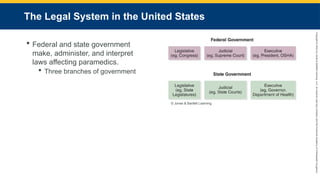
A. Passage, administration, and interpretation of federal and state laws affecting paramedics
1. Legislative branch
a. Composed of elected officials
b. Makes the laws
2. Judicial branch
a. Composed of the court system
b. Enforces and interprets the laws
c. Resolves disputes based on interpretation of laws
d. Common law is defined as a decision that has been made by a judge through a court case based on the interpretation of statutes and constitutions.
i. Can be overturned by another court with higher authority or the issuing court at a later time
e. Precedence and the law of the state in which paramedics practice
i. In most cases, court decisions establish standard of negligence.
3. Executive branch
a. Reports directly to the president or the governor
b. Composed of cabinets and agencies that carry out and administer laws
i. Often use regulations to establish how things should be done
ii. Examples: US Department of Transportation (US DOT) at the federal level and Department of Health at the state level
#15 Lecture Outline
B. Types of law
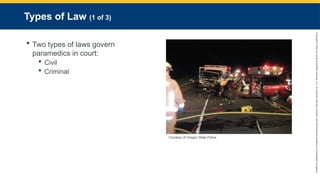
1. Civil and criminal law govern paramedics in court.
a. Under civil law, a patient can sue you for a perceived injury.
b. Criminal law allows the state to prosecute a paramedic for breaking a legal statute.
c. Malpractice suits are tried under civil law.
i. May be based on statutes, but claims usually arise from principles of negligence
d. Cases of medication misuse are usually tried under criminal law.
#16 Lecture Outline
2. Most civil law is concerned with establishing liability.
a. The judicial process determines who is responsible when a person is injured and seeks redress.
b. People have a constitutional right to take legal action against a medical provider they believe provided inadequate care.
i. However, they must prove that the medical provider was negligent.
ii. A bad outcome alone does not imply negligence.
c. Actionable cause could lead to a civil lawsuit.
i. Legal action instituted by a private person or entity (plaintiff)
ii. Defendant: The person or entity against whom a legal action is brought
iii. Tort: Wrongful act that gives rise to a civil suit
d. There are two classifications of torts:
i. Unintentional (negligence)
ii. Intentional (where there is an intent to cause harm)
e. The objective of a civil lawsuit is usually compensation (damages) for injury the plaintiff sustained.
3. To succeed in a civil lawsuit:
a. The plaintiff needs to show a majority of evidence favors their position.
b. The plaintiff must convince the jury of this position.
4. Most EMS lawsuits result from emergency vehicle crashes.
5. Other kinds of lawsuits against EMS providers:
a. Dispatch and transport issues
i. Examples: Delayed transport response, patient deterioration after not being transported
b. Quality of medical care provided by EMS providers, especially paramedics
6. A civil lawsuit may elicit criminal prosecution.
#17 Lecture Outline
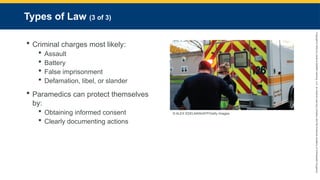
7. Criminal laws are most likely to apply to prehospital care.
a. Assault: When a person instills the fear of immediate bodily harm or breach of bodily security in another person, regardless of whether the threat of harm is actually carried out
b. Battery: When the defendant touches another person without the person’s consent
c. False imprisonment: When a person is unintentionally and unjustifiably detained
d. Any act of medical treatment performed without consent may be considered assault or battery or both.
e. In criminal cases, the prosecution needs to prove there was intent to do harm.
f. In civil cases, the plaintiff needs only to establish that the conduct took place without consent.
g. The charge of false imprisonment is infrequently prosecuted in EMS.
i. Courts tend to be lenient toward EMS personnel when they show that they were:
(a) Acting in the patient’s best interest
(b) Believed the patient did not have the capacity to provide informed consent
ii. EMS providers may be charged with battery when they physically force someone to be transported in the absence of just cause.
iii. The best way for EMS providers to protect themselves:
(a) Obtain informed consent for almost everything they do, or
(b) Clearly document the need to use restraints for the patient’s protection
iv. Rule of thumb: use the least amount of restraint necessary when restraining or transporting patients against their will.
h. Paramedics may be sued for defamation.
i. Intentionally making a false statement through written or verbal communication that injures a person’s good name or reputation
ii. Libel means making a false statement in the written form that injures a person’s good name.
iii. Slander means verbally making a false oral statement that injures a person’s good name.
#18 Lecture Outline
C. The legal process
1. A civil lawsuit begins when a dissatisfied patient contacts an attorney, who then files a document for a lawsuit (complaint) with a local court.
a. The complaint contains general allegations against the paramedic and the EMS system but may not contain specific information about what the patient thinks went wrong.
2. The lawsuit may take several years.
3. Discovery period:
a. Can last a few months to more than 2 years
b. Attorneys on both sides seek as much information about the case as possible.
4. Attorneys may also file motions and argue them before the judge.
a. Seeking to have a lawsuit dismissed
b. Plaintiff’s attorney asking the court to rule on certain portions of the claim
c. Can be used to compel either side to produce documents or information
5. Most civil cases are resolved during a settlement process.
a. Settlement processes involves both parties and their attorneys in mediation or arbitration.
b. If the case cannot be resolved during settlement, it will proceed to trial.
#19 Lecture Outline
IV. Legal Accountability of the Paramedic
A. The paramedic and the medical director
1. The relationship between the paramedic and medical director is complex.
2. The paramedic must answer to:
a. The medical director
b. The licensing agency
c. The employer
3. There may be some overlap, but these distinctions are important.
#20 Lecture Outline
4. Usually, state EMS legislation requires the paramedic to perform advanced life-support procedures and skills only under physician’s supervision.
5. Legislation may also require a medical director.
a. The medical director supervises the paramedic.
b. Legally, the paramedic is not the medical director’s agent.
6. The acts of the paramedic are not the actions of the physician.
a. The paramedic will be responsible for his or her own actions.
7. The medical director can be accountable for failing to supervise closely or take action when a paramedic is not meeting standards.
8. A medical director may do any of the following if he or she does not believe the paramedic is performing to standards:
a. Restrict the paramedic’s practice
b. Withdraw supervision entirely
c. Require remedial training
9. Medical directors are generally not held legally responsible for an employer’s disciplinary actions.
#21 Lecture Outline
10. Many paramedics’ activities require an order from a physician.
a. Online or off-line
b. Paramedics cannot disregard or reverse a physician’s order unless carrying out the order will harm the patient.
c. Paramedics may be at the scene of an emergency with an inexperienced physician and feel the orders of the physician are inappropriate.
d. Disregarding orders from a physician places the paramedic on questionable legal ground.
i. The physician’s orders must be appropriate, and they must be licensed in that state.
e. The physician is not required to ride to the hospital with the EMS unless procedures have been performed above the EMS provider’s level of training or the physician has assumed responsibility for patient care.
f. Be sure that the physician is licensed in your state, and document the physician’s name and contact information prior to patient care.
g. Conflicts should be resolved by online medical control.
h. The borrowed servant doctrine is a principle that absolves your institution from liability when you act beyond your scope of certification or training by following someone else’s orders.
i. Do not follow a physician’s order that falls outside your scope of practice.
#22 Lecture Outline
B. EMS-enabling legislation
1. Defines how EMS is structured
2. Designates responsibilities to government agencies
3. Provides framework for the paramedic’s practice
a. Defines the need for the medical director
b. Defines the scope of practice for the different levels of EMS personnel
4. Leads to regulations that paramedics should be familiar with
#23 Lecture Outline
C. Administrative regulations
1. Set forth by bureaucracies at the state and federal levels
2. Affect and define the specific rules under which paramedics practice
a. Example: Regulations may set out specific skills and medications to be used by each level of EMS provider.
3. Usually developed by the state’s Department of Health or the county agency responsible for regulating EMS practice
4. May further define the paramedic’s role in patient care
5. May define the requirements for:
a. Licensure or certification
b. Renewal
c. Continuing education
d. A list of behaviors that may subject paramedics to suspension or revocation of their license or certification
6. Action against a paramedic’s license for providing less than adequate care or failing to meet the requirements for recertification
#24 Lecture Outline
7. Licensure and certification
a. These terms are often confused.
b. Certification is a level of credentials based on hours of training and competency, which may be granted by a governmental agency or by a private organization.
i. It does not mean someone has authority to practice the skills in that certification.
c. Licensure refers to a carefully defined level of practice, usually granted by a government agency or local authority.
i. State health department or county EMS authority.
ii. These agencies can create and administer the licensing examinations.
d. A license is a privilege granted by a government authority on certain conditions.
e. The paramedic must comply with the government requirements or risk losing licensure.
i. Professional behavior
ii. Continuing education
iii. Licensure renewal
f. Rights and privileges conferred by licensing in one state may not be conferred in other states that certify, rather than license, paramedics.
g. Credentialing may be required for EMS employment.
#25 Lecture Outline
8. Discipline and due process
a. Paramedics who commit an infraction to licensure rules may have their license restricted, suspended, or revoked by the granting agency.
b. Administrative agencies can propose a licensing action called due process.
i. Due process: A right to a fair procedure for the action the agency proposes to take
ii. Two components: Notice and the opportunity to be heard
c. A hearing allows the paramedic to tell his or her side of the story.
d. A notice of final action is sent if the licensing agency believes action is warranted.
e. The paramedic may have the right to appeal.
#26 Lecture Outline
D. Medical Practice Act
1. Defines the minimum qualifications of those who may perform various health services and the skills that each type of practitioner is legally permitted to use
2. Establishes a means of licensure or certification for different categories of health care professionals
3. May contain requirements for relicensure or recertification based on continuing education or other factors
4. May require a physician to assume responsibility for competency of the paramedic
a. Training
b. Skill competency testing
c. Run review
5. Varies by state
#27 Lecture Outline
E. Scope of practice
1. Care that a paramedic is permitted to perform according to the state under its license or certification
2. A medical director may limit the skills you may perform (eg, rapid sequence intubation).
3. Carrying out procedures outside the scope of practice may be considered for negligence or a criminal offense.
a. Scope of practice should not be confused with standard of care.
b. Standard of care is what a reasonable paramedic would do in a similar situation.
#28 Lecture Outline
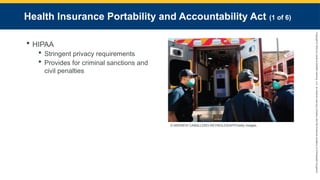
F. Health Insurance Portability and Accountability Act (HIPAA)
1. Provides stringent privacy requirements for patient information
2. Provides for criminal sanctions as well as civil penalties for releasing a patient’s private medical information in an unauthorized manner
#29 Lecture Outline
3. HIPAA Privacy Rule—the most relevant part of HIPAA for health care providers
a. Enforced by the US Department of Health and Human Services
b. Establishes what is considered to be a person’s protected health information (PHI)
i. Also protects electronic health information
c. Medical information can be disclosed only:
i. If necessary for a patient’s treatment
ii. For payment for medical/billing operations
iii. If a release has been authorized in writing by the patient or lawful patient representative
d. Requires each EMS agency to have a privacy officer
i. Ensures that all PHI that the service deals with in either written or electronic form is not released in an unauthorized manner
e. Use caution when giving reports or discussing patient information in public places.
#30 Lecture Outline
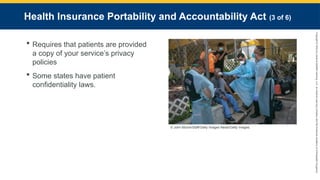
4. Patients entitled to a copy of your service’s privacy policies
5. State laws pertaining to patient confidentiality
a. Breach of confidentiality may allow patients to sue.
#31 Lecture Outline
6. Release of medical information without patient’s authorization
a. Legally mandated reporting
b. Authorized data collection
c. Research by public health agencies
d. Authorized requests by law enforcement
e. Information required to be disclosed pursuant to a valid subpoena
f. Exchange of health information for a medical need
#32 Lecture Outline
7. HIPAA implications for electronic communications
a. Some agencies prohibit EMS providers from carrying camera-enabled mobile phones while on duty.
b. Ensure everyone understands that patient information should never be posted on any social media network.
c. Ensure no patient identifiers are present if an emergency scene is captured in any photographs or videos.
d. The Safeguards Principle of HIPAA requires that reasonable administrative, technical, and physical safeguards be put in place to aid in the protection of patient information.
#33 Lecture Outline
8. HIPAA training
a. Rules and regulations should be taught to all entities involved in health care.
b. Covered entities, as defined by the US Department of Health and Human Services, should follow HIPAA guidelines.
i. Each agency must have a designated privacy officer.
ii. Employer is required to provide paramedics with training upon hiring and then on an annual basis.
#34 Lecture Outline
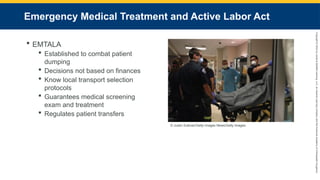
G. The Emergency Medical Treatment and Active Labor Act (EMTALA)
1. Combats the practice of patient dumping
a. Historically occurred when hospital staff discovered the patient did not have health insurance or was unable to pay
b. Pays particular attention to the practice of sending women in labor to distant hospitals
2. Economic triage is the practice of making health care decisions based on the ability of the patient or the insurance carrier to provide payment for services.
a. Never make decisions to treat or transport based on financial considerations, regardless of the current state of the EMS employer.
3. Understand local protocols regarding hospitals to transfer patients.
4. EMTALA can be enforced.
a. It regulates hospitals that receive Medicare funding.
5. EMTALA issues severe fines for hospitals and doctors who violate its provisions.
a. The law allows private citizens to sue for violations.
b. Normally, neither an ambulance service nor paramedic can be sued or charged.
c. Ambulance systems owned by hospitals may be subject to a claim.
6. EMTALA issues are regulated by the Centers for Medicare and Medicaid Services (CMS).
a. Carries severe monetary penalties
i. Up to and including loss of Medicare funding for hospitals failing to comply
7. EMTALA guarantees a medical screening examination and treatment to stabilize any emergency medical conditions found, to any patient presenting to a hospital that has an emergency department.
a. Prohibits discrimination for any reason, including the ability to pay
b. Includes some urgent care centers
8. EMTALA regulates patient transfers.
a. Applies to both sending and receiving facilities.
b. Never transfer a patient who needs care that falls outside scope of practice between facilities.
c. Only a stable patient can be transferred.
d. A transferring hospital is obligated to ensure the transferring ambulance and crew are capable of meeting the needs of the patient during transfer.
#35 Lecture Outline
H. Emergency vehicle laws
1. Most states have specific statutes that define an emergency vehicle and what traffic should do when an emergency vehicle approaches.
2. Laws vary from state to state.
a. Emergency vehicles must be operated in a safe and prudent manner.
b. Laws do not authorize speeding, running red lights, or driving the vehicle in an unsafe manner, if any of those activities put the public at unreasonable risk.
c. State laws establish higher standards for the operator.
i. Due regard: proper consideration and attention
d. In a crash, often the EMS provider will be found at fault in civil cases against the driver.
e. The driver may be charged criminally.
#36 Lecture Outline
I. Transportation
1. Patients should be transported to the hospital of their choice.
a. Most EMS systems have protocols to transport certain types of patients to particular hospitals.
i. Transporting a patient to a facility that does not have the ability to care for the patient may result in liability for the paramedic.
b. Paramedics who have decided not to transport patients have been the subject of litigation.
#37 Lecture Outline
J. Crime scene and emergency scene responsibilities
1. When handling a situation involving death, or a potential crime scene, it may take law enforcement officials time to figure out whether the scene involved a suicide, homicide, or some other form of criminal activity.
a. Use extreme caution, and do not disturb or destroy any potential evidence.
b. If the scene is a vehicle crash:
i. Do not move anything unless you have to.
ii. Leave deceased people where they are until a coroner or medical examiner arrives to investigate.
c. If the scene is indoors:
i. Do not touch anything you do not have to for risk of eliminating fingerprints.
ii. Document statements made by witnesses, and get their contact information.
iii. Limit the number of EMS personnel who enter the scene.
iv. Notify law enforcement personnel if furniture or other objects have been moved.
v. Preserve any clothing removed from the patient.
vi. Do not alter evidence on the clothing.
d. In cases of sexual assault, the patient may carry vital pieces of evidence.
e. In the event of a death at the scene:
i. Stay with the body until the police arrive.
ii. Protect the scene from contamination from bystanders, family members, media, and other EMS personnel.
f. When in doubt about the possibility of saving a patient:
i. Initiate resuscitation.
ii. Transport the patient to the hospital.
#38 Lecture Outline
K. Mandatory reporting
1. Each state has its own requirements for reporting to authorities.
a. Every state has laws requiring EMS to report child and elder abuse.
i. In most states, reporting laws contain immunity provisions protecting the health care provider from legal liability, provided the report was not made with malicious intent.
ii. Failure to report is a crime.
(a) In many states, there are serious implications for not reporting.
2. The obligation to report is frequently applied to:
a. Neglect or abuse of children
b. Neglect or abuse of older people
c. Domestic violence
d. Injury from a felony or suspicious origin
e. Drug-related injuries
f. Childbirth occurring outside a licensed medical facility
g. Rape
h. Animal bites
i. Certain communicable diseases
#39 Lecture Outline
L. Coroner and medical examiner cases
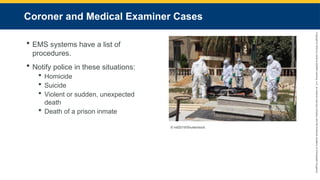
1. EMS systems have a list of procedures that involve the coroner and medical examiner.
a. Generally, the police should be notified in all cases.
i. Obvious or suspected homicide
ii. Obvious or suspected suicide
iii. Violent or sudden, unexpected death
iv. Death of a prison inmate
#40 Lecture Outline
V. Paramedic–Patient Relationships
A. Most important rule in medical care: do what is best for the patient
1. Every decision should be based on the standards of good medical care, not on the possible legal consequences.
#41 Lecture Outline
B. Consent and refusal
1. Obtain consent of the patient prior to providing emergency medical care.
a. Consent refers to patients who are of legal age and possess decision-making capacity (capacity to make medical care decisions for themselves).
b. Patients have the right to refuse all or part of the emergency medical care.
c. There are two types of consent:
i. Informed consent
ii. Implied consent
#42 Lecture Outline
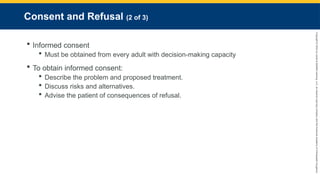
2. Informed consent must be obtained from every adult patient who has decision-making capacity.
a. Describe the suspected injury or illness to the patient.
b. Describe the treatment you would like to administer, and list the potential risks associated with the proposed treatment.
c. Discuss any alternative types of available treatments.
d. Advise the patient regarding potential consequences of refusing treatment.
3. A number of things may impede you giving patients what they need to make decisions:
a. Language barrier
b. Emotional state
c. Mental ability
4. Ensure the patient understands what you are trying to do and grants you permission to treat.
5. Informed consent may lack the formality of that seen in the hospital.
a. Document the patient’s consent to protect yourself against potential legal action.
#43 Lecture Outline
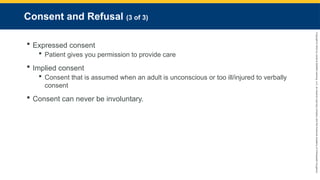
7. Implied consent is a form of consent assumed to be given by unconscious adults or those who are too ill or injured to consent verbally to emergency life-saving treatment.
a. Assume the patient would want care due to severity of condition.
b. If the patient exhibits signs that he or she does not have the decision-making capacity, treat the patient under implied consent.
i. Mental illness
ii. Shock
iii. Stress
iv. Confusion
v. Head injury
8. Some EMS personnel incorrectly use the term involuntary consent.
a. This term is incorrectly used in situations where a law enforcement officer or legal guardian grants permission to treat someone who is under arrest, incapacitated, or a minor, or for some other reason.
b. Consent can never be involuntary.
c. People under arrest or in prison do not necessarily lose their right to be involved in medical treatment decisions.
d. It is not uncommon for law enforcement to direct EMS personnel to treat a person under arrest.
i. Paramedic should continue to follow informed consent guidelines.
e. Medical control should be involved if a prisoner refuses treatment.
f. Do not assume that a law enforcement officer or anyone else has the right to refuse treatment for a patient.
#44 Lecture Outline
C. Decision-making capacity
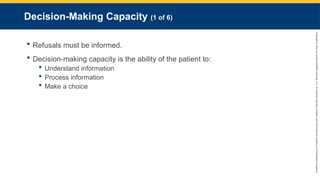
1. Refusals must be informed.
a. The same prerequisites as consent apply.
i. Decision-making capacity: The ability of patients to understand the information that is being provided to them and make a choice regarding appropriate medical care
b. The best tool to evaluate a patient’s decision-making capacity is the ability to talk to the patient to see the patient understands what is happening.
c. Include detailed documentation of decision-making capacity in the patient care report.
#45 Lecture Outline
2. If a patient with decision-making capacity refuses medical care, that person may not be treated without a court order.
a. Consult with medical control for instructions.
b. Inform the patient in a calm and sympathetic manner of the potential consequences of refusing treatment.
c. Remember, many people who refuse medical treatment do so out of fear and emotional distress.
d. The patient’s distress needs to be recognized and managed in an understanding way.
e. It is not uncommon for patients to refuse treatment and transportation to the hospital due to cost.
i. Cost of ambulance
ii. Cost of hospital treatment
f. Addressing these concerns can be challenging.
g. Situations like this may require all of your people skills.
#46 Lecture Outline
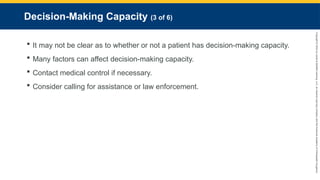
3. A patient may be alert and oriented but still incapable of making an informed decision even after you have communicated the need for care to the best of your ability.
a. Many factors may prevent the patient from making an informed refusal.
i. Head injury
ii. Altered mental status
iii. Unstable vital signs
iv. Abnormal blood glucose levels
v. Abnormal oxygen saturation levels
vi. Cerebral ischemia
vii. Mental illness
viii. Drug or alcohol intoxication
ix. Urinary tract infection
x. Suicidal or homicidal ideation
xi. Inability to cope with emotional distress
xii. Developmental disability
b. Contact medical control for guidance.
c. Consider calling for assistance or law enforcement.
#47 Lecture Outline
4. Psychiatric emergencies present problems of consent.
a. A person’s life is not in danger.
b. Police officer is generally the only person given authority to restrain and transport the patient without consent.
c. EMS should not do so unless at the expressed request of the police.
d. Neither a physician nor the patient’s family may authorize transport in most regions.
i. They may authorize involuntary commitment.
ii. Authority does not extend to the forcible transport of a patient.
#48 Lecture Outline
5. If you believe that the patient is not competent to make a reasonable decision regarding care, and that treatment is necessary, it is better to treat the patient.
6. Some patients refuse treatment as a way to deny they have a problem.
7. Patients speaking with medical control by radio or telephone may be helpful.
a. If the patient still declines care after you explain the medical situation and possible consequences, and there is no evidence that the patient is impaired in any way, there is not much that you can do.
b. Inform the patient that if they change their mind, you will be willing and ready to help them.
8. Maintain a courteous and sympathetic attitude.
a. Let patients know your chief concern is their well-being.
b. Tell patients that it’s okay to change their minds.
c. Urge patients to seek further medical evaluation from the physician of their choice.
d. Help patients make concrete plans for follow-up.
e. Some patients will consent to transport but not treatment.
f. Some patients will consent to treatment but not transport.
i. Make sure someone will be with the patient after you leave.
ii. Advise them to call 9-1-1 again for help.
iii. Never threaten the patient in any way.
#49 Lecture Outline
9. Documentation of patient refusals is critical.
a. Litigation may arise.
b. The patient may claim you committed abandonment.
c. Document all findings of your assessment and the patient’s mental status exam carefully, including:
i. Patient’s history
ii. Patient’s stated reasons for refusing care
iii. All instructions and explanations given to patient
iv. How much time you spent attempting to provide care
d. The report should be signed:
i. By the patient
ii. By an impartial observer
#50 Lecture Outline
D. Minors
1. Minors present special issues for the paramedic.
a. Minors have no legal status.
b. Minors cannot refuse or consent to medical care.
c. Consent must be obtained from the parent or legal guardian of the patient.
i. If the legal guardian is not available, emergency treatment to sustain life may be undertaken without direct consent under the doctrine of implied consent.
d. Be aware of the legal principle in loco parentis.
i. In loco parentis: In the place of the parent
ii. May apply in school, day care, or summer camp
iii. Decisions by school administrators or day care directors on behalf of the minor
2. Difficult circumstances may arise if a parent or legal guardian refuses to grant consent to treat a minor who clearly requires life-saving or limb-saving treatment.
a. Adults have the right to refuse treatment.
b. State laws generally do not permit a parent or guardian to deny treatment to a minor.
c. The failure to allow treatment may constitute neglect.
d. The paramedic should notify law enforcement and medical control.
e. State law may permit the state to assume custody of the minor.
#51 Lecture Outline
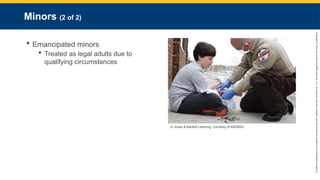
3. Emancipated minors are under the legal age in a given state but can be treated as legal adults due to qualifying circumstances.
a. Individual state law determines circumstances.
b. Most states recognize any minor who has been emancipated by court order.
c. Some states add criteria:
i. Marriage
ii. Pregnancy
iii. Active military service
d. Emancipated minors may be treated as adults when obtaining consent or refusal.
e. If you reasonably suspect the patient is a minor and that patient has no proof to the contrary, then be prepared to transport.
#52 Lecture Outline
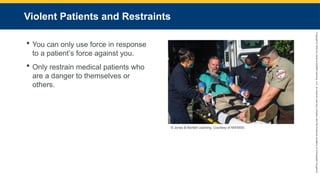
E. Violent patients and restraints
1. Force can only be used in response to a patient’s use of force against you.
a. If attacked, you may defend yourself.
b. The use of temporary disabling sprays, knives, or firearms are usually prohibited by the EMS agency.
c. The amount of force allowed by law is either equal to or slightly greater than the force offered by the patient.
i. Must be in response to the patient’s actions
2. Restraint can be used for medical reasons.
a. Only when patients are a danger to themselves or others
b. Violence can be a result of:
i. Hypoxia
ii. Hypoglycemia
iii. Mental illness
iv. Brain injury
v. Drug abuse or overdose
vi. Alcohol
vii. A variety of underlying medical and psychiatric causes
c. Medical protocols cover what is considered appropriate.
d. Many EMS systems use medications (chemical restraints).
i. Benzodiazepines
ii. Antipsychotics
#53 Lecture Outline
VI. Negligence and Protection Against Negligence Claims
A. No protection from liability for gross negligence, other than immunity
1. Negligence occurs when:
a. The paramedic or EMS system had a legal duty to the patient.
b. There was a breach of duty.
c. The failure to act appropriately was the proximate cause of the plaintiff’s injury.
d. Harm resulted.
#54 Lecture Outline
2. Paramedics and the EMS systems are protected from liability as long as they perform according to the standards for paramedics and EMS systems.
3. Paramedics may obtain their own insurance coverage, in addition to their employer’s, to provide for additional protection.
a. Having additional insurance provides protection:
i. If your employer’s insurance carrier is required to pay out on a claim based on wrongdoing for which you are responsible
ii. If you are sued as a result of having provided off-duty emergency assistance
iii. If you are an instructor teaching EMS-related classes outside the scope of your employment and are sued by a student or other party
4. One aspect of negligence is foreseeability.
a. Implies that the injury or harm could have been predicted
b. Avoided if proper precautions were taken
#55 Lecture Outline
5. Negligence is divided into three categories.
a. Malfeasance: When a paramedic performs an act that he or she was never authorized to do
i. Example: Medical intervention outside the scope of practice
b. Misfeasance: When a paramedic performs an act that he or she is legally permitted to do, but improperly carries it out
i. Example: Administering medication that is clearly within the scope of practice but accidentally calculating an incorrect dose
c. Nonfeasance: When a paramedic fails to perform an act that he or she is required or expected to perform
i. Example: Failure to perform CPR when a patient goes into cardiac arrest
#56 Lecture Outline
B. Elements of negligence
1. Duty
a. Prescribed by the law
b. What you must do and how you must do it
c. First duty: to do no further harm to a patient
d. Successful lawsuit: Proof of duty
i. Duty is “an obligation, to which law will give recognition and effect; to conform to a particular standard of conduct toward another” (Keeton et al., 1984.).
ii. If a person fails to perform according to that standard, and this failure caused the injury, that person may be considered legally liable.
e. Confusion around the concept of legal duty in EMS
i. Example: Many paramedics think they are legally obligated to stop at roadside crashes because they are paramedics.
ii. In all but a few states, this is not the case.
f. Obligation to respond to calls when working a shift or volunteering for a squad
i. Most services have a policy addressing the passing by of another incident when en route to a call or to the hospital with a patient.
ii. Make sure the appropriate personnel are dispatched.
#57 Lecture Outline
g. Common misconception: Requirement to stop at all emergencies due to the paramedic sticker on your personal vehicles
h. Legal duty to perform within the standard of care if a decision is made to stop and provide assistance
i. Further legal duty not to abandon the patient once treatment has begun
j. Legal obligations when off duty
k. State laws
l. Education of peers regarding off-duty obligations
m. Concept of duty extends to:
i. Maintaining licensure or certification
ii. Attending continuing education courses
iii. Maintaining your skills
iv. Maintaining health
v. Maintaining psychological well-being
vi. Duty to check equipment to ensure it is functioning properly
vii. Duty to honor patient’s rights to privacy
viii. Honoring patient’s right to refuse or limit care you provide
n. Legal duty of EMS agencies and systems
i. Agencies have a duty to respond to calls for aid.
ii. Use mutual aid resources appropriately if call volume is heavy.
(a) Allows response within an appropriate time frame.
iii. Agencies may operate with contracts specifying legal duties.
(a) Example: Minimum response time
o. Legal duty
i. A concept in the law that tells you what your standards of practice are
(a) Unpredictable legal concept
ii. Often defined in the context of a case tried in court of law
iii. Used by attorneys defending EMS providers
p. Attorneys
i. Lack of legal duty is a general defense.
ii. However general, it may still be true.
#58 Lecture Outline
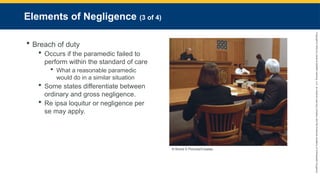
2. Breach of duty
a. A lawsuit will be successful if a paramedic failed to perform within the standard of care.
b. Some states differentiate between ordinary negligence and gross negligence.
i. Standard of care from a paramedic differs by state.
ii. Some states provide immunity.
(a) Covers all but the poorest care given by the paramedic
(b) Comes in the form of a Good Samaritan law
c. Some states follow a gross negligence standard.
i. Lawsuits against paramedics will not be successful unless the paramedic has seriously departed from accepted standards.
ii. Gross negligence applies if the paramedic’s actions are found to be willful or wanton (malicious) under the law.
iii. Either intentional conduct or recklessness is essential to the finding of willful or wanton conduct.
(a) Example: Black’s Law Dictionary defines willful misconduct as intentional disregard to safety of others, and wanton misconduct as the reckless disregard for the safety and rights of others while knowing harm or injury may result.
(b) Some states have defined wanton misconduct as reckless disregard, utter indifference, or conscious disregard for the safety of others.
d. In other states, the plaintiff shows ordinary negligence.
i. Ordinary negligence: A failure to act or a simple mistake that causes harm to a patient
e. Res ipsa loquitur
i. Applies even though the plaintiff is unable to demonstrate clearly the exact manner by which an injury occurred
ii. Means the thing that speaks for itself
iii. You could be held liable:
(a) If it is shown that the plaintiff was injured
(b) If the cause of injury was in your control
(c) If such injuries do not ordinarily occur unless there is negligence
f. Negligence per se
i. Applied to circumstances where a paramedic inexcusably violates a statute
(a) Example: A paramedic treats a patient despite an expired license.
ii. A finding that a statute has been violated can sometimes lead to an automatic finding of negligence.
#59 Lecture Outline
3. Proximate cause
a. Applies in cases where the paramedic has a legal duty to the patient and breaches the standard of care
b. The plaintiff must link the act that fell below the standard of care directly to the injury.
i. Proof required that the paramedic’s improper action, or failure to act, was the cause of the injury
c. Careful documentation of patient’s status when you first encountered patient might be essential to your defense.
4. Harm
a. In addition to physical injury, patients can claim damages for:
i. Emotional distress
ii. Loss of income
iii. Loss of enjoyment of life
iv. Loss of spousal consortium
v. Loss of household services
vi. Loss of future earning capacity
b. Plaintiff will need to show the paramedic’s actions were proximate causes of each of these losses.
#60 Lecture Outline
C. Abandonment
1. Involves the termination of care without the patient’s consent.
a. Implies the patient had continuing need for medical treatment.
b. The abrupt termination of treatment caused subsequent injury or death.
c. You may not leave a patient in need of medical treatment until another competent health care professional with equal or higher level of training has taken responsibility.
d. You must notify an appropriate health care professional of the patient’s presence in the ED.
e. Notify that person that you are transferring responsibility for care to that person.
#61 Lecture Outline
2. Complete a written report.
3. Some situations may not require transport but are not considered abandonment.
a. Frequent calls for patients who do not really need treatment or transportation
i. Patient may have fallen and needs help getting up.
ii. Patient may need help taking medication.
iii. Patient with hypoglycemia may feel fine after treatment.
b. Protocol of medical director
c. Transport encouraged
4. Some systems have a tiered response.
a. If BLS responds and makes an improper determination, the system may be exposed to liability.
#62 Lecture Outline
VII. Patient Autonomy
A. Patients’ rights to direct their own care, make end-of-life care decisions
1. Patient autonomy and medical ethics
a. Does not apply when the patient is a minor or lacks decision-making capacity
b. Respect and honor the patient’s right to make medical decisions, however irrational or unsound
2. Patients’ decisions
a. Decisions may not be accepted by other members of the public or the patient’s family.
b. Courts, including the US Supreme Court, have recognized the right of patients to make decisions about their own medical care.
c. People can make their own decisions, even if it means death.
d. Paramedics find themselves being accountable to more systems than the average health care provider in trying to respect the wishes of the patient.
e. The following can compete with the wishes of the patient:
i. The EMS system
ii. Your medical director
iii. The EMS service for which you work
iv. Your community’s standard of care
f. Competing interests can create an ethical conflict.
#63 Lecture Outline
g. You will need to resolve conflicts through communication with all involved parties.
3. Physician’s orders
a. You may feel they are detrimental to the patient’s best interests.
b. Communicate fully with the physician.
c. Never perform a procedure or administer a medication you believe will harm the patient.
d. Obtain clarification from the physician.
e. Discuss your current standing orders.
f. Offer a feasible alternative within your scope of practice.
g. Request that the physician speaks with your medical director.
h. Act in the patient’s best interest as an advocate.
#64 Lecture Outline
B. Advance directives
1. Usually a written document (may be an oral statement)
a. Expresses the wants, needs, desires of a patient about future medical care
b. State what medical care the patient wants or does not want when the patient is unable to express these wishes
c. Examples:
i. Living wills
ii. Do not resuscitate (DNR) orders
iii. Organ donation
2. Differ from state to state
a. DNR order may restrict any ALS care.
b. Some orders provide for comfort care (including pain medication and oxygen therapy).
c. Know your own local and state protocols and regulations.
3. State law
a. State law covers whether EMS personnel are bound by advance directives.
b. Those that cover DNR orders are usually strict.
i. Usually limited to terminal patients in nursing homes or hospice care
#65 Lecture Outline
4. Living will and health care power of attorney
a. These are types of advance directives.
b. A patient can express wishes regarding end-of-life medical care.
c. These are sometimes called health care “durable” powers of attorney.
i. Remain in effect after a patient loses decision-making capacity
d. There are various types of powers of attorney.
i. Not all authorize the designated agent to make decisions regarding health care.
e. Older patients commonly execute powers of attorney.
i. Enable others to conduct financial affairs on their behalf
ii. Have no effect on health care whatsoever
f. These documents may have been executed outside the state in which the patient now resides.
#66 Lecture Outline
g. Ask to see the power of attorney and carefully review it.
h. Determine whether it authorizes the agent to make health care decisions.
i. When in doubt, contact medical control.
j. Living wills need a precondition to activate.
i. Example: Terminal illness or irreversible coma
ii. Spells out exactly what kind of treatment a patient wishes to be given
iii. Often contains a health care power of attorney
iv. Designates another person to make health care decisions for the patient at any time the patient is unable to make those decisions
v. Does not have to be a relative
vi. Limited field use if a health care power of attorney is not identified
(a) Consult medical control.
#67 Lecture Outline
k. The health care power of attorney is often called the surrogate decision maker.
i. Surrogate decision maker: Legally obligated to make decisions as the patient would want
ii. Has no authority until the patient becomes incapable of making decisions
(a) If a surrogate decision maker is attempting to make decisions that conflict with a competent patient’s decisions, the patient’s decisions are always followed.
#68 Lecture Outline
5. Do not resuscitate (DNR) orders
a. Also known as do not attempt resuscitation (DNAR) orders.
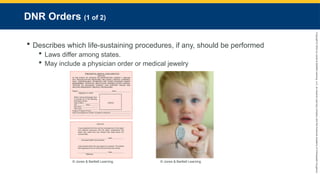
b. Describes which life-sustaining procedures should be performed if a patient’s medical condition suddenly deteriorates.
c. Many states have DNR forms specific to EMS.
d. States have their own procedures for recognizing valid DNR orders.
e. Some states rely on written physician orders.
i. These may not be available to the EMS provider.
f. Others require the patient to wear an identification bracelet or necklace.
i. Jewelry indicates the patient has consented to the release of stored information.
(a) Example: DNR status
g. DNR orders expire in some states and must be renewed to remain valid.
h. In some cases, the DNR order must be executed within your state by a physician licensed to practice medicine within the state.
#69 Lecture Outline
i. DNR orders must:
i. Clearly state the patient’s medical condition(s)
ii. Include the signature of the patient or legal guardian
iii. Include the signature of one or more physicians
iv. Be dated in the preceding 12 months to be valid, if there’s an expiration date
j. You are obligated to provide supportive measures.
#70 Lecture Outline
6. Withholding or withdrawing resuscitation
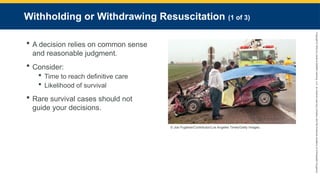
a. Rely on the use of common sense and reasonable judgment in deciding when to stop CPR and resuscitation efforts, or to decline to initiate them at all.
b. The National Association of EMS Physicians has published data and guidelines for the termination of resuscitation of nontraumatic cardiopulmonary arrest that demonstrates the benefits of on-scene resuscitation.
i. Many EMS organizations have adopted these guidelines.
ii. Each resuscitation should be based on the futility of such efforts.
c. Consider the time it will take for a patient to receive care and the likelihood of survival.
i. Rare survival cases should not be your guide to decision making.
#71 Lecture Outline
d. Each state has different laws defining the role of the paramedic in resuscitation issues.
i. In some jurisdictions, a paramedic can pronounce death.
ii. In other states, only a medical investigator or physician may do so.
iii. State laws govern your practice even if the patient is clinically deceased.
iv. Some laws include guidelines for basic life support.
v. If resuscitation has begun, cessation may be appropriate in cases of:
(a) Blunt trauma arrest
(b) A prolonged rescue or response time
(c) Lengthy medical resuscitation efforts
#72 Lecture Outline
e. The decision to halt resuscitation is difficult and emotional.
i. This is especially true when dealing with a pediatric patient.
ii. Sometimes, you can do more for the grieving family than for the child who has died.
(a) Be prepared to support the family.
f. Guidance and concerns about difficult resuscitation efforts come from various sources.
i. Training
ii. Literature reviews
iii. Open discussions
iv. Continuing education
g. Acquire a thorough understanding of the basic consequences of EMS interventions.
i. Medical interventions and life-saving attempts may prolong suffering.
ii. Interventions may fail to return a patient to a meaningful life.
iii. When in doubt, contact medical control.
iv. If communication is hindered, use your judgment.
#73 Lecture Outline
C. End-of-life decisions
1. Patients at the end of their lives
a. Treat these patients and families with the utmost respect and empathy.
b. Never question their reasoning.
c. A loved one, despite knowing that death is near, may call for an ambulance.
d. Many people have never been with someone at the moment of death.
e. Your job is to provide information and support.
#74 Lecture Outline
2. Your moral code in conflict with the patient’s
a. The patient’s value system may be different from your own.
b. You will encounter patients with varied cultural beliefs.
c. Be prepared to respect a patient’s lifestyle even if it differs from your own.
3. Confusing scenarios when DNR paperwork is not available
a. Begin resuscitation efforts, and then discontinue when the paperwork is confirmed.
b. In some cases, DNR paperwork may be available, but the patient’s family may disagree with the DNR order.
c. Avoid hostile encounters.
d. Carry out the patient’s wishes to the best of your ability.
e. Contact medical control in confusing situations with questions.
#75 Lecture Outline
4. Medical orders for life-sustaining treatment (MOLST) or physician orders for life-sustaining treatment (POLST)
a. More expansive than a DNR
b. Intended to be followed by all health care providers
c. Applies to patients who are in cardiac arrest
d. May apply to patients with impending pulmonary failure who are not in cardiac arrest
e. Typically contain provisions addressing:
i. Initiation of CPR
ii. Intubation
iii. Feeding tubes
iv. The use of antibiotics
v. Palliative care
f. Apply only when the patient has lost decision-making capacity
g. Not used in all states
#76 Lecture Outline
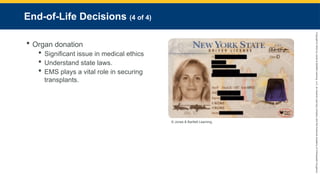
5. Organ donation
a. A significant issue in medical ethics involves the potential for patients with mortal injuries to donate organs.
b. Donor organs are badly needed. Many patients wait years for a match.
c. Organ donation and the parameters for viable organs should be spelled out within the individual EMS system.
i. In many cases, patients must have witnessed, informed consent to donate organs according to state law.
d. Major organs are not appropriate for organ donation after prolonged hypotension or CPR.
i. Other tissues may be valuable (such as corneas and skin).
ii. Many states have programs allowing patients to agree to organ donation.
iii. A patient’s donation wish is noted on a driver’s license.
iv. If a patient’s wishes are not known, relay this information when transferring care and discuss with medical direction.
v. Additional resources include:
(a) Workshops offered by organ transplant teams
(b) EMS leaders as continuing education for paramedics
vi. Be aware of the vital role you play in securing transplants.
#77 Lecture Outline
VIII. Defenses to Litigation
A. Public awareness due to media and public education
1. Lawsuits based on citizens’ perception of delayed response or incompetence
a. Your first defense to litigation is an open, informative, trust-based relationship with all patients.
b. Sometimes, this relationship is not possible or fails.
c. Several legal defenses may be used in the courtroom.
2. When a lawsuit is filed:
a. The paramedic and his or her employer may implement one of two defenses.
i. Statute of limitations
(a) Every state has laws that limit the time within which a lawsuit can be filed.
(1) Time to file varies by state
(2) 1 to 5 or 6 years
(b) Suits filed beyond these periods can be dismissed as untimely.
(c) The statute is extended for minors until the minor reaches the age of majority.
ii. Contributory negligence
(a) Applies when the plaintiff has done something that contributes to injuries
#78 Lecture Outline
B. Good Samaritan legislation
1. Every state has some form of Good Samaritan law, but not every state extends protection to all citizens and off-duty EMS personnel.
2. Statues were initially passed to encourage the public to help at emergency scenes.
3. Provides some protection for EMS personnel who are off duty and assist at an emergency.
4. An EMT or paramedic providing emergency care while on duty is not protected.
5. If a paramedic has a legal duty to a patient, the paramedic will not be covered.
6. The law may help cover paramedics rendering assistance in another state.
7. Requirements of the Good Samaritan laws:
a. Persons responding to an emergency must do all that they can, within their knowledge, to support and sustain life and prevent further injury.
b. The paramedic is not expected to function as a physician.
c. The paramedic is expected to deploy those skills that any other paramedic with similar training would use under the same or similar circumstances.
8. Courts have considered Good Samaritan applications.
a. Have not been generous during routine EMS work
b. Have been applying the concept of immunity only during emergencies
#79 Lecture Outline
C. Governmental immunity
1. In English law, you cannot sue the queen or king.
2. Such sovereign immunity has some application in the United States.
a. Legislation that identifies only limited types of lawsuits that can be filed against government agencies
b. Some immunity for paramedics working for government agencies
c. May set limited time frames in which lawsuits can be filed
d. May limit the amount of money a plaintiff can recover
#80 Lecture Outline
D. Qualified immunity
1. Governmental immunity does not cover civil rights violations.
2. Lawsuits have been filed against public sector paramedics.
3. An example would be EMS personnel improperly restraining a violent patient or using excessive force.
4. Another example would be conduct that deviates from a standard of care where a civil rights violation is said to occur.
5. Paramedics working or volunteering for public agencies may have qualified immunity. Liable only when:
a. The plaintiff can show the paramedic violated a clearly established law the paramedic should have known
6. Does not apply to tort cases
#81 Lecture Outline
IX. Employment Law and the Paramedic
A. Important laws affecting your relationship with your employer
1. Becoming involved in a legal issue regarding your employment is more likely than being sued by a patient.
a. Involves a complexity of state and federal laws and regulations.
#82 Lecture Outline
B. Americans With Disabilities Act (ADA)
1. A federal law
2. Adopted to protect qualified people with disabilities from being discriminated against in employment
3. Applies to all employers with a minimum of 15 employees
4. Possible state law protection for employees working for employers with fewer employees
5. Applies to all aspects of employment:
a. Hiring
b. Promotions
c. Training
d. Salary
e. Benefits
f. Termination
6. Misconception: employers must hire disabled employees not qualified for the job
7. Qualifications for protection:
a. Have a physical or mental disability that limits one or more major life activities such as hearing, seeing, walking, or speaking
b. Possess the basic qualifications for the job and be able to perform the essential functions of the job adequately, with or without reasonable accommodations
#83 Lecture Outline
8. Inquiries and accommodations
a. An employer may not inquire about an applicant’s disability or require a medical exam until after a job offer has been made.
b. If a person with a disability could perform the job using reasonable accommodations, the employer may be required to provide and pay for the cost of these accommodations.
c. The law does not require the employer to provide accommodations that would result in undue hardship to the employer or to other employees.
9. No requirement for giving preference to a person with a disability
#84 Lecture Outline
C. Title VII of the Civil Rights Act
1. Prohibits discrimination in employment based on race, color, religion, sex, or national origin.
2. Provides protection against sexual harassment in the workplace
3. Applies to all aspects of employment including:
a. Recruiting
b. Hiring
c. Promotions
d. Benefits
e. Termination
4. Applies only to businesses with more than 15 employees
5. Unusual for an employer to blatantly refuse to hire or promote someone based on race, sex, religion, color, or national origin
a. Successful claims involve the identification of a discriminatory hiring pattern
b. Develops over time
c. Demonstrates a particular class of people, such as women or African Americans, are:
i. Rarely hired or promoted
ii. Vastly under-represented in the overall workforce
6. Violations of Title VII even when hiring practice appears neutral
#85 Lecture Outline
D. Sexual harassment
1. Most common claim filed under Title VII
a. Can occur between any combination of sexes, sexual orientations, or gender identities
b. There are two types of sexual harassment:
i. Quid pro quo: A person in authority attempts to exchange some work-related benefit for sexual favors.
ii. Hostile environment: The employer or agent of the employer either creates or allows to continue an offensive practice that makes it uncomfortable or impossible for an employee to continue working.
c. Most claims fall into the category of hostile environment.
d. There is no precise definition in the law for sexual harassment.
#86 Lecture Outline
e. Court decisions have identified several circumstances that can be considered harassment:
i. Sexual jokes or comments
ii. Display of sexually offensive photographs or other material
iii. Unwelcome sexual advances
iv. Inappropriate and unwelcome touching or kissing
v. Inappropriate inquiry into an employee’s sex life
f. All employers must prevent sexual harassment.
i. Investigate all claims promptly.
ii. Employers should provide training.
g. Promptly report any conduct you feel constitutes sexual harassment to your supervisor or human resources department.
#87 Lecture Outline
E. Additional federal laws dealing with discrimination
1. Several federal laws prohibit various types of discrimination in the workplace.
a. The Pregnancy Discrimination Act
i. Illegal to discriminate based on pregnancy, childbirth, or any medical condition related to pregnancy
ii. Requires employers to provide health benefits and medical leave for pregnancy and childbirth equal to those provided for other medical conditions
b. The Equal Pay Act of 1963
i. Illegal to pay different rates of pay to men and women if they perform equal work in the same workplace
ii. Executives and managers are generally exempt.
c. The Age Discrimination in Employment Act of 1967
i. Protects people who are 40 years of age or older from discrimination based on age
ii. Applies to businesses with 15 or more employees
#88 Lecture Outline
F. State laws
1. Deal with discrimination in the workplace
a. Address the same issues covered under federal law
b. Some states provide more rights than federal laws.
i. Example: Some states prohibit discrimination based on sexual orientation, marital status, or gender identity.
c. Many apply whether or not there are 15 or more employees.
#89 Lecture Outline
G. Family Medical Leave Act (FMLA)
1. Grants eligible employees the right to take up to 12 weeks of unpaid leave per year under certain circumstances
a. Applies to employers with at least 50 employees
b. Covers those who have worked for that employer for at least 12 months
c. Allows leave to deal with a medical condition of the employee or family member or birth or adoption of a child
2. States’ own versions of FMLA may:
a. Provide the employee with more rights than the federal law
b. Apply to employers with fewer than 50 employees
#90 Lecture Outline
H. Occupational Safety and Health Administration (OSHA)
1. Federal agency that regulates safety in the workplace
a. States may enforce regulations tighter than those set by OSHA.
b. States may not make regulations more lenient.
c. All employers are covered by OSHA or an OSHA-approved safety plan.
e. All employers must:
i. Comply with all OSHA standards, rules, and regulations that apply to the business
ii. Provide all employees with a workplace that is free from hazards
iii. Warn employees of potential hazards
iv. Ensure that all employees are provided with appropriate safety equipment
v. Establish and maintain a reporting system for all workplace injuries or illnesses
vi. Provide training for all employees
f. Health care employers have additional responsibilities:
i. Development of an exposure control plan to assist employees who may have been exposed to certain bloodborne pathogens
ii. Development of training programs for all newly hired employees
iii. Annual refresher training for all employees that address issues related to bloodborne pathogens
iv. Making the hepatitis B vaccine available at no charge to all employees
v. Development of guidelines regarding the use of standard precautions
g. OSHA regulations and standards are changing.
h. You share an obligation to do all you can to avoid injuries.
#91 Lecture Outline
I. Ryan White Act
1. A federal law that provides certain safeguards and protections for health care workers who are exposed or potentially exposed to certain designated diseases
a. The Centers for Disease Control and Prevention has specified the conditions covered by this act; they include:
i. Human immunodeficiency virus (HIV) infection
ii. Acquired immunodeficiency syndrome (AIDS)
iii. Tuberculosis
iv. Hepatitis B
v. Meningitis
vi. Diphtheria
vii. Hemorrhagic fevers
viii. Plague
ix. Rabies
b. Contains several important provisions:
i. Hospitals and emergency response employers are required to establish a notification system to be used when exposure occurs.
ii. Employers must appoint a designated infection control officer to handle exposures and to assist all employees who may have been exposed.
iii. Access to the medical records of the patient who is the source of the exposure may be obtained to determine whether the patient has tested positively for, or is exhibiting signs and symptoms of, a covered infectious disease.
c. Notify the infection control officer of possible exposure to an infectious disease.
#92 Lecture Outline
J. National Labor Relations Act
1. Also known as the Wagner Act
a. The primary law establishing the rights of unions and union workers
b. Regulates unfair labor practices by employers
c. Employees have a wide variety of rights with which they should become familiar.
d. Each state has its own set of laws.
e. In some states, the so-called right to work laws do not allow an employer or a union to require you to join a union as a condition to being hired or retained on the job.
f. Other states may require you to join the union within a certain time period after you are hired.
























![Hypothalamus short notes on location, function and disorders by Dr. Neha [PT]...](https://cdn.slidesharecdn.com/ss_thumbnails/hypothalamusbydr-260124142231-2b48143d-thumbnail.jpg?width=640&height=640&fit=bounds)


