Bronchiolitis

Dr Yog Raj Khinchi
Bronchiolitis
• LRI – Leading cause – morbidity & mortality in children
• Bronchiolitis –
  - Most common serious LRTI needing hospital admission
  - Pediatric burden of illness world wide
  - Generally self limiting condition
Bronchiolitis: Definition
• Clinical Syndrome
• Acute onset of resp. symptoms: < 2 yrs age
• Initial symptoms: URT viral infections
• Fever, coryza, progresses in 4-6 days to
  LRT involvement: Cough and wheezing
Bronchiolitis: Epidemiology
•  incidence due to - More premature infants & children with
  chronic illnesses
• More common in children < 12 months
• > 50% affected children: 2 to 7 mo of age
• Infants < 6 months are at highest risk of clinically significant disease
• 2% to 3% of children require hospital admission
• Commonly in late autumn and early spring
Increasing hospitalization
             Predisposing factors
• Infants in day care

• Exposure to passive smoke

• Crowding in the household

• Environmental and genetic factors do contribute to severity
  of disease
Bronchiolitis: Etiology
• Viral
  Most common: Respiratory syncytial virus (RSV)
  Others: Influenza, parainfluenza
      adenovirus, coronavirus, rhinovirus
• M. pneumonia: though isolated not recognized as etiological agent
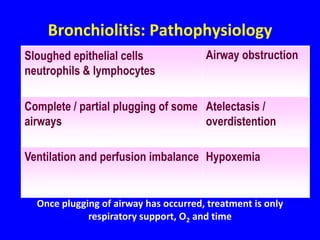
Bronchiolitis: Pathophysiology
Sloughed epithelial cells              Airway obstruction
neutrophils & lymphocytes

Complete / partial plugging of some Atelectasis /
airways                             overdistention

Ventilation and perfusion imbalance Hypoxemia


  Once plugging of airway has occurred, treatment is only
             respiratory support, O2 and time
Bronchiolitis: Clinical features
• Quite variable
• Nasal obstruction with or without rhinorrhea
• Cough - First irritating  tight cough
• Poor feeding after the initial onset of symptoms
• Apnea upto 20% in < 12 months with RSV
• Fever - higher than 39oC [adenovirus or influenza]
• Nasal flaring      Tachypnea      Chest retraction
Bronchiolitis: Clinical features…
• Respiratory distress
   – Mild, moderate or severe
• Clinical features - Nasal flaring, tachypnea, expanded
  chest, audible wheeze
• Auscultation - rales or rhonchi & poor air entry, prolonged
  expiratory phase
• Other features - Conjunctivitis, rhinitis & otitis media
• Mild-to-moderate hypoxia - Pulse oximetry or arterial blood
  gases
Bronchiolitis: Clinical classification

Mild, moderate, or severe
Based on
• Ability to feed
• Respiratory effort
• Oxygen saturation observed at admission
Investigations: Specific and supportive
• Complete blood count
• CXR
• Nasopharyngeal aspirate (NPA) -
  RSV and viral culture
• Electrolytes – especially if needing IV fluids
• Blood culture – if temperature > 38.5°C
• Blood gases

   Usually no lab tests needed in mild bronchiolitis
Chest X-ray
CXR shows:
• hyperinflation
• patchy infiltrates
  – typically migratory
   (post-obstructive atelectasis
               &
    peribronchial cuffing)
Bronchiolitis: Diagnosis
• A clinical diagnosis
• Infant with short prodrome of upper RTI
• Clinical finding
   - audible wheezing
   - wheezing with crackles
   - respiratory distress with
   - chest recession
Bronchiolitis: Differential diagnosis
• Congenital anomalies
  vascular ring, congenital heart disease
• Gastroesophageal reflux
• Aspiration pneumonia
• Foreign body aspiration
Management

• Supportive care - mainstay of therapy
• Moderately ill infants - require supplementary O2
• IVF in young infants - tachypnea, partial nasal obstruction
  & feeding difficulties
• Role of bronchodilators - Controversial
Oxygen
• Humidified oxygen ideal
• Supplemental oxygen
  if SaO2 <94%, combination of clinically significant respiratory
  distress, RR > 60/min, feeding difficulty
• Maintain SaO2 above 95%
• Use nasal prongs / face mask / hood / head box

• Hypoxaemia + / - distress, despite high O2 flow, require
  ventilatory support.
Fluid Therapy
• Indications
   – Nasal flaring, tachypnoea (>60/min), apnoeic
     episodes, marked retractions, tiring during feeds
• Normal maintenance volumes
   – N/2 or N/4 dextrose saline
• Fluid volumes increased up to 20%
   – if frequent or persistent fever (>38.5°C) and/or
     markedly increased respiratory effort
• Monitor serum electrolytes
Beta-agonist therapy and clinical outcome


 • RCT - no clear utility for bronchodilators in bronchiolitis
Nebulized epinephrine

• Improvement in respiratory symptoms - inconsistent &
  potentially short-lived
• May use nebulized epinephrine as a potential rescue
  medication who are to be admitted
Systemic Corticosteroids In Bronchiolitis


 • Data suggest moderate potential efficacy

 • In higher doses -
                hospitalization rates &
               improve symptoms at 4 hours in ED in
               patients with mod to severe bronchiolitis
Bronchiolitis: Ribavirin


• Ribavirin - considered in severely immuno- compromised
  developing lab confirmed RSV assoc. bronchiolitis
ICU management
Needed in the following category
• Progression to severe respiratory distress, especially in at-
  risk group
• Apnoeic episodes
   – Eg. associated with desaturation
      or > 15 seconds duration
      or frequent recurrent brief episodes
• Persistent desaturation despite oxygen
• ABG evidence of respiratory failure
   – i.e. pO2 < 80mm Hg;
         pCO2 > 50mm Hg;
         pH < 7
Bronchiolitis: CPAP
• May benefit infants with bronchiolitis by stenting open the
  smaller airways during all phases of respiration
• Prevents air trapping & obstructive disease
• As a constant stimulus in infants - propensity to experience
  apnea
• Data though promising, without controlled trials, are
  inconclusive
Discharge
• Minimal respiratory distress
• SaO2 > 90% in room air
   – Except in chronic lung disease, heart disease, or other
     risk factors
• Not received supplemental O2 for 10 hrs
• Minimal or no chest recession
• Able to take oral feeds
Complications
• Respiratory complications - most frequent
• Infectious complications - second most common,
• Cardiovascular, electrolyte imbalance
• Complication rates were higher in -
       premature infants
      congenital heart disease
       other congenital abnormalities
• Infants 33-35 weeks GA
       highest complication rates
       longer hospital stay
Serious complications
• Respiratory failure
• Apnea
• Pneumothroax
   – Among former premature infants
   – congenital abnormalities
• Risk of serious bacterial infections in first month of life
  regardless of RSV + / -
Prognosis
• Generally self limiting condition
• 2% to 3% of children require hospitalization
• Need for supplemental O2 based on SaO2 on admission and
  predict length of hospital stay
• Beware of rapid deterioration in high risk group
• Death is uncommon even in high risk group
Prevention
• RSV cross-infection is common and serious
   – but largely preventable
• Vaccine development for RSV has been slow
• RSV spread from nose/face/hands of another individual
   – Frequent hand washing by nursing, medical, other staff
     and parents minimize this problem
• Avoid nursing infants with bronchiolitis (RSV positive, or
  awaiting RSV results) in rooms with high-risk infants
• Some studies reveal
   – Efficacy of palivizumab prophylaxis in prevention of RSV
     bronchiolitis in severely premature infants with BPD

4 bronchiolitis

  • 1.
  • 2.
    Bronchiolitis • LRI –Leading cause – morbidity & mortality in children • Bronchiolitis – - Most common serious LRTI needing hospital admission - Pediatric burden of illness world wide - Generally self limiting condition
  • 3.
    Bronchiolitis: Definition • ClinicalSyndrome • Acute onset of resp. symptoms: < 2 yrs age • Initial symptoms: URT viral infections • Fever, coryza, progresses in 4-6 days to LRT involvement: Cough and wheezing
  • 4.
    Bronchiolitis: Epidemiology • incidence due to - More premature infants & children with chronic illnesses • More common in children < 12 months • > 50% affected children: 2 to 7 mo of age • Infants < 6 months are at highest risk of clinically significant disease • 2% to 3% of children require hospital admission • Commonly in late autumn and early spring
  • 5.
    Increasing hospitalization Predisposing factors • Infants in day care • Exposure to passive smoke • Crowding in the household • Environmental and genetic factors do contribute to severity of disease
  • 6.
    Bronchiolitis: Etiology • Viral Most common: Respiratory syncytial virus (RSV) Others: Influenza, parainfluenza adenovirus, coronavirus, rhinovirus • M. pneumonia: though isolated not recognized as etiological agent
  • 7.
    Bronchiolitis: Pathophysiology Sloughed epithelialcells Airway obstruction neutrophils & lymphocytes Complete / partial plugging of some Atelectasis / airways overdistention Ventilation and perfusion imbalance Hypoxemia Once plugging of airway has occurred, treatment is only respiratory support, O2 and time
  • 8.
    Bronchiolitis: Clinical features •Quite variable • Nasal obstruction with or without rhinorrhea • Cough - First irritating  tight cough • Poor feeding after the initial onset of symptoms • Apnea upto 20% in < 12 months with RSV • Fever - higher than 39oC [adenovirus or influenza]
  • 9.
    • Nasal flaring  Tachypnea  Chest retraction
  • 10.
    Bronchiolitis: Clinical features… •Respiratory distress – Mild, moderate or severe • Clinical features - Nasal flaring, tachypnea, expanded chest, audible wheeze • Auscultation - rales or rhonchi & poor air entry, prolonged expiratory phase • Other features - Conjunctivitis, rhinitis & otitis media • Mild-to-moderate hypoxia - Pulse oximetry or arterial blood gases
  • 11.
    Bronchiolitis: Clinical classification Mild,moderate, or severe Based on • Ability to feed • Respiratory effort • Oxygen saturation observed at admission
  • 12.
    Investigations: Specific andsupportive • Complete blood count • CXR • Nasopharyngeal aspirate (NPA) - RSV and viral culture • Electrolytes – especially if needing IV fluids • Blood culture – if temperature > 38.5°C • Blood gases Usually no lab tests needed in mild bronchiolitis
  • 13.
    Chest X-ray CXR shows: •hyperinflation • patchy infiltrates – typically migratory (post-obstructive atelectasis & peribronchial cuffing)
  • 14.
    Bronchiolitis: Diagnosis • Aclinical diagnosis • Infant with short prodrome of upper RTI • Clinical finding - audible wheezing - wheezing with crackles - respiratory distress with - chest recession
  • 15.
    Bronchiolitis: Differential diagnosis •Congenital anomalies vascular ring, congenital heart disease • Gastroesophageal reflux • Aspiration pneumonia • Foreign body aspiration
  • 16.
    Management • Supportive care- mainstay of therapy • Moderately ill infants - require supplementary O2 • IVF in young infants - tachypnea, partial nasal obstruction & feeding difficulties • Role of bronchodilators - Controversial
  • 17.
    Oxygen • Humidified oxygenideal • Supplemental oxygen if SaO2 <94%, combination of clinically significant respiratory distress, RR > 60/min, feeding difficulty • Maintain SaO2 above 95% • Use nasal prongs / face mask / hood / head box • Hypoxaemia + / - distress, despite high O2 flow, require ventilatory support.
  • 18.
    Fluid Therapy • Indications – Nasal flaring, tachypnoea (>60/min), apnoeic episodes, marked retractions, tiring during feeds • Normal maintenance volumes – N/2 or N/4 dextrose saline • Fluid volumes increased up to 20% – if frequent or persistent fever (>38.5°C) and/or markedly increased respiratory effort • Monitor serum electrolytes
  • 19.
    Beta-agonist therapy andclinical outcome • RCT - no clear utility for bronchodilators in bronchiolitis
  • 20.
    Nebulized epinephrine • Improvementin respiratory symptoms - inconsistent & potentially short-lived • May use nebulized epinephrine as a potential rescue medication who are to be admitted
  • 21.
    Systemic Corticosteroids InBronchiolitis • Data suggest moderate potential efficacy • In higher doses -  hospitalization rates & improve symptoms at 4 hours in ED in patients with mod to severe bronchiolitis
  • 22.
    Bronchiolitis: Ribavirin • Ribavirin- considered in severely immuno- compromised developing lab confirmed RSV assoc. bronchiolitis
  • 23.
    ICU management Needed inthe following category • Progression to severe respiratory distress, especially in at- risk group • Apnoeic episodes – Eg. associated with desaturation or > 15 seconds duration or frequent recurrent brief episodes • Persistent desaturation despite oxygen • ABG evidence of respiratory failure – i.e. pO2 < 80mm Hg; pCO2 > 50mm Hg; pH < 7
  • 24.
    Bronchiolitis: CPAP • Maybenefit infants with bronchiolitis by stenting open the smaller airways during all phases of respiration • Prevents air trapping & obstructive disease • As a constant stimulus in infants - propensity to experience apnea • Data though promising, without controlled trials, are inconclusive
  • 25.
    Discharge • Minimal respiratorydistress • SaO2 > 90% in room air – Except in chronic lung disease, heart disease, or other risk factors • Not received supplemental O2 for 10 hrs • Minimal or no chest recession • Able to take oral feeds
  • 26.
    Complications • Respiratory complications- most frequent • Infectious complications - second most common, • Cardiovascular, electrolyte imbalance • Complication rates were higher in - premature infants congenital heart disease other congenital abnormalities • Infants 33-35 weeks GA highest complication rates longer hospital stay
  • 27.
    Serious complications • Respiratoryfailure • Apnea • Pneumothroax – Among former premature infants – congenital abnormalities • Risk of serious bacterial infections in first month of life regardless of RSV + / -
  • 28.
    Prognosis • Generally selflimiting condition • 2% to 3% of children require hospitalization • Need for supplemental O2 based on SaO2 on admission and predict length of hospital stay • Beware of rapid deterioration in high risk group • Death is uncommon even in high risk group
  • 29.
    Prevention • RSV cross-infectionis common and serious – but largely preventable • Vaccine development for RSV has been slow • RSV spread from nose/face/hands of another individual – Frequent hand washing by nursing, medical, other staff and parents minimize this problem • Avoid nursing infants with bronchiolitis (RSV positive, or awaiting RSV results) in rooms with high-risk infants • Some studies reveal – Efficacy of palivizumab prophylaxis in prevention of RSV bronchiolitis in severely premature infants with BPD