Chapter 44
Multiple-Casualty Incidents and
Incident Management
Copyright ©2010 by Pearson Education, Inc.
All rights reserved.
Prehospital Emergency Care, Ninth Edition
Joseph J. Mistovich • Keith J. Karren
Multiple-Casualty
Incidents
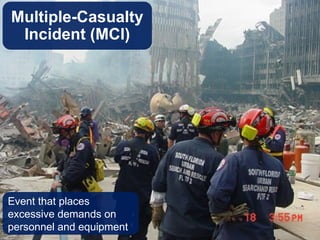
Multiple-Casualty
Incident (MCI)
Event that places
excessive demands on
personnel and equipment
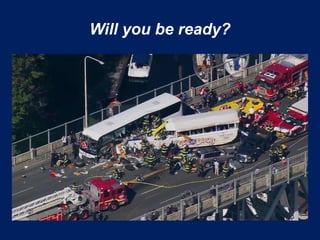
Will you be ready?
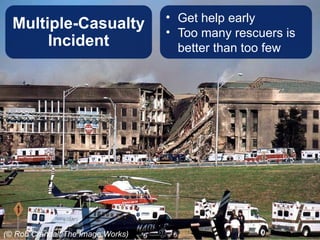
Multiple-Casualty
Incident
• Get help early
• Too many rescuers is
better than too few
(© Rob Crandall/The Image Works)
National Incident
Management System
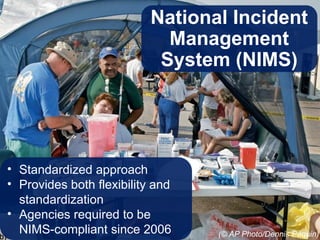
National Incident
Management
System (NIMS)
• Standardized approach
• Provides both flexibility and
standardization
• Agencies required to be
NIMS-compliant since 2006 (© AP Photo/Dennis Paquin)
Incident Command System
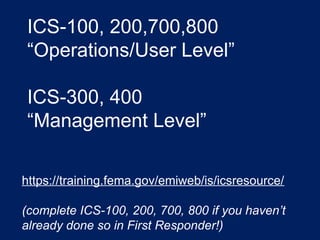
ICS-100, 200,700,800
“Operations/User Level”
ICS-300, 400
“Management Level”
https://training.fema.gov/emiweb/is/icsresource/
(complete ICS-100, 200, 700, 800 if you haven’t
already done so in First Responder!)
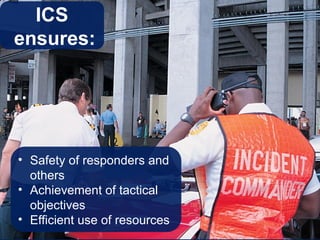
• Safety of responders and
others
• Achievement of tactical
objectives
• Efficient use of resources
ICS
ensures:
Triage
Primary and Secondary
Triage
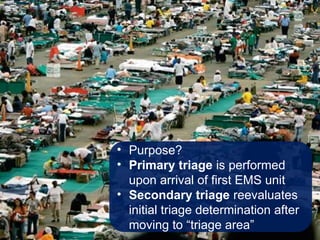
• Purpose?
• Primary triage is performed
upon arrival of first EMS unit
• Secondary triage reevaluates
initial triage determination after
moving to “triage area”
START Triage System
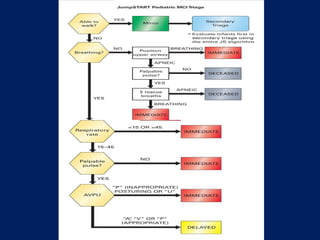
JumpSTART Pediatric
Triage System
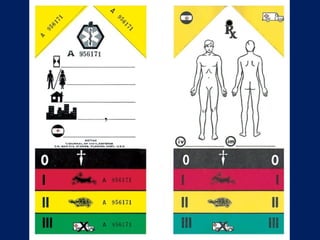
Patient Tagging
Treatment
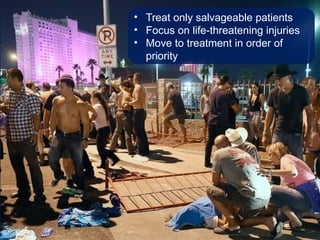
• Treat only salvageable patients
• Focus on life-threatening injuries
• Move to treatment in order of
priority
Staging and Transport
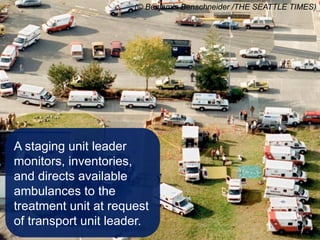
A staging unit leader
monitors, inventories,
and directs available
ambulances to the
treatment unit at request
of transport unit leader.
(© Benjamin Benschneider /THE SEATTLE TIMES)
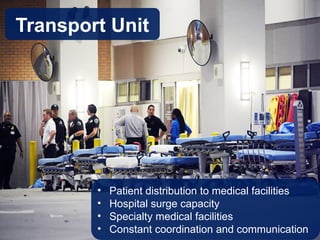
• Patient distribution to medical facilities
• Hospital surge capacity
• Specialty medical facilities
• Constant coordination and communication
Transport Unit
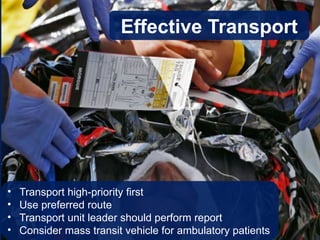
• Transport high-priority first
• Use preferred route
• Transport unit leader should perform report
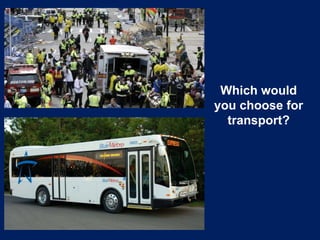
• Consider mass transit vehicle for ambulatory patients
Effective Transport
Which would
you choose for
transport?
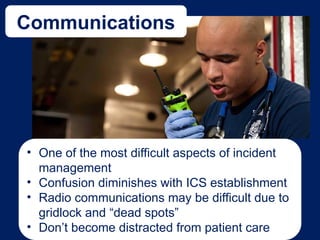
Communications
Communications
• One of the most difficult aspects of incident
management
• Confusion diminishes with ICS establishment
• Radio communications may be difficult due to
gridlock and “dead spots”
• Don’t become distracted from patient care
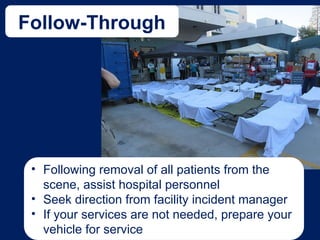
Follow-Through
Follow-Through
• Following removal of all patients from the
scene, assist hospital personnel
• Seek direction from facility incident manager
• If your services are not needed, prepare your
vehicle for service
Reducing Posttraumatic and
Cumulative Stress
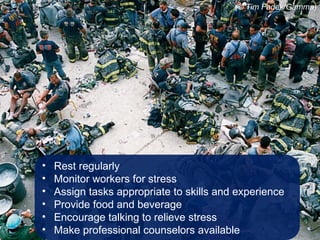
• Rest regularly
• Monitor workers for stress
• Assign tasks appropriate to skills and experience
• Provide food and beverage
• Encourage talking to relieve stress
• Make professional counselors available
(© Tim Fadek/Gamma)
Disaster Management
Requirements of Effective
Disaster Assistance
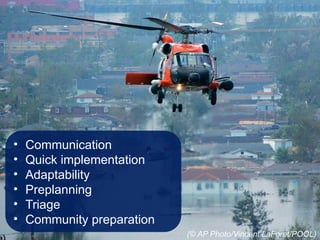
• Communication
• Quick implementation
• Adaptability
• Preplanning
• Triage
• Community preparation
(© AP Photo/Vincent LaForet/POOL)
Warning and Evacuation
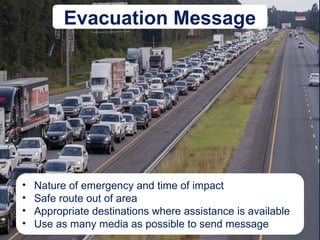
Evacuation Message
• Nature of emergency and time of impact
• Safe route out of area
• Appropriate destinations where assistance is available
• Use as many media as possible to send message
Disaster Communications
System
Disaster Communication
• Establish details of system ahead of time
• Appoint one person to communicate with
those outside of disaster area
• Maintain area-wide communications
• Establish central registration station
• Make travel information available
• Monitor all health care resources
• Transport officer at scene should handle
hospital report
• Record communications for later review
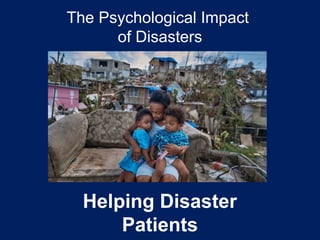
The Psychological Impact
of Disasters
Helping Disaster
Patients
Age Considerations
• Preschoolers tend to cry, lose control of bodily
functions, and suck their thumbs
• Elementary-age children suffer extreme fears
about their safety and show confusion,
depression, withdrawal, and the tendency to
fight with their peers
• Preadolescents and adolescents may show
the same reaction as elementary-age children,
coupled with extreme aggression and stress
that is severe enough to disrupt their lives
Reinforce and Review
Other Considerations
• The families of patients need and deserve
accurate information
• Reunite families as soon as possible
• Group people with families and neighbors
• Encourage people to do necessary chores
• Provide structure for emotionally injured
• Help patients confront reality
• Do not give false assurances
• Identify high-risk patients
• Provide care for rescuers as well
Reinforce and Review

Chapter 45 Multiple Casualty Incidents.pptx

Editor's Notes

  • #1 Advance Preparation Review local protocols and operating procedures regarding multiple-casualty incidents, triage, and incident command. Consider inviting someone with incident command expertise to guest lecture. Bring examples of triage tags used in your EMS system. (See slide 27.) Arrange for mock patients and assistant instructors in order to conduct a mock multiple-casualty incident (MCI) for your students. Predetermine the injuries for each patient and make sure each patient is well-informed about his role. Moulage is an important aspect of this exercise. If the above exercise is not feasible, prepare a table-top disaster exercise by writing patient descriptions on index cards.
  • #2 Teaching Time 5 minutes Points to Emphasize A multiple-casualty incident (MCI) is any event that places excessive demands on personnel and equipment. Some events that may lead to MCIs are food poisoning, toxic gas inhalation, and apartment fires. Managing MCIs effectively requires an organized, coordinated effort. Discussion Questions What events (local, state or national) can you recall that would be classified as an MCI? Why is the number of patients it takes to be considered an MCI different in different locations? Teaching Tip Discuss events that have led to MCIs in your community and events that your community includes in its disaster plan.
  • #3 Talking Points A multiple-casualty incident (MCI)—sometimes called a mass casualty incident or a multiple-casualty situation (MCS)—is any event that places excessive demands on personnel and equipment. Typically, an MCI involves three or more patients. A multiple-patient incident with three patients may be routine in a large metropolitan area, but three critically injured patients can quickly overwhelm a small community or rural area with limited resources and personnel. Motor vehicle crashes, gang-related violence, or apartment fires are just some of the situations in which you may encounter multiple patients. MCIs do not always involve victims of trauma. Your MCI plan should prepare you to manage the multiple-patient incident involving food poisoning, toxic gas inhalation, and in some parts of the nation, refugee influx.
  • #4 Talking Points A multiple-casualty incident (MCI)—sometimes called a mass casualty incident or a multiple-casualty situation (MCS)—is any event that places excessive demands on personnel and equipment. Typically, an MCI involves three or more patients. A multiple-patient incident with three patients may be routine in a large metropolitan area, but three critically injured patients can quickly overwhelm a small community or rural area with limited resources and personnel. Motor vehicle crashes, gang-related violence, or apartment fires are just some of the situations in which you may encounter multiple patients. MCIs do not always involve victims of trauma. Your MCI plan should prepare you to manage the multiple-patient incident involving food poisoning, toxic gas inhalation, and in some parts of the nation, refugee influx.
  • #5 Talking Points Each MCI is different than every MCI that has preceded it. Good planning, good training, good communication, following the Incident Command System (ICS) and EXPERIENCE are your best bets at handling an MCI effectively.
  • #6 Talking Points In any MCI, the key to effective emergency care is to call for plenty of help early. Make sure that you call for enough, or more than enough, rescuers with advanced life-saving skills as soon as you encounter the incident. It’s better to call too many rescuers than too few. Effective management of MCIs consists of getting enough help, positioning vehicles properly, giving appropriate emergency medical care, transporting patients efficiently, and providing follow-up care at receiving facilities. Critical Thinking Discussion What is the best way to be prepared to function in an MCI? What should be included in a personal disaster preparedness plan for you and your family?
  • #7 Teaching Time 20 minutes Discussion Question What is the purpose of NIMS? Points to Emphasize The Department of Homeland Security (DHS) developed the National Incident Management System (NIMS) to provide a consistent approach to disaster management. The incident command system (ICS) is a component of NIMS. NIMS combines principles of both flexibility and standardization to ensure cooperation and operability between various agencies. Preparedness standardization through training, planning, mutual aid agreements, and multiagency preparedness exercises is intended to lessen confusion, facilitate interdepartmental relationships, and provide responders experience in the incident management system.
  • #8 Talking Points The National Incident Management System (NIMS) provides for a consistent approach to managing disasters by all responders to the incident. These responders may include emergency response personnel and local, state, and federal government agencies and employees. The incident command system (ICS), which provides a standardized approach of management for multiple-casualty incidents, is a subset of the NIMS. NIMS provides for two main components: flexibility and standardization. These two components are the keys to managing any disaster and to ensuring cooperation and operability between various agencies. Every agency that may respond to a disaster was required to become NIMS-compliant through the completion of training in basic incident command systems and the National Incident Management System by September 2006. This training is intended to ensure that all responders comprehend and employ the same terminology and have a standardized knowledge of the incident command system.
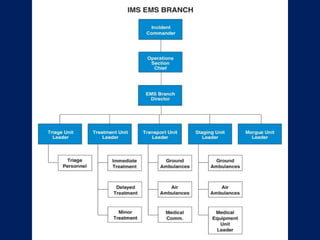
  • #9 Discussion Questions What is the purpose of ICS? What features are designed to make ICS effective? Points to Emphasize The goals of the ICS are to ensure the safety of responders and others; achieve tactical objectives; and use resources efficiently. The ICS uses common terminology, standard titles, and manageable spans of control to decrease the confusion that can occur at MCIs. The designated ICS sections are command, finance/administration, logistics, operations, and planning. The responsibilities of EMS within the ICS are likely to include triage, treatment, transport, staging, and morgue units. Teaching Tip Discuss local ICS configurations.
  • #10  Points to Emphasize ICS 100, 200, 700, 800 are for “User Level” (i.e. EMS, Fire Dept, Police, other responders, etc) ICS 300, 400 are for “management” (ranked officers in your agency that will be responsible for “being in charge” of the Incident Command) You will need to complete all Operations/User Level courses to work anywhere in EMS/Fire/LEO/etc.
  • #11 Talking Points As a standardized command system used among all of the responding agencies, ICS allows flexibility within the structure of the system to meet the needs of the incident regardless of the complexity and type of incident. The purpose of ICS is to use best management practices to ensure: – The safety of the emergency responders and others – The achievement of tactical objectives – The efficient use of resources Discussion Questions Who should assume incident command? What responsibilities are carried out by each of the typical EMS units in an ICS system?
  • #12  Talking Points Distinct titles are used. Only the incident commander is called “commander.” Section leaders or heads are called “chiefs.” The incident commander is responsible for coordinating all aspects of the incident. The incident commander must have the necessary training, experience, and expertise to serve in this capacity. The highest ranking officer is not always the incident commander. With standard terminology, it is clearly understood what position each person holds and what duties he is expected to perform.
  • #13 Teaching Time 60 minutes Point to Emphasize Triage is a system of organizing patients into the order in which they will receive care and transportation. Teaching Tip Discuss local triage practices.
  • #14 Points to Emphasize Primary triage occurs immediately upon arrival of the first EMS crew and is usually conducted at the site of the incident. In primary triage, patients are categorized as red, yellow, green, or black for easy recognition of priority for removal. The person performing primary triage must report back the estimated number of patients and resources needed at the scene. Patients are removed to a triage unit where secondary triage is performed and patients may be reclassified.
  • #15 Talking Points Primary triage is usually conducted at the actual site of the incident, provided the scene is safe. It is done very quickly and provides a very basic categorization of the severity of the patients involved in the incident. The patients are usually tagged as red, yellow, green, or black with colored ribbon or tape for rescue crews to easily recognize and remove patients according to priority. The person performing primary triage is also responsible for providing an initial report back to the EMS command. Secondary triage is designed to reevaluate the patient categorization, during which the patient may be upgraded to a higher priority, downgraded to a lower priority, or kept at the same priority status. The triage unit leader reassesses the patient as he is brought into the triage unit to categorize him for treatment and transport. During the treatment phase, the patient is retriaged and may be recategorized as a higher or lower priority.
  • #16 Talking Points The universally recognized triage categorizations by color are: Red: Immediate care and transport necessary, priority 1 Yellow: Delayed emergency care and transport, priority 2 Green: Minor injuries and ambulatory patients, priority 3 Black: Deceased or fatal injuries, priority 4 Discussion Question How are patients classified according to the red, yellow, green, and black color triage system? Class Activity Hold an MCI drill or, if this is not feasible, do a table-top triage exercise with students.
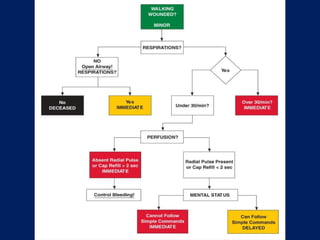
  • #17 Talking Points A widely accepted and used triage system is the START (Simple Triage and Rapid Transport) system. It is a very easy triage system to use and allows for rapid categorization of patients into the priority categories for further assessment, treatment, and transport. Discussion Question How is START triage performed? Point to Emphasize Use START triage to determine patient priority for movement to the triage unit. First have all ambulatory patients move to a safe area, then assess the remaining patients’ respiratory, perfusion, and mental status.
  • #18 Talking Points START is recommended for adults and can also be used for children who are older than eight years of age and greater than 100 pounds in weight. The first assessment that you perform that falls into the “immediate” category should cause you to stop triage, tag the patient as “red,” and have the patient moved to the triage unit. Keep in mind; the START triage is performed primarily to initially categorize patients for priority movement to the triage unit. It should not take you more than 30 seconds per patient to complete. The three basic categories assessed in START, easily remembered by the mnemonic RPM, are: – Respiratory status – Perfusion status – Mental status
  • #19 Discussion Question How is JumpSTART different from START? Point to Emphasize A pediatric variation of START is JumpSTART.
  • #20 Talking Points JumpSTART is used in pediatric patients primarily because of some physiological differences in young children as compared to adults. In the adult patient, respiratory failure due to a traumatic event usually occurs after severe blood loss with circulatory failure or severe head injury. In a child, the opposite usually occurs. The child typically goes into respiratory arrest, followed by circulatory failure and cardiac arrest. Respiratory arrest in a young child may occur rapidly after shorter periods of hypoxia. The child could be apneic and the pulse could be present because the child has not yet become extremely hypoxic. During this period, opening the airway and providing ventilation to the child may stimulate spontaneous ventilation until more emergency care can be provided. This brief provision of ventilation to the child is considered the “jumpstart” for the child to start breathing on his own. JumpSTART uses the same categories as START: – Respiratory status – Perfusion status – Mental status The triage of a pediatric patient should take no more than 15 seconds.
  • #21 Teaching Tip Show students the triage tags used in your system.
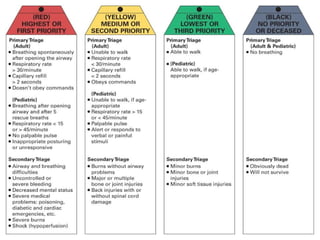
  • #22 Talking Points (Different agencies may use Triage Tags that differ somewhat in appearance than other agencies) Highest priority/red/immediate: The highest-level priority, “red,” is assigned to patients with the most critical injuries who may be able to survive the incident with quick treatment and transport. Most of the abnormalities are correlated with the primary assessment. Second priority/yellow/delayed: The second-level priority, or “yellow,” are patients who are suffering severe injuries; however, some delay in treatment should still provide the patient a good chance of survival. The abnormalities would more closely correlate with those findings and life threats identified in the rapid trauma assessment. Lowest priority/green/minor: The lowest-level priority, or “green,” are injuries in which delay in treatment will not reduce the patient’s chance of survival. Black/deceased: The final category, “black,” is reserved for those patients who will not survive, even with treatment, or who are already dead. It makes no sense to expend resources on a patient who has no chance of survival.
  • #24 Talking Points Remember that triage is ongoing. Many patients’ categories will change as their conditions improve or deteriorate. Since the dead are the last to be transported, establish a morgue unit. If you are working in the treatment unit, a key concept to remember is to provide only necessary care to manage life-threatening injuries. Once the highest-priority patients have been stabilized, move to the second-priority patients. The triage, treatment, and transport unit leaders should remain in constant communication with each other regarding transport availability and needs. Again become familiar with and follow local protocol. Knowledge Application Students should be able to apply the principles of triage while working within an ICS.
  • #25 Point to Emphasize The staging unit is used to monitor, inventory, and direct available ambulances to the treatment area at the request of the treatment unit leader.
  • #26 Talking Points To begin the process of transporting priority patients to the appropriate medical facility, a staging unit is set up. A staging unit leader monitors, inventories, and directs available ambulances to the treatment unit at the request of the transport unit leader.
  • #27 Talking Points The transport unit leader ensures that ambulances are accessible and that transportation does not occur without the direction of the incident commander or operations section chief. He also coordinates patient transportation with the triage unit leader and communicates with the hospitals involved. The transport unit leader must consider the following when making decisions on where to transport each patient: – Distribution of patients to each medical facility – Surge capacity of each hospital or medical facility – Need for transport to a specialty medical facility such as burn unit or pediatric emergency department – Need for constant coordination and communication
  • #28 Talking Points Follow triage in determining order of transport—Red (1), Yellow (2), Green (3), Black (4). Always follow the preferred route in exiting the MCI scene. The ambulance crew should NOT call in a hospital report en route; the transport unit leader should perform report. Multiple green patients may be loaded onto a mass transit vehicle with five EMTs with first aid equipment.
  • #29 What would be a better option for transport in this case?
  • #30 Teaching Tip Discuss mutual aid agreements in place for cooperation between jurisdictions.
  • #31 Talking Points Effective communications between emergency responders is one of the most difficult aspects of a multiple-casualty incident. As an EMT, you can expect a variety of MCI communication difficulties. Once an incident command system and mobile command center are established, the state of confusion diminishes. Throughout an MCI, you may also find radio communications of any kind difficult. Communication “dead spots,” frequency unavailability, and channel “gridlock” are a few of the more common radio communications problems you may encounter. Don’t let communication difficulties distract you from your patient care. Remember that plain English should be used in all communications at a multiple-casualty incident to avoid any miscommunication.
  • #33 Talking Points When all patients have been moved from the incident scene, emergency personnel should go to hospitals to assist hospital personnel. The incident manager and an assistant should remain at the scene to supervise clean-up and complete restoration. Once you arrive at the hospital, instructions for care and treatment will come from the facility’s incident manager. Depending on the size and nature of the MCI, some facilities may need your help while other hospitals may have enough personnel to manage the MCI without your assistance. If your services are not needed, you should prepare your vehicle and equipment for other EMS calls. Remember to update your dispatch center regarding your status and availability for response to additional calls. Teaching Tip Discuss the capabilities of local hospitals.
  • #34 Point to Emphasize Involvement in an MCI can lead to posttraumatic and cumulative stress for both patients and rescuers. Discussion Question What mechanisms should be in place to monitor for, minimize, and manage rescuer stress reactions?
  • #35 Talking Points Psychological stress is acute at the scene of a multiple-casualty incident. Rescuers react to disaster often the same way patients do. Common are fears regarding personal safety, crying, anger, guilt, numbness, preoccupation with death, frustration, fatigue, and burnout. The post-incident standard operating procedures should include methods to reduce emergency personnel stress such as regular rest, monitoring workers for stress, assigning tasks appropriate to skills and experience, providing food and beverage, encouraging dialogue, and making counselors available. Any rescuer who breaks down or becomes hysterical during the incident operation should be removed immediately to a hospital; a rescuer who is injured or becomes ill during rescue operations should be treated immediately and transported so that other rescuers can continue their work. Critical Thinking Discussion What should you do if you feel overwhelmed when working at the scene of an MCI?
  • #36 Teaching Time 15 minutes Discussion Question What types of events can be considered disasters? Points to Emphasize A disaster is a sudden catastrophic event that overwhelms natural order and causes great loss of property and/or life. Disasters may be natural or man-made. Critical Thinking Discussion What types of disasters should be anticipated in your community?
  • #37 Point to Emphasize EMTs can promote the need for individual and community preparedness. Teaching Tip Discuss the response to any disasters that have occurred in your area.
  • #38 Talking Points The following are requirements for effective disaster assistance: The ability to organize quickly and utilize fully all emergency personnel The ability to adapt the plan to meet special conditions, such as inclement weather or isolated locations A contingency plan that provides for shelter and transportation of people in an entire area, such as an entire community or county Doing the greatest good for the greatest number A plan that avoids simply relocating the disaster from the scene to the local hospital Critical Thinking Discussion How can you promote disaster preparedness in your community?
  • #39 Point to Emphasize Warning and evacuation are important in reducing disaster injuries and deaths.
  • #40 Talking Points In some cases, such as a hurricane or tornado, you may learn that a disaster is approaching and may have time to evacuate local residents. If you can conduct an orderly evacuation, you can prevent further injury, preserve life, and possibly protect property. Relocation should, as much as possible, keep people in their natural social groupings. For people who are not injured, make every effort to provide home-based relocation instead of relocation to hospitals and clinics. Alerts for the evacuation must be repeated often and with clarity. You must convince people that a disaster is really about to occur and that a substantial threat to their safety exists.
  • #41 Point to Emphasize A back-up communication system is needed in the event of failure of the primary system.
  • #42 Talking Points Critical to any successful rescue effort is an efficient communications system that includes a backup system in case the primary system fails. General guidelines of disaster communications systems include: – Establish details of the system ahead of time. – Appoint only one person to communicate to those outside the disaster area. – The designated person should stay in touch with local hospitals and rescue units who may be called on to respond to the disaster. – Area-wide communications are vital. – Establish a central location where people can register concerning their whereabouts, safety, health status, and so on. – Make sure that information regarding road conditions, alternative routes, and closed roads is constantly monitored and communicated. – Include a recorder or some other device that will allow you to record and later reassess crucial communications.
  • #43 Point to Emphasize Disasters can have a tremendous psychological impact. EMTs can take actions to reduce this impact. Discussion Questions What is the psychological impact of disasters? What can the EMT do to minimize the psychological effect of disasters?
  • #44 Talking Points At high risk for severe emotional reactions are children, the elderly, those in poor physical or emotional health, the handicapped, and those with a past loss or crisis. The reactions of children depend on their age, individual disposition, family support, and community support: – Preschoolers tend to cry, lose control of bowel and/or bladder, become confused, and suck their thumbs. – Elementary-age children suffer extreme fears about their safety and show confusion, depression, headache, inability to concentrate, withdrawal, poor performance, and the tendency to fight with their peers. – Preadolescents and adolescents may show the same reaction as elementary-age children, coupled with extreme aggression and stress that is severe enough to disrupt their lives.
  • #46 Talking Points While each disaster presents individual problems, the following are general guidelines that apply to any disaster: The families of patients need and deserve accurate information. Assign several rescue workers to gather information and disseminate it. Reunite families as soon as possible to reduce emotional stress. Group patients with their families and neighbors to reduce fear and alienation. Encourage patients to do necessary chores. Work can be therapeutic and should be used to help the patients get over their own problems. Provide a structure for the emotionally injured. Help patients confront the reality of the disaster and work through feelings. Don’t give false assurances. Identify high-risk patients: the elderly, children, the bereaved, those with prior psychiatric illness, those with low or no support systems, those from low socioeconomic backgrounds, and those with severe injuries. Arrange for all those involved in the disaster—including rescuers—to get good follow-up care and support.