Dr. D. K. Brahma 
Associate Professor 
Department of Pharmacology 
NEIGRIHMS, Shillong
 Emetic Response: Relaxation of fundus, body of stomach and also 
the oesophageal sphincter and oesophagus – but contraction of 
pylorus and duodenum – then rythmic contraction of diaphragm and 
abdominal muscles - expulsion via mouth 
 Centre: Medulla Oblongata 
 Relay Centers: chemoreceptor trigger zone (CTZ) and nucleus tractus 
solitarius (NTS) 
 Afferent impulses: GIT, throat and other viscera 
 Triggering agents: Blood borne drugs, mediators, hormones and 
toxins etc. – clinically cytotoxic drugs and radiation 
 Transmitter: 5-HT (enterochromaffin cells) – via 5HT3 receptor of 
ENS – to vagal and spinal visceral neurones ----- to CTZ and NTS 
 Spilling of 5-HT due to massive release – acts on CTZ
 Other mediators: H1, D2, 5HT3, Muscarinic M 
and opioid μ etc. – expressed in CTZ and NTS 
 Vestibular apparatus: generates impulses 
◦ Body equilibrium disturbed 
◦ Ototoxic drugs 
 Mainly relayed by cerebellum to vomiting 
centre – Muscarinic and H1 receptors 
 Directly in higher centres: Bad smell, ghastly 
sight, pain, fear etc. – drug cisplatin
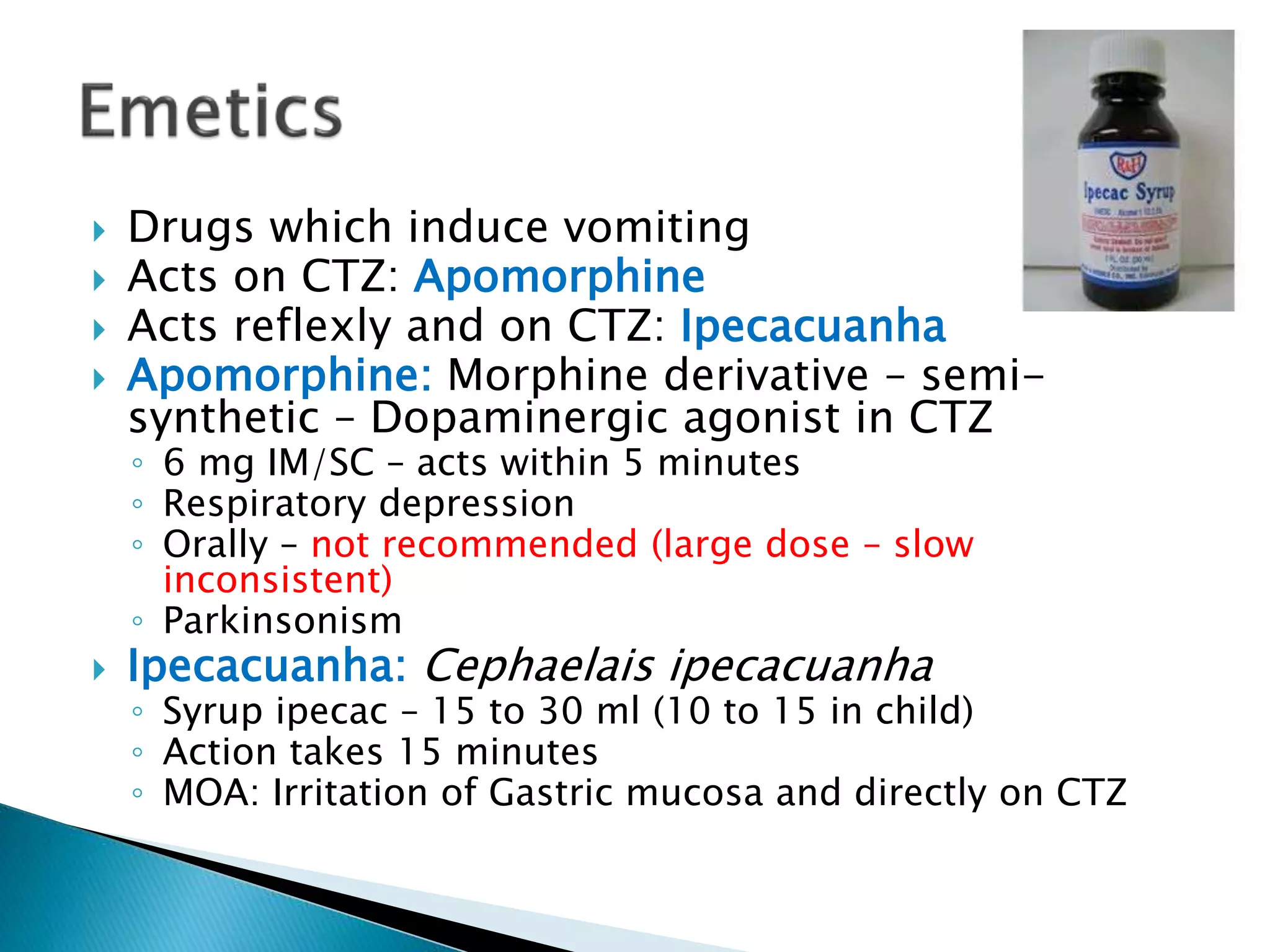
 Drugs which induce vomiting 
 Acts on CTZ: Apomorphine 
 Acts reflexly and on CTZ: Ipecacuanha 
 Apomorphine: Morphine derivative – semi-synthetic 
– Dopaminergic agonist in CTZ 
◦ 6 mg IM/SC – acts within 5 minutes 
◦ Respiratory depression 
◦ Orally – not recommended (large dose – slow 
inconsistent) 
◦ Parkinsonism 
 Ipecacuanha: Cephaelais ipecacuanha 
◦ Syrup ipecac – 15 to 30 ml (10 to 15 in child) 
◦ Action takes 15 minutes 
◦ MOA: Irritation of Gastric mucosa and directly on CTZ
 Salt water 
• Warm water – mild emetic 
• 2 spoonful of common salt in 1 pint of warm water 
 Mustard seed 
• 1 table spoonful ground mustard seeds in half-pin 
of warm water 
• Strong coffee is one of the best domestic 
stimulants, especially after a narcotic poison
 In Corrosive poisoning – acid and alkali (why?) 
 In CNS stimulant poisoning 
 To unconscious patients 
 In Morphine and Phenothiazine poisoning
1. Anticholinergics: Hyoscine, Dicyclomine 
2. H1 antihistaminics: Promethazine, 
Diphenhydramine, Doxylamine, Cyclizine, 
Meclizine and Cinnarazine 
3. Neuroleptics (D2 blockers): Chlorpromazine, 
Prochlorperazine and Haloperidol 
4. Prokinetics: Metoclopramide, Domperidone, 
Cisapride, Mosapride and Tegaserod 
5. 5HT3 antagonists: Ondansetron, Granisetron 
6. Others: Dexamethasone, Benzodiazepines and 
Cannabinoids 
7. Newer Ones: NK1 receptor antagonist - 
Aprepitant
 Hyoscine: Motion Sickness (0.2 to 0.4 mg IM) 
◦ Used IM/SC, but short duration of action 
◦ MOA: Blocking of cholinergic link of vestibular 
apparatus to the vomiting centre – does not work in 
vomiting due to other aetiology 
◦ ADRs: Sedation, dry mouth and other 
anticholinergic effects 
◦ Transdermal delivery system (1.5 mg) 
 Dicyclomine: Prophylaxis of motion sickness 
and morning sickness
 Primarily used in motion sickness, morning sickness and some 
other vomiting in lesser extent – also anticholinergic, 
antihistaminic and antidopaminergic actions 
 Promethazine (Phenothiazine), diphenhydramine: 4 – 6 Hours 
protection 
◦ Combined with metoclopramide in CINV: additive effect plus counters 
extra pyramidal effects 
 Promethazine theoclate (Avomine) – motion sickness 
 Doxylamine: Sedative H1 antihistaminic – marketed in 
combination with Pyridoxine – specifically for morning sickness – 
duration of action 10 Hours (at bed time) – drowsiness, dry 
mouth, vertigo 
 Meclizine: Long duration of action – sea sickness 
 Cinnarizine: anti vertigo action – inhibits Ca++ influx in 
endolymph
 Motion Sickness: Anticholinergics are 
preferred – followed by H1 Antihistaminics – 
antidopaminergics do not work 
 Morning Sickness: Preferably drugs should be 
avoided – reassurance and dietary 
modification 
◦ Dicyclomine, promethazine or metoclopramide are 
preferred at low doses
 Uses: 
◦ Useful in drug induced post anaesthetic nausea and 
vomiting 
◦ Disease induced vomiting – Gastroenteritis, uraemia, 
liver disease 
◦ Cancer chemotherapy 
◦ Radiation sickness (less) 
◦ Morning sickness 
 ADRs: Sedation, acute muscle dystonia – 
diagnose the cause first before administering 
 Prochlorperazine (Stemetil) – D2 blocking agent - 
labyrinthine suppressant – antivertigo and 
antiemetic action. Effective in CINV with vertigo 
◦ EPS and muscle dystonia
 Actions on GIT: On upper GIT - Increases 
gastric peristalsis 
◦ Relaxes pylorus and 1st part of duodenum – better 
gastric emptying 
◦ LES tone increased – also increases Intestinal 
peristalsis 
 Actions on CNS: Acts on CNS – can counter 
Apomorphine induced vomiting 
◦ Gastrokinetic action contributes 
◦ No antipsychotic property, but has extra pyramidal 
and prolactin secreting effects (Promethazine 
context)
1. D2 antagonism: Dopamine is inhibitory transmitter 
via D2 receptor – delays gastric emptying – also 
relaxation of LES – nausea and vomiting – 
Metoclopramide causes opposite effect 
• Also central antidopaminergic action 
2. 5-HT4 agonism: enhanced Acetylcholine release in 
myenteric plexus – gastric hurrying and increased 
LES tone 
3. 5-HT3 antagonism: at high concentration 
• Blocks at inhibitory myenteric interneurones and CTZ 
/NTS 
 Pharmacokinetics: Absorbed orally, crosses BBB and 
placenta and secreted in milk. Conjugated in liver, 
t1/2 = 4 – 6 Hrs.
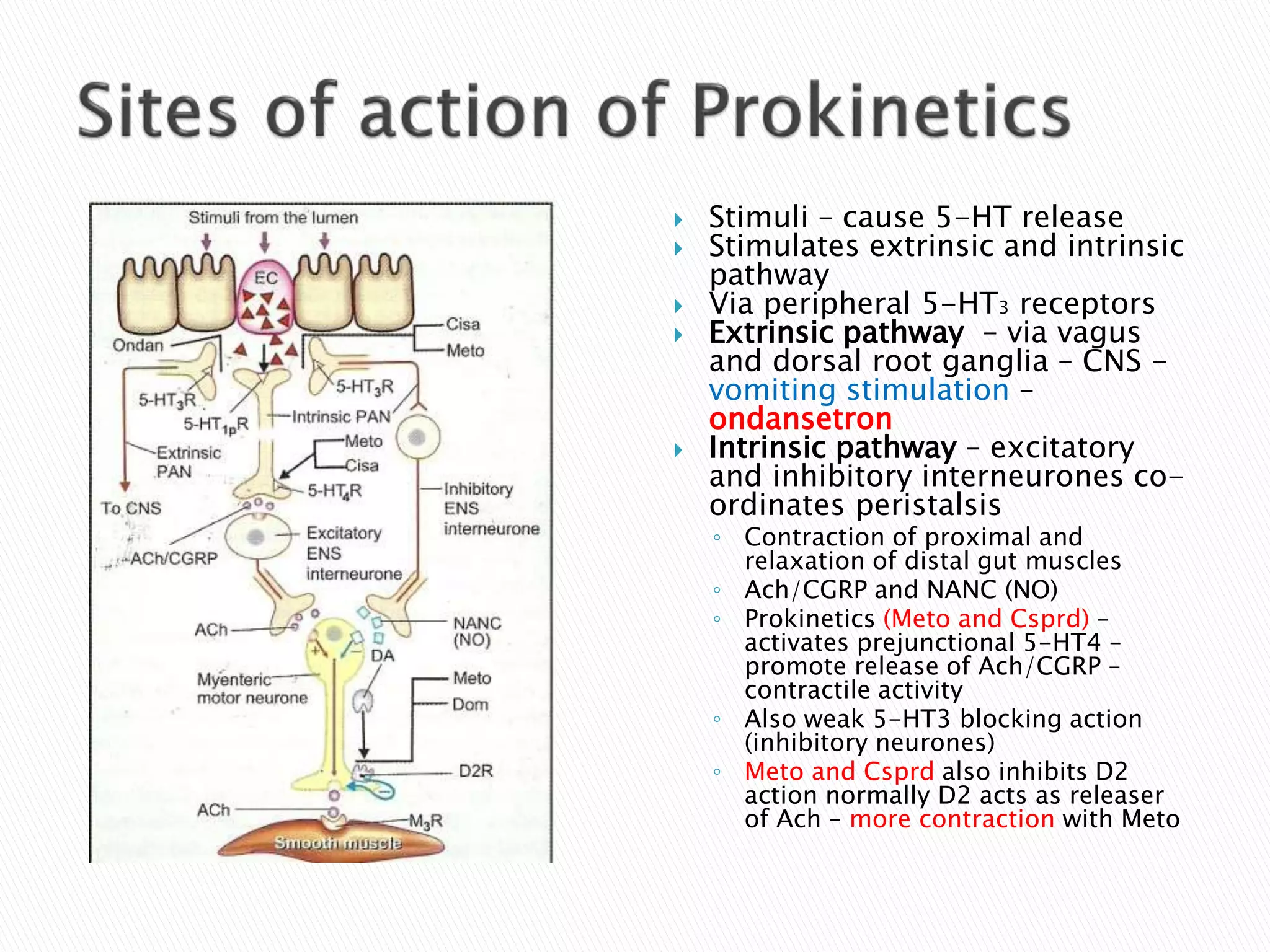
 Stimuli – cause 5-HT release 
 Stimulates extrinsic and intrinsic 
pathway 
 Via peripheral 5-HT3 receptors 
 Extrinsic pathway – via vagus 
and dorsal root ganglia – CNS - 
vomiting stimulation – 
ondansetron 
 Intrinsic pathway – excitatory 
and inhibitory interneurones co-ordinates 
peristalsis 
◦ Contraction of proximal and 
relaxation of distal gut muscles 
◦ Ach/CGRP and NANC (NO) 
◦ Prokinetics (Meto and Csprd) – 
activates prejunctional 5-HT4 – 
promote release of Ach/CGRP – 
contractile activity 
◦ Also weak 5-HT3 blocking action 
(inhibitory neurones) 
◦ Meto and Csprd also inhibits D2 
action normally D2 acts as releaser 
of Ach – more contraction with Meto
 ADRs: Sedation, dizziness, loose stool and muscle 
dystonia 
◦ Long use: Parkinsonism, galactorrhoea, gynaecomastia 
◦ Safe in pregnancy but in lactating mother children may have 
loose stool, dystonia etc. DI – abolishes levodopa action 
 Uses: 
◦ Antiemetic: Postoperative, drug induced, disease 
associated, radiation induced etc. but not effective in 
motion sickness. Still preferred in vomiting due to 
anticancer drug – in combination with Promethazine 
◦ Gastrokinetic: To accelerate gastric emptying – Emergency 
GA, gastroparesis (post vagotomy), duodenal intubation 
etc. 
◦ Dyspepsia: stops hiccup 
◦ GERD: Does not aid in healing, PPIs are preferred – used as 
adjuvant
 Chemically related to haloperidol but action like Metoclopramide 
 D2 antagonist – in upper GIT (not attenuated by atropine) 
 Rarely EP side effect – does not cross BBB, but 
hyperprolactinemia occurs 
 Acts mainly through CTZ – outside BBB 
 Does not abolish action of levodopa 
 Kinetics: absorbed orally but 15% bioavailability – high 1st pass 
metabolism, completely metabolized and excreted in urine. T1/2 
– 7 – 8 Hrs 
 ADRs: Less than Metoclopramide – dry mouth, loose stool, 
headache, galactorrhoea etc. Arrhythmia on injection 
 Uses: Similar as Metoclopramide but milder spectrum of action – 
not effective in chemotherapy 
 Read yourself (Prokinetics) – Cisapride, mosapride, Itopride etc.
 Developed for Chemotherapy/radiotherapy induced 
vomiting – also effective in others (PONV) 
 MOA: Acts peripherally as well as centrally - Blocks 
depolarizing action of 5-HT3 receptors in vagus at GIT and 
CTZ/NTS 
◦ No action on Dopamine receptor – does not block Apomorphine 
induced vomiting and mild gastrokinetic effect 
 Kinetics: 60 – 70% bioavailability – first pass metabolism. 
Metabolized as glucoronide and sulfate. Eliminated in 
urine and faeces. T1/2 life 5-7 Hrs 
 Dose: 8 mg slow IV for 15 minutes ½ hr before 
chemotherapy. Followed by 2 such doses 4 hours apart. 
Then 8 mg orally twice daily for 1 week. For others 4 – 8 
mg IV followed by every 8 hourly. 
 80% success – better/equal to Metoclopramide – no 
dystonia or sedation. Adjuvant improve response.
 ADRs: Headache and dizziness. Mild 
constipation and abdominal discomfort. 
Hypotension, allergic reactions, chest pain 
and bradycardia etc. 
 Other Drugs: Granisetron, Palonosetron and 
Ramosetron etc. – READ YOURSELF
 Aprepitant: Newer antiemetic 
 MOA: Emetogenic chemotherapy releases Substance P 
– stimulates CTZ and NTS by acting on NK1 - 
blocking of NK1 receptors causes emesis blocking 
◦ Little effect on 5-HT3 or D2 receptor 
◦ GIT motility not affected 
 Uses: 125 mg + 80 mg + 80 mg for 3 days with IV 
Ondansetron and Dexamethasone – for cisplatin 
induced vomiting – useful in multiple cycle patients – 
Orally 40 mg can be used for PONV 
 Kinetics: well absorbed orally, metabolized in liver, 
excreted in faeces and urine. T1/2 10 – 13 Hrs 
 ADRs: Weakness, fatigue, flatulence etc.
 Corticosteroids, Benzodiazepines and 
cannabinoides
Emetics and antiemetics

Emetics and antiemetics

  • 1.
    Dr. D. K.Brahma Associate Professor Department of Pharmacology NEIGRIHMS, Shillong
  • 2.
     Emetic Response:Relaxation of fundus, body of stomach and also the oesophageal sphincter and oesophagus – but contraction of pylorus and duodenum – then rythmic contraction of diaphragm and abdominal muscles - expulsion via mouth  Centre: Medulla Oblongata  Relay Centers: chemoreceptor trigger zone (CTZ) and nucleus tractus solitarius (NTS)  Afferent impulses: GIT, throat and other viscera  Triggering agents: Blood borne drugs, mediators, hormones and toxins etc. – clinically cytotoxic drugs and radiation  Transmitter: 5-HT (enterochromaffin cells) – via 5HT3 receptor of ENS – to vagal and spinal visceral neurones ----- to CTZ and NTS  Spilling of 5-HT due to massive release – acts on CTZ
  • 3.
     Other mediators:H1, D2, 5HT3, Muscarinic M and opioid μ etc. – expressed in CTZ and NTS  Vestibular apparatus: generates impulses ◦ Body equilibrium disturbed ◦ Ototoxic drugs  Mainly relayed by cerebellum to vomiting centre – Muscarinic and H1 receptors  Directly in higher centres: Bad smell, ghastly sight, pain, fear etc. – drug cisplatin
  • 4.
     Drugs whichinduce vomiting  Acts on CTZ: Apomorphine  Acts reflexly and on CTZ: Ipecacuanha  Apomorphine: Morphine derivative – semi-synthetic – Dopaminergic agonist in CTZ ◦ 6 mg IM/SC – acts within 5 minutes ◦ Respiratory depression ◦ Orally – not recommended (large dose – slow inconsistent) ◦ Parkinsonism  Ipecacuanha: Cephaelais ipecacuanha ◦ Syrup ipecac – 15 to 30 ml (10 to 15 in child) ◦ Action takes 15 minutes ◦ MOA: Irritation of Gastric mucosa and directly on CTZ
  • 5.
     Salt water • Warm water – mild emetic • 2 spoonful of common salt in 1 pint of warm water  Mustard seed • 1 table spoonful ground mustard seeds in half-pin of warm water • Strong coffee is one of the best domestic stimulants, especially after a narcotic poison
  • 6.
     In Corrosivepoisoning – acid and alkali (why?)  In CNS stimulant poisoning  To unconscious patients  In Morphine and Phenothiazine poisoning
  • 7.
    1. Anticholinergics: Hyoscine,Dicyclomine 2. H1 antihistaminics: Promethazine, Diphenhydramine, Doxylamine, Cyclizine, Meclizine and Cinnarazine 3. Neuroleptics (D2 blockers): Chlorpromazine, Prochlorperazine and Haloperidol 4. Prokinetics: Metoclopramide, Domperidone, Cisapride, Mosapride and Tegaserod 5. 5HT3 antagonists: Ondansetron, Granisetron 6. Others: Dexamethasone, Benzodiazepines and Cannabinoids 7. Newer Ones: NK1 receptor antagonist - Aprepitant
  • 8.
     Hyoscine: MotionSickness (0.2 to 0.4 mg IM) ◦ Used IM/SC, but short duration of action ◦ MOA: Blocking of cholinergic link of vestibular apparatus to the vomiting centre – does not work in vomiting due to other aetiology ◦ ADRs: Sedation, dry mouth and other anticholinergic effects ◦ Transdermal delivery system (1.5 mg)  Dicyclomine: Prophylaxis of motion sickness and morning sickness
  • 9.
     Primarily usedin motion sickness, morning sickness and some other vomiting in lesser extent – also anticholinergic, antihistaminic and antidopaminergic actions  Promethazine (Phenothiazine), diphenhydramine: 4 – 6 Hours protection ◦ Combined with metoclopramide in CINV: additive effect plus counters extra pyramidal effects  Promethazine theoclate (Avomine) – motion sickness  Doxylamine: Sedative H1 antihistaminic – marketed in combination with Pyridoxine – specifically for morning sickness – duration of action 10 Hours (at bed time) – drowsiness, dry mouth, vertigo  Meclizine: Long duration of action – sea sickness  Cinnarizine: anti vertigo action – inhibits Ca++ influx in endolymph
  • 10.
     Motion Sickness:Anticholinergics are preferred – followed by H1 Antihistaminics – antidopaminergics do not work  Morning Sickness: Preferably drugs should be avoided – reassurance and dietary modification ◦ Dicyclomine, promethazine or metoclopramide are preferred at low doses
  • 11.
     Uses: ◦Useful in drug induced post anaesthetic nausea and vomiting ◦ Disease induced vomiting – Gastroenteritis, uraemia, liver disease ◦ Cancer chemotherapy ◦ Radiation sickness (less) ◦ Morning sickness  ADRs: Sedation, acute muscle dystonia – diagnose the cause first before administering  Prochlorperazine (Stemetil) – D2 blocking agent - labyrinthine suppressant – antivertigo and antiemetic action. Effective in CINV with vertigo ◦ EPS and muscle dystonia
  • 12.
     Actions onGIT: On upper GIT - Increases gastric peristalsis ◦ Relaxes pylorus and 1st part of duodenum – better gastric emptying ◦ LES tone increased – also increases Intestinal peristalsis  Actions on CNS: Acts on CNS – can counter Apomorphine induced vomiting ◦ Gastrokinetic action contributes ◦ No antipsychotic property, but has extra pyramidal and prolactin secreting effects (Promethazine context)
  • 13.
    1. D2 antagonism:Dopamine is inhibitory transmitter via D2 receptor – delays gastric emptying – also relaxation of LES – nausea and vomiting – Metoclopramide causes opposite effect • Also central antidopaminergic action 2. 5-HT4 agonism: enhanced Acetylcholine release in myenteric plexus – gastric hurrying and increased LES tone 3. 5-HT3 antagonism: at high concentration • Blocks at inhibitory myenteric interneurones and CTZ /NTS  Pharmacokinetics: Absorbed orally, crosses BBB and placenta and secreted in milk. Conjugated in liver, t1/2 = 4 – 6 Hrs.
  • 14.
     Stimuli –cause 5-HT release  Stimulates extrinsic and intrinsic pathway  Via peripheral 5-HT3 receptors  Extrinsic pathway – via vagus and dorsal root ganglia – CNS - vomiting stimulation – ondansetron  Intrinsic pathway – excitatory and inhibitory interneurones co-ordinates peristalsis ◦ Contraction of proximal and relaxation of distal gut muscles ◦ Ach/CGRP and NANC (NO) ◦ Prokinetics (Meto and Csprd) – activates prejunctional 5-HT4 – promote release of Ach/CGRP – contractile activity ◦ Also weak 5-HT3 blocking action (inhibitory neurones) ◦ Meto and Csprd also inhibits D2 action normally D2 acts as releaser of Ach – more contraction with Meto
  • 15.
     ADRs: Sedation,dizziness, loose stool and muscle dystonia ◦ Long use: Parkinsonism, galactorrhoea, gynaecomastia ◦ Safe in pregnancy but in lactating mother children may have loose stool, dystonia etc. DI – abolishes levodopa action  Uses: ◦ Antiemetic: Postoperative, drug induced, disease associated, radiation induced etc. but not effective in motion sickness. Still preferred in vomiting due to anticancer drug – in combination with Promethazine ◦ Gastrokinetic: To accelerate gastric emptying – Emergency GA, gastroparesis (post vagotomy), duodenal intubation etc. ◦ Dyspepsia: stops hiccup ◦ GERD: Does not aid in healing, PPIs are preferred – used as adjuvant
  • 16.
     Chemically relatedto haloperidol but action like Metoclopramide  D2 antagonist – in upper GIT (not attenuated by atropine)  Rarely EP side effect – does not cross BBB, but hyperprolactinemia occurs  Acts mainly through CTZ – outside BBB  Does not abolish action of levodopa  Kinetics: absorbed orally but 15% bioavailability – high 1st pass metabolism, completely metabolized and excreted in urine. T1/2 – 7 – 8 Hrs  ADRs: Less than Metoclopramide – dry mouth, loose stool, headache, galactorrhoea etc. Arrhythmia on injection  Uses: Similar as Metoclopramide but milder spectrum of action – not effective in chemotherapy  Read yourself (Prokinetics) – Cisapride, mosapride, Itopride etc.
  • 17.
     Developed forChemotherapy/radiotherapy induced vomiting – also effective in others (PONV)  MOA: Acts peripherally as well as centrally - Blocks depolarizing action of 5-HT3 receptors in vagus at GIT and CTZ/NTS ◦ No action on Dopamine receptor – does not block Apomorphine induced vomiting and mild gastrokinetic effect  Kinetics: 60 – 70% bioavailability – first pass metabolism. Metabolized as glucoronide and sulfate. Eliminated in urine and faeces. T1/2 life 5-7 Hrs  Dose: 8 mg slow IV for 15 minutes ½ hr before chemotherapy. Followed by 2 such doses 4 hours apart. Then 8 mg orally twice daily for 1 week. For others 4 – 8 mg IV followed by every 8 hourly.  80% success – better/equal to Metoclopramide – no dystonia or sedation. Adjuvant improve response.
  • 18.
     ADRs: Headacheand dizziness. Mild constipation and abdominal discomfort. Hypotension, allergic reactions, chest pain and bradycardia etc.  Other Drugs: Granisetron, Palonosetron and Ramosetron etc. – READ YOURSELF
  • 19.
     Aprepitant: Newerantiemetic  MOA: Emetogenic chemotherapy releases Substance P – stimulates CTZ and NTS by acting on NK1 - blocking of NK1 receptors causes emesis blocking ◦ Little effect on 5-HT3 or D2 receptor ◦ GIT motility not affected  Uses: 125 mg + 80 mg + 80 mg for 3 days with IV Ondansetron and Dexamethasone – for cisplatin induced vomiting – useful in multiple cycle patients – Orally 40 mg can be used for PONV  Kinetics: well absorbed orally, metabolized in liver, excreted in faeces and urine. T1/2 10 – 13 Hrs  ADRs: Weakness, fatigue, flatulence etc.
  • 20.