Antinauseants & Antiemetic
         Agents
    Brian J. Piper, Ph.D., M.S.


                   October 16, 2012
Learning objectives
Pharmacy students should be able to:
1. Explain emesis pathway(s)
2. Identify drug targets for antiemetic agents
3. Describe mechanism of action of antiemetic agents
4. Recognize adverse effects of antiemetic agents


                    Ibn Bultan (1531)
Emesis
• A protective reflex that serves to rid the stomach
  and intestine of toxic substances and prevent their
  further ingestion.

• Vomiting is a complex process that consists of:
   – Pre-ejection phase: gastric relaxation & retroperistalsis
   – Retching: rhythmic action of respiratory muscles
     preceding vomiting and consisting of contraction of
     abdominal and intercostal muscles and diaphragm against
     a closed glottis
   – Ejection: intense contraction of the abdominal muscles
     and relaxation of the upper esophageal sphincter
Importance
• Vomiting is an adverse effect of many clinically
  useful drugs:
  – cancer chemotherapy & radiation
  – opioids
  – general anesthetics
• Nausea may be a component of:
  – migraines
  – pregnancy
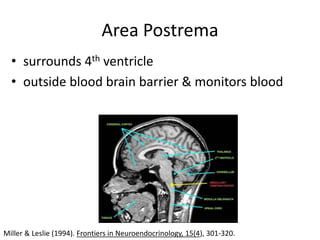
Area Postrema
  • surrounds 4th ventricle
  • outside blood brain barrier & monitors blood


Miller & Leslie (1994). Frontiers in Neuroendocrinology, 15(4), 301-320.
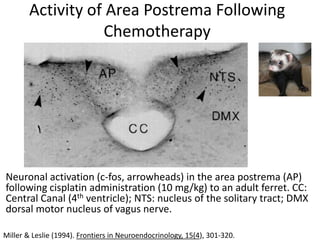
Activity of Area Postrema Following
                   Chemotherapy


Neuronal activation (c-fos, arrowheads) in the area postrema (AP)
following cisplatin administration (10 mg/kg) to an adult ferret. CC:
Central Canal (4th ventricle); NTS: nucleus of the solitary tract; DMX
dorsal motor nucleus of vagus nerve.

Miller & Leslie (1994). Frontiers in Neuroendocrinology, 15(4), 301-320.
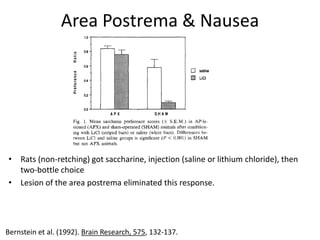
Area Postrema & Nausea


 • Rats (non-retching) got saccharine, injection (saline or lithium chloride), then
   two-bottle choice


Bernstein et al. (1992). Brain Research, 575, 132-137.
Area Postrema & Nausea


• Rats (non-retching) got saccharine, injection (saline or lithium chloride), then
  two-bottle choice
• Lesion of the area postrema eliminated this response.


Bernstein et al. (1992). Brain Research, 575, 132-137.
Area Postrema (AP) & Nausea
                                                                       *
                                *


•   Rats (+AP lesioned) got saccharine, injection (saline or lithium chloride)
•   Behavioral ratings of response to lithium (Lieing on Belly) were made
•   Pre-inections, a meal was consumed. Stomach contents were examined.
•   Area Postrema = chemoreceptor trigger zone


Bernstein et al. (1992). Brain Research, 575, 132-137.
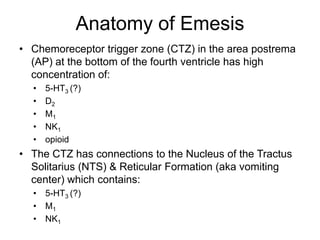
Anatomy of Emesis
• Chemoreceptor trigger zone (CTZ) in the area postrema
  (AP) at the bottom of the fourth ventricle has high
  concentration of:
  •   5-HT3 (?)
  •   D2
  •   M1
  •   NK1
  •   opioid
• The CTZ has connections to the Nucleus of the Tractus
  Solitarius (NTS) & Reticular Formation (aka vomiting
  center) which contains:
  • 5-HT3 (?)
  • M1
  • NK1
M1


                                                                     D2


Krakauer et al. (2005). New England Journal of Medicine, 352, 817.
Classification of antiemetics


† some peripheral activity at 5-HT3 receptor;
‡ some antihistamine and anticholinergic activity
Ondansetron
• MOA: 5-HT3 antagonist
• Indications:
  radiation, chemotherapy, postoperapative
• Dosing: 1x/day
• Adverse Effects: constipation & headache
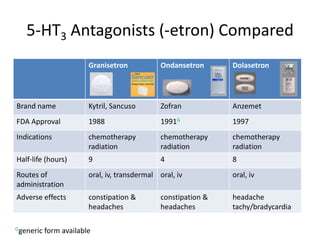
5-HT3 Antagonists (-etron) Compared
                        Granisetron            Ondansetron      Dolasetron


Brand name              Kytril, Sancuso        Zofran           Anzemet
FDA Approval            1988                   1991G            1997
Indications             chemotherapy           chemotherapy     chemotherapy
                        radiation              radiation        radiation
Half-life (hours)       9                      4                8
Routes of               oral, iv, transdermal oral, iv          oral, iv
administration
Adverse effects         constipation &         constipation &   headache
                        headaches              headaches        tachy/bradycardia

Ggeneric   form available
5-HT3 Antagonists (-etron) Compared
                    Granisetron           Ondansetron      Palonosetron


Brand name          Kytril, Sancuso       Zofran           Aloxi
FDA Approval        1988                  1991G            2003 (delayed nausea)
Indications         chemotherapy          chemotherapy     chemotherapy
                    radiation             radiation        post-operative
Half-life (hours)   10                    4                40
Routes of           oral, iv, transderm   oral, iv         oral, iv
administration
Adverse effects     constipation &        constipation &   headache, constipation,
                    headaches             headaches        QT
5-HT3 Antagonists Compared: Efficacy
 • Chemotherapy patients (N = 563) randomized to
   receive ondansetron versus palonosetron
 • Treatment failure = emetic response or rescue
   medication


                                             % of Patients


Gralla et al. (2003). Annals of Oncology, 14, 1570-1577.
5-HT3 Antagonists Compared: Safety
 • Chemotherapy patients (N = 563) randomized to
   receive ondansetron versus palonosetron


Gralla et al. (2003). Annals of Oncology, 14, 1570-1577.
Pathway of Emesis

     4
                3
      1

5


            2
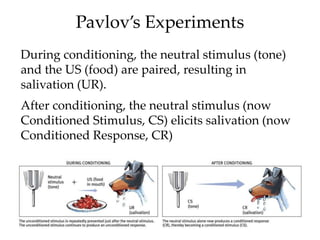
Pavlov’s Experiments
During conditioning, the neutral stimulus (tone)
and the US (food) are paired, resulting in
salivation (UR).
After conditioning, the neutral stimulus (now
Conditioned Stimulus, CS) elicits salivation (now
Conditioned Response, CR)


                                                    19
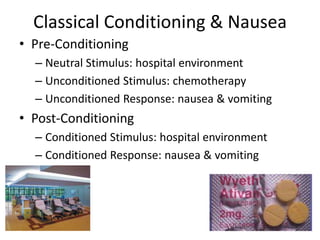
Classical Conditioning & Nausea
• Pre-Conditioning
  – Neutral Stimulus: hospital environment
  – Unconditioned Stimulus: chemotherapy
  – Unconditioned Response: nausea & vomiting
• Post-Conditioning
  – Conditioned Stimulus: hospital environment
  – Conditioned Response: nausea & vomiting
Metoclopramide
• MOA: D2 antagonist, 5-HT3 antagonist
• Indications: chemotherapy, post-operative
• Adverse Effects: restlessness, Parkinsonian
  symptoms


1 min: http://www.youtube.com/watch?v=dum81RdFrhM
Pronunciation: http://dictionary.reference.com/browse/metoclopramide?s=t
Olanzapine
• MOA: D2 antagonist + others
• Indications: acute & delayed CINV
• Adverse Effects:


                     Stahl (2008). Essential Psychopharmacology, p. 411.
Dronabinol
•   Synthetic delta-9-tetrahydrocannabinol (Δ9-THC)
•   Schedule: III
•   MOA: Cannabinoid receptors?
•   AE: dysphoria, postural hypotension
Density of Cannabinoid Receptor 1 (Increased
 Darkness = more receptors labeled with [3H]CP-55,940)


                                     Hekenham et al. (1991) J Neurosci, 11, 563-583.
Aprepitant
MOA:
 substance P binds to NeurokininA receptors
  Arg-Pro-Lys-Pro-Gln-Gln-Phe-Phe-Gly-Leu-Met
  NeurokininA antagonist
Indications: CINV, PONV
Adverse Effects: asthenia, constipation, hiccups
NeurokininA Antagonist: Efficacy
 • Abdominal surgery patients (N=750) randomized
   to receive oral Aprepitant or Ondansetron
 • Hours until vomiting or rescue medication


Gan et al. (2007). Anesthesia & Analgesia, 104(5), 1082-1089.
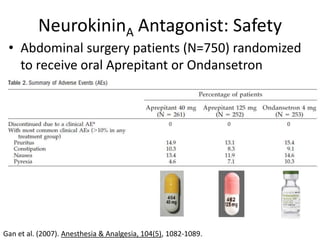
NeurokininA Antagonist: Safety
 • Abdominal surgery patients (N=750) randomized
   to receive oral Aprepitant or Ondansetron


Gan et al. (2007). Anesthesia & Analgesia, 104(5), 1082-1089.
Summary
   • High Therapeutic Index                   • Low Therapeutic Index
       – 5-HT3 antagonists                        – cannabinoids
       – NK1 antagonists                          – dopamine antagonists
       – corticosteroids (combo)                  – benzodiazepines


Hesketh (2008). New England Journal of Medicine, 358, 2482-2494.
Abbreviations
CB1    Cannabinoid 1
CINV   Chemotherapy-induced nausea and vomiting
CTZ    Chemoreceptor trigger zone
DA     Dopamine
NK1    Neurokinin 1
PONV   Post-operative nausea and vomiting
STN    Solitary tract nucleus
VC     Vomiting center

Antiemetics

  • 1.
    Antinauseants & Antiemetic Agents Brian J. Piper, Ph.D., M.S. October 16, 2012
  • 2.
    Learning objectives Pharmacy studentsshould be able to: 1. Explain emesis pathway(s) 2. Identify drug targets for antiemetic agents 3. Describe mechanism of action of antiemetic agents 4. Recognize adverse effects of antiemetic agents Ibn Bultan (1531)
  • 3.
    Emesis • A protectivereflex that serves to rid the stomach and intestine of toxic substances and prevent their further ingestion. • Vomiting is a complex process that consists of: – Pre-ejection phase: gastric relaxation & retroperistalsis – Retching: rhythmic action of respiratory muscles preceding vomiting and consisting of contraction of abdominal and intercostal muscles and diaphragm against a closed glottis – Ejection: intense contraction of the abdominal muscles and relaxation of the upper esophageal sphincter
  • 4.
    Importance • Vomiting isan adverse effect of many clinically useful drugs: – cancer chemotherapy & radiation – opioids – general anesthetics • Nausea may be a component of: – migraines – pregnancy
  • 5.
    Area Postrema • surrounds 4th ventricle • outside blood brain barrier & monitors blood Miller & Leslie (1994). Frontiers in Neuroendocrinology, 15(4), 301-320.
  • 6.
    Activity of AreaPostrema Following Chemotherapy Neuronal activation (c-fos, arrowheads) in the area postrema (AP) following cisplatin administration (10 mg/kg) to an adult ferret. CC: Central Canal (4th ventricle); NTS: nucleus of the solitary tract; DMX dorsal motor nucleus of vagus nerve. Miller & Leslie (1994). Frontiers in Neuroendocrinology, 15(4), 301-320.
  • 7.
    Area Postrema &Nausea • Rats (non-retching) got saccharine, injection (saline or lithium chloride), then two-bottle choice Bernstein et al. (1992). Brain Research, 575, 132-137.
  • 8.
    Area Postrema &Nausea • Rats (non-retching) got saccharine, injection (saline or lithium chloride), then two-bottle choice • Lesion of the area postrema eliminated this response. Bernstein et al. (1992). Brain Research, 575, 132-137.
  • 9.
    Area Postrema (AP)& Nausea * * • Rats (+AP lesioned) got saccharine, injection (saline or lithium chloride) • Behavioral ratings of response to lithium (Lieing on Belly) were made • Pre-inections, a meal was consumed. Stomach contents were examined. • Area Postrema = chemoreceptor trigger zone Bernstein et al. (1992). Brain Research, 575, 132-137.
  • 10.
    Anatomy of Emesis •Chemoreceptor trigger zone (CTZ) in the area postrema (AP) at the bottom of the fourth ventricle has high concentration of: • 5-HT3 (?) • D2 • M1 • NK1 • opioid • The CTZ has connections to the Nucleus of the Tractus Solitarius (NTS) & Reticular Formation (aka vomiting center) which contains: • 5-HT3 (?) • M1 • NK1
  • 11.
    M1 D2 Krakauer et al. (2005). New England Journal of Medicine, 352, 817.
  • 12.
    Classification of antiemetics †some peripheral activity at 5-HT3 receptor; ‡ some antihistamine and anticholinergic activity
  • 13.
    Ondansetron • MOA: 5-HT3antagonist • Indications: radiation, chemotherapy, postoperapative • Dosing: 1x/day • Adverse Effects: constipation & headache
  • 14.
    5-HT3 Antagonists (-etron)Compared Granisetron Ondansetron Dolasetron Brand name Kytril, Sancuso Zofran Anzemet FDA Approval 1988 1991G 1997 Indications chemotherapy chemotherapy chemotherapy radiation radiation radiation Half-life (hours) 9 4 8 Routes of oral, iv, transdermal oral, iv oral, iv administration Adverse effects constipation & constipation & headache headaches headaches tachy/bradycardia Ggeneric form available
  • 15.
    5-HT3 Antagonists (-etron)Compared Granisetron Ondansetron Palonosetron Brand name Kytril, Sancuso Zofran Aloxi FDA Approval 1988 1991G 2003 (delayed nausea) Indications chemotherapy chemotherapy chemotherapy radiation radiation post-operative Half-life (hours) 10 4 40 Routes of oral, iv, transderm oral, iv oral, iv administration Adverse effects constipation & constipation & headache, constipation, headaches headaches QT
  • 16.
    5-HT3 Antagonists Compared:Efficacy • Chemotherapy patients (N = 563) randomized to receive ondansetron versus palonosetron • Treatment failure = emetic response or rescue medication % of Patients Gralla et al. (2003). Annals of Oncology, 14, 1570-1577.
  • 17.
    5-HT3 Antagonists Compared:Safety • Chemotherapy patients (N = 563) randomized to receive ondansetron versus palonosetron Gralla et al. (2003). Annals of Oncology, 14, 1570-1577.
  • 18.
  • 19.
    Pavlov’s Experiments During conditioning,the neutral stimulus (tone) and the US (food) are paired, resulting in salivation (UR). After conditioning, the neutral stimulus (now Conditioned Stimulus, CS) elicits salivation (now Conditioned Response, CR) 19
  • 20.
    Classical Conditioning &Nausea • Pre-Conditioning – Neutral Stimulus: hospital environment – Unconditioned Stimulus: chemotherapy – Unconditioned Response: nausea & vomiting • Post-Conditioning – Conditioned Stimulus: hospital environment – Conditioned Response: nausea & vomiting
  • 21.
    Metoclopramide • MOA: D2antagonist, 5-HT3 antagonist • Indications: chemotherapy, post-operative • Adverse Effects: restlessness, Parkinsonian symptoms 1 min: http://www.youtube.com/watch?v=dum81RdFrhM Pronunciation: http://dictionary.reference.com/browse/metoclopramide?s=t
  • 22.
    Olanzapine • MOA: D2antagonist + others • Indications: acute & delayed CINV • Adverse Effects: Stahl (2008). Essential Psychopharmacology, p. 411.
  • 23.
    Dronabinol • Synthetic delta-9-tetrahydrocannabinol (Δ9-THC) • Schedule: III • MOA: Cannabinoid receptors? • AE: dysphoria, postural hypotension
  • 24.
    Density of CannabinoidReceptor 1 (Increased Darkness = more receptors labeled with [3H]CP-55,940) Hekenham et al. (1991) J Neurosci, 11, 563-583.
  • 25.
    Aprepitant MOA: substance Pbinds to NeurokininA receptors Arg-Pro-Lys-Pro-Gln-Gln-Phe-Phe-Gly-Leu-Met NeurokininA antagonist Indications: CINV, PONV Adverse Effects: asthenia, constipation, hiccups
  • 26.
    NeurokininA Antagonist: Efficacy • Abdominal surgery patients (N=750) randomized to receive oral Aprepitant or Ondansetron • Hours until vomiting or rescue medication Gan et al. (2007). Anesthesia & Analgesia, 104(5), 1082-1089.
  • 27.
    NeurokininA Antagonist: Safety • Abdominal surgery patients (N=750) randomized to receive oral Aprepitant or Ondansetron Gan et al. (2007). Anesthesia & Analgesia, 104(5), 1082-1089.
  • 29.
    Summary • High Therapeutic Index • Low Therapeutic Index – 5-HT3 antagonists – cannabinoids – NK1 antagonists – dopamine antagonists – corticosteroids (combo) – benzodiazepines Hesketh (2008). New England Journal of Medicine, 358, 2482-2494.
  • 30.
    Abbreviations CB1 Cannabinoid 1 CINV Chemotherapy-induced nausea and vomiting CTZ Chemoreceptor trigger zone DA Dopamine NK1 Neurokinin 1 PONV Post-operative nausea and vomiting STN Solitary tract nucleus VC Vomiting center

Editor's Notes

  • #2 Source of painting unknown (Wikipedia)
  • #3 Left: 14th century illustration of vomiting from the CasanatenseTacuinumSanitatis,a medieval handbook on health and wellbeing written in Baghdad. 
  • #4 Emesis is the medical name for vomiting, throwing-up, retching, and puking. This can be a life-saving event (think alcohol poisoning). This may or may not be preceded by nausea.
  • #5 A young, medically qualified patient being treated by combination chemotherapy for sarcoma stated that “the severity of vomiting at time made the thought of death seem like a welcome relief”. Lower right shows offspring of mothers that received thalidomide to treat their morning sickness.
  • #6 There are just a few areas that are outside the BBB (pineal, posterior pituitary, and structures adjacent to the 3rd & 4th ventricles). The area postrema is located adjacent to the most caudal end of the 4th ventricle.
  • #7 The ferret vomited 1.5 hours after chemo administration.
  • #8 Two bottle choice involves saccharine solution versus water.
  • #11 5-HT3 receptor is present in both the CTZ & NTS but it is unclear if these have an effect on vomiting.
  • #12 Vomiting consists of voluntary (cortex) and involuntary (medulla) components. Vestibular system connects of vomiting center via 8th cranial nerve.
  • #14 Pronounced: on dance ah tron; often combined with dexamethasone (the mechanism for corticosteroid increase in effectiveness of 5-HT3 antagonists is unknown, adverse effects are relatively rare
  • #15 Half-life following oral administration. >90% of serotonin in body is found in GI tract so constipation should come as no surprise with 5-HT3 antagonists. Dolasetron may prolong QT interval so avoid with patients born with congenital long QT syndrome or taking medications that prolong QT (e.g. epinephrine, amitryptyline). These 3 1st generation 5-HT3 antagonists produce largely equivalent effects.
  • #16 Palonosetron has exceptional binding to 5-HT3 and a very long-half life. This is useful as some chemos produce both an acute and delayed nausea. Adverse effects include prolongation of the QT interval.
  • #17 The majority of patients were breast cancer (57%) and the most common chemo was cyclophosphamide (63%). No prophylactic corticosteroids were used.
  • #18 These are adverse events that are believed to be unrelated to the chemotherapy.
  • #21 Benzodiazepines can be quite helpful for anticipatory nausea.
  • #22 Pronunciation:met-oh-klO-pruh-mahyd; also used as a gastroprokinetic as this will stimulate stomach emptying; may also cause dystonias
  • #23 Olanzapine is an atypical anti-psychotic that acts to block D2 > 5-HT2A >5-HT3, antihistamine.
  • #26 Pronunciation: (ap-RE-pi-tant). Substance P is a peptide composed of 11 amino acids and is released following pain. Asthenia (as-thee-nee-uh) is weakness. Fosaprepitant is a prodrug.
  • #28 Although studied here individually, when used for CINV,Aprepitant is often combined with 5-HT3 antagonists and corticosteriods. Note that nausea is listed here but all patients are post-operative.