
Anti-ulcer Drugs
Zulcaif Ahmad
Introduction
 Peptic /stomach ulcer is the condition in which imbalance of
  aggressive factor and defensive factors.

 From ancient time stomach ulcer has been recognized and also
  therapy established according to their knowledge.

 A Roman emperor Marcus Aurelius, whose death has been
  attributed by some to a perforated ulcer.

 More than 12 centuries ago, Paulus Aeginata who recognized that
  acid – neutralization was the effective treatment.

 Later in starting of 19 century the lot of research has been
  developed for the treatment of ulcer.
Continue….
 After period of time it has been identified that bacteria can
  causes the ulcer.

 Mainly Helicobacter pylori found to be recurrence of stomach
  ulcer.

 The main goal of anti-ulcer drug is that to decreasing the level
  of gastric acidity or enhancing mucosal protection.

 For infectious agent new approaches was found in order to
  prevention of infection or removal of micro organism.
PHYSIOLOGY OF GASTRIC ACID
 SECERTION
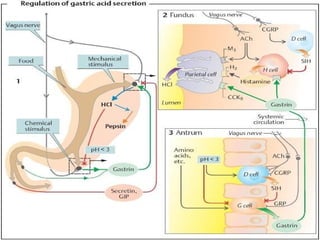
 Gastric acid secretion is a complex, continuous process in which
  multiple central and peripheral factors contribute to a common
  endpoint: the secretion of H+ by parietal cells.

 Neuronal    (acetylcholine, ACh), paracrine (histamine),       and
  endocrine (gastrin) factors all regulate acid secretion .

 Their specific receptors (M3, H2, and CCK2 receptors, respectively)
  are on the basolateral membrane of parietal cells in the body and
  fundus of the stomach.
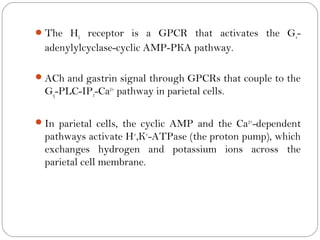
 The H2 receptor is a GPCR that activates the Gs-
  adenylylcyclase-cyclic AMP-PKA pathway.

 ACh and gastrin signal through GPCRs that couple to the
  Gq-PLC-IP3-Ca2+ pathway in parietal cells.

 In parietal cells, the cyclic AMP and the Ca 2+-dependent
  pathways activate H+,K+-ATPase (the proton pump), which
  exchanges hydrogen and potassium ions across the
  parietal cell membrane.
What is Peptic Ulcer?
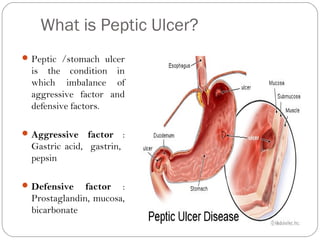
 Peptic /stomach ulcer
  is the condition in
  which imbalance of
  aggressive factor and
  defensive factors.

 Aggressive    factor :
  Gastric acid, gastrin,
  pepsin

 Defensive    factor :
  Prostaglandin, mucosa,
  bicarbonate
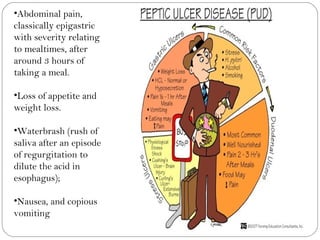
•Abdominal pain,
classically epigastric
with severity relating
to mealtimes, after
around 3 hours of
taking a meal.

•Loss of appetite and
weight loss.

•Waterbrash (rush of
saliva after an episode
of regurgitation to
dilute the acid in
esophagus);

•Nausea, and copious
vomiting
Complications
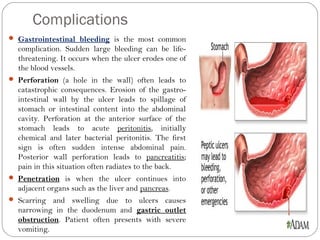
 Gastrointestinal bleeding is the most common
  complication. Sudden large bleeding can be life-
  threatening. It occurs when the ulcer erodes one of
  the blood vessels.
 Perforation (a hole in the wall) often leads to
  catastrophic consequences. Erosion of the gastro-
  intestinal wall by the ulcer leads to spillage of
  stomach or intestinal content into the abdominal
  cavity. Perforation at the anterior surface of the
  stomach leads to acute peritonitis, initially
  chemical and later bacterial peritonitis. The first
  sign is often sudden intense abdominal pain.
  Posterior wall perforation leads to pancreatitis;
  pain in this situation often radiates to the back.
 Penetration is when the ulcer continues into
  adjacent organs such as the liver and pancreas.
 Scarring  and swelling due to ulcers causes
  narrowing in the duodenum and gastric outlet
  obstruction. Patient often presents with severe
  vomiting.
Classification Of Antiulcer Agent
1) Reduction of gastric acid secretion
 H2 antihistamines: Cimetidine, ranitidine, famotidine, roxaatidine, loxatidine

 PPI’s : Omeprazole, lansoprazole, pantoprazole, rabeprazole, esomeprazole

 Anticholinergics: Pirenzepine, propantheline, oxyphenonium

 Prostaglandine analogues:- Misoprostol, enprostil, rioprostil

2) Neutralization of gastric acid (Antacids)

 Systemic : Sodium bicarbonate, sod.citrate

 Nonsystemic (Local) : Mg hydroxide, Mg trisilicate, Al hydroxide gel, calcium

   carbonate

3) Ulcer protectives: Sucralfate, CBS ( Colloidal Bismuth Subcitrate)

4) Ulcer healing drugs: Carbenoxolone sod.

5) Anti-H. pyloric drugs: Amoxicillin, clarithromycin, metronidazole, tinidazole,
   tetracycline
Histamine: H2 Receptor Antagonist
 Histamine receptor on parietal cells
  Autonomic system: food stimulates gastrin release, gastrin
    stimulates histamine release, histamine
  stimulates parietal cells secretion of HCl.

  MECHANISM OF ACTION

 The H2 receptor antagonists inhibit acid production by
  reversibly competing with histamine for binding to H2
  receptors on the basolateral membrane of parietal cells.

 Block histamine from stimulating the acid-secreting parietal cells
  of the stomach.

 H2 antagonist mainly basal, psychic, neurogenic, gastric
  secretion is suppressed and other stimuli Ach, gastrin, alcohol,
  food also inhibited.
 Reversible competitive inhibitors of H2 receptor.


 Highly selective for H2 receptors.


 Very effective in inhibiting nocturnal acid secretion
  ( as it depends largely on Histamine ).


 Modest impact on meal stimulated acid secretion (As
  it depends on gastrin, acetylcholine and histamine).
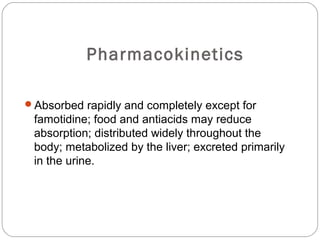
Pharmacokinetics

Absorbed rapidly and completely except for
 famotidine; food and antiacids may reduce
 absorption; distributed widely throughout the
 body; metabolized by the liver; excreted primarily
 in the urine.
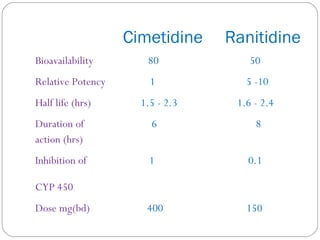
Cimetidine    Ranitidine
Bioavailability       80             50
Relative Potency       1            5 -10
Half life (hrs)      1.5 - 2.3    1.6 - 2.4
Duration of            6              8
action (hrs)
Inhibition of          1            0.1

CYP 450
Dose mg(bd)           400           150
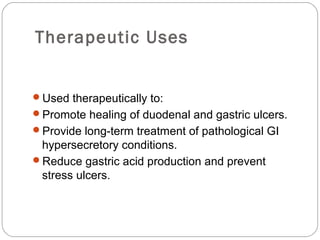
Therapeutic Uses


Used therapeutically to:
Promote healing of duodenal and gastric ulcers.
Provide long-term treatment of pathological GI
 hypersecretory conditions.
Reduce gastric acid production and prevent
 stress ulcers.
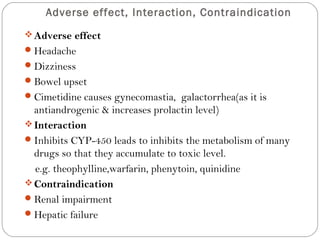
Adverse effect, Interaction, Contraindication
 Adverse effect
 Headache
 Dizziness
 Bowel upset
 Cimetidine causes gynecomastia, galactorrhea(as it is
  antiandrogenic & increases prolactin level)
 Interaction
 Inhibits CYP-450 leads to inhibits the metabolism of many
  drugs so that they accumulate to toxic level.
  e.g. theophylline,warfarin, phenytoin, quinidine
 Contraindication
 Renal impairment
 Hepatic failure
Proton Pump Inhibitors
            (PPIs)
 Disrupt chemical binding in stomach cells to reduce acid
  production, lessening irritation and allowing peptic ulcers to
  heal.
 These drugs include:
 Omeprazole
 Rabeprazole
 Pantoprazole
 Lansoprazole
 Esomaprazole


MECHANISM OF ACTION OF PPIs.

Block the last step in the secretion of gastric
  acid by combining with hydrogen, potassium,
  and adenosine triphosphate in the parietal cells
  of the stomach.
Continued MOA….
 Most effective drugs in antiulcer therapy.

 Irreversible inhibitor of H+ K+ ATPase to apical membrane of the
   parietal cell.
 Prodrugs requiring activation in acid environment.

 Inactivate at neutral pH, at pH<5 rearranges to 2 charged cationic
   form- sulphenic acid & sulphenamide.
 React covalently with –SH groups of the H+ K+ ATPase enzyme.

 Weakly basic drugs & so accumulate in canaliculi of parietal cell.

 Activated in canaliculi & binds covalently to extracellular domain of
   H+ K+ ATPase.
 Acid secretion resumes only after synthesis of new molecules.
o Pharmacokinetic
Bioavailability : ~50% (instability at acidic pH)
Metabolism : In Liver (CYP2C19 and CYP3A4).
Excretion : Metabolites excreted through renally
Onset action : ½-1 hour
Duration of action : 24 hours
 Adverse effect
 Hepatic dysfunction
 Dizziness
 Nausea
 Headache
 Interaction
 Inhibits oxidation of certain drugs : diazepam,
  phenytoin, warfarin
Antacid
These are the basic substances which neutralize gastric
  acidity.
Acid neutralizing capacity: no.of mEq of 1N HCl that
  brought to pH 3.5 in 15 min. by a unit dose of the
  antacid preparation.
 Systemic antacid :
 Sodium bicarbonate, water soluble, acts i.v. duration of
  action is short.
 Potent neutralizer, pH may rises above 7.
 Produces CO2 in stomach leads to distention,
  discomfort.
 Increases sodium load leads to worsen in CHF with
  edema.
 Large dose produces alkalosis.
 Non-systemic antacid:
 These are insoluble and poorly absorbed basic compound.
 React in stomach with acid to form respective chloride
  salts.
 This again reacts with bicarbonate is not spared for
  absorption, hence no acid –base disturbance.

 Aluminium hydroxide gel:
 The Al+³ ions relaxes smooth muscle leads to delay in
  gastric emptying.
 This causes constipation.
 Mucosal astringent reaction also leads to constipation.
Ulcer Protectives - Sucralfate
Sucralfate consists of the octasulfate of sucrose to
  which Al(OH)3 has been added.

 In an acid environment(pH <4), sucralfate undergoes
  extensive cross-linking to produce a viscous, sticky
  polymer that adheres to epithelial cells and ulcer
  craters for up to 6 hours after a single dose.

In addition to inhibiting hydrolysis of mucosal
  proteins by pepsin, sucralfate may have additional
  cytoprotectiveeffects, including stimulation of local
  production of prostaglandins and epidermal growth
  factor.
Since it is activated by acid, sucralfate should be taken
  on an empty stomach 1 hour before meals.

The use of antacids within 30 minutes of a dose of
  sucralfate should be avoided.

The usual dose of sucralfate is 1 g four times daily
  (for active duodenal ulcer) or 1 g twice daily (for
  maintenance therapy).
Anti H.pylori drugs

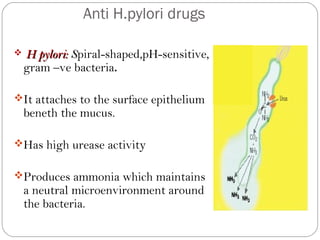
   H pylori: Spiral-shaped,pH-sensitive,
    gram –ve bacteria.

It attaches to the surface epithelium
    beneth the mucus.

Has high urease activity


Produces ammonia which maintains
    a neutral microenvironment around
    the bacteria.
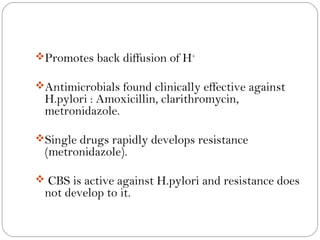
Promotes back diffusion of H+

Antimicrobials found clinically effective against
 H.pylori : Amoxicillin, clarithromycin,
 metronidazole.

Single drugs rapidly develops resistance
 (metronidazole).

 CBS is active against H.pylori and resistance does
 not develop to it.
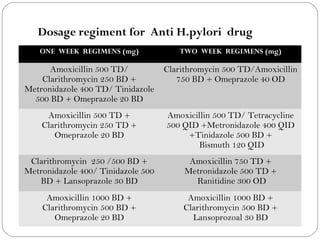
Dosage regiment for Anti H.pylori drug
   ONE WEEK REGIMENS (mg)              TWO WEEK REGIMENS (mg)

      Amoxicillin 500 TD/           Clarithromycin 500 TD/Amoxicillin
    Clarithromycin 250 BD +            750 BD + Omeprazole 40 OD
Metronidazole 400 TD/ Tinidazole
  500 BD + Omeprazole 20 BD
     Amoxicillin 500 TD +           Amoxicillin 500 TD/ Tetracycline
    Clarithromycin 250 TD +         500 QID +Metronidazole 400 QID
       Omeprazole 20 BD                  +Tinidazole 500 BD +
                                            Bismuth 120 QID
 Clarithromycin 250 /500 BD +             Amoxicillin 750 TD +
Metronidazole 400/ Tinidazole 500        Metronidazole 500 TD +
   BD + Lansoprazole 30 BD                 Ranitidine 300 OD
     Amoxicillin 1000 BD +               Amoxicillin 1000 BD +
    Clarithromycin 500 BD +             Clarithromycin 500 BD +
       Omeprazole 20 BD                   Lansoprozoal 30 BD
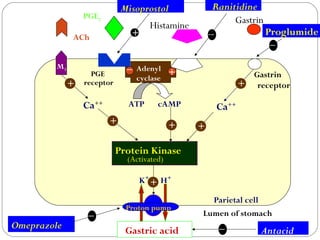
Misoprostol              Ranitidine
                  PGE2                                      Gastrin
                                      Histamine
                                +                     _             Proglumide
              ACh                                                    _

         M3                    _   Adenyl
                    PGE
                                   cyclase
                                             +                    Gastrin
              +   receptor                                    +    receptor

                  Ca++         ATP       cAMP          Ca++
                         +                   +    +

                             Protein Kinase
                               (Activated)

                                    K+ + H+

                                                    Parietal cell
                               Proton pump
                   _                              Lumen of stomach
Omeprazole                                              _
                               Gastric acid                        Antacid
REFERENCE
VC Scanlon, Tina ssnders. Essential of Anatomy and
 Physiology;5th Edn.2007,F.A.Davis
 Company,Philadelphia:376-379.
KD Tripathi. Essentials of medical pharmacology;5th Edn.
 2004,Jaypee brothers publication, New Delhi :587-598.
Goodman & Gilman’s. Manual of Pharmacology &
 Therapeutics; 11th Edn.2008, MacGraw’s Hill, New york :
 621-635.
www.wikepedia/antiulcer.
N K
 H A
T U
 Y O

Anti ulcer drugs classification

  • 1.
  • 2.
    Introduction  Peptic /stomachulcer is the condition in which imbalance of aggressive factor and defensive factors.  From ancient time stomach ulcer has been recognized and also therapy established according to their knowledge.  A Roman emperor Marcus Aurelius, whose death has been attributed by some to a perforated ulcer.  More than 12 centuries ago, Paulus Aeginata who recognized that acid – neutralization was the effective treatment.  Later in starting of 19 century the lot of research has been developed for the treatment of ulcer.
  • 3.
    Continue….  After periodof time it has been identified that bacteria can causes the ulcer.  Mainly Helicobacter pylori found to be recurrence of stomach ulcer.  The main goal of anti-ulcer drug is that to decreasing the level of gastric acidity or enhancing mucosal protection.  For infectious agent new approaches was found in order to prevention of infection or removal of micro organism.
  • 4.
    PHYSIOLOGY OF GASTRICACID SECERTION  Gastric acid secretion is a complex, continuous process in which multiple central and peripheral factors contribute to a common endpoint: the secretion of H+ by parietal cells.  Neuronal (acetylcholine, ACh), paracrine (histamine), and endocrine (gastrin) factors all regulate acid secretion .  Their specific receptors (M3, H2, and CCK2 receptors, respectively) are on the basolateral membrane of parietal cells in the body and fundus of the stomach.
  • 5.
     The H2receptor is a GPCR that activates the Gs- adenylylcyclase-cyclic AMP-PKA pathway.  ACh and gastrin signal through GPCRs that couple to the Gq-PLC-IP3-Ca2+ pathway in parietal cells.  In parietal cells, the cyclic AMP and the Ca 2+-dependent pathways activate H+,K+-ATPase (the proton pump), which exchanges hydrogen and potassium ions across the parietal cell membrane.
  • 7.
    What is PepticUlcer?  Peptic /stomach ulcer is the condition in which imbalance of aggressive factor and defensive factors.  Aggressive factor : Gastric acid, gastrin, pepsin  Defensive factor : Prostaglandin, mucosa, bicarbonate
  • 8.
    •Abdominal pain, classically epigastric withseverity relating to mealtimes, after around 3 hours of taking a meal. •Loss of appetite and weight loss. •Waterbrash (rush of saliva after an episode of regurgitation to dilute the acid in esophagus); •Nausea, and copious vomiting
  • 9.
    Complications  Gastrointestinal bleedingis the most common complication. Sudden large bleeding can be life- threatening. It occurs when the ulcer erodes one of the blood vessels.  Perforation (a hole in the wall) often leads to catastrophic consequences. Erosion of the gastro- intestinal wall by the ulcer leads to spillage of stomach or intestinal content into the abdominal cavity. Perforation at the anterior surface of the stomach leads to acute peritonitis, initially chemical and later bacterial peritonitis. The first sign is often sudden intense abdominal pain. Posterior wall perforation leads to pancreatitis; pain in this situation often radiates to the back.  Penetration is when the ulcer continues into adjacent organs such as the liver and pancreas.  Scarring and swelling due to ulcers causes narrowing in the duodenum and gastric outlet obstruction. Patient often presents with severe vomiting.
  • 10.
    Classification Of AntiulcerAgent 1) Reduction of gastric acid secretion  H2 antihistamines: Cimetidine, ranitidine, famotidine, roxaatidine, loxatidine  PPI’s : Omeprazole, lansoprazole, pantoprazole, rabeprazole, esomeprazole  Anticholinergics: Pirenzepine, propantheline, oxyphenonium  Prostaglandine analogues:- Misoprostol, enprostil, rioprostil 2) Neutralization of gastric acid (Antacids)  Systemic : Sodium bicarbonate, sod.citrate  Nonsystemic (Local) : Mg hydroxide, Mg trisilicate, Al hydroxide gel, calcium carbonate 3) Ulcer protectives: Sucralfate, CBS ( Colloidal Bismuth Subcitrate) 4) Ulcer healing drugs: Carbenoxolone sod. 5) Anti-H. pyloric drugs: Amoxicillin, clarithromycin, metronidazole, tinidazole, tetracycline
  • 11.
    Histamine: H2 ReceptorAntagonist  Histamine receptor on parietal cells Autonomic system: food stimulates gastrin release, gastrin stimulates histamine release, histamine stimulates parietal cells secretion of HCl. MECHANISM OF ACTION  The H2 receptor antagonists inhibit acid production by reversibly competing with histamine for binding to H2 receptors on the basolateral membrane of parietal cells.  Block histamine from stimulating the acid-secreting parietal cells of the stomach.  H2 antagonist mainly basal, psychic, neurogenic, gastric secretion is suppressed and other stimuli Ach, gastrin, alcohol, food also inhibited.
  • 12.
     Reversible competitiveinhibitors of H2 receptor.  Highly selective for H2 receptors.  Very effective in inhibiting nocturnal acid secretion ( as it depends largely on Histamine ).  Modest impact on meal stimulated acid secretion (As it depends on gastrin, acetylcholine and histamine).
  • 13.
    Pharmacokinetics Absorbed rapidly andcompletely except for famotidine; food and antiacids may reduce absorption; distributed widely throughout the body; metabolized by the liver; excreted primarily in the urine.
  • 14.
    Cimetidine Ranitidine Bioavailability 80 50 Relative Potency 1 5 -10 Half life (hrs) 1.5 - 2.3 1.6 - 2.4 Duration of 6 8 action (hrs) Inhibition of 1 0.1 CYP 450 Dose mg(bd) 400 150
  • 15.
    Therapeutic Uses Used therapeuticallyto: Promote healing of duodenal and gastric ulcers. Provide long-term treatment of pathological GI hypersecretory conditions. Reduce gastric acid production and prevent stress ulcers.
  • 16.
    Adverse effect, Interaction,Contraindication  Adverse effect  Headache  Dizziness  Bowel upset  Cimetidine causes gynecomastia, galactorrhea(as it is antiandrogenic & increases prolactin level)  Interaction  Inhibits CYP-450 leads to inhibits the metabolism of many drugs so that they accumulate to toxic level. e.g. theophylline,warfarin, phenytoin, quinidine  Contraindication  Renal impairment  Hepatic failure
  • 17.
    Proton Pump Inhibitors (PPIs)  Disrupt chemical binding in stomach cells to reduce acid production, lessening irritation and allowing peptic ulcers to heal.  These drugs include:  Omeprazole  Rabeprazole  Pantoprazole  Lansoprazole  Esomaprazole MECHANISM OF ACTION OF PPIs. Block the last step in the secretion of gastric acid by combining with hydrogen, potassium, and adenosine triphosphate in the parietal cells of the stomach.
  • 18.
    Continued MOA….  Mosteffective drugs in antiulcer therapy.  Irreversible inhibitor of H+ K+ ATPase to apical membrane of the parietal cell.  Prodrugs requiring activation in acid environment.  Inactivate at neutral pH, at pH<5 rearranges to 2 charged cationic form- sulphenic acid & sulphenamide.  React covalently with –SH groups of the H+ K+ ATPase enzyme.  Weakly basic drugs & so accumulate in canaliculi of parietal cell.  Activated in canaliculi & binds covalently to extracellular domain of H+ K+ ATPase.  Acid secretion resumes only after synthesis of new molecules.
  • 19.
    o Pharmacokinetic Bioavailability :~50% (instability at acidic pH) Metabolism : In Liver (CYP2C19 and CYP3A4). Excretion : Metabolites excreted through renally Onset action : ½-1 hour Duration of action : 24 hours  Adverse effect  Hepatic dysfunction  Dizziness  Nausea  Headache  Interaction  Inhibits oxidation of certain drugs : diazepam, phenytoin, warfarin
  • 20.
    Antacid These are thebasic substances which neutralize gastric acidity. Acid neutralizing capacity: no.of mEq of 1N HCl that brought to pH 3.5 in 15 min. by a unit dose of the antacid preparation.  Systemic antacid :  Sodium bicarbonate, water soluble, acts i.v. duration of action is short.  Potent neutralizer, pH may rises above 7.  Produces CO2 in stomach leads to distention, discomfort.  Increases sodium load leads to worsen in CHF with edema.  Large dose produces alkalosis.
  • 21.
     Non-systemic antacid: These are insoluble and poorly absorbed basic compound.  React in stomach with acid to form respective chloride salts.  This again reacts with bicarbonate is not spared for absorption, hence no acid –base disturbance.  Aluminium hydroxide gel:  The Al+³ ions relaxes smooth muscle leads to delay in gastric emptying.  This causes constipation.  Mucosal astringent reaction also leads to constipation.
  • 22.
    Ulcer Protectives -Sucralfate Sucralfate consists of the octasulfate of sucrose to which Al(OH)3 has been added.  In an acid environment(pH <4), sucralfate undergoes extensive cross-linking to produce a viscous, sticky polymer that adheres to epithelial cells and ulcer craters for up to 6 hours after a single dose. In addition to inhibiting hydrolysis of mucosal proteins by pepsin, sucralfate may have additional cytoprotectiveeffects, including stimulation of local production of prostaglandins and epidermal growth factor.
  • 23.
    Since it isactivated by acid, sucralfate should be taken on an empty stomach 1 hour before meals. The use of antacids within 30 minutes of a dose of sucralfate should be avoided. The usual dose of sucralfate is 1 g four times daily (for active duodenal ulcer) or 1 g twice daily (for maintenance therapy).
  • 24.
    Anti H.pylori drugs  H pylori: Spiral-shaped,pH-sensitive, gram –ve bacteria. It attaches to the surface epithelium beneth the mucus. Has high urease activity Produces ammonia which maintains a neutral microenvironment around the bacteria.
  • 25.
    Promotes back diffusionof H+ Antimicrobials found clinically effective against H.pylori : Amoxicillin, clarithromycin, metronidazole. Single drugs rapidly develops resistance (metronidazole).  CBS is active against H.pylori and resistance does not develop to it.
  • 26.
    Dosage regiment forAnti H.pylori drug ONE WEEK REGIMENS (mg) TWO WEEK REGIMENS (mg) Amoxicillin 500 TD/ Clarithromycin 500 TD/Amoxicillin Clarithromycin 250 BD + 750 BD + Omeprazole 40 OD Metronidazole 400 TD/ Tinidazole 500 BD + Omeprazole 20 BD Amoxicillin 500 TD + Amoxicillin 500 TD/ Tetracycline Clarithromycin 250 TD + 500 QID +Metronidazole 400 QID Omeprazole 20 BD +Tinidazole 500 BD + Bismuth 120 QID Clarithromycin 250 /500 BD + Amoxicillin 750 TD + Metronidazole 400/ Tinidazole 500 Metronidazole 500 TD + BD + Lansoprazole 30 BD Ranitidine 300 OD Amoxicillin 1000 BD + Amoxicillin 1000 BD + Clarithromycin 500 BD + Clarithromycin 500 BD + Omeprazole 20 BD Lansoprozoal 30 BD
  • 27.
    Misoprostol Ranitidine PGE2 Gastrin Histamine + _ Proglumide ACh _ M3 _ Adenyl PGE cyclase + Gastrin + receptor + receptor Ca++ ATP cAMP Ca++ + + + Protein Kinase (Activated) K+ + H+ Parietal cell Proton pump _ Lumen of stomach Omeprazole _ Gastric acid Antacid
  • 28.
    REFERENCE VC Scanlon, Tinassnders. Essential of Anatomy and Physiology;5th Edn.2007,F.A.Davis Company,Philadelphia:376-379. KD Tripathi. Essentials of medical pharmacology;5th Edn. 2004,Jaypee brothers publication, New Delhi :587-598. Goodman & Gilman’s. Manual of Pharmacology & Therapeutics; 11th Edn.2008, MacGraw’s Hill, New york : 621-635. www.wikepedia/antiulcer.
  • 29.
    N K HA T U Y O