ANTI EMETIC DRUGS
OR
ANTIEMETICS
PREPARED BY
KESHARI KUMAR SRIWASTAWA
M. PHARM (PHARMACOLOGY) , 1STYEAR
(2NDSEM)
WHAT IS EMESIS?
 It is defined as the involuntary, forceful
expulsion of contents of the stomach
through the mouth and sometimes through
the nose.
 It is also known as vomiting, puking, barfing
or throwing up.
 Nausea is a feeling of discomfort or sickness
in the stomach that may lead to an urge to
vomit.
CAUSES OF EMESIS
 Motion sickness or sea sickness
 Early stages of pregnancy (nausea occurs in
almost 50%-90% of all pregnancies,
vomiting occurs in 25%-55%)
 Medication induced vomiting
 Intense pain
 Emotional stress
 Gall bladder disease
 Food poisoning
 Reaction to certain smells or odours.
HOW DOES EMESIS OCCUR?
 Emesis (vomiting) occurs due to the activation of
vomiting centre (VC) present in the medullary
reticular formation. It receives input from GI mucosa,
chemoreceptor trigger zone (CTZ) and vestibular
apparatus.
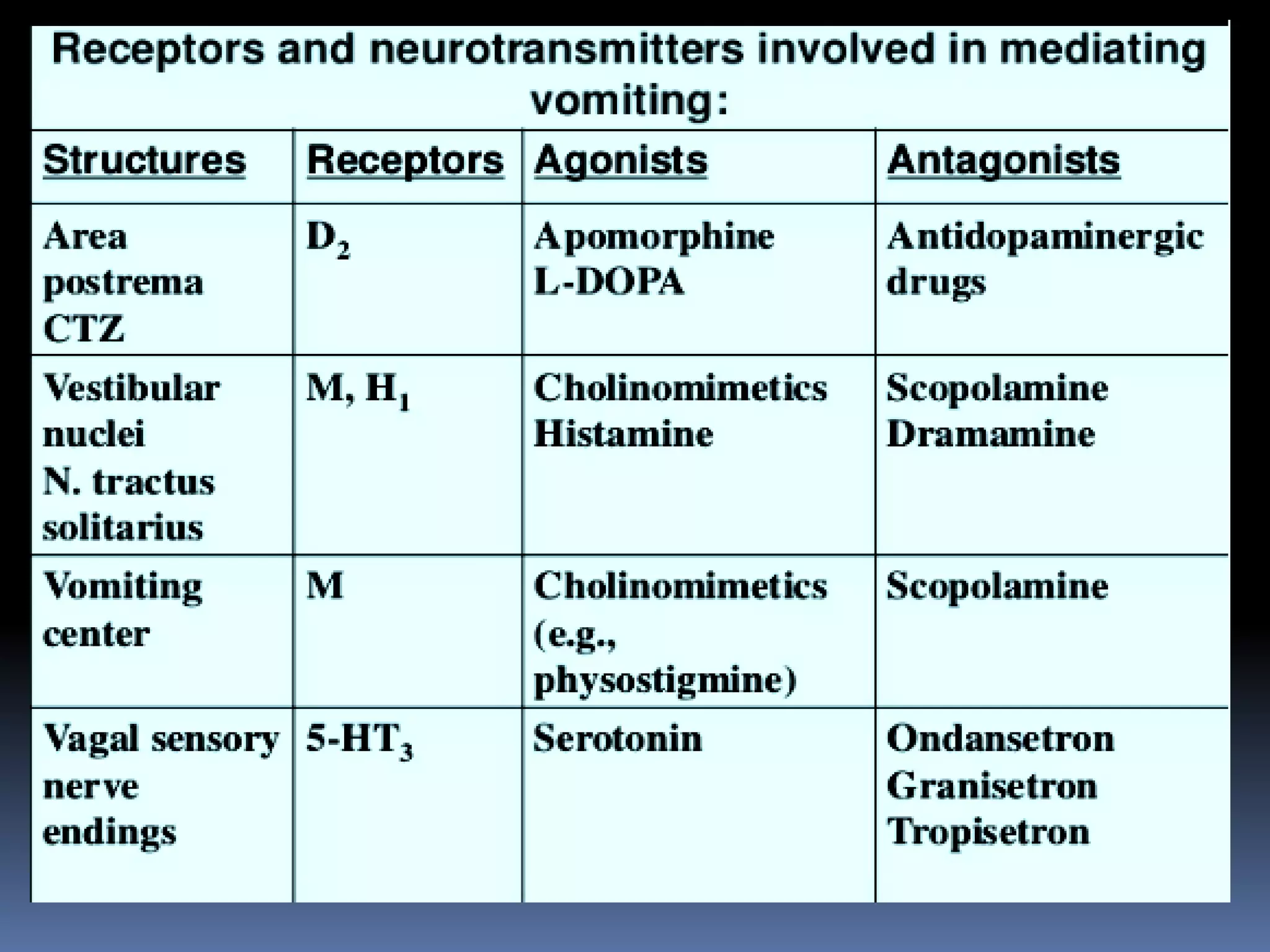
 The main neurotransmitters involved in the control of
vomiting are acetylcholine, histamine, 5-HT and
dopamine.
 Irritation of GI mucosa by drugs or irritants leads to
release of serotonin that stimulatesVC by 5-HT3
receptors.
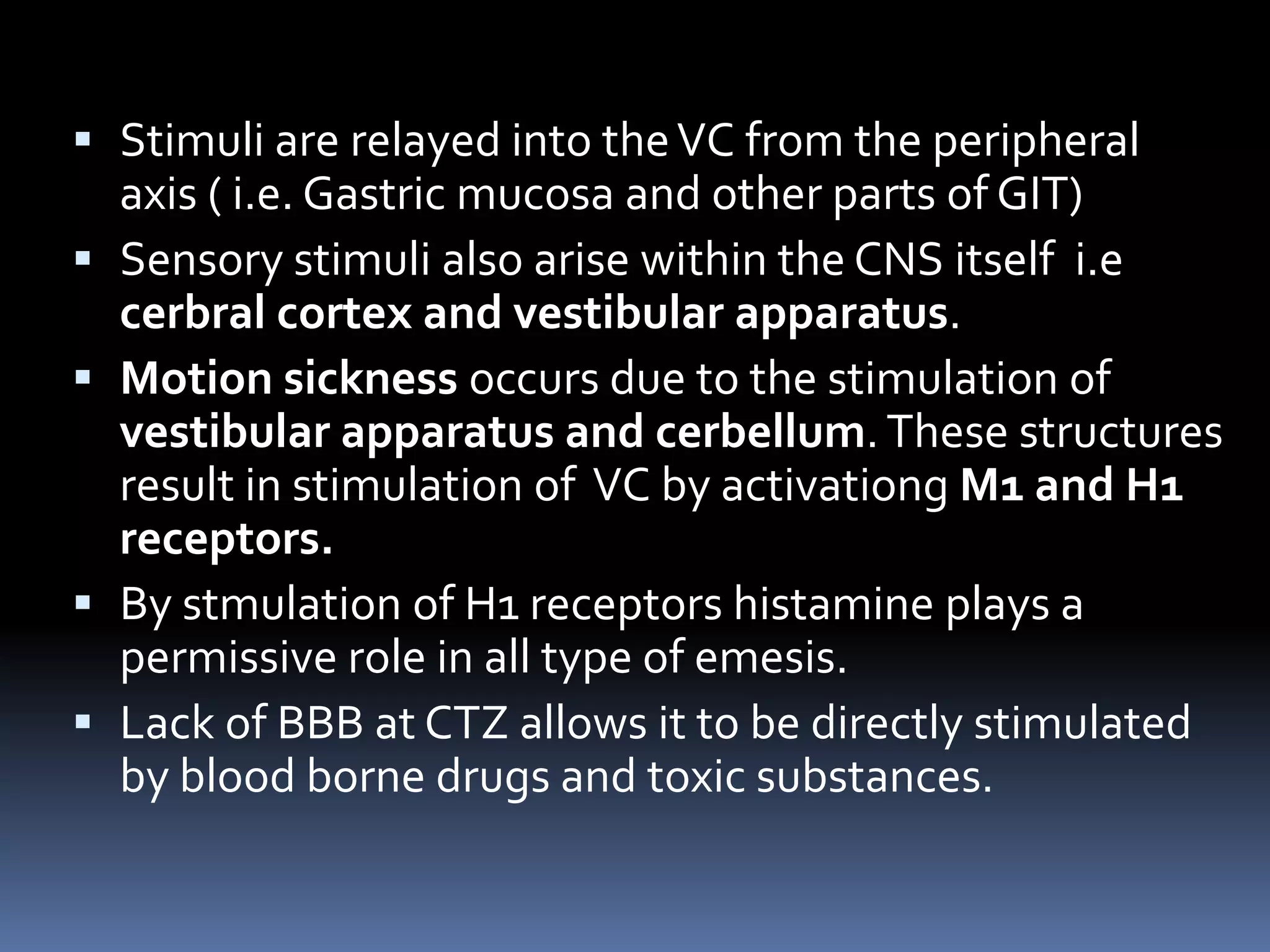
 Stimuli are relayed into theVC from the peripheral
axis ( i.e. Gastric mucosa and other parts of GIT)
 Sensory stimuli also arise within the CNS itself i.e
cerbral cortex and vestibular apparatus.
 Motion sickness occurs due to the stimulation of
vestibular apparatus and cerbellum.These structures
result in stimulation of VC by activationg M1 and H1
receptors.
 By stmulation of H1 receptors histamine plays a
permissive role in all type of emesis.
 Lack of BBB at CTZ allows it to be directly stimulated
by blood borne drugs and toxic substances.
CLASSIFICATION
SITES OF ACTION
1. ANTICHOLINERGICS
Scopolamine ( Hyoscine or Devil’s breath )
1. Natural or synthetically prepared tropane alkaloid
2. Non specific muscarinic antagonist
3. Drug of choice for motion sickness.
4. It is used as IM injection or transdermal patch (applied behind pinna) in the
prophylaxis of motion sickness
5. It has no role in treatment once vomiting starts.
6. MOA – Blocks the afferent impulses from the vestibular apparatus in theVC by
its anticholinergic action .
7. Its sedative effect also contributes to its antiemetic action.
8. When given by injection its effect begins after 20 minutes and lasts upto 8
hours.
9. Other routes of administration– Oral, eye drops, SC, sublingual , rectal , buccal
and transmucosal.
10. Pharmacokinetics – A – Unergoes first pass metabolism
M- Liver
E- 2.6 % excreted unchanged in urine ,
Elimination half life 0f 4.5 hours
2. NEUROLEPTICS (D2 BLOCKERS)
 It is divided into 2 classes-
(i) Phenothiazines-
Chlorpromazine , Prochlorperazine,Trifluoperazine ,
Metoclopramide,Thiethyl perazine(used only as antiemetic)
(ii) Butyrophenone derivatives –
Haloperidol, Domperidone, Droperidol etc.
1) These drugs apart from blocking the D2 receptors also block
the M1 and H1 receptors in the CTZ.
2) Most commonly used drug is Prochlorperazine.
3) These drugs are not much effective in motion sickness.
4) Metoclopramide and Domperidone produces prokinetic effect
due to blocking the peripheral D2 receptors and activating the
muscarinic receptor in GIT.
 Metoclopramide crosses the BBB therefore causes
extrapyramidal side effects which are :Acute
dystonia andTardive dyskinesia. It also produces
some other side effects like gynecomastia,
galactorrhea and long term parkinsonism.
 Domperidone poorly crosses the BBB and hence does
not cause extrapyramidal side effects.
 Metoclopramide is also a 5HT4 agonist and prolactin
releaser.
 Moreover Metoclopramide has been found to be safe
in pregnancy.
 Metoclopramide has an oral bioavailibility of 65%-
95% and excreted 70-85% in urine and 2% in faeces
with an elimination half life of 5-6 hours.
3. ANTIHISTAMICS (H1 RECEPTOR BLOCKER)
 Thse drugs block the H1 receptors in the CTZ and NTS.
 Drugs like Promethazine,Cyclizine,Meclizine,and
Diphenhydramine are used in the prophylaxis of motion
sickness.
 Cinnarizine (antiemetic with antihistaminic and
anticholinergic property) is used in the treatment of vertigo.
 Centrally acting antihistaminics like Diphenhydramine,
Dimenhydrinate, Promethazine etc are also used in the
treatment of parkinsonism.
 Promethazine can be administered via a rectal suppository, IV
injection,oral tablet or oral suspension for adults and children
for over 2 years of age.
 Mirtazepine is a antidepressant that also has antiemetic effect
is also a potent H1 blocker.
4. PROKINETIC AGENTS
 They are also called as gastroprokinetic or gastrokinetic or
propulsive agents.
 These agents increase the GI motility by increasing the
frequency or strength of contractions without disrupting the
rhythm and hasten the gastric emptying time.
 Cisapride and Zipapride are structurally similar to
metoclopramide but deprived of the D2 blocking property.
 Metoclopramide acclerates the absorption of diazepam but
decreases the absorption of digoxin.
 Metoclopramide has 2 important actions – Central and
Peripheral.
5HT4
agonist
5HT3 antagonist
in the GIT
Increases Ach secretion from the myenteric motor neurons
D2 - Antagonist
Metoclopramide
PROKINETIC EFFECT OF METOCLOPRAMIDE
ON UPPER GIT
Increase in tone
of lower
oesophagal
sphincter (LES)
Increase in tone
and amplitude
of antral
contractions
Increase of
peristalsis of small
intestine
Relaxation of
Pyloric
Sphincter
Effects of
metoclopramide
on the upper GI
tract
5. 5HT3 RECEPTOR ANTAGONIST
 Ondansetron is the prototype drug with the shortest half life.
 These classes of drugs shows 2 kinds of actions –
(I) Central action – Blocks 5-HT3 receptors inCTZ and NTS
(II) Peripheral action – Blocks 5-HT3 receptors in vagal afferents in the
gut.
• They are the DOC for chemotherapy and radiation therapy induced
vomiting.
• Palonosetron is the most potent in this class and has the longest half life
of 40 hours.
• Dolasetron may prolong QT interval.
• They also decrease dopamine synthesis and decreases dopamine release.
• They are also effective in hyperemesis in pregnancy and post operative
nausea.
• Ramosetron can be used in irritable bowel syndrome.
• Transdermal patches of granisetron are also available for the prevention
of cancer chemotherapy induced vomiting.
6. NEUROKININ 1 (NK1) RECEPTOR
ANTAGONIST
 The agonist for NK-1 receptor is substance P which is a
neuropeptide whose concentration increases during emesis.
So these drugs block the NK 1 receptors and thereby block
the actions of substance P in the CTZ and NTS.
 They ae higly effective in the treatment of delayed emesis
following moderately to highly ematogenic chemotherapy.
 It increases the efficacy of standard antiemetic regimens
( eg. Dexamethosone+5 HT3 antagonist)
 Aprepitant is a highly selective antagonist , orally active and
enter the brain. It is metabolized by CYP3A4 enzymes.
 Fasoprepitant is the intravenous prodrug of Aprepitant.
 It is well tolerated by patients.
 Flattulence may occur.
7. ADJUVANT ANTIEMETICS
Dronabinol and Nabilone
 These are the derivatives of cannabinoids.
 They produce antiemetic effect by blocking the CB1
receptors present in and around the CTZ.
 Their antiemetic effect is inhibited by Naloxone.
 Dronabinol is also a appetite stimulant used in AIDS with
anorexia.
 ADR- Hallucinations, insomnia, drowsiness, thinking
abnormalities.They also produce some cental
sympathomimetic side effects like tachycardia ,palpitation
and hypotension
 They are used as prophylactivc agent in chemotherapy
induced vomiting.
 Glucocorticoids like dexamethasone ,
methylprednisolone, betamethasone etc. are
commonly used in combination with ondansetron or
metoclopramide in the treatment of anticancer drug
induced acute and delayed vomiting.
 The beneficial effect of steroids is due to their anti -
inflammatory effect.
 Benzodiazepines like diazepam, lorazepam and
alprazolam are used in the treatment of psychogenic
and anticipatory vomiting.
 The beneficial effects of benzodiazepines is due to
their sedative, amnesic and antianxiety effects.
Drugs Uses Important side effects
Anticholnergics
(Scopolamine) Motion sickness
Sedation, dryness of
mouth, blurred vision and
urinary retention
5-HT 3-receptor
antagonists
Cancer chemotherapy-induced
vomiting, radiation sickness and post-
operative vomiting
Headache, dizziness and
diarrhoea
Neuroleptics Drug-induced, disease­induced, post-
operative, cancer chemotherapy and
radiation-induced vomiting
Extrapyramidal
symptoms, sedation,
dystonic reactions and
orthostatic hypotension
Neurokinin
(NK1) receptor
antagonist
Cancer chemotherapy­induced
vomiting
Dizziness, diarrhoea and
fatigue
Benzodiazepines
(Adjuvant
antiemetics)
Psychogenic and anticipatory vomiting Sedation and drowsiness
Drugs Uses Important side effects
Dronabinol Vomiting due to cytotoxic drugs and
radiation sickness
Sedation, dysphoria,
hallucinations and drug
dependence
Glucocorticoids
(Adjuvant
antiemetics)
Adjuvant antiemetlc along with
ondansetron or metoclo­pramide in
cancer chemotherapy-induced
vomiting
Metabolic Disturbances
Prokinetic drugs-
•Metoclopramide
•Domperidone
•Drug-induced, disease­induced,
post-operative, cancer
chemotherapy induced vomiting and
radiation sickness ,
•Preferred antiemetic in children and
levodopa-lnduced vomiting
•Drowsiness, dizziness,
diarrhoea, acute
dystonias and other
extrapyramidal
symptoms (EPS)
•Dryness of mouth,
diarrhoea and headache
Antihistamines Motion sickness, morning sickness,
post operative, Meniere's disease,
drug induced, radiation sickness,
cancer chemotherapy-induced
vomiting
Drowsiness and dryness
of mouth
THANK YOU

KK Anti emetic drugs

  • 1.
    ANTI EMETIC DRUGS OR ANTIEMETICS PREPAREDBY KESHARI KUMAR SRIWASTAWA M. PHARM (PHARMACOLOGY) , 1STYEAR (2NDSEM)
  • 2.
    WHAT IS EMESIS? It is defined as the involuntary, forceful expulsion of contents of the stomach through the mouth and sometimes through the nose.  It is also known as vomiting, puking, barfing or throwing up.  Nausea is a feeling of discomfort or sickness in the stomach that may lead to an urge to vomit.
  • 3.
    CAUSES OF EMESIS Motion sickness or sea sickness  Early stages of pregnancy (nausea occurs in almost 50%-90% of all pregnancies, vomiting occurs in 25%-55%)  Medication induced vomiting  Intense pain  Emotional stress  Gall bladder disease  Food poisoning  Reaction to certain smells or odours.
  • 4.
    HOW DOES EMESISOCCUR?  Emesis (vomiting) occurs due to the activation of vomiting centre (VC) present in the medullary reticular formation. It receives input from GI mucosa, chemoreceptor trigger zone (CTZ) and vestibular apparatus.  The main neurotransmitters involved in the control of vomiting are acetylcholine, histamine, 5-HT and dopamine.  Irritation of GI mucosa by drugs or irritants leads to release of serotonin that stimulatesVC by 5-HT3 receptors.
  • 5.
     Stimuli arerelayed into theVC from the peripheral axis ( i.e. Gastric mucosa and other parts of GIT)  Sensory stimuli also arise within the CNS itself i.e cerbral cortex and vestibular apparatus.  Motion sickness occurs due to the stimulation of vestibular apparatus and cerbellum.These structures result in stimulation of VC by activationg M1 and H1 receptors.  By stmulation of H1 receptors histamine plays a permissive role in all type of emesis.  Lack of BBB at CTZ allows it to be directly stimulated by blood borne drugs and toxic substances.
  • 8.
  • 9.
  • 10.
    1. ANTICHOLINERGICS Scopolamine (Hyoscine or Devil’s breath ) 1. Natural or synthetically prepared tropane alkaloid 2. Non specific muscarinic antagonist 3. Drug of choice for motion sickness. 4. It is used as IM injection or transdermal patch (applied behind pinna) in the prophylaxis of motion sickness 5. It has no role in treatment once vomiting starts. 6. MOA – Blocks the afferent impulses from the vestibular apparatus in theVC by its anticholinergic action . 7. Its sedative effect also contributes to its antiemetic action. 8. When given by injection its effect begins after 20 minutes and lasts upto 8 hours. 9. Other routes of administration– Oral, eye drops, SC, sublingual , rectal , buccal and transmucosal. 10. Pharmacokinetics – A – Unergoes first pass metabolism M- Liver E- 2.6 % excreted unchanged in urine , Elimination half life 0f 4.5 hours
  • 11.
    2. NEUROLEPTICS (D2BLOCKERS)  It is divided into 2 classes- (i) Phenothiazines- Chlorpromazine , Prochlorperazine,Trifluoperazine , Metoclopramide,Thiethyl perazine(used only as antiemetic) (ii) Butyrophenone derivatives – Haloperidol, Domperidone, Droperidol etc. 1) These drugs apart from blocking the D2 receptors also block the M1 and H1 receptors in the CTZ. 2) Most commonly used drug is Prochlorperazine. 3) These drugs are not much effective in motion sickness. 4) Metoclopramide and Domperidone produces prokinetic effect due to blocking the peripheral D2 receptors and activating the muscarinic receptor in GIT.
  • 12.
     Metoclopramide crossesthe BBB therefore causes extrapyramidal side effects which are :Acute dystonia andTardive dyskinesia. It also produces some other side effects like gynecomastia, galactorrhea and long term parkinsonism.  Domperidone poorly crosses the BBB and hence does not cause extrapyramidal side effects.  Metoclopramide is also a 5HT4 agonist and prolactin releaser.  Moreover Metoclopramide has been found to be safe in pregnancy.  Metoclopramide has an oral bioavailibility of 65%- 95% and excreted 70-85% in urine and 2% in faeces with an elimination half life of 5-6 hours.
  • 13.
    3. ANTIHISTAMICS (H1RECEPTOR BLOCKER)  Thse drugs block the H1 receptors in the CTZ and NTS.  Drugs like Promethazine,Cyclizine,Meclizine,and Diphenhydramine are used in the prophylaxis of motion sickness.  Cinnarizine (antiemetic with antihistaminic and anticholinergic property) is used in the treatment of vertigo.  Centrally acting antihistaminics like Diphenhydramine, Dimenhydrinate, Promethazine etc are also used in the treatment of parkinsonism.  Promethazine can be administered via a rectal suppository, IV injection,oral tablet or oral suspension for adults and children for over 2 years of age.  Mirtazepine is a antidepressant that also has antiemetic effect is also a potent H1 blocker.
  • 14.
    4. PROKINETIC AGENTS They are also called as gastroprokinetic or gastrokinetic or propulsive agents.  These agents increase the GI motility by increasing the frequency or strength of contractions without disrupting the rhythm and hasten the gastric emptying time.  Cisapride and Zipapride are structurally similar to metoclopramide but deprived of the D2 blocking property.  Metoclopramide acclerates the absorption of diazepam but decreases the absorption of digoxin.  Metoclopramide has 2 important actions – Central and Peripheral.
  • 15.
    5HT4 agonist 5HT3 antagonist in theGIT Increases Ach secretion from the myenteric motor neurons D2 - Antagonist Metoclopramide PROKINETIC EFFECT OF METOCLOPRAMIDE ON UPPER GIT
  • 16.
    Increase in tone oflower oesophagal sphincter (LES) Increase in tone and amplitude of antral contractions Increase of peristalsis of small intestine Relaxation of Pyloric Sphincter Effects of metoclopramide on the upper GI tract
  • 17.
    5. 5HT3 RECEPTORANTAGONIST  Ondansetron is the prototype drug with the shortest half life.  These classes of drugs shows 2 kinds of actions – (I) Central action – Blocks 5-HT3 receptors inCTZ and NTS (II) Peripheral action – Blocks 5-HT3 receptors in vagal afferents in the gut. • They are the DOC for chemotherapy and radiation therapy induced vomiting. • Palonosetron is the most potent in this class and has the longest half life of 40 hours. • Dolasetron may prolong QT interval. • They also decrease dopamine synthesis and decreases dopamine release. • They are also effective in hyperemesis in pregnancy and post operative nausea. • Ramosetron can be used in irritable bowel syndrome. • Transdermal patches of granisetron are also available for the prevention of cancer chemotherapy induced vomiting.
  • 18.
    6. NEUROKININ 1(NK1) RECEPTOR ANTAGONIST  The agonist for NK-1 receptor is substance P which is a neuropeptide whose concentration increases during emesis. So these drugs block the NK 1 receptors and thereby block the actions of substance P in the CTZ and NTS.  They ae higly effective in the treatment of delayed emesis following moderately to highly ematogenic chemotherapy.  It increases the efficacy of standard antiemetic regimens ( eg. Dexamethosone+5 HT3 antagonist)  Aprepitant is a highly selective antagonist , orally active and enter the brain. It is metabolized by CYP3A4 enzymes.  Fasoprepitant is the intravenous prodrug of Aprepitant.  It is well tolerated by patients.  Flattulence may occur.
  • 19.
    7. ADJUVANT ANTIEMETICS Dronabinoland Nabilone  These are the derivatives of cannabinoids.  They produce antiemetic effect by blocking the CB1 receptors present in and around the CTZ.  Their antiemetic effect is inhibited by Naloxone.  Dronabinol is also a appetite stimulant used in AIDS with anorexia.  ADR- Hallucinations, insomnia, drowsiness, thinking abnormalities.They also produce some cental sympathomimetic side effects like tachycardia ,palpitation and hypotension  They are used as prophylactivc agent in chemotherapy induced vomiting.
  • 20.
     Glucocorticoids likedexamethasone , methylprednisolone, betamethasone etc. are commonly used in combination with ondansetron or metoclopramide in the treatment of anticancer drug induced acute and delayed vomiting.  The beneficial effect of steroids is due to their anti - inflammatory effect.  Benzodiazepines like diazepam, lorazepam and alprazolam are used in the treatment of psychogenic and anticipatory vomiting.  The beneficial effects of benzodiazepines is due to their sedative, amnesic and antianxiety effects.
  • 21.
    Drugs Uses Importantside effects Anticholnergics (Scopolamine) Motion sickness Sedation, dryness of mouth, blurred vision and urinary retention 5-HT 3-receptor antagonists Cancer chemotherapy-induced vomiting, radiation sickness and post- operative vomiting Headache, dizziness and diarrhoea Neuroleptics Drug-induced, disease­induced, post- operative, cancer chemotherapy and radiation-induced vomiting Extrapyramidal symptoms, sedation, dystonic reactions and orthostatic hypotension Neurokinin (NK1) receptor antagonist Cancer chemotherapy­induced vomiting Dizziness, diarrhoea and fatigue Benzodiazepines (Adjuvant antiemetics) Psychogenic and anticipatory vomiting Sedation and drowsiness
  • 22.
    Drugs Uses Importantside effects Dronabinol Vomiting due to cytotoxic drugs and radiation sickness Sedation, dysphoria, hallucinations and drug dependence Glucocorticoids (Adjuvant antiemetics) Adjuvant antiemetlc along with ondansetron or metoclo­pramide in cancer chemotherapy-induced vomiting Metabolic Disturbances Prokinetic drugs- •Metoclopramide •Domperidone •Drug-induced, disease­induced, post-operative, cancer chemotherapy induced vomiting and radiation sickness , •Preferred antiemetic in children and levodopa-lnduced vomiting •Drowsiness, dizziness, diarrhoea, acute dystonias and other extrapyramidal symptoms (EPS) •Dryness of mouth, diarrhoea and headache Antihistamines Motion sickness, morning sickness, post operative, Meniere's disease, drug induced, radiation sickness, cancer chemotherapy-induced vomiting Drowsiness and dryness of mouth
  • 23.