Miscellaneous inorganic
pharmaceutical agents
Dr. Taj Khan
Dept. of Pharmaceutical Chemistry, Oriental college of pharmacy
Sanpada, New Mumbai.
Expectorants
Expectorants are the drugs used orally to stimulate flow of
respiratory tract secretions.
By using this ciliary motion could throw mucus towards pharynx
easily.
Used in respiratory disorders in which secretions are purulent,
viscid /excess.
2 categories:
1)Directly acting on bronchial secretory cells e.g. Terpin hydrate
2)Reflex acting (Irritate gastric mucosa & then stimulate RT
secretion e.g. NH4Cl, KI, HI syrup, Iodinated glycerine
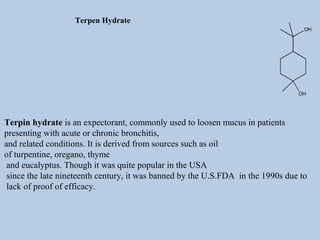
Terpen Hydrate
Terpin hydrate is an expectorant, commonly used to loosen mucus in patients
presenting with acute or chronic bronchitis,
and related conditions. It is derived from sources such as oil
of turpentine, oregano, thyme
and eucalyptus. Though it was quite popular in the USA
since the late nineteenth century, it was banned by the U.S.FDA in the 1990s due to
lack of proof of efficacy.
Ammonium Chloride I.P.
NH4Cl Mol wt 53.49
Also known as Ammonium muriate
Preparation: By neutralization rxn, evaporation to dryness. Purification by
recrystallization/ sublimation
Properties: Colourless crystals/crystalline powder, cool saline taste. Hygroscopic.
Freely soluble in water & in glycerin. Sparingly soluble in alcohol.
Assay: Weighed qty dissolved in water & HCHO solution is added. Titrated with 0.1N
NaOH using phenolphthalein as indicator
Each mi of 0.1N NaOH = 0.005349 gm of NH4Cl
Dose: 4-12 gm daily orally
Potassium Iodide I.P.
NH4Cl Mol wt 165.87
NLT 99% & NMT 100% on dried basis
KI soln NF contain 10% KI with 0.05% Na2S2O3 to reduce free I2 which
can form on storage
Assay: Iiodometry, weighed compound dissolved in water, HCl, CHCl3 added
& Titrated with 0.05M Potassium iodate, until purple/grey color of CHCl3 layer
I2 disappear
Dose: 300 mg QID orally
Emetics
Definition: Agents induce emesis/vomiting.
In low dose added in anti-cough preparations.
The use of emetics is limited to the treatment of poisoning with
certain toxins that have been swallowed.
The act of emesis is controlled by the vomiting centre in the
medulla and close to it is other visceral centres in the medulla
oblongata.
Mild emetic response can stimulate respiratory tract secretion.
It also minimise nausea caused by opiates e.g. Antimony K
tartrate
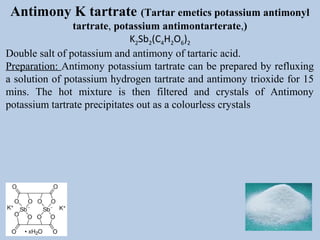
Antimony K tartrate (Tartar emetics potassium antimonyl
tartrate, potassium antimontarterate,)
K2Sb2(C4H2O6)2
Double salt of potassium and antimony of tartaric acid.
Preparation: Antimony potassium tartrate can be prepared by refluxing
a solution of potassium hydrogen tartrate and antimony trioxide for 15
mins. The hot mixture is then filtered and crystals of Antimony
potassium tartrate precipitates out as a colourless crystals
Use: Formerly used as emetics & expectorant. Now a days
used for the treatment of schistosomiasis & leishmaniasis.
Emetic action is slow onset followed by marked depression
so not used in current clinical practice.
Dose: 40 mg can be increased to 140 mg daily.
Use: Formerly used as emetics & expectorant. Now a days
used for the treatment of schistosomiasis & leishmaniasis.
Emetic action is slow onset followed by marked depression
so not used in current clinical practice.
Dose: 40 mg can be increased to 140 mg daily.

Miscllaneous inorganic Pharmaceutical agents

  • 1.
    Miscellaneous inorganic pharmaceutical agents Dr.Taj Khan Dept. of Pharmaceutical Chemistry, Oriental college of pharmacy Sanpada, New Mumbai.
  • 2.
    Expectorants Expectorants are thedrugs used orally to stimulate flow of respiratory tract secretions. By using this ciliary motion could throw mucus towards pharynx easily. Used in respiratory disorders in which secretions are purulent, viscid /excess. 2 categories: 1)Directly acting on bronchial secretory cells e.g. Terpin hydrate 2)Reflex acting (Irritate gastric mucosa & then stimulate RT secretion e.g. NH4Cl, KI, HI syrup, Iodinated glycerine
  • 3.
    Terpen Hydrate Terpin hydrateis an expectorant, commonly used to loosen mucus in patients presenting with acute or chronic bronchitis, and related conditions. It is derived from sources such as oil of turpentine, oregano, thyme and eucalyptus. Though it was quite popular in the USA since the late nineteenth century, it was banned by the U.S.FDA in the 1990s due to lack of proof of efficacy.
  • 4.
    Ammonium Chloride I.P. NH4ClMol wt 53.49 Also known as Ammonium muriate Preparation: By neutralization rxn, evaporation to dryness. Purification by recrystallization/ sublimation Properties: Colourless crystals/crystalline powder, cool saline taste. Hygroscopic. Freely soluble in water & in glycerin. Sparingly soluble in alcohol. Assay: Weighed qty dissolved in water & HCHO solution is added. Titrated with 0.1N NaOH using phenolphthalein as indicator Each mi of 0.1N NaOH = 0.005349 gm of NH4Cl Dose: 4-12 gm daily orally
  • 5.
    Potassium Iodide I.P. NH4ClMol wt 165.87 NLT 99% & NMT 100% on dried basis KI soln NF contain 10% KI with 0.05% Na2S2O3 to reduce free I2 which can form on storage Assay: Iiodometry, weighed compound dissolved in water, HCl, CHCl3 added & Titrated with 0.05M Potassium iodate, until purple/grey color of CHCl3 layer I2 disappear Dose: 300 mg QID orally
  • 7.
    Emetics Definition: Agents induceemesis/vomiting. In low dose added in anti-cough preparations. The use of emetics is limited to the treatment of poisoning with certain toxins that have been swallowed. The act of emesis is controlled by the vomiting centre in the medulla and close to it is other visceral centres in the medulla oblongata. Mild emetic response can stimulate respiratory tract secretion. It also minimise nausea caused by opiates e.g. Antimony K tartrate
  • 8.
    Antimony K tartrate(Tartar emetics potassium antimonyl tartrate, potassium antimontarterate,) K2Sb2(C4H2O6)2 Double salt of potassium and antimony of tartaric acid. Preparation: Antimony potassium tartrate can be prepared by refluxing a solution of potassium hydrogen tartrate and antimony trioxide for 15 mins. The hot mixture is then filtered and crystals of Antimony potassium tartrate precipitates out as a colourless crystals
  • 9.
    Use: Formerly usedas emetics & expectorant. Now a days used for the treatment of schistosomiasis & leishmaniasis. Emetic action is slow onset followed by marked depression so not used in current clinical practice. Dose: 40 mg can be increased to 140 mg daily.
  • 10.
    Use: Formerly usedas emetics & expectorant. Now a days used for the treatment of schistosomiasis & leishmaniasis. Emetic action is slow onset followed by marked depression so not used in current clinical practice. Dose: 40 mg can be increased to 140 mg daily.