DR. D. K. Brahma
Associate Professor
Department of Pharmacology
NEIGRIHMS, Shillong
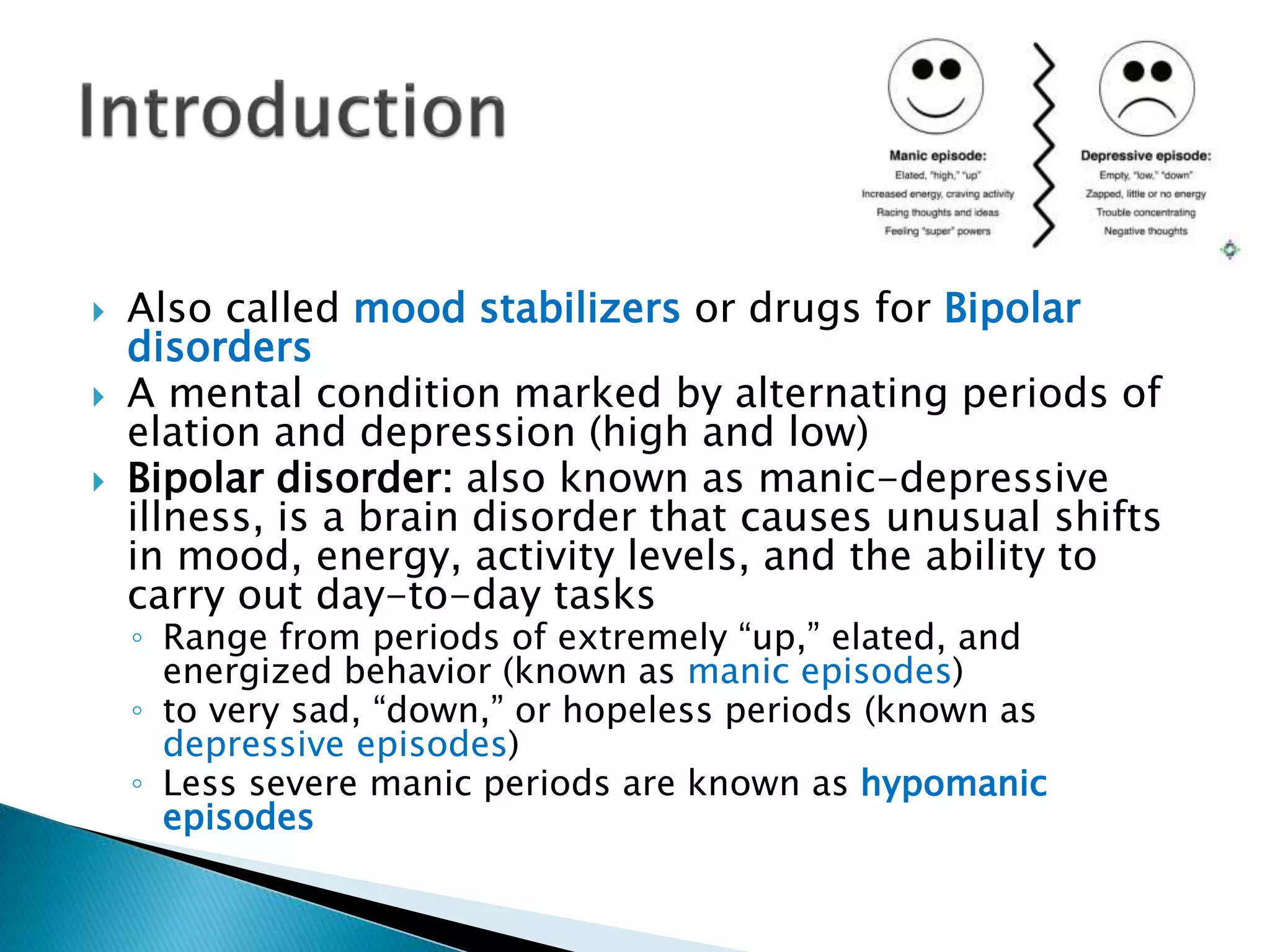
 Also called mood stabilizers or drugs for Bipolar
disorders
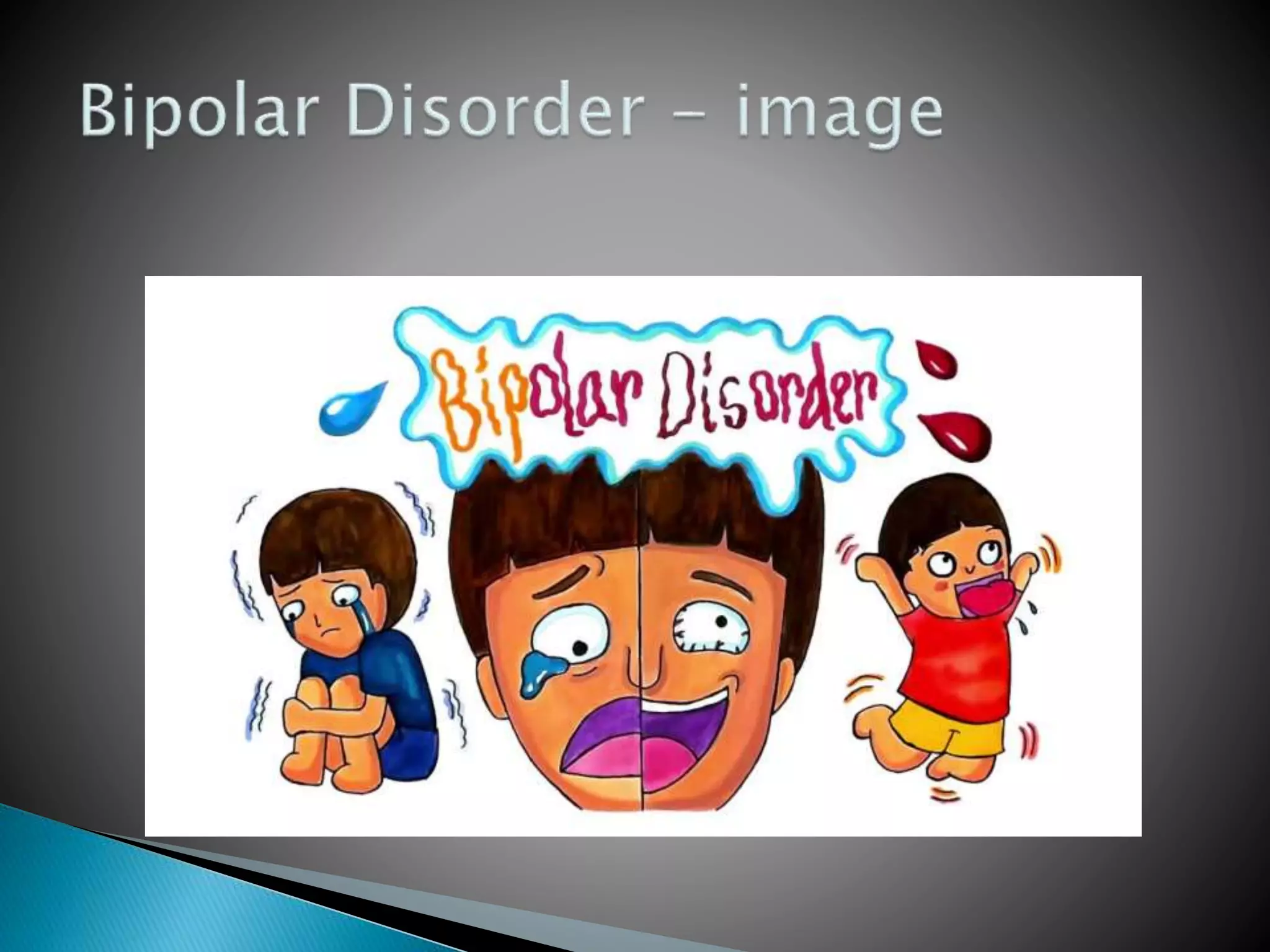
 A mental condition marked by alternating periods of
elation and depression (high and low)
 Bipolar disorder: also known as manic-depressive
illness, is a brain disorder that causes unusual shifts
in mood, energy, activity levels, and the ability to
carry out day-to-day tasks
◦ Range from periods of extremely “up,” elated, and
energized behavior (known as manic episodes)
◦ to very sad, “down,” or hopeless periods (known as
depressive episodes)
◦ Less severe manic periods are known as hypomanic
episodes
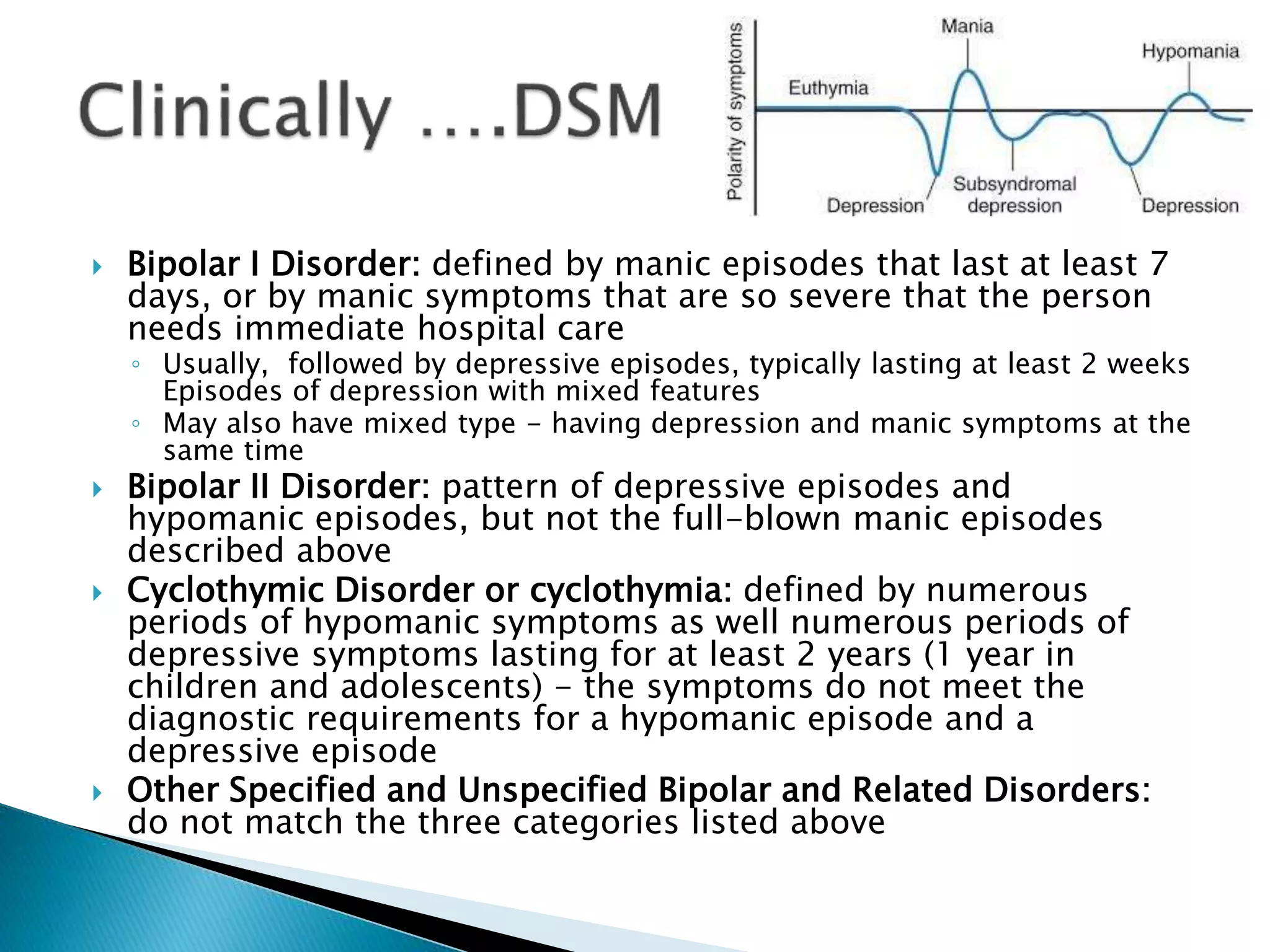
 Bipolar I Disorder: defined by manic episodes that last at least 7
days, or by manic symptoms that are so severe that the person
needs immediate hospital care
◦ Usually, followed by depressive episodes, typically lasting at least 2 weeks
Episodes of depression with mixed features
◦ May also have mixed type - having depression and manic symptoms at the
same time
 Bipolar II Disorder: pattern of depressive episodes and
hypomanic episodes, but not the full-blown manic episodes
described above
 Cyclothymic Disorder or cyclothymia: defined by numerous
periods of hypomanic symptoms as well numerous periods of
depressive symptoms lasting for at least 2 years (1 year in
children and adolescents) - the symptoms do not meet the
diagnostic requirements for a hypomanic episode and a
depressive episode
 Other Specified and Unspecified Bipolar and Related Disorders:
do not match the three categories listed above
Bipolar I Bipolar II
 high self-esteem
 little need for sleep
 increased rate of speech
(talking fast)
 flight of ideas
 getting easily distracted
 an increased interest in
goals or activities
 psychomotor agitation
(pacing, hand wringing,
etc.)
 increased pursuit of
activities with a high risk of
danger
 changes in appetite or
weight, sleep, or
psychomotor activity
 decreased energy
 feelings of worthlessness
or guilt
 trouble thinking,
concentrating, or making
decisions
 thoughts of death or
suicidal plans or
attempts
 Lithium Carbonate (Li) – sedative in animals in
1949
 Alternative Drugs:
◦ Carbamazepine
◦ Sodium Valproate
◦ Lamotrigine
◦ Topiramate
 Atypical anyipsychotics – olanzapine,
risperidone, aripiprazole, quetiapine etc
 No acute effects in bipolar and normal person
 Neither sedative nor euphorient
 But, on prolong administration – stabilizes mood in bipolar
disorder
 In acute mania – gradually suppresses episodes (1 – 2
weeks) – continued treatment prevents cycle of mood
changes
 Reduced sleep time normalized
 MOA:
1. Effects on Electrolyte and ion transport
2. Effects on Neurotransmitters
3. Effects on 2nd Messenger generation
 Li is the lightest of the alkali metal atoms
 Na+ and K+ are important in this family
 Li partly replaces Na+ and distributes evenly
in extracellular and intracellular fluids
(contrast to Na+ and K+)
 Affects ionic fluxes across brain cells or
modify property of cell membranes
 However, conc. of Li in comparison to Na+
and K+ is very low
 Li decreases the presynaptic NA and DA
release in the brain (animals) – no affect on
5-HT release
 Corrects the imbalance in the turn over of
brain mono-amine
 Li has no effects on persons without mania ???
 Li inhibits hydrolysis of inositol-1-phosphate by inositol
phosphatase
 Supply of free inositol for regeneration of Phosphatidyl inositides
(source of IP3 and DAG) reduced - IP3 and DAG are important
2nd messengers
 Hyperactive neurones involved in manic state preferentially get
affected - - supply of inositol from extracellular source is very
low
 Thus spare normally operating receptors and “search out”
selectively overactive receptors – dampen signal transduction
 Valproic acid – Li like effects in mania – inhibits conc. of inositol
in human brain by inhibiting de novo inositol synthesis
 Inhibits actions of ADH - DI like state
 Insulin like action on glucose metabolism
 Increase in Leukocyte count
 Inhibits release of thyroid hormone –
feedback stimulation of thyroid –
compensated euthyroid state
 Well absorbed orally, but slowly
 Not metabolized and not protein bound
 First extracellular – enters brain - attains uniform distribution in
total body water
 CSF conc. is half of plasma - apparent Vd – 0.8L/kg at steady
state
 Li is actively reabsorbed from proximal tubule in the kidney
similar to Na+
 When Na+ is restricted larger portion of Na+ is reabsorbed -
similar is in case of Li
 2 half-life of excretion - Initially rapid excretion, then slower in
later phase – 10-12 hours Vs 16-30 hours
 Clearance is 20% of creatinine
 Steady state is attained in 5-7 days – elderly and renal
insufficiency
 Available as 300 and 400 mg tablets
 Individual variation in the rate of excretion
 Narrow margin of safety - monitoring
 Done 5 days after the start of treatment
 Measurement is done 12 Hrs after the last dose
- steady state (0.5 to 0.8 mEq/L for maintenance)
- 0.8 to 1.1 mEq/L for acute attack
 Toxicity above 1.5 mEq/L
 Dosing is usually in divided doses 2 -3 times of a
tablet
 Excreted in sweat, saliva, breast milk etc.
 Side effects are tolerable – but toxicity ….
 Nausea, vomiting and mild diarrrhoea – low dose start
 Thirst and polyuria and mild fluid retention
 Fine tremor frequently
 CNS toxicity: in rise in plasma conc.
◦ Coarse tremor, giddiness, ataxia, motor incoordination, nystagmus,
mental confusion, slurred speech and hyper-reflexia etc. etc. – delirium,
coma
◦ Occurs mainly when plasma level is high (2 mEq/L)
◦ Acute intoxication: muscle twitching, drowsiness, delirium, coma and
convulsion, vomiting, diarrhoea, albuminuria, hypotension and cardiac
arrhythmia
◦ Symptomatic treatment – osmotic diuretics, Sodium bicarbonate and
haemodialysis – also propranolol, atenolol etc.
 Long term use – diabetes insipidus, weight gain and goiter and
hypothyroidism (supplement thyroid hormone)
 Contraindicated in pregnancy – foetal goiter and cardiac
abnormalities
 Dermatitis and acne
 Diuretics (thiazide, furosemide): Na+ loss and
promote proximal tubular reabsorption of Na+
and Li – plasma Li rise (K+ sparing diuretics)
 Tetracyclines, NSAIDS and ACEIs: Renal clearance
of Lithium is reduced
 Reduces pressor action of NA
 Enhance Insulin/Sulfonyurea induced
hypoglycaemia
 Succinylcholine and pancuronium – prolonged
paralysis
 All Neuroleptics (haloperidol), except clozapine –
increased EPS
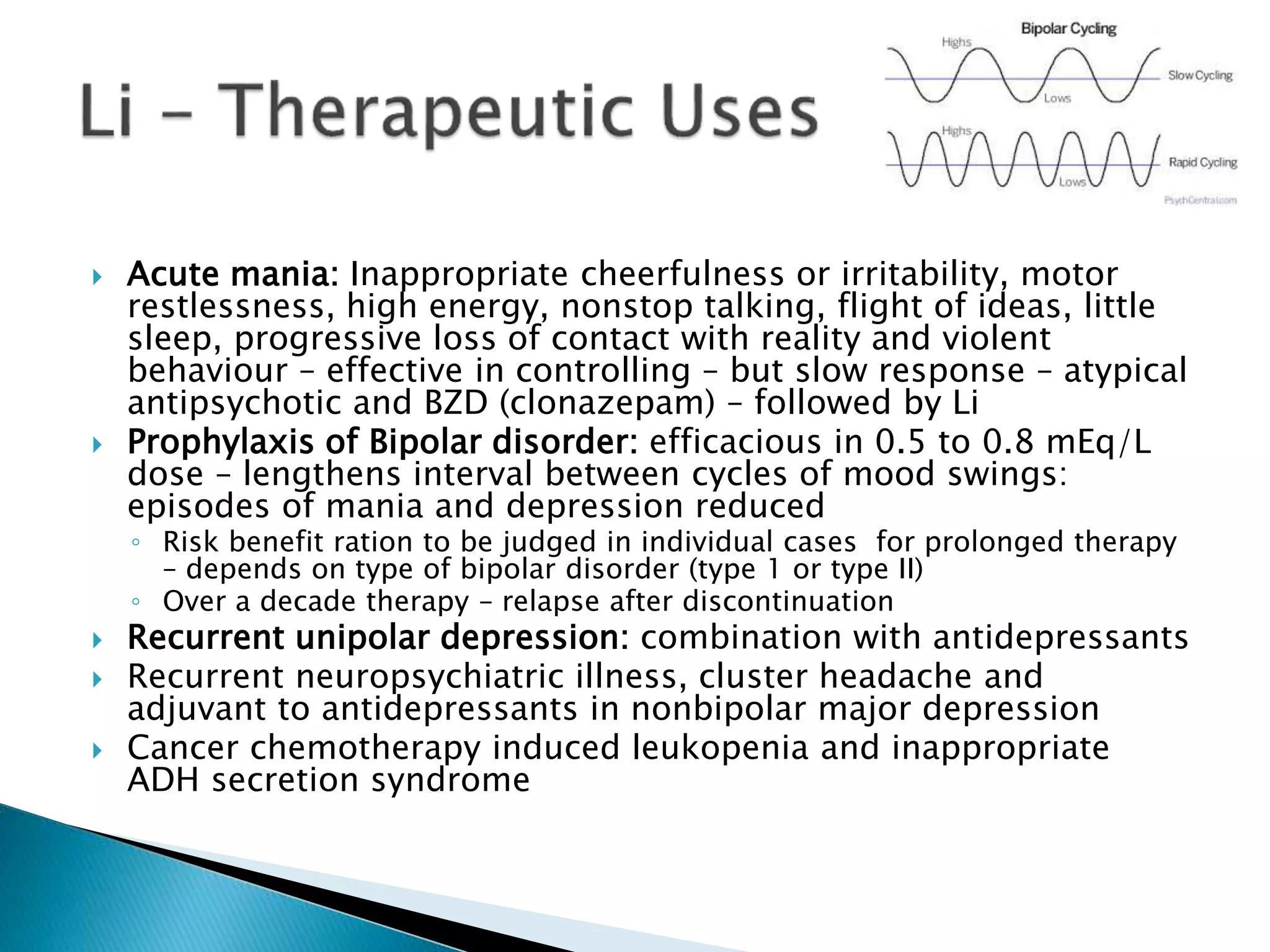
 Acute mania: Inappropriate cheerfulness or irritability, motor
restlessness, high energy, nonstop talking, flight of ideas, little
sleep, progressive loss of contact with reality and violent
behaviour – effective in controlling – but slow response – atypical
antipsychotic and BZD (clonazepam) – followed by Li
 Prophylaxis of Bipolar disorder: efficacious in 0.5 to 0.8 mEq/L
dose – lengthens interval between cycles of mood swings:
episodes of mania and depression reduced
◦ Risk benefit ration to be judged in individual cases for prolonged therapy
– depends on type of bipolar disorder (type 1 or type II)
◦ Over a decade therapy – relapse after discontinuation
 Recurrent unipolar depression: combination with antidepressants
 Recurrent neuropsychiatric illness, cluster headache and
adjuvant to antidepressants in nonbipolar major depression
 Cancer chemotherapy induced leukopenia and inappropriate
ADH secretion syndrome
 1st line in acute mania
 High dose acts faster than Li
 Alternative to antipsychotic ± BZD
 Lithium resistance cases or not tolerating cases
 Lithium + Valproate – resistance to monotherapy
 Prophylactic in bipolar disorders
 Atypical antipsychotic + Valproate - high
efficacy in acute mania
 Divalproex
 Carbamazepine: Prolong the remission of bipolar
disorder
◦ Less popular and less effective than valproate and Li
◦ Acute mania – quickly acting drug required and also high
doses – Carbamazepine limitation
◦ Long term prophylaxis and prevention of suicide –
therapeutic value not proven
◦ However, Alternative to Li
 Lamotrigine: Prophylaxis of depression in bipolar
disorder
◦ Not effective in treatment and prevention of mania
◦ Used in type 2
◦ Can be combined with Li
 Acute mania: 1st line drug now - Olanzapine,
risperidone, aripiprazole, quetiapine with or without
BZD except cases requiring urgent parenteral
administration
 Aripiprazole: fovoured drug for Bipolar type 1
maintenance as monotherapy or in combination with
Li and Valproate
◦ Prevents mania but not depressive episodes
 Olanzapine: Mainenance therapy of bipolar disorder –
both depressive and manic phase
◦ Long term therapy – weight gain and hyperglycaemia
 Combination of Valproate or Li with antipsychotic -
acute phases and maintenance therapy of bipolar
disorder
Antimanic drugs and mood stabilizing agents

Antimanic drugs and mood stabilizing agents

  • 1.
    DR. D. K.Brahma Associate Professor Department of Pharmacology NEIGRIHMS, Shillong
  • 2.
     Also calledmood stabilizers or drugs for Bipolar disorders  A mental condition marked by alternating periods of elation and depression (high and low)  Bipolar disorder: also known as manic-depressive illness, is a brain disorder that causes unusual shifts in mood, energy, activity levels, and the ability to carry out day-to-day tasks ◦ Range from periods of extremely “up,” elated, and energized behavior (known as manic episodes) ◦ to very sad, “down,” or hopeless periods (known as depressive episodes) ◦ Less severe manic periods are known as hypomanic episodes
  • 3.
     Bipolar IDisorder: defined by manic episodes that last at least 7 days, or by manic symptoms that are so severe that the person needs immediate hospital care ◦ Usually, followed by depressive episodes, typically lasting at least 2 weeks Episodes of depression with mixed features ◦ May also have mixed type - having depression and manic symptoms at the same time  Bipolar II Disorder: pattern of depressive episodes and hypomanic episodes, but not the full-blown manic episodes described above  Cyclothymic Disorder or cyclothymia: defined by numerous periods of hypomanic symptoms as well numerous periods of depressive symptoms lasting for at least 2 years (1 year in children and adolescents) - the symptoms do not meet the diagnostic requirements for a hypomanic episode and a depressive episode  Other Specified and Unspecified Bipolar and Related Disorders: do not match the three categories listed above
  • 4.
    Bipolar I BipolarII  high self-esteem  little need for sleep  increased rate of speech (talking fast)  flight of ideas  getting easily distracted  an increased interest in goals or activities  psychomotor agitation (pacing, hand wringing, etc.)  increased pursuit of activities with a high risk of danger  changes in appetite or weight, sleep, or psychomotor activity  decreased energy  feelings of worthlessness or guilt  trouble thinking, concentrating, or making decisions  thoughts of death or suicidal plans or attempts
  • 6.
     Lithium Carbonate(Li) – sedative in animals in 1949  Alternative Drugs: ◦ Carbamazepine ◦ Sodium Valproate ◦ Lamotrigine ◦ Topiramate  Atypical anyipsychotics – olanzapine, risperidone, aripiprazole, quetiapine etc
  • 7.
     No acuteeffects in bipolar and normal person  Neither sedative nor euphorient  But, on prolong administration – stabilizes mood in bipolar disorder  In acute mania – gradually suppresses episodes (1 – 2 weeks) – continued treatment prevents cycle of mood changes  Reduced sleep time normalized  MOA: 1. Effects on Electrolyte and ion transport 2. Effects on Neurotransmitters 3. Effects on 2nd Messenger generation
  • 8.
     Li isthe lightest of the alkali metal atoms  Na+ and K+ are important in this family  Li partly replaces Na+ and distributes evenly in extracellular and intracellular fluids (contrast to Na+ and K+)  Affects ionic fluxes across brain cells or modify property of cell membranes  However, conc. of Li in comparison to Na+ and K+ is very low
  • 9.
     Li decreasesthe presynaptic NA and DA release in the brain (animals) – no affect on 5-HT release  Corrects the imbalance in the turn over of brain mono-amine
  • 10.
     Li hasno effects on persons without mania ???  Li inhibits hydrolysis of inositol-1-phosphate by inositol phosphatase  Supply of free inositol for regeneration of Phosphatidyl inositides (source of IP3 and DAG) reduced - IP3 and DAG are important 2nd messengers  Hyperactive neurones involved in manic state preferentially get affected - - supply of inositol from extracellular source is very low  Thus spare normally operating receptors and “search out” selectively overactive receptors – dampen signal transduction  Valproic acid – Li like effects in mania – inhibits conc. of inositol in human brain by inhibiting de novo inositol synthesis
  • 11.
     Inhibits actionsof ADH - DI like state  Insulin like action on glucose metabolism  Increase in Leukocyte count  Inhibits release of thyroid hormone – feedback stimulation of thyroid – compensated euthyroid state
  • 12.
     Well absorbedorally, but slowly  Not metabolized and not protein bound  First extracellular – enters brain - attains uniform distribution in total body water  CSF conc. is half of plasma - apparent Vd – 0.8L/kg at steady state  Li is actively reabsorbed from proximal tubule in the kidney similar to Na+  When Na+ is restricted larger portion of Na+ is reabsorbed - similar is in case of Li  2 half-life of excretion - Initially rapid excretion, then slower in later phase – 10-12 hours Vs 16-30 hours  Clearance is 20% of creatinine  Steady state is attained in 5-7 days – elderly and renal insufficiency  Available as 300 and 400 mg tablets
  • 13.
     Individual variationin the rate of excretion  Narrow margin of safety - monitoring  Done 5 days after the start of treatment  Measurement is done 12 Hrs after the last dose - steady state (0.5 to 0.8 mEq/L for maintenance) - 0.8 to 1.1 mEq/L for acute attack  Toxicity above 1.5 mEq/L  Dosing is usually in divided doses 2 -3 times of a tablet  Excreted in sweat, saliva, breast milk etc.
  • 14.
     Side effectsare tolerable – but toxicity ….  Nausea, vomiting and mild diarrrhoea – low dose start  Thirst and polyuria and mild fluid retention  Fine tremor frequently  CNS toxicity: in rise in plasma conc. ◦ Coarse tremor, giddiness, ataxia, motor incoordination, nystagmus, mental confusion, slurred speech and hyper-reflexia etc. etc. – delirium, coma ◦ Occurs mainly when plasma level is high (2 mEq/L) ◦ Acute intoxication: muscle twitching, drowsiness, delirium, coma and convulsion, vomiting, diarrhoea, albuminuria, hypotension and cardiac arrhythmia ◦ Symptomatic treatment – osmotic diuretics, Sodium bicarbonate and haemodialysis – also propranolol, atenolol etc.  Long term use – diabetes insipidus, weight gain and goiter and hypothyroidism (supplement thyroid hormone)  Contraindicated in pregnancy – foetal goiter and cardiac abnormalities  Dermatitis and acne
  • 15.
     Diuretics (thiazide,furosemide): Na+ loss and promote proximal tubular reabsorption of Na+ and Li – plasma Li rise (K+ sparing diuretics)  Tetracyclines, NSAIDS and ACEIs: Renal clearance of Lithium is reduced  Reduces pressor action of NA  Enhance Insulin/Sulfonyurea induced hypoglycaemia  Succinylcholine and pancuronium – prolonged paralysis  All Neuroleptics (haloperidol), except clozapine – increased EPS
  • 16.
     Acute mania:Inappropriate cheerfulness or irritability, motor restlessness, high energy, nonstop talking, flight of ideas, little sleep, progressive loss of contact with reality and violent behaviour – effective in controlling – but slow response – atypical antipsychotic and BZD (clonazepam) – followed by Li  Prophylaxis of Bipolar disorder: efficacious in 0.5 to 0.8 mEq/L dose – lengthens interval between cycles of mood swings: episodes of mania and depression reduced ◦ Risk benefit ration to be judged in individual cases for prolonged therapy – depends on type of bipolar disorder (type 1 or type II) ◦ Over a decade therapy – relapse after discontinuation  Recurrent unipolar depression: combination with antidepressants  Recurrent neuropsychiatric illness, cluster headache and adjuvant to antidepressants in nonbipolar major depression  Cancer chemotherapy induced leukopenia and inappropriate ADH secretion syndrome
  • 17.
     1st linein acute mania  High dose acts faster than Li  Alternative to antipsychotic ± BZD  Lithium resistance cases or not tolerating cases  Lithium + Valproate – resistance to monotherapy  Prophylactic in bipolar disorders  Atypical antipsychotic + Valproate - high efficacy in acute mania  Divalproex
  • 18.
     Carbamazepine: Prolongthe remission of bipolar disorder ◦ Less popular and less effective than valproate and Li ◦ Acute mania – quickly acting drug required and also high doses – Carbamazepine limitation ◦ Long term prophylaxis and prevention of suicide – therapeutic value not proven ◦ However, Alternative to Li  Lamotrigine: Prophylaxis of depression in bipolar disorder ◦ Not effective in treatment and prevention of mania ◦ Used in type 2 ◦ Can be combined with Li
  • 19.
     Acute mania:1st line drug now - Olanzapine, risperidone, aripiprazole, quetiapine with or without BZD except cases requiring urgent parenteral administration  Aripiprazole: fovoured drug for Bipolar type 1 maintenance as monotherapy or in combination with Li and Valproate ◦ Prevents mania but not depressive episodes  Olanzapine: Mainenance therapy of bipolar disorder – both depressive and manic phase ◦ Long term therapy – weight gain and hyperglycaemia  Combination of Valproate or Li with antipsychotic - acute phases and maintenance therapy of bipolar disorder