Haematinics
Dr. D. K. Brahma
Associate Professor
Department of Pharmacology
NEIGRIHMS, Shillong
Background
• These are the substances required in the formation of
blood, and are used in the treatment of anaemias
• Anaemia: a condition in which there is a deficiency of
red cells or of haemoglobin in the blood, resulting in
pallor and weariness
• Balance between production and destruction of RBCs
are disturbed:
– Blood Loss (acute or chronic)
– Impaired cell formation due to
• Deficiency of essential factors – Iron, Vit. B12 and Folic acid
• Bone marrow depression (hypoplastic), erythropoietin deficiency
– Increased cell destruction (haemolytic)
IRON
Iron – Basics
• Total Body Iron content – 3.5 gm (average): Male – 50 mg/kg and Female
– 38 mg/kg
• Hemoglobin – 66% - Protoporphyrin – 4 Iron containing haeme residues
• Loss of 100 ml of blood – 50 mg elemental Iron
• To raise 1 gm/dl – 200 mg elemental Iron required
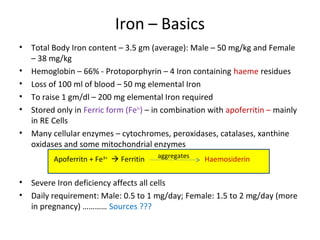
• Stored only in Ferric form (Fe3+
) – in combination with apoferritin – mainly
in RE Cells
• Many cellular enzymes – cytochromes, peroxidases, catalases, xanthine
oxidases and some mitochondrial enzymes
• Severe Iron deficiency affects all cells
• Daily requirement: Male: 0.5 to 1 mg/day; Female: 1.5 to 2 mg/day (more
in pregnancy) ………… Sources ???
Apoferritn + Fe3+
 Ferritin Haemosiderinaggregates
Iron Absorption
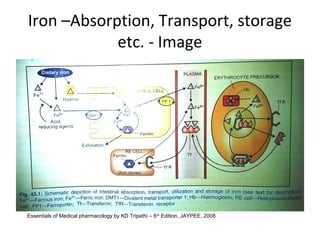
• Diet – 10 to 20 mg – absorbed from all over the Intestine (more
from upper part)
• 2 forms – haeme and Inorganic
– Haeme – minor form of dietary Iron but absorbed better without any
transporter
– Inorganic – in ferric form but absorbs lesser – converted to ferrous
form in Intestine for absorption – needs transporter
– Divalent metal transporter (DMT1) and Ferroportin (FP)
• Factors increasing absorption – acid, reducing substances – ascorbic
acid, amino acid etc. and meat
• Factors impending absorption – alkali (antacids), Phosphates,
phytates, tetracycline and presence of other food
• Mucosal block: from mucosal cell – transported to plasma or
remains stored in mucosal cell by forming ferritin - Ferritin curtain
– Balance between those two – detremines how much Iron to enter
body - by haematopoietic transcription factor
Iron – Transport, storage etc.
• In plasma immediately converted to Fe3+
form – complexed
with transferrin (Tf) – Total Plasma Iron – 3 mg - recycled
• Transported to RBCs by transferrin receptors (TfRs) –
endocytosis – Iron dissociates from TfR in acidic pH of
vesicles
• Iron utilized for Hb synthesis – TfRs return to surface
• In Iron deficiency – TfRs increase
• Storage – RE cells in Liver, spleen, bone and muscles as
ferritin and haemsiderin
• Apoferritin – determines how much Iron storage needed -
synthesis regulated by Iron status and Iron regulating
element on mRNA – blocked in low Iron – no apoferritin
synthesis – in high Iron state – more apoferritin synthesis
• Excretion – 0.5 to 1 mg/day – exfoliation in GI mecosal
cells, RBCs and in Bile …. Also in skin, urine and sweat
Iron –Absorption, Transport, storage
etc. - Image
Essentials of Medical pharmacology by KD Tripathi – 6th
Edition, JAYPEE, 2008
Iron Preparations - Oral
• Preferred route – ferrous salts – high Iron content, inexpensive,
better absorbed than ferric salts …. Gastric irritation and
constipation limits use
– Ferrous sulfate (20% hydrated salt and dried salt 32% or 65 mg)
– Ferrous gluconate (12% Iron or 28-36 mg)
– Ferrous fumerate (33% or 106 mg)
– Colloidal ferric hydroxide (50%) ……… 150 to 200 mg per day
• Other preparations: Ferrous succinate, Iron choline citrate, Iron
calcium complex, Ferric ammonium citrate, Iron hydroxy
polymaltose … low Iron content (less GI upset) and expensive
• No to Vit. B –complex combination (GOI) with Iron and Folic acid
preparations and also no to sustained release preparations
• Dosage: 200 mg daily in 3 divided doses (3 – 5 mg/kg for children)
• ADRs: Differ in susceptibility – individuals …. Epigastric pain, heart
burn, nausea, vomiting, staining of teeth, metallic taste, bloating,
colic -- CONSTIPATION
Iron Preparations - Parenteral
• Indications:
– Failure to absorb oral Iron – malabsorption, inflammatory bowel
disease (proximal small bowel)
– Post gastrectomy conditions
– Severe deficiency with chronic bleeding
– Either intolerance and non-compliance to oral Iron
– With erythropoietin
• Calculation: 4.4 X body weight (kg) X Hb deficit (g/dl)
• Not faster absorption than oral but stores replenish faster
• Preparations: Iron-dextran (colloidal solution) 50 mg/ml
Iron and Iron-sorbitol-citric acid complex and Sodium ferric
gluconate complex in sucrose
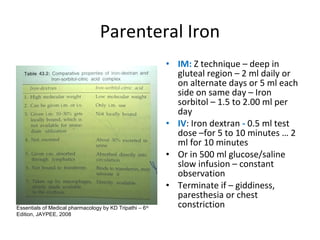
Parenteral Iron
• IM: Z technique – deep in
gluteal region – 2 ml daily or
on alternate days or 5 ml each
side on same day – Iron
sorbitol – 1.5 to 2.00 ml per
day
• IV: Iron dextran - 0.5 ml test
dose –for 5 to 10 minutes … 2
ml for 10 minutes
• Or in 500 ml glucose/saline
slow infusion – constant
observation
• Terminate if – giddiness,
paresthesia or chest
constrictionEssentials of Medical pharmacology by KD Tripathi – 6th
Edition, JAYPEE, 2008
Iron – contd.
• ADRs:
– Local: Pain in IM injection, pigmentation of skin, sterile abscess
– Systemic: Fever, headache, joint pain, flushing, palpitation, chest pain,
dyspnoea, lymph node enlargement
• Metallic taste with sorbitol
• Anaphylactoid reaction – Kidney diseases (no sorbitol)
• Uses:
– Iron deficiency anaemia: Nutritional deficiency, chronic blood loss (GIT
ulcers and hook worm)
• Oral Iron preferred : Target – 0.5 to 1 g/dl per week – 1 to 3 months therapy
plus 2 to 3 months afterwards
• Prophylaxis: Ceiling on Iron absorption - = 3 mg/day ….. Pregnancy and
infancy to be taken care of well in advance
– Megaloblastic anaemia
– As astringent: Ferric chloride
Acute Iron Poisoning
• Infants and children – 10 to 20 tablets (60 mg/kg Iron)
• Symptoms: Vomiting, abdominal pain, haematemesis, diarrhoea,
lethargy, cyanosis, dehydration, acidosis, convulsion, CVS collapse
and death (12 – 36 Hours)
– Haemorrhage and inflammation of gut, hepatic necrosis and brain
damage
• Treatment:
– Prevent further absorption: Induce vomitingor gastric lavage with
NaHCO3 – to render Iron insoluble …… and also Egg yolk and Milk orally
– Antidote: Desferrioxamine: 0.5 to 1.00 gm IM repeated 4 – 12 Hourly
or IV 10 – 15 mg/kg/Hour (max 75 mg/day) till serum levels fall
– DTPA and Calcium edetate
– Supportive: Fluid and electrolyte, correction of acidosis and Diazepam
VITAMIN – B12
Introduction
• Complex cobalt containing compounds
Cyanocobalamin and hydroxocobalamin
• Physical: Water soluble, red crystals
synthesized only by microorganisms
• Sources: Liver, Kidney, sea fish, egg yolk ….
Streptomyces geireus
• Daily Requirement: 1 – 3 mcg (Pregnancy and
Lactation3 – 5 mcg)
Vit. B12 - Metabolic functions
• Linked with folic acid metabolism – megaloblastic anaemia
indistinguishable
• Two active forms - Deoxy-adenosyl-cobalamin (DAB12) and methyl-
cobalamin (methyl-B12)
1) Vit. B12 needed for conversion of homocysteine to methionine – methionine
is methyl group donor in metabolic reactions – also critical for making THFA
available
2) Purine and pyrymidine synthesis is affected – folate trap – non availability
of thymidylate for DNA synthesis
3) Malonic acid Succinic acid - important for propionic acid
metabolism (Carbohydrate and lipid metabolism) – linked to demyelination
in Vit. B12 deficiency
4) Methionine S-adenosyl methionine – neurological
damage
5) Vit. B12 is needed for cell growth and multiplications
Vit. B12 - Kinetics
• Absorption: Present in food as protein conjugates – released
by cooking/proteolysis
– IF forms a complex with Vit. B12 – attaches to specific receptor in
mucosa – absorbed by active transport
• Transport: In combination with transcobalamin II (TCII) –
congenital absence/abnormal protein (liver disease and BM
disease) – defective supply to tissues
• Storage: In liver – 4/5th
of Body`s Vit.B12
• Degradation: Not degraded in body – excreted mainly in Bile –
enterohepatic circulation ….. absence of IF and malabsorption
Vs Nutritional deficiency
• Parenteral – completely absorbed -IM and SC administration
– excreted via urine
Deficiency - Vit. B12
• Deficiency: Addisonian pernicious anaemia (destruction of
parietal cells – IF absent), gastric mucosal damage, damaged
intestinal mucosa, consumption by abnormal flora (blind loop
syndrome & fish tape worm), nutritional deficiency, increased
demand
• Manifestations: Megaloblastic anaemia, glossitis, GI
disturbance, degeneration of spinal chord and peripheral
neuritis – diminished vibration and position sense,
paresthesia, depressed reflexes and mental changes
• Preparations: Cyanocobalamin Injection, Hydroxocobalamin
Injection and Methylcobalamin Tablets
Vit. B12 – Uses and ADRs
• Prophylactically in diabetics and alcoholics – to prevent
peripheral neuritis – 1.5 mg/day
• Treatment of deficiency states: Add Folic acid and Iron
– Very quick response – appetite increases, patient feel better, mucosal
lesions heal, neurological parameters improve
– If due to IF factor lacking – IM or SC (not IV) – necessary to by pass
defective absor scheduleption – daily-weekly-monthly
• Mega doses: in neuropathies, psychiatric disorders,
cutaneous sarcoid
• Tobacco amblyopia – cyanide to cyanocobalamin
• ADRs: Safe – allergic reactions due to contaminants
FOLIC ACID
Introduction
• Physical: Yellow crystals, insoluble in water, Pteroyl glutamic acid
(PGA) – pteridine + paraminobenzoic acids + glutamic acid
• Daily requirement: 0.2 mg per day (0.8 mg in pregnancy and
lactation)
• Kinetics:
– Absorption: As polyglutamates in food – glutamates split off and
absorbed in upper intestine ….. Reduction to DHFA and methylation
also occurs at same site
– Transport: as methyl-THFA – partly bound to plasma protein
– Store: tissues extract FA rapidly and store as polyglutamates in cells.
Liver takes up major portion – releases methyl-THFA – enterohepatic
circulation (alcohol interferes)
– Excretion: Pharmacological doses – excreted in Urine
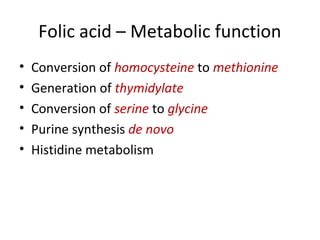
Folic acid – Metabolic function
• Conversion of homocysteine to methionine
• Generation of thymidylate
• Conversion of serine to glycine
• Purine synthesis de novo
• Histidine metabolism
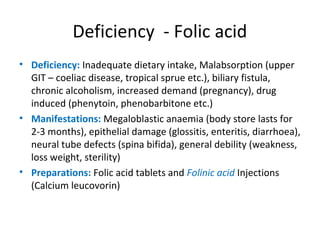
Deficiency - Folic acid
• Deficiency: Inadequate dietary intake, Malabsorption (upper
GIT – coeliac disease, tropical sprue etc.), biliary fistula,
chronic alcoholism, increased demand (pregnancy), drug
induced (phenytoin, phenobarbitone etc.)
• Manifestations: Megaloblastic anaemia (body store lasts for
2-3 months), epithelial damage (glossitis, enteritis, diarrhoea),
neural tube defects (spina bifida), general debility (weakness,
loss weight, sterility)
• Preparations: Folic acid tablets and Folinic acid Injections
(Calcium leucovorin)
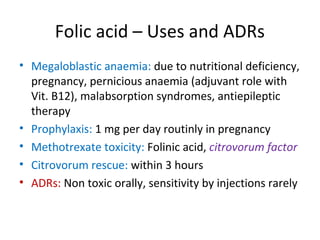
Folic acid – Uses and ADRs
• Megaloblastic anaemia: due to nutritional deficiency,
pregnancy, pernicious anaemia (adjuvant role with
Vit. B12), malabsorption syndromes, antiepileptic
therapy
• Prophylaxis: 1 mg per day routinly in pregnancy
• Methotrexate toxicity: Folinic acid, citrovorum factor
• Citrovorum rescue: within 3 hours
• ADRs: Non toxic orally, sensitivity by injections rarely
Erythropoietin (EPO)
Introduction
• Sialoglycoprotein hormone – produced by peritubular cells of Kidney
• Recombinant human erythropoietin (Epoetin α, β) – administerd IV or SC
• Half life: 6 – 10 Hours
• Required for erythropoiesis: anaemia and hypoxia sensed by kidney cells –
EPO secretes and acts on marrow:
– Stimulates proliferation of colony forming cells of erythroid series
– Induces Hb formation and erythroblast maturation
– Release of reticulocytes
• MOA: Binds to specific EPO receptor (JAK-STAT-kinase) – alters
phosphorylation of intracellular proteins and activates transcription
factors to regulate gene expression – erythropoiesis
Erythropoietin – Uses and ADRs
• Anaemia of chronic renal failure – 25 – 100 U/kg SC or IV 3
times a day – concomitant Iron therapy
• Anaemia with AIDS patients treated with zidovudine
• Cancer chemotherapy induced anaemia
• Preoperative increased blood production – autologous
transfusion
• ADRs: Nonimmunogenic, ----- ADRs occur due to increase in
haematocrit, viscosity and peripheral resistance – increased
clot formation in AV- shunts, hypertensive episodes, seizure,
flu like symptoms
Remember ….. Take home !
• Haematinics – The Perfect example of a
Teamwork
Thank you

Haematinics

  • 1.
    Haematinics Dr. D. K.Brahma Associate Professor Department of Pharmacology NEIGRIHMS, Shillong
  • 2.
    Background • These arethe substances required in the formation of blood, and are used in the treatment of anaemias • Anaemia: a condition in which there is a deficiency of red cells or of haemoglobin in the blood, resulting in pallor and weariness • Balance between production and destruction of RBCs are disturbed: – Blood Loss (acute or chronic) – Impaired cell formation due to • Deficiency of essential factors – Iron, Vit. B12 and Folic acid • Bone marrow depression (hypoplastic), erythropoietin deficiency – Increased cell destruction (haemolytic)
  • 3.
  • 4.
    Iron – Basics •Total Body Iron content – 3.5 gm (average): Male – 50 mg/kg and Female – 38 mg/kg • Hemoglobin – 66% - Protoporphyrin – 4 Iron containing haeme residues • Loss of 100 ml of blood – 50 mg elemental Iron • To raise 1 gm/dl – 200 mg elemental Iron required • Stored only in Ferric form (Fe3+ ) – in combination with apoferritin – mainly in RE Cells • Many cellular enzymes – cytochromes, peroxidases, catalases, xanthine oxidases and some mitochondrial enzymes • Severe Iron deficiency affects all cells • Daily requirement: Male: 0.5 to 1 mg/day; Female: 1.5 to 2 mg/day (more in pregnancy) ………… Sources ??? Apoferritn + Fe3+  Ferritin Haemosiderinaggregates
  • 5.
    Iron Absorption • Diet– 10 to 20 mg – absorbed from all over the Intestine (more from upper part) • 2 forms – haeme and Inorganic – Haeme – minor form of dietary Iron but absorbed better without any transporter – Inorganic – in ferric form but absorbs lesser – converted to ferrous form in Intestine for absorption – needs transporter – Divalent metal transporter (DMT1) and Ferroportin (FP) • Factors increasing absorption – acid, reducing substances – ascorbic acid, amino acid etc. and meat • Factors impending absorption – alkali (antacids), Phosphates, phytates, tetracycline and presence of other food • Mucosal block: from mucosal cell – transported to plasma or remains stored in mucosal cell by forming ferritin - Ferritin curtain – Balance between those two – detremines how much Iron to enter body - by haematopoietic transcription factor
  • 6.
    Iron – Transport,storage etc. • In plasma immediately converted to Fe3+ form – complexed with transferrin (Tf) – Total Plasma Iron – 3 mg - recycled • Transported to RBCs by transferrin receptors (TfRs) – endocytosis – Iron dissociates from TfR in acidic pH of vesicles • Iron utilized for Hb synthesis – TfRs return to surface • In Iron deficiency – TfRs increase • Storage – RE cells in Liver, spleen, bone and muscles as ferritin and haemsiderin • Apoferritin – determines how much Iron storage needed - synthesis regulated by Iron status and Iron regulating element on mRNA – blocked in low Iron – no apoferritin synthesis – in high Iron state – more apoferritin synthesis • Excretion – 0.5 to 1 mg/day – exfoliation in GI mecosal cells, RBCs and in Bile …. Also in skin, urine and sweat
  • 7.
    Iron –Absorption, Transport,storage etc. - Image Essentials of Medical pharmacology by KD Tripathi – 6th Edition, JAYPEE, 2008
  • 8.
    Iron Preparations -Oral • Preferred route – ferrous salts – high Iron content, inexpensive, better absorbed than ferric salts …. Gastric irritation and constipation limits use – Ferrous sulfate (20% hydrated salt and dried salt 32% or 65 mg) – Ferrous gluconate (12% Iron or 28-36 mg) – Ferrous fumerate (33% or 106 mg) – Colloidal ferric hydroxide (50%) ……… 150 to 200 mg per day • Other preparations: Ferrous succinate, Iron choline citrate, Iron calcium complex, Ferric ammonium citrate, Iron hydroxy polymaltose … low Iron content (less GI upset) and expensive • No to Vit. B –complex combination (GOI) with Iron and Folic acid preparations and also no to sustained release preparations • Dosage: 200 mg daily in 3 divided doses (3 – 5 mg/kg for children) • ADRs: Differ in susceptibility – individuals …. Epigastric pain, heart burn, nausea, vomiting, staining of teeth, metallic taste, bloating, colic -- CONSTIPATION
  • 9.
    Iron Preparations -Parenteral • Indications: – Failure to absorb oral Iron – malabsorption, inflammatory bowel disease (proximal small bowel) – Post gastrectomy conditions – Severe deficiency with chronic bleeding – Either intolerance and non-compliance to oral Iron – With erythropoietin • Calculation: 4.4 X body weight (kg) X Hb deficit (g/dl) • Not faster absorption than oral but stores replenish faster • Preparations: Iron-dextran (colloidal solution) 50 mg/ml Iron and Iron-sorbitol-citric acid complex and Sodium ferric gluconate complex in sucrose
  • 10.
    Parenteral Iron • IM:Z technique – deep in gluteal region – 2 ml daily or on alternate days or 5 ml each side on same day – Iron sorbitol – 1.5 to 2.00 ml per day • IV: Iron dextran - 0.5 ml test dose –for 5 to 10 minutes … 2 ml for 10 minutes • Or in 500 ml glucose/saline slow infusion – constant observation • Terminate if – giddiness, paresthesia or chest constrictionEssentials of Medical pharmacology by KD Tripathi – 6th Edition, JAYPEE, 2008
  • 11.
    Iron – contd. •ADRs: – Local: Pain in IM injection, pigmentation of skin, sterile abscess – Systemic: Fever, headache, joint pain, flushing, palpitation, chest pain, dyspnoea, lymph node enlargement • Metallic taste with sorbitol • Anaphylactoid reaction – Kidney diseases (no sorbitol) • Uses: – Iron deficiency anaemia: Nutritional deficiency, chronic blood loss (GIT ulcers and hook worm) • Oral Iron preferred : Target – 0.5 to 1 g/dl per week – 1 to 3 months therapy plus 2 to 3 months afterwards • Prophylaxis: Ceiling on Iron absorption - = 3 mg/day ….. Pregnancy and infancy to be taken care of well in advance – Megaloblastic anaemia – As astringent: Ferric chloride
  • 12.
    Acute Iron Poisoning •Infants and children – 10 to 20 tablets (60 mg/kg Iron) • Symptoms: Vomiting, abdominal pain, haematemesis, diarrhoea, lethargy, cyanosis, dehydration, acidosis, convulsion, CVS collapse and death (12 – 36 Hours) – Haemorrhage and inflammation of gut, hepatic necrosis and brain damage • Treatment: – Prevent further absorption: Induce vomitingor gastric lavage with NaHCO3 – to render Iron insoluble …… and also Egg yolk and Milk orally – Antidote: Desferrioxamine: 0.5 to 1.00 gm IM repeated 4 – 12 Hourly or IV 10 – 15 mg/kg/Hour (max 75 mg/day) till serum levels fall – DTPA and Calcium edetate – Supportive: Fluid and electrolyte, correction of acidosis and Diazepam
  • 13.
  • 14.
    Introduction • Complex cobaltcontaining compounds Cyanocobalamin and hydroxocobalamin • Physical: Water soluble, red crystals synthesized only by microorganisms • Sources: Liver, Kidney, sea fish, egg yolk …. Streptomyces geireus • Daily Requirement: 1 – 3 mcg (Pregnancy and Lactation3 – 5 mcg)
  • 15.
    Vit. B12 -Metabolic functions • Linked with folic acid metabolism – megaloblastic anaemia indistinguishable • Two active forms - Deoxy-adenosyl-cobalamin (DAB12) and methyl- cobalamin (methyl-B12) 1) Vit. B12 needed for conversion of homocysteine to methionine – methionine is methyl group donor in metabolic reactions – also critical for making THFA available 2) Purine and pyrymidine synthesis is affected – folate trap – non availability of thymidylate for DNA synthesis 3) Malonic acid Succinic acid - important for propionic acid metabolism (Carbohydrate and lipid metabolism) – linked to demyelination in Vit. B12 deficiency 4) Methionine S-adenosyl methionine – neurological damage 5) Vit. B12 is needed for cell growth and multiplications
  • 16.
    Vit. B12 -Kinetics • Absorption: Present in food as protein conjugates – released by cooking/proteolysis – IF forms a complex with Vit. B12 – attaches to specific receptor in mucosa – absorbed by active transport • Transport: In combination with transcobalamin II (TCII) – congenital absence/abnormal protein (liver disease and BM disease) – defective supply to tissues • Storage: In liver – 4/5th of Body`s Vit.B12 • Degradation: Not degraded in body – excreted mainly in Bile – enterohepatic circulation ….. absence of IF and malabsorption Vs Nutritional deficiency • Parenteral – completely absorbed -IM and SC administration – excreted via urine
  • 17.
    Deficiency - Vit.B12 • Deficiency: Addisonian pernicious anaemia (destruction of parietal cells – IF absent), gastric mucosal damage, damaged intestinal mucosa, consumption by abnormal flora (blind loop syndrome & fish tape worm), nutritional deficiency, increased demand • Manifestations: Megaloblastic anaemia, glossitis, GI disturbance, degeneration of spinal chord and peripheral neuritis – diminished vibration and position sense, paresthesia, depressed reflexes and mental changes • Preparations: Cyanocobalamin Injection, Hydroxocobalamin Injection and Methylcobalamin Tablets
  • 18.
    Vit. B12 –Uses and ADRs • Prophylactically in diabetics and alcoholics – to prevent peripheral neuritis – 1.5 mg/day • Treatment of deficiency states: Add Folic acid and Iron – Very quick response – appetite increases, patient feel better, mucosal lesions heal, neurological parameters improve – If due to IF factor lacking – IM or SC (not IV) – necessary to by pass defective absor scheduleption – daily-weekly-monthly • Mega doses: in neuropathies, psychiatric disorders, cutaneous sarcoid • Tobacco amblyopia – cyanide to cyanocobalamin • ADRs: Safe – allergic reactions due to contaminants
  • 19.
  • 20.
    Introduction • Physical: Yellowcrystals, insoluble in water, Pteroyl glutamic acid (PGA) – pteridine + paraminobenzoic acids + glutamic acid • Daily requirement: 0.2 mg per day (0.8 mg in pregnancy and lactation) • Kinetics: – Absorption: As polyglutamates in food – glutamates split off and absorbed in upper intestine ….. Reduction to DHFA and methylation also occurs at same site – Transport: as methyl-THFA – partly bound to plasma protein – Store: tissues extract FA rapidly and store as polyglutamates in cells. Liver takes up major portion – releases methyl-THFA – enterohepatic circulation (alcohol interferes) – Excretion: Pharmacological doses – excreted in Urine
  • 21.
    Folic acid –Metabolic function • Conversion of homocysteine to methionine • Generation of thymidylate • Conversion of serine to glycine • Purine synthesis de novo • Histidine metabolism
  • 22.
    Deficiency - Folicacid • Deficiency: Inadequate dietary intake, Malabsorption (upper GIT – coeliac disease, tropical sprue etc.), biliary fistula, chronic alcoholism, increased demand (pregnancy), drug induced (phenytoin, phenobarbitone etc.) • Manifestations: Megaloblastic anaemia (body store lasts for 2-3 months), epithelial damage (glossitis, enteritis, diarrhoea), neural tube defects (spina bifida), general debility (weakness, loss weight, sterility) • Preparations: Folic acid tablets and Folinic acid Injections (Calcium leucovorin)
  • 23.
    Folic acid –Uses and ADRs • Megaloblastic anaemia: due to nutritional deficiency, pregnancy, pernicious anaemia (adjuvant role with Vit. B12), malabsorption syndromes, antiepileptic therapy • Prophylaxis: 1 mg per day routinly in pregnancy • Methotrexate toxicity: Folinic acid, citrovorum factor • Citrovorum rescue: within 3 hours • ADRs: Non toxic orally, sensitivity by injections rarely
  • 24.
  • 25.
    Introduction • Sialoglycoprotein hormone– produced by peritubular cells of Kidney • Recombinant human erythropoietin (Epoetin α, β) – administerd IV or SC • Half life: 6 – 10 Hours • Required for erythropoiesis: anaemia and hypoxia sensed by kidney cells – EPO secretes and acts on marrow: – Stimulates proliferation of colony forming cells of erythroid series – Induces Hb formation and erythroblast maturation – Release of reticulocytes • MOA: Binds to specific EPO receptor (JAK-STAT-kinase) – alters phosphorylation of intracellular proteins and activates transcription factors to regulate gene expression – erythropoiesis
  • 26.
    Erythropoietin – Usesand ADRs • Anaemia of chronic renal failure – 25 – 100 U/kg SC or IV 3 times a day – concomitant Iron therapy • Anaemia with AIDS patients treated with zidovudine • Cancer chemotherapy induced anaemia • Preoperative increased blood production – autologous transfusion • ADRs: Nonimmunogenic, ----- ADRs occur due to increase in haematocrit, viscosity and peripheral resistance – increased clot formation in AV- shunts, hypertensive episodes, seizure, flu like symptoms
  • 27.
    Remember ….. Takehome ! • Haematinics – The Perfect example of a Teamwork
  • 28.