AntiemeticsAntiemetics
DefinitionsDefinitions
 NauseaNausea
• Unpleasant feeling that often precedes vomitingUnpleasant feeling that often precedes vomiting
 Emesis (vomiting)Emesis (vomiting)
• Forcible emptying of gastric, and occasionally,Forcible emptying of gastric, and occasionally,
intestinal contentsintestinal contents
 Antiemetic agentsAntiemetic agents
• Used to relieve nausea and vomitingUsed to relieve nausea and vomiting
VC and CTZVC and CTZ
 Vomiting center (VC)Vomiting center (VC)
 Chemoreceptor trigger zone (CTZ)Chemoreceptor trigger zone (CTZ)
• Both located in the brainBoth located in the brain
• Once stimulated, cause the vomiting reflexOnce stimulated, cause the vomiting reflex
Mechanism of ActionMechanism of Action
 Many different mechanisms of actionMany different mechanisms of action
 Most work by blocking one of the vomitingMost work by blocking one of the vomiting
pathways, thus blocking the stimulus thatpathways, thus blocking the stimulus that
induces vomitinginduces vomiting
Mechanism of Action and IndicationsMechanism of Action and Indications
 Anticholinergic agents (ACh blockers)Anticholinergic agents (ACh blockers)
• scopolaminescopolamine
• Also used for motion sicknessAlso used for motion sickness
Mechanism of ActionMechanism of Action
Antihistamine agents (HAntihistamine agents (H11 receptor blockers)receptor blockers)
• dimenhydrinate,dimenhydrinate, diphenhydramine, meclizine,diphenhydramine, meclizine,
promethazinepromethazine
• Also used for nonproductive cough, allergyAlso used for nonproductive cough, allergy
symptoms, sedationsymptoms, sedation
Mechanism of Action (cont'd)Mechanism of Action (cont'd)
Neuroleptic agentsNeuroleptic agents
• Block dopamine receptors on the CTZBlock dopamine receptors on the CTZ
• chlorpromazine,chlorpromazine, perphenazine, triflupromazineperphenazine, triflupromazine
• Also used for psychotic disorders, intractableAlso used for psychotic disorders, intractable
hiccupshiccups
Mechanism of Action (cont'd)Mechanism of Action (cont'd)
Prokinetic agentsProkinetic agents
• Block dopamine in the CTZBlock dopamine in the CTZ
• Cause CTZ to be desensitized to impulses itCause CTZ to be desensitized to impulses it
receives from the GI tractreceives from the GI tract
• Also stimulate peristalsis in GI tract, enhancingAlso stimulate peristalsis in GI tract, enhancing
emptying of stomach contentsemptying of stomach contents
• metoclopramidemetoclopramide, cisapride, cisapride
• Also used for GERD, delayed gastric emptyingAlso used for GERD, delayed gastric emptying
Mechanism of Action (cont'd)Mechanism of Action (cont'd)
Serotonin blockersSerotonin blockers
• Block serotonin receptors in the GI tract, CTZ, andBlock serotonin receptors in the GI tract, CTZ, and
VCVC
• dolasetron, granisetron,dolasetron, granisetron, ondansetronondansetron
• Used for N&V for patients receivingUsed for N&V for patients receiving
chemotherapy and postoperative nausea andchemotherapy and postoperative nausea and
vomitingvomiting
Mechanism of Action (cont'd)Mechanism of Action (cont'd)
TetrahydrocannabinoidsTetrahydrocannabinoids
• Major psychoactive substance in marijuanaMajor psychoactive substance in marijuana
• Inhibitory effects on reticular formation, thalamus,Inhibitory effects on reticular formation, thalamus,
cerebral cortexcerebral cortex
• Alter mood and body’s perception of itsAlter mood and body’s perception of its
surroundingssurroundings
Mechanism of Action (cont'd)Mechanism of Action (cont'd)
Tetrahydrocannabinoids (cont'd)Tetrahydrocannabinoids (cont'd)
• dronabinol (Marinol)dronabinol (Marinol)
• Used for N&V associated with chemotherapy, andUsed for N&V associated with chemotherapy, and
anorexia associated with weight loss in AIDSanorexia associated with weight loss in AIDS
patientspatients
IndicationsIndications
 Vary per class of antiemeticsVary per class of antiemetics
 General use: prevention and reduction ofGeneral use: prevention and reduction of
nausea and vomitingnausea and vomiting
Now answer this question
Which group of drugs can be used as antiemetics ?
 Serotonin 5 HT3 Antagonists
 Dopamine D2 Antagonist
 Anticholinergics
 H1 Antihistaminics
 Cannabinoids
CLASSIFICATIONCLASSIFICATION
1.1. Anti histamines (HAnti histamines (H11 antagonist)antagonist)
 CyclizineCyclizine
 MeclozineMeclozine
 DimenhydrinateDimenhydrinate
 HdroxyzineHdroxyzine
 DiphenhydramineDiphenhydramine
2.2. Anticholinergic drugsAnticholinergic drugs
 HyoscineHyoscine
3.3. Selective 5-HTSelective 5-HT33 receptor antagonist.receptor antagonist.
 OndansetronOndansetron
 GranisetronGranisetron
 TropisetronTropisetron
 DolasetronDolasetron
4.4. PhenothiazinesPhenothiazines
 ProchlorperazineProchlorperazine
 ThiethylperazineThiethylperazine
 PromethazinePromethazine
5.5. DD22 receptor Antagonistreceptor Antagonist
 MetoclopramideMetoclopramide
 Domperidone:- does not cross BBB and thus has no CNSDomperidone:- does not cross BBB and thus has no CNS
side effects.side effects.
6.6. CannabinoidsCannabinoids
 NabiloneNabilone
 DronabinolDronabinol
7.7.GlucocorticoidsGlucocorticoids
 DexamethasoneDexamethasone
 MethylprednisoloneMethylprednisolone
8.8.BenzodiazepinesBenzodiazepines
 DiazepamDiazepam
 LorazipamLorazipam
9.9.Neurokinin-1 receptor AntagonistNeurokinin-1 receptor Antagonist
 AprepitantAprepitant
 FosaprepitantFosaprepitant
Serotonin 5 HT3 Antagonist
 Potent antiemetics
 Even though 5 HT3 receptors are present in vomiting
centre & CTZ, the antiemetic action is restricted to
emesis caused by vagal stimulation.
 High first pass metabolism
 Excreted by liver & kidney
 No dose reduction in renal insufficiency but needed in
hepatic insufficiency
 Given once or twice daily – orally or intravenously.
Drugs Available
 Ondansetron 32 mg / day
 Granisetron 10 mg / kg / day
 Dolasetron 1.8 mg / kg / day
Indications
 Chemotherapy induced nausea & vomiting – given 30
min. before chemotherapy.
 Postoperative & postradiation nausea & vomiting
Adverse Effects
 Excellent safety profile
 Headache & constipation
 All three drugs cause prolongation of QT interval, but
more pronounced with dolasetron.
Dopamine D2 Antagonist
 Antagonise D2 receptors in CTZ.
 Drugs available
Metoclopramide 2.5 mg b.d
Domperidone 10 mg b.d
 Both drugs are also prokinetic agents due to their 5 HT4
agonist activity.
 Domperidone – oral ; Metoclopramide – oral & i.v
 Metoclopramide crosses BBB but domperidone cannot.
Now answer this question
Which is a better antiemetic – Metoclopramide or
Domperidone ?
 As CTZ is outside BBB both have antiemetic effects.
 But as metoclopramide crosses BBB it has adverse
effects like extrapyramidal side effects..
 Domperidone is well tolerated.
Phenothiazines & Butyrophenones
 Phenothiazines
Prochlorperazine
Promethazine
 Phenothiazines are antipsychotics with potent
antiemetic property due to D2 antagonism.
 Butyrophenone
Droperidol
 Droperidol used for postop. nausea & vomiting, but
cause QT prolongation.
H1 Antihistaminics
 Most effective drugs for motion sickness
 Drugs available
Meclizine
Cyclizine
Dimenhydrinate
Diphenydramine
Promethazine – Used in pregnancy, used by
NASA for space motion sickness
Anticholinergics
 Scopolamine (hyoscine) – used as transdermal patch
for motion sickness
Cannabinoids
 Dronabinol – used as adjuvant in chemotherapy
induced vomiting.It is a psychoactive substance
 Nabilone
Now answer this question
A physician prescribed Tab.Ondansetron for
prophylaxis of motion sickness. Even though
ondansetron is a potent antiemetic it didn’t
produce any effect in this patient. Can you
explain why ?
Explanation :
Vestibular nuclei has only muscarinic
and H1 histaminic receptors.
Points to Ponder
Even though both atropine and scopolamine are
antimuscarinic, only scopolamine is used in the
treatment of motion sickness. Why ?
Generally transdermal patches are applied over
the arm or chest. But scopolamine transdermal
patch is applied behind the ear. Why?
AreaArea Type of receptorsType of receptors StimulusStimulus
ChemoreceptorChemoreceptor
trigger zone (CTZ)trigger zone (CTZ)
a)a) Dopamine DDopamine D22
b)b) 5HT5HT33
c)c) OpioidOpioid
1)1) CancerCancer
chemotherapychemotherapy
2)2) OpioidsOpioids
Vestibular nucleiVestibular nuclei a)a) MscarinicMscarinic
b)b) Histamine HHistamine H11
1)1) Motion sicknessMotion sickness
Pharynx and GITPharynx and GIT a)a) 5HT5HT33 1)1) CancerCancer
chemotherapychemotherapy
2)2) Radio therapyRadio therapy
3)3) GastroenteritisGastroenteritis
Cerebral cortexCerebral cortex 1)1) SmellSmell
2)2) SightSight
3)3) ThoughtThought
4)4) AnticipatoryAnticipatory
emesisemesis
Serotonin 5HT3 receptorSerotonin 5HT3 receptor
antagonistsantagonists
5HT3 receptor5HT3 receptor
PhenothiazinesPhenothiazines Dopamine DDopamine D22 receptorsreceptors
AntihistaminicAntihistaminic
AnticholinergicAnticholinergic
Substituted benzamidesSubstituted benzamides Dopamine DDopamine D22 receptorsreceptors
Anticholinergic drugsAnticholinergic drugs Muscarinic receptorsMuscarinic receptors
Antihistaminic drugsAntihistaminic drugs Histamine HHistamine H11 receptorsreceptors
DiphenhydramineDiphenhydramine
dimenhydrinatedimenhydrinate
First generation H1 receptorFirst generation H1 receptor
blockers that haveblockers that have
anticholinergic and sedatinganticholinergic and sedating
propertiesproperties
MeclizineMeclizine First generation H1 receptorFirst generation H1 receptor
blockers that have lesserblockers that have lesser
anticholinergic and sedatinganticholinergic and sedating
propertiesproperties
HyoscineHyoscine Muscarinic receptor blockerMuscarinic receptor blocker
Drugs to Know AboutDrugs to Know About
 OndansetronOndansetron
 ScopolamineScopolamine
 MetoclopramideMetoclopramide
 ChlorpromazineChlorpromazine
 DiphenhydramineDiphenhydramine
 MeclizineMeclizine
 PromethazinePromethazine
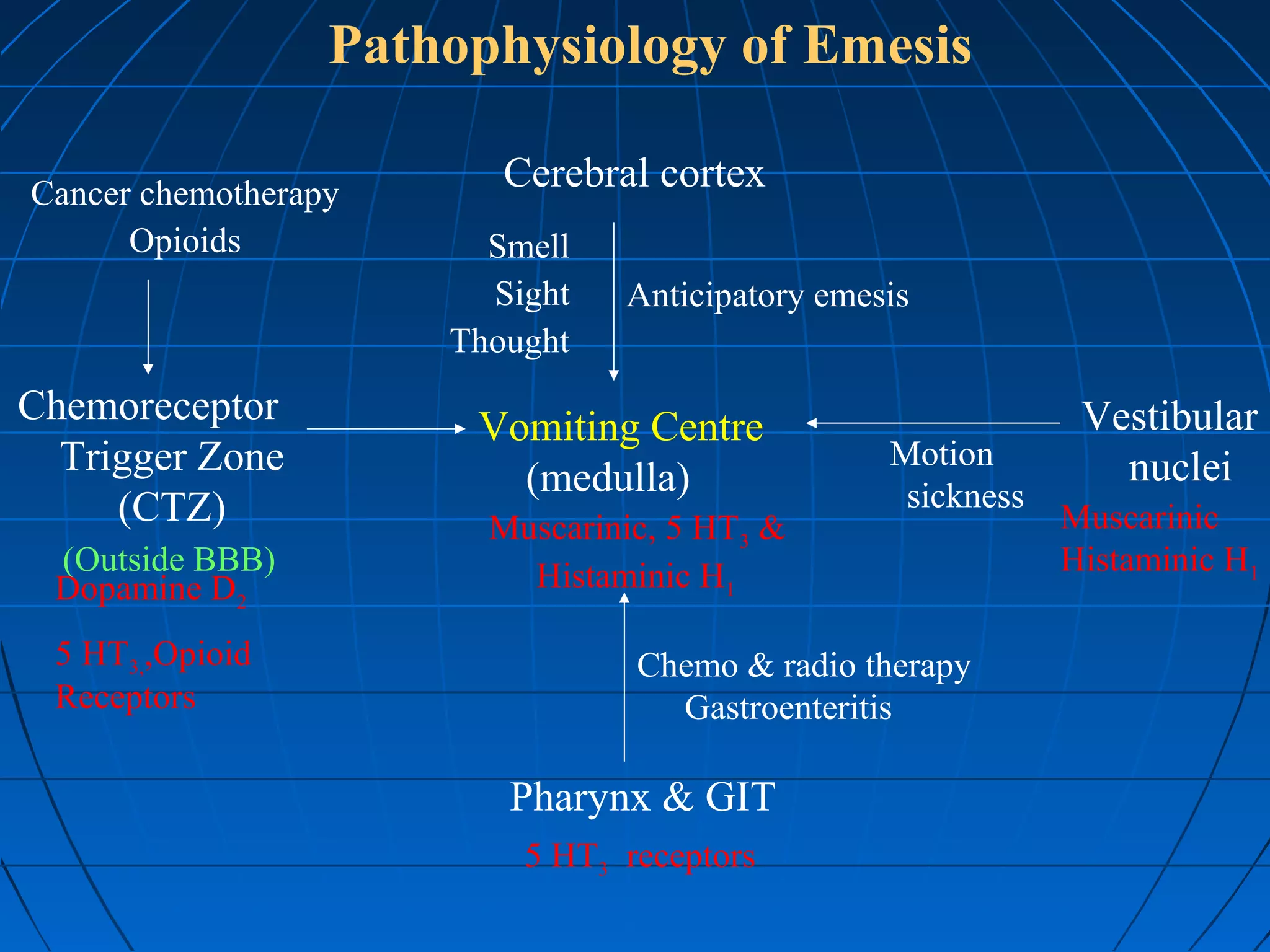
Vomiting Centre
(medulla)
Cerebral cortex
Anticipatory emesis
Smell
Sight
Thought
Vestibular
nucleiMotion
sickness
Pharynx & GIT
Chemo & radio therapy
Gastroenteritis
Chemoreceptor
Trigger Zone
(CTZ)
(Outside BBB)
Cancer chemotherapy
Opioids
Muscarinic, 5 HT3 &
Histaminic H1
5 HT3 receptors
Dopamine D2
5 HT3,,Opioid
Receptors
Muscarinic
Histaminic H1
Pathophysiology of Emesis

Antiemetics

  • 1.
  • 3.
    DefinitionsDefinitions  NauseaNausea • Unpleasantfeeling that often precedes vomitingUnpleasant feeling that often precedes vomiting  Emesis (vomiting)Emesis (vomiting) • Forcible emptying of gastric, and occasionally,Forcible emptying of gastric, and occasionally, intestinal contentsintestinal contents  Antiemetic agentsAntiemetic agents • Used to relieve nausea and vomitingUsed to relieve nausea and vomiting
  • 4.
    VC and CTZVCand CTZ  Vomiting center (VC)Vomiting center (VC)  Chemoreceptor trigger zone (CTZ)Chemoreceptor trigger zone (CTZ) • Both located in the brainBoth located in the brain • Once stimulated, cause the vomiting reflexOnce stimulated, cause the vomiting reflex
  • 5.
    Mechanism of ActionMechanismof Action  Many different mechanisms of actionMany different mechanisms of action  Most work by blocking one of the vomitingMost work by blocking one of the vomiting pathways, thus blocking the stimulus thatpathways, thus blocking the stimulus that induces vomitinginduces vomiting
  • 6.
    Mechanism of Actionand IndicationsMechanism of Action and Indications  Anticholinergic agents (ACh blockers)Anticholinergic agents (ACh blockers) • scopolaminescopolamine • Also used for motion sicknessAlso used for motion sickness
  • 7.
    Mechanism of ActionMechanismof Action Antihistamine agents (HAntihistamine agents (H11 receptor blockers)receptor blockers) • dimenhydrinate,dimenhydrinate, diphenhydramine, meclizine,diphenhydramine, meclizine, promethazinepromethazine • Also used for nonproductive cough, allergyAlso used for nonproductive cough, allergy symptoms, sedationsymptoms, sedation
  • 8.
    Mechanism of Action(cont'd)Mechanism of Action (cont'd) Neuroleptic agentsNeuroleptic agents • Block dopamine receptors on the CTZBlock dopamine receptors on the CTZ • chlorpromazine,chlorpromazine, perphenazine, triflupromazineperphenazine, triflupromazine • Also used for psychotic disorders, intractableAlso used for psychotic disorders, intractable hiccupshiccups
  • 9.
    Mechanism of Action(cont'd)Mechanism of Action (cont'd) Prokinetic agentsProkinetic agents • Block dopamine in the CTZBlock dopamine in the CTZ • Cause CTZ to be desensitized to impulses itCause CTZ to be desensitized to impulses it receives from the GI tractreceives from the GI tract • Also stimulate peristalsis in GI tract, enhancingAlso stimulate peristalsis in GI tract, enhancing emptying of stomach contentsemptying of stomach contents • metoclopramidemetoclopramide, cisapride, cisapride • Also used for GERD, delayed gastric emptyingAlso used for GERD, delayed gastric emptying
  • 10.
    Mechanism of Action(cont'd)Mechanism of Action (cont'd) Serotonin blockersSerotonin blockers • Block serotonin receptors in the GI tract, CTZ, andBlock serotonin receptors in the GI tract, CTZ, and VCVC • dolasetron, granisetron,dolasetron, granisetron, ondansetronondansetron • Used for N&V for patients receivingUsed for N&V for patients receiving chemotherapy and postoperative nausea andchemotherapy and postoperative nausea and vomitingvomiting
  • 11.
    Mechanism of Action(cont'd)Mechanism of Action (cont'd) TetrahydrocannabinoidsTetrahydrocannabinoids • Major psychoactive substance in marijuanaMajor psychoactive substance in marijuana • Inhibitory effects on reticular formation, thalamus,Inhibitory effects on reticular formation, thalamus, cerebral cortexcerebral cortex • Alter mood and body’s perception of itsAlter mood and body’s perception of its surroundingssurroundings
  • 12.
    Mechanism of Action(cont'd)Mechanism of Action (cont'd) Tetrahydrocannabinoids (cont'd)Tetrahydrocannabinoids (cont'd) • dronabinol (Marinol)dronabinol (Marinol) • Used for N&V associated with chemotherapy, andUsed for N&V associated with chemotherapy, and anorexia associated with weight loss in AIDSanorexia associated with weight loss in AIDS patientspatients
  • 13.
    IndicationsIndications  Vary perclass of antiemeticsVary per class of antiemetics  General use: prevention and reduction ofGeneral use: prevention and reduction of nausea and vomitingnausea and vomiting
  • 14.
    Now answer thisquestion Which group of drugs can be used as antiemetics ?  Serotonin 5 HT3 Antagonists  Dopamine D2 Antagonist  Anticholinergics  H1 Antihistaminics  Cannabinoids
  • 15.
    CLASSIFICATIONCLASSIFICATION 1.1. Anti histamines(HAnti histamines (H11 antagonist)antagonist)  CyclizineCyclizine  MeclozineMeclozine  DimenhydrinateDimenhydrinate  HdroxyzineHdroxyzine  DiphenhydramineDiphenhydramine 2.2. Anticholinergic drugsAnticholinergic drugs  HyoscineHyoscine 3.3. Selective 5-HTSelective 5-HT33 receptor antagonist.receptor antagonist.  OndansetronOndansetron  GranisetronGranisetron  TropisetronTropisetron  DolasetronDolasetron
  • 16.
    4.4. PhenothiazinesPhenothiazines  ProchlorperazineProchlorperazine ThiethylperazineThiethylperazine  PromethazinePromethazine 5.5. DD22 receptor Antagonistreceptor Antagonist  MetoclopramideMetoclopramide  Domperidone:- does not cross BBB and thus has no CNSDomperidone:- does not cross BBB and thus has no CNS side effects.side effects. 6.6. CannabinoidsCannabinoids  NabiloneNabilone  DronabinolDronabinol
  • 17.
    7.7.GlucocorticoidsGlucocorticoids  DexamethasoneDexamethasone  MethylprednisoloneMethylprednisolone 8.8.BenzodiazepinesBenzodiazepines DiazepamDiazepam  LorazipamLorazipam 9.9.Neurokinin-1 receptor AntagonistNeurokinin-1 receptor Antagonist  AprepitantAprepitant  FosaprepitantFosaprepitant
  • 18.
    Serotonin 5 HT3Antagonist  Potent antiemetics  Even though 5 HT3 receptors are present in vomiting centre & CTZ, the antiemetic action is restricted to emesis caused by vagal stimulation.  High first pass metabolism  Excreted by liver & kidney  No dose reduction in renal insufficiency but needed in hepatic insufficiency  Given once or twice daily – orally or intravenously.
  • 19.
    Drugs Available  Ondansetron32 mg / day  Granisetron 10 mg / kg / day  Dolasetron 1.8 mg / kg / day Indications  Chemotherapy induced nausea & vomiting – given 30 min. before chemotherapy.  Postoperative & postradiation nausea & vomiting
  • 20.
    Adverse Effects  Excellentsafety profile  Headache & constipation  All three drugs cause prolongation of QT interval, but more pronounced with dolasetron.
  • 21.
    Dopamine D2 Antagonist Antagonise D2 receptors in CTZ.  Drugs available Metoclopramide 2.5 mg b.d Domperidone 10 mg b.d  Both drugs are also prokinetic agents due to their 5 HT4 agonist activity.  Domperidone – oral ; Metoclopramide – oral & i.v  Metoclopramide crosses BBB but domperidone cannot.
  • 22.
    Now answer thisquestion Which is a better antiemetic – Metoclopramide or Domperidone ?  As CTZ is outside BBB both have antiemetic effects.  But as metoclopramide crosses BBB it has adverse effects like extrapyramidal side effects..  Domperidone is well tolerated.
  • 23.
    Phenothiazines & Butyrophenones Phenothiazines Prochlorperazine Promethazine  Phenothiazines are antipsychotics with potent antiemetic property due to D2 antagonism.  Butyrophenone Droperidol  Droperidol used for postop. nausea & vomiting, but cause QT prolongation.
  • 24.
    H1 Antihistaminics  Mosteffective drugs for motion sickness  Drugs available Meclizine Cyclizine Dimenhydrinate Diphenydramine Promethazine – Used in pregnancy, used by NASA for space motion sickness
  • 25.
    Anticholinergics  Scopolamine (hyoscine)– used as transdermal patch for motion sickness Cannabinoids  Dronabinol – used as adjuvant in chemotherapy induced vomiting.It is a psychoactive substance  Nabilone
  • 26.
    Now answer thisquestion A physician prescribed Tab.Ondansetron for prophylaxis of motion sickness. Even though ondansetron is a potent antiemetic it didn’t produce any effect in this patient. Can you explain why ?
  • 27.
    Explanation : Vestibular nucleihas only muscarinic and H1 histaminic receptors.
  • 28.
  • 29.
    Even though bothatropine and scopolamine are antimuscarinic, only scopolamine is used in the treatment of motion sickness. Why ? Generally transdermal patches are applied over the arm or chest. But scopolamine transdermal patch is applied behind the ear. Why?
  • 30.
    AreaArea Type ofreceptorsType of receptors StimulusStimulus ChemoreceptorChemoreceptor trigger zone (CTZ)trigger zone (CTZ) a)a) Dopamine DDopamine D22 b)b) 5HT5HT33 c)c) OpioidOpioid 1)1) CancerCancer chemotherapychemotherapy 2)2) OpioidsOpioids Vestibular nucleiVestibular nuclei a)a) MscarinicMscarinic b)b) Histamine HHistamine H11 1)1) Motion sicknessMotion sickness Pharynx and GITPharynx and GIT a)a) 5HT5HT33 1)1) CancerCancer chemotherapychemotherapy 2)2) Radio therapyRadio therapy 3)3) GastroenteritisGastroenteritis Cerebral cortexCerebral cortex 1)1) SmellSmell 2)2) SightSight 3)3) ThoughtThought 4)4) AnticipatoryAnticipatory emesisemesis
  • 31.
    Serotonin 5HT3 receptorSerotonin5HT3 receptor antagonistsantagonists 5HT3 receptor5HT3 receptor PhenothiazinesPhenothiazines Dopamine DDopamine D22 receptorsreceptors AntihistaminicAntihistaminic AnticholinergicAnticholinergic Substituted benzamidesSubstituted benzamides Dopamine DDopamine D22 receptorsreceptors Anticholinergic drugsAnticholinergic drugs Muscarinic receptorsMuscarinic receptors Antihistaminic drugsAntihistaminic drugs Histamine HHistamine H11 receptorsreceptors
  • 32.
    DiphenhydramineDiphenhydramine dimenhydrinatedimenhydrinate First generation H1receptorFirst generation H1 receptor blockers that haveblockers that have anticholinergic and sedatinganticholinergic and sedating propertiesproperties MeclizineMeclizine First generation H1 receptorFirst generation H1 receptor blockers that have lesserblockers that have lesser anticholinergic and sedatinganticholinergic and sedating propertiesproperties HyoscineHyoscine Muscarinic receptor blockerMuscarinic receptor blocker
  • 33.
    Drugs to KnowAboutDrugs to Know About  OndansetronOndansetron  ScopolamineScopolamine  MetoclopramideMetoclopramide  ChlorpromazineChlorpromazine  DiphenhydramineDiphenhydramine  MeclizineMeclizine  PromethazinePromethazine
  • 34.
    Vomiting Centre (medulla) Cerebral cortex Anticipatoryemesis Smell Sight Thought Vestibular nucleiMotion sickness Pharynx & GIT Chemo & radio therapy Gastroenteritis Chemoreceptor Trigger Zone (CTZ) (Outside BBB) Cancer chemotherapy Opioids Muscarinic, 5 HT3 & Histaminic H1 5 HT3 receptors Dopamine D2 5 HT3,,Opioid Receptors Muscarinic Histaminic H1 Pathophysiology of Emesis