•Vomiting or emesis is the involuntary forceful expulsion of the contents of
the stomach through mouth or sometime nose.
• Useful vomiting occurs as a protective mechanism for eliminating irritant or harmful
substances from the upper gastrointestinal tract.
• Causes:
• Gastritis, indigestion, poisoning, chemotherapy
• Brain tumors, Ionizing radiations
• Motion sickness, pregnancy
• Pathophysiology:
• Vomiting occurs due to stimulation of the vomiting centre situated in medulla
oblongata. Vomiting centre can be stimulated by:
The chemoreceptor trigger zone (lacks BBB)
The vestibular system
Cortical centres
Periphery (GIT, Pharynx)
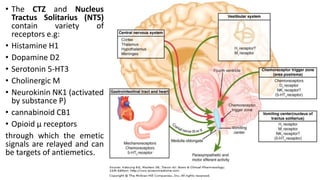
• The CTZ and Nucleus
Tractus Solitarius (NTS)
contain variety of
receptors e.g:
• Histamine H1
• Dopamine D2
• Serotonin 5-HT3
• Cholinergic M
• Neurokinin NK1 (activated
by substance P)
• cannabinoid CB1
• Opioid μ receptors
through which the emetic
signals are relayed and can
be targets of antiemetics.
Vomiting Centre
(medulla)
Anticipatory emesis
Smell
Sight
Thought
Motion
sickness
Chemo & radio therapy
Gastroenteritis
(Outside BBB)
chemotherapy
Opioids
Anesthetics
Muscarinic, 5 HT3 &
Histaminic H1
5 HT3 receptors
5 HT3
Dopamine D2
Opioid receptors
Substance P
Muscarinic
Histaminic H1
Pathophysiology of Emesis
Cerebral cortex
CTZ
Vestibular nuclei
Pharynx & GIT
Emetics
• Drugs acting on CTZ: Apomorphine
• Drugs that act reflexly & on CTZ: Ipecacaunha
• Apomorphine is a semisynthetic derivative of morphine; acts as a
dopaminergic agonist on the CTZ.
• Injected i.m./s.c.in a dose of 6 mg, it promptly (within 5 min) induces vomiting.
• Ipecacuanha: The dried root of Cephaelis ipecacuanha contains emetine and
is used as syrup ipecac (15–30 ml in adults, 10–15 ml in children, 5 ml in
infants) for inducing vomiting.
• It acts by irritating gastric mucosa as well as through CTZ.
• Indication:
• Non corrosive poisoning in conscious patients
• Contraindication:
• Corrosive (acid, alkali) poisoning: risk of perforation and further injury to
oesophageal mucosa.
• CNS stimulant drug poisoning: convulsions may be precipitated.
• Kerosene (petroleum) poisoning: chances of aspiration of the liquid (due to
low viscosity) chemical pneumonia are high.
• Unconscious patient: may aspirate the vomitus, because laryngeal reflex is
likelyto be impaired.
• Morphine or phenothiazine poisoning: emetics may fail to act.
•Antiemetics are drugs used to prevent or suppress vomiting.
• Antiemetics Classification
1. Anticholinergics: Hyoscine, Dicyclomine
2. H1 antihistamines: Promethazine, Diphenhydramine, Cyclizine, Cinnarazine
3. Neuroleptics: Chlorpromazine, Prochlorperazine, Haloperidol
4. Prokinetics: Metoclopramide, Domperidone, Cisapride, Mosapride
5. 5HT3 Antagonists: Ondansetron, Graniosetron
6. NK1 Antagonists: Aprepitant
7. Adjuvant antiemetics: Dexamethasone, Benzodiazepines, Cannabinoids
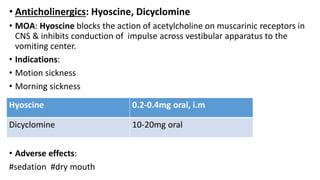
• Anticholinergics: Hyoscine, Dicyclomine
• MOA: Hyoscine blocks the action of acetylcholine on muscarinic receptors in
CNS & inhibits conduction of impulse across vestibular apparatus to the
vomiting center.
• Indications:
• Motion sickness
• Morning sickness
• Adverse effects:
#sedation #dry mouth
Hyoscine 0.2-0.4mg oral, i.m
Dicyclomine 10-20mg oral
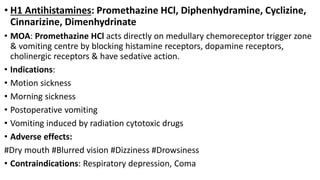
• H1 Antihistamines: Promethazine HCl, Diphenhydramine, Cyclizine,
Cinnarizine, Dimenhydrinate
• MOA: Promethazine HCl acts directly on medullary chemoreceptor trigger zone
& vomiting centre by blocking histamine receptors, dopamine receptors,
cholinergic receptors & have sedative action.
• Indications:
• Motion sickness
• Morning sickness
• Postoperative vomiting
• Vomiting induced by radiation cytotoxic drugs
• Adverse effects:
#Dry mouth #Blurred vision #Dizziness #Drowsiness
• Contraindications: Respiratory depression, Coma
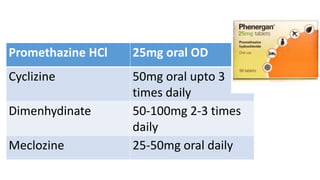
Promethazine HCl 25mg oral OD
Cyclizine 50mg oral upto 3
times daily
Dimenhydinate 50-100mg 2-3 times
daily
Meclozine 25-50mg oral daily
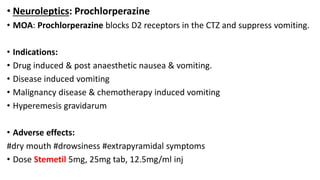
• Neuroleptics: Prochlorperazine
• MOA: Prochlorperazine blocks D2 receptors in the CTZ and suppress vomiting.
• Indications:
• Drug induced & post anaesthetic nausea & vomiting.
• Disease induced vomiting
• Malignancy disease & chemotherapy induced vomiting
• Hyperemesis gravidarum
• Adverse effects:
#dry mouth #drowsiness #extrapyramidal symptoms
• Dose Stemetil 5mg, 25mg tab, 12.5mg/ml inj
• Prokinetics: Metoclopramide, Domperidone, Cisapride, Mosapride
• These drugs promote gastrointestinal transit, increases peristalsis & speed gastric
emptying.
•Metoclopramide
• MOA: acts centrally by blocking D2 receptors in CTZ, and peripherally by enhancing the
action of acetylcholine at muscarinic nerve endings in the gut. It raises tone of lower
esophageal sphincter, relaxes pyloric antrum and duodenal cap, and increases
peristalsis and emptying of the upper gut.
D2 antagonism
5HT4 agonism
5HT3 antagonism
• Indications:
• Postoperative vomiting, drug induced vomiting, disease induced vomiting, radiation &
chemotherapy induced vomiting
• Accelerate gastric emptying
• Dyspepsia
• Gastroesophageal reflux disease (GERD)
• Dose 10mg TDS oral or IM
• Adverse effects:
• Sedation, Diarrhoea, Dizziness
• Pakinsonism, Galactorrhoea, Gynaecomastia
• Contraindications:
• History of seizures
• Patients with extrapyramidal symptoms
•Domperidone
• MOA: D2 antagonist pharmacologically related to metoclopramide. It blocks D2
receptor in the CTZ, increases tone of lower esophageal sphincter, enhances
contractions of gastric antrum & relaxes pyloric sphincter.
• Indications:
• Nausea & vomiting associated with gastrointestinal disorders.
• Chemotherapy induced vomiting
• Adverse effects:
• Loose stools, headache, gynaecomastia, galactorrhoea, rashes, dry mouth
•5HT3 Antagonists: Ondansetron, Graniosetron
• MOA: Ondansetron is a selective 5HT3-receptor antagonist. It blocks the
depolarizing action of 5HT3 (Serotonin) through 5HT3 receptor on vagal
afferents in the GIT & in the brain (CTZ)
• Indications:
• 1st choice in Chemotherapy induced nausea & vomiting (CINV)
• Radiation induced vomiting
• Postoperative nausea & vomiting
• Adverse effects
#headache #abdominal discomfort # allergic reactions #constipation or diarrhea
#rashes
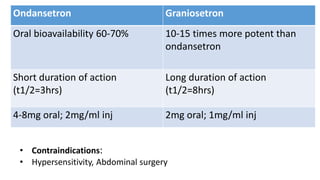
Ondansetron Graniosetron
Oral bioavailability 60-70% 10-15 times more potent than
ondansetron
Short duration of action
(t1/2=3hrs)
Long duration of action
(t1/2=8hrs)
4-8mg oral; 2mg/ml inj 2mg oral; 1mg/ml inj
• Contraindications:
• Hypersensitivity, Abdominal surgery
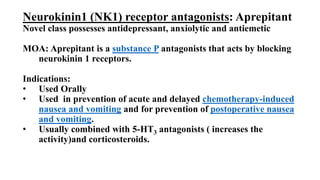
Neurokinin1 (NK1) receptor antagonists: Aprepitant
Novel class possesses antidepressant, anxiolytic and antiemetic
MOA: Aprepitant is a substance P antagonists that acts by blocking
neurokinin 1 receptors.
Indications:
• Used Orally
• Used in prevention of acute and delayed chemotherapy-induced
nausea and vomiting and for prevention of postoperative nausea
and vomiting.
• Usually combined with 5-HT3 antagonists ( increases the
activity)and corticosteroids.
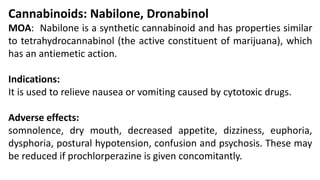
Cannabinoids: Nabilone, Dronabinol
MOA: Nabilone is a synthetic cannabinoid and has properties similar
to tetrahydrocannabinol (the active constituent of marijuana), which
has an antiemetic action.
Indications:
It is used to relieve nausea or vomiting caused by cytotoxic drugs.
Adverse effects:
somnolence, dry mouth, decreased appetite, dizziness, euphoria,
dysphoria, postural hypotension, confusion and psychosis. These may
be reduced if prochlorperazine is given concomitantly.
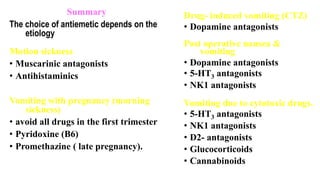
Summary
The choice of antiemetic depends on the
etiology
Motion sickness
• Muscarinic antagonists
• Antihistaminics
Vomiting with pregnancy (morning
sickness)
• avoid all drugs in the first trimester
• Pyridoxine (B6)
• Promethazine ( late pregnancy).
Drug- induced vomiting (CTZ)
• Dopamine antagonists
Post operative nausea &
vomiting
• Dopamine antagonists
• 5-HT3 antagonists
• NK1 antagonists
Vomiting due to cytotoxic drugs.
• 5-HT3 antagonists
• NK1 antagonists
• D2- antagonists
• Glucocorticoids
• Cannabinoids

Antiemetics, emetics

  • 1.
    •Vomiting or emesisis the involuntary forceful expulsion of the contents of the stomach through mouth or sometime nose. • Useful vomiting occurs as a protective mechanism for eliminating irritant or harmful substances from the upper gastrointestinal tract. • Causes: • Gastritis, indigestion, poisoning, chemotherapy • Brain tumors, Ionizing radiations • Motion sickness, pregnancy • Pathophysiology: • Vomiting occurs due to stimulation of the vomiting centre situated in medulla oblongata. Vomiting centre can be stimulated by: The chemoreceptor trigger zone (lacks BBB) The vestibular system Cortical centres Periphery (GIT, Pharynx)
  • 2.
    • The CTZand Nucleus Tractus Solitarius (NTS) contain variety of receptors e.g: • Histamine H1 • Dopamine D2 • Serotonin 5-HT3 • Cholinergic M • Neurokinin NK1 (activated by substance P) • cannabinoid CB1 • Opioid μ receptors through which the emetic signals are relayed and can be targets of antiemetics.
  • 3.
    Vomiting Centre (medulla) Anticipatory emesis Smell Sight Thought Motion sickness Chemo& radio therapy Gastroenteritis (Outside BBB) chemotherapy Opioids Anesthetics Muscarinic, 5 HT3 & Histaminic H1 5 HT3 receptors 5 HT3 Dopamine D2 Opioid receptors Substance P Muscarinic Histaminic H1 Pathophysiology of Emesis Cerebral cortex CTZ Vestibular nuclei Pharynx & GIT
  • 4.
    Emetics • Drugs actingon CTZ: Apomorphine • Drugs that act reflexly & on CTZ: Ipecacaunha • Apomorphine is a semisynthetic derivative of morphine; acts as a dopaminergic agonist on the CTZ. • Injected i.m./s.c.in a dose of 6 mg, it promptly (within 5 min) induces vomiting. • Ipecacuanha: The dried root of Cephaelis ipecacuanha contains emetine and is used as syrup ipecac (15–30 ml in adults, 10–15 ml in children, 5 ml in infants) for inducing vomiting. • It acts by irritating gastric mucosa as well as through CTZ.
  • 5.
    • Indication: • Noncorrosive poisoning in conscious patients • Contraindication: • Corrosive (acid, alkali) poisoning: risk of perforation and further injury to oesophageal mucosa. • CNS stimulant drug poisoning: convulsions may be precipitated. • Kerosene (petroleum) poisoning: chances of aspiration of the liquid (due to low viscosity) chemical pneumonia are high. • Unconscious patient: may aspirate the vomitus, because laryngeal reflex is likelyto be impaired. • Morphine or phenothiazine poisoning: emetics may fail to act.
  • 6.
    •Antiemetics are drugsused to prevent or suppress vomiting. • Antiemetics Classification 1. Anticholinergics: Hyoscine, Dicyclomine 2. H1 antihistamines: Promethazine, Diphenhydramine, Cyclizine, Cinnarazine 3. Neuroleptics: Chlorpromazine, Prochlorperazine, Haloperidol 4. Prokinetics: Metoclopramide, Domperidone, Cisapride, Mosapride 5. 5HT3 Antagonists: Ondansetron, Graniosetron 6. NK1 Antagonists: Aprepitant 7. Adjuvant antiemetics: Dexamethasone, Benzodiazepines, Cannabinoids
  • 7.
    • Anticholinergics: Hyoscine,Dicyclomine • MOA: Hyoscine blocks the action of acetylcholine on muscarinic receptors in CNS & inhibits conduction of impulse across vestibular apparatus to the vomiting center. • Indications: • Motion sickness • Morning sickness • Adverse effects: #sedation #dry mouth Hyoscine 0.2-0.4mg oral, i.m Dicyclomine 10-20mg oral
  • 8.
    • H1 Antihistamines:Promethazine HCl, Diphenhydramine, Cyclizine, Cinnarizine, Dimenhydrinate • MOA: Promethazine HCl acts directly on medullary chemoreceptor trigger zone & vomiting centre by blocking histamine receptors, dopamine receptors, cholinergic receptors & have sedative action. • Indications: • Motion sickness • Morning sickness • Postoperative vomiting • Vomiting induced by radiation cytotoxic drugs • Adverse effects: #Dry mouth #Blurred vision #Dizziness #Drowsiness • Contraindications: Respiratory depression, Coma
  • 9.
    Promethazine HCl 25mgoral OD Cyclizine 50mg oral upto 3 times daily Dimenhydinate 50-100mg 2-3 times daily Meclozine 25-50mg oral daily
  • 10.
    • Neuroleptics: Prochlorperazine •MOA: Prochlorperazine blocks D2 receptors in the CTZ and suppress vomiting. • Indications: • Drug induced & post anaesthetic nausea & vomiting. • Disease induced vomiting • Malignancy disease & chemotherapy induced vomiting • Hyperemesis gravidarum • Adverse effects: #dry mouth #drowsiness #extrapyramidal symptoms • Dose Stemetil 5mg, 25mg tab, 12.5mg/ml inj
  • 11.
    • Prokinetics: Metoclopramide,Domperidone, Cisapride, Mosapride • These drugs promote gastrointestinal transit, increases peristalsis & speed gastric emptying. •Metoclopramide • MOA: acts centrally by blocking D2 receptors in CTZ, and peripherally by enhancing the action of acetylcholine at muscarinic nerve endings in the gut. It raises tone of lower esophageal sphincter, relaxes pyloric antrum and duodenal cap, and increases peristalsis and emptying of the upper gut. D2 antagonism 5HT4 agonism 5HT3 antagonism • Indications: • Postoperative vomiting, drug induced vomiting, disease induced vomiting, radiation & chemotherapy induced vomiting • Accelerate gastric emptying • Dyspepsia • Gastroesophageal reflux disease (GERD)
  • 12.
    • Dose 10mgTDS oral or IM • Adverse effects: • Sedation, Diarrhoea, Dizziness • Pakinsonism, Galactorrhoea, Gynaecomastia • Contraindications: • History of seizures • Patients with extrapyramidal symptoms
  • 13.
    •Domperidone • MOA: D2antagonist pharmacologically related to metoclopramide. It blocks D2 receptor in the CTZ, increases tone of lower esophageal sphincter, enhances contractions of gastric antrum & relaxes pyloric sphincter. • Indications: • Nausea & vomiting associated with gastrointestinal disorders. • Chemotherapy induced vomiting • Adverse effects: • Loose stools, headache, gynaecomastia, galactorrhoea, rashes, dry mouth
  • 14.
    •5HT3 Antagonists: Ondansetron,Graniosetron • MOA: Ondansetron is a selective 5HT3-receptor antagonist. It blocks the depolarizing action of 5HT3 (Serotonin) through 5HT3 receptor on vagal afferents in the GIT & in the brain (CTZ) • Indications: • 1st choice in Chemotherapy induced nausea & vomiting (CINV) • Radiation induced vomiting • Postoperative nausea & vomiting • Adverse effects #headache #abdominal discomfort # allergic reactions #constipation or diarrhea #rashes
  • 15.
    Ondansetron Graniosetron Oral bioavailability60-70% 10-15 times more potent than ondansetron Short duration of action (t1/2=3hrs) Long duration of action (t1/2=8hrs) 4-8mg oral; 2mg/ml inj 2mg oral; 1mg/ml inj • Contraindications: • Hypersensitivity, Abdominal surgery
  • 16.
    Neurokinin1 (NK1) receptorantagonists: Aprepitant Novel class possesses antidepressant, anxiolytic and antiemetic MOA: Aprepitant is a substance P antagonists that acts by blocking neurokinin 1 receptors. Indications: • Used Orally • Used in prevention of acute and delayed chemotherapy-induced nausea and vomiting and for prevention of postoperative nausea and vomiting. • Usually combined with 5-HT3 antagonists ( increases the activity)and corticosteroids.
  • 17.
    Cannabinoids: Nabilone, Dronabinol MOA:Nabilone is a synthetic cannabinoid and has properties similar to tetrahydrocannabinol (the active constituent of marijuana), which has an antiemetic action. Indications: It is used to relieve nausea or vomiting caused by cytotoxic drugs. Adverse effects: somnolence, dry mouth, decreased appetite, dizziness, euphoria, dysphoria, postural hypotension, confusion and psychosis. These may be reduced if prochlorperazine is given concomitantly.
  • 18.
    Summary The choice ofantiemetic depends on the etiology Motion sickness • Muscarinic antagonists • Antihistaminics Vomiting with pregnancy (morning sickness) • avoid all drugs in the first trimester • Pyridoxine (B6) • Promethazine ( late pregnancy). Drug- induced vomiting (CTZ) • Dopamine antagonists Post operative nausea & vomiting • Dopamine antagonists • 5-HT3 antagonists • NK1 antagonists Vomiting due to cytotoxic drugs. • 5-HT3 antagonists • NK1 antagonists • D2- antagonists • Glucocorticoids • Cannabinoids