Drugs used in
constipation &
diarrhoea
By: Ms. Shipra Omar
 Constipation is a condition in which one may have
 Fewer than three bowel movements a week
 Stools that are hard, dry, or lumpy
 Stools that are difficult or painful to pass
 A feeling that not all stool has passed.
Constipation
 Unsatisfactory defecation, characterized by
infrequent stools and/or difficult stool passage.
 Patients may define constipation as passing hard
stools or straining, incomplete or painful defecation.
 Constipation is a symptom, NOT a disease.
 Constipation has many causes and may be a sign
of undiagnosed disease
Types of Constipation:
1. Primary Constipation: Slow colonic transit
time, Pelvic floor/anal sphincter dysfunction
• Secondary Constipation: Endocrine
dysfunction (DM, hypothyroid), Metabolic disorder
(↑ Ca,↓ K), Mechanical (obstruction, rectocele),
Pregnancy, Neurologic disorders (spinal cord
injuries)
Risk Factors
• ↓ fiber :(most common)
• ↓ liquid: ( 8 glasses/day is needed for constipated)
• ↓ Exercise : bedridden, coma
• Ignoring urge to defecate
• Disease: Hypothyroidism, DM, hypercalcemia,
Hypokalemia Stroke, Parkinsonism,
• Pregnancy
• Medication therapy: Opioid, Aluminum hydroxide,
Anti- hypertensives, Muscle Relaxants
• Obesity
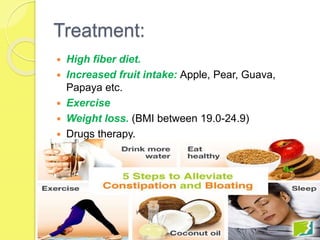
Treatment:
 High fiber diet.
 Increased fruit intake: Apple, Pear, Guava,
Papaya etc.
 Exercise
 Weight loss. (BMI between 19.0-24.9)
 Drugs therapy.
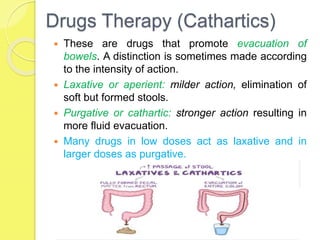
Drugs Therapy (Cathartics)
 These are drugs that promote evacuation of
bowels. A distinction is sometimes made according
to the intensity of action.
 Laxative or aperient: milder action, elimination of
soft but formed stools.
 Purgative or cathartic: stronger action resulting in
more fluid evacuation.
 Many drugs in low doses act as laxative and in
larger doses as purgative.
Classification of Drugs:
Bulk forming: Dietary fibre: Bran, Psyllium ,
Ispaghula, Methylcellulose
Stool softener: Docusates (DOSS), Liquid
paraffin
Stimulant purgatives:
 Diphenylmethanes: Phenolphthalein, Bisacodyl
 Anthraquinones (Emodins): Senna, Cascara
sagrada
 5-HT4 agonist: Prucalopride
 Fixed oil: Castor oil
Osmotic purgatives:
 Magnesium salts: Sulfate, hydroxide
 Sodium salts: sulfate, phosphate, Lactulose
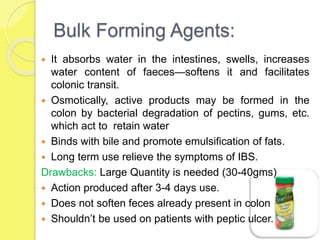
Bulk Forming Agents:
 It absorbs water in the intestines, swells, increases
water content of faeces—softens it and facilitates
colonic transit.
 Osmotically, active products may be formed in the
colon by bacterial degradation of pectins, gums, etc.
which act to retain water
 Binds with bile and promote emulsification of fats.
 Long term use relieve the symptoms of IBS.
Drawbacks: Large Quantity is needed (30-40gms)
 Action produced after 3-4 days use.
 Does not soften feces already present in colon
 Shouldn’t be used on patients with peptic ulcer.
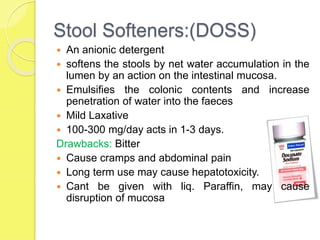
Stool Softeners:(DOSS)
 An anionic detergent
 softens the stools by net water accumulation in the
lumen by an action on the intestinal mucosa.
 Emulsifies the colonic contents and increase
penetration of water into the faeces
 Mild Laxative
 100-300 mg/day acts in 1-3 days.
Drawbacks: Bitter
 Cause cramps and abdominal pain
 Long term use may cause hepatotoxicity.
 Cant be given with liq. Paraffin, may cause
disruption of mucosa
Stool Softeners:(Liquid
Paraffin)
 Viscous liquid
 Mixture of petroleum hydrocarbons
 Taken for 2–3 days, it softens stools and is
lubricates hard scybali by coating them.
 Dose: 15–30 ml/day—oil as such or in emulsified
form.
Drawbacks: very unpleasant to swallow
 While swallowing it may trickle into lungs—cause
lipid pneumonia.
 Carries away fat soluble vitamins with it into the
stools:
Stimulant Purgatives:
 Bisacodyl (5- 15mg), PTHP ( 60-130 mg)
 Powerful
 May produce griping
 Act by accumulation of water and electrolytes in the
lumen by altering absorptive and secretory activity
of the mucosal cell.
 Enhance NO release into the colon
 Larger doses of stimulant purgatives can cause
excess purgation resulting in fluid and electrolyte
imbalance.
 Hypokalaemia can occur on regular intake.
 contraindicated during pregnancy.
Osmotic Cathartics:
 Solutes that are not absorbed in the intestine retain
water osmotically and distend the bowel—
increasing peristalsis indirectly.
 Magnesium ions release cholecystokinin which
augments motility and secretion, contributing to
purgative action.
 Saline purgatives are not used now for the
treatment of constipation because they are
inconvenient/ unpleasant, produce watery stools
and after constipation.
 Should be taken along 150-200ml water
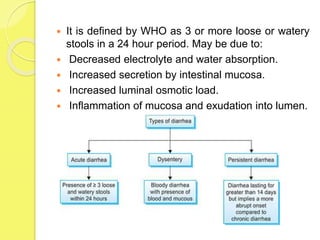
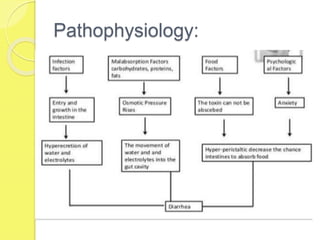
 It is defined by WHO as 3 or more loose or watery
stools in a 24 hour period. May be due to:
 Decreased electrolyte and water absorption.
 Increased secretion by intestinal mucosa.
 Increased luminal osmotic load.
 Inflammation of mucosa and exudation into lumen.
Pathophysiology:
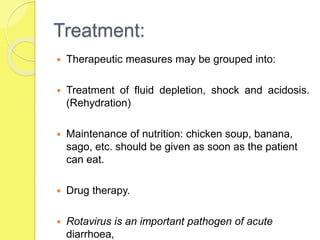
Treatment:
 Therapeutic measures may be grouped into:
 Treatment of fluid depletion, shock and acidosis.
(Rehydration)
 Maintenance of nutrition: chicken soup, banana,
sago, etc. should be given as soon as the patient
can eat.
 Drug therapy.
 Rotavirus is an important pathogen of acute
diarrhoea,
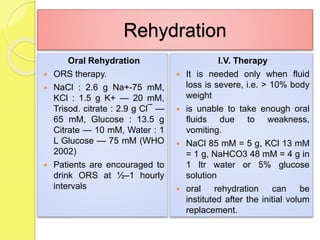
Rehydration
Oral Rehydration
 ORS therapy.
 NaCl : 2.6 g Na+-75 mM,
KCl : 1.5 g K+ — 20 mM,
Trisod. citrate : 2.9 g Cl¯ —
65 mM, Glucose : 13.5 g
Citrate — 10 mM, Water : 1
L Glucose — 75 mM (WHO
2002)
 Patients are encouraged to
drink ORS at ½–1 hourly
intervals
I.V. Therapy
 It is needed only when fluid
loss is severe, i.e. > 10% body
weight
 is unable to take enough oral
fluids due to weakness,
vomiting.
 NaCl 85 mM = 5 g, KCl 13 mM
= 1 g, NaHCO3 48 mM = 4 g in
1 ltr water or 5% glucose
solution
 oral rehydration can be
instituted after the initial volum
replacement.
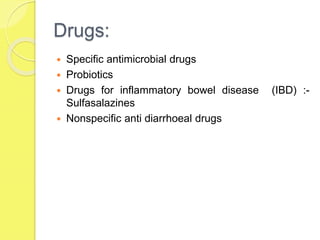
Drugs:
 Specific antimicrobial drugs
 Probiotics
 Drugs for inflammatory bowel disease (IBD) :-
Sulfasalazines
 Nonspecific anti diarrhoeal drugs
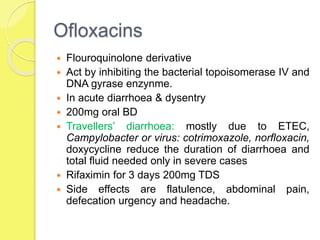
Ofloxacins
 Flouroquinolone derivative
 Act by inhibiting the bacterial topoisomerase IV and
DNA gyrase enzynme.
 In acute diarrhoea & dysentry
 200mg oral BD
 Travellers’ diarrhoea: mostly due to ETEC,
Campylobacter or virus: cotrimoxazole, norfloxacin,
doxycycline reduce the duration of diarrhoea and
total fluid needed only in severe cases
 Rifaximin for 3 days 200mg TDS
 Side effects are flatulence, abdominal pain,
defecation urgency and headache.
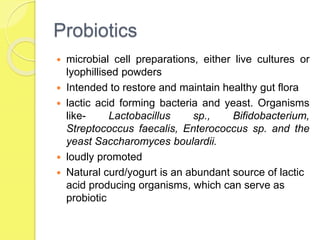
Probiotics
 microbial cell preparations, either live cultures or
lyophillised powders
 Intended to restore and maintain healthy gut flora
 lactic acid forming bacteria and yeast. Organisms
like- Lactobacillus sp., Bifidobacterium,
Streptococcus faecalis, Enterococcus sp. and the
yeast Saccharomyces boulardii.
 loudly promoted
 Natural curd/yogurt is an abundant source of lactic
acid producing organisms, which can serve as
probiotic
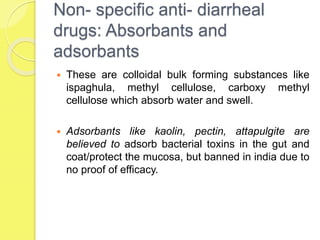
Non- specific anti- diarrheal
drugs: Absorbants and
adsorbants
 These are colloidal bulk forming substances like
ispaghula, methyl cellulose, carboxy methyl
cellulose which absorb water and swell.
 Adsorbants like kaolin, pectin, attapulgite are
believed to adsorb bacterial toxins in the gut and
coat/protect the mucosa, but banned in india due to
no proof of efficacy.
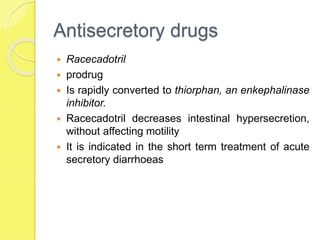
Antisecretory drugs
 Racecadotril
 prodrug
 Is rapidly converted to thiorphan, an enkephalinase
inhibitor.
 Racecadotril decreases intestinal hypersecretion,
without affecting motility
 It is indicated in the short term treatment of acute
secretory diarrhoeas
Antimotility drugs
 Loperamide
 Opiate analogue with major peripheral μ opioid and
additional weak anticholinergic property.
 constipating agent
 Longer DOA (12 hrs)
 Faecal continence is improved by enhancement of
anal sphincter tone
Dose: 4 mg followed by 2 mg after every motion
Drawback: Abdominal cramps and rashes
Drugs used in constipation & diarrhoea

Drugs used in constipation & diarrhoea

  • 1.
    Drugs used in constipation& diarrhoea By: Ms. Shipra Omar
  • 2.
     Constipation isa condition in which one may have  Fewer than three bowel movements a week  Stools that are hard, dry, or lumpy  Stools that are difficult or painful to pass  A feeling that not all stool has passed. Constipation
  • 3.
     Unsatisfactory defecation,characterized by infrequent stools and/or difficult stool passage.  Patients may define constipation as passing hard stools or straining, incomplete or painful defecation.  Constipation is a symptom, NOT a disease.  Constipation has many causes and may be a sign of undiagnosed disease
  • 4.
    Types of Constipation: 1.Primary Constipation: Slow colonic transit time, Pelvic floor/anal sphincter dysfunction • Secondary Constipation: Endocrine dysfunction (DM, hypothyroid), Metabolic disorder (↑ Ca,↓ K), Mechanical (obstruction, rectocele), Pregnancy, Neurologic disorders (spinal cord injuries)
  • 5.
    Risk Factors • ↓fiber :(most common) • ↓ liquid: ( 8 glasses/day is needed for constipated) • ↓ Exercise : bedridden, coma • Ignoring urge to defecate • Disease: Hypothyroidism, DM, hypercalcemia, Hypokalemia Stroke, Parkinsonism, • Pregnancy • Medication therapy: Opioid, Aluminum hydroxide, Anti- hypertensives, Muscle Relaxants • Obesity
  • 6.
    Treatment:  High fiberdiet.  Increased fruit intake: Apple, Pear, Guava, Papaya etc.  Exercise  Weight loss. (BMI between 19.0-24.9)  Drugs therapy.
  • 7.
    Drugs Therapy (Cathartics) These are drugs that promote evacuation of bowels. A distinction is sometimes made according to the intensity of action.  Laxative or aperient: milder action, elimination of soft but formed stools.  Purgative or cathartic: stronger action resulting in more fluid evacuation.  Many drugs in low doses act as laxative and in larger doses as purgative.
  • 8.
    Classification of Drugs: Bulkforming: Dietary fibre: Bran, Psyllium , Ispaghula, Methylcellulose Stool softener: Docusates (DOSS), Liquid paraffin Stimulant purgatives:  Diphenylmethanes: Phenolphthalein, Bisacodyl  Anthraquinones (Emodins): Senna, Cascara sagrada  5-HT4 agonist: Prucalopride  Fixed oil: Castor oil Osmotic purgatives:  Magnesium salts: Sulfate, hydroxide  Sodium salts: sulfate, phosphate, Lactulose
  • 9.
    Bulk Forming Agents: It absorbs water in the intestines, swells, increases water content of faeces—softens it and facilitates colonic transit.  Osmotically, active products may be formed in the colon by bacterial degradation of pectins, gums, etc. which act to retain water  Binds with bile and promote emulsification of fats.  Long term use relieve the symptoms of IBS. Drawbacks: Large Quantity is needed (30-40gms)  Action produced after 3-4 days use.  Does not soften feces already present in colon  Shouldn’t be used on patients with peptic ulcer.
  • 10.
    Stool Softeners:(DOSS)  Ananionic detergent  softens the stools by net water accumulation in the lumen by an action on the intestinal mucosa.  Emulsifies the colonic contents and increase penetration of water into the faeces  Mild Laxative  100-300 mg/day acts in 1-3 days. Drawbacks: Bitter  Cause cramps and abdominal pain  Long term use may cause hepatotoxicity.  Cant be given with liq. Paraffin, may cause disruption of mucosa
  • 11.
    Stool Softeners:(Liquid Paraffin)  Viscousliquid  Mixture of petroleum hydrocarbons  Taken for 2–3 days, it softens stools and is lubricates hard scybali by coating them.  Dose: 15–30 ml/day—oil as such or in emulsified form. Drawbacks: very unpleasant to swallow  While swallowing it may trickle into lungs—cause lipid pneumonia.  Carries away fat soluble vitamins with it into the stools:
  • 12.
    Stimulant Purgatives:  Bisacodyl(5- 15mg), PTHP ( 60-130 mg)  Powerful  May produce griping  Act by accumulation of water and electrolytes in the lumen by altering absorptive and secretory activity of the mucosal cell.  Enhance NO release into the colon  Larger doses of stimulant purgatives can cause excess purgation resulting in fluid and electrolyte imbalance.  Hypokalaemia can occur on regular intake.  contraindicated during pregnancy.
  • 13.
    Osmotic Cathartics:  Solutesthat are not absorbed in the intestine retain water osmotically and distend the bowel— increasing peristalsis indirectly.  Magnesium ions release cholecystokinin which augments motility and secretion, contributing to purgative action.  Saline purgatives are not used now for the treatment of constipation because they are inconvenient/ unpleasant, produce watery stools and after constipation.  Should be taken along 150-200ml water
  • 15.
     It isdefined by WHO as 3 or more loose or watery stools in a 24 hour period. May be due to:  Decreased electrolyte and water absorption.  Increased secretion by intestinal mucosa.  Increased luminal osmotic load.  Inflammation of mucosa and exudation into lumen.
  • 16.
  • 17.
    Treatment:  Therapeutic measuresmay be grouped into:  Treatment of fluid depletion, shock and acidosis. (Rehydration)  Maintenance of nutrition: chicken soup, banana, sago, etc. should be given as soon as the patient can eat.  Drug therapy.  Rotavirus is an important pathogen of acute diarrhoea,
  • 18.
    Rehydration Oral Rehydration  ORStherapy.  NaCl : 2.6 g Na+-75 mM, KCl : 1.5 g K+ — 20 mM, Trisod. citrate : 2.9 g Cl¯ — 65 mM, Glucose : 13.5 g Citrate — 10 mM, Water : 1 L Glucose — 75 mM (WHO 2002)  Patients are encouraged to drink ORS at ½–1 hourly intervals I.V. Therapy  It is needed only when fluid loss is severe, i.e. > 10% body weight  is unable to take enough oral fluids due to weakness, vomiting.  NaCl 85 mM = 5 g, KCl 13 mM = 1 g, NaHCO3 48 mM = 4 g in 1 ltr water or 5% glucose solution  oral rehydration can be instituted after the initial volum replacement.
  • 19.
    Drugs:  Specific antimicrobialdrugs  Probiotics  Drugs for inflammatory bowel disease (IBD) :- Sulfasalazines  Nonspecific anti diarrhoeal drugs
  • 20.
    Ofloxacins  Flouroquinolone derivative Act by inhibiting the bacterial topoisomerase IV and DNA gyrase enzynme.  In acute diarrhoea & dysentry  200mg oral BD  Travellers’ diarrhoea: mostly due to ETEC, Campylobacter or virus: cotrimoxazole, norfloxacin, doxycycline reduce the duration of diarrhoea and total fluid needed only in severe cases  Rifaximin for 3 days 200mg TDS  Side effects are flatulence, abdominal pain, defecation urgency and headache.
  • 21.
    Probiotics  microbial cellpreparations, either live cultures or lyophillised powders  Intended to restore and maintain healthy gut flora  lactic acid forming bacteria and yeast. Organisms like- Lactobacillus sp., Bifidobacterium, Streptococcus faecalis, Enterococcus sp. and the yeast Saccharomyces boulardii.  loudly promoted  Natural curd/yogurt is an abundant source of lactic acid producing organisms, which can serve as probiotic
  • 22.
    Non- specific anti-diarrheal drugs: Absorbants and adsorbants  These are colloidal bulk forming substances like ispaghula, methyl cellulose, carboxy methyl cellulose which absorb water and swell.  Adsorbants like kaolin, pectin, attapulgite are believed to adsorb bacterial toxins in the gut and coat/protect the mucosa, but banned in india due to no proof of efficacy.
  • 23.
    Antisecretory drugs  Racecadotril prodrug  Is rapidly converted to thiorphan, an enkephalinase inhibitor.  Racecadotril decreases intestinal hypersecretion, without affecting motility  It is indicated in the short term treatment of acute secretory diarrhoeas
  • 24.
    Antimotility drugs  Loperamide Opiate analogue with major peripheral μ opioid and additional weak anticholinergic property.  constipating agent  Longer DOA (12 hrs)  Faecal continence is improved by enhancement of anal sphincter tone Dose: 4 mg followed by 2 mg after every motion Drawback: Abdominal cramps and rashes