Dr. D. K. Brahma
Associate Professor
Department of Pharmacology
NEIGRIHMS, Shillong
 Demographic transition – a global
demographic event
 WHO – People 60 years of age and older is
650 million now and forecast to reach 2 Billion
by 2050
 Persons aged 65 years and older constitute
13% of the population and purchase 33% of
all prescription medications
 By 2040, 25% of the population will purchase
50% of all prescription drugs
 Medications play crucial role in geriatric health
care as they treat chronic diseases, alleviate pain
and improve quality of life
 Age-related changes in drug disposition and
pharmacodynamic responses have significant
clinical implications
 Increased use of a number of medications in
elderly raises the risk of medicine-related problems
that may occur
 Medication use and the incidence of adverse drug
outcomes increase with advancing age
 It is important to ensure quality use of medicines in
older people
 Large number of new drugs available each
year
 Off-label indications are expanding
 Advanced understanding of drug-drug
interactions
 Increasing popularity of “nutriceuticals”
 Multiple co-morbid states
 Polypharmacy
 Medication compliance
 Effects of aging physiology on drug therapy
 Medication cost
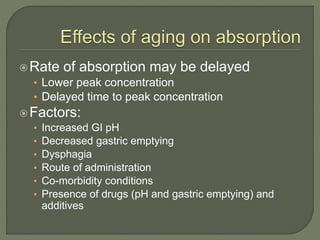
Rate of absorption may be delayed
• Lower peak concentration
• Delayed time to peak concentration
Factors:
• Increased GI pH
• Decreased gastric emptying
• Dysphagia
• Route of administration
• Co-morbidity conditions
• Presence of drugs (pH and gastric emptying) and
additives
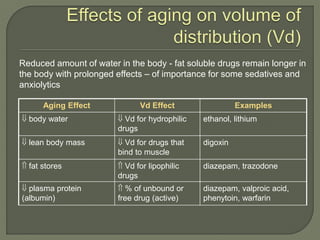
Aging Effect Vd Effect Examples
 body water  Vd for hydrophilic
drugs
ethanol, lithium
 lean body mass  Vd for drugs that
bind to muscle
digoxin
 fat stores  Vd for lipophilic
drugs
diazepam, trazodone
 plasma protein
(albumin)
 % of unbound or
free drug (active)
diazepam, valproic acid,
phenytoin, warfarin
Reduced amount of water in the body - fat soluble drugs remain longer in
the body with prolonged effects – of importance for some sedatives and
anxiolytics
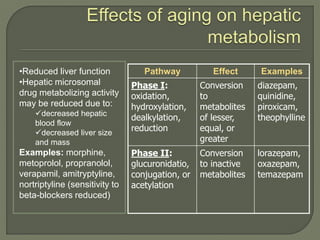
Pathway Effect Examples
Phase I:
oxidation,
hydroxylation,
dealkylation,
reduction
Conversion
to
metabolites
of lesser,
equal, or
greater
diazepam,
quinidine,
piroxicam,
theophylline
Phase II:
glucuronidatio,
conjugation, or
acetylation
Conversion
to inactive
metabolites
lorazepam,
oxazepam,
temazepam
•Reduced liver function
•Hepatic microsomal
drug metabolizing activity
may be reduced due to:
decreased hepatic
blood flow
decreased liver size
and mass
Examples: morphine,
metoprolol, propranolol,
verapamil, amitryptyline,
nortriptyline (sensitivity to
beta-blockers reduced)
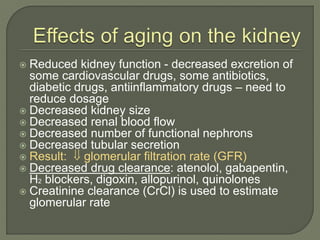
 Reduced kidney function - decreased excretion of
some cardiovascular drugs, some antibiotics,
diabetic drugs, antiinflammatory drugs – need to
reduce dosage
 Decreased kidney size
 Decreased renal blood flow
 Decreased number of functional nephrons
 Decreased tubular secretion
 Result:  glomerular filtration rate (GFR)
 Decreased drug clearance: atenolol, gabapentin,
H2 blockers, digoxin, allopurinol, quinolones
 Creatinine clearance (CrCl) is used to estimate
glomerular rate
Brain and nervous system more sensitive
to psychotropic and analgesic drugs –
dizziness, confusion, cognitive impairment
Decreased capacity to regulate blood
pressure – blood pressure fall, fainting,
vertigo when using drugs for hypertension
Gastrointestinal sensitivity to anti-
inflammatory drugs - bleeding
Balance between overprescribing and
underprescribing
• Correct drug
• Correct dose
• Targets appropriate condition
• Is appropriate for the individual patient
Avoid “a pill for every ill”
Always consider non-pharmacologic therapy
Adverse drug events (ADEs)
Drug interactions
Duplication of drug therapy
Decreased quality of life
Unnecessary cost
Medication non-adherence
 Responsible for 5-28% of acute geriatric hospital
admissions
 Greater than 95% of ADEs in the elderly are
considered predictable (Type A) and approximately
50% are considered preventable
 Most errors occur at the ordering and monitoring
stages
 Most common medications associated with ADEs
in elderly
• Opioid analgesics
• NSAIDs
• Anticholinergics
• Benzodiazepines
• Also: cardiovascular agents, CNS agents, and
musculoskeletal agents
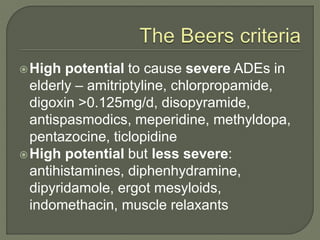
High potential to cause severe ADEs in
elderly – amitriptyline, chlorpropamide,
digoxin >0.125mg/d, disopyramide,
antispasmodics, meperidine, methyldopa,
pentazocine, ticlopidine
High potential but less severe:
antihistamines, diphenhydramine,
dipyridamole, ergot mesyloids,
indomethacin, muscle relaxants
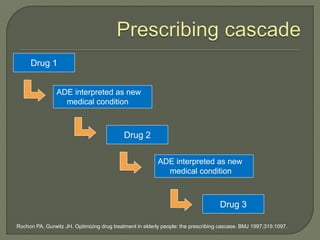
ADE interpreted as new
medical condition
Drug 1
Drug 2
ADE interpreted as new
medical condition
Drug 3
Rochon PA, Gurwitz JH. Optimizing drug treatment in elderly people: the prescribing cascase. BMJ 1997;315:1097.
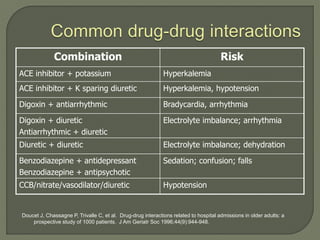
Combination Risk
ACE inhibitor + potassium Hyperkalemia
ACE inhibitor + K sparing diuretic Hyperkalemia, hypotension
Digoxin + antiarrhythmic Bradycardia, arrhythmia
Digoxin + diuretic
Antiarrhythmic + diuretic
Electrolyte imbalance; arrhythmia
Diuretic + diuretic Electrolyte imbalance; dehydration
Benzodiazepine + antidepressant
Benzodiazepine + antipsychotic
Sedation; confusion; falls
CCB/nitrate/vasodilator/diuretic Hypotension
Doucet J, Chassagne P, Trivalle C, et al. Drug-drug interactions related to hospital admissions in older adults: a
prospective study of 1000 patients. J Am Geriatr Soc 1996;44(9):944-948.
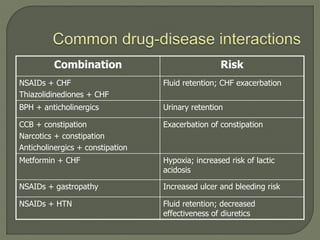
Combination Risk
NSAIDs + CHF
Thiazolidinediones + CHF
Fluid retention; CHF exacerbation
BPH + anticholinergics Urinary retention
CCB + constipation
Narcotics + constipation
Anticholinergics + constipation
Exacerbation of constipation
Metformin + CHF Hypoxia; increased risk of lactic
acidosis
NSAIDs + gastropathy Increased ulcer and bleeding risk
NSAIDs + HTN Fluid retention; decreased
effectiveness of diuretics
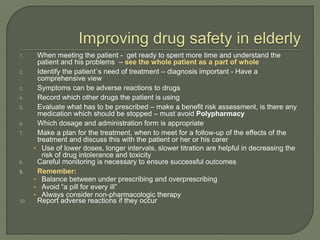
1. When meeting the patient - get ready to spent more time and understand the
patient and his problems – see the whole patient as a part of whole
2. Identify the patient`s need of treatment – diagnosis important - Have a
comprehensive view
3. Symptoms can be adverse reactions to drugs
4. Record which other drugs the patient is using
5. Evaluate what has to be prescribed – make a benefit risk assessment, is there any
medication which should be stopped – must avoid Polypharmacy
6. Which dosage and administration form is appropriate
7. Make a plan for the treatment, when to meet for a follow-up of the effects of the
treatment and discuss this with the patient or her or his carer
• Use of lower doses, longer intervals, slower titration are helpful in decreasing the
risk of drug intolerance and toxicity
8. Careful monitoring is necessary to ensure successful outcomes
9. Remember:
• Balance between under prescribing and overprescribing
• Avoid “a pill for every ill”
• Always consider non-pharmacologic therapy
10. Report adverse reactions if they occur
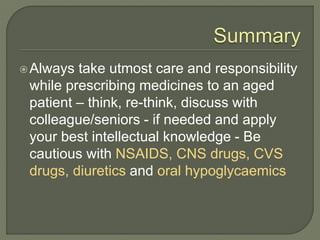
Always take utmost care and responsibility
while prescribing medicines to an aged
patient – think, re-think, discuss with
colleague/seniors - if needed and apply
your best intellectual knowledge - Be
cautious with NSAIDS, CNS drugs, CVS
drugs, diuretics and oral hypoglycaemics
Brahma DK, Wahlang JB, Marak MD, Ch. Sangma M. Adverse drug reactions in the elderly. J Pharmacol Pharmacother [serial online] 2013 [cited 2017 Sep 24];4:91-4.
Available from: http://www.jpharmacol.com/text.asp?2013/4/2/91/110872
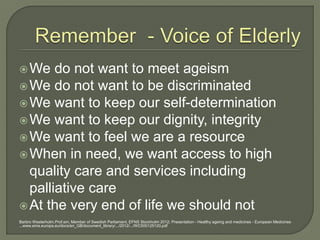
We do not want to meet ageism
We do not want to be discriminated
We want to keep our self-determination
We want to keep our dignity, integrity
We want to feel we are a resource
When in need, we want access to high
quality care and services including
palliative care
At the very end of life we should not
Barbro Westerholm.Prof.em, Member of Swedish Parliament. EFNS Stockholm 2012; Presentation - Healthy ageing and medicines - European Medicines
...www.ema.europa.eu/docs/en_GB/document_library/.../2012/.../WC500125120.pdf
“To care for those who once
cared for us is one of the
highest honours.”