Emesis
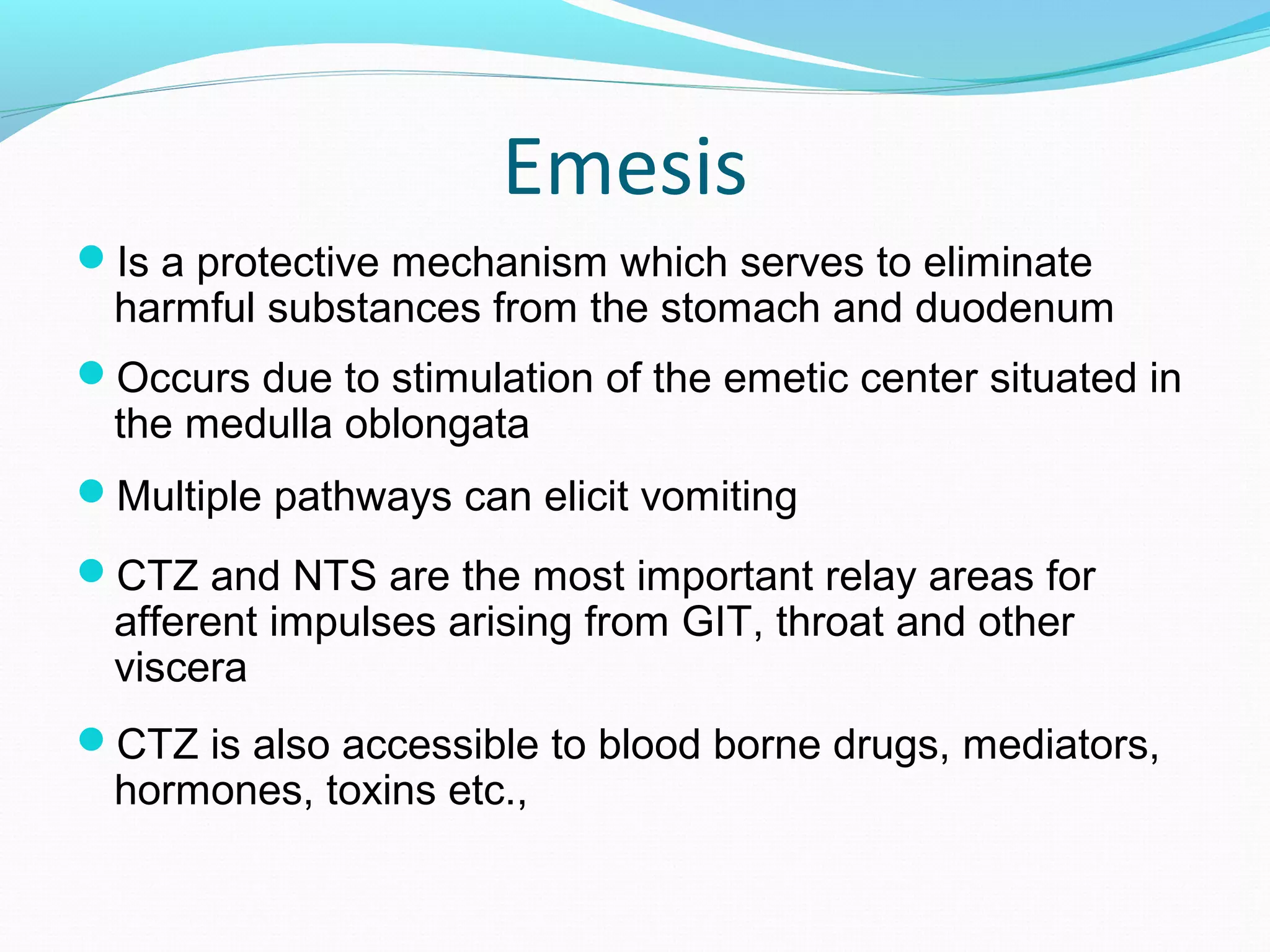
Is a protective mechanism which serves to eliminate

harmful substances from the stomach and duodenum

Occurs due to stimulation of the emetic center situated in

the medulla oblongata

Multiple pathways can elicit vomiting
CTZ and NTS are the most important relay areas for

afferent impulses arising from GIT, throat and other
viscera

CTZ is also accessible to blood borne drugs, mediators,

hormones, toxins etc.,
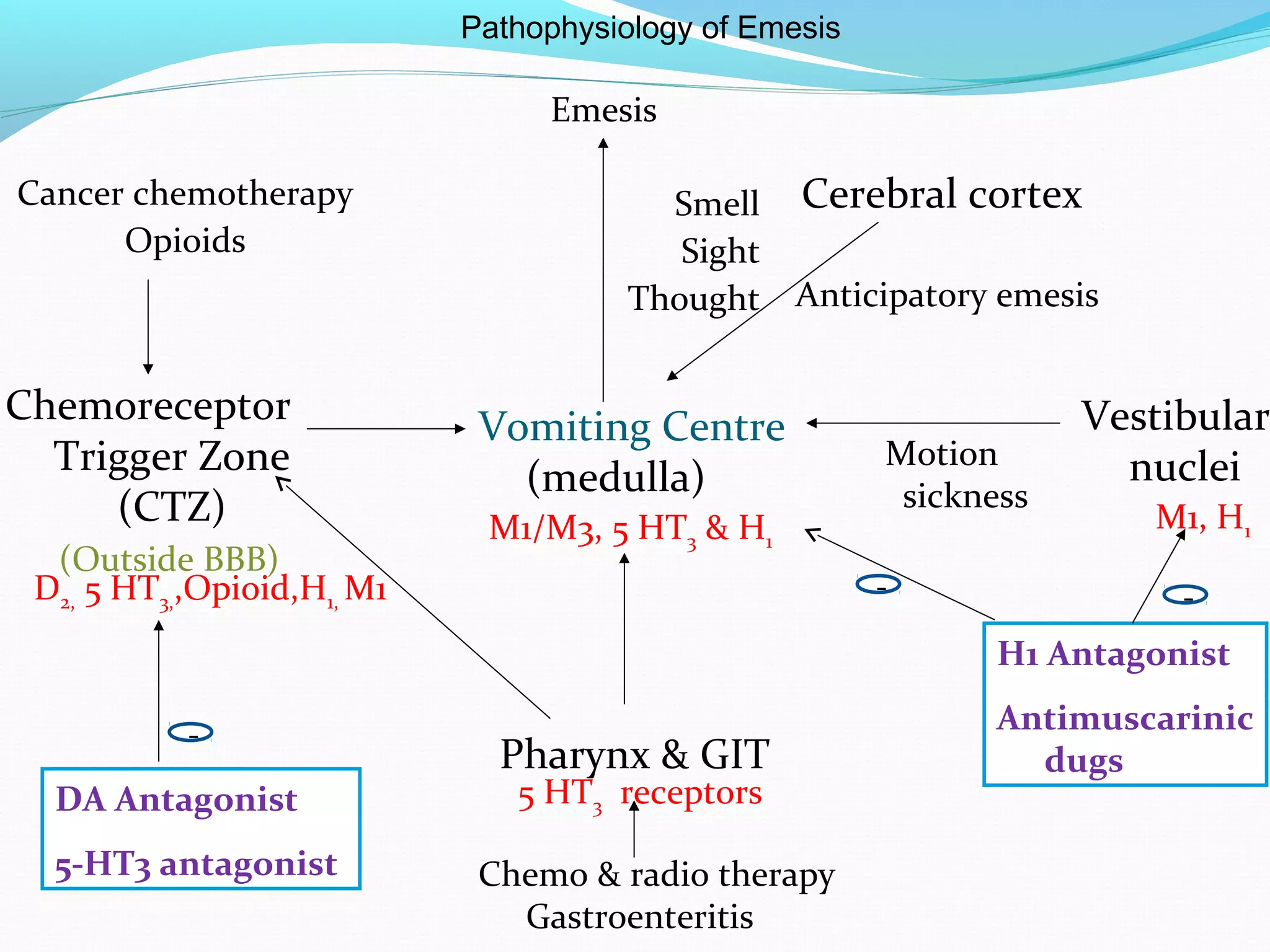
Pathophysiology of Emesis

Emesis
Cancer chemotherapy
Opioids

Chemoreceptor
Trigger Zone
(CTZ)
(Outside BBB)
D2, 5 HT3,,Opioid,H1, M1

Smell
Sight
Thought

Cerebral cortex
Anticipatory emesis

Vomiting Centre
(medulla)
M1/M3, 5 HT3 & H1

Motion
sickness
-

Vestibular
nuclei
M1, H1
-

H1 Antagonist
-

DA Antagonist
5-HT3 antagonist

Pharynx & GIT
5 HT3 receptors

Chemo & radio therapy
Gastroenteritis

Antimuscarinic
dugs
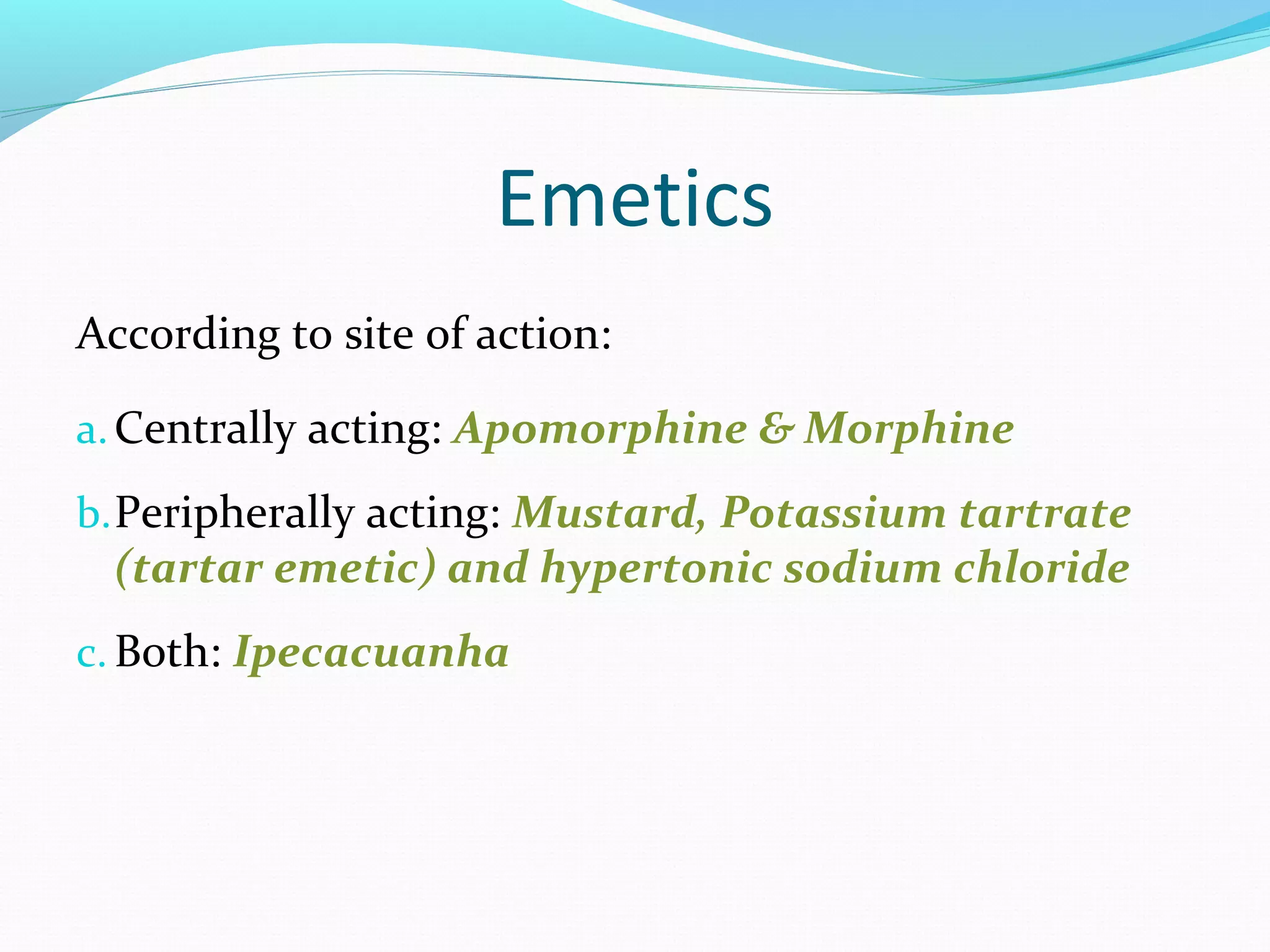
Emetics
According to site of action:
a. Centrally acting: Apomorphine & Morphine
b. Peripherally acting: Mustard, Potassium tartrate

(tartar emetic) and hypertonic sodium chloride

c. Both: Ipecacuanha
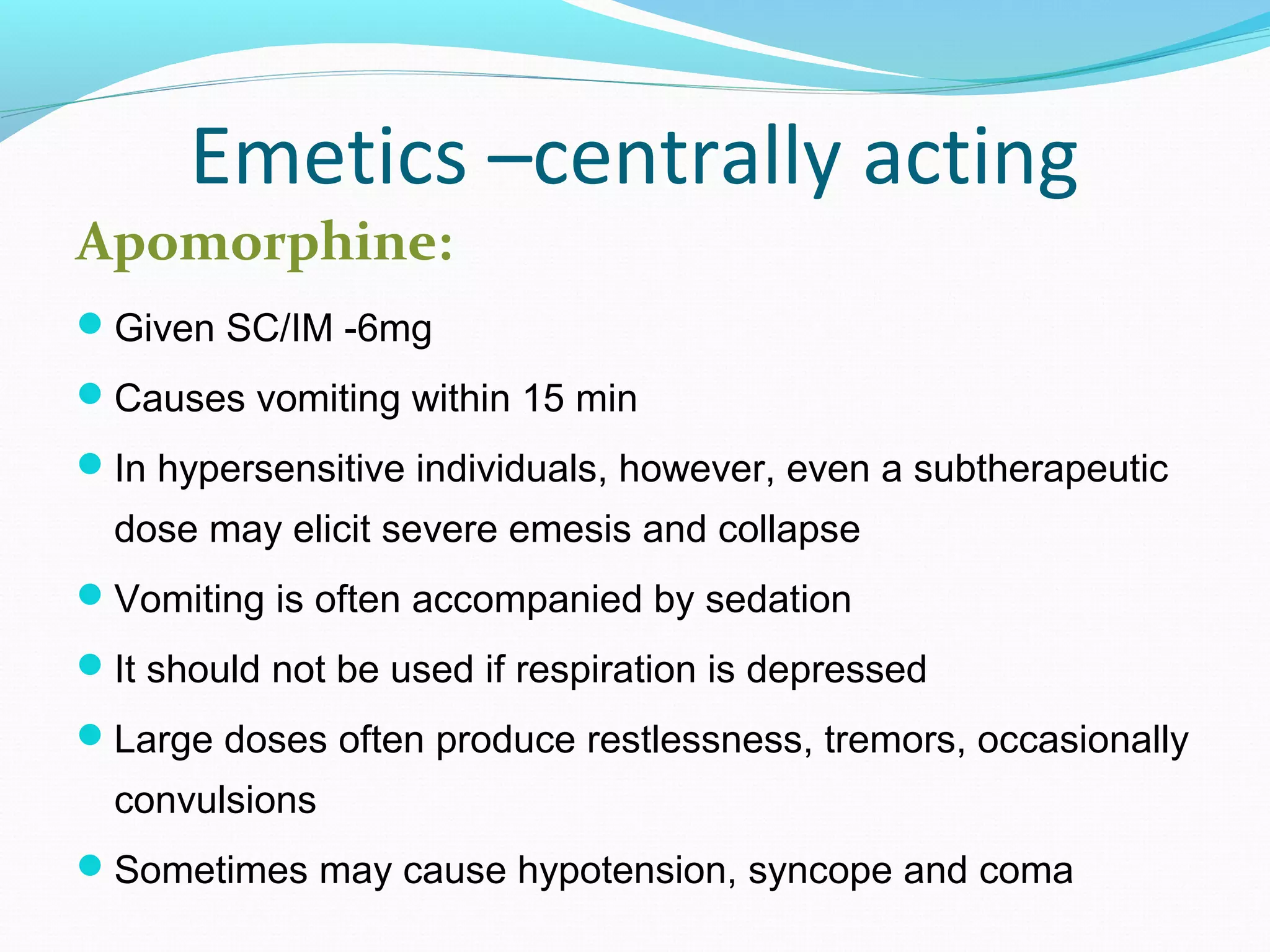
Emetics –centrally acting
Apomorphine:
Given SC/IM -6mg
Causes vomiting within 15 min
In hypersensitive individuals, however, even a subtherapeutic

dose may elicit severe emesis and collapse
Vomiting is often accompanied by sedation
It should not be used if respiration is depressed
Large doses often produce restlessness, tremors, occasionally

convulsions
Sometimes may cause hypotension, syncope and coma
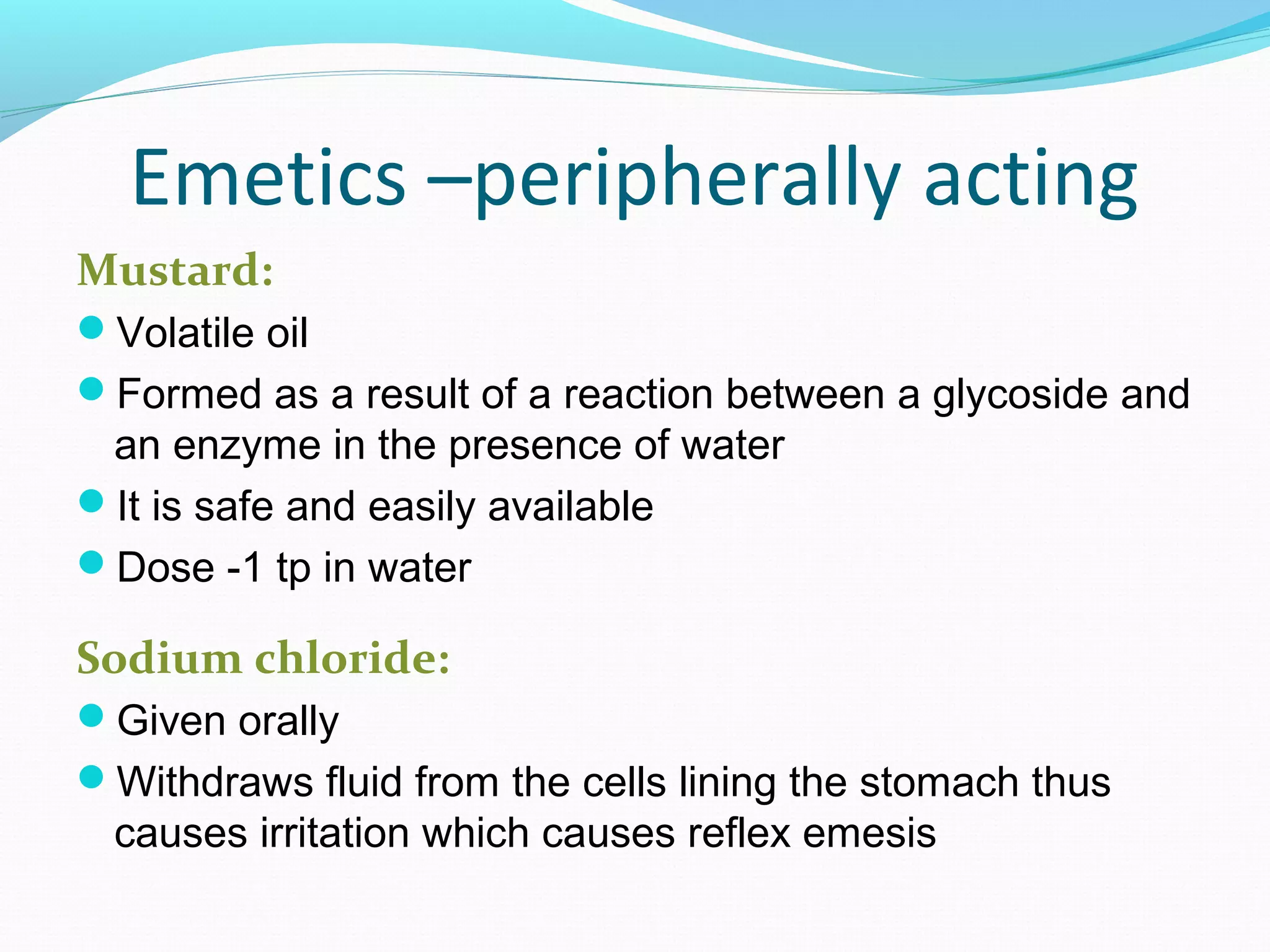
Emetics –peripherally acting
Mustard:
Volatile oil
Formed as a result of a reaction between a glycoside and

an enzyme in the presence of water
It is safe and easily available
Dose -1 tp in water

Sodium chloride:
Given orally
Withdraws fluid from the cells lining the stomach thus

causes irritation which causes reflex emesis
Emetics –both
Ipecacuanha (Emetine):
Acts by irritating gastric mucosa as well as through CTZ
Dried root of Cephalis ipecacuanha contains emetine
Used as syrup ipecac (15-20ml adults,10-15ml children,

5ml in infants) for inducing vomiting
Takes 15 min or more for the effect
Although apomorphine is highly effective emetic,

syrup ipecac is safer
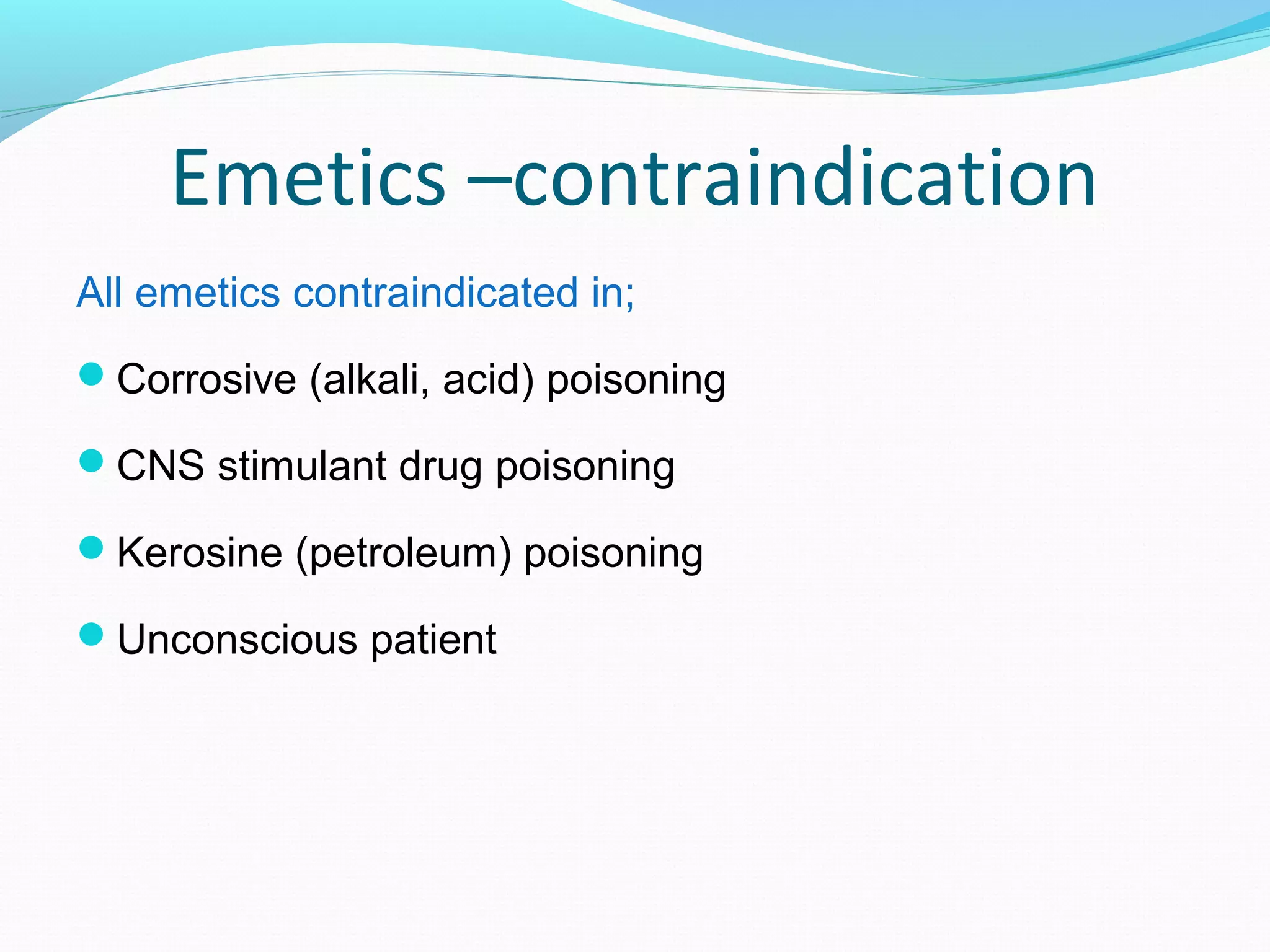
Emetics –contraindication
All emetics contraindicated in;
Corrosive (alkali, acid) poisoning
CNS stimulant drug poisoning
Kerosine (petroleum) poisoning
Unconscious patient
List of Drugs induce vomiting
Anticancer drugs
Amiodarone
Apomorphine
Chloroquine, quinine
Diltiazem
Emetine
Ergot derivatives
Erythromycin, tetracyclines
Fluroquinolones
Metronidazole
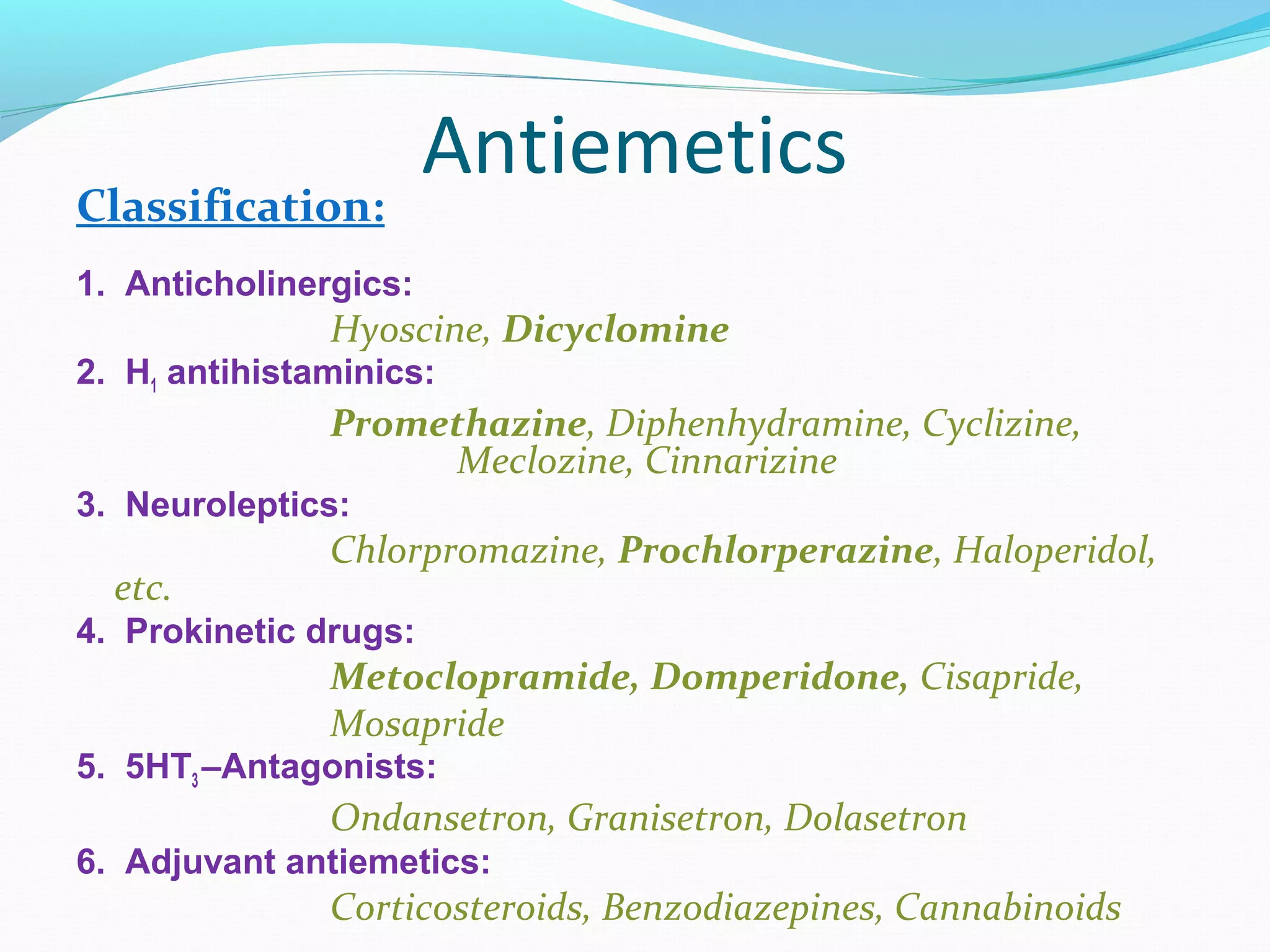
Classification:

Antiemetics

1. Anticholinergics:

Hyoscine, Dicyclomine

2. H1 antihistaminics:

Promethazine, Diphenhydramine, Cyclizine,
Meclozine, Cinnarizine
3. Neuroleptics:

etc.

Chlorpromazine, Prochlorperazine, Haloperidol,

4. Prokinetic drugs:

Metoclopramide, Domperidone, Cisapride,
Mosapride

5. 5HT3 –Antagonists:

Ondansetron, Granisetron, Dolasetron
6. Adjuvant antiemetics:

Corticosteroids, Benzodiazepines, Cannabinoids
Anticholinergics
Hyoscine:
Most effective for motion sickness
0.2 -0.4mg oral, i.m
Brief duration of action
Produces sedation and other anticholinergic side effects
Suitable for short brisk journeys
Transdermal patch 1.5mg applied behind the pinna –to

be delivered over 3 days –suppresses motion sickness
while producing only mild side effects
Anticholinergics

Cont…

Dicyclomine:
10-20mg oral
Used for prophylaxis of motion sickness and for morning

sickness
It has been cleared of teratogenic potential
H1 antihistaminics
 Some antihistaminics are antiemetic
 They are useful mainly in motion sickness and lesser extent in

morning sickness, postoperative and some other forms of vomiting
 Their antiemetic effect appears to be based on anticholinergic,

antihistaminic and sedative properties
 Drugs available
1.

Meclizine

2.

Cyclizine

3.

Dimenhydrinate

4.

Diphenydramine

5.

Promethazine – Used in pregnancy, used by
NASA for space motion sickness
H1 antihistaminics

Cont..

All antimotion drugs are more effective when taken ½ -1

hr before commencing journey
Once sickness has started, it is more difficult to control
Neuroleptics
Potent antiemetics
Act by blocking D2 receptors in the CTZ
Antagonize apomorphine induced vomiting
Antiemetic dose is much lower than antipsychotic doses
These agents should not be administered until the cause

of vomiting has been diagnosed
Neuroleptics

Cont…

Broad spectrum antiemetic , effective in;
Drug induced and postanesthetic nausea and vomiting
Disease induced vomiting
Chemotherapy induced (mildly emetogenic)
Morning sickness: should not be used except in

hyperemesis gravidarum
Prokinetic drugs
Promote GI transit and speed gastric emptying

Drugs available

Metoclopramide
Domperidone
Cisapride
Mechanism of action of Prokinetic Drugs

D2 antagonism
5-HT4 agonism
5-HT3 antagonism
Prokinetic drugs

Cont…

Metoclopramide
 Introduced in early 1970s as a ‘gastric hurrying agent’
 Widely used antiemetic

Actions:
GIT
CNS
Prokinetic drugs
Interactions:
Hastens absorption of many drugs:
Aspirin,
Diazepam etc. by facilitating the gastric emptying

Reduces absorption of digoxin

Cont…
Prokinetic drugs

Cont…

Adverse effects:
Well tolerated
Sedation, dizziness, diarrhoea, muscle dystonias
Long term use can cause parkinsonism, galactorrhoea

and gynaecomastia
Prokinetic drugs
Uses:
Antiemetic
Gastrokinetic
Dyspepsia
Gastroesophageal reflux

disease

Cont…
Prokinetic drugs

Cont…

Domperidone:
D2 antagonist
Chemically related to haloperidol but pharmacologically related

to metoclopramide
Has lower ceiling antiemetic and prokinetic actions
Poorly crosses BBB
Rare extra pyramidal side effects
Given with levodopa or bromocriptine to counteract their dose

limiting emetic action
Prokinetic drugs

Cont…

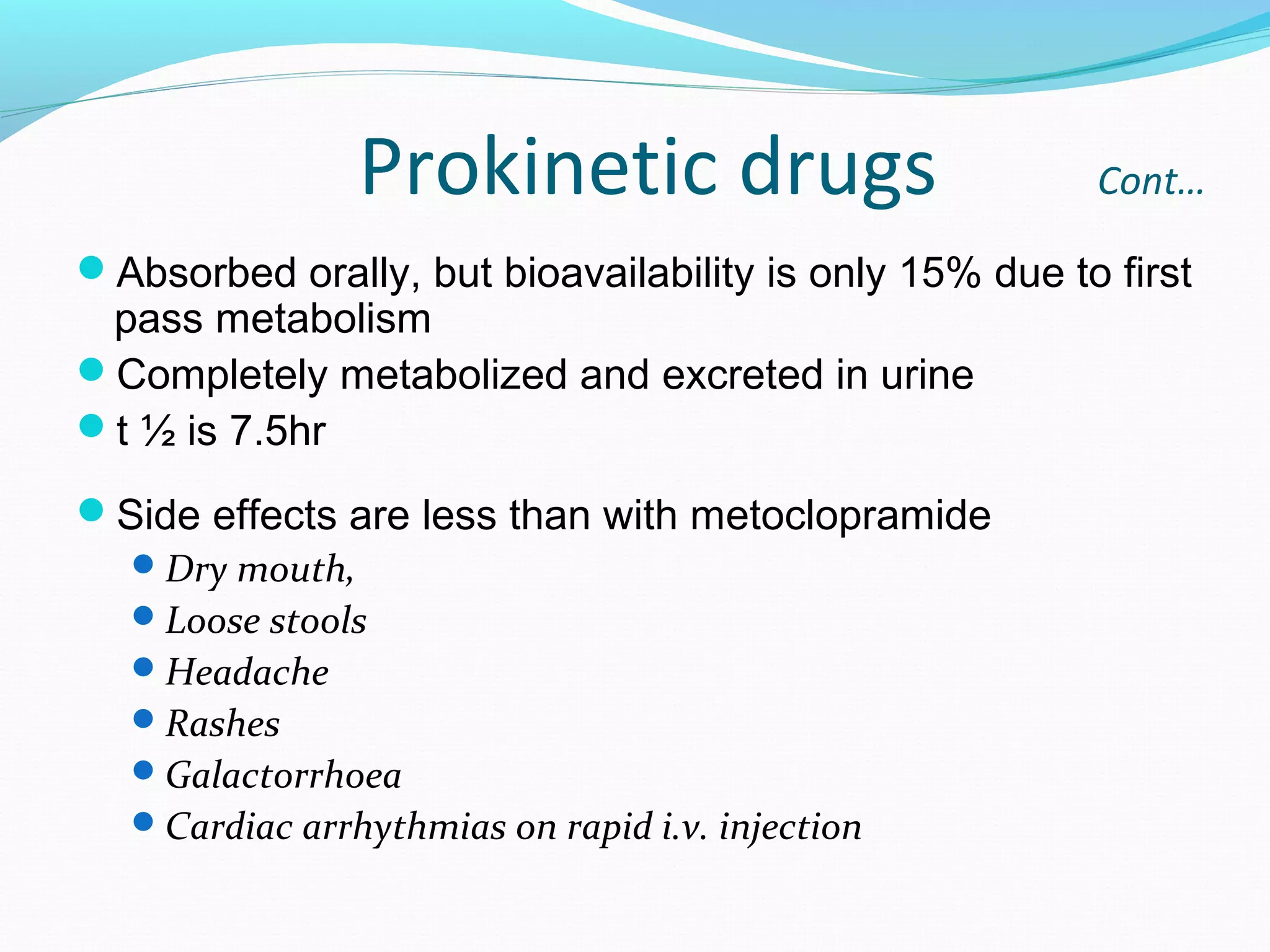
Absorbed orally, but bioavailability is only 15% due to first

pass metabolism
Completely metabolized and excreted in urine
t ½ is 7.5hr

Side effects are less than with metoclopramide
 Dry mouth,
 Loose stools
 Headache
 Rashes
 Galactorrhoea
 Cardiac arrhythmias on rapid i.v. injection
Prokinetic drugs

Cont…

Which is a better antiemetic – Metoclopramide or
Domperidone ?
As CTZ is outside BBB both have antiemetic effects.
But as metoclopramide crosses BBB it has adverse effects

like extrapyramidal side effects..

Domperidone is well tolerated
Prokinetic drugs

Cont…

Cisapride:
Prokinetic drug with little antiemetic property, because it lacks

D2 receptor antagonism
Gastric emptying is accelerated
LES tone is improved, esophageal peristalsis augmented
Devoid of action on CTZ and does not produce extrapyramidal

symptoms

Primary indication of cisapride has been GERD
5-HT3 antagonists
 Potent antiemetics
 Even though 5 HT3 receptors are present in vomiting

centre & CTZ, the antiemetic action is restricted to
emesis caused by vagal stimulation.
 High first pass metabolism
 Excreted by liver & kidney
 No dose reduction in renal insufficiency but needed in

hepatic insufficiency
 Given once or twice daily – orally or intravenously.
5-HT3 antagonists
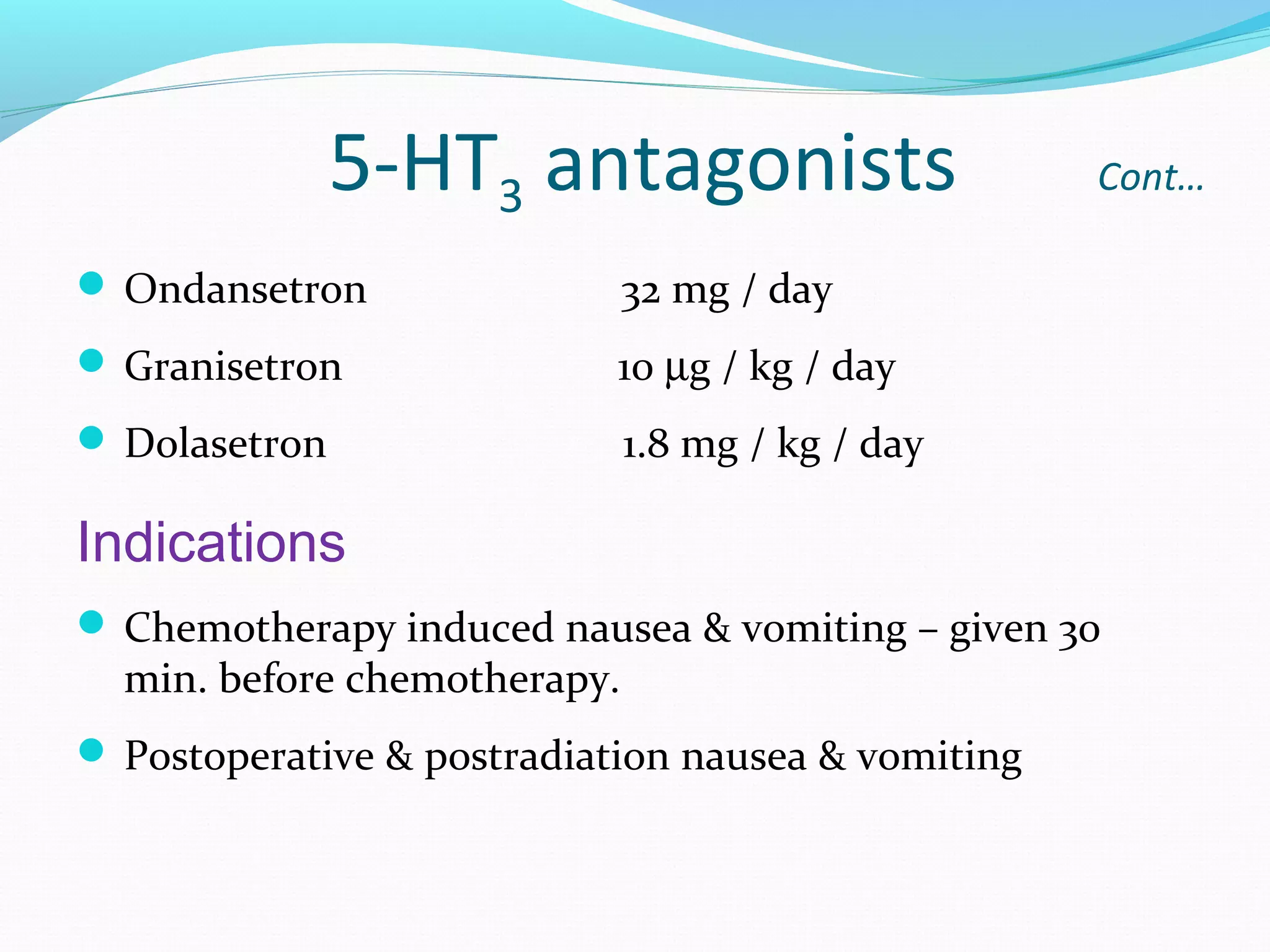
 Ondansetron

32 mg / day

 Granisetron

10 µg / kg / day

 Dolasetron

Cont…

1.8 mg / kg / day

Indications
 Chemotherapy induced nausea & vomiting – given 30

min. before chemotherapy.

 Postoperative & postradiation nausea & vomiting
5-HT3 antagonists

Cont…

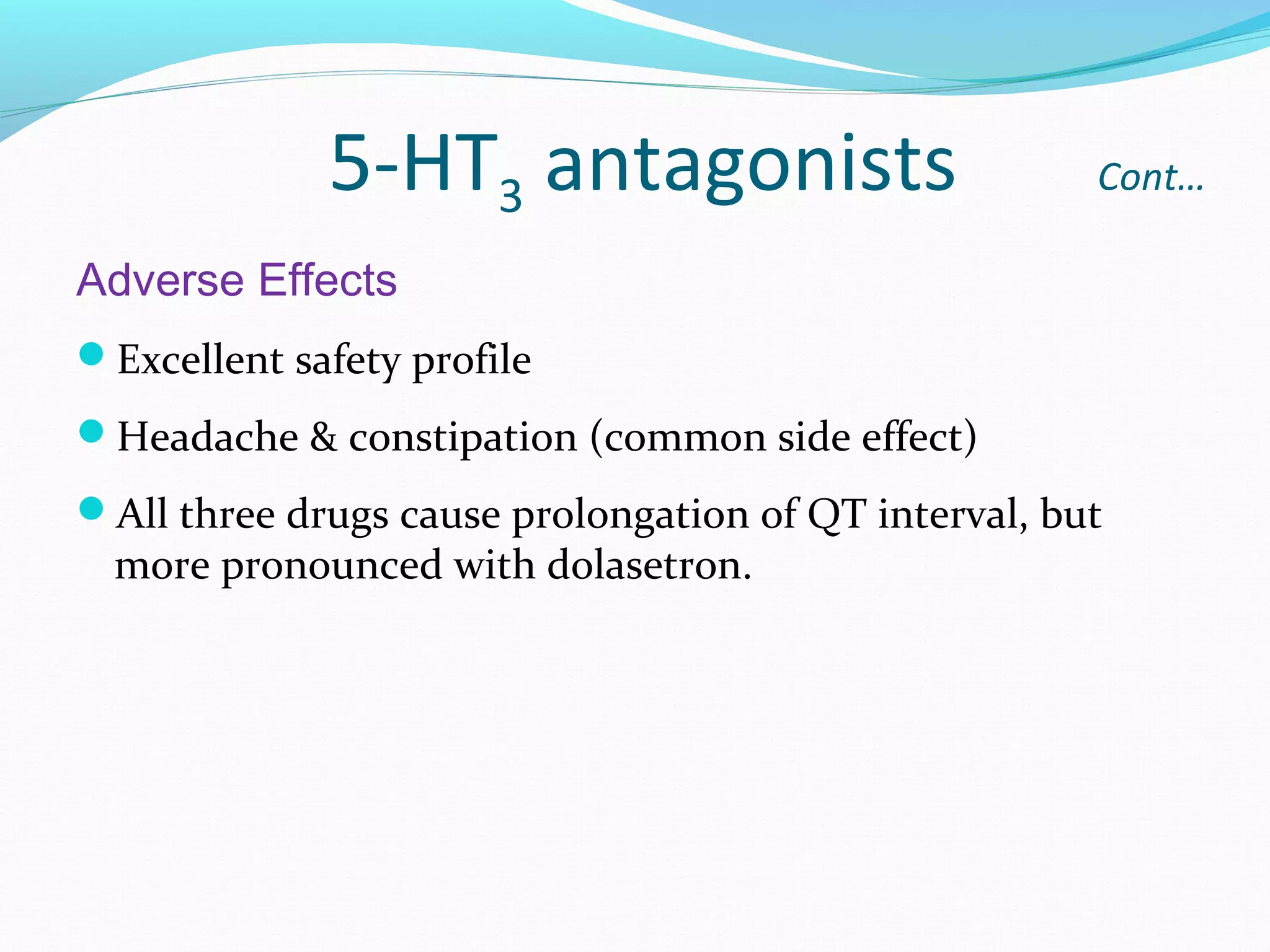
Adverse Effects
Excellent safety profile
Headache & constipation (common side effect)
All three drugs cause prolongation of QT interval, but

more pronounced with dolasetron.
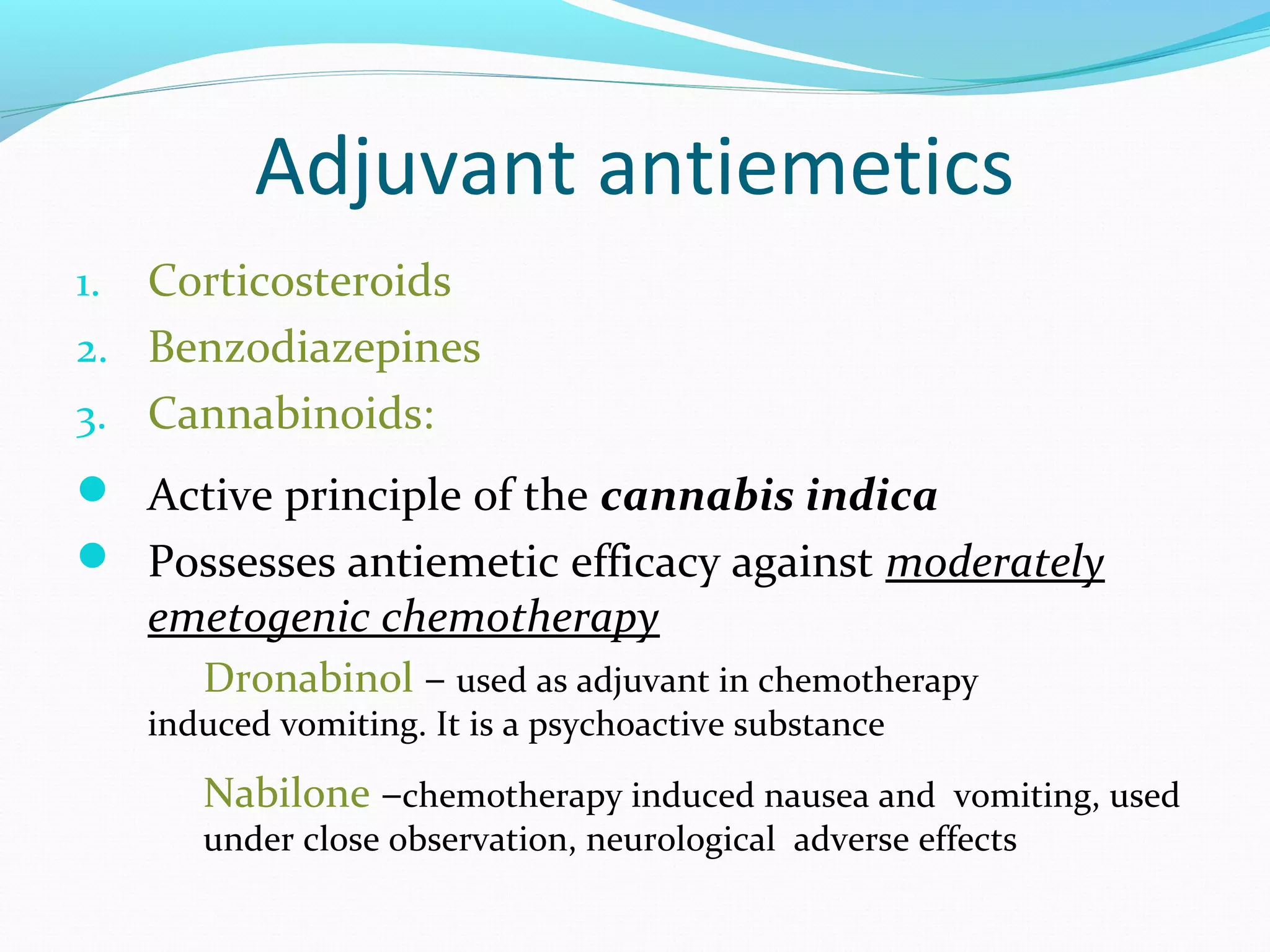
Adjuvant antiemetics
Corticosteroids
2. Benzodiazepines
3. Cannabinoids:
1.

 Active principle of the cannabis indica
 Possesses antiemetic efficacy against moderately

emetogenic chemotherapy

Dronabinol – used as adjuvant in chemotherapy

induced vomiting. It is a psychoactive substance

Nabilone –chemotherapy induced nausea and vomiting, used
under close observation, neurological adverse effects
Thank You

Emetics and antiemetics(VK)

  • 2.
    Emesis Is a protectivemechanism which serves to eliminate harmful substances from the stomach and duodenum Occurs due to stimulation of the emetic center situated in the medulla oblongata Multiple pathways can elicit vomiting CTZ and NTS are the most important relay areas for afferent impulses arising from GIT, throat and other viscera CTZ is also accessible to blood borne drugs, mediators, hormones, toxins etc.,
  • 3.
    Pathophysiology of Emesis Emesis Cancerchemotherapy Opioids Chemoreceptor Trigger Zone (CTZ) (Outside BBB) D2, 5 HT3,,Opioid,H1, M1 Smell Sight Thought Cerebral cortex Anticipatory emesis Vomiting Centre (medulla) M1/M3, 5 HT3 & H1 Motion sickness - Vestibular nuclei M1, H1 - H1 Antagonist - DA Antagonist 5-HT3 antagonist Pharynx & GIT 5 HT3 receptors Chemo & radio therapy Gastroenteritis Antimuscarinic dugs
  • 4.
    Emetics According to siteof action: a. Centrally acting: Apomorphine & Morphine b. Peripherally acting: Mustard, Potassium tartrate (tartar emetic) and hypertonic sodium chloride c. Both: Ipecacuanha
  • 5.
    Emetics –centrally acting Apomorphine: GivenSC/IM -6mg Causes vomiting within 15 min In hypersensitive individuals, however, even a subtherapeutic dose may elicit severe emesis and collapse Vomiting is often accompanied by sedation It should not be used if respiration is depressed Large doses often produce restlessness, tremors, occasionally convulsions Sometimes may cause hypotension, syncope and coma
  • 6.
    Emetics –peripherally acting Mustard: Volatileoil Formed as a result of a reaction between a glycoside and an enzyme in the presence of water It is safe and easily available Dose -1 tp in water Sodium chloride: Given orally Withdraws fluid from the cells lining the stomach thus causes irritation which causes reflex emesis
  • 7.
    Emetics –both Ipecacuanha (Emetine): Actsby irritating gastric mucosa as well as through CTZ Dried root of Cephalis ipecacuanha contains emetine Used as syrup ipecac (15-20ml adults,10-15ml children, 5ml in infants) for inducing vomiting Takes 15 min or more for the effect
  • 8.
    Although apomorphine ishighly effective emetic, syrup ipecac is safer
  • 9.
    Emetics –contraindication All emeticscontraindicated in; Corrosive (alkali, acid) poisoning CNS stimulant drug poisoning Kerosine (petroleum) poisoning Unconscious patient
  • 10.
    List of Drugsinduce vomiting Anticancer drugs Amiodarone Apomorphine Chloroquine, quinine Diltiazem Emetine Ergot derivatives Erythromycin, tetracyclines Fluroquinolones Metronidazole
  • 11.
    Classification: Antiemetics 1. Anticholinergics: Hyoscine, Dicyclomine 2.H1 antihistaminics: Promethazine, Diphenhydramine, Cyclizine, Meclozine, Cinnarizine 3. Neuroleptics: etc. Chlorpromazine, Prochlorperazine, Haloperidol, 4. Prokinetic drugs: Metoclopramide, Domperidone, Cisapride, Mosapride 5. 5HT3 –Antagonists: Ondansetron, Granisetron, Dolasetron 6. Adjuvant antiemetics: Corticosteroids, Benzodiazepines, Cannabinoids
  • 12.
    Anticholinergics Hyoscine: Most effective formotion sickness 0.2 -0.4mg oral, i.m Brief duration of action Produces sedation and other anticholinergic side effects Suitable for short brisk journeys Transdermal patch 1.5mg applied behind the pinna –to be delivered over 3 days –suppresses motion sickness while producing only mild side effects
  • 13.
    Anticholinergics Cont… Dicyclomine: 10-20mg oral Used forprophylaxis of motion sickness and for morning sickness It has been cleared of teratogenic potential
  • 14.
    H1 antihistaminics  Someantihistaminics are antiemetic  They are useful mainly in motion sickness and lesser extent in morning sickness, postoperative and some other forms of vomiting  Their antiemetic effect appears to be based on anticholinergic, antihistaminic and sedative properties  Drugs available 1. Meclizine 2. Cyclizine 3. Dimenhydrinate 4. Diphenydramine 5. Promethazine – Used in pregnancy, used by NASA for space motion sickness
  • 15.
    H1 antihistaminics Cont.. All antimotiondrugs are more effective when taken ½ -1 hr before commencing journey Once sickness has started, it is more difficult to control
  • 16.
    Neuroleptics Potent antiemetics Act byblocking D2 receptors in the CTZ Antagonize apomorphine induced vomiting Antiemetic dose is much lower than antipsychotic doses These agents should not be administered until the cause of vomiting has been diagnosed
  • 17.
    Neuroleptics Cont… Broad spectrum antiemetic, effective in; Drug induced and postanesthetic nausea and vomiting Disease induced vomiting Chemotherapy induced (mildly emetogenic) Morning sickness: should not be used except in hyperemesis gravidarum
  • 18.
    Prokinetic drugs Promote GItransit and speed gastric emptying Drugs available Metoclopramide Domperidone Cisapride
  • 19.
    Mechanism of actionof Prokinetic Drugs D2 antagonism 5-HT4 agonism 5-HT3 antagonism
  • 20.
    Prokinetic drugs Cont… Metoclopramide  Introducedin early 1970s as a ‘gastric hurrying agent’  Widely used antiemetic Actions: GIT CNS
  • 21.
    Prokinetic drugs Interactions: Hastens absorptionof many drugs: Aspirin, Diazepam etc. by facilitating the gastric emptying Reduces absorption of digoxin Cont…
  • 22.
    Prokinetic drugs Cont… Adverse effects: Welltolerated Sedation, dizziness, diarrhoea, muscle dystonias Long term use can cause parkinsonism, galactorrhoea and gynaecomastia
  • 23.
  • 24.
    Prokinetic drugs Cont… Domperidone: D2 antagonist Chemicallyrelated to haloperidol but pharmacologically related to metoclopramide Has lower ceiling antiemetic and prokinetic actions Poorly crosses BBB Rare extra pyramidal side effects Given with levodopa or bromocriptine to counteract their dose limiting emetic action
  • 25.
    Prokinetic drugs Cont… Absorbed orally,but bioavailability is only 15% due to first pass metabolism Completely metabolized and excreted in urine t ½ is 7.5hr Side effects are less than with metoclopramide  Dry mouth,  Loose stools  Headache  Rashes  Galactorrhoea  Cardiac arrhythmias on rapid i.v. injection
  • 26.
    Prokinetic drugs Cont… Which isa better antiemetic – Metoclopramide or Domperidone ? As CTZ is outside BBB both have antiemetic effects. But as metoclopramide crosses BBB it has adverse effects like extrapyramidal side effects.. Domperidone is well tolerated
  • 27.
    Prokinetic drugs Cont… Cisapride: Prokinetic drugwith little antiemetic property, because it lacks D2 receptor antagonism Gastric emptying is accelerated LES tone is improved, esophageal peristalsis augmented Devoid of action on CTZ and does not produce extrapyramidal symptoms Primary indication of cisapride has been GERD
  • 28.
    5-HT3 antagonists  Potentantiemetics  Even though 5 HT3 receptors are present in vomiting centre & CTZ, the antiemetic action is restricted to emesis caused by vagal stimulation.  High first pass metabolism  Excreted by liver & kidney  No dose reduction in renal insufficiency but needed in hepatic insufficiency  Given once or twice daily – orally or intravenously.
  • 29.
    5-HT3 antagonists  Ondansetron 32mg / day  Granisetron 10 µg / kg / day  Dolasetron Cont… 1.8 mg / kg / day Indications  Chemotherapy induced nausea & vomiting – given 30 min. before chemotherapy.  Postoperative & postradiation nausea & vomiting
  • 30.
    5-HT3 antagonists Cont… Adverse Effects Excellentsafety profile Headache & constipation (common side effect) All three drugs cause prolongation of QT interval, but more pronounced with dolasetron.
  • 31.
    Adjuvant antiemetics Corticosteroids 2. Benzodiazepines 3.Cannabinoids: 1.  Active principle of the cannabis indica  Possesses antiemetic efficacy against moderately emetogenic chemotherapy Dronabinol – used as adjuvant in chemotherapy induced vomiting. It is a psychoactive substance Nabilone –chemotherapy induced nausea and vomiting, used under close observation, neurological adverse effects
  • 32.

Editor's Notes

  • #21 Lower esophageal sphincter (LES) tone is increased and GER is opposed Also increases intestinal peristalsis to some extent CNS: Acts on the CTZ, blocks apomorphine induced vomiting No neuroleptic action GIT: Prominent effect on upper g.i.t; increases gastric peristalisis Speeds gastric emptying, specially if it was slow