Miscellaneous Antibiotics
Dr. D. K. Brahma
Associate Professsor
Department of Pharmacology
NEIGRIHMS, Shillong
???
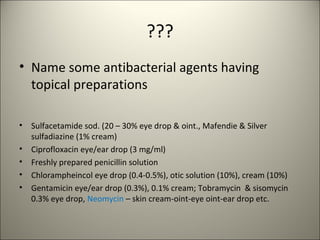
• Name some antibacterial agents having
topical preparations
• Sulfacetamide sod. (20 – 30% eye drop & oint., Mafendie & Silver
sulfadiazine (1% cream)
• Ciprofloxacin eye/ear drop (3 mg/ml)
• Freshly prepared penicillin solution
• Chlorampheincol eye drop (0.4-0.5%), otic solution (10%), cream (10%)
• Gentamicin eye/ear drop (0.3%), 0.1% cream; Tobramycin & sisomycin
0.3% eye drop, Neomycin – skin cream-oint-eye oint-ear drop etc.
Polypeptide Antibiotics
• Low molecular weight cationic polypeptide
• Powerful bactericidal agents – toxicity
• Elaborated from bacteria
• Names –
1. Polymyxin B - Bacillus polymyxa
2. Colistin - B. Colistinus
3. and Bacitracin - Bacillus subtillis
Polymyxin B and Colistin
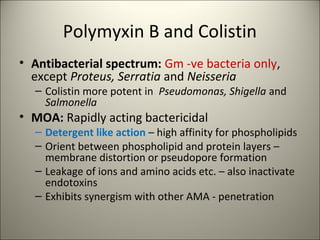
• Antibacterial spectrum: Gm -ve bacteria only,
except Proteus, Serratia and Neisseria
– Colistin more potent in Pseudomonas, Shigella and
Salmonella
• MOA: Rapidly acting bactericidal
– Detergent like action – high affinity for phospholipids
– Orient between phospholipid and protein layers –
membrane distortion or pseudopore formation
– Leakage of ions and amino acids etc. – also inactivate
endotoxins
– Exhibits synergism with other AMA - penetration
Polymyxin B and Colistin
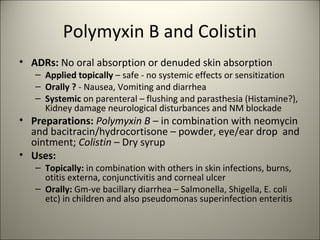
• ADRs: No oral absorption or denuded skin absorption
– Applied topically – safe - no systemic effects or sensitization
– Orally ? - Nausea, Vomiting and diarrhea
– Systemic on parenteral – flushing and parasthesia (Histamine?),
Kidney damage neurological disturbances and NM blockade
• Preparations: Polymyxin B – in combination with neomycin
and bacitracin/hydrocortisone – powder, eye/ear drop and
ointment; Colistin – Dry syrup
• Uses:
– Topically: in combination with others in skin infections, burns,
otitis externa, conjunctivitis and corneal ulcer
– Orally: Gm-ve bacillary diarrhea – Salmonella, Shigella, E. coli
etc) in children and also pseudomonas superinfection enteritis
Bacitracin
• Bactericidal
• Source – Bacillus subtillis
• Spectrum: Gm +ve cocci and bacilli; also Neisseria and
H. influenzae
• MOA: Inhibits cell wall synthesis (Penicillin) – efflux of
ions
• Kinetics: Not absorbed orally, high toxicity parenterally
(kidney) – topical only
• Uses: Infected wounds – ulcers, eye infections – in
combination with neomycin and polymyxin
– Does not penetrate intact skin
– NEBASULF, NEOSPORIN
Others …
• Spectinomycin: Spectromyces spectabilis – narrow spectrum
antibiotic similar to aminoglycosides – effective against limited no.
of gm-ve bacteria
– MOA: Inhibits bacterial protein synthesis – 30S rhibozome
– Uses: IV - Drug resistant gonorrhoea / beta lactum allergy or
contraindicated
• Quinupristine/Daflopristine – semisynthetic antibiotic – like
macrolides and lincosamides -
• Streptogramins group – Gr. A and Gr. B – naturally occurring
bacteriostatic
• 30: 70 mixture – bactericidal – administered parenterally
– MOA: Inhibition of bacterial protein synthesis – (i) 50S fraction -
inhibition of incorporation of aminoacyl tRNA and mRNA translation
– Spectrum: Gm +ve cocci including MRSA, VRSA, VRE, Neisseria,
Legionella and Chlamydia pneumoniae – not in E. faecium
– Uses: Nosocomial MRSA, VRE and other resistant gm+ve infections
Mupirocin and Fusidic acid
• Mupirocin: Topical antibiotic - Obtained from Pseudomonas
(pseudomonic acid)
– Specturm: Gm +ve bacteria – Stre. pyogenes (sensitive penicillin &
resistant), Staph. aureus, MRSA
– Bacteriostatic – at high conc. bactericidal
– Uses: furunculosis, folliculitis, impetigo, infected insect bites and small
wounds
– Preparation – 2% ointment – local use only
– BACTROBAN, MUPIN, T-BACT
• Fusidic acid: narrow spectrum steroidal antibiotic – blocks protein
synthesis
– Effective against penicillinase producing Staph. aureus and few gm
+ve bacteria
– Uses: Boils, furunculosis and other cutaneous infections
– FUSIDERM, FUSIBACT
Oxazolindinone
• Linezolid - New Class of syntheic antibiotic - 2 rings –
Oxazolidine and Oxazoline
• Spectrum: Useful in resistant gm+ve coccal (aerobic and
anaerobic) and bacillary infection
– MRSA, VRSA, VRE, penicilin resistant – Strep. pyogens, Strep. Viridans,
Strep. pneumoniae, M. tuberculosis, Corynebacterium, Listeria,
Clostridia and Bact. Fragilis
• MOA: Binds to 23S fraction (p site) of 50S ribosome and
interfere with formation of N-formylmethionine – tRNA
(tRNAfMet
) -70S initiation complex
– Distorts tRNA binding site – overlapping of 50S and 30S ribosomal
subunits – stops protein synthesis – (Resistance – mutation of 23S)
Linezolid
• Kinetics: Completetly absorbed orally, metabolized non-
enzymatically and excreted in urine – half life – 5 hours
• Uses: Complicated and uncomplicated skin and soft tissue
infections, community and hospital acquired pneumonias,
bacteraemias and other gm+ infections
– However – hospital acquired pneumonias, febrile neutropenia, wound
infections others due to multidrug resistant gm +ve bacteria – VRE,
VRSA etc.
• ADRs: Mild – abdominal pain, nausea, taste disturbance
– Rash, pruritus, headache, oreal/vaginal candidiasis
– Neutropenia, thrombocytopenia and optic neuropathy
– MAO inhibitor
Khublei shibun

Polypeptide antibiotics

  • 1.
    Miscellaneous Antibiotics Dr. D.K. Brahma Associate Professsor Department of Pharmacology NEIGRIHMS, Shillong
  • 2.
    ??? • Name someantibacterial agents having topical preparations • Sulfacetamide sod. (20 – 30% eye drop & oint., Mafendie & Silver sulfadiazine (1% cream) • Ciprofloxacin eye/ear drop (3 mg/ml) • Freshly prepared penicillin solution • Chlorampheincol eye drop (0.4-0.5%), otic solution (10%), cream (10%) • Gentamicin eye/ear drop (0.3%), 0.1% cream; Tobramycin & sisomycin 0.3% eye drop, Neomycin – skin cream-oint-eye oint-ear drop etc.
  • 3.
    Polypeptide Antibiotics • Lowmolecular weight cationic polypeptide • Powerful bactericidal agents – toxicity • Elaborated from bacteria • Names – 1. Polymyxin B - Bacillus polymyxa 2. Colistin - B. Colistinus 3. and Bacitracin - Bacillus subtillis
  • 4.
    Polymyxin B andColistin • Antibacterial spectrum: Gm -ve bacteria only, except Proteus, Serratia and Neisseria – Colistin more potent in Pseudomonas, Shigella and Salmonella • MOA: Rapidly acting bactericidal – Detergent like action – high affinity for phospholipids – Orient between phospholipid and protein layers – membrane distortion or pseudopore formation – Leakage of ions and amino acids etc. – also inactivate endotoxins – Exhibits synergism with other AMA - penetration
  • 5.
    Polymyxin B andColistin • ADRs: No oral absorption or denuded skin absorption – Applied topically – safe - no systemic effects or sensitization – Orally ? - Nausea, Vomiting and diarrhea – Systemic on parenteral – flushing and parasthesia (Histamine?), Kidney damage neurological disturbances and NM blockade • Preparations: Polymyxin B – in combination with neomycin and bacitracin/hydrocortisone – powder, eye/ear drop and ointment; Colistin – Dry syrup • Uses: – Topically: in combination with others in skin infections, burns, otitis externa, conjunctivitis and corneal ulcer – Orally: Gm-ve bacillary diarrhea – Salmonella, Shigella, E. coli etc) in children and also pseudomonas superinfection enteritis
  • 6.
    Bacitracin • Bactericidal • Source– Bacillus subtillis • Spectrum: Gm +ve cocci and bacilli; also Neisseria and H. influenzae • MOA: Inhibits cell wall synthesis (Penicillin) – efflux of ions • Kinetics: Not absorbed orally, high toxicity parenterally (kidney) – topical only • Uses: Infected wounds – ulcers, eye infections – in combination with neomycin and polymyxin – Does not penetrate intact skin – NEBASULF, NEOSPORIN
  • 7.
    Others … • Spectinomycin:Spectromyces spectabilis – narrow spectrum antibiotic similar to aminoglycosides – effective against limited no. of gm-ve bacteria – MOA: Inhibits bacterial protein synthesis – 30S rhibozome – Uses: IV - Drug resistant gonorrhoea / beta lactum allergy or contraindicated • Quinupristine/Daflopristine – semisynthetic antibiotic – like macrolides and lincosamides - • Streptogramins group – Gr. A and Gr. B – naturally occurring bacteriostatic • 30: 70 mixture – bactericidal – administered parenterally – MOA: Inhibition of bacterial protein synthesis – (i) 50S fraction - inhibition of incorporation of aminoacyl tRNA and mRNA translation – Spectrum: Gm +ve cocci including MRSA, VRSA, VRE, Neisseria, Legionella and Chlamydia pneumoniae – not in E. faecium – Uses: Nosocomial MRSA, VRE and other resistant gm+ve infections
  • 8.
    Mupirocin and Fusidicacid • Mupirocin: Topical antibiotic - Obtained from Pseudomonas (pseudomonic acid) – Specturm: Gm +ve bacteria – Stre. pyogenes (sensitive penicillin & resistant), Staph. aureus, MRSA – Bacteriostatic – at high conc. bactericidal – Uses: furunculosis, folliculitis, impetigo, infected insect bites and small wounds – Preparation – 2% ointment – local use only – BACTROBAN, MUPIN, T-BACT • Fusidic acid: narrow spectrum steroidal antibiotic – blocks protein synthesis – Effective against penicillinase producing Staph. aureus and few gm +ve bacteria – Uses: Boils, furunculosis and other cutaneous infections – FUSIDERM, FUSIBACT
  • 9.
    Oxazolindinone • Linezolid -New Class of syntheic antibiotic - 2 rings – Oxazolidine and Oxazoline • Spectrum: Useful in resistant gm+ve coccal (aerobic and anaerobic) and bacillary infection – MRSA, VRSA, VRE, penicilin resistant – Strep. pyogens, Strep. Viridans, Strep. pneumoniae, M. tuberculosis, Corynebacterium, Listeria, Clostridia and Bact. Fragilis • MOA: Binds to 23S fraction (p site) of 50S ribosome and interfere with formation of N-formylmethionine – tRNA (tRNAfMet ) -70S initiation complex – Distorts tRNA binding site – overlapping of 50S and 30S ribosomal subunits – stops protein synthesis – (Resistance – mutation of 23S)
  • 10.
    Linezolid • Kinetics: Completetlyabsorbed orally, metabolized non- enzymatically and excreted in urine – half life – 5 hours • Uses: Complicated and uncomplicated skin and soft tissue infections, community and hospital acquired pneumonias, bacteraemias and other gm+ infections – However – hospital acquired pneumonias, febrile neutropenia, wound infections others due to multidrug resistant gm +ve bacteria – VRE, VRSA etc. • ADRs: Mild – abdominal pain, nausea, taste disturbance – Rash, pruritus, headache, oreal/vaginal candidiasis – Neutropenia, thrombocytopenia and optic neuropathy – MAO inhibitor
  • 11.