SEDATIVE-HYPNOTICS
Dr. D. K. Brahma
Associate Professor
Department of Pharmacology
NEIGRIHMS, Shillong
DEFINITIONS
 Sedative: A drug that subdues excitement and calms the subject
without inducing sleep, though drowsiness may be produced –
refers to decreased responsiveness to any level of stimulation; is
associated with some decrease in motor activity and ideation -
depression of awareness to the environment and reduction of
responsiveness to external stimulation
 Newer - An effective sedative agent should reduce anxiety and exert
a calming effect with little or no effect on motor or mental functions
 Hypnotic: A drug that induces and/or maintains sleep, similar to
normal sleep which is can be aroused. Should not be confused
with “Trans like state” - hypnosis, meditation, magic, flow, and
prayer etc. – subjects are passive and highly suggestible
 Older drugs: alcohol, opium, bromides, chloral hydrate,
paraldehyde – obsolete now
IN GENERAL …
 Sedative: Calm down, treat agitation
 Hypnotic: Induce sleep
 go to sleep fast, feel refreshed tomorrow !
 Treatment of Insomnia
 Anxiolytic: Reduce anxiety
 physical, emotional, cognitive
Sedative
Hypnotic
IN GENERAL …
 All are CNS depressants – different time-action and
dose –action relationship
 Quick action. But short duration of action and steeper
DRC – hypnotic
 Slowly acting and flatter DRC – sedative
 But, overlaps – hypnotic at lower doses may act as
sedative
 Anxiolysis > Sedation > Hypnosis >General
Anaesthesia (grades of CNS depression)
The linear slope for drug A is typical of many of the older sedative-hypnotics,
including the barbiturates and alcohols - an increase in dose higher than that
needed for hypnosis may lead to a state of general anesthesia. At still higher
doses, these sedative-hypnotics may depress respiratory and vasomotor centers
in the medulla, leading to coma and death.
Deviations from a linear dose-response relationship for drug B - proportionately
greater dosage increments to achieve central nervous system depression more
profound than hypnosis. This appears to be the case for benzodiazepines and for
certain newer hypnotics that have a similar mechanism of action.
AVAILABLE DRUGS
 Barbiturates:
 Long acting: Phenobarbitone
 Short acting (Intermediate): Pentobarbitone, Butobarbitone,
Amylobarbitone
 Ultra-short acting: Methohexitone, Thiopentone, Secobarbitone
 Benzodiazepines:
 Newer Non-benzodiazepines: Zopiclone, Zolpidem, Zaleplon etc.
(Chloral hydrate, paraldehyde, meprobamate – not used anymore)
Hypnotic Antianxiety Anticonvulsant
Diazepam Diazepam Diazepam
Flurazepam Chlordiazepoxide Lorazepam
Nitrazepam Oxazepam Clonazepam
Alprazolam Lorazepam Clobazam
Temazepam and
Triazolam
Alprazolam
BARBITURATES
 Last century – upto 1960 – not used now – but
prototype drug
 Chemically – condensation of malonic acid and urea –
Barbituric acid
 Important drawbacks:
 General depressants of all excitable cells (CNS)
 Potentially Fatal Respiratory Depression
 narrow therapeutic range
 Potent liver inducers: interactions
BARBITURATE – CNS ACTION
 Dose dependant effect: sedation – sleep – anaesthesia
– coma
 Short acting – hypnotic (100-200 mg)
 Shortens time taken to fall asleep and increases sleep
duration
 Arousable – but confused and drowsy if aroused early
 Night awakening – reduced
 REM and stage 3 and 4 sleep reduced – disruption of sleep
cycle
 Progressively decreases effects on sleep – continuous use –
rebound increase in REM sleep on discontinuation
 Hang over in the morning – dizziness, distortions of mood,
irritability and lethargy
 Impair learning, short-term memory and judgment
 No analgesic action – hyperalgesia instead
 Phenobarbitone – higher anticonvulsant : sedative ratio
BARBITURATE - MOA
 Act primarily at GABA:BZD
receptor-Cl-
channel
 Potentiates GABAergic inhibition
by increasing the lifetime of Cl-
channel opening
 Bind to other site than GABA –
located in α and β subunit
 Also enhance BZD binding
 High doses – directly increases
Cl-
conductance (GABA mimetic)
and inhibit Ca++
dependent
release of neurotransmitters
 Also depress Glutamate induced
neuronal depolarization
 Very High doses – depress
voltage sensitive Na+
and K+
channel
BARBITURATE – OTHER ACTIONS
 Respiration: Depressed – neurogenic, hypercapneic
and hypoxic drives to respiratory centre depressed
 CVS: Slight decrease in BP and Heart Rate
 Toxic doses: Marked fall in BP and HR – due to ganglion
blockade, vasomotor centre depression and direct cardiac
action – reflex tachycardia
 Skeletal Muscle: Little effect but anaesthetic doses
reduce muscle contraction
 Smooth muscle: Tone and motility of bowel is
decreased. Higher doses – more profound decrease
 Kidney: Reduce urine flow – due to decrease BP and
ADH release
BARBITURATE - KINETICS
 Well absorbed orally – widely distributed
 Entry into CNS depends on lipid solubility – Phenobarbitone Vs
Thiopentone
 Plasma protein binding – Phenobarbitone – 20%, Thiopentone – 75%
 Crosses placenta and secreted in milk
 Redistribution: highly lipid soluble barbiturates (ultra short acting) –
IV injection – consciousness after 6-10 minutes, but actual
elimination by metabolism – half life 9 hours - Short acting ones – TE 6
– 10 hours and elimination half life is 12-40 hours
 Metabolism: metabolized in liver by oxidation, dealkylation and
conjugation
 Excretion: Long acting – excreted significantly unchanged -
Alkalinization – excretion
 Microsomal enzyme inducer – induce own metabolism and Others
BARBITURATES – CONTD.
 Adverse Effects: Hang over, tolerance and dependence,
metal confusion, impaired performance – accidents
 Idiosyncrasy: Occasional excitement – In elderly
 Hypersensitivity: Rashes, swelling of eyelids, lips etc.
 Tolerance and dependence: Cellular and pharmacokinetic – on
repeated use
 Physical and psychological dependence – abuse liability
 Drug Interactions:
1. Induce metabolism of many drugs – warfarin, steroids, OCP,
chloramphenicol, tolbutamide
2. Alcohol, antihistamines, opioids – CNS depression
3. Sodium valproate – increases plasma conc. Of phenobarbitone
4. Phenobarbitone – competitively induces phenytoin metabolism
ACUTE BARBITURATE POISONING
 Mostly suicidal – excessive CNS depression – flabby
and comatose with shallow and failing respiration,
CVS collapse, renal shut down, pulmonary
complications
 Treatment:
 Gastric lavage (activated charcoal)
 Supportive – patent airway, assisted respiration, oxygen, IV
fluid and vasopressors like Dopamine
 Alkaline diuresis: Sodium bicarbonate 1 meq/kg IV with or
without mannitol – for long acting ones
 Haemodyalysis: highly effective in long as well as short acting
ones
 No specific antidote
 Contraindications: acute intermittent porphyria, Liver
and kidney disease, severe pulmonary insufficiency
BENZODIAZEPINES (BZDS)
Chlordiazepoxide and Diazepam - Since 1960
BENZODIAZEPINES (BZDS)
 Chemically – all are
1,4-benzodiazepines,
and most contain a
carboxamide group in
the 7-membered
heterocyclic ring
structure
 A substituent in the 7
position, such as a
halogen or a nitro
group, is required for
sedative- hypnotic
activity
BENZODIAZEPINES VS OLDER ONES
 Most widely used sedative-hypnotics now since
1960 and replaced Barbiturates
1. High therapeutic index – 20 hypnotic doses – no loss
of consciousness or respiratory depression – patient
can be aroused
2. Hypnotic doses – do not depress CVS or respiratory
function. Higher doses may be
3. BZDs have no action on other body system – only IV
injection BP may fall – Barbiturates ?
4. BZDs cause less distortion of sleep architecture
5. No microsomal induction – less drug interaction
6. Low abuse liability, mild tolerance, psychological and
physical dependence and less withdrawal symptoms
7. Specific antagonist - flumazenil
BZDS – CNS ACTIONS
 All agents - Qualitatively similar, but different
members are used for different purposes –
selectivity and time course of action different
 Midbrain (RAS), limbic system, medulla and cerebellum
 Not general CNS depressants – exert selective -
anxiolytic, hypnotic, muscle relaxant and
anticonvulsant effects
 Even anaesthetic doses of Diazepam – some
degree of awareness maintained (although, events
of recovery may not be remembered by patient
anteretrograde amnesia)
BZDS –EFFECTS
 On sleep: Basic actions (Note the comparisons)
 Hastens onset of sleep, reduce intermittent awakening and
increased total sleep time – Like Barbiturates
 Time spent in stage 2 (unequivocal sleep) is increased (Unlike
Barbiturates) and stage 3 & 4 decreased (Like Barbiturates)
 Regulates a Key on sleep - Shorten REM (Unlike
Barbiturates), but more REM cycles (Unlike Barbiturates) –
such that overall effects on REM less marked (Nitrazepam) –
more sleep cycles
 Night terror (at stage 4) and body movements are reduced
 Stage shift to stage 1 and 0 are reduced (awake and dozing)
and wake up fresh (no Hang over) – some degree of tolerance
 Centrally mediated muscle relaxant – Clonazepam and Diazepam
 Anticonvulsant: Clonazepam, diazepam and flurazepam
 Diazepam – on IV use - analgesia (no hyperalgesia) and
decreases nocturnal gastric secretion – stress ulcer prevention
MOA – BZD
 Midbrain ascending reticular activating system (RAS) and limbic
system (thought and mental function); also medullary sites and
cerebellum
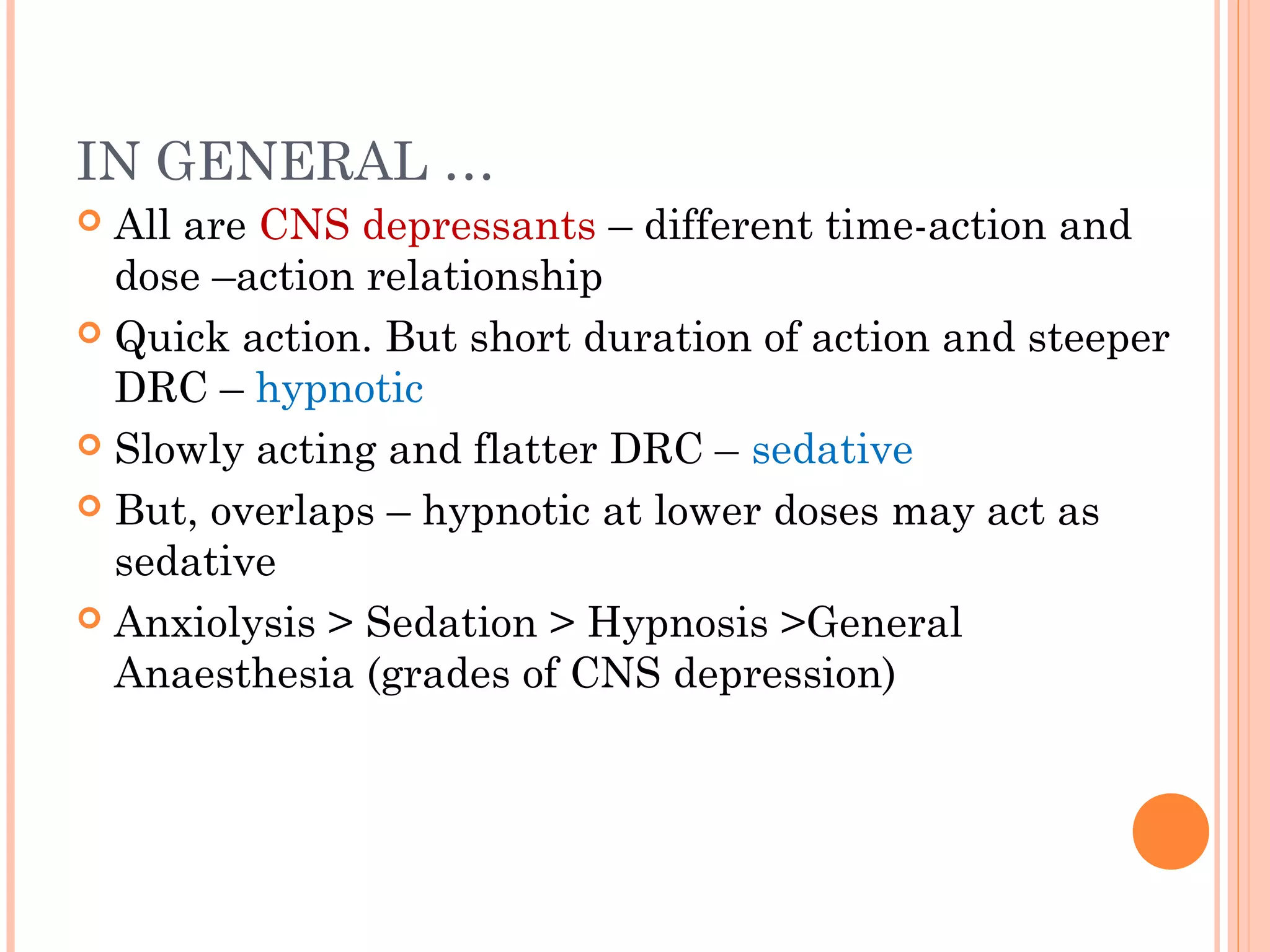
 Acts via (inhibitory) ligand gated BZD: GABAA receptor- Cl-
channel
complex
 α/γ subunits carries the BZD binding site - BZD receptors are
integral to GABAA receptor
 BZDs modulate action on GABA receptor - increases frequency of
channel opening (unlike Barbiturate - Potentiation)
 Also enhances binding of GABA to GABAA receptor
 Bicuculine (GABAA antagonist) antagonizes BZD action as non-
competitive
 BZDs are GABA facilitator but not Mimetic (unlike Barbiturates)
 Constitutive action – fine tunes GABA action – bidirectional
 BZD agonists enhance GABA action (hyperpolarization) – but
antagonists like dimethoxyethyl-carbomethoxy-β-carboline (DMCM)
inhibits GABA
BZD - KINETICS
 Marked pharmacokinetic differences – differ in lipid
solubility
 Oral absorption – some rapid, some slow; on IM injection –
irregular absorption except lorazepam
 Plasma protein binding also varies (Flurazepam – 10%;
Diazepam 99%)
 Usually short duration of action – with a single dose –
REDISTRIBUTION – prediction of duration of action is
difficult
 Metabolism: In Liver by dealkylation and hydroxylation to
metabolites (some are active) – Biological half-life longer
than plasma half life
 Enterohepatic circulation – Diazepam and excreted in
urine as glucoronide conjugate
 BZDs are secreted in milk and crosses placenta
BZD - COMPARISON
Drugs Half life (hour)
Diazepam 30 - 60
Nitrazepam 30
Flurazepam 50-100
Alprazolam 12
Chlordiazepoxide 15 - 40
Lorazepam 10 - 20
Temazepam 8 - 12
INDIVIDUAL DRUGS
 Slow elimination but rapid redistribution
 Diazepam: Generates active metabolite (desmethyl-diazepam, oxazepam)
– single dose no residual effects – regular use accumulation and
prolonged anxiolytic effect – Difference with others
 Nitrazepam: Accumulates - Residual effects – day time sedation (not on
single dose) – for frequent nocturnal awakening patients (if day time
sedation acceptable)
 Flurazepam: Slow elimination of parent drug or metabolite - Produces
active metabolite which have long half life – residual effects frequently
(morning) – cumulation – day time sedation (if day time sedation
acceptable)
 Rapid elimination and marked redistribution
 Alprazolam: Basically used as anxiolytic – but also night time hypnotic –
withdrawal phenimenon after regular use - sedation
 Temazepam: No residual effect, no metabolite – used in sleep onset
difficulty
 Ultrarapid elimination: Triazolam – potent, quick acting – for
induction of sleep
BZDS – ADVERSE EFFECTS
 Older individuals are more susceptible – Be careful
 Hypnotic doses: Dizziness, vertigo, ataxia, disorientation,
amnesia, prolongation of reaction time – impairment of
psychomotor skill
 Hang over with larger doses – long acting ones
 Weakness, blurring of vision, dry mouth and urinary incontinence
 Paradoxical stimulation, irritability and sweating – Flurazepam
 Nightmares and behaviuoral alteration – Nitrazepam
 Tolerance to sedative effect very slowly – little tendency to increase
dose – cross tolerance to alcohol and other CNS depressants
 Dependence liability and drug seeking behaviour – low (bland) -
Midazolam
 Low withdrawal syndrome – more with ultrarapid ones – anxiety,
insomnia, restlessness, malaise, loss of appetite, bad dreams
 Pregnancy – flaccidity and respiratory depression in neonate
NONBENZODIAZEPINES -
ZOPICLONE
 Cyclopyrrolone derivative - active metabolite – N-
desmethylzopiclone
 MOA: Binds to α subunit of BZD receptor (Unlike BZD) –
hypnotic action
 Vs BZD: Sleep resembles but – does not alter REM and
tends to prolong stage 3 and stage 4 (Unlike BZD)
 No sleep architecture distortion or withdrawal phenomena
 Uses: to wean off insomniacs on BZD and short term
therapy for insomnia
 ADRs: Metallic taste, impairment of judgment and
alertness, psychological disturbance – addictive property
(rarely)
 Half life: 5 – 6 hours
ZOLPIDEM - IMIDAZOPYRIDINE
 MOA: Acts on α1 subunit of BZD receptor (hypnotic)
 Actions: Sleep latency shortened, prolongs sleep time
– but no anticonvulsant, antianxiety or muscle
relaxant effects
 Lack of effect on sleep stages (REM)
 Minimal residual day time sedation or fading of effects on
repeated use
 Little rebound insomnia on discontinuation
 Absence of tolerance, physical dependence and low abuse
potential
 Kinetics: Completely metabolized in liver – half life –
2 hrs
 Uses: short term therapy of sleep onset insomnia –
day time sedation less (short half life) – late night (!)
 Most popular – even large doses no respiratory
depression
ZALEPLON
 Shortest acting - acts on α1 subunit of BZD
receptor (hypnotic)
 Rapidly absorbed (30% bioavailability – high first
pass) – rapidly cleared by hepatic metabolism –
Half life (1 hr) – no active metabolite
 Does not prolong total sleep time or reduce the
number of awakenings
 Can be taken late night – no morning sedation,
anxiety or insomnia
 No tolerance or dependence
 Uses: Sleep-onset insomnia (1-2 weeks therapy)
USES OF BZDS
 As Hypnotic: Not all are useful as hypnotic agents, although
all have sedative or calming effects
 As anxiolytic and for day time sedation
 As anticonvulsant – status epilepticus, febrile convulsion,
tetanus
 As Muscle relaxant (centrally acting)
 Preananesthetic medication, IV anaesthesia and conscious
sedation
 Before procedures: ECT, electrical cardioversion of
arrhythmias, cardiac catheterization, endoscopies and other
minor procedures
 Alcohol and other sedative-hypnotic withdrawal
 Along with analgesics, NSAIDs, spasmolytics, antiulcer and
many other drugs
AS HYPNOTIC
 A hypnotic should not be casually prescribed for every
case of insomnia – BZDs and Non-BZDs are most
frequently used
 The choice of a particular BZD to treat a sleep
disturbance is generally based on Pharmacokinetic
criteria:
 Long-acting compounds (e.g. flurazepam) may
ensure that a patient will sleep through the night,
they also may cause cumulative effects resulting in
daytime sluggishness or drug hangover
 Short-acting compounds (e.g. triazolam) avoid the
hangover problem, but their use may be associated
with early awakening and an increase in daytime
anxiety
BZD AS HYPNOTIC – GENERAL
POINTS
 A hypnotic should be used – (1) shorten sleep
latency, (2) to reduce nocturnal awakening and
(3) to provide anxiolytic effect the next day
 Should consider onset of action and duration of
action of the drug
 Should consider next day effects – prolonged
sedation or rebound anxiety
 All become useless after regular use – except ` z`
drugs
 Should consider the subjects perception and
assessment
INSOMNIA
 Chronic Insomnia (> 3 weeks) – Be cautious prescribing
hypnotics
 May be Personality disorder; chronic hypnotic user; alcoholic;
somatic diseases – GERD, pain, COPD
 Other measures - Exercise, yoga, counseling – advice avoiding
anxiety, attempting sleep when maximum sleepiness, avoid
napping day time, coffee/alcohol restriction treatment of
concurrent diseases
 Intermittent use of hypnotics
 Short term insomnia (3 – 21 days): Emotional problem –
stress, bereavement and physical illness etc. – either induction
difficulty or waking up early – Hypnotic free of residual effects
(sometimes may be needed) - short acting drugs in elderly
 Transient insomnia (1 – 3 days): Alterations in the
circumstances – new place, journey, work related, night shift,
travel jetlag etc. – a short acting without residual effects
FLUMAZENIL
 BZD analogue, but specific BZD receptor
antagonist – no IA – no effect on normal
person
 Competes with BZD agonists and inverse
agonists – reverses their action
 Absorbed orally (20% bioavailability), but used
IV and intranasal - half life- 1 hr
 Uses:
 To reverse BZD anesthesia – quick action within 1 minute
– Resedation
 BZD overdose
SUMMARY
 Name of different Barbiturates – Details
of Phenobarbitone and Thiopentone
 Benzodiazepine Classification (long and
short acting)
 Mechanism of action of BZD
 Uses of BZD
 Non-benzodiazepines
 Pharmacotherapy of Insomnia
 Remember Flumazenil
THANK YOU