
ANTIEMETICS
DR.ZIKRULLAH
INTRODUCTION
• Short description pathophysiology of nausea
and vomiting
• Classification of antiemetics based on
mechanism of action and specific receptor
activity.
• Pharmacodynamics and pharmacokinetics of
antiemetic drugs.
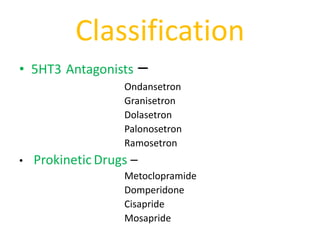
Classification
• 5HT3 Antagonists –
Ondansetron
Granisetron
Dolasetron
Palonosetron
Ramosetron
• Prokinetic Drugs –
Metoclopramide
Domperidone
Cisapride
Mosapride
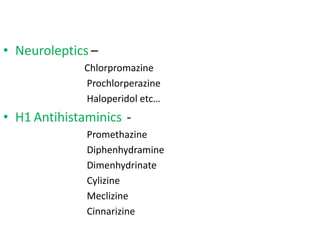
• Neuroleptics –
Chlorpromazine
Prochlorperazine
Haloperidol etc…
• H1 Antihistaminics -
Promethazine
Diphenhydramine
Dimenhydrinate
Cylizine
Meclizine
Cinnarizine
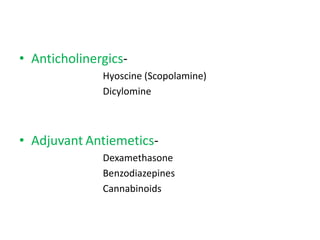
• Anticholinergics-
Hyoscine (Scopolamine)
Dicylomine
• Adjuvant Antiemetics-
Dexamethasone
Benzodiazepines
Cannabinoids
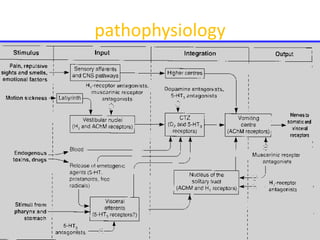
Pathophysiology -
 Vomiting centre lies in the medulla oblongata.
 The chemoreceptor trigger zone (CTZ) and the nucleus
tractus solitarius (NTS) the most important relay areas for
afferent impulses arising in the G.I.T., throat ,and other
viscera.
 The CTZ is accessible to blood born drugs, toxins etc because
of it lack blood brain barrier.
 The CTZ and NTS expresses different receptors eg
Histaminic H1,Dopamine D2, Serotonin 5HT3,Cholinergic M
And opoid
 Emetic signals are relayed through these receptors, which
could be target of antiemetic drug action.
 Impulses from vestibular apparatus reaches vomiting centre
mainly relayed from the cerebellum and utilises muscarinic
and H1 receptors.
 Cytotoxic drugs, radiation , and other G.I. irritant release
serotonin (5HT) from enterochromaffin cells acts on 5 HT
receptors present on vagal afferent and send impulse to
NTS and CTZ .
 Released in large quantities 5HT may also spill into
circulation and reach CTZ.
pathophysiology
Vomiting Centre
(medulla)
Cerebral cortex
Anticipatory emesis
Smell
Sight
Thought
Vestibular
nucleiMotion
sickness
Pharynx & GIT
Chemo & radio therapy
Gastroenteritis
Chemoreceptor
Trigger Zone
(CTZ)
(Outside BBB)
Cancer chemotherapy
Opioids
Muscarinic, 5 HT3 &
Histaminic H1
5 HT3 receptors
Dopamine D2
5 HT3,,Opioid
Receptors
Muscarinic
Histaminic H1
Pathophysiology of Emesis
Drug Dopamine Acetylcholine Histamine Serotonin
Anticholinergic
scopolamine + ++++ + _
Antihistamines + ++/+++ ++++ _
Antiserotonins _ _ _ ++++
Benzamides -
Domperidone
Metoclopramide
++++
+++
_
_
_
_
+
++
Neuroleptics ++++ +/- +/++ -/+
Steroids _ _ _ _
RECEPTOR Specificity-
5HT3 Antagonists-
ONDANSETRON-
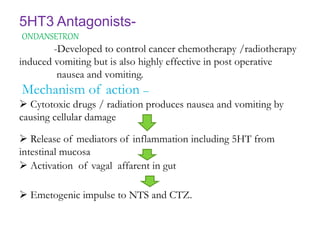
-Developed to control cancer chemotherapy /radiotherapy
induced vomiting but is also highly effective in post operative
nausea and vomiting.
Mechanism of action –
 Cytotoxic drugs / radiation produces nausea and vomiting by
causing cellular damage
 Release of mediators of inflammation including 5HT from
intestinal mucosa
 Activation of vagal affarent in gut
 Emetogenic impulse to NTS and CTZ.
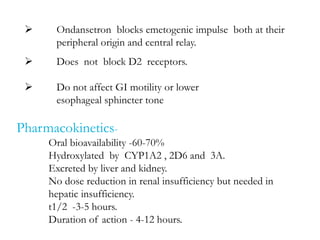
 Ondansetron blocks emetogenic impulse both at their
peripheral origin and central relay.
 Does not block D2 receptors.
 Do not affect GI motility or lower
esophageal sphincter tone
Pharmacokinetics-
Oral bioavailability -60-70%
Hydroxylated by CYP1A2 , 2D6 and 3A.
Excreted by liver and kidney.
No dose reduction in renal insufficiency but needed in
hepatic insufficiency.
t1/2 -3-5 hours.
Duration of action - 4-12 hours.
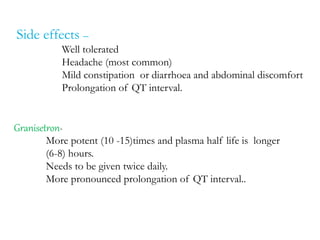
Side effects –
Well tolerated
Headache (most common)
Mild constipation or diarrhoea and abdominal discomfort
Prolongation of QT interval.
Granisetron-
More potent (10 -15)times and plasma half life is longer
(6-8) hours.
Needs to be given twice daily.
More pronounced prolongation of QT interval..
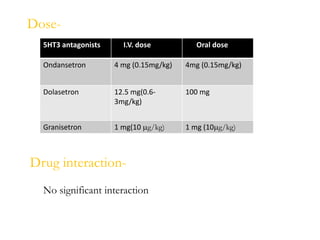
5HT3 antagonists I.V. dose Oral dose
Ondansetron 4 mg (0.15mg/kg) 4mg (0.15mg/kg)
Dolasetron 12.5 mg(0.6-
3mg/kg)
100 mg
Granisetron 1 mg(10 mg/kg) 1 mg (10mg/kg)
Dose-
Drug interaction-
No significant interaction
Prokinetic drugs-
Metoclopramide-
 Chemically related to procainamide but no pharmacological
similarity with it.
GASTRIC HURRYING AGENT. ’
Mechanism of action –
Acts through both dopaminergic and serotonergic receptors.
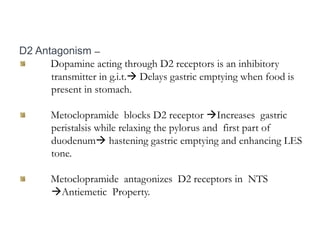
D2 Antagonism –
Dopamine acting through D2 receptors is an inhibitory
transmitter in g.i.t. Delays gastric emptying when food is
present in stomach.
Metoclopramide blocks D2 receptor Increases gastric
peristalsis while relaxing the pylorus and first part of
duodenum hastening gastric emptying and enhancing LES
tone.
Metoclopramide antagonizes D2 receptors in NTS
Antiemetic Property.
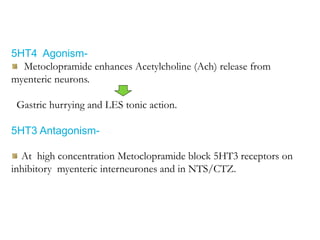
5HT4 Agonism-
Metoclopramide enhances Acetylcholine (Ach) release from
myenteric neurons.
Gastric hurrying and LES tonic action.
5HT3 Antagonism-
At high concentration Metoclopramide block 5HT3 receptors on
inhibitory myenteric interneurones and in NTS/CTZ.
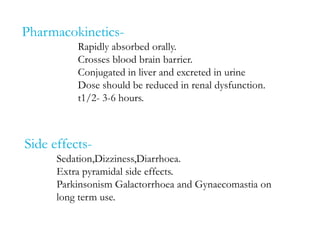
Pharmacokinetics-
Rapidly absorbed orally.
Crosses blood brain barrier.
Conjugated in liver and excreted in urine
Dose should be reduced in renal dysfunction.
t1/2- 3-6 hours.
Side effects-
Sedation,Dizziness,Diarrhoea.
Extra pyramidal side effects.
Parkinsonism Galactorrhoea and Gynaecomastia on
long term use.
Dose-
0.25 mg/kg (10-20 mg adult dose) is effective orally ,i.m. or i.v.
Higher dose (1-2 mg) is used for emesis during chemotherapy.
Drug interactions-
Antimuscarinic drugs block GI effects of metoclopramide.
Decreases absorption of orally administered Cimetidine.
Concurrent use of neuroleptics increases likelihood of extra
pyramidal side effects.
Domperidone-
• D2 Antagonists.
• Chemically related to haloperidol but pharmacologically
related to metoclopramide.
• Lower ceiling antiemetic and prokinetic action .
• Crosses blood brain barrier poorly
.
• Extra pyramidal side effects are rare but hyperprolactenemia
can occur.
Cisapride-
• Prokinetic drug with little anti emetic property.
• Action is mainly due to 5HT4 agonism and 5HT3 antagonism.
• Lacks D2 receptor antagonism.
• Oral bioavailability is 33%
• Hepatic metabolism by CYP3A4.
• Severe ventricular arrhythmias ,prolongation of QTc interval
and torsades de pointes,when taken with CYP3A4 inhibitors
Neuroleptics-( CHLORPROMAZINE)
• D2 Antagonists.
• Potent antiemetics.
• Broad spectrum antiemetic action but not effective in motion
sickness.
• Antiemetic dose is lower generally than antipsychotic doses.
• Side effects –
Sedation
Acute muscle dystonia
Extra pyramidal signs.
H1 Antihistaminics-
Mechanism of action -
Based on anticholinergic, antihistaminic and sedative
properties.
• Mainly used in motion sickness and to a lesser extent in morning
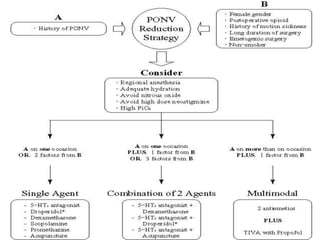
sickness and PONV.
• When combined with Metoclopramide , blocks extra pyramidal
side effect while supplementing its antiemetic action.
Anticholinergics
• Most effective for motion sickness.
• Shown to have some activity in PONV.
• Side effects are urinary retention ,difficulty in visual
accommodation , exacerbation of glaucoma.
• eg. Hyosine , dicyclomine.
Corticosteroids-
DEXAMETHASONE-
o Synthetic glucocorticoid
o Effective antiemetics for PONV , chemotherapy and
radiation induced nausea vomiting.
o Effective for refractory nausea and vomiting particularly
in children.
o Effective up to 24 hrs ,useful for postdischarge nausea
and vomiting.
Mechanism of Action
o Anti-emetic mechasnism of Dexa. is still unclear
o Some experimental studies results suggest that dexamethasone
exerts its central anti-emetic action through an activatoin of the
gluco-corticoid receptors in the B/L (Bilateral) NTS in the
medulla, not AP (area of postrema)
Dose: - (anti-emetic)
150 µg/kg in child &
8 mg i.v.in adult
The anti-emetic effect are more when Dexa. is used with the
combination of ondansetron.
Antiemetics
Antiemetics