Opiate overdose
Opiate overdose
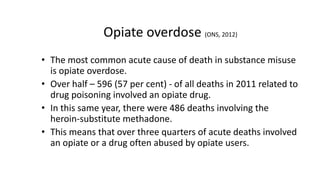
(ONS, 2012)
• The most common acute cause of drug-related death is opiate
overdose.
• Over half – 596 (57 per cent) - of all deaths in 2011 related to
drug poisoning involved an opiate drug.
• In this same year, there were 486 deaths involving the heroin-
substitute methadone.
• This means that over three quarters of acute deaths involved
an opiate or a drug often abused by opiate users.
Opiate overdose
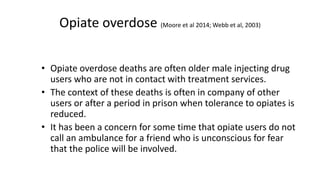
(Moore et al 2014; Webb et al, 2003)
• Opiate overdose deaths are often older male injecting drug
users who are not in contact with treatment services.
• The context of these deaths is often in company of other
users or after a period in prison when tolerance to opiates is
reduced.
• It has been a concern for some time that opiate users do not
call an ambulance for a friend who is unconscious for fear that
the police will be involved.
Opiate overdose symptoms are likely to be:
• Drowsiness
• Pinpoint pupils
• Slowed breathing
• History of recent drug use (is there a syringe or foil around?)
If you suspect an overdose – call 999 and ask for an ambulance.
Opiate overdose symptoms
Opiate overdose – acute care
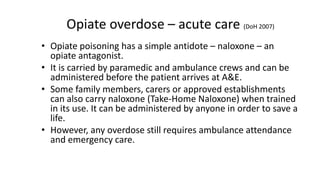
(DoH 2007)
• Opiate poisoning has a simple antidote – naloxone – an opiate
antagonist.
• It is carried by paramedic and ambulance crews and can be
administered before the patient arrives at A&E.
• Some family members, carers or approved establishments can also
carry naloxone (Take-Home Naloxone) when trained in its use. It can
be administered by anyone in order to save a life.
• However, any overdose still requires ambulance attendance and
emergency care.
• All services working with problem drug users should have an
emergency protocol in place that covers the management of drug
overdoses. This should include rapid ambulance call and competent
preservation of a clear airway, and may include protocols for the
emergency administration of interim naloxone while awaiting the
arrival of the ambulance
References
• Department of Health (England) and the devolved administrations (2007). Drug Misuse
and Dependence: UK Guidelines on Clinical Management. London: Department of
Health (England), the Scottish Government, Welsh Assembly Government and
Northern Ireland Executive.
• Moore, C. Lloyd, G. Oretti, R. Russell, I. and Snooks, H. (2014) Paramedic-supplied
‘Take Home’ Naloxone: protocol for cluster randomised feasibility study. BMJ
Open 2014;4:e004712 doi:10.1136/bmjopen-2013-004712
• National Records of Scotland (2014) Drug-related deaths in Scotland in 2014. Available
at: http://www.nrscotland.gov.uk/files//statistics/drug-related-deaths/drd14/drugs-
related-deaths-2014.pdf
• ONS (2014) Deaths related to drug poisoning in England and Wales, 2014
registrations. Available at: http://www.ons.gov.uk/ons/dcp171778_414574.pdf
• Webb, L., Oyefeso, A., Schifano, F., Cheeta, S., Pollard, M. & Ghodse, H. (2003)
Cause and manner of death in drug-related fatality: an analysis of drug-related deaths
recorded by coroners in England and Wales in 2000. Drug and Alcohol Dependence,
72, 67-74.
Opiate overdose

Opiate overdose

  • 1.
  • 2.
    Opiate overdose (ONS, 2012) •The most common acute cause of drug-related death is opiate overdose. • Over half – 596 (57 per cent) - of all deaths in 2011 related to drug poisoning involved an opiate drug. • In this same year, there were 486 deaths involving the heroin- substitute methadone. • This means that over three quarters of acute deaths involved an opiate or a drug often abused by opiate users.
  • 3.
    Opiate overdose (Moore etal 2014; Webb et al, 2003) • Opiate overdose deaths are often older male injecting drug users who are not in contact with treatment services. • The context of these deaths is often in company of other users or after a period in prison when tolerance to opiates is reduced. • It has been a concern for some time that opiate users do not call an ambulance for a friend who is unconscious for fear that the police will be involved.
  • 4.
    Opiate overdose symptomsare likely to be: • Drowsiness • Pinpoint pupils • Slowed breathing • History of recent drug use (is there a syringe or foil around?) If you suspect an overdose – call 999 and ask for an ambulance. Opiate overdose symptoms
  • 5.
    Opiate overdose –acute care (DoH 2007) • Opiate poisoning has a simple antidote – naloxone – an opiate antagonist. • It is carried by paramedic and ambulance crews and can be administered before the patient arrives at A&E. • Some family members, carers or approved establishments can also carry naloxone (Take-Home Naloxone) when trained in its use. It can be administered by anyone in order to save a life. • However, any overdose still requires ambulance attendance and emergency care. • All services working with problem drug users should have an emergency protocol in place that covers the management of drug overdoses. This should include rapid ambulance call and competent preservation of a clear airway, and may include protocols for the emergency administration of interim naloxone while awaiting the arrival of the ambulance
  • 6.
    References • Department ofHealth (England) and the devolved administrations (2007). Drug Misuse and Dependence: UK Guidelines on Clinical Management. London: Department of Health (England), the Scottish Government, Welsh Assembly Government and Northern Ireland Executive. • Moore, C. Lloyd, G. Oretti, R. Russell, I. and Snooks, H. (2014) Paramedic-supplied ‘Take Home’ Naloxone: protocol for cluster randomised feasibility study. BMJ Open 2014;4:e004712 doi:10.1136/bmjopen-2013-004712 • National Records of Scotland (2014) Drug-related deaths in Scotland in 2014. Available at: http://www.nrscotland.gov.uk/files//statistics/drug-related-deaths/drd14/drugs- related-deaths-2014.pdf • ONS (2014) Deaths related to drug poisoning in England and Wales, 2014 registrations. Available at: http://www.ons.gov.uk/ons/dcp171778_414574.pdf • Webb, L., Oyefeso, A., Schifano, F., Cheeta, S., Pollard, M. & Ghodse, H. (2003) Cause and manner of death in drug-related fatality: an analysis of drug-related deaths recorded by coroners in England and Wales in 2000. Drug and Alcohol Dependence, 72, 67-74.