ANTI-EMETICS 
SUBJECT: SYSTEMIC PHARMACOLGY 
23-10-2014 
MERIN BABU 
M.Pharm 1st Semester 
Department of Pharmacology 
Amrita School Of Pharmacy, Kochi
NAUSEA & VOMITING 
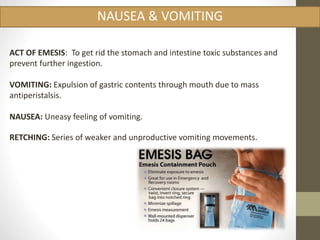
ACT OF EMESIS: To get rid the stomach and intestine toxic substances and 
prevent further ingestion. 
VOMITING: Expulsion of gastric contents through mouth due to mass 
antiperistalsis. 
NAUSEA: Uneasy feeling of vomiting. 
RETCHING: Series of weaker and unproductive vomiting movements.
VOMITING 
• Vomiting is a complex process that consists of : 
• PRE-EJECTION PHASE: 
Gastric relaxation and retro peristalsis. 
• RETCHING: 
Rhythmic action of respiratory muscles preceding vomiting and 
consist of abdominal & intercoastal muscles and diaphragm against a closed 
glottis. 
• EJECTION: 
Intense contraction of abdominal muscles and relaxation of upper 
oesophageal sphincter. 
• Followed by multiple autonomic phenomena: 
Salivation, Shivering, Vasomotor changes
ANTI-EMETIC MECHANISM
ANTI-EMETIC MECHANISM 
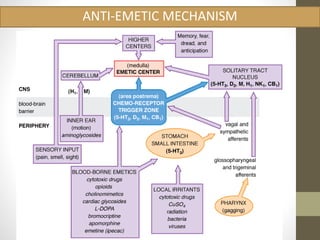
• Anti-emesis process is 
coordinated by a central emesis 
center in lateral reticular 
formation of midbrain adjacent 
to both chemoreceptor trigger 
zone (CTZ) in the area 
postrema (AP) at the bottom of 
4th ventricle and solitary tract 
nucleus (STN). 
• Lack of blood-brain barrier 
(BBB) allows CTZ to monitor 
the blood and CSF for toxic 
substances and to relay 
information to emesis center to 
trigger nausea and vomiting.
ANTI-EMETIC MECHANISM 
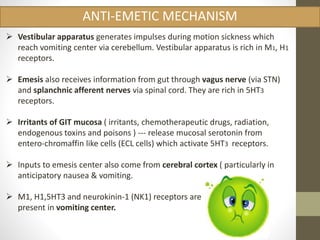
 Vestibular apparatus generates impulses during motion sickness which 
reach vomiting center via cerebellum. Vestibular apparatus is rich in M1, H1 
receptors. 
 Emesis also receives information from gut through vagus nerve (via STN) 
and splanchnic afferent nerves via spinal cord. They are rich in 5HT3 
receptors. 
 Irritants of GIT mucosa ( irritants, chemotherapeutic drugs, radiation, 
endogenous toxins and poisons ) --- release mucosal serotonin from 
entero-chromaffin like cells (ECL cells) which activate 5HT3 receptors. 
 Inputs to emesis center also come from cerebral cortex ( particularly in 
anticipatory nausea & vomiting. 
 M1, H1,5HT3 and neurokinin-1 (NK1) receptors are 
present in vomiting center.
CLASSIFICATION OF ANTI-EMETIC DRUGS 
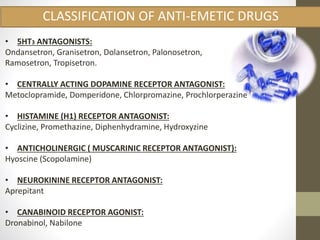
• 5HT3 ANTAGONISTS: 
Ondansetron, Granisetron, Dolansetron, Palonosetron, 
Ramosetron, Tropisetron. 
• CENTRALLY ACTING DOPAMINE RECEPTOR ANTAGONIST: 
Metoclopramide, Domperidone, Chlorpromazine, Prochlorperazine 
• HISTAMINE (H1) RECEPTOR ANTAGONIST: 
Cyclizine, Promethazine, Diphenhydramine, Hydroxyzine 
• ANTICHOLINERGIC ( MUSCARINIC RECEPTOR ANTAGONIST): 
Hyoscine (Scopolamine) 
• NEUROKININE RECEPTOR ANTAGONIST: 
Aprepitant 
• CANABINOID RECEPTOR AGONIST: 
Dronabinol, Nabilone
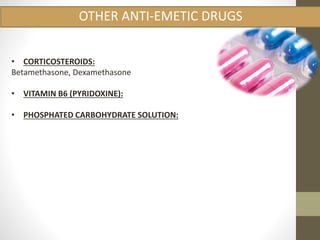
OTHER ANTI-EMETIC DRUGS 
• CORTICOSTEROIDS: 
Betamethasone, Dexamethasone 
• VITAMIN B6 (PYRIDOXINE): 
• PHOSPHATED CARBOHYDRATE SOLUTION:
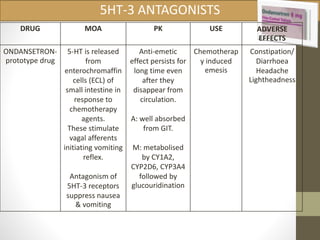
5HT-3 ANTAGONISTS 
DRUG MOA PK USE ADVERSE 
EFFECTS 
ONDANSETRON-prototype 
drug 
5-HT is released 
from 
enterochromaffin 
cells (ECL) of 
small intestine in 
response to 
chemotherapy 
agents. 
These stimulate 
vagal afferents 
initiating vomiting 
reflex. 
Antagonism of 
5HT-3 receptors 
suppress nausea 
& vomiting 
Anti-emetic 
effect persists for 
long time even 
after they 
disappear from 
circulation. 
A: well absorbed 
from GIT. 
M: metabolised 
by CY1A2, 
CYP2D6, CYP3A4 
followed by 
glucouridination 
Chemotherap 
y induced 
emesis 
Constipation/ 
Diarrhoea 
Headache 
Lightheadness
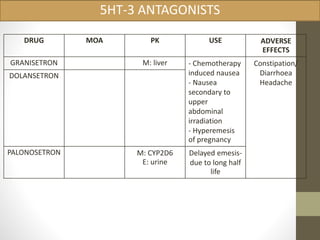
5HT-3 ANTAGONISTS 
DRUG MOA PK USE ADVERSE 
EFFECTS 
GRANISETRON M: liver - Chemotherapy 
induced nausea 
- Nausea 
secondary to 
upper 
abdominal 
irradiation 
- Hyperemesis 
of pregnancy 
Constipation/ 
Diarrhoea 
Headache 
DOLANSETRON 
PALONOSETRON M: CYP2D6 
E: urine 
Delayed emesis-due 
to long half 
life
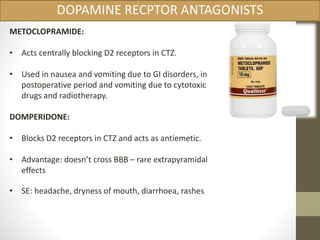
DOPAMINE RECPTOR ANTAGONISTS 
METOCLOPRAMIDE: 
• Acts centrally blocking D2 receptors in CTZ. 
• Used in nausea and vomiting due to GI disorders, in 
postoperative period and vomiting due to cytotoxic 
drugs and radiotherapy. 
DOMPERIDONE: 
• Blocks D2 receptors in CTZ and acts as antiemetic. 
• Advantage: doesn’t cross BBB – rare extrapyramidal 
effects 
• SE: headache, dryness of mouth, diarrhoea, rashes
ANTI-HISTAMINERGIC DRUGS 
• H1 antagonists --- useful for motion sickness and post-operative emesis. 
• Act on vestibular afferents and within brainstem. 
CYCLIZINE, HYDROXYCYZINE, PROMETHAZINE, DIPHENHYDRAMINE. 
PROMETHAZINE: 
• Most potent and effective. 
• Drug must be taken 1 hr before the motion. 
• Useful for chemotherapy/ radiation therapy for malignancies.
ANTI-CHOLINERGIC DRUGS 
HYOSCINE (SCOPOLAMINE): 
• Labyrinthine sedative. 
 Very effective in motion sickness. 
• Motion sickness is due to over stimulation of vestibular 
apparatus along with psychological and environmental 
factors. 
 Given as transdermal patch. 
 Useful for post-operative nausea & vomiting.
SUBSTANCE P ANTAGONISTS 
Nausea and vomiting associated with Cisplatin have 
2 components: 
Acute Phase: within 24hrs after chemotherapy 
Delayed Phase: affects only some patients ( only 
days 2-5) 
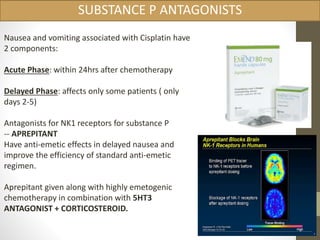
Antagonists for NK1 receptors for substance P 
-- APREPITANT 
Have anti-emetic effects in delayed nausea and 
improve the efficiency of standard anti-emetic 
regimen. 
Aprepitant given along with highly emetogenic 
chemotherapy in combination with 5HT3 
ANTAGONIST + CORTICOSTEROID.
CANNABINOIDS 
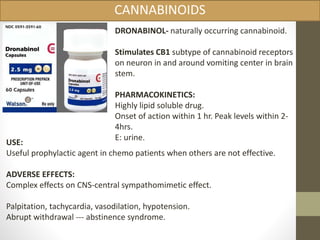
DRONABINOL- naturally occurring cannabinoid. 
Stimulates CB1 subtype of cannabinoid receptors 
on neuron in and around vomiting center in brain 
stem. 
PHARMACOKINETICS: 
Highly lipid soluble drug. 
Onset of action within 1 hr. Peak levels within 2- 
4hrs. 
E: urine. 
USE: 
Useful prophylactic agent in chemo patients when others are not effective. 
ADVERSE EFFECTS: 
Complex effects on CNS-central sympathomimetic effect. 
Palpitation, tachycardia, vasodilation, hypotension. 
Abrupt withdrawal --- abstinence syndrome.
OTHER ANTI-EMETICS 
GLUCOCORTICOIDS: 
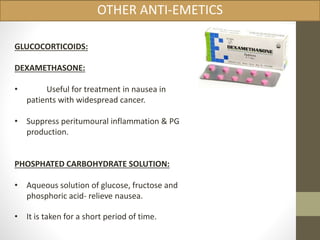
DEXAMETHASONE: 
• Useful for treatment in nausea in 
patients with widespread cancer. 
• Suppress peritumoural inflammation & PG 
production. 
PHOSPHATED CARBOHYDRATE SOLUTION: 
• Aqueous solution of glucose, fructose and 
phosphoric acid- relieve nausea. 
• It is taken for a short period of time.
TYPES OF EMESIS 
 MOTION SICKNESS 
 MORNING SICKNESS (VOMITING 
DURING PREGNANCY) 
 CHEMOTHERAPY/ RADIATION 
INDUCED NAUSEA AND EMESIS 
(CIE) 
 POST OPERATIVE EMESIS 
 VOMITING OF VARIED ORIGIN & 
ADJUVANT ANTI-EMETIC
TYPES OF EMESIS-MOTION SICKNESS 
Result during space flights, taking off and 
landing of an aeroplane etc. 
It is a labyrinthine vomiting via stimulation of 
vestibular nuclei. 
Drugs used: 
H1 ANTAGONIST/ CENTRAL ACTING 
ANTICHOLINERGIC. 
Hyoscine. 
Side effects of hyoscine: anticholinergic 
Blurred vision, dryness of mouth, 
cyclopelgia, sedation and sleepiness. 
DIPHENHYDRAMINE, CYCLIZINE, MECLIZINE 
– prevents motion sickness and treatment of 
vertigo due to labyrinth dysfunction. 
CINNARAZINE-Anti vertigo drug. 
Used in prevention of motion 
sickness. 
Acts as antihistaminic, 
anticholinergic, antiserotonin & 
Ca2+ channel blocker. 
Inhibits influx of Ca2+ from 
endolymph into vestibular 
apparatus.
TYPES OF EMESIS-MORNING SICKNESS 
• Morning sickness ( Vomiting during 
pregnancy). 
• During 1st trimester of pregnancy due to 
effect of increased oestrogen levels on 
CTZ. 
• DOXYLAMINE- safest drug. 
CYCLIZINE, MECLIZINE 
• VITAMIN B6 (PYRIDOXINE): 
High doses (60mg/d) acts as 
cofactor for enzyme glutamate 
decarboxylase and increases GABA. 
• Inhibits neurotransmitter at CTZ.
TYPES OF EMESIS- CIE 
• Anti-cancer drugs induce emesis by direct 
activation of 5HT3 receptors in CTZ / may activate 
vagal and splanchnic 5HT3 receptors to send 
emetogenic signals to vomiting center through 
neurotransmitters. 
 ONDANSETRON 
 GRANISETRON 
 DOLASETRON 
 TROPISETRON 
 PALONOSETRON 
 RAMOSETRON
TYPES OF EMESIS-POST OPERATIVE VOMITING 
• Complications in patients receiving general 
anaesthesia. 
• 5HT3 ANTAGONIST- preferred 
• PROCHLORAZINE- blocks Dopamine 2 and 
muscarinic receptors. 
• PROMETHAZINE- potent anticholinergic and 
antihistaminic.
TYPES OF EMESIS-VOMITING OF VARIED ORIGIN 
 Drug induced vomiting. 
 Increased intra-cranial pressure induces emesis. 
 Vomiting in patients due to brain injury, cerebral tumour, 
hydrocephalous- increases CSF pressure. 
- Activates receptors on CTZ. 
 NABILONE, DRONABINOL.
REFERENCE 
i. Laurence L.B, Bruce A C, Bjorn C K. Goodman and Gilman’s The 
Pharmacological Basis of Therapeutics.2011. 12th edition. China: Mc 
Graw Hill books; pp: 1341-6. 
ii. Padmaja Udayakumar. Textbook of medical pharmacology.2nd edition. 
New Delhi: CBS Publishers and distributors; pp: 326-9. 
iii. Sharma HL , Sharma KK. Principles of pharmacology.2nd edition. 
Hyderabad: Paras publisher; pp: 395-9.