WELCOME
ANTIASTHMATICSPresented byP.Pavani10T22SO112      Under The Guidence 						      of                                   Mr. J. Anoop
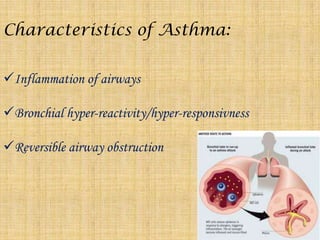
..Definition:Asthma is a chronic inflammatory disorder of the  airways that is characterized by increased responsiveness of the tracheobranchial tree to a variety of stimuli resulting in widespread spasmodic narrowing of the air passages which may be relieved spontaneously or therapy. Asthma literally meaning ‘Panting’Characteristics of Asthma:Inflammation of airways
Bronchial hyper-reactivity/hyper-responsivness
Reversible airway obstructionCLASSIFICATION OF ASTHMA:Based on the stimuli initiating  bronchial asthma,broad etiologic types are described:Extrinsic(allergic, atopic)  asthma		Intrinsic(idiosyncratic,non-atopic) asthma		Mixed type
PATHOPHYSIOLOGY:
MORPHOLOGICAL FEATURES:              1.The mucus plugs contain normal or degenerated respiratory epithelium forming twisted strips called “Curschmann’ssprials”.             2.The sputum usually contains numerous eosinophils and diamond-shaped crystals derived from eosinophils called               “Charcot-Leyden crystals”.            3. Airway  remodeling.
Symptoms:    Early Warning SignsBreathing changes			Sneezing			Runny/stuffy nose			Coughing			Chin or throat itches			Feeling tired			Dark circles under eyes			Trouble sleeping   Asthma Episode SymptomsWheezing			Shortness of breath			Tightness in the chest
 Severe Asthma Episode Symptoms	personal Severe coughing, wheezing, 	Shortness of breath or tightness in the chest		Difficulty talking or concentrating		Walking causes shortness of breath		Breathing may be shallow and fast or slower than usual		Hunched shoulders (posturing)		Nasal flaring  		Retractions		Cyanosis.
Asthma Diagnosis:The diagnosis of asthma is based on:History
Physical examination
Supportive diagnostic tests:*Pulmonary funcion testsSpirometery			Peak flow meterMethacholine challenge test*Allergic test		*Chest x-ray 		*GERD assesment test
APPROACHES TO  TREATMENT:1.Prevention of AG:AB reactions2.Neutralisation  of IgE antibodyeg: Omalizumab3.Suppresssion of inflamation and bronchial hyperreactivityeg: cotricosteriods4.Prevention of realease of mediatorseg: mast cell stabilisers5.Antagonism of realeased mediatorseg: leukotrieneantagonists6.Blocked of constictor neurotransmitterseg:anticholinergics7.Mimicking dilator neurotransmittereg:sympathomimetics.8.Directly acting bronchodilatorseg:methylxanthines
CLASSIFICATION:Bronchodilatorsß2 sympathomimetics  :    Salbutamol, Terbutaline,SalmetrolMethylxanthines   :   Theophylline, AminophyllineAnticholinergics    :       Ipratropium bromideLeukotriene antagonists    :   Montelukast, ZafirlukastAnti-inflammatory agentsMast cell stabilisers    :  sodium cromoglycate, NedocromilCorticosteriodsInhalational   : Beclomethasone, fluticasone		Systemic      : Hydrocortisone, PrednisoloneAnti-IgE antibody   : Omlizumab
STEPWISE MANAGEMENT OF ASTHMA:Mild intermittent asthma                 		↓	Regular preventer therapy                 		↓	Add -on therapy				↓		Persistent  poor  control			 ↓	Continuous or frequent  use of oral  steriod
SHORT  -ACTING  ß2 AGONISTS:Eg: Salbutamol,  T erbutalineThese  are  mainstay  of asthma managementM.O.A:ß2 Receptor stimulation ->↑edcAMP in bronchial  muscle cell -> 	relaxationRoute of administration:By inhalation of aerosol, powder.Salbutamol is given as intravenous infusion in status asthmaticus.Adverse reactions:Down regulation of  bronchial  ß2 receptors	Tachycardia , palpitations
CORTICOSTEROIDS:Corticosteriods  afford more complete and sustained symptomatic relief than  bronchodialators and othersM.O.A:	Decrease formation of cytokines(Th2), that recruit  and  activate eosinophils and are responsible for  promoting the production of IgE  and expression  of IgE receptors.INHALED CORTICOSTERIODS:Eg: Beclomethasone, fluticasone, ciclesonide1ST  choice  in patients with any degree of  persistent asthma
ROUTE OF ADMINISTRATION:Inhalation by MDI	SLOWLY  and  DEEPLY inhalation  for solution type inhalers	QUICKLY  and  DEEPLY inhalation for dry powdet inhalersADVERSE REACTIONS:Hoarseness 	Oral or pharyngeal candidiasis	Adrenal suppressionICS directly targets underlying airway inflammation
.SYSTEMIC STERIODSEG: Hydrocortisone, prednisolone These are oral steriodsUsed in status asthmaticus. ADVERSE REACTIONS:Adrenal suppression	Cushing syndrome	Growth suppression in children
ANTI-IgE ANTIBODY:Eg: OmalizumabM.O.A:This drug leads to ↓ed binding of IgE  to high affinity IgE  receptors  on surface of mast cells and basophils and limits  realease of mediators of allergic responseUSES:	◦In moderate to  severe asthma patients who are poorly  controlled  with  conventional therapy.	◦Reduces steriod requirements
Status Asthmaticus:In which the smooth muscles of the bronchi suddenly contract and narrow the airways.
Status asthmaticus can vary from a mild form to a severe form with bronchospasm.
Status asthmaticus is an acute episode of asthma that remains unresponsive to standard treatment with bronchodilators. symptoms: extreme difficulty with breathing, which causes restlessness
coughing and wheezing are not common, because there is not enough airflow

Antiasthmatics

  • 1.
  • 2.
    ANTIASTHMATICSPresented byP.Pavani10T22SO112 Under The Guidence of Mr. J. Anoop
  • 3.
    ..Definition:Asthma is achronic inflammatory disorder of the airways that is characterized by increased responsiveness of the tracheobranchial tree to a variety of stimuli resulting in widespread spasmodic narrowing of the air passages which may be relieved spontaneously or therapy. Asthma literally meaning ‘Panting’Characteristics of Asthma:Inflammation of airways
  • 4.
  • 5.
    Reversible airway obstructionCLASSIFICATIONOF ASTHMA:Based on the stimuli initiating bronchial asthma,broad etiologic types are described:Extrinsic(allergic, atopic) asthma Intrinsic(idiosyncratic,non-atopic) asthma Mixed type
  • 6.
  • 7.
    MORPHOLOGICAL FEATURES: 1.The mucus plugs contain normal or degenerated respiratory epithelium forming twisted strips called “Curschmann’ssprials”. 2.The sputum usually contains numerous eosinophils and diamond-shaped crystals derived from eosinophils called “Charcot-Leyden crystals”. 3. Airway remodeling.
  • 8.
    Symptoms: Early Warning SignsBreathing changes Sneezing Runny/stuffy nose Coughing Chin or throat itches Feeling tired Dark circles under eyes Trouble sleeping Asthma Episode SymptomsWheezing Shortness of breath Tightness in the chest
  • 9.
     Severe Asthma EpisodeSymptoms personal Severe coughing, wheezing, Shortness of breath or tightness in the chest Difficulty talking or concentrating Walking causes shortness of breath Breathing may be shallow and fast or slower than usual Hunched shoulders (posturing) Nasal flaring Retractions Cyanosis.
  • 10.
    Asthma Diagnosis:The diagnosisof asthma is based on:History
  • 11.
  • 12.
    Supportive diagnostic tests:*Pulmonaryfuncion testsSpirometery Peak flow meterMethacholine challenge test*Allergic test *Chest x-ray *GERD assesment test
  • 13.
    APPROACHES TO TREATMENT:1.Prevention of AG:AB reactions2.Neutralisation of IgE antibodyeg: Omalizumab3.Suppresssion of inflamation and bronchial hyperreactivityeg: cotricosteriods4.Prevention of realease of mediatorseg: mast cell stabilisers5.Antagonism of realeased mediatorseg: leukotrieneantagonists6.Blocked of constictor neurotransmitterseg:anticholinergics7.Mimicking dilator neurotransmittereg:sympathomimetics.8.Directly acting bronchodilatorseg:methylxanthines
  • 14.
    CLASSIFICATION:Bronchodilatorsß2 sympathomimetics : Salbutamol, Terbutaline,SalmetrolMethylxanthines : Theophylline, AminophyllineAnticholinergics : Ipratropium bromideLeukotriene antagonists : Montelukast, ZafirlukastAnti-inflammatory agentsMast cell stabilisers : sodium cromoglycate, NedocromilCorticosteriodsInhalational : Beclomethasone, fluticasone Systemic : Hydrocortisone, PrednisoloneAnti-IgE antibody : Omlizumab
  • 15.
    STEPWISE MANAGEMENT OFASTHMA:Mild intermittent asthma ↓ Regular preventer therapy ↓ Add -on therapy ↓ Persistent poor control ↓ Continuous or frequent use of oral steriod
  • 16.
    SHORT -ACTING ß2 AGONISTS:Eg: Salbutamol, T erbutalineThese are mainstay of asthma managementM.O.A:ß2 Receptor stimulation ->↑edcAMP in bronchial muscle cell -> relaxationRoute of administration:By inhalation of aerosol, powder.Salbutamol is given as intravenous infusion in status asthmaticus.Adverse reactions:Down regulation of bronchial ß2 receptors Tachycardia , palpitations
  • 17.
    CORTICOSTEROIDS:Corticosteriods affordmore complete and sustained symptomatic relief than bronchodialators and othersM.O.A: Decrease formation of cytokines(Th2), that recruit and activate eosinophils and are responsible for promoting the production of IgE and expression of IgE receptors.INHALED CORTICOSTERIODS:Eg: Beclomethasone, fluticasone, ciclesonide1ST choice in patients with any degree of persistent asthma
  • 18.
    ROUTE OF ADMINISTRATION:Inhalationby MDI SLOWLY and DEEPLY inhalation for solution type inhalers QUICKLY and DEEPLY inhalation for dry powdet inhalersADVERSE REACTIONS:Hoarseness Oral or pharyngeal candidiasis Adrenal suppressionICS directly targets underlying airway inflammation
  • 19.
    .SYSTEMIC STERIODSEG: Hydrocortisone,prednisolone These are oral steriodsUsed in status asthmaticus. ADVERSE REACTIONS:Adrenal suppression Cushing syndrome Growth suppression in children
  • 20.
    ANTI-IgE ANTIBODY:Eg: OmalizumabM.O.A:Thisdrug leads to ↓ed binding of IgE to high affinity IgE receptors on surface of mast cells and basophils and limits realease of mediators of allergic responseUSES: ◦In moderate to severe asthma patients who are poorly controlled with conventional therapy. ◦Reduces steriod requirements
  • 21.
    Status Asthmaticus:In whichthe smooth muscles of the bronchi suddenly contract and narrow the airways.
  • 22.
    Status asthmaticus canvary from a mild form to a severe form with bronchospasm.
  • 23.
    Status asthmaticus isan acute episode of asthma that remains unresponsive to standard treatment with bronchodilators. symptoms: extreme difficulty with breathing, which causes restlessness
  • 24.
    coughing and wheezingare not common, because there is not enough airflow
  • 25.
    advanced symptoms includelittle or no breath sounds
  • 26.
    inability to speakskin becomes bluish
  • 27.
  • 28.
    unconsciousness and evencardiopulmonary arrest, which can be fatalTREATMENT:Hospitalisation is necessary
  • 29.
    The initial treatmentstarts with supplemental oxygen to increase blood oxygen levels.
  • 30.
    Inhaled orintravenous bronchodilator to open the airways.
  • 31.
    large doses ofcorticosteroids drugs and bronchodilators to reduce inflammation.
  • 33.
    Conclusion:Asthma is acurable disease, so it is needed to take proper medication and there is a need to follow the medication therapy systematically.