Dr. D. K. Brahma
Associate Professor
Department of Pharmacology
NEIGRIHMS, Shillong
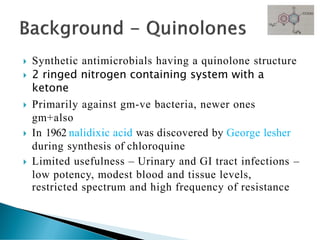
 Synthetic antimicrobials having a quinolone structure
 2 ringed nitrogen containing system with a
ketone
 Primarily against gm-ve bacteria, newer ones
gm+also
 In 1962 nalidixic acid was discovered by George lesher
during synthesis of chloroquine
 Limited usefulness – Urinary and GI tract infections –
low potency, modest blood and tissue levels,
restricted spectrum and high frequency of resistance
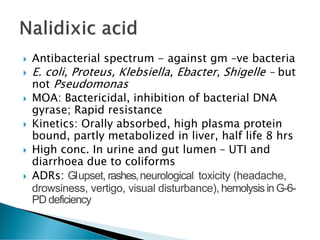
 Antibacterial spectrum - against gm –ve bacteria
 E. coli, Proteus, Klebsiella, Ebacter, Shigelle – but
not Pseudomonas
 MOA: Bactericidal, inhibition of bacterial DNA
gyrase; Rapid resistance
 Kinetics: Orally absorbed, high plasma protein
bound, partly metabolized in liver, half life 8 hrs
 High conc. In urine and gut lumen – UTI and
diarrhoea due to coliforms
 ADRs: GIupset, rashes,neurological toxicity (headache,
drowsiness, vertigo, visual disturbance), hemolysisin G-6-
PD deficiency
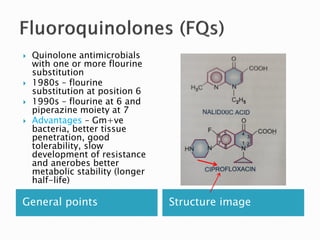
General points Structure image
 Quinolone antimicrobials
with one or more flourine
substitution
 1980s – flourine
substitution at position 6
 1990s – flourine at 6 and
piperazine moiety at 7
 Advantages – Gm+ve
bacteria, better tissue
penetration, good
tolerability, slow
development of resistance
and anerobes better
metabolic stability (longer
half-life)
 1st generation: Norfloxacin, Ciprofloxacin,
Ofloxacin and Pefloxacin
 2nd generation: Levofloxacin, Moxifloxacin,
Gemifloxacin, Prulifloxacin, Lomefloxacin and
Sparfloxacin
 Additional Newer: Pazufloxacin and
Balofloxacin
 Unique mechanism of action
◦ Inhibits bacterial
 DNA gyrase – nicks double-stranded DNA, removes excess
positive supercoiling in the DNA helix and reseals nicked ends
 Primary target in gram-negative bacteria
 2 subunits – 2 A subunits and 2 B subunits
 A subunits – nicking and resealing of strands
 B subunit – introduces negative supercoil
 Topoisomerase IV – essential for nicking and separation of
interlinked daughter DNA molecules
 Primary target for many gram-positive bacteria
◦ FQs have greater affinity for Topoisomerase IV
◦ Digestion of DNA by exonucleases
◦ FQs display concentration-dependent bactericidal activity
◦ Topoisomerase II ????
• No plasmid mediated transferable resistance
• Reduced affinity – chromosomal mutations in genes
that code for DNA gyrase or topoisomerase IV
 most important and most common
• Altered cell wall permeability – decreased
porinexpression
• Expression of active efflux – transfers FQs out of cell
• Cross-resistance occurs between FQs
• Nalidixic acid – single step resistance, FQs not easily
selected (long time) – Salmonella, Pseudomonas,
Gonococci and Pneumococci
 The most potent first generation FQ – wide range of bacteria
 Aerobic gm –ve bacilli, Enterobacteriacae and Neisseria
 Highly susceptible: E. coli, N. gonorrhoea, K. pneumoniae, N.
meningitidid, Enterobacter, H. influenzae, S. typhi, H. ducrei,
N. salmonella, C, jejuni, Shigella, Yersinia, Proteus, V.
cholerae
 Moderately susceptible: P. aureginosa, Legionella, Brucella,
Mycoplasma, Listeria, Chlamydia, Staph. Epidermidis, Bacillus
anthracis, B. catarrhalis, M. tuberculosis
 Variable susceptibility: Strep pyogenes, Strep fecalis, Strep
pneumoniae, MRSA, Mycobact. Kansalis, M. avium
 Resistant: Bacteroides fragilis, Clostridia and anaerobic cocci
 Bactericidal and high potency – MBC = MIC
 Relatively long post antibiotic effect on
Enterobacteriaceae, Pseudomonas and Staph.
 Low frequency of mutational resistance
 Low frequency of plasmid type resistance
 Protective intestinal streptococci and
anerobes are spared
 Less active iin acidic pH
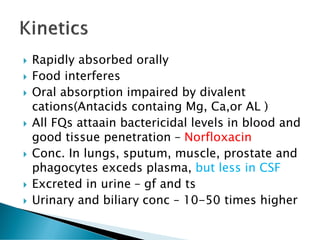
 Rapidly absorbed orally
 Food interferes
 Oral absorption impaired by divalent
cations(Antacids containg Mg, Ca,or AL )
 All FQs attaain bactericidal levels in blood and
good tissue penetration – Norfloxacin
 Conc. In lungs, sputum, muscle, prostate and
phagocytes exceds plasma, but less in CSF
 Excreted in urine – gf and ts
 Urinary and biliary conc – 10-50 times higher
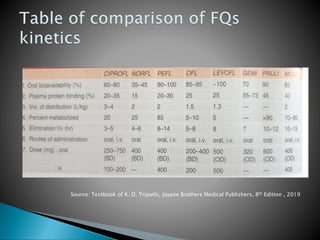
Source: Textbook of K. D. Tripathi, Jaypee Brothers Medical Publishers, 8th Edition , 2019
 Good safety record – ADRs mild and in 10%
withdrawal in 1.5%
 GIT: Nausea, vomiting, bad taste, anorexia
but no diarrhoea
 CNS: dizziness, headache, restlesness,
anxiety, insomnia, impairement in conc. and
dexterity (???) - tremor and seizure
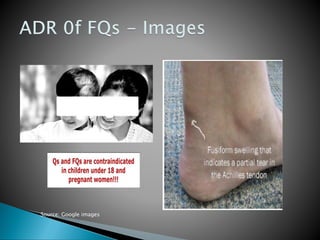
 Tendonitis and tendon rupture – 60+ years
 Cartilage damage – children
 Pregnancy ????
Source: Google images
 Theophylline, caffeine, and warfarin conc
increased – inhibition of metabolism – CNS
toxicity
 NSAIDS – enhance CNS toxicity
 Antacids, sucralfate and Iron salts – reduce
absorption
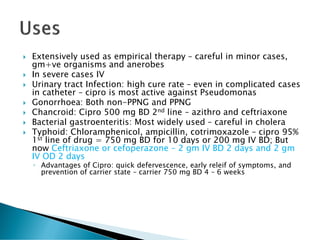
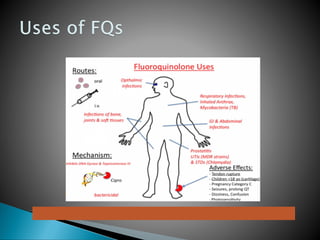
 Extensively used as empirical therapy – careful in minor cases,
gm+ve organisms and anerobes
 In severe cases IV
 Urinary tract Infection: high cure rate – even in complicated cases
in catheter – cipro is most active against Pseudomonas
 Gonorrhoea: Both non-PPNG and PPNG
 Chancroid: Cipro 500 mg BD 2nd line – azithro and ceftriaxone
 Bacterial gastroenteritis: Most widely used – careful in cholera
 Typhoid: Chloramphenicol, ampicillin, cotrimoxazole – cipro 95%
1st line of drug = 750 mg BD for 10 days or 200 mg IV BD; But
now Ceftriaxone or cefoperazone – 2 gm IV BD 2 days and 2 gm
IV OD 2 days
◦ Advantages of Cipro: quick defervescence, early releif of symptoms, and
prevention of carrier state – carrier 750 mg BD 4 – 6 weeks
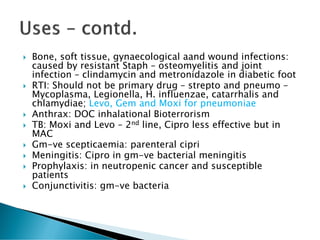
 Bone, soft tissue, gynaecological aand wound infections:
caused by resistant Staph – osteomyelitis and joint
infection – clindamycin and metronidazole in diabetic foot
 RTI: Should not be primary drug – strepto and pneumo –
Mycoplasma, Legionella, H. influenzae, catarrhalis and
chlamydiae; Levo, Gem and Moxi for pneumoniae
 Anthrax: DOC inhalational Bioterrorism
 TB: Moxi and Levo – 2nd line, Cipro less effective but in
MAC
 Gm-ve scepticaemia: parenteral cipri
 Meningitis: Cipro in gm-ve bacterial meningitis
 Prophylaxis: in neutropenic cancer and susceptible
patients
 Conjunctivitis: gm-ve bacteria
 Less potent FQ – MIC values for gm-ve are 2-8 times
higher than Cipro
 Many Pseudomonas and gm+ organisms are not
inhibited
 Lower conc. in plasma
 Used in UTI 8-12 weeks, bacterial diarrhoea –
anerobic gut flora not disturbed
 Pefloxacin: Derivative of Norfloxacin – Lipid soluble,
higher plasma conc., more tissue penetration and CSF
penetration
◦ Highly metabolized partly to Norfloxacin
◦ Better than other FQs in meningitis
◦ Cumulation on frequent dosing – effective in some systemic
infections
◦ Dose reduction in liver disease but not kidney dideases
 Less active than Cipro in gm0ve bacteria
 Equally against Strep, pyogens and other gm
+ve cocci and anerobes
 Good against Chlamydia and Mycoplasma
 Useful in nonspecific urethritis, cervicitis, and
atypical pneumonia by Clamydia trachmatis
 Effective agains M. tuberculosis and M.
Lepare – alternative regime in TB and
alternative multidrug regime
 Levo isomer of Ofloxacin with better effectivity
against M. tuberculosis and Pneumoniae and some
gm+ve and gm –ve bacteria
 Moderately effective against anerobes
 100% oral bioavailability (oral and IV) – given single
dose slow elimination
 No drug interaction with theophylline,warfarin etc.
 Uses: community acquired pneumonia and
exacerbation of chronic bronchitis
◦ Sinusitis, pyelonephritis, prostatitis and other UTIs and also
STIs
◦ Alternative drug for chlamydial urethritis
◦ 2nd most effective drug in TB and multi drug regime in
MDR-TB
 Loong acting 2nd generationFQ – effective aginst
Str. Pneumonae and other gm +ve bacteria
including beta-lactam and macrolide resistant
ones
 Also effective against anerobes
 Most effective against M. tuberculosis and used
MDR-TB
 Bacterial Topoisomerase IV major target
 Also used in pneumonias, bronchitis, sinusitis
and otitis media
 Not given in liver diseases
 No dose reduction required in renal
 Proarrythmic potential – QT prolongation
 Gemifloxacin:
 2nd generation
 Another broad spectrum FQ effective against gm +ve bacteria
(Strep. Pneumoniae, H. influenzae, Mycoplasma, Chlamydia
 Diarrhoea, nausea, headache, rise in serum amino transferase,
skin rash
 Uses: CAP, Chronic Bronchitis Exacerbation
 Prulifloxacin
 2nd generation effective against gm+ve bacteria, gm –ve
including resistant strains
 Prodrug of Ulifloxacin excreted unchanged in urine
 Broad spectrum
 Chronic Bronchitis Exacerbation, UTI
 FQs are important and widely used as
empirical therapy
 However – should be used rationally and
cautiously
 Classification of FQs
 MOA and ADRs of FQs
 Empirical and rational uses and of FQs
Fluoroquinolones

Fluoroquinolones

  • 1.
    Dr. D. K.Brahma Associate Professor Department of Pharmacology NEIGRIHMS, Shillong
  • 2.
     Synthetic antimicrobialshaving a quinolone structure  2 ringed nitrogen containing system with a ketone  Primarily against gm-ve bacteria, newer ones gm+also  In 1962 nalidixic acid was discovered by George lesher during synthesis of chloroquine  Limited usefulness – Urinary and GI tract infections – low potency, modest blood and tissue levels, restricted spectrum and high frequency of resistance
  • 3.
     Antibacterial spectrum- against gm –ve bacteria  E. coli, Proteus, Klebsiella, Ebacter, Shigelle – but not Pseudomonas  MOA: Bactericidal, inhibition of bacterial DNA gyrase; Rapid resistance  Kinetics: Orally absorbed, high plasma protein bound, partly metabolized in liver, half life 8 hrs  High conc. In urine and gut lumen – UTI and diarrhoea due to coliforms  ADRs: GIupset, rashes,neurological toxicity (headache, drowsiness, vertigo, visual disturbance), hemolysisin G-6- PD deficiency
  • 4.
    General points Structureimage  Quinolone antimicrobials with one or more flourine substitution  1980s – flourine substitution at position 6  1990s – flourine at 6 and piperazine moiety at 7  Advantages – Gm+ve bacteria, better tissue penetration, good tolerability, slow development of resistance and anerobes better metabolic stability (longer half-life)
  • 5.
     1st generation:Norfloxacin, Ciprofloxacin, Ofloxacin and Pefloxacin  2nd generation: Levofloxacin, Moxifloxacin, Gemifloxacin, Prulifloxacin, Lomefloxacin and Sparfloxacin  Additional Newer: Pazufloxacin and Balofloxacin
  • 6.
     Unique mechanismof action ◦ Inhibits bacterial  DNA gyrase – nicks double-stranded DNA, removes excess positive supercoiling in the DNA helix and reseals nicked ends  Primary target in gram-negative bacteria  2 subunits – 2 A subunits and 2 B subunits  A subunits – nicking and resealing of strands  B subunit – introduces negative supercoil  Topoisomerase IV – essential for nicking and separation of interlinked daughter DNA molecules  Primary target for many gram-positive bacteria ◦ FQs have greater affinity for Topoisomerase IV ◦ Digestion of DNA by exonucleases ◦ FQs display concentration-dependent bactericidal activity ◦ Topoisomerase II ????
  • 7.
    • No plasmidmediated transferable resistance • Reduced affinity – chromosomal mutations in genes that code for DNA gyrase or topoisomerase IV  most important and most common • Altered cell wall permeability – decreased porinexpression • Expression of active efflux – transfers FQs out of cell • Cross-resistance occurs between FQs • Nalidixic acid – single step resistance, FQs not easily selected (long time) – Salmonella, Pseudomonas, Gonococci and Pneumococci
  • 8.
     The mostpotent first generation FQ – wide range of bacteria  Aerobic gm –ve bacilli, Enterobacteriacae and Neisseria  Highly susceptible: E. coli, N. gonorrhoea, K. pneumoniae, N. meningitidid, Enterobacter, H. influenzae, S. typhi, H. ducrei, N. salmonella, C, jejuni, Shigella, Yersinia, Proteus, V. cholerae  Moderately susceptible: P. aureginosa, Legionella, Brucella, Mycoplasma, Listeria, Chlamydia, Staph. Epidermidis, Bacillus anthracis, B. catarrhalis, M. tuberculosis  Variable susceptibility: Strep pyogenes, Strep fecalis, Strep pneumoniae, MRSA, Mycobact. Kansalis, M. avium  Resistant: Bacteroides fragilis, Clostridia and anaerobic cocci
  • 9.
     Bactericidal andhigh potency – MBC = MIC  Relatively long post antibiotic effect on Enterobacteriaceae, Pseudomonas and Staph.  Low frequency of mutational resistance  Low frequency of plasmid type resistance  Protective intestinal streptococci and anerobes are spared  Less active iin acidic pH
  • 10.
     Rapidly absorbedorally  Food interferes  Oral absorption impaired by divalent cations(Antacids containg Mg, Ca,or AL )  All FQs attaain bactericidal levels in blood and good tissue penetration – Norfloxacin  Conc. In lungs, sputum, muscle, prostate and phagocytes exceds plasma, but less in CSF  Excreted in urine – gf and ts  Urinary and biliary conc – 10-50 times higher
  • 11.
    Source: Textbook ofK. D. Tripathi, Jaypee Brothers Medical Publishers, 8th Edition , 2019
  • 12.
     Good safetyrecord – ADRs mild and in 10% withdrawal in 1.5%  GIT: Nausea, vomiting, bad taste, anorexia but no diarrhoea  CNS: dizziness, headache, restlesness, anxiety, insomnia, impairement in conc. and dexterity (???) - tremor and seizure  Tendonitis and tendon rupture – 60+ years  Cartilage damage – children  Pregnancy ????
  • 13.
  • 14.
     Theophylline, caffeine,and warfarin conc increased – inhibition of metabolism – CNS toxicity  NSAIDS – enhance CNS toxicity  Antacids, sucralfate and Iron salts – reduce absorption
  • 15.
     Extensively usedas empirical therapy – careful in minor cases, gm+ve organisms and anerobes  In severe cases IV  Urinary tract Infection: high cure rate – even in complicated cases in catheter – cipro is most active against Pseudomonas  Gonorrhoea: Both non-PPNG and PPNG  Chancroid: Cipro 500 mg BD 2nd line – azithro and ceftriaxone  Bacterial gastroenteritis: Most widely used – careful in cholera  Typhoid: Chloramphenicol, ampicillin, cotrimoxazole – cipro 95% 1st line of drug = 750 mg BD for 10 days or 200 mg IV BD; But now Ceftriaxone or cefoperazone – 2 gm IV BD 2 days and 2 gm IV OD 2 days ◦ Advantages of Cipro: quick defervescence, early releif of symptoms, and prevention of carrier state – carrier 750 mg BD 4 – 6 weeks
  • 16.
     Bone, softtissue, gynaecological aand wound infections: caused by resistant Staph – osteomyelitis and joint infection – clindamycin and metronidazole in diabetic foot  RTI: Should not be primary drug – strepto and pneumo – Mycoplasma, Legionella, H. influenzae, catarrhalis and chlamydiae; Levo, Gem and Moxi for pneumoniae  Anthrax: DOC inhalational Bioterrorism  TB: Moxi and Levo – 2nd line, Cipro less effective but in MAC  Gm-ve scepticaemia: parenteral cipri  Meningitis: Cipro in gm-ve bacterial meningitis  Prophylaxis: in neutropenic cancer and susceptible patients  Conjunctivitis: gm-ve bacteria
  • 18.
     Less potentFQ – MIC values for gm-ve are 2-8 times higher than Cipro  Many Pseudomonas and gm+ organisms are not inhibited  Lower conc. in plasma  Used in UTI 8-12 weeks, bacterial diarrhoea – anerobic gut flora not disturbed  Pefloxacin: Derivative of Norfloxacin – Lipid soluble, higher plasma conc., more tissue penetration and CSF penetration ◦ Highly metabolized partly to Norfloxacin ◦ Better than other FQs in meningitis ◦ Cumulation on frequent dosing – effective in some systemic infections ◦ Dose reduction in liver disease but not kidney dideases
  • 19.
     Less activethan Cipro in gm0ve bacteria  Equally against Strep, pyogens and other gm +ve cocci and anerobes  Good against Chlamydia and Mycoplasma  Useful in nonspecific urethritis, cervicitis, and atypical pneumonia by Clamydia trachmatis  Effective agains M. tuberculosis and M. Lepare – alternative regime in TB and alternative multidrug regime
  • 20.
     Levo isomerof Ofloxacin with better effectivity against M. tuberculosis and Pneumoniae and some gm+ve and gm –ve bacteria  Moderately effective against anerobes  100% oral bioavailability (oral and IV) – given single dose slow elimination  No drug interaction with theophylline,warfarin etc.  Uses: community acquired pneumonia and exacerbation of chronic bronchitis ◦ Sinusitis, pyelonephritis, prostatitis and other UTIs and also STIs ◦ Alternative drug for chlamydial urethritis ◦ 2nd most effective drug in TB and multi drug regime in MDR-TB
  • 21.
     Loong acting2nd generationFQ – effective aginst Str. Pneumonae and other gm +ve bacteria including beta-lactam and macrolide resistant ones  Also effective against anerobes  Most effective against M. tuberculosis and used MDR-TB  Bacterial Topoisomerase IV major target  Also used in pneumonias, bronchitis, sinusitis and otitis media  Not given in liver diseases  No dose reduction required in renal  Proarrythmic potential – QT prolongation
  • 22.
     Gemifloxacin:  2ndgeneration  Another broad spectrum FQ effective against gm +ve bacteria (Strep. Pneumoniae, H. influenzae, Mycoplasma, Chlamydia  Diarrhoea, nausea, headache, rise in serum amino transferase, skin rash  Uses: CAP, Chronic Bronchitis Exacerbation  Prulifloxacin  2nd generation effective against gm+ve bacteria, gm –ve including resistant strains  Prodrug of Ulifloxacin excreted unchanged in urine  Broad spectrum  Chronic Bronchitis Exacerbation, UTI
  • 23.
     FQs areimportant and widely used as empirical therapy  However – should be used rationally and cautiously
  • 24.
     Classification ofFQs  MOA and ADRs of FQs  Empirical and rational uses and of FQs