8051 Microcontroller
Instruction Set
Prof. Anish Goel
Embedded Systems
Introduction
Embedded Systems Prof.Anish Goel2
 The process of writing program for the microcontroller mainly
consists of giving instructions (commands) in the specific order
in which they should be executed in order to carry out a
specific task.
 As electronics cannot “understand” what for example an
instruction “if the push button is pressed- turn the light on”
means, then a certain number of simpler and precisely defined
orders that decoder can recognise must be used.
 All commands are known as INSTRUCTION SET.
 All microcontrollers compatibile with the 8051 have in total of
255 instructions, i.e. 255 different words available for program
writing.
Types of instructions
Embedded Systems Prof.Anish Goel3
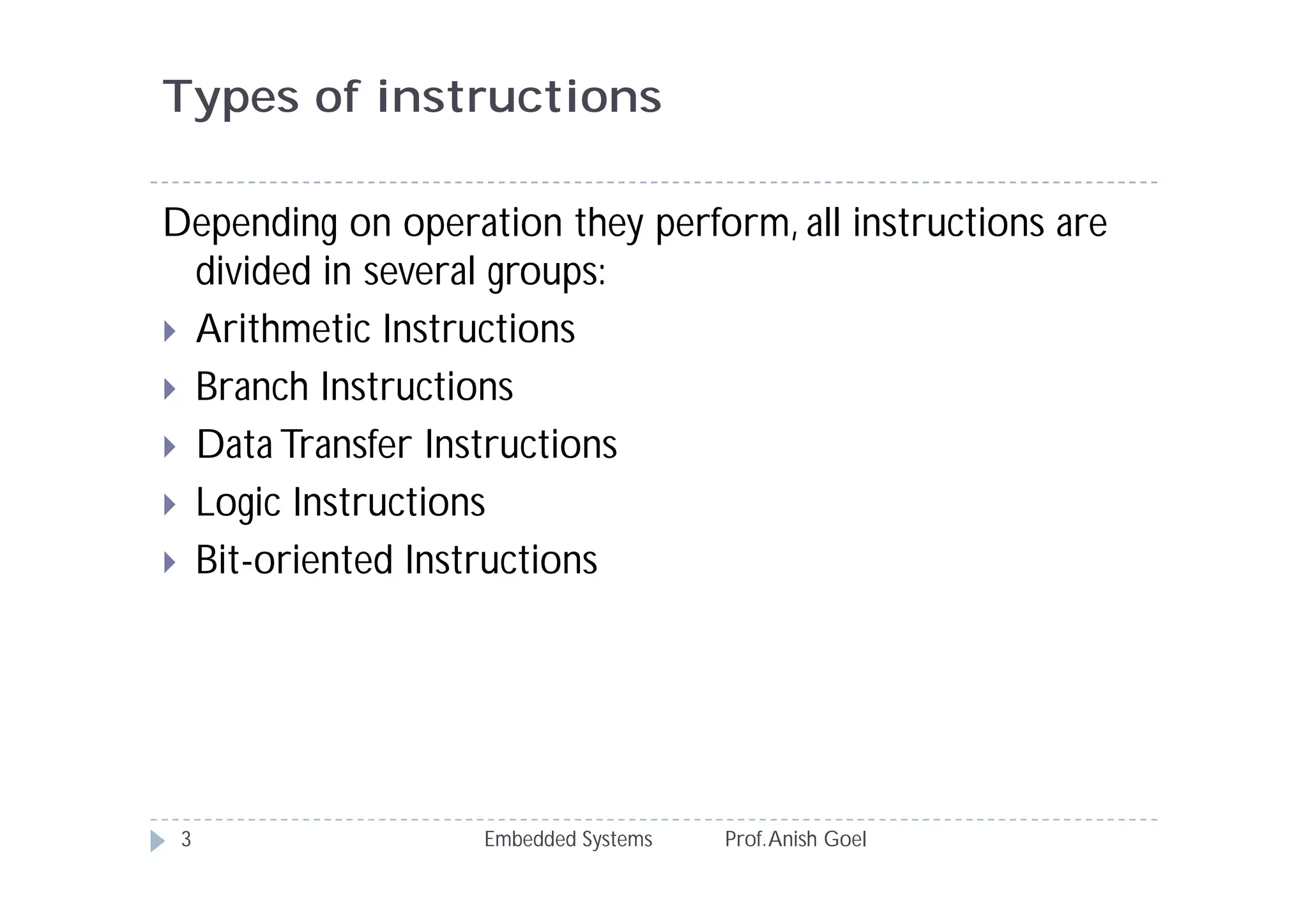
Depending on operation they perform, all instructions are
divided in several groups:
 Arithmetic Instructions
 Branch Instructions
 Data Transfer Instructions
 Logic Instructions
 Bit-oriented Instructions
Description of all 8051 instructions
Embedded Systems Prof.Anish Goel4
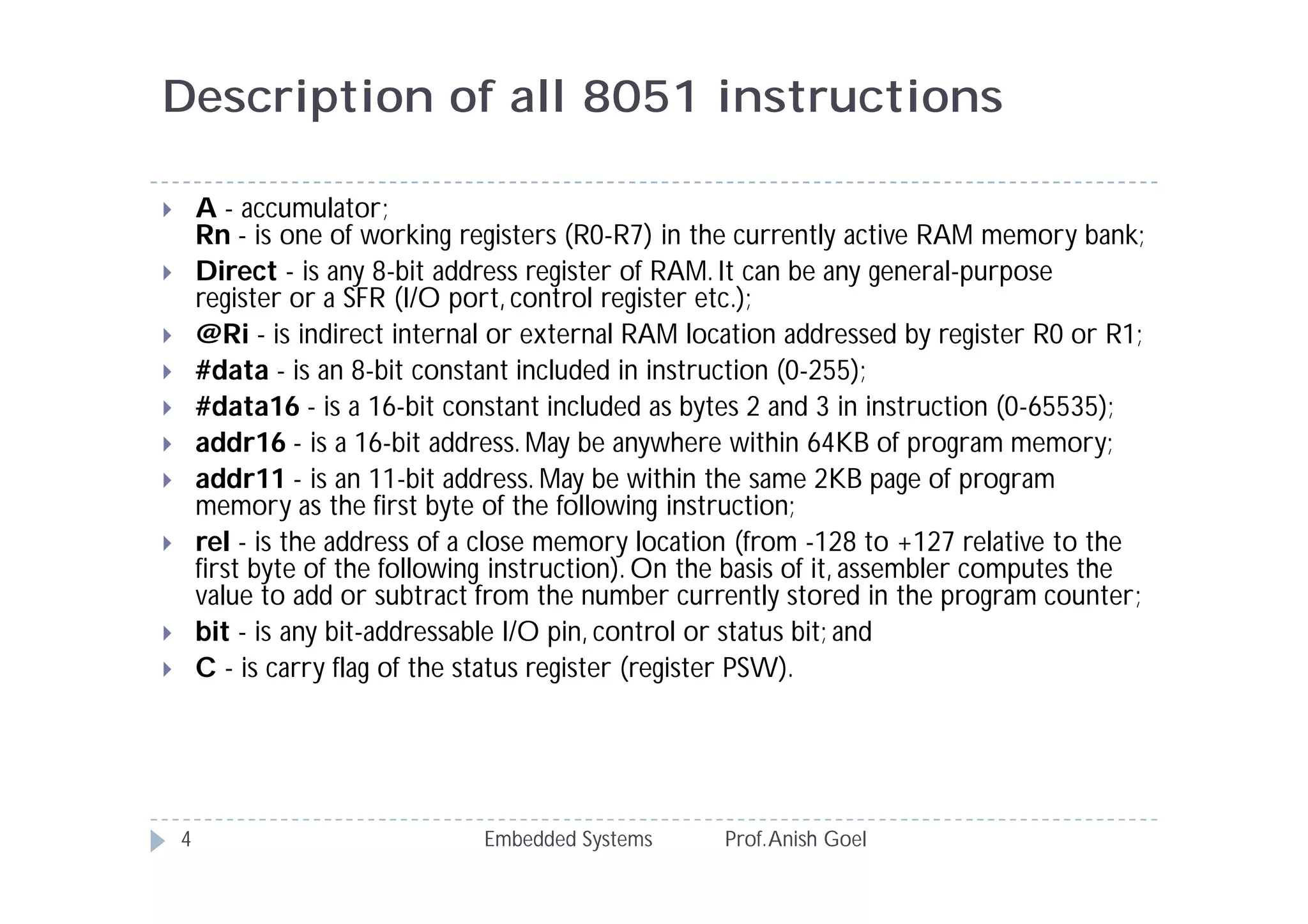
 A - accumulator;
Rn - is one of working registers (R0-R7) in the currently active RAM memory bank;
 Direct - is any 8-bit address register of RAM. It can be any general-purpose
register or a SFR (I/O port, control register etc.);
 @Ri - is indirect internal or external RAM location addressed by register R0 or R1;
 #data - is an 8-bit constant included in instruction (0-255);
 #data16 - is a 16-bit constant included as bytes 2 and 3 in instruction (0-65535);
 addr16 - is a 16-bit address. May be anywhere within 64KB of program memory;
 addr11 - is an 11-bit address. May be within the same 2KB page of program
memory as the first byte of the following instruction;
 rel - is the address of a close memory location (from -128 to +127 relative to the
first byte of the following instruction). On the basis of it, assembler computes the
value to add or subtract from the number currently stored in the program counter;
 bit - is any bit-addressable I/O pin, control or status bit; and
 C - is carry flag of the status register (register PSW).
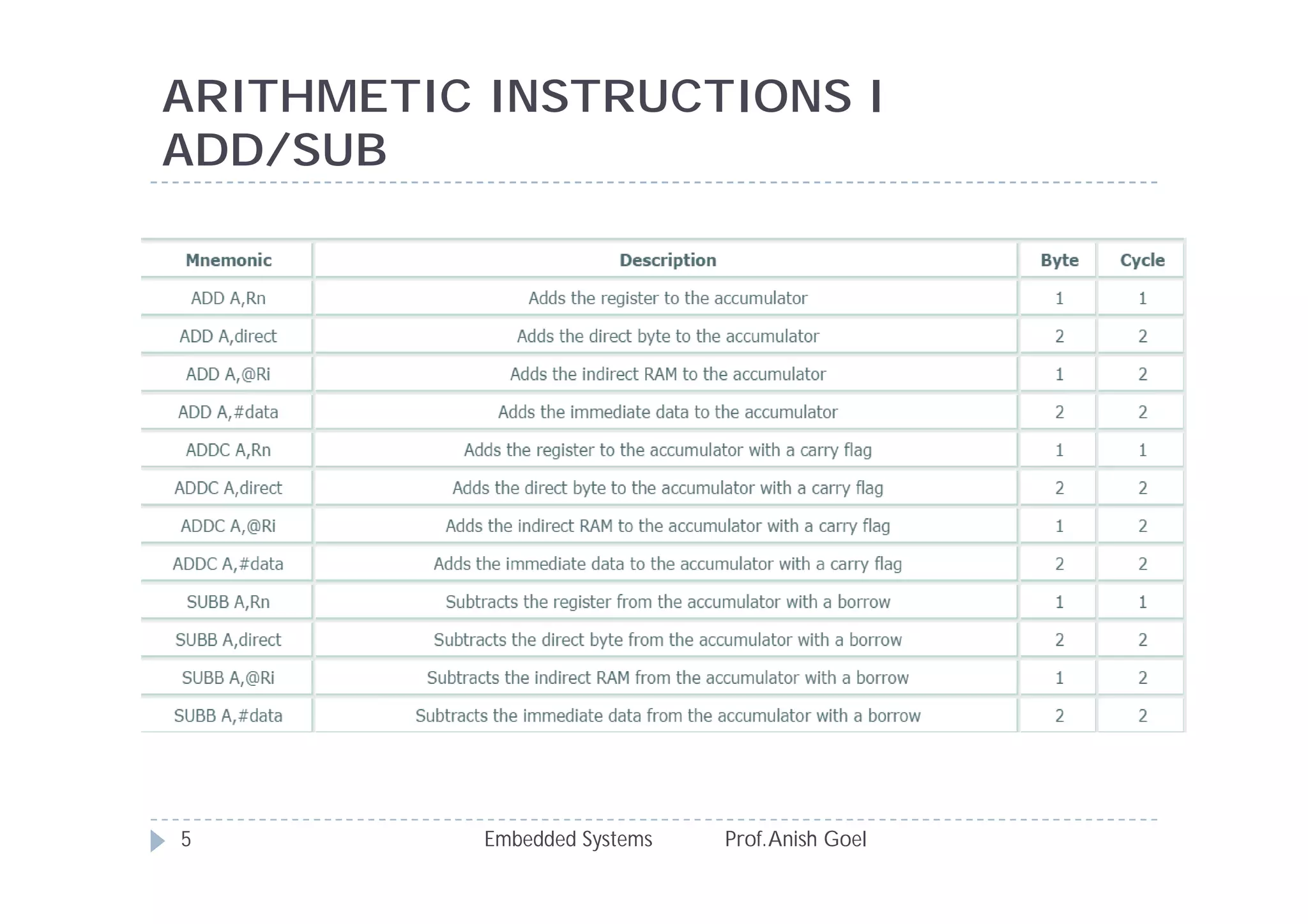
ARITHMETIC INSTRUCTIONS I
ADD/SUB
Embedded Systems Prof.Anish Goel5
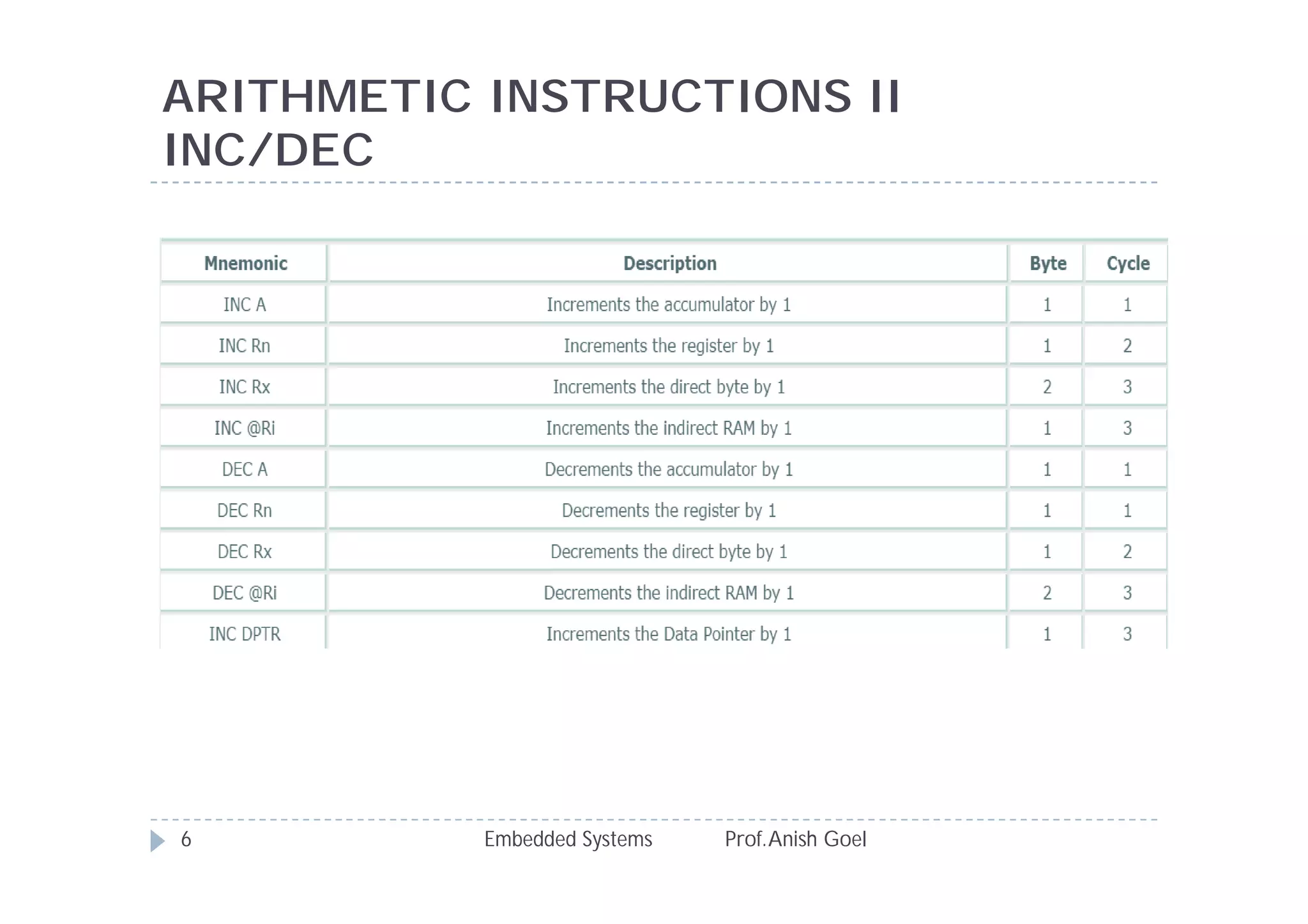
ARITHMETIC INSTRUCTIONS II
INC/DEC
Embedded Systems Prof.Anish Goel6
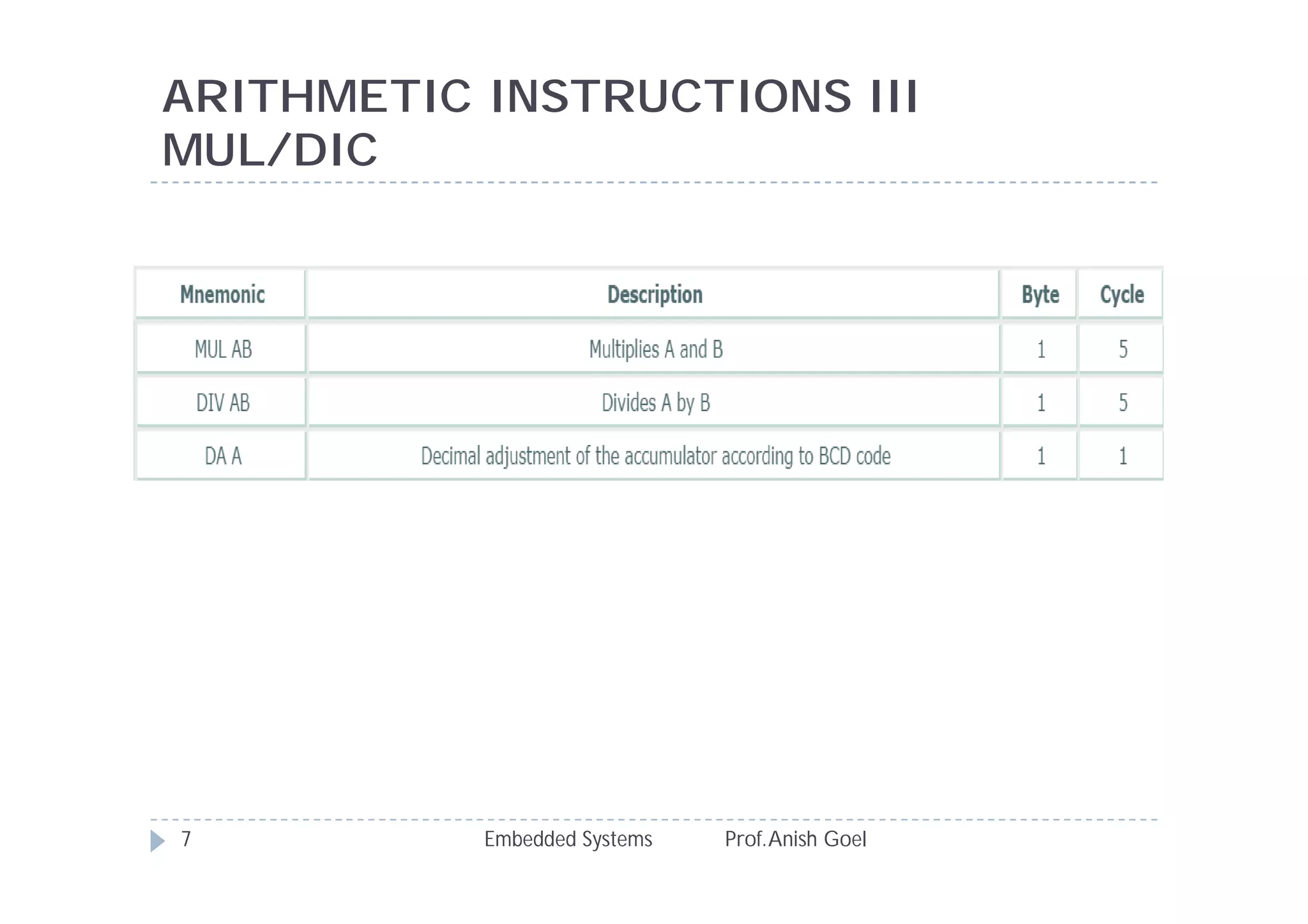
ARITHMETIC INSTRUCTIONS III
MUL/DIC
Embedded Systems Prof.Anish Goel7
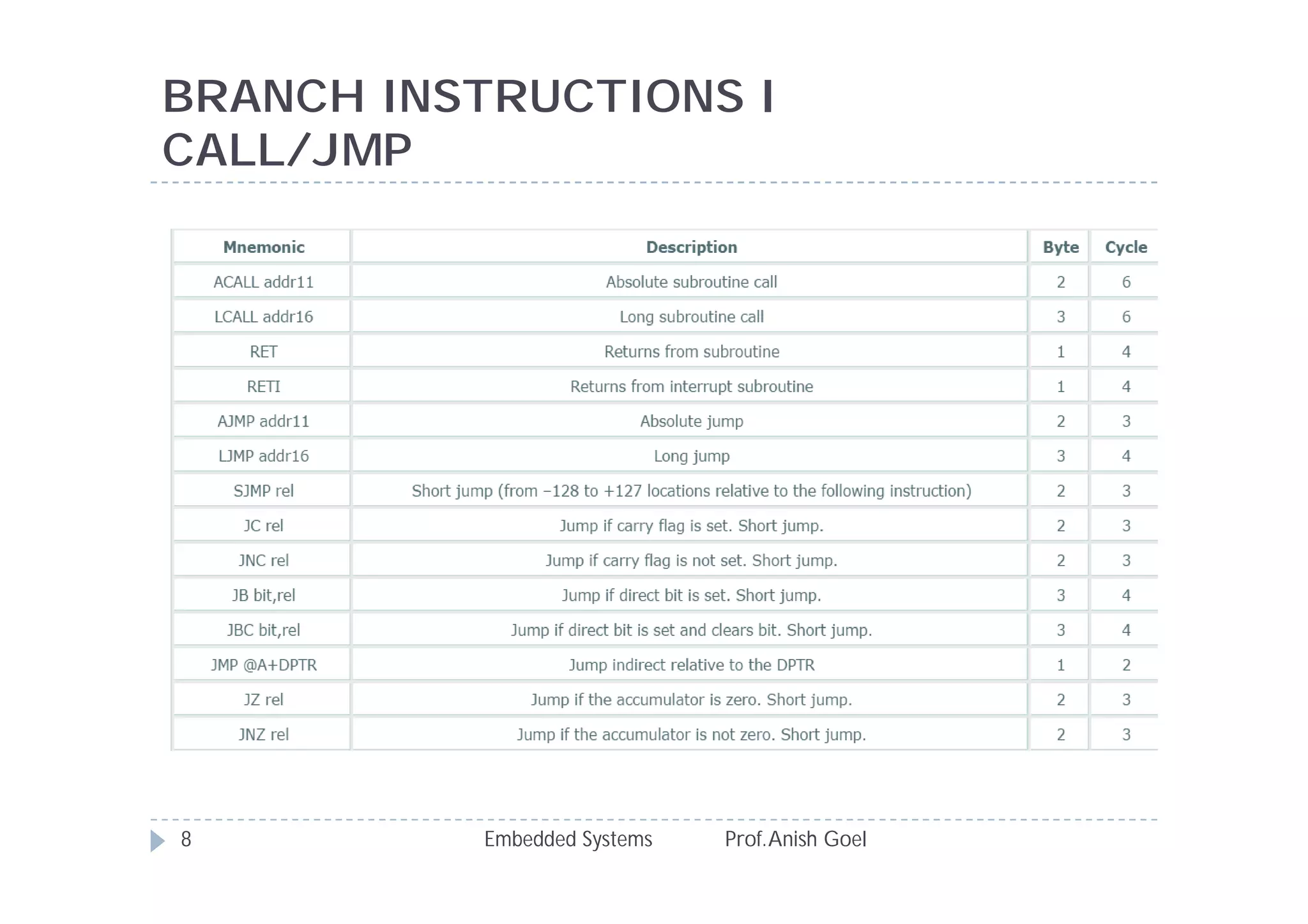
BRANCH INSTRUCTIONS I
CALL/JMP
Embedded Systems Prof.Anish Goel8
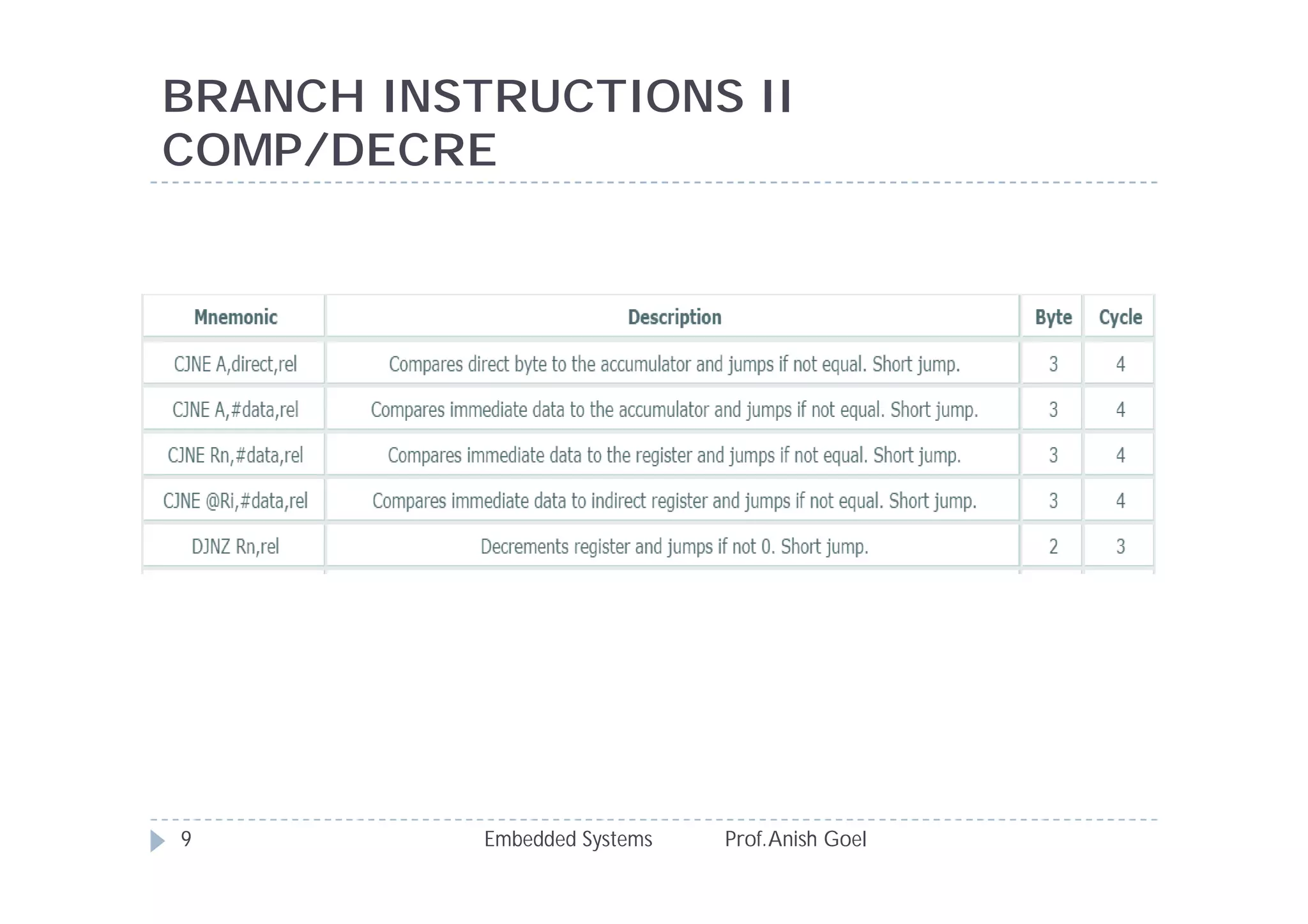
BRANCH INSTRUCTIONS II
COMP/DECRE
Embedded Systems Prof.Anish Goel9
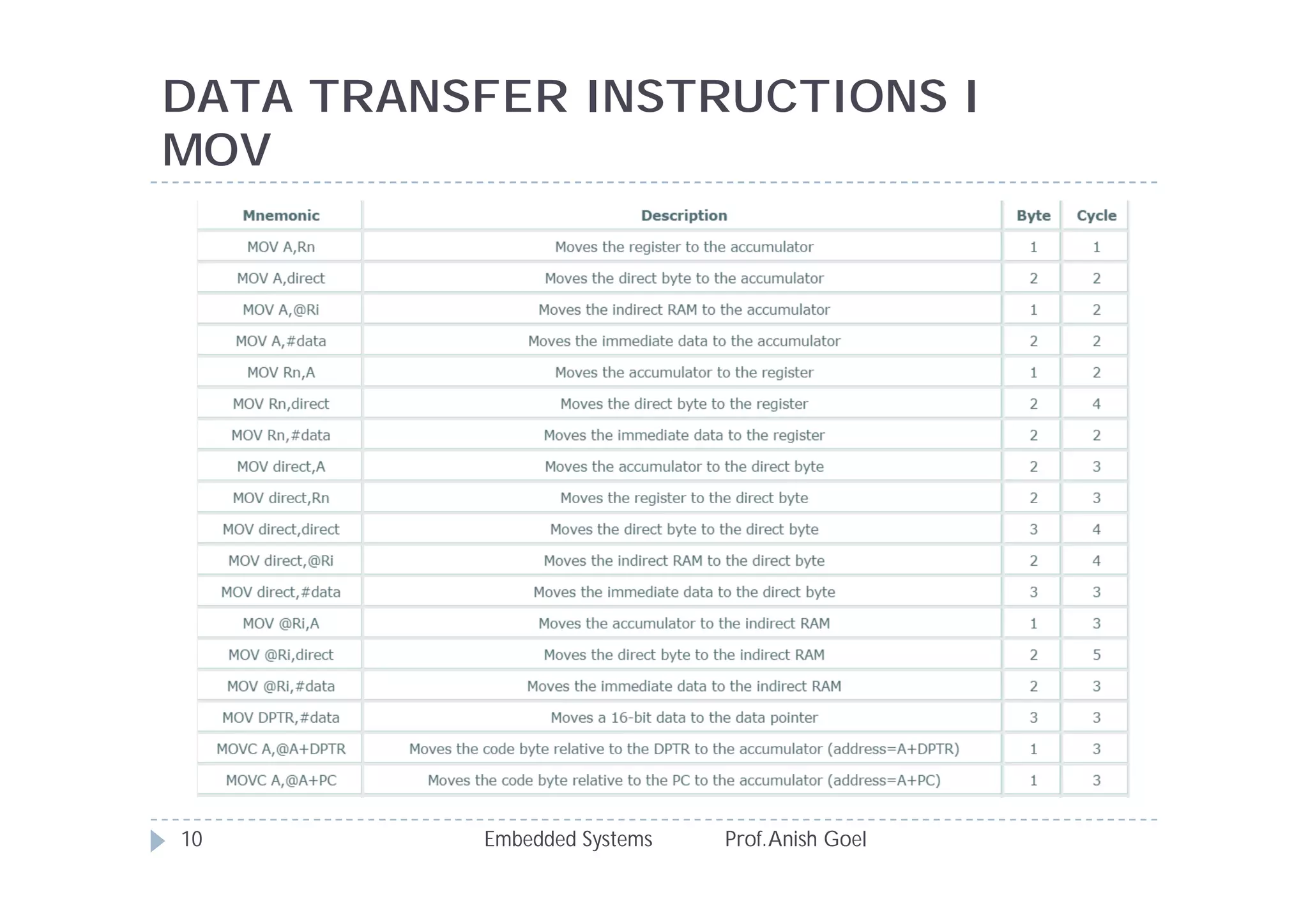
DATA TRANSFER INSTRUCTIONS I
MOV
Embedded Systems Prof.Anish Goel10
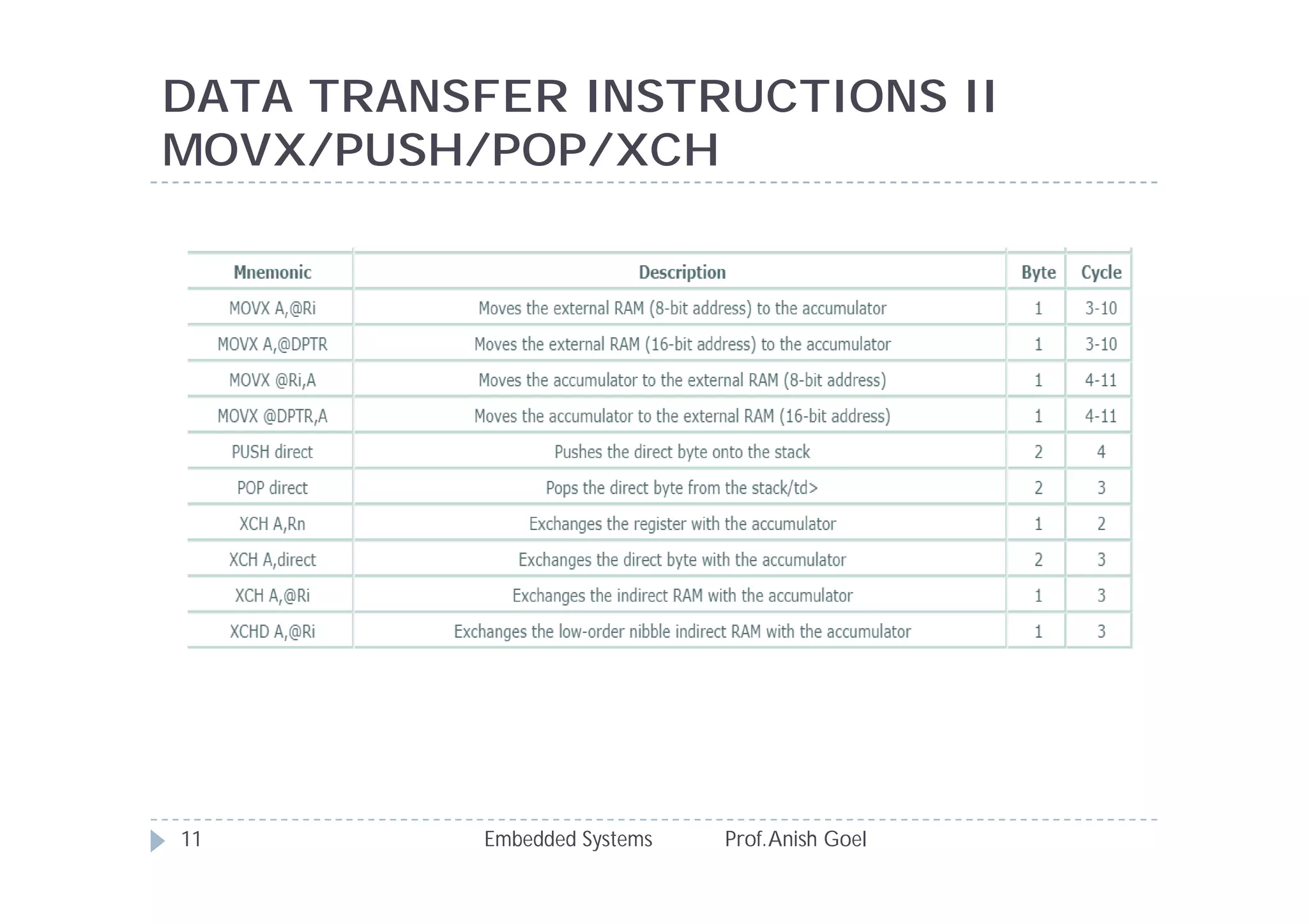
DATA TRANSFER INSTRUCTIONS II
MOVX/PUSH/POP/XCH
Embedded Systems Prof.Anish Goel11
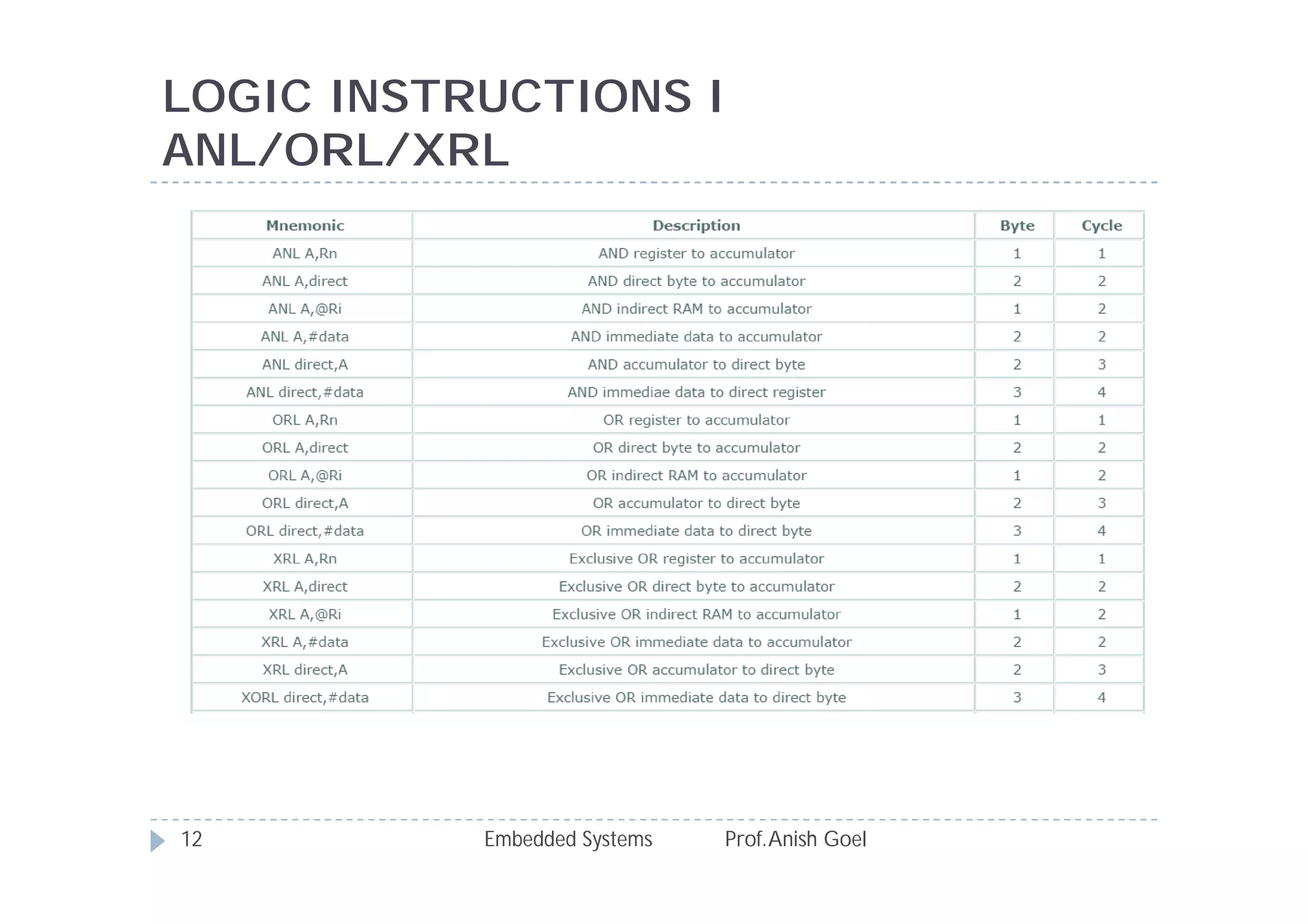
LOGIC INSTRUCTIONS I
ANL/ORL/XRL
Embedded Systems Prof.Anish Goel12
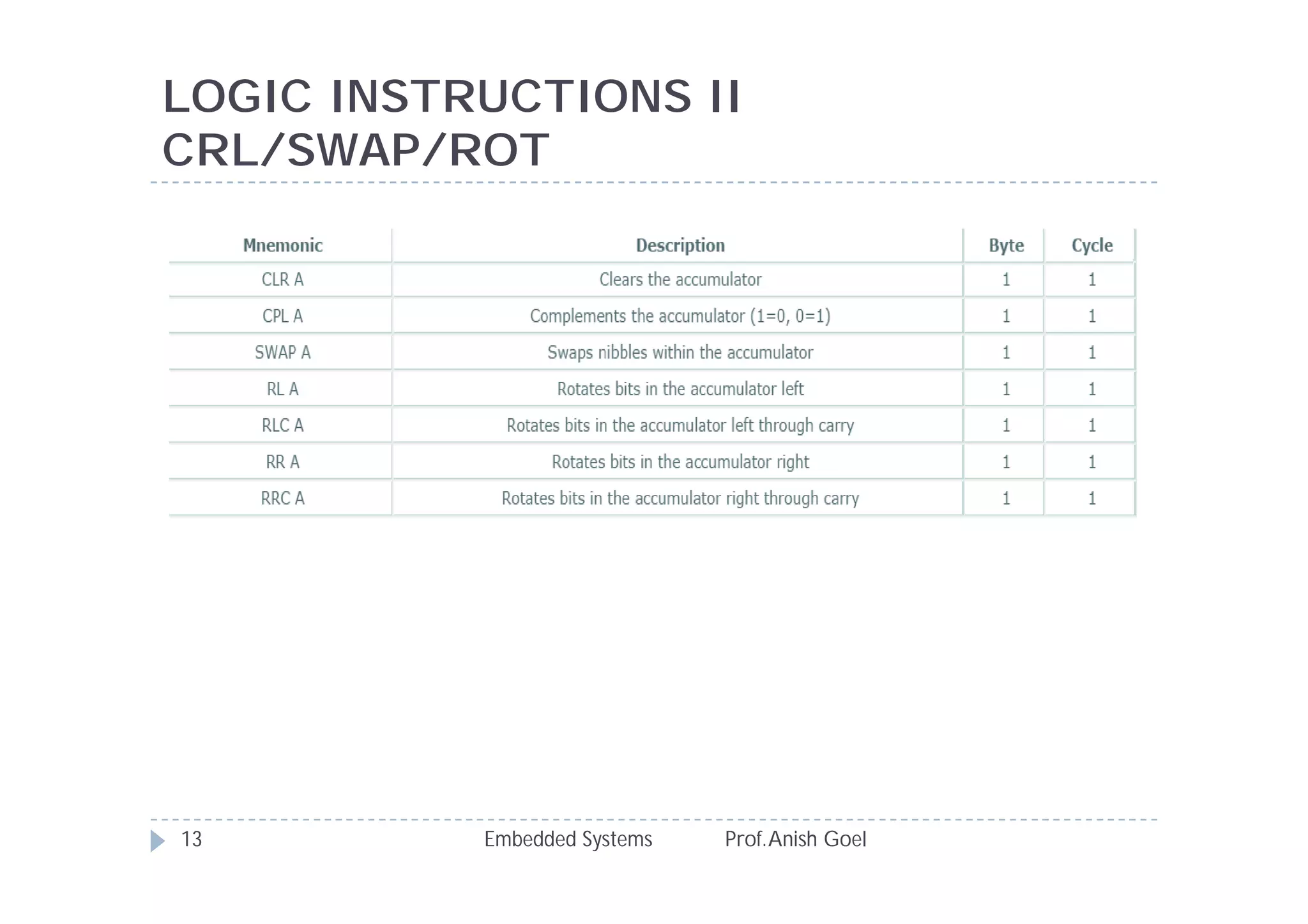
LOGIC INSTRUCTIONS II
CRL/SWAP/ROT
Embedded Systems Prof.Anish Goel13
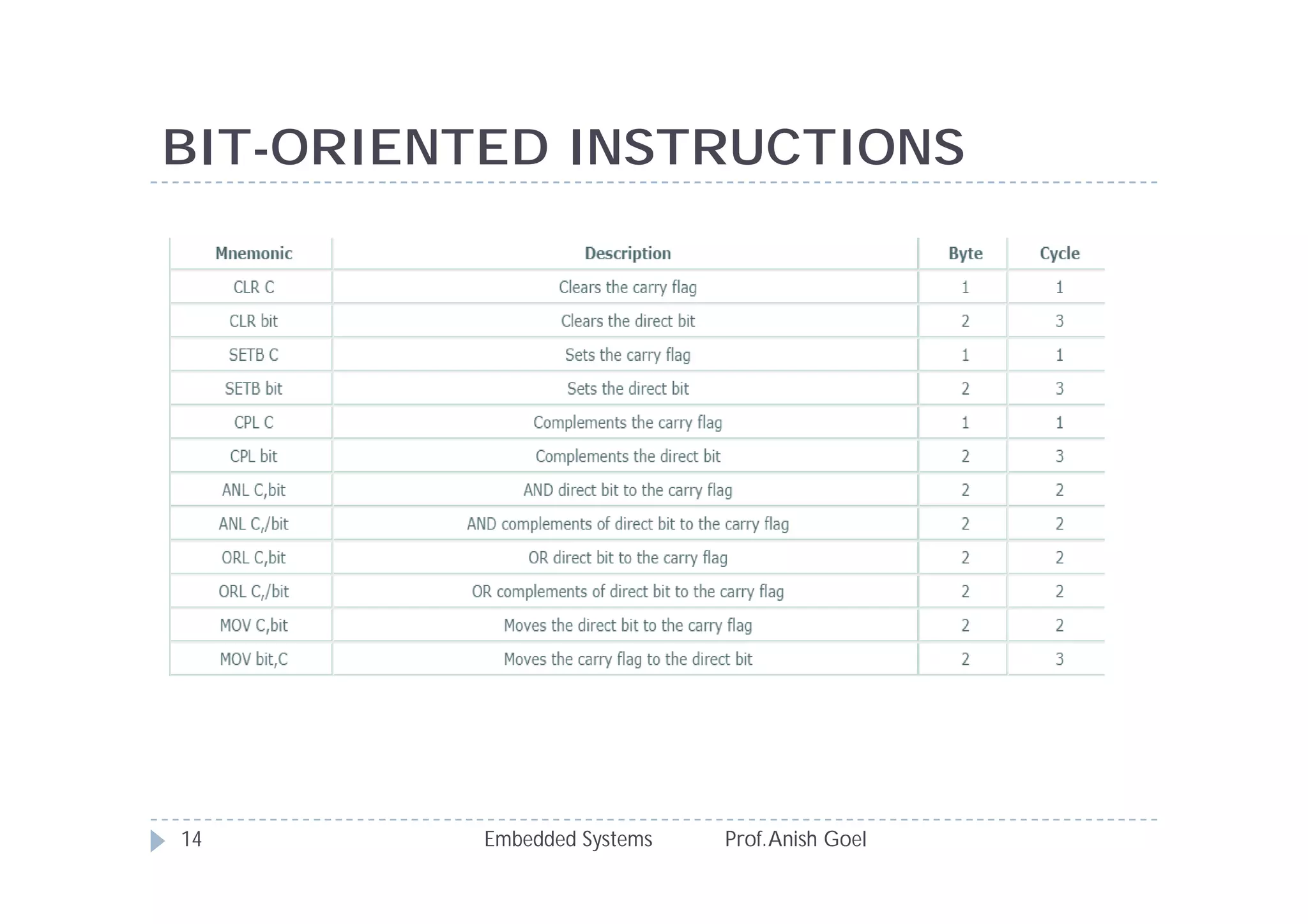
BIT-ORIENTED INSTRUCTIONS
Embedded Systems Prof.Anish Goel14
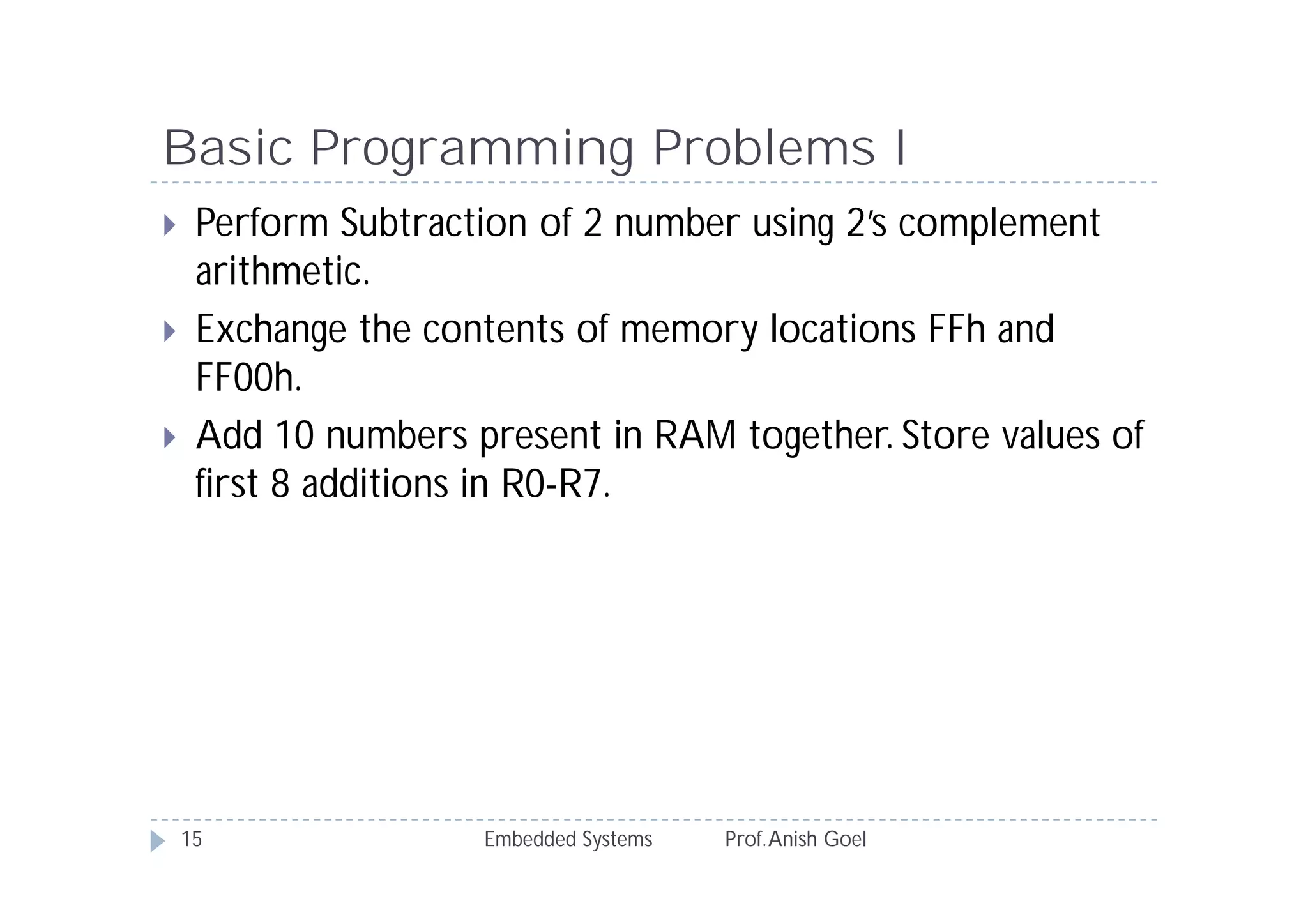
Basic Programming Problems I
Embedded Systems Prof.Anish Goel15
 Perform Subtraction of 2 number using 2’s complement
arithmetic.
 Exchange the contents of memory locations FFh and
FF00h.
 Add 10 numbers present in RAM together. Store values of
first 8 additions in R0-R7.

Embedded systems ppt ii

  • 1.
    8051 Microcontroller Instruction Set Prof.Anish Goel Embedded Systems
  • 2.
    Introduction Embedded Systems Prof.AnishGoel2  The process of writing program for the microcontroller mainly consists of giving instructions (commands) in the specific order in which they should be executed in order to carry out a specific task.  As electronics cannot “understand” what for example an instruction “if the push button is pressed- turn the light on” means, then a certain number of simpler and precisely defined orders that decoder can recognise must be used.  All commands are known as INSTRUCTION SET.  All microcontrollers compatibile with the 8051 have in total of 255 instructions, i.e. 255 different words available for program writing.
  • 3.
    Types of instructions EmbeddedSystems Prof.Anish Goel3 Depending on operation they perform, all instructions are divided in several groups:  Arithmetic Instructions  Branch Instructions  Data Transfer Instructions  Logic Instructions  Bit-oriented Instructions
  • 4.
    Description of all8051 instructions Embedded Systems Prof.Anish Goel4  A - accumulator; Rn - is one of working registers (R0-R7) in the currently active RAM memory bank;  Direct - is any 8-bit address register of RAM. It can be any general-purpose register or a SFR (I/O port, control register etc.);  @Ri - is indirect internal or external RAM location addressed by register R0 or R1;  #data - is an 8-bit constant included in instruction (0-255);  #data16 - is a 16-bit constant included as bytes 2 and 3 in instruction (0-65535);  addr16 - is a 16-bit address. May be anywhere within 64KB of program memory;  addr11 - is an 11-bit address. May be within the same 2KB page of program memory as the first byte of the following instruction;  rel - is the address of a close memory location (from -128 to +127 relative to the first byte of the following instruction). On the basis of it, assembler computes the value to add or subtract from the number currently stored in the program counter;  bit - is any bit-addressable I/O pin, control or status bit; and  C - is carry flag of the status register (register PSW).
  • 5.
  • 6.
  • 7.
  • 8.
  • 9.
  • 10.
    DATA TRANSFER INSTRUCTIONSI MOV Embedded Systems Prof.Anish Goel10
  • 11.
    DATA TRANSFER INSTRUCTIONSII MOVX/PUSH/POP/XCH Embedded Systems Prof.Anish Goel11
  • 12.
  • 13.
  • 14.
  • 15.
    Basic Programming ProblemsI Embedded Systems Prof.Anish Goel15  Perform Subtraction of 2 number using 2’s complement arithmetic.  Exchange the contents of memory locations FFh and FF00h.  Add 10 numbers present in RAM together. Store values of first 8 additions in R0-R7.