AJAL.A.J
professorajal@gmail.com
DEPARTMENT OF ECE
UNIVERSAL ENGINEERING COLLEGE,
VALLIVATTOM P.O, THRISSUR

1
 Intel

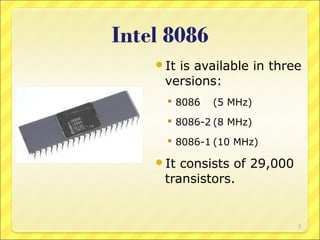
8086 was launched
in 1978.

 It

was the first 16-bit
microprocessor.

 This

microprocessor had
major improvement over
the execution speed of
8085.

 It

is available as 40-pin
Dual-Inline-Package
(DIP).
2
It

is available in three
versions:
 8086

(5 MHz)

 8086-2 (8 MHz)
 8086-1 (10 MHz)

It

consists of 29,000
transistors.

3
 It

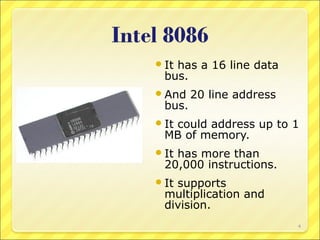
has a 16 line data
bus.

 And

bus.

20 line address

 It

could address up to 1
MB of memory.

 It

has more than
20,000 instructions.

 It

supports
multiplication and
division.
4
5
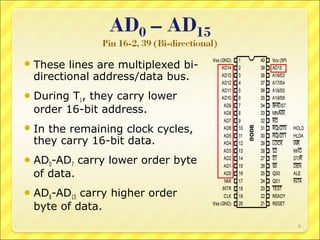
 These

lines are multiplexed bidirectional address/data bus.
 During

T1, they carry lower
order 16-bit address.

 In

the remaining clock cycles,
they carry 16-bit data.

 AD0-AD7

carry lower order byte

of data.

 AD8-AD15

carry higher order
byte of data.
6
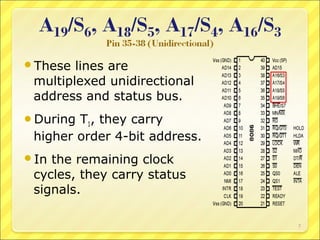
These

lines are
multiplexed unidirectional
address and status bus.

During

T1, they carry
higher order 4-bit address.

In

the remaining clock
cycles, they carry status
signals.
7
 BHE

stands for Bus High
Enable.

 BHE

signal is used to indicate
the transfer of data over
higher order data bus (D8 –
D15).

 8-bit

I/O devices use this
signal.

 It

is multiplexed with status
pin S7.
8
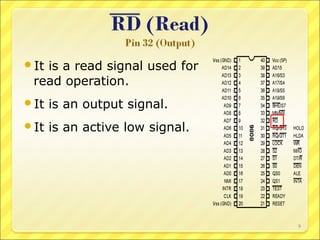
It

is a read signal used for
read operation.

It

is an output signal.

It

is an active low signal.

9
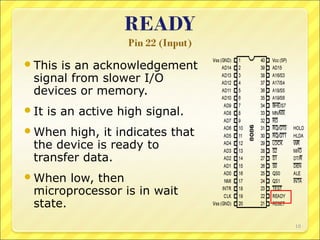
 This

is an acknowledgement
signal from slower I/O
devices or memory.

 It

is an active high signal.

 When

high, it indicates that
the device is ready to
transfer data.

 When

low, then
microprocessor is in wait
state.
10
It

is a system reset.

It

is an active high signal.

When

high,
microprocessor enters into
reset state and terminates
the current activity.

It

must be active for at
least four clock cycles to
reset the microprocessor.
11
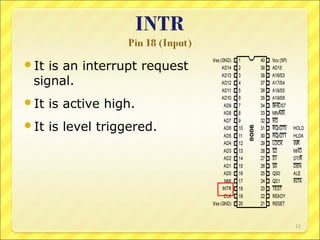
It

is an interrupt request
signal.

It

is active high.

It

is level triggered.

12
It

is a non-maskable
interrupt signal.

It

is an active high.

It

is an edge triggered
interrupt.

13
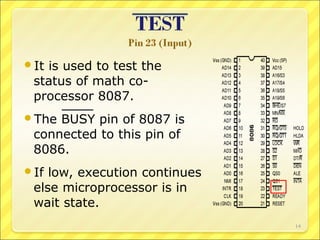
It

is used to test the
status of math coprocessor 8087.

The

BUSY pin of 8087 is
connected to this pin of
8086.

If

low, execution continues
else microprocessor is in
wait state.
14
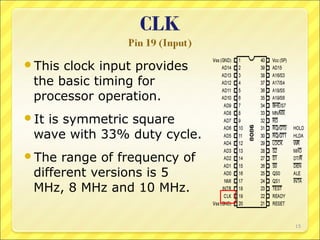
This

clock input provides
the basic timing for
processor operation.

It

is symmetric square
wave with 33% duty cycle.

The

range of frequency of
different versions is 5
MHz, 8 MHz and 10 MHz.
15
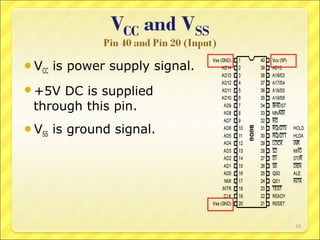
VCC

is power supply signal.

+5V

DC is supplied
through this pin.

VSS

is ground signal.

16
8086

works in two modes:

 Minimum Mode
 Maximum Mode

If

MN/MX is high, it works
in minimum mode.

If

MN/MX is low, it works
in maximum mode.

17
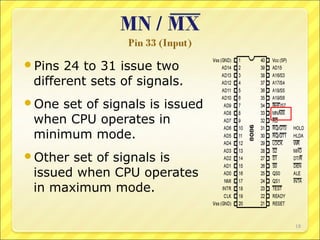
Pins

24 to 31 issue two
different sets of signals.

One

set of signals is issued
when CPU operates in
minimum mode.

Other

set of signals is
issued when CPU operates
in maximum mode.
18
19
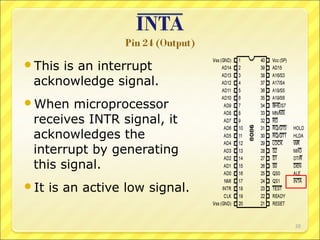
This

is an interrupt
acknowledge signal.

When

microprocessor
receives INTR signal, it
acknowledges the
interrupt by generating
this signal.

It

is an active low signal.
20
 This

is an Address Latch
Enable signal.

 It

indicates that valid address
is available on bus AD0 –
AD15.

 It

is an active high signal and
remains high during T1 state.

 It

is connected to enable pin
of latch 8282.
21
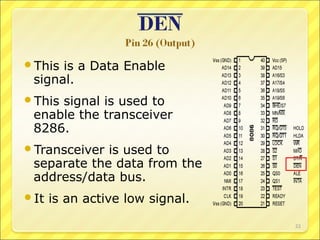
This

is a Data Enable
signal.

This

signal is used to
enable the transceiver
8286.

Transceiver

is used to
separate the data from the
address/data bus.

It

is an active low signal.
22
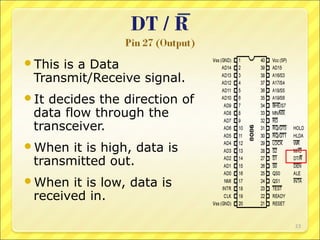
This

is a Data
Transmit/Receive signal.

It

decides the direction of
data flow through the
transceiver.

When

it is high, data is
transmitted out.

When

it is low, data is
received in.
23
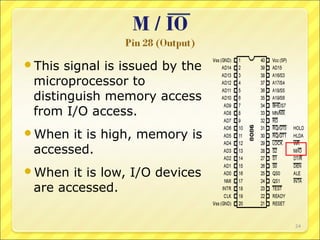
This

signal is issued by the
microprocessor to
distinguish memory access
from I/O access.

When

it is high, memory is
accessed.

When

it is low, I/O devices
are accessed.
24
It

is a Write signal.

It

is used to write data in
memory or output device
depending on the status of
M/IO signal.

It

is an active low signal.

25
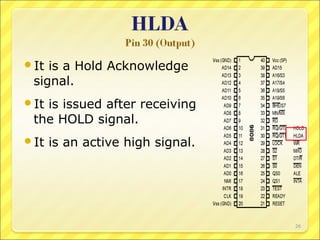
It

is a Hold Acknowledge
signal.

It

is issued after receiving
the HOLD signal.

It

is an active high signal.

26
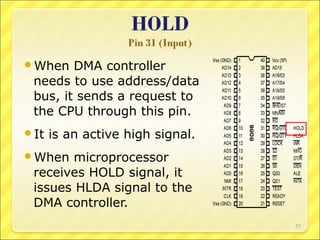
When

DMA controller
needs to use address/data
bus, it sends a request to
the CPU through this pin.

It

is an active high signal.

When

microprocessor
receives HOLD signal, it
issues HLDA signal to the
DMA controller.
27
28
These

pins provide the
status of instruction
queue.

QS1

QS0

Status

0

0

No operation

0

1

1st byte of opcode from queue

1

0

Empty queue

1

1

Subsequent byte from queue

29
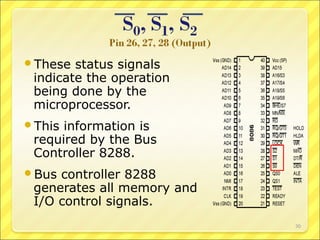
These

status signals
indicate the operation
being done by the
microprocessor.

This

information is
required by the Bus
Controller 8288.

Bus

controller 8288
generates all memory and
I/O control signals.
30
S2

S1

S0

Status

0

0

0

Interrupt Acknowledge

0

0

1

I/O Read

0

1

0

I/O Write

0

1

1

Halt

1

0

0

Opcode Fetch

1

0

1

Memory Read

1

1

0

Memory Write

1

1

1

Passive

31
 This

signal indicates that
other processors should not
ask CPU to relinquish the
system bus.

 When

it goes low, all
interrupts are masked and
HOLD request is not granted.

 This

pin is activated by using
LOCK prefix on any
instruction.
32
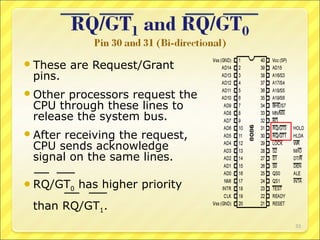
 These

pins.

are Request/Grant

 Other

processors request the
CPU through these lines to
release the system bus.

 After

receiving the request,
CPU sends acknowledge
signal on the same lines.

 RQ/GT0

has higher priority

than RQ/GT1.
33
The

READY input causes wait states
for
slower
memory
&
I/O
components.

A

wait state(Tw) is an extra clocking
period, inserted between T2 & T3,
that lengthens the bus cycle.

If

one wait state in inserted, then the
memory access time, normally 460 ns
with a 5 MHz clock, is lengthened by
one clocking period (200ns) to 660
ns.
m

35
m

36
m

37
a

38
a

39
a

40
41

8086 pin details

  • 1.
    AJAL.A.J professorajal@gmail.com DEPARTMENT OF ECE UNIVERSALENGINEERING COLLEGE, VALLIVATTOM P.O, THRISSUR 1
  • 2.
     Intel 8086 waslaunched in 1978.  It was the first 16-bit microprocessor.  This microprocessor had major improvement over the execution speed of 8085.  It is available as 40-pin Dual-Inline-Package (DIP). 2
  • 3.
    It is available inthree versions:  8086 (5 MHz)  8086-2 (8 MHz)  8086-1 (10 MHz) It consists of 29,000 transistors. 3
  • 4.
     It has a16 line data bus.  And bus. 20 line address  It could address up to 1 MB of memory.  It has more than 20,000 instructions.  It supports multiplication and division. 4
  • 5.
  • 6.
     These lines aremultiplexed bidirectional address/data bus.  During T1, they carry lower order 16-bit address.  In the remaining clock cycles, they carry 16-bit data.  AD0-AD7 carry lower order byte of data.  AD8-AD15 carry higher order byte of data. 6
  • 7.
    These lines are multiplexed unidirectional addressand status bus. During T1, they carry higher order 4-bit address. In the remaining clock cycles, they carry status signals. 7
  • 8.
     BHE stands forBus High Enable.  BHE signal is used to indicate the transfer of data over higher order data bus (D8 – D15).  8-bit I/O devices use this signal.  It is multiplexed with status pin S7. 8
  • 9.
    It is a readsignal used for read operation. It is an output signal. It is an active low signal. 9
  • 10.
     This is anacknowledgement signal from slower I/O devices or memory.  It is an active high signal.  When high, it indicates that the device is ready to transfer data.  When low, then microprocessor is in wait state. 10
  • 11.
    It is a systemreset. It is an active high signal. When high, microprocessor enters into reset state and terminates the current activity. It must be active for at least four clock cycles to reset the microprocessor. 11
  • 12.
    It is an interruptrequest signal. It is active high. It is level triggered. 12
  • 13.
    It is a non-maskable interruptsignal. It is an active high. It is an edge triggered interrupt. 13
  • 14.
    It is used totest the status of math coprocessor 8087. The BUSY pin of 8087 is connected to this pin of 8086. If low, execution continues else microprocessor is in wait state. 14
  • 15.
    This clock input provides thebasic timing for processor operation. It is symmetric square wave with 33% duty cycle. The range of frequency of different versions is 5 MHz, 8 MHz and 10 MHz. 15
  • 16.
    VCC is power supplysignal. +5V DC is supplied through this pin. VSS is ground signal. 16
  • 17.
    8086 works in twomodes:  Minimum Mode  Maximum Mode If MN/MX is high, it works in minimum mode. If MN/MX is low, it works in maximum mode. 17
  • 18.
    Pins 24 to 31issue two different sets of signals. One set of signals is issued when CPU operates in minimum mode. Other set of signals is issued when CPU operates in maximum mode. 18
  • 19.
  • 20.
    This is an interrupt acknowledgesignal. When microprocessor receives INTR signal, it acknowledges the interrupt by generating this signal. It is an active low signal. 20
  • 21.
     This is anAddress Latch Enable signal.  It indicates that valid address is available on bus AD0 – AD15.  It is an active high signal and remains high during T1 state.  It is connected to enable pin of latch 8282. 21
  • 22.
    This is a DataEnable signal. This signal is used to enable the transceiver 8286. Transceiver is used to separate the data from the address/data bus. It is an active low signal. 22
  • 23.
    This is a Data Transmit/Receivesignal. It decides the direction of data flow through the transceiver. When it is high, data is transmitted out. When it is low, data is received in. 23
  • 24.
    This signal is issuedby the microprocessor to distinguish memory access from I/O access. When it is high, memory is accessed. When it is low, I/O devices are accessed. 24
  • 25.
    It is a Writesignal. It is used to write data in memory or output device depending on the status of M/IO signal. It is an active low signal. 25
  • 26.
    It is a HoldAcknowledge signal. It is issued after receiving the HOLD signal. It is an active high signal. 26
  • 27.
    When DMA controller needs touse address/data bus, it sends a request to the CPU through this pin. It is an active high signal. When microprocessor receives HOLD signal, it issues HLDA signal to the DMA controller. 27
  • 28.
  • 29.
    These pins provide the statusof instruction queue. QS1 QS0 Status 0 0 No operation 0 1 1st byte of opcode from queue 1 0 Empty queue 1 1 Subsequent byte from queue 29
  • 30.
    These status signals indicate theoperation being done by the microprocessor. This information is required by the Bus Controller 8288. Bus controller 8288 generates all memory and I/O control signals. 30
  • 31.
    S2 S1 S0 Status 0 0 0 Interrupt Acknowledge 0 0 1 I/O Read 0 1 0 I/OWrite 0 1 1 Halt 1 0 0 Opcode Fetch 1 0 1 Memory Read 1 1 0 Memory Write 1 1 1 Passive 31
  • 32.
     This signal indicatesthat other processors should not ask CPU to relinquish the system bus.  When it goes low, all interrupts are masked and HOLD request is not granted.  This pin is activated by using LOCK prefix on any instruction. 32
  • 33.
     These pins. are Request/Grant Other processors request the CPU through these lines to release the system bus.  After receiving the request, CPU sends acknowledge signal on the same lines.  RQ/GT0 has higher priority than RQ/GT1. 33
  • 34.
    The READY input causeswait states for slower memory & I/O components. A wait state(Tw) is an extra clocking period, inserted between T2 & T3, that lengthens the bus cycle. If one wait state in inserted, then the memory access time, normally 460 ns with a 5 MHz clock, is lengthened by one clocking period (200ns) to 660 ns.
  • 35.
  • 36.
  • 37.
  • 38.
  • 39.
  • 40.
  • 41.