Learning VHDL by Examples
Prof. Anish Goel
Contents
 VHDL Entity and Architecture
 VHDL styles of Modelling
 Conditional and concurrent assignment statements
LearningVHDL by Examples: Prof.Anish Goel2
VHDL Entity
LearningVHDL by Examples: Prof.Anish Goel
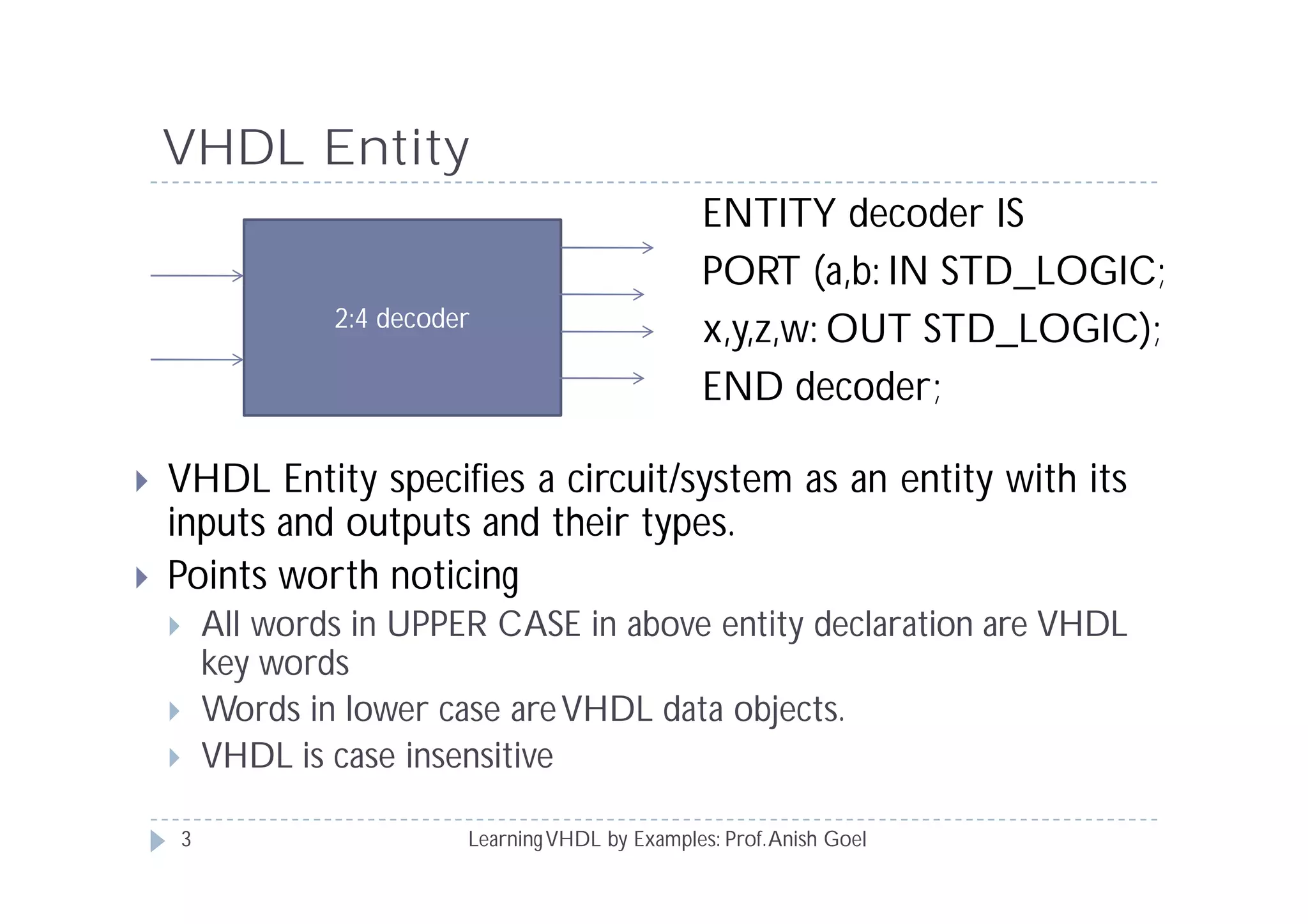
 VHDL Entity specifies a circuit/system as an entity with its
inputs and outputs and their types.
 Points worth noticing
 All words in UPPER CASE in above entity declaration are VHDL
key words
 Words in lower case areVHDL data objects.
 VHDL is case insensitive
2:4 decoder
ENTITY decoder IS
PORT (a,b: IN STD_LOGIC;
x,y,z,w: OUT STD_LOGIC);
END decoder;
3
VHDL Entity
LearningVHDL by Examples: Prof.Anish Goel
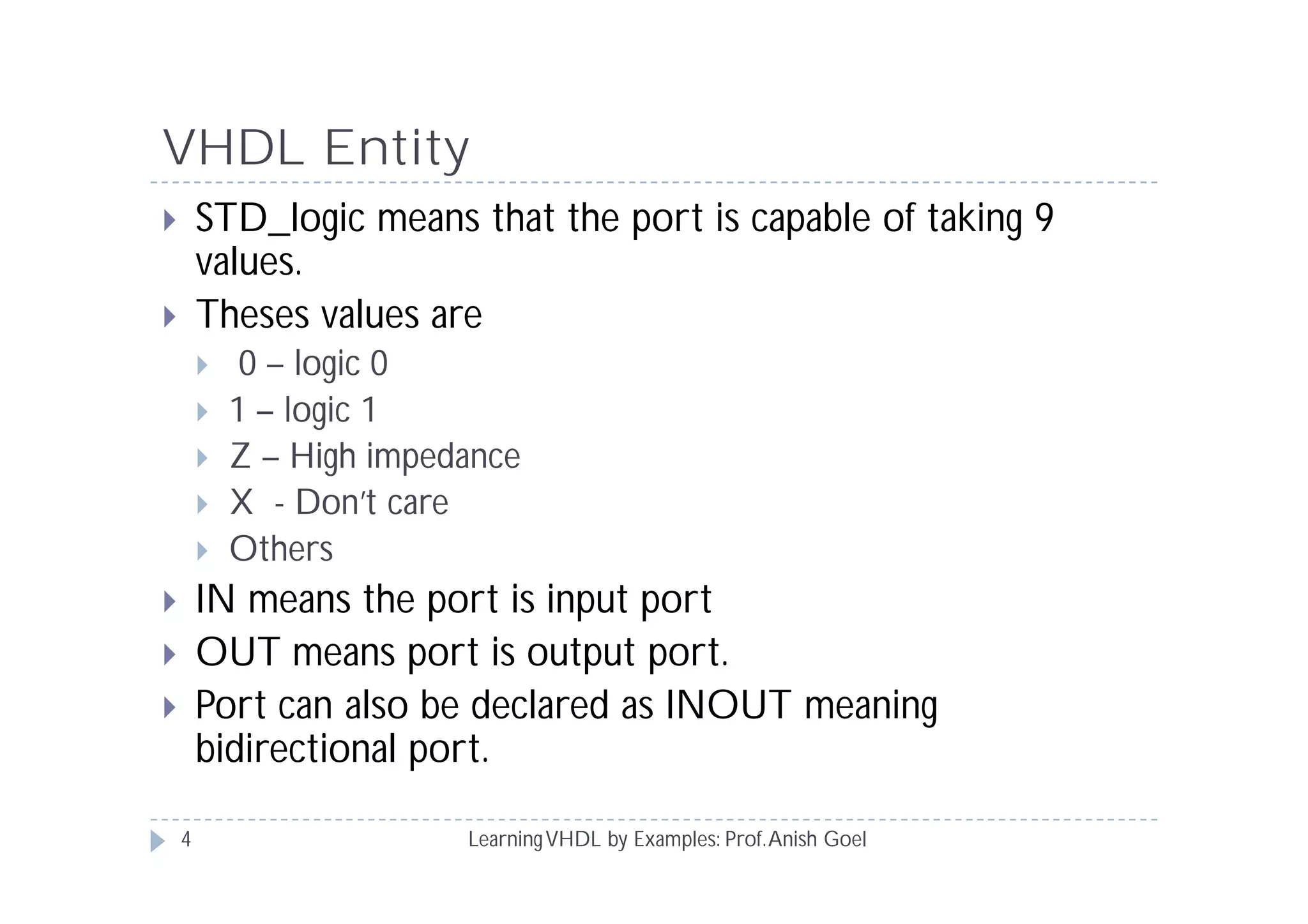
 STD_logic means that the port is capable of taking 9
values.
 Theses values are
 0 – logic 0
 1 – logic 1
 Z – High impedance
 X - Don’t care
 Others
 IN means the port is input port
 OUT means port is output port.
 Port can also be declared as INOUT meaning
bidirectional port.
4
VHDL Architecture
LearningVHDL by Examples: Prof.Anish Goel
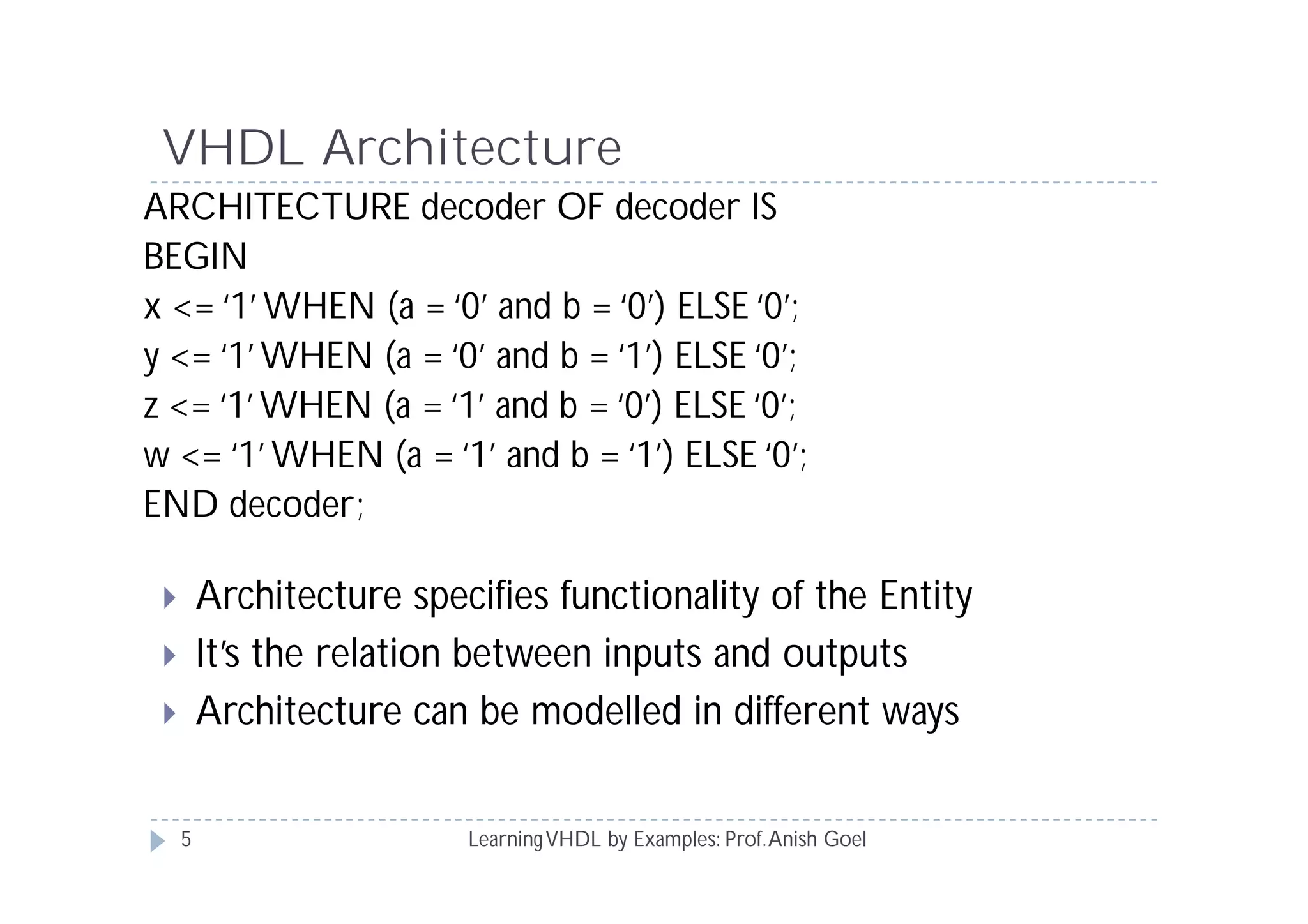
 Architecture specifies functionality of the Entity
 It’s the relation between inputs and outputs
 Architecture can be modelled in different ways
ARCHITECTURE decoder OF decoder IS
BEGIN
x <= ‘1’ WHEN (a = ‘0’ and b = ‘0’) ELSE ‘0’;
y <= ‘1’WHEN (a = ‘0’ and b = ‘1’) ELSE ‘0’;
z <= ‘1’WHEN (a = ‘1’ and b = ‘0’) ELSE ‘0’;
w <= ‘1’ WHEN (a = ‘1’ and b = ‘1’) ELSE ‘0’;
END decoder;
5
Styles of Modelling
LearningVHDL by Examples: Prof.Anish Goel
 VHDL offers 3 different styles of modelling a system/circuit.
 These are
 Data flow coding
 Behavioural coding
 Structural coding
 A same circuit/system can be modelled by 3 different styles.
 Although for some circuits a particular style of modelling
might be the best suitable.
 Like of synchronous circuits Behavioural style seems to be the
best suitable.
 A singleVHDL code can have combination of different styles.
 This is called as mixed style of modelling.
6
Data Flow Modelling
LearningVHDL by Examples: Prof.Anish Goel
 This is also called RTL/Concurrent style of coding.
 It has a relation to the flow of signals in the design and
hence data flow.
 Generally used to model combinational circuit.
7
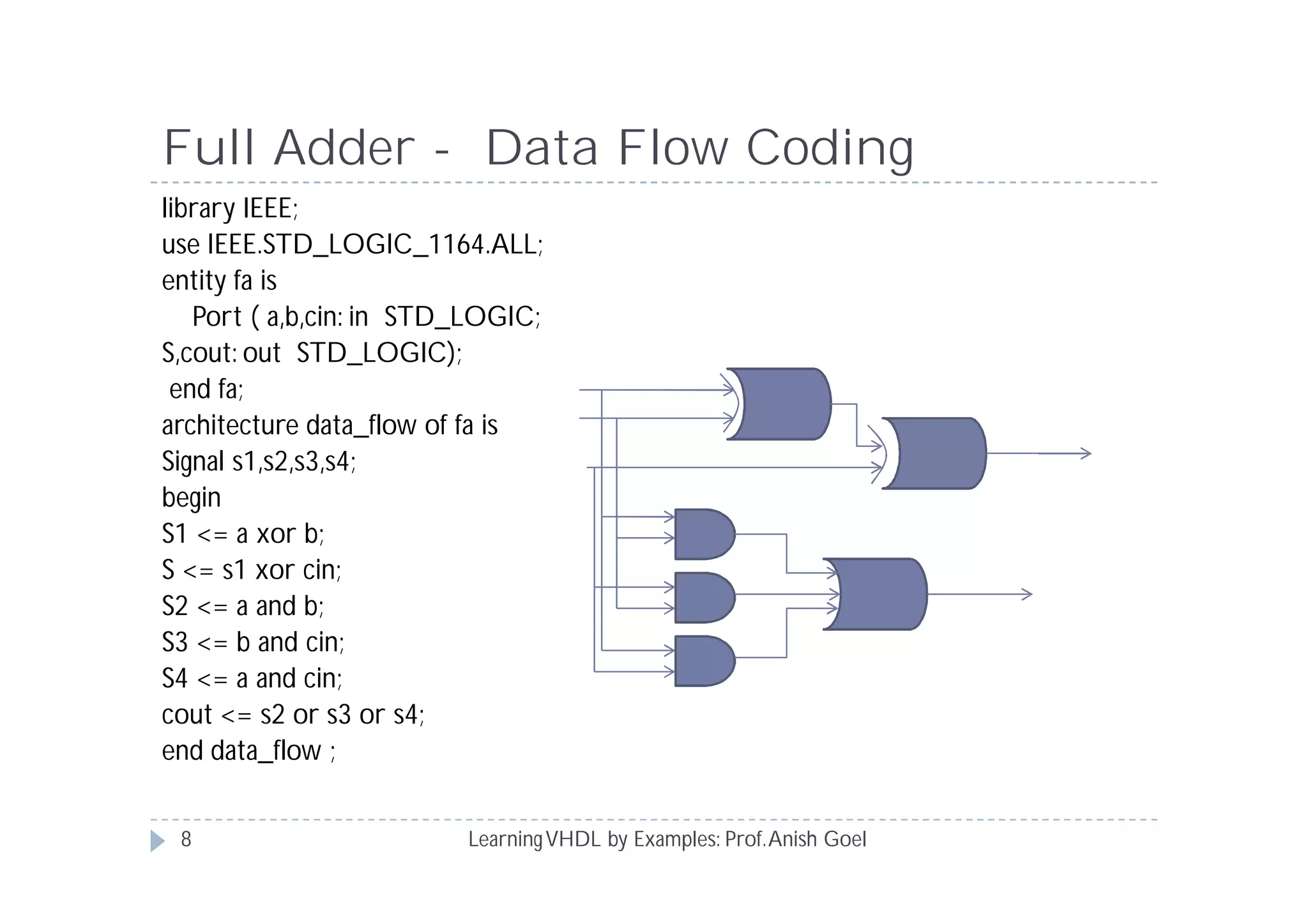
Full Adder - Data Flow Coding
LearningVHDL by Examples: Prof.Anish Goel
library IEEE;
use IEEE.STD_LOGIC_1164.ALL;
entity fa is
Port ( a,b,cin: in STD_LOGIC;
S,cout: out STD_LOGIC);
end fa;
architecture data_flow of fa is
Signal s1,s2,s3,s4;
begin
S1 <= a xor b;
S <= s1 xor cin;
S2 <= a and b;
S3 <= b and cin;
S4 <= a and cin;
cout <= s2 or s3 or s4;
end data_flow ;
8
Behavioural Coding
LearningVHDL by Examples: Prof.Anish Goel
 This is used to describe the circuit to its lower level of
abstraction.
 Generally used to model synchronous/sequential circuits.
 A behavioural code contains PROCESS necessarily.
 The flow and execution of code inside process in a
behavioural code is sequential.
9
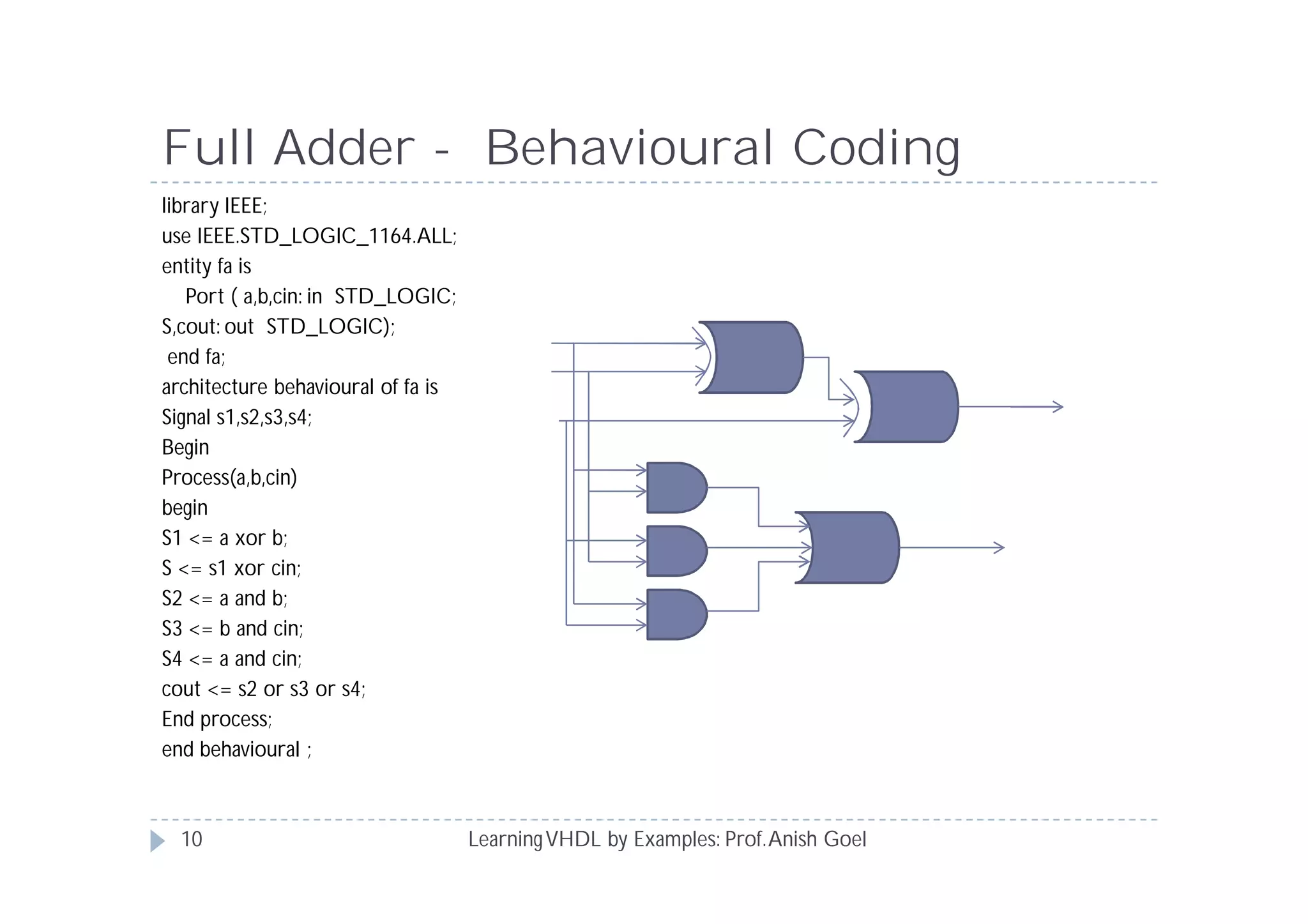
Full Adder - Behavioural Coding
LearningVHDL by Examples: Prof.Anish Goel
library IEEE;
use IEEE.STD_LOGIC_1164.ALL;
entity fa is
Port ( a,b,cin: in STD_LOGIC;
S,cout: out STD_LOGIC);
end fa;
architecture behavioural of fa is
Signal s1,s2,s3,s4;
Begin
Process(a,b,cin)
begin
S1 <= a xor b;
S <= s1 xor cin;
S2 <= a and b;
S3 <= b and cin;
S4 <= a and cin;
cout <= s2 or s3 or s4;
End process;
end behavioural ;
10
Structural Style of Coding
LearningVHDL by Examples: Prof.Anish Goel
 This style of coding is most suitable for
 Creating large circuits/systems that are created from smaller
systems.
 Create circuits that have multiple instantiations of a single small
circuit.
 It uses previousVHDL codes to model the currentVHDL
codes.
 The previous codes must be compiled and present in the
same project as this of code.
 The blocks/circuits/systems used to model structural
style of code can be in any style of modelling.
11
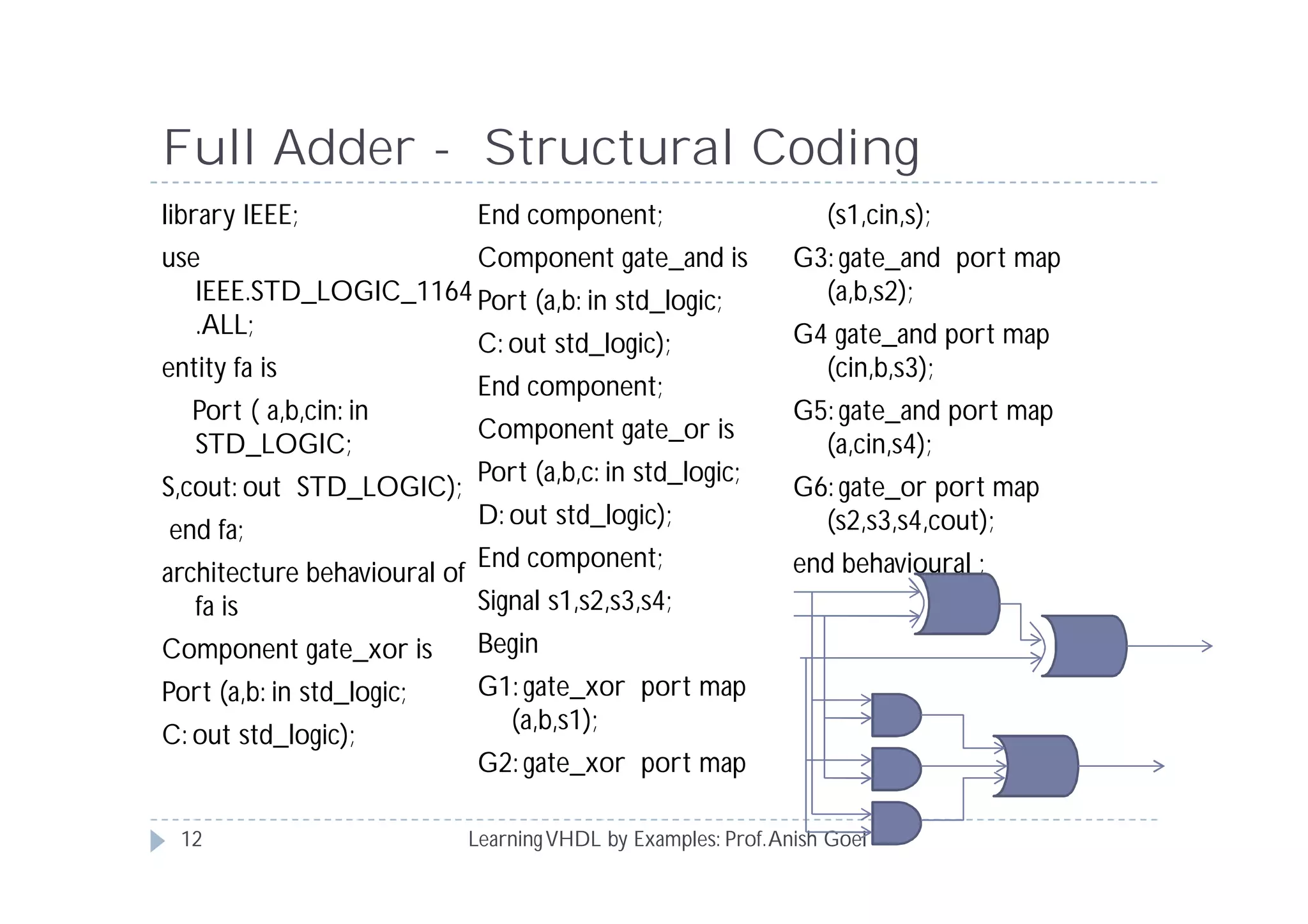
Full Adder - Structural Coding
LearningVHDL by Examples: Prof.Anish Goel
library IEEE;
use
IEEE.STD_LOGIC_1164
.ALL;
entity fa is
Port ( a,b,cin: in
STD_LOGIC;
S,cout: out STD_LOGIC);
end fa;
architecture behavioural of
fa is
Component gate_xor is
Port (a,b: in std_logic;
C: out std_logic);
End component;
Component gate_and is
Port (a,b: in std_logic;
C: out std_logic);
End component;
Component gate_or is
Port (a,b,c: in std_logic;
D: out std_logic);
End component;
Signal s1,s2,s3,s4;
Begin
G1: gate_xor port map
(a,b,s1);
G2: gate_xor port map
(s1,cin,s);
G3: gate_and port map
(a,b,s2);
G4 gate_and port map
(cin,b,s3);
G5: gate_and port map
(a,cin,s4);
G6: gate_or port map
(s2,s3,s4,cout);
end behavioural ;
12
VHDL Statements
LearningVHDL by Examples: Prof.Anish Goel
 Two of theVHDL assignment statements are concurrent:
 With-Select
 When-Else
 Other two are sequential
 If-then-else
 Case
 Both are generally used to model conditional circuits.
 First 2 cannot be used inside the process and other 2
cannot be used outside the process.
13
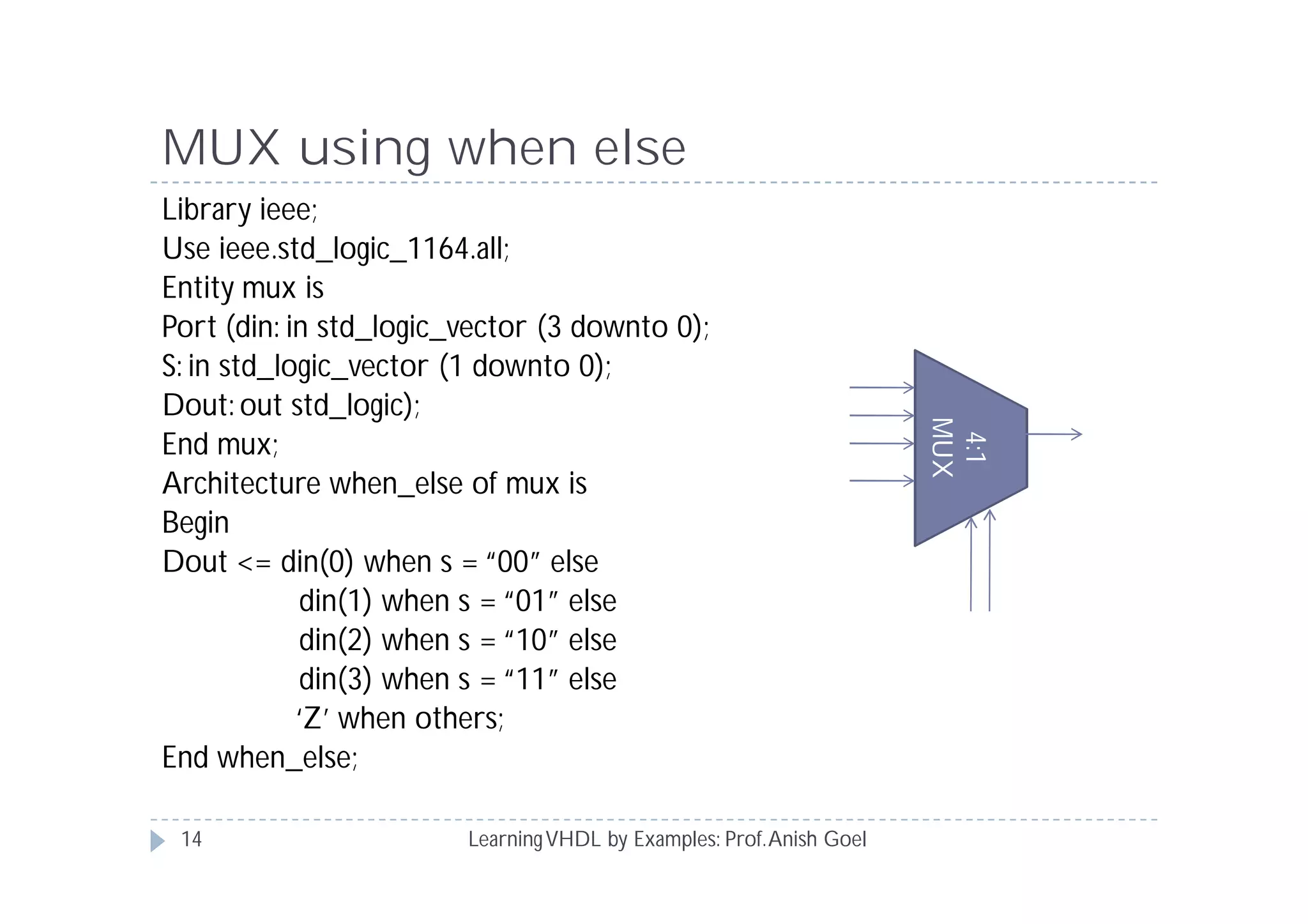
MUX using when else
LearningVHDL by Examples: Prof.Anish Goel
Library ieee;
Use ieee.std_logic_1164.all;
Entity mux is
Port (din: in std_logic_vector (3 downto 0);
S: in std_logic_vector (1 downto 0);
Dout: out std_logic);
End mux;
Architecture when_else of mux is
Begin
Dout <= din(0) when s = “00” else
din(1) when s = “01” else
din(2) when s = “10” else
din(3) when s = “11” else
‘Z’ when others;
End when_else;
4:1
MUX
14
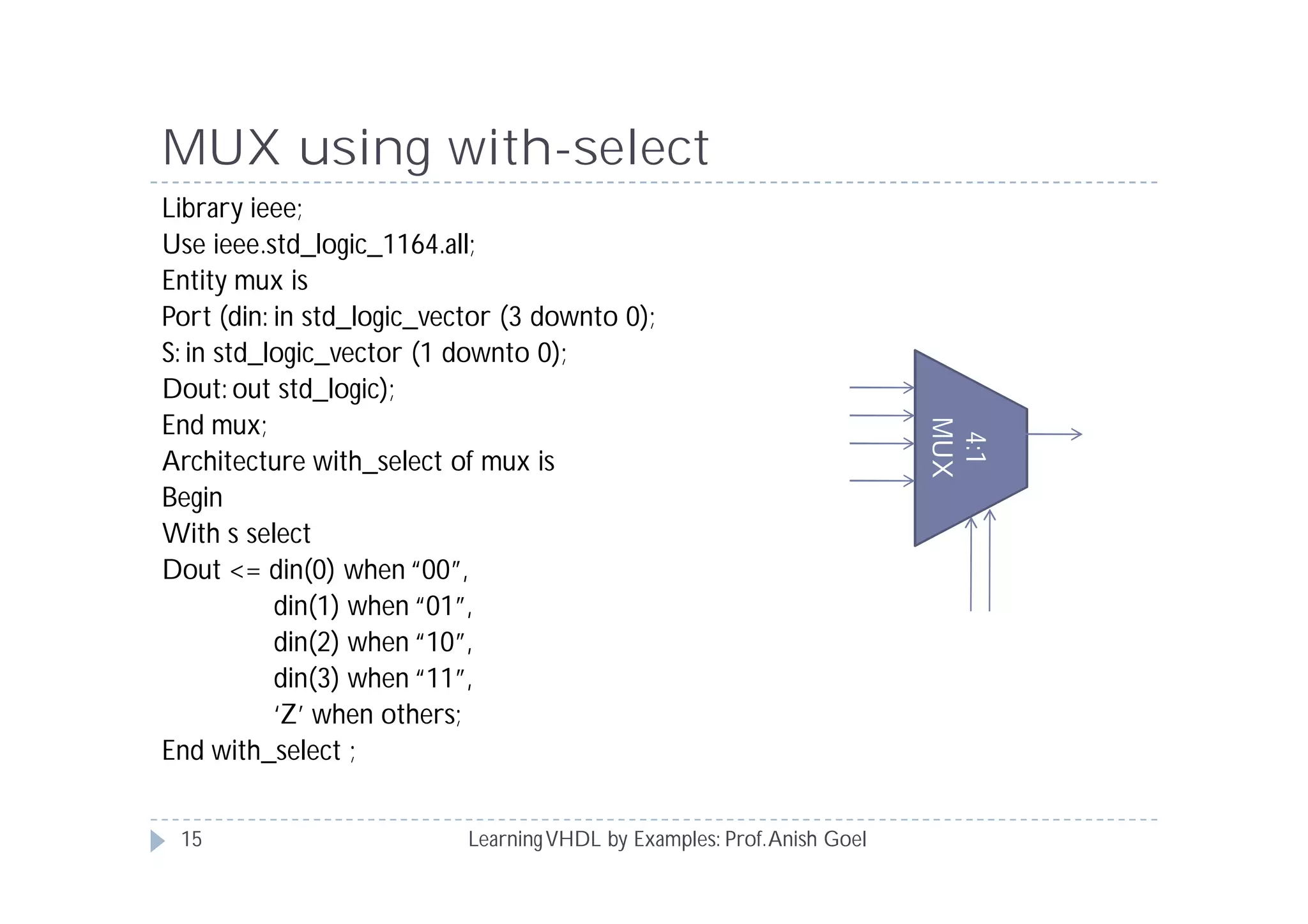
MUX using with-select
LearningVHDL by Examples: Prof.Anish Goel
Library ieee;
Use ieee.std_logic_1164.all;
Entity mux is
Port (din: in std_logic_vector (3 downto 0);
S: in std_logic_vector (1 downto 0);
Dout: out std_logic);
End mux;
Architecture with_select of mux is
Begin
With s select
Dout <= din(0) when “00”,
din(1) when “01”,
din(2) when “10”,
din(3) when “11”,
‘Z’ when others;
End with_select ;
4:1
MUX
15
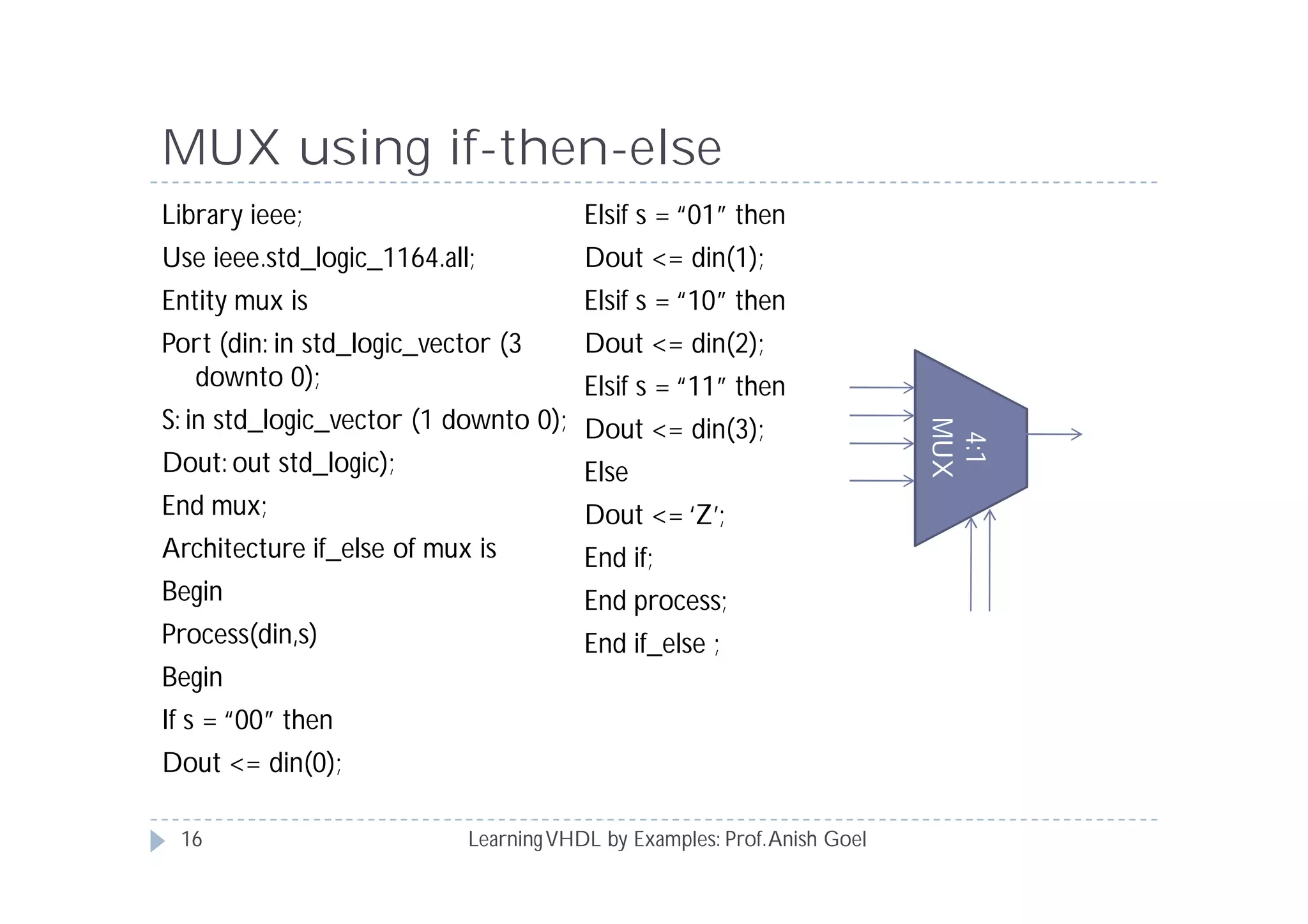
MUX using if-then-else
LearningVHDL by Examples: Prof.Anish Goel
Library ieee;
Use ieee.std_logic_1164.all;
Entity mux is
Port (din: in std_logic_vector (3
downto 0);
S: in std_logic_vector (1 downto 0);
Dout: out std_logic);
End mux;
Architecture if_else of mux is
Begin
Process(din,s)
Begin
If s = “00” then
Dout <= din(0);
Elsif s = “01” then
Dout <= din(1);
Elsif s = “10” then
Dout <= din(2);
Elsif s = “11” then
Dout <= din(3);
Else
Dout <= ‘Z’;
End if;
End process;
End if_else ;
4:1
MUX
16
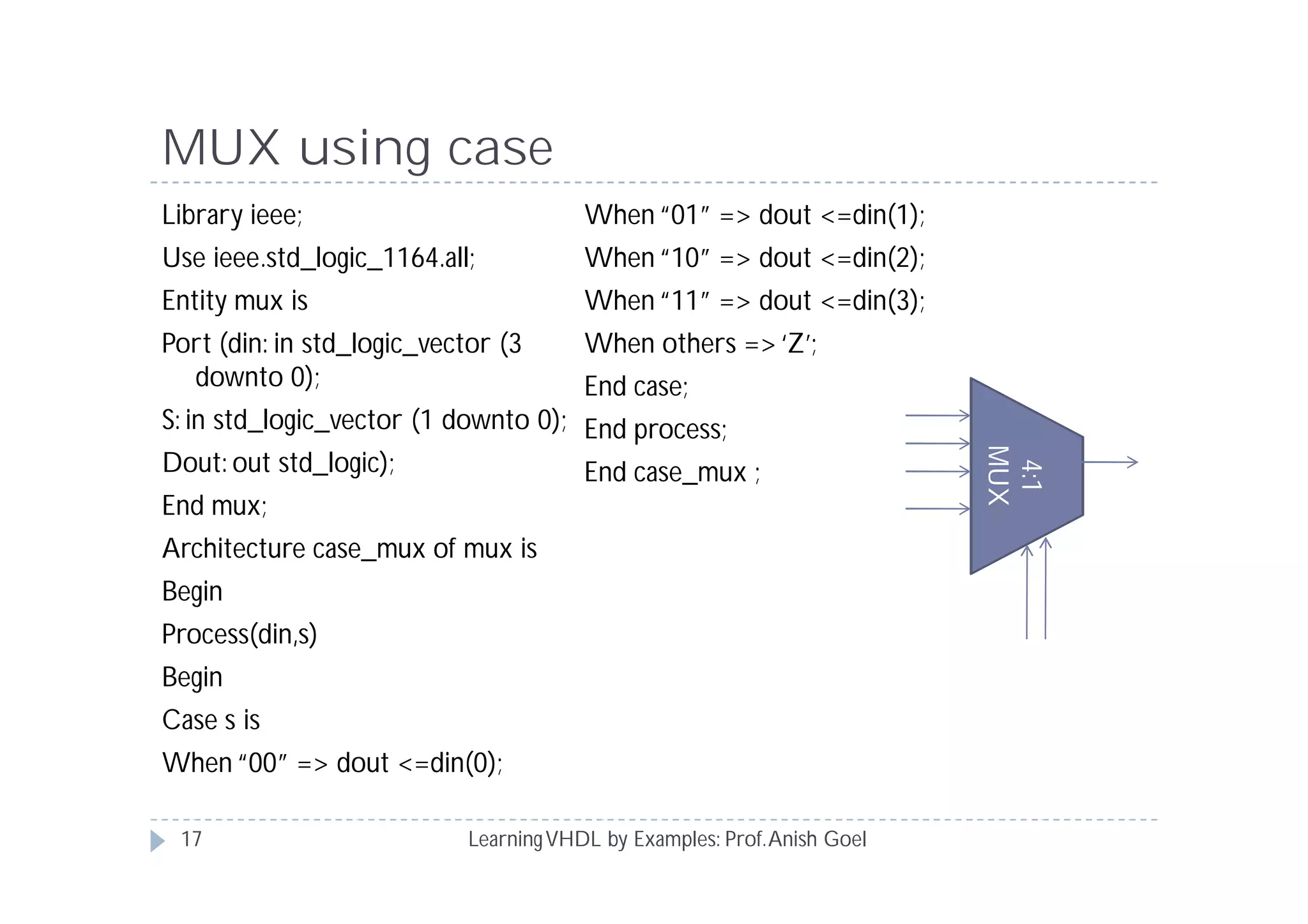
MUX using case
LearningVHDL by Examples: Prof.Anish Goel
Library ieee;
Use ieee.std_logic_1164.all;
Entity mux is
Port (din: in std_logic_vector (3
downto 0);
S: in std_logic_vector (1 downto 0);
Dout: out std_logic);
End mux;
Architecture case_mux of mux is
Begin
Process(din,s)
Begin
Case s is
When “00” => dout <=din(0);
When “01” => dout <=din(1);
When “10” => dout <=din(2);
When “11” => dout <=din(3);
When others => ‘Z’;
End case;
End process;
End case_mux ;
4:1
MUX
17
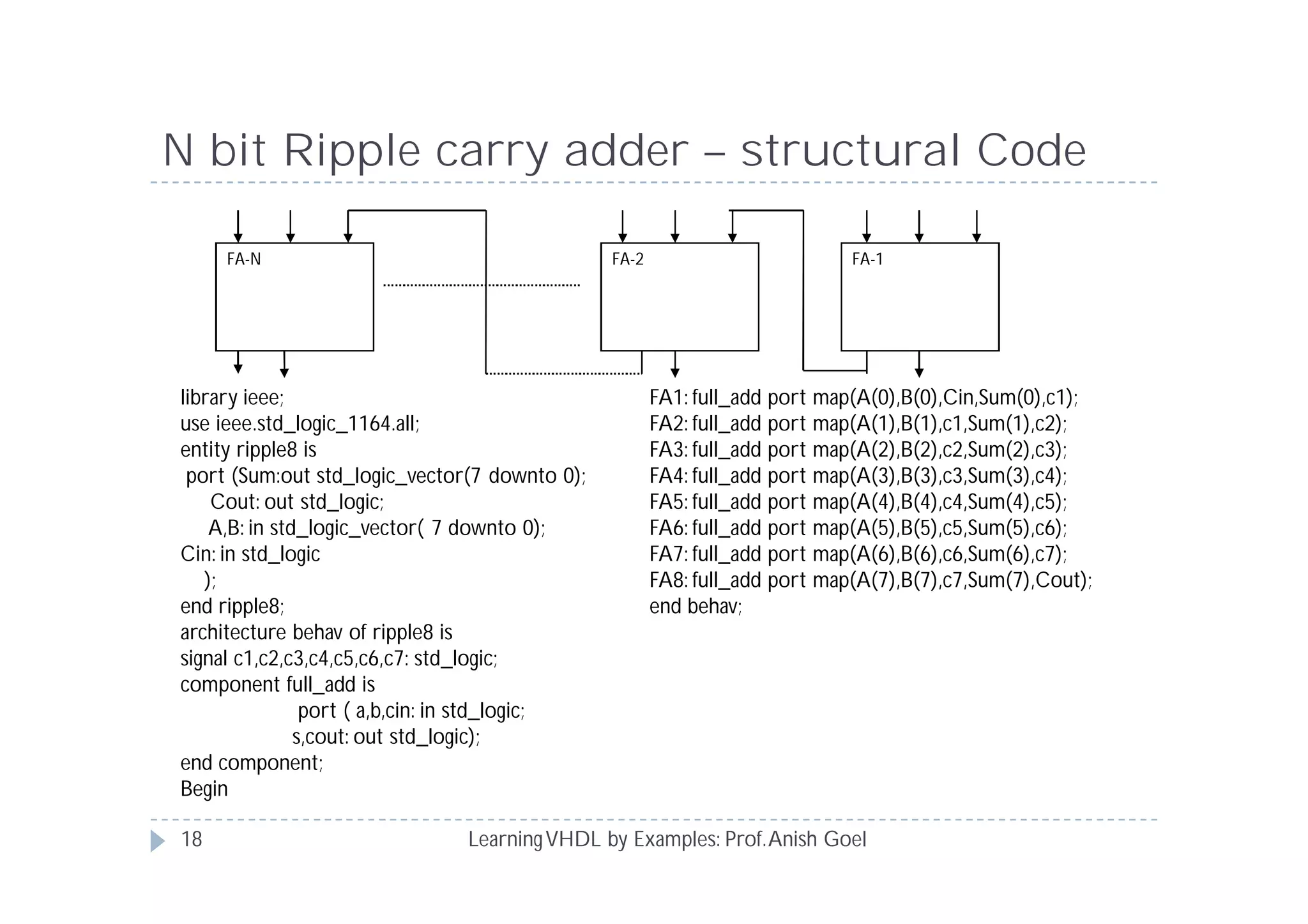
N bit Ripple carry adder – structural Code
LearningVHDL by Examples: Prof.Anish Goel
FA-N FA-2 FA-1
library ieee;
use ieee.std_logic_1164.all;
entity ripple8 is
port (Sum:out std_logic_vector(7 downto 0);
Cout: out std_logic;
A,B: in std_logic_vector( 7 downto 0);
Cin: in std_logic
);
end ripple8;
architecture behav of ripple8 is
signal c1,c2,c3,c4,c5,c6,c7: std_logic;
component full_add is
port ( a,b,cin: in std_logic;
s,cout: out std_logic);
end component;
Begin
FA1: full_add port map(A(0),B(0),Cin,Sum(0),c1);
FA2: full_add port map(A(1),B(1),c1,Sum(1),c2);
FA3: full_add port map(A(2),B(2),c2,Sum(2),c3);
FA4: full_add port map(A(3),B(3),c3,Sum(3),c4);
FA5: full_add port map(A(4),B(4),c4,Sum(4),c5);
FA6: full_add port map(A(5),B(5),c5,Sum(5),c6);
FA7: full_add port map(A(6),B(6),c6,Sum(6),c7);
FA8: full_add port map(A(7),B(7),c7,Sum(7),Cout);
end behav;
18
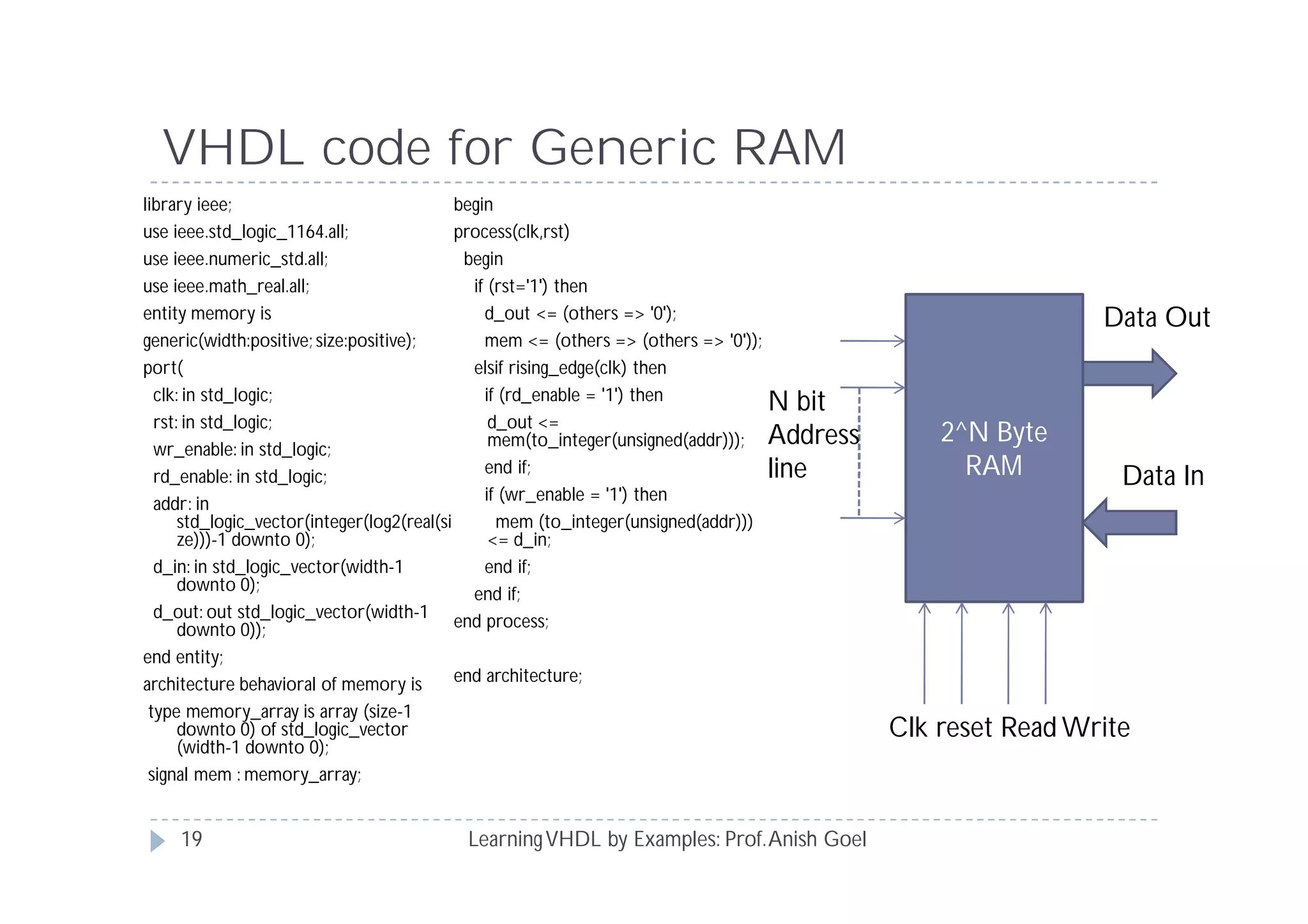
VHDL code for Generic RAM
LearningVHDL by Examples: Prof.Anish Goel
library ieee;
use ieee.std_logic_1164.all;
use ieee.numeric_std.all;
use ieee.math_real.all;
entity memory is
generic(width:positive; size:positive);
port(
clk: in std_logic;
rst: in std_logic;
wr_enable: in std_logic;
rd_enable: in std_logic;
addr: in
std_logic_vector(integer(log2(real(si
ze)))-1 downto 0);
d_in: in std_logic_vector(width-1
downto 0);
d_out: out std_logic_vector(width-1
downto 0));
end entity;
architecture behavioral of memory is
type memory_array is array (size-1
downto 0) of std_logic_vector
(width-1 downto 0);
signal mem : memory_array;
begin
process(clk,rst)
begin
if (rst='1') then
d_out <= (others => '0');
mem <= (others => (others => '0'));
elsif rising_edge(clk) then
if (rd_enable = '1') then
d_out <=
mem(to_integer(unsigned(addr)));
end if;
if (wr_enable = '1') then
mem (to_integer(unsigned(addr)))
<= d_in;
end if;
end if;
end process;
end architecture;
2^N Byte
RAM
N bit
Address
line
Clk reset Read Write
Data Out
Data In
19
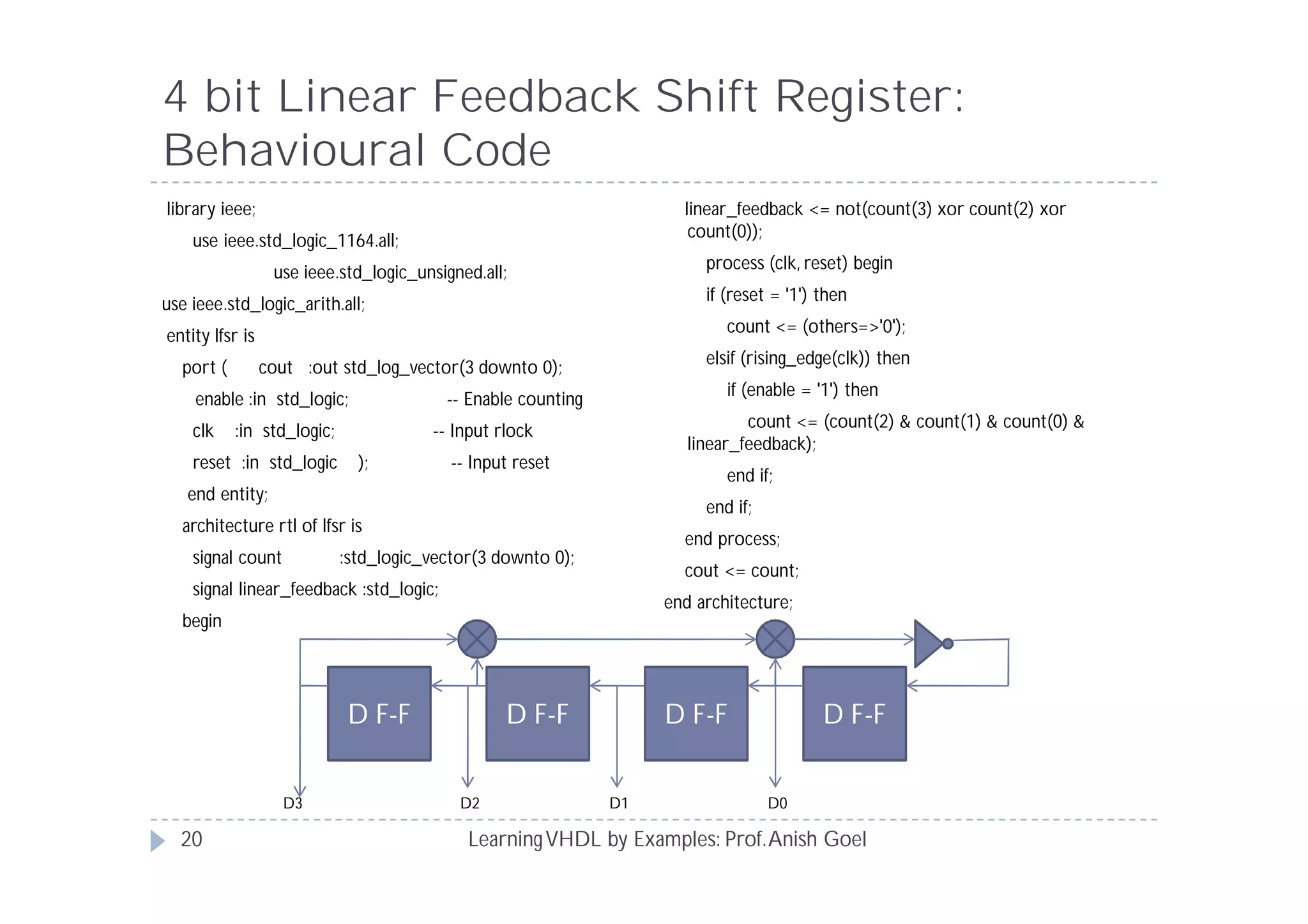
4 bit Linear Feedback Shift Register:
Behavioural Code
LearningVHDL by Examples: Prof.Anish Goel
library ieee;
use ieee.std_logic_1164.all;
use ieee.std_logic_unsigned.all;
use ieee.std_logic_arith.all;
entity lfsr is
port ( cout :out std_log_vector(3 downto 0);
enable :in std_logic; -- Enable counting
clk :in std_logic; -- Input rlock
reset :in std_logic ); -- Input reset
end entity;
architecture rtl of lfsr is
signal count :std_logic_vector(3 downto 0);
signal linear_feedback :std_logic;
begin
linear_feedback <= not(count(3) xor count(2) xor
count(0));
process (clk, reset) begin
if (reset = '1') then
count <= (others=>'0');
elsif (rising_edge(clk)) then
if (enable = '1') then
count <= (count(2) & count(1) & count(0) &
linear_feedback);
end if;
end if;
end process;
cout <= count;
end architecture;
D F-F D F-F D F-F D F-F
D0D1D2D3
20
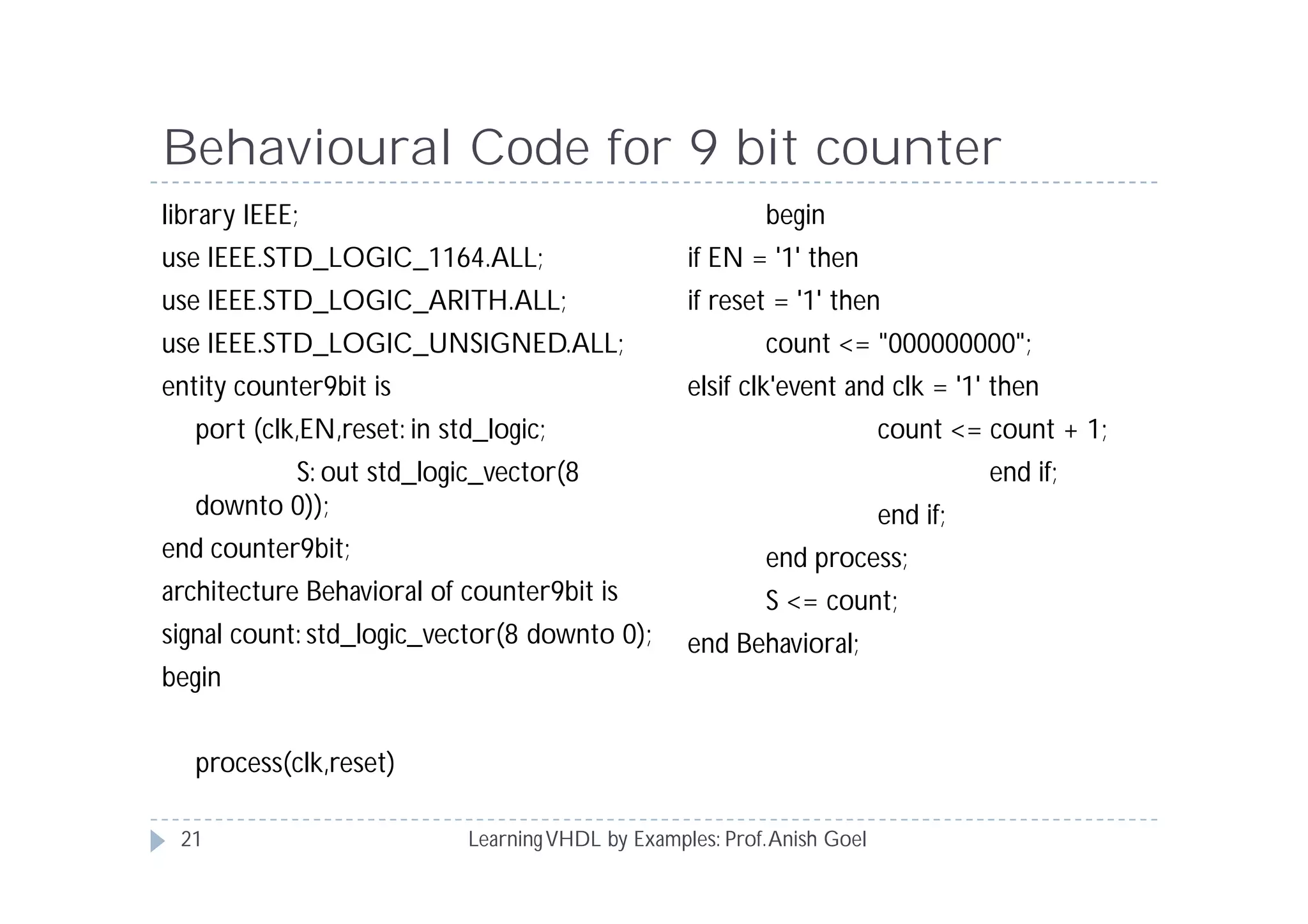
Behavioural Code for 9 bit counter
LearningVHDL by Examples: Prof.Anish Goel
library IEEE;
use IEEE.STD_LOGIC_1164.ALL;
use IEEE.STD_LOGIC_ARITH.ALL;
use IEEE.STD_LOGIC_UNSIGNED.ALL;
entity counter9bit is
port (clk,EN,reset: in std_logic;
S: out std_logic_vector(8
downto 0));
end counter9bit;
architecture Behavioral of counter9bit is
signal count: std_logic_vector(8 downto 0);
begin
process(clk,reset)
begin
if EN = '1' then
if reset = '1' then
count <= "000000000";
elsif clk'event and clk = '1' then
count <= count + 1;
end if;
end if;
end process;
S <= count;
end Behavioral;
21
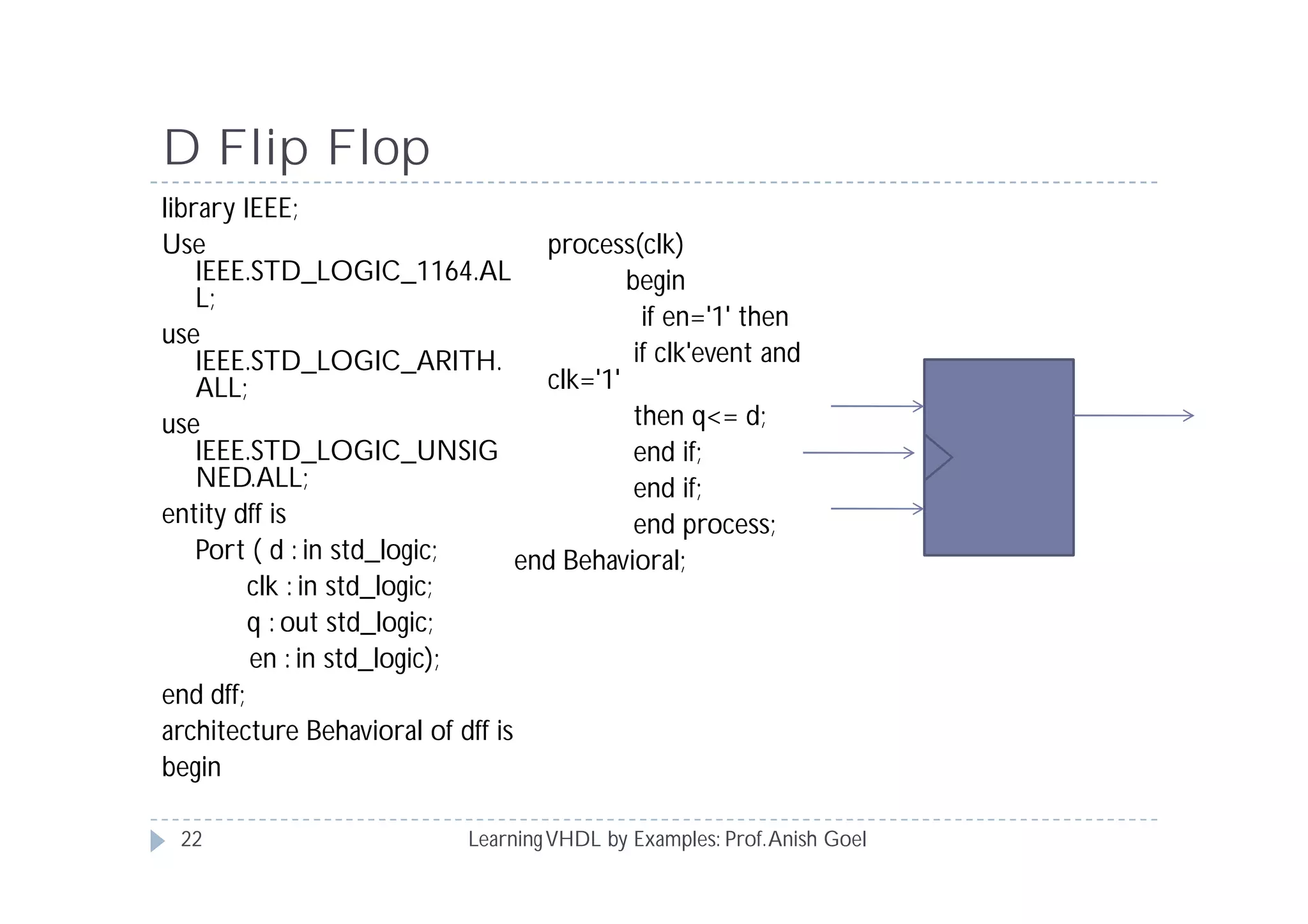
D Flip Flop
LearningVHDL by Examples: Prof.Anish Goel
library IEEE;
Use
IEEE.STD_LOGIC_1164.AL
L;
use
IEEE.STD_LOGIC_ARITH.
ALL;
use
IEEE.STD_LOGIC_UNSIG
NED.ALL;
entity dff is
Port ( d : in std_logic;
clk : in std_logic;
q : out std_logic;
en : in std_logic);
end dff;
architecture Behavioral of dff is
begin
process(clk)
begin
if en='1' then
if clk'event and
clk='1'
then q<= d;
end if;
end if;
end process;
end Behavioral;
22
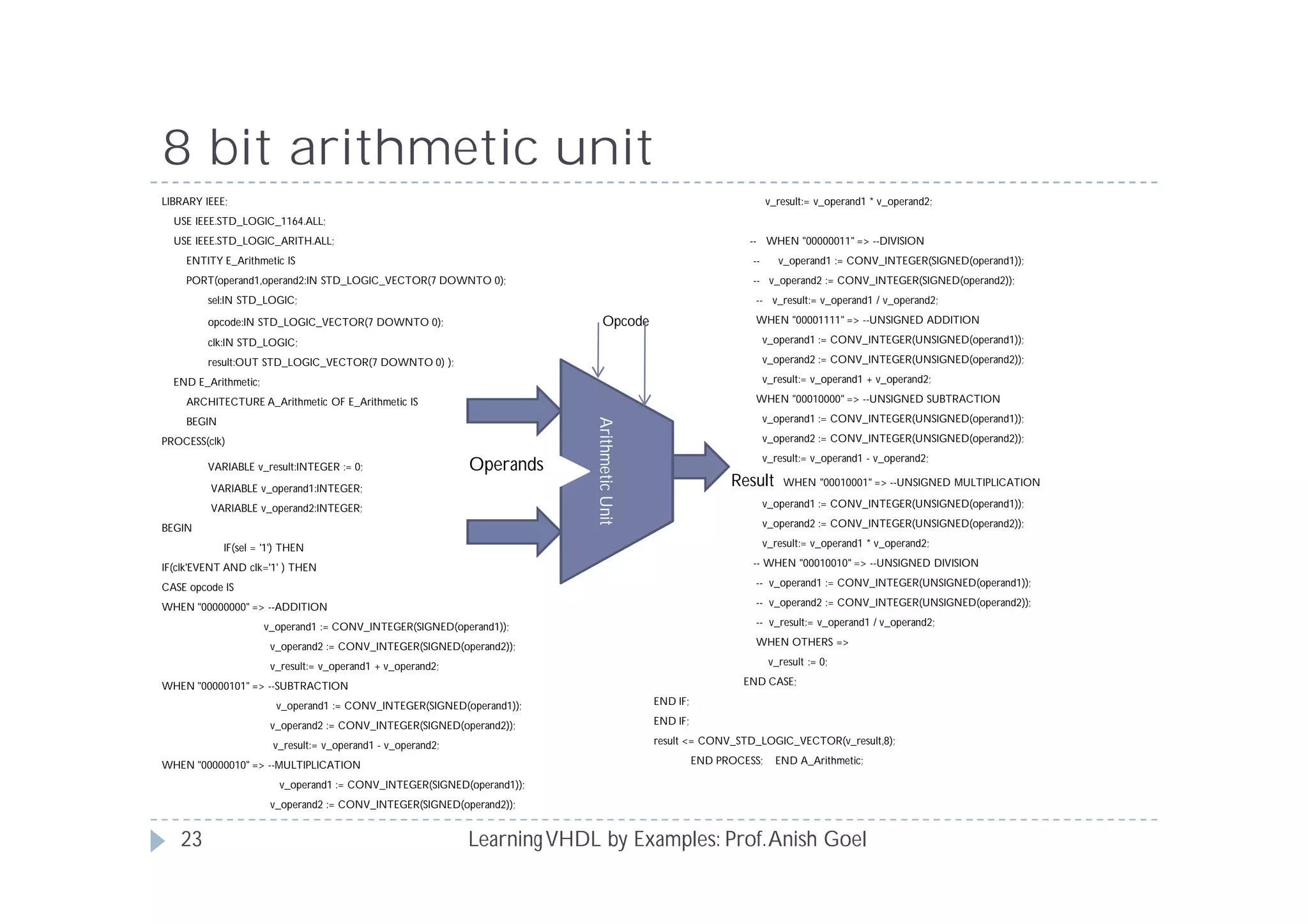
8 bit arithmetic unit
LearningVHDL by Examples: Prof.Anish Goel
LIBRARY IEEE;
USE IEEE.STD_LOGIC_1164.ALL;
USE IEEE.STD_LOGIC_ARITH.ALL;
ENTITY E_Arithmetic IS
PORT(operand1,operand2:IN STD_LOGIC_VECTOR(7 DOWNTO 0);
sel:IN STD_LOGIC;
opcode:IN STD_LOGIC_VECTOR(7 DOWNTO 0); Opcode
clk:IN STD_LOGIC;
result:OUT STD_LOGIC_VECTOR(7 DOWNTO 0) );
END E_Arithmetic;
ARCHITECTURE A_Arithmetic OF E_Arithmetic IS
BEGIN
PROCESS(clk)
VARIABLE v_result:INTEGER := 0; Operands
VARIABLE v_operand1:INTEGER;
VARIABLE v_operand2:INTEGER;
BEGIN
IF(sel = '1') THEN
IF(clk'EVENT AND clk='1' ) THEN
CASE opcode IS
WHEN "00000000" => --ADDITION
v_operand1 := CONV_INTEGER(SIGNED(operand1));
v_operand2 := CONV_INTEGER(SIGNED(operand2));
v_result:= v_operand1 + v_operand2;
WHEN "00000101" => --SUBTRACTION
v_operand1 := CONV_INTEGER(SIGNED(operand1));
v_operand2 := CONV_INTEGER(SIGNED(operand2));
v_result:= v_operand1 - v_operand2;
WHEN "00000010" => --MULTIPLICATION
v_operand1 := CONV_INTEGER(SIGNED(operand1));
v_operand2 := CONV_INTEGER(SIGNED(operand2));
v_result:= v_operand1 * v_operand2;
-- WHEN "00000011" => --DIVISION
-- v_operand1 := CONV_INTEGER(SIGNED(operand1));
-- v_operand2 := CONV_INTEGER(SIGNED(operand2));
-- v_result:= v_operand1 / v_operand2;
WHEN "00001111" => --UNSIGNED ADDITION
v_operand1 := CONV_INTEGER(UNSIGNED(operand1));
v_operand2 := CONV_INTEGER(UNSIGNED(operand2));
v_result:= v_operand1 + v_operand2;
WHEN "00010000" => --UNSIGNED SUBTRACTION
v_operand1 := CONV_INTEGER(UNSIGNED(operand1));
v_operand2 := CONV_INTEGER(UNSIGNED(operand2));
v_result:= v_operand1 - v_operand2;
Result WHEN "00010001" => --UNSIGNED MULTIPLICATION
v_operand1 := CONV_INTEGER(UNSIGNED(operand1));
v_operand2 := CONV_INTEGER(UNSIGNED(operand2));
v_result:= v_operand1 * v_operand2;
-- WHEN "00010010" => --UNSIGNED DIVISION
-- v_operand1 := CONV_INTEGER(UNSIGNED(operand1));
-- v_operand2 := CONV_INTEGER(UNSIGNED(operand2));
-- v_result:= v_operand1 / v_operand2;
WHEN OTHERS =>
v_result := 0;
END CASE;
END IF;
END IF;
result <= CONV_STD_LOGIC_VECTOR(v_result,8);
END PROCESS; END A_Arithmetic;
ArithmeticUnit
23
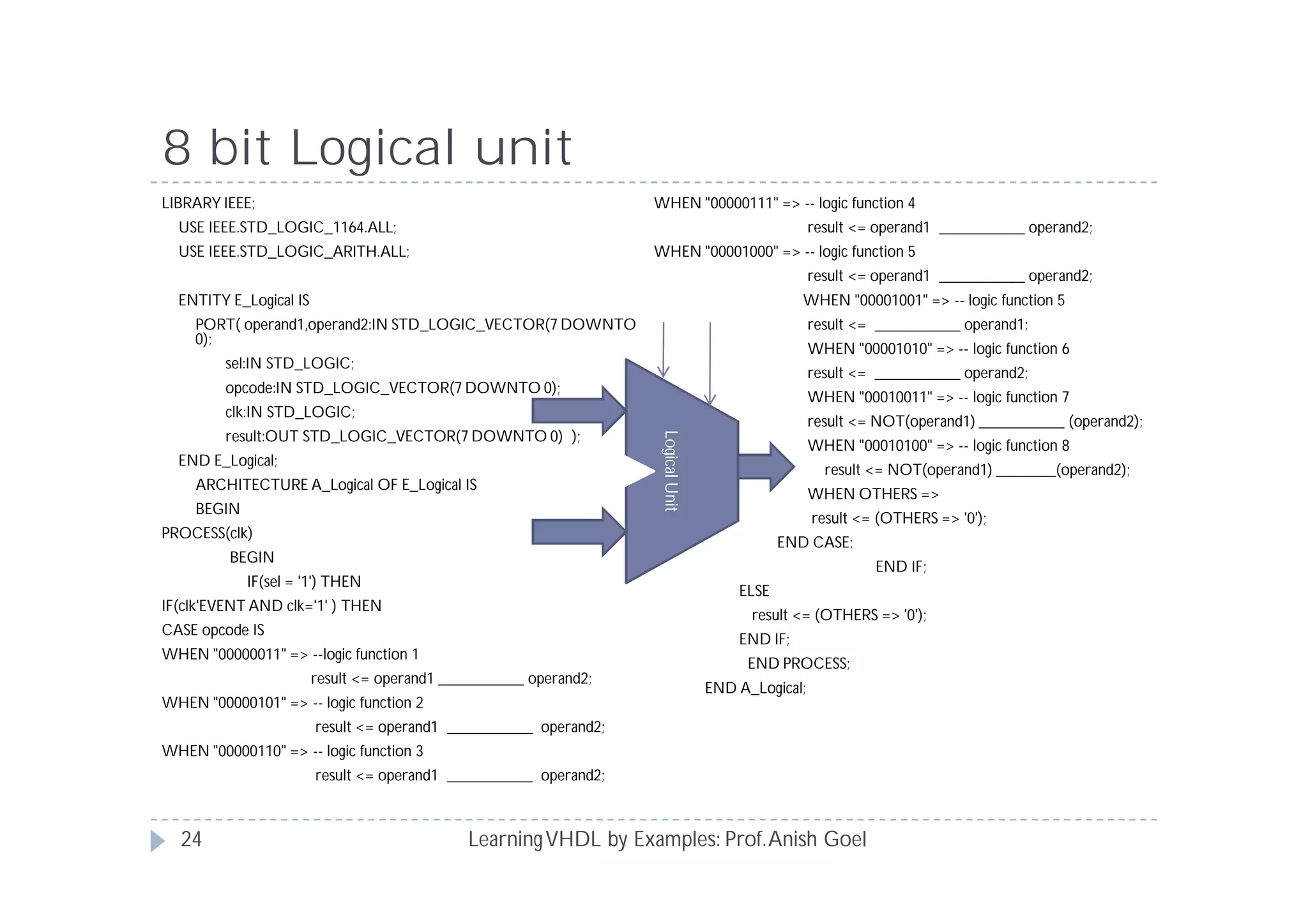
8 bit Logical unit
LearningVHDL by Examples: Prof.Anish Goel
LIBRARY IEEE;
USE IEEE.STD_LOGIC_1164.ALL;
USE IEEE.STD_LOGIC_ARITH.ALL;
ENTITY E_Logical IS
PORT( operand1,operand2:IN STD_LOGIC_VECTOR(7 DOWNTO
0);
sel:IN STD_LOGIC;
opcode:IN STD_LOGIC_VECTOR(7 DOWNTO 0);
clk:IN STD_LOGIC;
result:OUT STD_LOGIC_VECTOR(7 DOWNTO 0) );
END E_Logical;
ARCHITECTURE A_Logical OF E_Logical IS
BEGIN
PROCESS(clk)
BEGIN
IF(sel = '1') THEN
IF(clk'EVENT AND clk='1' ) THEN
CASE opcode IS
WHEN "00000011" => --logic function 1
result <= operand1 __________ operand2;
WHEN "00000101" => -- logic function 2
result <= operand1 __________ operand2;
WHEN "00000110" => -- logic function 3
result <= operand1 __________ operand2;
WHEN "00000111" => -- logic function 4
result <= operand1 __________ operand2;
WHEN "00001000" => -- logic function 5
result <= operand1 __________ operand2;
WHEN "00001001" => -- logic function 5
result <= __________ operand1;
WHEN "00001010" => -- logic function 6
result <= __________ operand2;
WHEN "00010011" => -- logic function 7
result <= NOT(operand1) __________ (operand2);
WHEN "00010100" => -- logic function 8
result <= NOT(operand1) _______(operand2);
WHEN OTHERS =>
result <= (OTHERS => '0');
END CASE;
END IF;
ELSE
result <= (OTHERS => '0');
END IF;
END PROCESS;
END A_Logical;
LogicalUnit
24
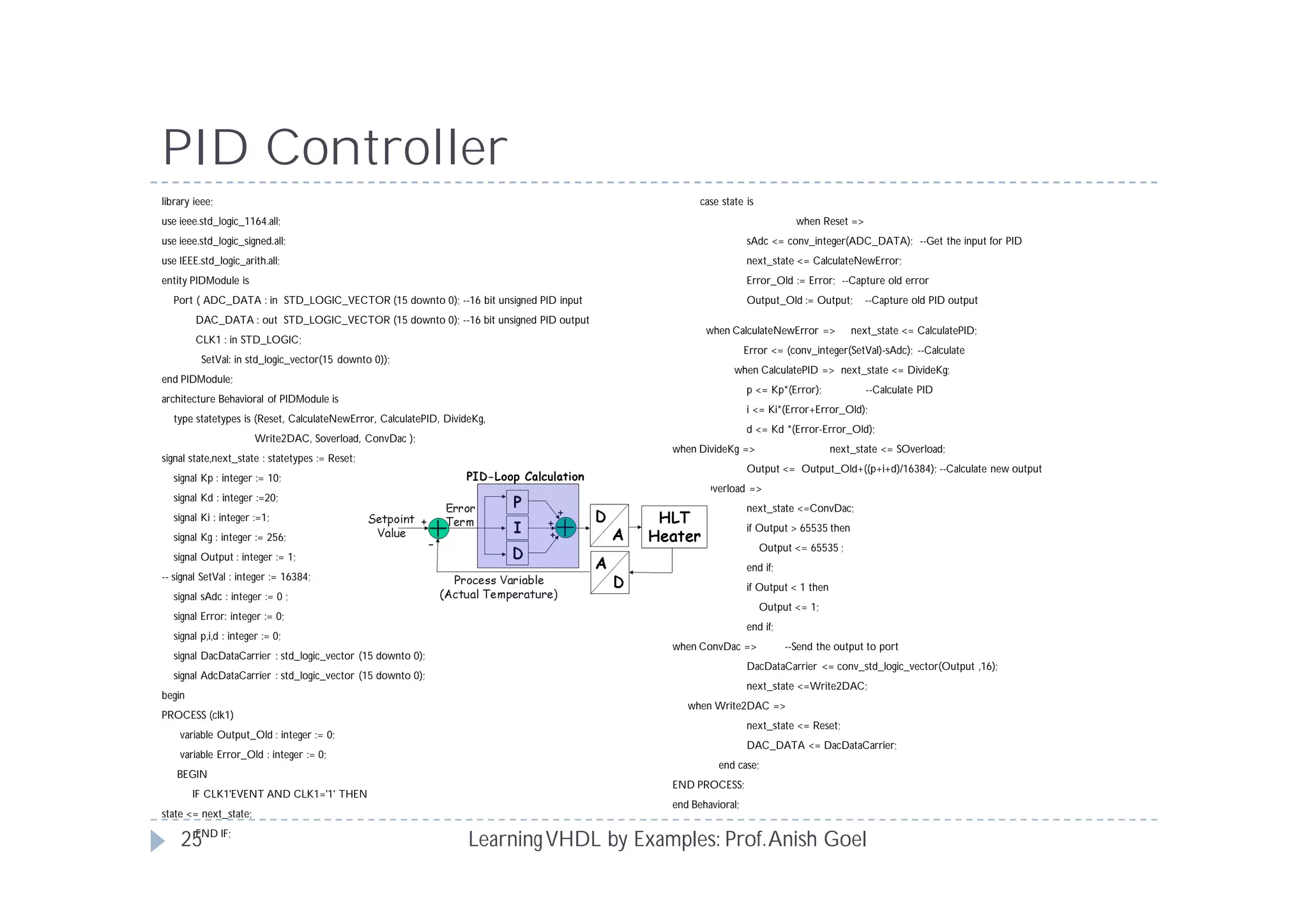
PID Controller
LearningVHDL by Examples: Prof.Anish Goel
library ieee;
use ieee.std_logic_1164.all;
use ieee.std_logic_signed.all;
use IEEE.std_logic_arith.all;
entity PIDModule is
Port ( ADC_DATA : in STD_LOGIC_VECTOR (15 downto 0); --16 bit unsigned PID input
DAC_DATA : out STD_LOGIC_VECTOR (15 downto 0); --16 bit unsigned PID output
CLK1 : in STD_LOGIC;
SetVal: in std_logic_vector(15 downto 0));
end PIDModule;
architecture Behavioral of PIDModule is
type statetypes is (Reset, CalculateNewError, CalculatePID, DivideKg,
Write2DAC, Soverload, ConvDac );
signal state,next_state : statetypes := Reset;
signal Kp : integer := 10;
signal Kd : integer :=20;
signal Ki : integer :=1;
signal Kg : integer := 256;
signal Output : integer := 1;
-- signal SetVal : integer := 16384;
signal sAdc : integer := 0 ;
signal Error: integer := 0;
signal p,i,d : integer := 0;
signal DacDataCarrier : std_logic_vector (15 downto 0);
signal AdcDataCarrier : std_logic_vector (15 downto 0);
begin
PROCESS (clk1)
variable Output_Old : integer := 0;
variable Error_Old : integer := 0;
BEGIN
IF CLK1'EVENT AND CLK1='1' THEN
state <= next_state;
END IF;
case state is
when Reset =>
sAdc <= conv_integer(ADC_DATA); --Get the input for PID
next_state <= CalculateNewError;
Error_Old := Error; --Capture old error
Output_Old := Output; --Capture old PID output
when CalculateNewError => next_state <= CalculatePID;
Error <= (conv_integer(SetVal)-sAdc); --Calculate
when CalculatePID => next_state <= DivideKg;
p <= Kp*(Error); --Calculate PID
i <= Ki*(Error+Error_Old);
d <= Kd *(Error-Error_Old);
when DivideKg => next_state <= SOverload;
Output <= Output_Old+((p+i+d)/16384); --Calculate new output
when SOverload =>
next_state <=ConvDac;
if Output > 65535 then
Output <= 65535 ;
end if;
if Output < 1 then
Output <= 1;
end if;
when ConvDac => --Send the output to port
DacDataCarrier <= conv_std_logic_vector(Output ,16);
next_state <=Write2DAC;
when Write2DAC =>
next_state <= Reset;
DAC_DATA <= DacDataCarrier;
end case;
END PROCESS;
end Behavioral;
25
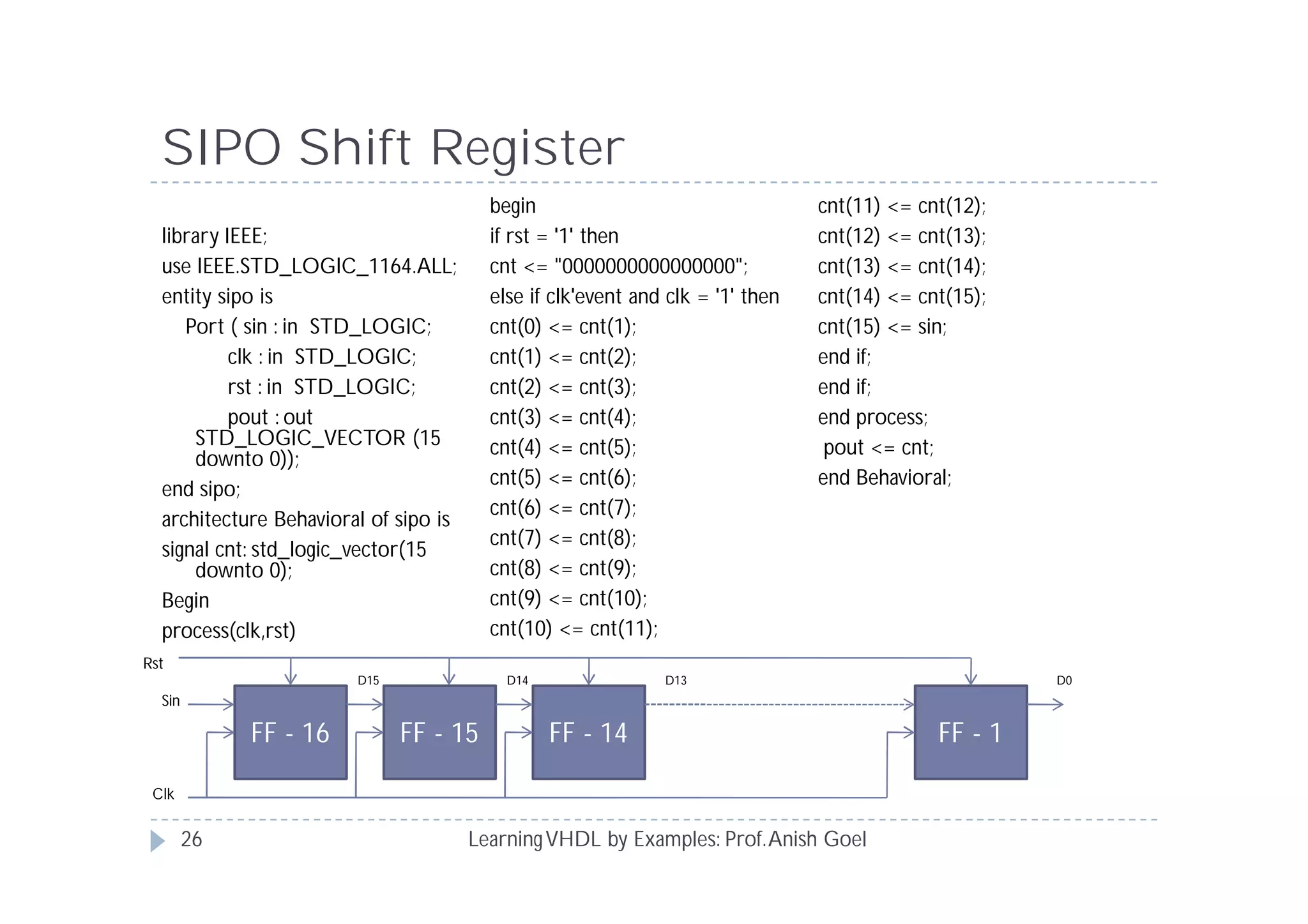
SIPO Shift Register
LearningVHDL by Examples: Prof.Anish Goel
library IEEE;
use IEEE.STD_LOGIC_1164.ALL;
entity sipo is
Port ( sin : in STD_LOGIC;
clk : in STD_LOGIC;
rst : in STD_LOGIC;
pout : out
STD_LOGIC_VECTOR (15
downto 0));
end sipo;
architecture Behavioral of sipo is
signal cnt: std_logic_vector(15
downto 0);
Begin
process(clk,rst)
begin
if rst = '1' then
cnt <= "0000000000000000";
else if clk'event and clk = '1' then
cnt(0) <= cnt(1);
cnt(1) <= cnt(2);
cnt(2) <= cnt(3);
cnt(3) <= cnt(4);
cnt(4) <= cnt(5);
cnt(5) <= cnt(6);
cnt(6) <= cnt(7);
cnt(7) <= cnt(8);
cnt(8) <= cnt(9);
cnt(9) <= cnt(10);
cnt(10) <= cnt(11);
cnt(11) <= cnt(12);
cnt(12) <= cnt(13);
cnt(13) <= cnt(14);
cnt(14) <= cnt(15);
cnt(15) <= sin;
end if;
end if;
end process;
pout <= cnt;
end Behavioral;
FF - 16 FF - 15 FF - 14 FF - 1
Sin
Rst
Clk
D15 D14 D13 D0
26
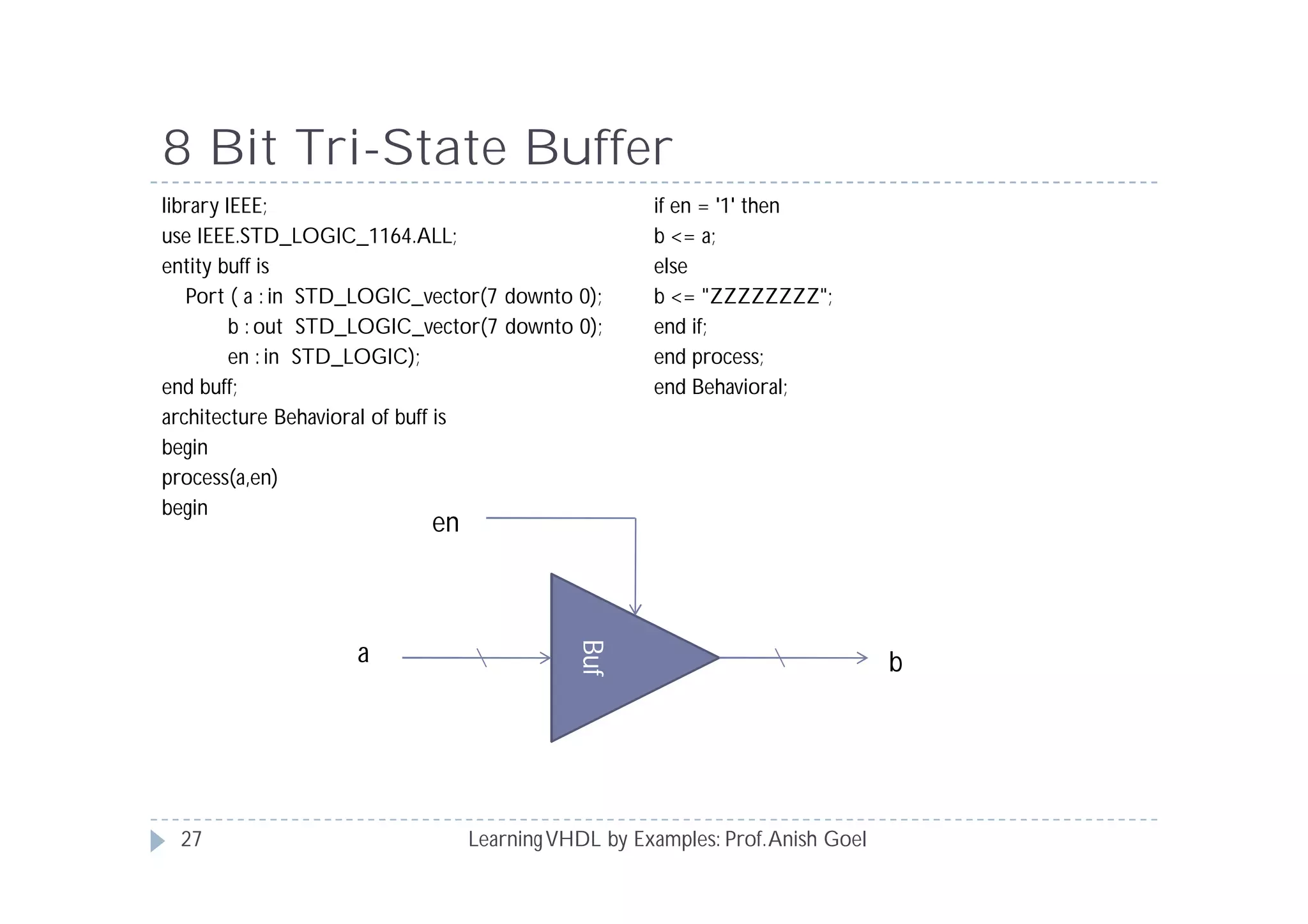
8 Bit Tri-State Buffer
LearningVHDL by Examples: Prof.Anish Goel
library IEEE;
use IEEE.STD_LOGIC_1164.ALL;
entity buff is
Port ( a : in STD_LOGIC_vector(7 downto 0);
b : out STD_LOGIC_vector(7 downto 0);
en : in STD_LOGIC);
end buff;
architecture Behavioral of buff is
begin
process(a,en)
begin
if en = '1' then
b <= a;
else
b <= "ZZZZZZZZ";
end if;
end process;
end Behavioral;
Buf
en
a b
27

Learning vhdl by examples

  • 1.
    Learning VHDL byExamples Prof. Anish Goel
  • 2.
    Contents  VHDL Entityand Architecture  VHDL styles of Modelling  Conditional and concurrent assignment statements LearningVHDL by Examples: Prof.Anish Goel2
  • 3.
    VHDL Entity LearningVHDL byExamples: Prof.Anish Goel  VHDL Entity specifies a circuit/system as an entity with its inputs and outputs and their types.  Points worth noticing  All words in UPPER CASE in above entity declaration are VHDL key words  Words in lower case areVHDL data objects.  VHDL is case insensitive 2:4 decoder ENTITY decoder IS PORT (a,b: IN STD_LOGIC; x,y,z,w: OUT STD_LOGIC); END decoder; 3
  • 4.
    VHDL Entity LearningVHDL byExamples: Prof.Anish Goel  STD_logic means that the port is capable of taking 9 values.  Theses values are  0 – logic 0  1 – logic 1  Z – High impedance  X - Don’t care  Others  IN means the port is input port  OUT means port is output port.  Port can also be declared as INOUT meaning bidirectional port. 4
  • 5.
    VHDL Architecture LearningVHDL byExamples: Prof.Anish Goel  Architecture specifies functionality of the Entity  It’s the relation between inputs and outputs  Architecture can be modelled in different ways ARCHITECTURE decoder OF decoder IS BEGIN x <= ‘1’ WHEN (a = ‘0’ and b = ‘0’) ELSE ‘0’; y <= ‘1’WHEN (a = ‘0’ and b = ‘1’) ELSE ‘0’; z <= ‘1’WHEN (a = ‘1’ and b = ‘0’) ELSE ‘0’; w <= ‘1’ WHEN (a = ‘1’ and b = ‘1’) ELSE ‘0’; END decoder; 5
  • 6.
    Styles of Modelling LearningVHDLby Examples: Prof.Anish Goel  VHDL offers 3 different styles of modelling a system/circuit.  These are  Data flow coding  Behavioural coding  Structural coding  A same circuit/system can be modelled by 3 different styles.  Although for some circuits a particular style of modelling might be the best suitable.  Like of synchronous circuits Behavioural style seems to be the best suitable.  A singleVHDL code can have combination of different styles.  This is called as mixed style of modelling. 6
  • 7.
    Data Flow Modelling LearningVHDLby Examples: Prof.Anish Goel  This is also called RTL/Concurrent style of coding.  It has a relation to the flow of signals in the design and hence data flow.  Generally used to model combinational circuit. 7
  • 8.
    Full Adder -Data Flow Coding LearningVHDL by Examples: Prof.Anish Goel library IEEE; use IEEE.STD_LOGIC_1164.ALL; entity fa is Port ( a,b,cin: in STD_LOGIC; S,cout: out STD_LOGIC); end fa; architecture data_flow of fa is Signal s1,s2,s3,s4; begin S1 <= a xor b; S <= s1 xor cin; S2 <= a and b; S3 <= b and cin; S4 <= a and cin; cout <= s2 or s3 or s4; end data_flow ; 8
  • 9.
    Behavioural Coding LearningVHDL byExamples: Prof.Anish Goel  This is used to describe the circuit to its lower level of abstraction.  Generally used to model synchronous/sequential circuits.  A behavioural code contains PROCESS necessarily.  The flow and execution of code inside process in a behavioural code is sequential. 9
  • 10.
    Full Adder -Behavioural Coding LearningVHDL by Examples: Prof.Anish Goel library IEEE; use IEEE.STD_LOGIC_1164.ALL; entity fa is Port ( a,b,cin: in STD_LOGIC; S,cout: out STD_LOGIC); end fa; architecture behavioural of fa is Signal s1,s2,s3,s4; Begin Process(a,b,cin) begin S1 <= a xor b; S <= s1 xor cin; S2 <= a and b; S3 <= b and cin; S4 <= a and cin; cout <= s2 or s3 or s4; End process; end behavioural ; 10
  • 11.
    Structural Style ofCoding LearningVHDL by Examples: Prof.Anish Goel  This style of coding is most suitable for  Creating large circuits/systems that are created from smaller systems.  Create circuits that have multiple instantiations of a single small circuit.  It uses previousVHDL codes to model the currentVHDL codes.  The previous codes must be compiled and present in the same project as this of code.  The blocks/circuits/systems used to model structural style of code can be in any style of modelling. 11
  • 12.
    Full Adder -Structural Coding LearningVHDL by Examples: Prof.Anish Goel library IEEE; use IEEE.STD_LOGIC_1164 .ALL; entity fa is Port ( a,b,cin: in STD_LOGIC; S,cout: out STD_LOGIC); end fa; architecture behavioural of fa is Component gate_xor is Port (a,b: in std_logic; C: out std_logic); End component; Component gate_and is Port (a,b: in std_logic; C: out std_logic); End component; Component gate_or is Port (a,b,c: in std_logic; D: out std_logic); End component; Signal s1,s2,s3,s4; Begin G1: gate_xor port map (a,b,s1); G2: gate_xor port map (s1,cin,s); G3: gate_and port map (a,b,s2); G4 gate_and port map (cin,b,s3); G5: gate_and port map (a,cin,s4); G6: gate_or port map (s2,s3,s4,cout); end behavioural ; 12
  • 13.
    VHDL Statements LearningVHDL byExamples: Prof.Anish Goel  Two of theVHDL assignment statements are concurrent:  With-Select  When-Else  Other two are sequential  If-then-else  Case  Both are generally used to model conditional circuits.  First 2 cannot be used inside the process and other 2 cannot be used outside the process. 13
  • 14.
    MUX using whenelse LearningVHDL by Examples: Prof.Anish Goel Library ieee; Use ieee.std_logic_1164.all; Entity mux is Port (din: in std_logic_vector (3 downto 0); S: in std_logic_vector (1 downto 0); Dout: out std_logic); End mux; Architecture when_else of mux is Begin Dout <= din(0) when s = “00” else din(1) when s = “01” else din(2) when s = “10” else din(3) when s = “11” else ‘Z’ when others; End when_else; 4:1 MUX 14
  • 15.
    MUX using with-select LearningVHDLby Examples: Prof.Anish Goel Library ieee; Use ieee.std_logic_1164.all; Entity mux is Port (din: in std_logic_vector (3 downto 0); S: in std_logic_vector (1 downto 0); Dout: out std_logic); End mux; Architecture with_select of mux is Begin With s select Dout <= din(0) when “00”, din(1) when “01”, din(2) when “10”, din(3) when “11”, ‘Z’ when others; End with_select ; 4:1 MUX 15
  • 16.
    MUX using if-then-else LearningVHDLby Examples: Prof.Anish Goel Library ieee; Use ieee.std_logic_1164.all; Entity mux is Port (din: in std_logic_vector (3 downto 0); S: in std_logic_vector (1 downto 0); Dout: out std_logic); End mux; Architecture if_else of mux is Begin Process(din,s) Begin If s = “00” then Dout <= din(0); Elsif s = “01” then Dout <= din(1); Elsif s = “10” then Dout <= din(2); Elsif s = “11” then Dout <= din(3); Else Dout <= ‘Z’; End if; End process; End if_else ; 4:1 MUX 16
  • 17.
    MUX using case LearningVHDLby Examples: Prof.Anish Goel Library ieee; Use ieee.std_logic_1164.all; Entity mux is Port (din: in std_logic_vector (3 downto 0); S: in std_logic_vector (1 downto 0); Dout: out std_logic); End mux; Architecture case_mux of mux is Begin Process(din,s) Begin Case s is When “00” => dout <=din(0); When “01” => dout <=din(1); When “10” => dout <=din(2); When “11” => dout <=din(3); When others => ‘Z’; End case; End process; End case_mux ; 4:1 MUX 17
  • 18.
    N bit Ripplecarry adder – structural Code LearningVHDL by Examples: Prof.Anish Goel FA-N FA-2 FA-1 library ieee; use ieee.std_logic_1164.all; entity ripple8 is port (Sum:out std_logic_vector(7 downto 0); Cout: out std_logic; A,B: in std_logic_vector( 7 downto 0); Cin: in std_logic ); end ripple8; architecture behav of ripple8 is signal c1,c2,c3,c4,c5,c6,c7: std_logic; component full_add is port ( a,b,cin: in std_logic; s,cout: out std_logic); end component; Begin FA1: full_add port map(A(0),B(0),Cin,Sum(0),c1); FA2: full_add port map(A(1),B(1),c1,Sum(1),c2); FA3: full_add port map(A(2),B(2),c2,Sum(2),c3); FA4: full_add port map(A(3),B(3),c3,Sum(3),c4); FA5: full_add port map(A(4),B(4),c4,Sum(4),c5); FA6: full_add port map(A(5),B(5),c5,Sum(5),c6); FA7: full_add port map(A(6),B(6),c6,Sum(6),c7); FA8: full_add port map(A(7),B(7),c7,Sum(7),Cout); end behav; 18
  • 19.
    VHDL code forGeneric RAM LearningVHDL by Examples: Prof.Anish Goel library ieee; use ieee.std_logic_1164.all; use ieee.numeric_std.all; use ieee.math_real.all; entity memory is generic(width:positive; size:positive); port( clk: in std_logic; rst: in std_logic; wr_enable: in std_logic; rd_enable: in std_logic; addr: in std_logic_vector(integer(log2(real(si ze)))-1 downto 0); d_in: in std_logic_vector(width-1 downto 0); d_out: out std_logic_vector(width-1 downto 0)); end entity; architecture behavioral of memory is type memory_array is array (size-1 downto 0) of std_logic_vector (width-1 downto 0); signal mem : memory_array; begin process(clk,rst) begin if (rst='1') then d_out <= (others => '0'); mem <= (others => (others => '0')); elsif rising_edge(clk) then if (rd_enable = '1') then d_out <= mem(to_integer(unsigned(addr))); end if; if (wr_enable = '1') then mem (to_integer(unsigned(addr))) <= d_in; end if; end if; end process; end architecture; 2^N Byte RAM N bit Address line Clk reset Read Write Data Out Data In 19
  • 20.
    4 bit LinearFeedback Shift Register: Behavioural Code LearningVHDL by Examples: Prof.Anish Goel library ieee; use ieee.std_logic_1164.all; use ieee.std_logic_unsigned.all; use ieee.std_logic_arith.all; entity lfsr is port ( cout :out std_log_vector(3 downto 0); enable :in std_logic; -- Enable counting clk :in std_logic; -- Input rlock reset :in std_logic ); -- Input reset end entity; architecture rtl of lfsr is signal count :std_logic_vector(3 downto 0); signal linear_feedback :std_logic; begin linear_feedback <= not(count(3) xor count(2) xor count(0)); process (clk, reset) begin if (reset = '1') then count <= (others=>'0'); elsif (rising_edge(clk)) then if (enable = '1') then count <= (count(2) & count(1) & count(0) & linear_feedback); end if; end if; end process; cout <= count; end architecture; D F-F D F-F D F-F D F-F D0D1D2D3 20
  • 21.
    Behavioural Code for9 bit counter LearningVHDL by Examples: Prof.Anish Goel library IEEE; use IEEE.STD_LOGIC_1164.ALL; use IEEE.STD_LOGIC_ARITH.ALL; use IEEE.STD_LOGIC_UNSIGNED.ALL; entity counter9bit is port (clk,EN,reset: in std_logic; S: out std_logic_vector(8 downto 0)); end counter9bit; architecture Behavioral of counter9bit is signal count: std_logic_vector(8 downto 0); begin process(clk,reset) begin if EN = '1' then if reset = '1' then count <= "000000000"; elsif clk'event and clk = '1' then count <= count + 1; end if; end if; end process; S <= count; end Behavioral; 21
  • 22.
    D Flip Flop LearningVHDLby Examples: Prof.Anish Goel library IEEE; Use IEEE.STD_LOGIC_1164.AL L; use IEEE.STD_LOGIC_ARITH. ALL; use IEEE.STD_LOGIC_UNSIG NED.ALL; entity dff is Port ( d : in std_logic; clk : in std_logic; q : out std_logic; en : in std_logic); end dff; architecture Behavioral of dff is begin process(clk) begin if en='1' then if clk'event and clk='1' then q<= d; end if; end if; end process; end Behavioral; 22
  • 23.
    8 bit arithmeticunit LearningVHDL by Examples: Prof.Anish Goel LIBRARY IEEE; USE IEEE.STD_LOGIC_1164.ALL; USE IEEE.STD_LOGIC_ARITH.ALL; ENTITY E_Arithmetic IS PORT(operand1,operand2:IN STD_LOGIC_VECTOR(7 DOWNTO 0); sel:IN STD_LOGIC; opcode:IN STD_LOGIC_VECTOR(7 DOWNTO 0); Opcode clk:IN STD_LOGIC; result:OUT STD_LOGIC_VECTOR(7 DOWNTO 0) ); END E_Arithmetic; ARCHITECTURE A_Arithmetic OF E_Arithmetic IS BEGIN PROCESS(clk) VARIABLE v_result:INTEGER := 0; Operands VARIABLE v_operand1:INTEGER; VARIABLE v_operand2:INTEGER; BEGIN IF(sel = '1') THEN IF(clk'EVENT AND clk='1' ) THEN CASE opcode IS WHEN "00000000" => --ADDITION v_operand1 := CONV_INTEGER(SIGNED(operand1)); v_operand2 := CONV_INTEGER(SIGNED(operand2)); v_result:= v_operand1 + v_operand2; WHEN "00000101" => --SUBTRACTION v_operand1 := CONV_INTEGER(SIGNED(operand1)); v_operand2 := CONV_INTEGER(SIGNED(operand2)); v_result:= v_operand1 - v_operand2; WHEN "00000010" => --MULTIPLICATION v_operand1 := CONV_INTEGER(SIGNED(operand1)); v_operand2 := CONV_INTEGER(SIGNED(operand2)); v_result:= v_operand1 * v_operand2; -- WHEN "00000011" => --DIVISION -- v_operand1 := CONV_INTEGER(SIGNED(operand1)); -- v_operand2 := CONV_INTEGER(SIGNED(operand2)); -- v_result:= v_operand1 / v_operand2; WHEN "00001111" => --UNSIGNED ADDITION v_operand1 := CONV_INTEGER(UNSIGNED(operand1)); v_operand2 := CONV_INTEGER(UNSIGNED(operand2)); v_result:= v_operand1 + v_operand2; WHEN "00010000" => --UNSIGNED SUBTRACTION v_operand1 := CONV_INTEGER(UNSIGNED(operand1)); v_operand2 := CONV_INTEGER(UNSIGNED(operand2)); v_result:= v_operand1 - v_operand2; Result WHEN "00010001" => --UNSIGNED MULTIPLICATION v_operand1 := CONV_INTEGER(UNSIGNED(operand1)); v_operand2 := CONV_INTEGER(UNSIGNED(operand2)); v_result:= v_operand1 * v_operand2; -- WHEN "00010010" => --UNSIGNED DIVISION -- v_operand1 := CONV_INTEGER(UNSIGNED(operand1)); -- v_operand2 := CONV_INTEGER(UNSIGNED(operand2)); -- v_result:= v_operand1 / v_operand2; WHEN OTHERS => v_result := 0; END CASE; END IF; END IF; result <= CONV_STD_LOGIC_VECTOR(v_result,8); END PROCESS; END A_Arithmetic; ArithmeticUnit 23
  • 24.
    8 bit Logicalunit LearningVHDL by Examples: Prof.Anish Goel LIBRARY IEEE; USE IEEE.STD_LOGIC_1164.ALL; USE IEEE.STD_LOGIC_ARITH.ALL; ENTITY E_Logical IS PORT( operand1,operand2:IN STD_LOGIC_VECTOR(7 DOWNTO 0); sel:IN STD_LOGIC; opcode:IN STD_LOGIC_VECTOR(7 DOWNTO 0); clk:IN STD_LOGIC; result:OUT STD_LOGIC_VECTOR(7 DOWNTO 0) ); END E_Logical; ARCHITECTURE A_Logical OF E_Logical IS BEGIN PROCESS(clk) BEGIN IF(sel = '1') THEN IF(clk'EVENT AND clk='1' ) THEN CASE opcode IS WHEN "00000011" => --logic function 1 result <= operand1 __________ operand2; WHEN "00000101" => -- logic function 2 result <= operand1 __________ operand2; WHEN "00000110" => -- logic function 3 result <= operand1 __________ operand2; WHEN "00000111" => -- logic function 4 result <= operand1 __________ operand2; WHEN "00001000" => -- logic function 5 result <= operand1 __________ operand2; WHEN "00001001" => -- logic function 5 result <= __________ operand1; WHEN "00001010" => -- logic function 6 result <= __________ operand2; WHEN "00010011" => -- logic function 7 result <= NOT(operand1) __________ (operand2); WHEN "00010100" => -- logic function 8 result <= NOT(operand1) _______(operand2); WHEN OTHERS => result <= (OTHERS => '0'); END CASE; END IF; ELSE result <= (OTHERS => '0'); END IF; END PROCESS; END A_Logical; LogicalUnit 24
  • 25.
    PID Controller LearningVHDL byExamples: Prof.Anish Goel library ieee; use ieee.std_logic_1164.all; use ieee.std_logic_signed.all; use IEEE.std_logic_arith.all; entity PIDModule is Port ( ADC_DATA : in STD_LOGIC_VECTOR (15 downto 0); --16 bit unsigned PID input DAC_DATA : out STD_LOGIC_VECTOR (15 downto 0); --16 bit unsigned PID output CLK1 : in STD_LOGIC; SetVal: in std_logic_vector(15 downto 0)); end PIDModule; architecture Behavioral of PIDModule is type statetypes is (Reset, CalculateNewError, CalculatePID, DivideKg, Write2DAC, Soverload, ConvDac ); signal state,next_state : statetypes := Reset; signal Kp : integer := 10; signal Kd : integer :=20; signal Ki : integer :=1; signal Kg : integer := 256; signal Output : integer := 1; -- signal SetVal : integer := 16384; signal sAdc : integer := 0 ; signal Error: integer := 0; signal p,i,d : integer := 0; signal DacDataCarrier : std_logic_vector (15 downto 0); signal AdcDataCarrier : std_logic_vector (15 downto 0); begin PROCESS (clk1) variable Output_Old : integer := 0; variable Error_Old : integer := 0; BEGIN IF CLK1'EVENT AND CLK1='1' THEN state <= next_state; END IF; case state is when Reset => sAdc <= conv_integer(ADC_DATA); --Get the input for PID next_state <= CalculateNewError; Error_Old := Error; --Capture old error Output_Old := Output; --Capture old PID output when CalculateNewError => next_state <= CalculatePID; Error <= (conv_integer(SetVal)-sAdc); --Calculate when CalculatePID => next_state <= DivideKg; p <= Kp*(Error); --Calculate PID i <= Ki*(Error+Error_Old); d <= Kd *(Error-Error_Old); when DivideKg => next_state <= SOverload; Output <= Output_Old+((p+i+d)/16384); --Calculate new output when SOverload => next_state <=ConvDac; if Output > 65535 then Output <= 65535 ; end if; if Output < 1 then Output <= 1; end if; when ConvDac => --Send the output to port DacDataCarrier <= conv_std_logic_vector(Output ,16); next_state <=Write2DAC; when Write2DAC => next_state <= Reset; DAC_DATA <= DacDataCarrier; end case; END PROCESS; end Behavioral; 25
  • 26.
    SIPO Shift Register LearningVHDLby Examples: Prof.Anish Goel library IEEE; use IEEE.STD_LOGIC_1164.ALL; entity sipo is Port ( sin : in STD_LOGIC; clk : in STD_LOGIC; rst : in STD_LOGIC; pout : out STD_LOGIC_VECTOR (15 downto 0)); end sipo; architecture Behavioral of sipo is signal cnt: std_logic_vector(15 downto 0); Begin process(clk,rst) begin if rst = '1' then cnt <= "0000000000000000"; else if clk'event and clk = '1' then cnt(0) <= cnt(1); cnt(1) <= cnt(2); cnt(2) <= cnt(3); cnt(3) <= cnt(4); cnt(4) <= cnt(5); cnt(5) <= cnt(6); cnt(6) <= cnt(7); cnt(7) <= cnt(8); cnt(8) <= cnt(9); cnt(9) <= cnt(10); cnt(10) <= cnt(11); cnt(11) <= cnt(12); cnt(12) <= cnt(13); cnt(13) <= cnt(14); cnt(14) <= cnt(15); cnt(15) <= sin; end if; end if; end process; pout <= cnt; end Behavioral; FF - 16 FF - 15 FF - 14 FF - 1 Sin Rst Clk D15 D14 D13 D0 26
  • 27.
    8 Bit Tri-StateBuffer LearningVHDL by Examples: Prof.Anish Goel library IEEE; use IEEE.STD_LOGIC_1164.ALL; entity buff is Port ( a : in STD_LOGIC_vector(7 downto 0); b : out STD_LOGIC_vector(7 downto 0); en : in STD_LOGIC); end buff; architecture Behavioral of buff is begin process(a,en) begin if en = '1' then b <= a; else b <= "ZZZZZZZZ"; end if; end process; end Behavioral; Buf en a b 27