CHOLESTEROL
BIOSYNTHESIS
Department of Biochemistry, KMC, DuwakotThursday, April
09, 2015
Cholesterol
Thursday, April 09, 2015
 Chole: bile; Stereos: solid
 Principal sterol synthesized by animals.
 In vertebrates, hepatic cells typically produce more
cholesterol than other cells.
 Absent among prokaryotes.
Biomedical importance of
cholesterol
 One of the most publicized lipids since it has got correlation with
cardiovascular disease.
 And, less advertised as a component of cell membrane
 Cholesterol occurs in food of animal origin such as egg yolk, liver, meat,
brain etc.
 Vehicle for cholesterol uptake in tissues: LDL
 Vehicle for transport: HDL
 Cholesterol is the major constituent of gall stone. Thursday, April 09, 2015
Cholesterol | Introduction
 Amphipathic lipid, found in two forms:
 Free form
 Esterified form
 Component of outer layer of plasma membrane,
synthesized from Acetyl-CoA
 Precursor for:
Corticosteroids
Bile acids
Sex hormones
Vitamin D
Thursday, April 09, 2015
Cholesterol biosynthesis
 Almost equal amount of cholesterol is derived from diet and
synthesis in body.
 700 mg/day is synthesized. Liver and Intestine accounts for
10% each.
 NOTE: Virtually all cells containing nucleated cells are
capable of synthesizing cholesterol which occurs in
endoplasmic reticulum (ER) and nucleus.
 Acetyl-CoA is the source of all carbon atoms in cholesterol.
Coronary atherosclerosis correlates with high plasma LDL/HDL cholesterol ratio.
Cholesterol biosynthesis
 Divided into 5 steps:
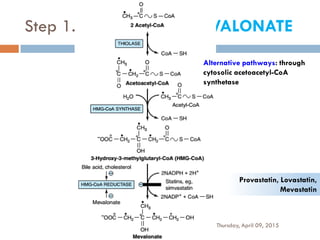
 1. Synthesis of mevalonate occurs from Acetyl-CoA
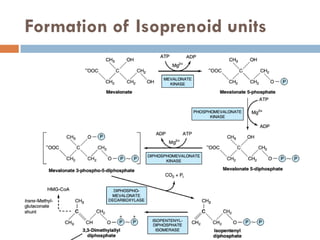
 2. Isoprenoid units are formed from MEVALONATE by loss of
CO2
 3. Six isoprenoid units condense to form SQUALENE
 4. SQUALENE is cyclizes to give rise to parent steroid
LANOSTEROL
 5. Cholesterol is formed from LANOSTEROL
Thursday, April 09, 2015
Step 1. Biosynthesis of MEVALONATE
Thursday, April 09, 2015
Provastatin, Lovastatin,
Mevastatin
Alternative pathways: through
cytosolic acetoacetyl-CoA
synthetase
Formation of Isoprenoid units
Thursday, April 09, 2015
3. Six Isoprenoid units forms
Squalene
Thursday, April 09, 2015
4. Formation of LANOSTEROL
Thursday, April 09, 2015
5. Formation of Cholesterol
Thursday, April 09, 2015
Regulation of Cholesterol synthesis
is controlled by HMG-CoA reductase
Thursday, April 09, 2015
Regulation of Cholesterol synthesis
is controlled by HMG-CoA reductase
Thursday, April 09, 2015
1. Decreased synthesis of cholesterol in starving animals is accompanied by
reduced activity of the enzyme.
2. Hepatic synthesis is inhibited by dietary cholesterol.
3. HMG-CoA reductase in liver is inhibited by Cholesterol.
4. Cholesterol and metabolites represses transcription of HMG-CoA
reductase transcription by Sterol Regulatory Element Binding Protein
(SREBP).
5. Insulin or thyroid hormone  increases HMG-CoA reductase activity
1. While, Glucagon or glucocorticoids decrease it.
Increase and Decrease in Cholesterol
Thursday, April 09, 2015
 Increased by
 1. Uptake of cholesterol-containing lipoproteins by
receptors.
 2. Uptake of free cholesterol from cholesterol-rich
lipoproteins to the cell membrane
 3. Cholesterol synthesis
 4. Hydrolysis of cholesterol ester by the enzyme
cholesterylester hydrolase.
Increase and Decrease in Cholesterol
Thursday, April 09, 2015
 Decreased by
 1. Efflux of cholesterol from the membrane to
lipoproteins of low cholesterol potential
 2. Esterification of cholesterol by ACAT (acyl-CoA:
cholesterol acyltransferase)
 3. Utilization of cholesterol for synthesis of other
steroids such as hormones or bile acids in liver
What are the factors that influence
cholesterol balance in tissues?
Thursday, April 09, 2015
LDL receptor is highly regulated.
Transport of Cholesterol between
tissues in plasma lipoproteins
Thursday, April 09, 2015
What is reverse cholesterol transport?
Transport of Cholesterol between
tissues in plasma lipoproteins
Cholesterol that is synthesized in extrahepatic tissues or acquired from
lipoproteins is returned to the liver for excretion in a process called
“reverse cholesterol transport”.
Uptake of cholesterol by receptor-
mediated endocytosis
Thursday, April 09, 2015
Conversion of cholesterol to bile
Thursday, April 09, 2015
Conversion of cholesterol to bile
Thursday, April 09, 2015
Excretion of Cholesterol from body
Thursday, April 09, 2015
 Excreted from the body via the bile either in the
unesterified form or after conversion into bile acids
in the liver.
 Coprostanol is the principal sterol in the feces; it is
formed from cholesterol by the bacteria in the lower
intestine.
Cholesterol balance in tissues
Thursday, April 09, 2015
 Increase of cholesterol in cells
 Increased synthesis of cholesterol
 Hydrolysis of cholesterol ester by the enzyme
“cholesterol ester hydrolyase”.
 Uptake and delivery of cholesterol in cells by
circulating LDL
 Uptake of cholesterol-containing lipoproteins by ‘non-
receptor’
 Uptake of free cholesterol by cell membranes
Cholesterol balance in tissue
(contd…)
Thursday, April 09, 2015
 Decrease of cholesterol in cells
 Efflux of cholesterol from cells to HDL
 Esterification of cholesterol by the enzyme “Acyl-CoA-
cholesterol acyl transferase” (ACAT).
 Utilization of cholesterol for synthesis of steroid
hormones, viz. glucocorticoids, mineralo-corticoids,
gonadal hormones
 In liver cells: formation of cholic acid
 Formation of Vitamin D3
Consideration of other factors that
influence cholesterol level in blood
Thursday, April 09, 2015
 Dietary fats (saturated FA vs Unsaturated FA)
 Dietary cholesterol
 Dietary carbohydrates
 Heredity
 Blood groups
 Calorie Intake
 Vitamin B-complex
 Minerals
 Dietary fibers
 Physical exercise
 Life style of an individual
Clinical aspects
Thursday, April 09, 2015
 Plasma cholesterol level >5.2 mmol/L is one of the
major factors in promoting atherosclerosis.
 Prolonged elevation of levels of VLDL, IDL,
chylomicron remnants, or LDL in blood (e.g.,
diabetes mellitus, lipid nephrosis, hypothyroidism)
 LDL/HDL cholesterol ratio is a good predictive
parameter.
Drugs help to reduce serum
cholesterol and triacylglycerol
Thursday, April 09, 2015
 Statin acts by inhibiting HMG-CoA reductase and
upregulating LDL receptor activity
 Example: atrovastatin, simvastatin, fluvastatin,
pravastatin.
 Ezetimibe reduces blood cholesterol levels by
inhibiting the absorption of cholesterol by the intestine
by blocking uptake via the Neimann-Pick C-like 1
protein.
1. Harper’s Biochemistry, 25th. Edition.
2. Lippincott’s Illustrated Review, 5th.
Edition
3. Lehninger, Principles of Biochemistry,
5th. Edition.
References
Thursday, April 09, 2015

Cholesterol biosynthesis

  • 1.
    CHOLESTEROL BIOSYNTHESIS Department of Biochemistry,KMC, DuwakotThursday, April 09, 2015
  • 2.
    Cholesterol Thursday, April 09,2015  Chole: bile; Stereos: solid  Principal sterol synthesized by animals.  In vertebrates, hepatic cells typically produce more cholesterol than other cells.  Absent among prokaryotes.
  • 3.
    Biomedical importance of cholesterol One of the most publicized lipids since it has got correlation with cardiovascular disease.  And, less advertised as a component of cell membrane  Cholesterol occurs in food of animal origin such as egg yolk, liver, meat, brain etc.  Vehicle for cholesterol uptake in tissues: LDL  Vehicle for transport: HDL  Cholesterol is the major constituent of gall stone. Thursday, April 09, 2015
  • 4.
    Cholesterol | Introduction Amphipathic lipid, found in two forms:  Free form  Esterified form  Component of outer layer of plasma membrane, synthesized from Acetyl-CoA  Precursor for: Corticosteroids Bile acids Sex hormones Vitamin D Thursday, April 09, 2015
  • 5.
    Cholesterol biosynthesis  Almostequal amount of cholesterol is derived from diet and synthesis in body.  700 mg/day is synthesized. Liver and Intestine accounts for 10% each.  NOTE: Virtually all cells containing nucleated cells are capable of synthesizing cholesterol which occurs in endoplasmic reticulum (ER) and nucleus.  Acetyl-CoA is the source of all carbon atoms in cholesterol. Coronary atherosclerosis correlates with high plasma LDL/HDL cholesterol ratio.
  • 6.
    Cholesterol biosynthesis  Dividedinto 5 steps:  1. Synthesis of mevalonate occurs from Acetyl-CoA  2. Isoprenoid units are formed from MEVALONATE by loss of CO2  3. Six isoprenoid units condense to form SQUALENE  4. SQUALENE is cyclizes to give rise to parent steroid LANOSTEROL  5. Cholesterol is formed from LANOSTEROL Thursday, April 09, 2015
  • 7.
    Step 1. Biosynthesisof MEVALONATE Thursday, April 09, 2015 Provastatin, Lovastatin, Mevastatin Alternative pathways: through cytosolic acetoacetyl-CoA synthetase
  • 8.
    Formation of Isoprenoidunits Thursday, April 09, 2015
  • 9.
    3. Six Isoprenoidunits forms Squalene Thursday, April 09, 2015
  • 10.
    4. Formation ofLANOSTEROL Thursday, April 09, 2015
  • 11.
    5. Formation ofCholesterol Thursday, April 09, 2015
  • 12.
    Regulation of Cholesterolsynthesis is controlled by HMG-CoA reductase Thursday, April 09, 2015
  • 13.
    Regulation of Cholesterolsynthesis is controlled by HMG-CoA reductase Thursday, April 09, 2015 1. Decreased synthesis of cholesterol in starving animals is accompanied by reduced activity of the enzyme. 2. Hepatic synthesis is inhibited by dietary cholesterol. 3. HMG-CoA reductase in liver is inhibited by Cholesterol. 4. Cholesterol and metabolites represses transcription of HMG-CoA reductase transcription by Sterol Regulatory Element Binding Protein (SREBP). 5. Insulin or thyroid hormone  increases HMG-CoA reductase activity 1. While, Glucagon or glucocorticoids decrease it.
  • 14.
    Increase and Decreasein Cholesterol Thursday, April 09, 2015  Increased by  1. Uptake of cholesterol-containing lipoproteins by receptors.  2. Uptake of free cholesterol from cholesterol-rich lipoproteins to the cell membrane  3. Cholesterol synthesis  4. Hydrolysis of cholesterol ester by the enzyme cholesterylester hydrolase.
  • 15.
    Increase and Decreasein Cholesterol Thursday, April 09, 2015  Decreased by  1. Efflux of cholesterol from the membrane to lipoproteins of low cholesterol potential  2. Esterification of cholesterol by ACAT (acyl-CoA: cholesterol acyltransferase)  3. Utilization of cholesterol for synthesis of other steroids such as hormones or bile acids in liver
  • 16.
    What are thefactors that influence cholesterol balance in tissues? Thursday, April 09, 2015 LDL receptor is highly regulated.
  • 17.
    Transport of Cholesterolbetween tissues in plasma lipoproteins Thursday, April 09, 2015 What is reverse cholesterol transport?
  • 18.
    Transport of Cholesterolbetween tissues in plasma lipoproteins Cholesterol that is synthesized in extrahepatic tissues or acquired from lipoproteins is returned to the liver for excretion in a process called “reverse cholesterol transport”.
  • 19.
    Uptake of cholesterolby receptor- mediated endocytosis Thursday, April 09, 2015
  • 20.
    Conversion of cholesterolto bile Thursday, April 09, 2015
  • 21.
    Conversion of cholesterolto bile Thursday, April 09, 2015
  • 22.
    Excretion of Cholesterolfrom body Thursday, April 09, 2015  Excreted from the body via the bile either in the unesterified form or after conversion into bile acids in the liver.  Coprostanol is the principal sterol in the feces; it is formed from cholesterol by the bacteria in the lower intestine.
  • 23.
    Cholesterol balance intissues Thursday, April 09, 2015  Increase of cholesterol in cells  Increased synthesis of cholesterol  Hydrolysis of cholesterol ester by the enzyme “cholesterol ester hydrolyase”.  Uptake and delivery of cholesterol in cells by circulating LDL  Uptake of cholesterol-containing lipoproteins by ‘non- receptor’  Uptake of free cholesterol by cell membranes
  • 24.
    Cholesterol balance intissue (contd…) Thursday, April 09, 2015  Decrease of cholesterol in cells  Efflux of cholesterol from cells to HDL  Esterification of cholesterol by the enzyme “Acyl-CoA- cholesterol acyl transferase” (ACAT).  Utilization of cholesterol for synthesis of steroid hormones, viz. glucocorticoids, mineralo-corticoids, gonadal hormones  In liver cells: formation of cholic acid  Formation of Vitamin D3
  • 25.
    Consideration of otherfactors that influence cholesterol level in blood Thursday, April 09, 2015  Dietary fats (saturated FA vs Unsaturated FA)  Dietary cholesterol  Dietary carbohydrates  Heredity  Blood groups  Calorie Intake  Vitamin B-complex  Minerals  Dietary fibers  Physical exercise  Life style of an individual
  • 26.
    Clinical aspects Thursday, April09, 2015  Plasma cholesterol level >5.2 mmol/L is one of the major factors in promoting atherosclerosis.  Prolonged elevation of levels of VLDL, IDL, chylomicron remnants, or LDL in blood (e.g., diabetes mellitus, lipid nephrosis, hypothyroidism)  LDL/HDL cholesterol ratio is a good predictive parameter.
  • 27.
    Drugs help toreduce serum cholesterol and triacylglycerol Thursday, April 09, 2015  Statin acts by inhibiting HMG-CoA reductase and upregulating LDL receptor activity  Example: atrovastatin, simvastatin, fluvastatin, pravastatin.  Ezetimibe reduces blood cholesterol levels by inhibiting the absorption of cholesterol by the intestine by blocking uptake via the Neimann-Pick C-like 1 protein.
  • 28.
    1. Harper’s Biochemistry,25th. Edition. 2. Lippincott’s Illustrated Review, 5th. Edition 3. Lehninger, Principles of Biochemistry, 5th. Edition. References Thursday, April 09, 2015