ELECTRICITY, MAGNETISM AND 
ELECTROMAGNETISM.
ATOMS… 
Have neutrons, protons, and electrons. 
 Protons are positively charged 
 Electrons are negatively charged
ELECTRONS… 
 Are located on the outer edges of 
atoms…they can be moved. 
A concentration of electrons in an atom 
creates a net negative charge. 
 If electrons are stripped away, the atom 
becomes positively charged.
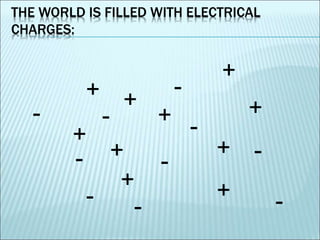
THE WORLD IS FILLED WITH ELECTRICAL 
CHARGES: 
+ 
+ 
- 
+ 
+ + 
+ 
+ 
+ 
+ 
+ 
- 
- 
- - 
- 
- 
- - -
STATIC ELECTRICITY 
 The build up of an electric charge on the 
surface of an object. 
The charge builds up but does not flow. 
 Static electricity is potential energy. It 
does not move. It is stored.
STATIC DISCHARGE… 
Occurs when there is a loss of static 
electricity due to three possible things: 
Friction - rubbing 
Conduction – direct contact 
Induction – through an electrical field 
(not direct contact)
ELECTRICITY THAT MOVES… 
Current: The flow of electrons from one 
place to another. 
Measured in amperes (amps) 
 Kinetic energy
HOW CAN WE CONTROL CURRENTS? 
 With circuits. 
 Circuit: is a path for the flow of electrons. 
We use wires.
Static electricity is stationary or collects on the surface of 
an object, whereas current electricity is flowing very 
rapidly through a conductor.
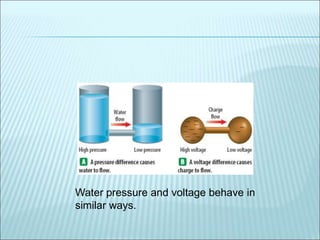
The flow of electricity in current electricity has 
electrical pressure or voltage. Electric 
charges flow from an area of high voltage to 
an area of low voltage.
Water pressure and voltage behave in 
similar ways.
THERE ARE 2 TYPES OF CURRENTS: 
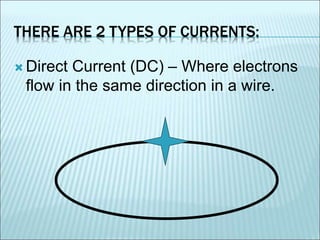
 Direct Current (DC) – Where electrons 
flow in the same direction in a wire.
THERE ARE 2 TYPES OF CURRENTS: 
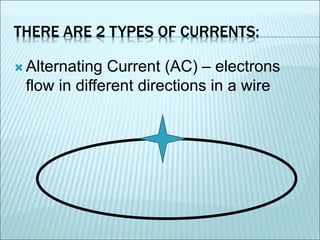
 Alternating Current (AC) – electrons 
flow in different directions in a wire
THERE ARE 2 TYPES OF CIRCUITS: 
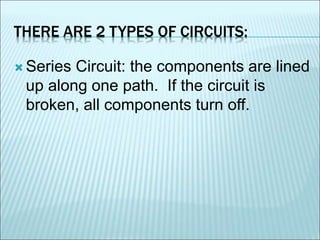
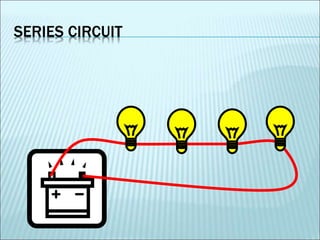
 Series Circuit: the components are lined 
up along one path. If the circuit is 
broken, all components turn off.
SERIES CIRCUIT
THERE ARE 2 TYPES OF CIRCUITS: 
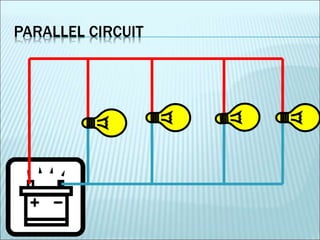
 Parallel Circuit – there are several 
branching paths to the components. If 
the circuit is broken at any one branch, 
only the components on that branch will 
turn off.
PARALLEL CIRCUIT
CONDUCTORS VS. INSULATORS 
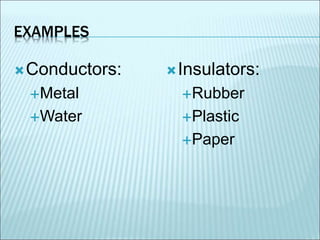
Conductors – material through which 
electric current flows easily. 
 Insulators – materials through which 
electric current cannot move.
EXAMPLES 
Conductors: 
Metal 
Water 
Insulators: 
Rubber 
Plastic 
Paper
WHAT IS RESISTANCE? 
The opposition to the flow of an electric 
current, producing heat. 
The greater the resistance, the less 
current gets through. 
Good conductors have low resistance. 
Measured in ohms.
WHAT IS VOLTAGE? 
The measure of energy given to the 
charge flowing in a circuit. 
 The greater the voltage, the greater the 
force or “pressure” that drives the 
charge through the circuit.
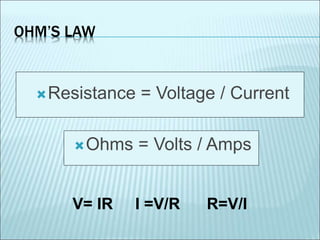
OHM’S LAW 
Resistance = Voltage / Current 
Ohms = Volts / Amps 
V= IR I =V/R R=V/I
MAGNETISM
What is magnetism? 
Magnetism is the properties and interactions of magnets 
The earliest magnets were found naturally in the mineral 
magnetite which is abundant the rock-type lodestone. 
These magnets were used by the ancient peoples as 
compasses to guide sailing vessels.
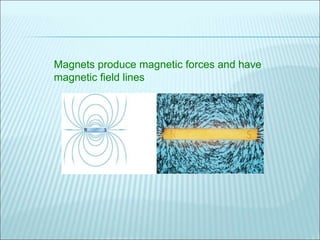
Magnets produce magnetic forces and have 
magnetic field lines
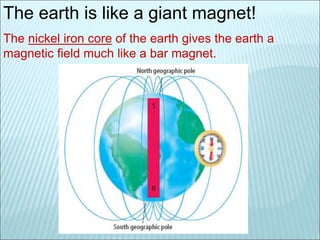
The earth is like a giant magnet! 
The nickel iron core of the earth gives the earth a 
magnetic field much like a bar magnet.
MAGNETS 
 USUALLY MADE OF IRON 
 EVERY MAGNET HAS A NORTH AND SOUTH 
POLES 
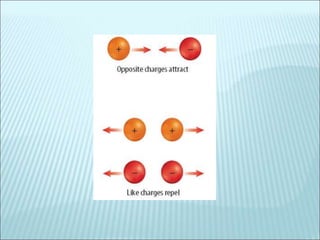
 LIKE SIMILAR CHARGES REPEL 
 OPPOSITES ATTRACT
FERROMAGNETIC 
 OBJECTS THAT CAN BE MAGNETIZED 
(IRON, COBALT, NICKEL) 
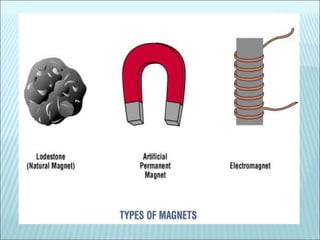
 3 TYPES OF MAGNETS 
 LODESTONE – NATURAL (PERMANENT) 
 ARTIFICAL – INDUCED 
 ELECTROMAGNET – temporary magnets 
produced by moving electric current
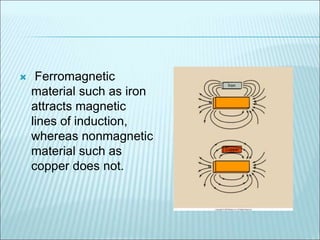
 Ferromagnetic 
material such as iron 
attracts magnetic 
lines of induction, 
whereas nonmagnetic 
material such as 
copper does not.
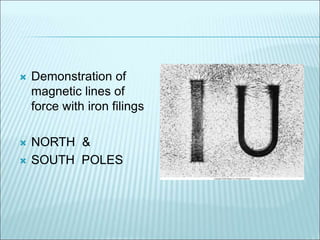
 Demonstration of 
magnetic lines of 
force with iron filings 
 NORTH & 
 SOUTH POLES
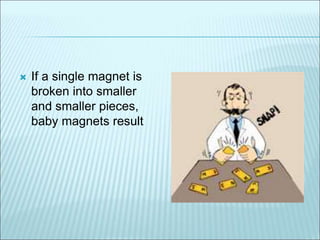
 If a single magnet is 
broken into smaller 
and smaller pieces, 
baby magnets result
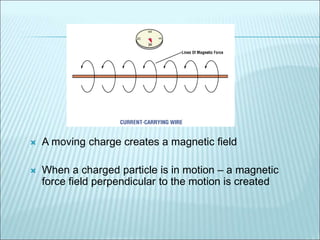
 A moving charge creates a magnetic field 
 When a charged particle is in motion – a magnetic 
force field perpendicular to the motion is created
ELECTROMAGNETISM
ELECTROMAGNETISM 
 A MOVING CHARGE CREATES A MAGNETIC 
FIELD
RT HAND RULE 
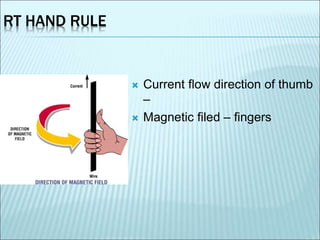
 Current flow direction of thumb 
– 
 Magnetic filed – fingers
ELECTROMAGNET IS CREATED BY: 
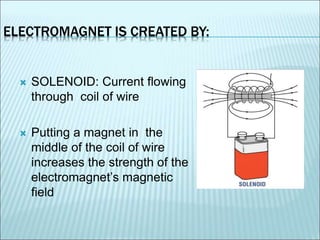
 SOLENOID: Current flowing 
through coil of wire 
 Putting a magnet in the 
middle of the coil of wire 
increases the strength of the 
electromagnet’s magnetic 
field
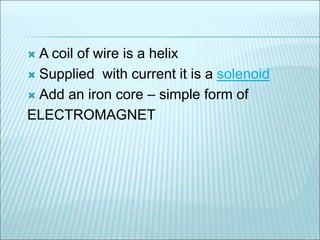
 A coil of wire is a helix 
 Supplied with current it is a solenoid 
 Add an iron core – simple form of 
ELECTROMAGNET
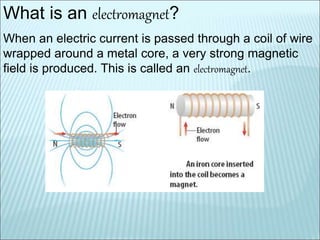
What is an electromagnet? 
When an electric current is passed through a coil of wire 
wrapped around a metal core, a very strong magnetic 
field is produced. This is called an electromagnet.
HOW ELECTRIC & MAGNETIC FIELDS 
INTERACT 
Faraday discovered that the 
magnetic lines of force and the wire 
must have a motion relative to each 
other to induce an electrical current
ELECTROMAGNET INDUCTION 
 Moving a wire through a magnetic field 
will induce a current (Faraday) 
 Wire or field can move 
 Moving a magnet through a coil of wire 
will induce an electrical current
“FARADAY’S LAWS : OR HOW TO INCREASE THE 
STRENGTH OF THE INDUCED CURRENT 
 Increase the Strength of field or size of 
magnet 
 Increase the SPEED of motion 
 Change the ANGLE (more 
perpendicular) 
 Increase the Number of Turns of coil
ELECTROMAGNET INDUCTION 
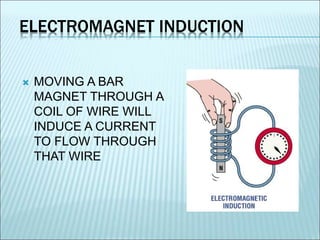
 MOVING A BAR 
MAGNET THROUGH A 
COIL OF WIRE WILL 
INDUCE A CURRENT 
TO FLOW THROUGH 
THAT WIRE
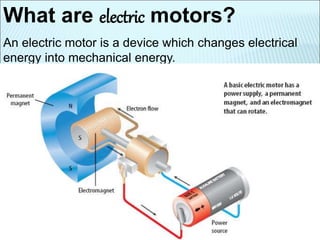
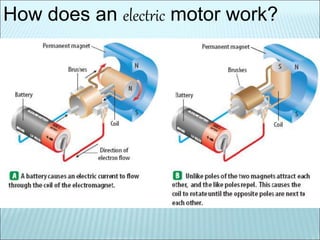
What are electric motors? 
An electric motor is a device which changes electrical 
energy into mechanical energy.
How does an electric motor work?
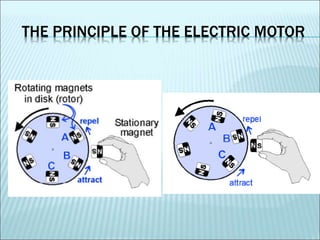
THE PRINCIPLE OF THE ELECTRIC MOTOR
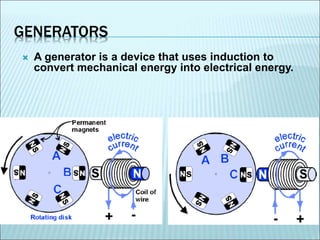
GENERATORS 
 A generator is a device that uses induction to 
convert mechanical energy into electrical energy.
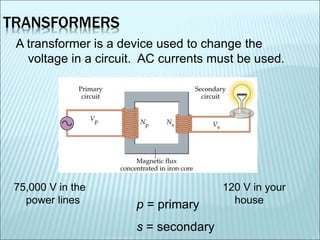
TRANSFORMERS 
A transformer is a device used to change the 
voltage in a circuit. AC currents must be used. 
75,000 V in the 
power lines 
120 V in your 
p = primary house 
s = secondary
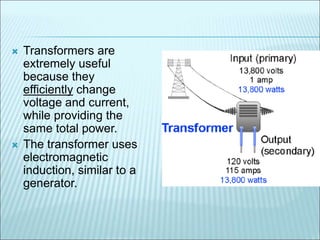
 Transformers are 
extremely useful 
because they 
efficiently change 
voltage and current, 
while providing the 
same total power. 
 The transformer uses 
electromagnetic 
induction, similar to a 
generator.
Electricity, magnetism and electromagnetism

Electricity, magnetism and electromagnetism

  • 1.
    ELECTRICITY, MAGNETISM AND ELECTROMAGNETISM.
  • 2.
    ATOMS… Have neutrons,protons, and electrons.  Protons are positively charged  Electrons are negatively charged
  • 3.
    ELECTRONS…  Arelocated on the outer edges of atoms…they can be moved. A concentration of electrons in an atom creates a net negative charge.  If electrons are stripped away, the atom becomes positively charged.
  • 4.
    THE WORLD ISFILLED WITH ELECTRICAL CHARGES: + + - + + + + + + + + - - - - - - - - -
  • 5.
    STATIC ELECTRICITY The build up of an electric charge on the surface of an object. The charge builds up but does not flow.  Static electricity is potential energy. It does not move. It is stored.
  • 6.
    STATIC DISCHARGE… Occurswhen there is a loss of static electricity due to three possible things: Friction - rubbing Conduction – direct contact Induction – through an electrical field (not direct contact)
  • 8.
    ELECTRICITY THAT MOVES… Current: The flow of electrons from one place to another. Measured in amperes (amps)  Kinetic energy
  • 9.
    HOW CAN WECONTROL CURRENTS?  With circuits.  Circuit: is a path for the flow of electrons. We use wires.
  • 10.
    Static electricity isstationary or collects on the surface of an object, whereas current electricity is flowing very rapidly through a conductor.
  • 11.
    The flow ofelectricity in current electricity has electrical pressure or voltage. Electric charges flow from an area of high voltage to an area of low voltage.
  • 12.
    Water pressure andvoltage behave in similar ways.
  • 13.
    THERE ARE 2TYPES OF CURRENTS:  Direct Current (DC) – Where electrons flow in the same direction in a wire.
  • 14.
    THERE ARE 2TYPES OF CURRENTS:  Alternating Current (AC) – electrons flow in different directions in a wire
  • 15.
    THERE ARE 2TYPES OF CIRCUITS:  Series Circuit: the components are lined up along one path. If the circuit is broken, all components turn off.
  • 16.
  • 17.
    THERE ARE 2TYPES OF CIRCUITS:  Parallel Circuit – there are several branching paths to the components. If the circuit is broken at any one branch, only the components on that branch will turn off.
  • 18.
  • 19.
    CONDUCTORS VS. INSULATORS Conductors – material through which electric current flows easily.  Insulators – materials through which electric current cannot move.
  • 20.
    EXAMPLES Conductors: Metal Water Insulators: Rubber Plastic Paper
  • 21.
    WHAT IS RESISTANCE? The opposition to the flow of an electric current, producing heat. The greater the resistance, the less current gets through. Good conductors have low resistance. Measured in ohms.
  • 22.
    WHAT IS VOLTAGE? The measure of energy given to the charge flowing in a circuit.  The greater the voltage, the greater the force or “pressure” that drives the charge through the circuit.
  • 23.
    OHM’S LAW Resistance= Voltage / Current Ohms = Volts / Amps V= IR I =V/R R=V/I
  • 24.
  • 25.
    What is magnetism? Magnetism is the properties and interactions of magnets The earliest magnets were found naturally in the mineral magnetite which is abundant the rock-type lodestone. These magnets were used by the ancient peoples as compasses to guide sailing vessels.
  • 26.
    Magnets produce magneticforces and have magnetic field lines
  • 27.
    The earth islike a giant magnet! The nickel iron core of the earth gives the earth a magnetic field much like a bar magnet.
  • 28.
    MAGNETS  USUALLYMADE OF IRON  EVERY MAGNET HAS A NORTH AND SOUTH POLES  LIKE SIMILAR CHARGES REPEL  OPPOSITES ATTRACT
  • 29.
    FERROMAGNETIC  OBJECTSTHAT CAN BE MAGNETIZED (IRON, COBALT, NICKEL)  3 TYPES OF MAGNETS  LODESTONE – NATURAL (PERMANENT)  ARTIFICAL – INDUCED  ELECTROMAGNET – temporary magnets produced by moving electric current
  • 31.
     Ferromagnetic materialsuch as iron attracts magnetic lines of induction, whereas nonmagnetic material such as copper does not.
  • 32.
     Demonstration of magnetic lines of force with iron filings  NORTH &  SOUTH POLES
  • 33.
     If asingle magnet is broken into smaller and smaller pieces, baby magnets result
  • 34.
     A movingcharge creates a magnetic field  When a charged particle is in motion – a magnetic force field perpendicular to the motion is created
  • 35.
  • 36.
    ELECTROMAGNETISM  AMOVING CHARGE CREATES A MAGNETIC FIELD
  • 37.
    RT HAND RULE  Current flow direction of thumb –  Magnetic filed – fingers
  • 38.
    ELECTROMAGNET IS CREATEDBY:  SOLENOID: Current flowing through coil of wire  Putting a magnet in the middle of the coil of wire increases the strength of the electromagnet’s magnetic field
  • 39.
     A coilof wire is a helix  Supplied with current it is a solenoid  Add an iron core – simple form of ELECTROMAGNET
  • 40.
    What is anelectromagnet? When an electric current is passed through a coil of wire wrapped around a metal core, a very strong magnetic field is produced. This is called an electromagnet.
  • 41.
    HOW ELECTRIC &MAGNETIC FIELDS INTERACT Faraday discovered that the magnetic lines of force and the wire must have a motion relative to each other to induce an electrical current
  • 42.
    ELECTROMAGNET INDUCTION Moving a wire through a magnetic field will induce a current (Faraday)  Wire or field can move  Moving a magnet through a coil of wire will induce an electrical current
  • 43.
    “FARADAY’S LAWS :OR HOW TO INCREASE THE STRENGTH OF THE INDUCED CURRENT  Increase the Strength of field or size of magnet  Increase the SPEED of motion  Change the ANGLE (more perpendicular)  Increase the Number of Turns of coil
  • 44.
    ELECTROMAGNET INDUCTION MOVING A BAR MAGNET THROUGH A COIL OF WIRE WILL INDUCE A CURRENT TO FLOW THROUGH THAT WIRE
  • 45.
    What are electricmotors? An electric motor is a device which changes electrical energy into mechanical energy.
  • 46.
    How does anelectric motor work?
  • 47.
    THE PRINCIPLE OFTHE ELECTRIC MOTOR
  • 48.
    GENERATORS  Agenerator is a device that uses induction to convert mechanical energy into electrical energy.
  • 49.
    TRANSFORMERS A transformeris a device used to change the voltage in a circuit. AC currents must be used. 75,000 V in the power lines 120 V in your p = primary house s = secondary
  • 50.
     Transformers are extremely useful because they efficiently change voltage and current, while providing the same total power.  The transformer uses electromagnetic induction, similar to a generator.