MAGNETISMMAGNETISM
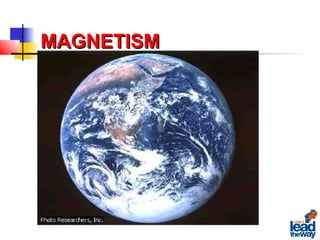
The Earth
Magnetic Poles
North and South
Geographic Poles
North and South
Earth is a giant magnet.
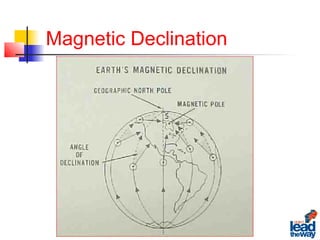
Magnetic Declination
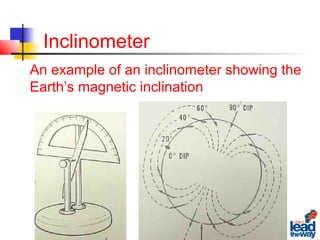
Inclinometer
An example of an inclinometer showing the
Earth’s magnetic inclination
Compass Points
The direction of compass points in United
States
Types of Magnets
LOADSTONE
BAR
U
COIL
ALNICO
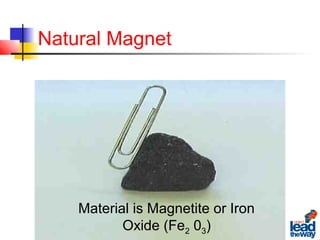
Natural Magnet
Material is Magnetite or Iron
Oxide (Fe2 03)
Magnets
A very strong magnet can be made with
a coil of wire and the flow of an electric
current.
Alnico
An extremely strong Alnico permanent
magnet with keeper
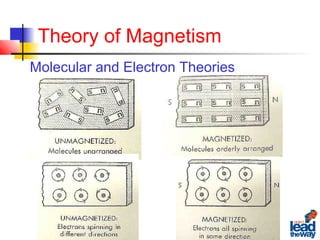
Theory of Magnetism
Molecular and Electron Theories
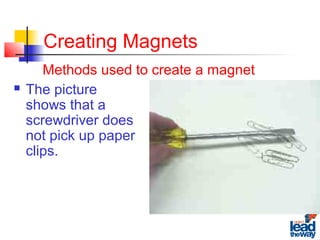
Creating Magnets
 The picture
shows that a
screwdriver does
not pick up paper
clips.
Methods used to create a magnet
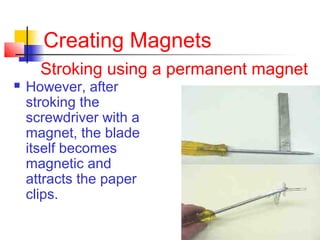
Creating Magnets
Stroking using a permanent magnet
 However, after
stroking the
screwdriver with a
magnet, the blade
itself becomes
magnetic and
attracts the paper
clips.
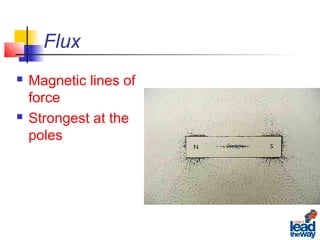
Flux
 Magnetic lines of
force
 Strongest at the
poles
Removing Magnetism
Heat is one way to remove
magnetism.
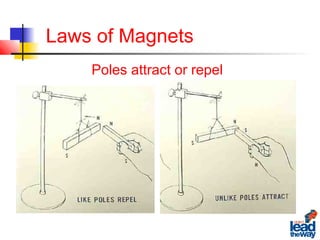
Laws of Magnets
Poles attract or repel
Like Poles Repel
Laws of magnets shown
by flux lines
Unlike poles attract Like poles repel
Stray Lines of Force
Controlling stray lines using
a keeper
Magnetic Lines of Force
 Notice how the
materials are affected
 Soft iron is a material
that distorts flux
Magnetism will pass through any material
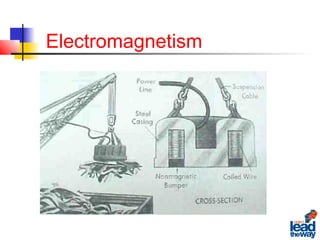
Electromagnetism
Electromagnets
A 30-foot diameter electromagnet
used in research for a superconductor
A large electromagnet
used to lift scrap metal
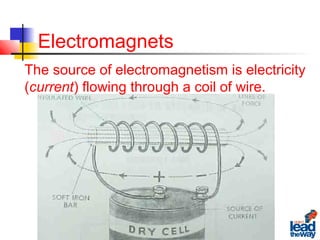
Electromagnets
The source of electromagnetism is electricity
(current) flowing through a coil of wire.
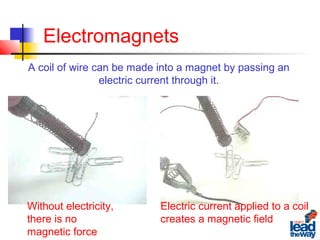
Electromagnets
A coil of wire can be made into a magnet by passing an
electric current through it.
Without electricity,
there is no
magnetic force
Electric current applied to a coil
creates a magnetic field
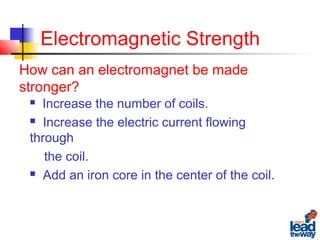
Electromagnetic Strength
 Increase the number of coils.
 Increase the electric current flowing
through
the coil.
 Add an iron core in the center of the coil.
How can an electromagnet be made
stronger?
Electromagnetic Strength
The left hand rule to
determine North Pole
NORTH POLE SOUTH POLE
Making a Magnet
An example of a very strong magnet
The magnet is strong
enough to lift this 50
pound engine cylinder
head.
The coil of wire has been
attached to a 12 volt DC
power source making an
extremely strong magnet.
Making a Magnet
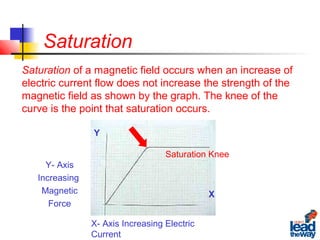
Saturation
Saturation Knee
Y- Axis
Increasing
Magnetic
Force
Y
X- Axis Increasing Electric
Current
X
Saturation of a magnetic field occurs when an increase of
electric current flow does not increase the strength of the
magnetic field as shown by the graph. The knee of the
curve is the point that saturation occurs.
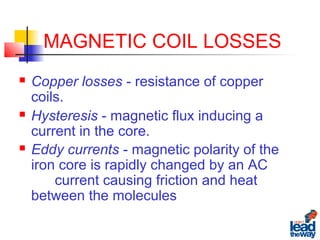
MAGNETIC COIL LOSSES
 Copper losses - resistance of copper
coils.
 Hysteresis - magnetic flux inducing a
current in the core.
 Eddy currents - magnetic polarity of the
iron core is rapidly changed by an AC
current causing friction and heat
between the molecules
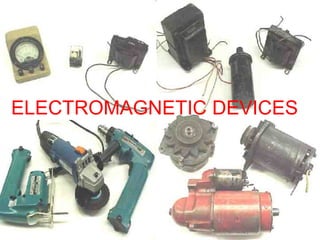
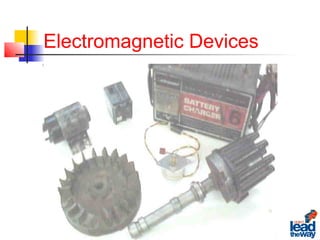
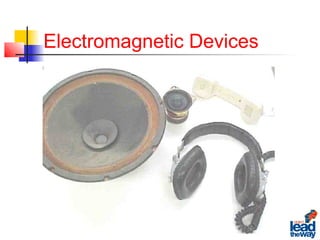
ELECTROMAGNETIC DEVICES
Electromagnetic Devices
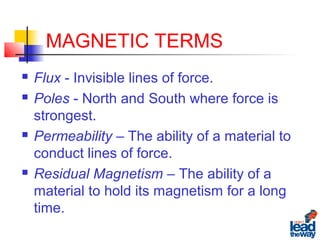
MAGNETIC TERMS
 Flux - Invisible lines of force.
 Poles - North and South where force is
strongest.
 Permeability – The ability of a material to
conduct lines of force.
 Residual Magnetism – The ability of a
material to hold its magnetism for a long
time.
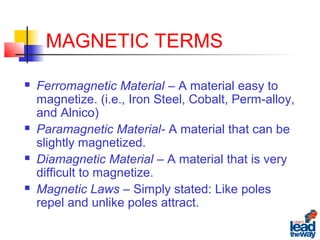
MAGNETIC TERMS
 Ferromagnetic Material – A material easy to
magnetize. (i.e., Iron Steel, Cobalt, Perm-alloy,
and Alnico)
 Paramagnetic Material- A material that can be
slightly magnetized.
 Diamagnetic Material – A material that is very
difficult to magnetize.
 Magnetic Laws – Simply stated: Like poles
repel and unlike poles attract.
Review
 What are the poles of a magnet?
 Name the magnetic lines of force.
 List five types of magnets and their two
families.
 List the laws of magnets.
 Explain two methods for making a magnet.
Review
 Explain two theories of magnetism.
 Name five different types of devices that are
associated with electromagnetism?
 List three magnetic and three nonmagnetic
materials.
 What will remove magnetic lines of force?

Magnetism

Editor's Notes

  • #8 A natural magnet from the Earth known as a loadstone is attracting a paper clip
  • #10 An type of magnet.
  • #20 Other example material include: METALS, WOOD, PLASTIC, CERAMICS, RUBBER, GLASS, COMPOSIT FIBERS, AND ALL COMPOUNDS
  • #28 An example of a very strong magnet made with a coil of wire and the flow of an electric current.