Magnetism

Yogesh kumar
Brief History…..
 Term came from the ancient Greek city of Magnesia, at which
many natural magnets were found.
 Chinese as early as 121 AD knew that an iron rod which had
been brought near one of these natural magnets would
acquire and retain the magnetic property and that such a rod
when suspended from a string would align itself in a northsouth direction.
 the Indian surgeon, Sushruta was the first to make use of the
magnet for surgical purposes.
What is magnetism……
 Magnetism is the force of attraction or repulsion of a
magnetic material due to the arrangement of its atoms,
particularly its electrons.
 Substances that can alter the value of the magnetic field in
which they are placed are magnetic materials.
Some Science…….
 In 1819, Hans Christian Oersted Professor at university of
copenhegen accidently found out that electric current can
influence compass needle.
 In 1831, Michael Faraday discovered that a momentary
current existed in a circuit when the current in a nearby circuit
was started or stopped.
 after this he discovered that that motion of a magnet toward
or away from a circuit could produce the same effect.
Mgnetic Domain
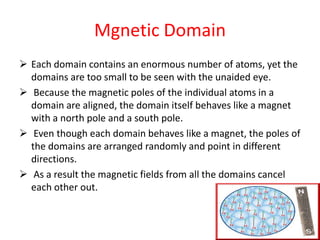
 Each domain contains an enormous number of atoms, yet the
domains are too small to be seen with the unaided eye.
 Because the magnetic poles of the individual atoms in a
domain are aligned, the domain itself behaves like a magnet
with a north pole and a south pole.
 Even though each domain behaves like a magnet, the poles of
the domains are arranged randomly and point in different
directions.
 As a result the magnetic fields from all the domains cancel
each other out.
Do Magnetic Monopole exits!
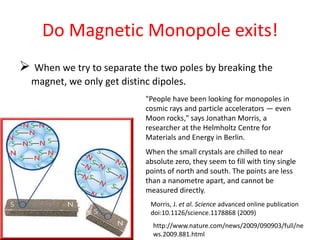
 When we try to separate the two poles by breaking the
magnet, we only get distinc dipoles.
"People have been looking for monopoles in
cosmic rays and particle accelerators — even
Moon rocks," says Jonathan Morris, a
researcher at the Helmholtz Centre for
Materials and Energy in Berlin.
When the small crystals are chilled to near
absolute zero, they seem to fill with tiny single
points of north and south. The points are less
than a nanometre apart, and cannot be
measured directly.
Morris, J. et al. Science advanced online publication
doi:10.1126/science.1178868 (2009)
http://www.nature.com/news/2009/090903/full/ne
ws.2009.881.html
Source of magnetism
 originates from electron orbital motion
 intrinsic spin from the presence of unpaired electrons.
Hysteresis
Vibrating sample magnetometer
 Used to measure Hysteresis loop.
 invented in 1955 by Simon Foner at Lincoln Laboratory MIT
 sample is placed inside a uniform magnetic field to
magnetize .
 physically vibrated sinusoidally.
 The induced voltage in the pickup coil is proportional to the
sample's magnetic moment.
Type of Magnetism
 Paramagnetism
 Paramagnetic materials possess a permanent magnetic
moment due to unpaired electrons in partially filled orbital.
 Paramagnetic materials have a small, positive susceptibility to
magnetic fields.
 Diamagnetism
 oppose an applied magnetic field, and therefore, to be
repelled by a magnetic field.
 Ferromagnetism
 Ferromagnetic materials possess a permanent magnetic
moment in the absence of an external field.
 positive susceptibility (upto 10⁶ emu mol⁻¹ Oe⁻¹).
Magnetic Nanoparticles : Inside Us
and Everywhere Around Us…….
 Interstellar space, lunar samples, and meteorites contain
magnetic Nanoparticles.
 The geomagnetic navigational aids in all migratory birds,
fishes and other animals contain magnetic nanoparticles.
 The human brain contains over 10⁸ magnetic nanoparticles of
magnetite–maghemite per gram of tissue.
J.L. Kirschvink, A. Kirschvink-Kobayashi, B.J. Woodford, Proc.
Natl.Acad. Sci, 1992, 89, 7683
Magnetic hyperthermia
 There are a number of therapeutic benefits in producing
localized heating, for example, delivering toxic doses of
thermal energy to tumors, or increasing the efficacy of certain
anti-cancer drugs.
 heating the surrounding tissue can also produce unwelcome
side-effects so there are advantages to strictly controlling the
region under treatment by using magnetic nanoparticles as
the heating element.
 The magnetic moments on nanoparticles will align with an
external magnetic field. As the external field changes
direction, the magnetic moment will also change direction.
This produces dissipation leading to heating. One of the
major advantages of using magnetic fields to produce heating
is that they readily penetrate tissue.
Targeted drug delivery
 An external magnetic field gradient will produce a force on
magnetic nanoparticles. There is considerable interest in
using this effect for targeted drug delivery by attaching the
drug to the magnetic nanoparticles, then applying a large
magnetic field to the desired region (e.g. a cancerous tumor),
which will attract the magnetic nanoparticles, hence also
attract the attached drug.
Magnetism

Magnetism

  • 1.
  • 2.
    Brief History…..  Termcame from the ancient Greek city of Magnesia, at which many natural magnets were found.  Chinese as early as 121 AD knew that an iron rod which had been brought near one of these natural magnets would acquire and retain the magnetic property and that such a rod when suspended from a string would align itself in a northsouth direction.  the Indian surgeon, Sushruta was the first to make use of the magnet for surgical purposes.
  • 3.
    What is magnetism…… Magnetism is the force of attraction or repulsion of a magnetic material due to the arrangement of its atoms, particularly its electrons.  Substances that can alter the value of the magnetic field in which they are placed are magnetic materials.
  • 4.
    Some Science…….  In1819, Hans Christian Oersted Professor at university of copenhegen accidently found out that electric current can influence compass needle.  In 1831, Michael Faraday discovered that a momentary current existed in a circuit when the current in a nearby circuit was started or stopped.  after this he discovered that that motion of a magnet toward or away from a circuit could produce the same effect.
  • 5.
    Mgnetic Domain  Eachdomain contains an enormous number of atoms, yet the domains are too small to be seen with the unaided eye.  Because the magnetic poles of the individual atoms in a domain are aligned, the domain itself behaves like a magnet with a north pole and a south pole.  Even though each domain behaves like a magnet, the poles of the domains are arranged randomly and point in different directions.  As a result the magnetic fields from all the domains cancel each other out.
  • 6.
    Do Magnetic Monopoleexits!  When we try to separate the two poles by breaking the magnet, we only get distinc dipoles. "People have been looking for monopoles in cosmic rays and particle accelerators — even Moon rocks," says Jonathan Morris, a researcher at the Helmholtz Centre for Materials and Energy in Berlin. When the small crystals are chilled to near absolute zero, they seem to fill with tiny single points of north and south. The points are less than a nanometre apart, and cannot be measured directly. Morris, J. et al. Science advanced online publication doi:10.1126/science.1178868 (2009) http://www.nature.com/news/2009/090903/full/ne ws.2009.881.html
  • 7.
    Source of magnetism originates from electron orbital motion  intrinsic spin from the presence of unpaired electrons.
  • 8.
  • 9.
    Vibrating sample magnetometer Used to measure Hysteresis loop.  invented in 1955 by Simon Foner at Lincoln Laboratory MIT  sample is placed inside a uniform magnetic field to magnetize .  physically vibrated sinusoidally.  The induced voltage in the pickup coil is proportional to the sample's magnetic moment.
  • 10.
    Type of Magnetism Paramagnetism  Paramagnetic materials possess a permanent magnetic moment due to unpaired electrons in partially filled orbital.  Paramagnetic materials have a small, positive susceptibility to magnetic fields.  Diamagnetism  oppose an applied magnetic field, and therefore, to be repelled by a magnetic field.  Ferromagnetism  Ferromagnetic materials possess a permanent magnetic moment in the absence of an external field.  positive susceptibility (upto 10⁶ emu mol⁻¹ Oe⁻¹).
  • 11.
    Magnetic Nanoparticles :Inside Us and Everywhere Around Us…….  Interstellar space, lunar samples, and meteorites contain magnetic Nanoparticles.  The geomagnetic navigational aids in all migratory birds, fishes and other animals contain magnetic nanoparticles.  The human brain contains over 10⁸ magnetic nanoparticles of magnetite–maghemite per gram of tissue. J.L. Kirschvink, A. Kirschvink-Kobayashi, B.J. Woodford, Proc. Natl.Acad. Sci, 1992, 89, 7683
  • 12.
    Magnetic hyperthermia  Thereare a number of therapeutic benefits in producing localized heating, for example, delivering toxic doses of thermal energy to tumors, or increasing the efficacy of certain anti-cancer drugs.  heating the surrounding tissue can also produce unwelcome side-effects so there are advantages to strictly controlling the region under treatment by using magnetic nanoparticles as the heating element.  The magnetic moments on nanoparticles will align with an external magnetic field. As the external field changes direction, the magnetic moment will also change direction. This produces dissipation leading to heating. One of the major advantages of using magnetic fields to produce heating is that they readily penetrate tissue.
  • 13.
    Targeted drug delivery An external magnetic field gradient will produce a force on magnetic nanoparticles. There is considerable interest in using this effect for targeted drug delivery by attaching the drug to the magnetic nanoparticles, then applying a large magnetic field to the desired region (e.g. a cancerous tumor), which will attract the magnetic nanoparticles, hence also attract the attached drug.