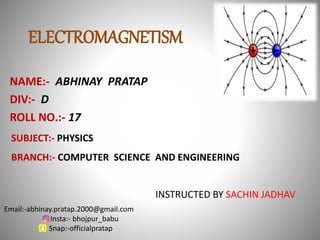
ELECTROMAGNETISM
NAME:- ABHINAY PRATAP
DIV:- D
ROLL NO.:- 17
SUBJECT:- PHYSICS
BRANCH:- COMPUTER SCIENCE AND ENGINEERING
INSTRUCTED BY SACHIN JADHAV
Email:-abhinay.pratap.2000@gmail.com
Insta:- bhojpur_babu
Snap:-officialpratap
INTRODUCTION:
 Electricity and magnetism are different facets of
electromagnetism.
• A moving electric charge produces magnetic field.
• Changing magnetic fields move electric charges.
 Einstein saw electricity and magnetism as frame
dependent facets of unified electromagnetic force.
 Electromagnetic phenomena are defined in terms of the
electromagnetic force, sometimes called the Lorentz force.
 The theoretical implications of electromagnetism,
particularly the establishment of the speed of light based
on properties of the "medium" of propagation
(permeability and permittivity), led to the development of
special relativity by Albert Einstein in 1905.
HISTORY :
 The origin of electricity and magnetism
sprang from ancient men’s curiosity over
the ability of two materials, amber and
lodestone to attract other materials.
 With the publication of James Clerk
Maxwell’s 1873, A Treatise on Electricity and
Magnetism in which the interactions of
positive and negative charges were shown
to be mediated by one force.
 Hans Christian Ørsted was not the only
person to examine the relationship between
electricity and magnetism.
 In early 19 𝑡ℎ century faraday discover
electromagnetic induction.
LAWS OF MAGNETIC FORCE:
FIRST LAW:-
Like poles repel each other and unlike poles attract each other.
SECOND LAW:-
The magnetic force between two isolated magnetic poles placed in a
medium is directly proportional to the product of the pole strength and
inversely proportional to square of the distance between them.
F =
𝒎 𝟏 𝒎 𝟐
𝒅 𝟐
Where K is a constant whose value depends upon the surrounding
medium.
K =
𝟏
𝟒𝝅𝝁 𝒐 𝝁 𝒓
, Where 𝜇 𝑜 = Absolute permeability
𝜇 𝑟 = Relative permeability
Magnetic field lines:
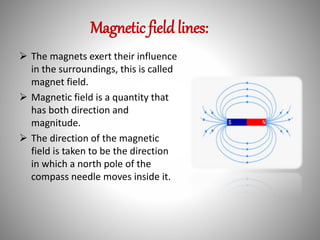
 The magnets exert their influence
in the surroundings, this is called
magnet field.
 Magnetic field is a quantity that
has both direction and
magnitude.
 The direction of the magnetic
field is taken to be the direction
in which a north pole of the
compass needle moves inside it.
Direction of Magnetic field:
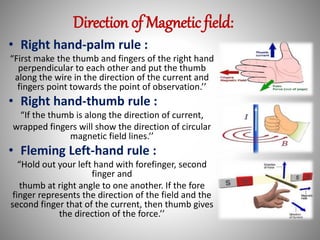
• Right hand-palm rule :
“First make the thumb and fingers of the right hand
perpendicular to each other and put the thumb
along the wire in the direction of the current and
fingers point towards the point of observation.’’
• Right hand-thumb rule :
“If the thumb is along the direction of current,
wrapped fingers will show the direction of circular
magnetic field lines.’’
• Fleming Left-hand rule :
“Hold out your left hand with forefinger, second
finger and
thumb at right angle to one another. If the fore
finger represents the direction of the field and the
second finger that of the current, then thumb gives
the direction of the force.’’
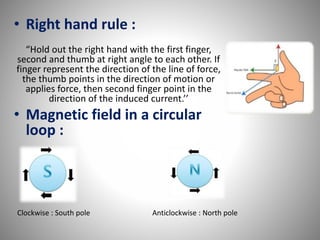
• Right hand rule :
“Hold out the right hand with the first finger,
second and thumb at right angle to each other. If
finger represent the direction of the line of force,
the thumb points in the direction of motion or
applies force, then second finger point in the
direction of the induced current.’’
• Magnetic field in a circular
loop :
Clockwise : South pole Anticlockwise : North pole
Electromagnet:
Arranging wire in coil and running a current
through produces a magnetic field that looks a
lot like bar magnet.
• Called an electromagnet
• Putting a real magnet inside, can shove the magnet back and
forth depending on current direction : Solenoid
TESLA COIL:
 A Tesla coil is a resonant air core
transformer system inventor Nikola
Tesla in the 1890’s.
 Originally, Tesla coils were designed
to broadcast electricity and signals
wirelessly.
 It is a from of induction coil for
producing high frequency
alternating currents.
THE ELECTROMAGNETIC SPECTRUM:
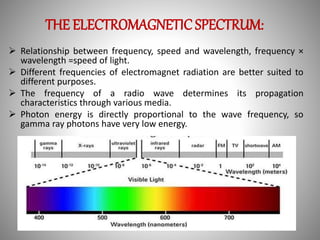
 Relationship between frequency, speed and wavelength, frequency ×
wavelength =speed of light.
 Different frequencies of electromagnet radiation are better suited to
different purposes.
 The frequency of a radio wave determines its propagation
characteristics through various media.
 Photon energy is directly proportional to the wave frequency, so
gamma ray photons have very low energy.
ELF-EMF MAY AFFECT THE DNA IN HUMAN
CELLS:
 Used technical to detect any DNA damage at the level of
the individual eukaryotic cell (Comet assay).
 Human primary fibroblast cells were exposed to 50Hz of
emf at 1 militesla(mT) of flus density.
 Assay showed that the processes of DNA replication and
cell reproduction were the ones affected, not on the
DNA itself.
 In conclusion, the exposure of human primary fibroblast
to ELF-EMF simulates cell termination(necrosis) rather
than DNA alteration .
Exampleof Electromagnetic
Radiation:
• AM and FM radio waves
• Cell phone
communication links
• Microwaves
• Infrared radiation
• Light X-rays
• Gamma rays
Uses of Electromagnetic Waves:
• Communication system (One
way and two way)
• Radar
• Cooking (Microwaves)
• Medical Imaging(X rays)
• “Night vision” (Infrared)
• Astronomy (Radio, Microwave,
IR, Visible, UV, Gamma
Email:-abhinay.pratap.2000@gmail.com
Insta:- bhojpur_babu
Snap:-officialpratap

Ppt on electromagnetism

  • 1.
    ELECTROMAGNETISM NAME:- ABHINAY PRATAP DIV:-D ROLL NO.:- 17 SUBJECT:- PHYSICS BRANCH:- COMPUTER SCIENCE AND ENGINEERING INSTRUCTED BY SACHIN JADHAV Email:-abhinay.pratap.2000@gmail.com Insta:- bhojpur_babu Snap:-officialpratap
  • 2.
    INTRODUCTION:  Electricity andmagnetism are different facets of electromagnetism. • A moving electric charge produces magnetic field. • Changing magnetic fields move electric charges.  Einstein saw electricity and magnetism as frame dependent facets of unified electromagnetic force.  Electromagnetic phenomena are defined in terms of the electromagnetic force, sometimes called the Lorentz force.  The theoretical implications of electromagnetism, particularly the establishment of the speed of light based on properties of the "medium" of propagation (permeability and permittivity), led to the development of special relativity by Albert Einstein in 1905.
  • 3.
    HISTORY :  Theorigin of electricity and magnetism sprang from ancient men’s curiosity over the ability of two materials, amber and lodestone to attract other materials.  With the publication of James Clerk Maxwell’s 1873, A Treatise on Electricity and Magnetism in which the interactions of positive and negative charges were shown to be mediated by one force.  Hans Christian Ørsted was not the only person to examine the relationship between electricity and magnetism.  In early 19 𝑡ℎ century faraday discover electromagnetic induction.
  • 4.
    LAWS OF MAGNETICFORCE: FIRST LAW:- Like poles repel each other and unlike poles attract each other. SECOND LAW:- The magnetic force between two isolated magnetic poles placed in a medium is directly proportional to the product of the pole strength and inversely proportional to square of the distance between them. F = 𝒎 𝟏 𝒎 𝟐 𝒅 𝟐 Where K is a constant whose value depends upon the surrounding medium. K = 𝟏 𝟒𝝅𝝁 𝒐 𝝁 𝒓 , Where 𝜇 𝑜 = Absolute permeability 𝜇 𝑟 = Relative permeability
  • 5.
    Magnetic field lines: The magnets exert their influence in the surroundings, this is called magnet field.  Magnetic field is a quantity that has both direction and magnitude.  The direction of the magnetic field is taken to be the direction in which a north pole of the compass needle moves inside it.
  • 6.
    Direction of Magneticfield: • Right hand-palm rule : “First make the thumb and fingers of the right hand perpendicular to each other and put the thumb along the wire in the direction of the current and fingers point towards the point of observation.’’ • Right hand-thumb rule : “If the thumb is along the direction of current, wrapped fingers will show the direction of circular magnetic field lines.’’ • Fleming Left-hand rule : “Hold out your left hand with forefinger, second finger and thumb at right angle to one another. If the fore finger represents the direction of the field and the second finger that of the current, then thumb gives the direction of the force.’’
  • 7.
    • Right handrule : “Hold out the right hand with the first finger, second and thumb at right angle to each other. If finger represent the direction of the line of force, the thumb points in the direction of motion or applies force, then second finger point in the direction of the induced current.’’ • Magnetic field in a circular loop : Clockwise : South pole Anticlockwise : North pole
  • 8.
    Electromagnet: Arranging wire incoil and running a current through produces a magnetic field that looks a lot like bar magnet. • Called an electromagnet • Putting a real magnet inside, can shove the magnet back and forth depending on current direction : Solenoid
  • 9.
    TESLA COIL:  ATesla coil is a resonant air core transformer system inventor Nikola Tesla in the 1890’s.  Originally, Tesla coils were designed to broadcast electricity and signals wirelessly.  It is a from of induction coil for producing high frequency alternating currents.
  • 10.
    THE ELECTROMAGNETIC SPECTRUM: Relationship between frequency, speed and wavelength, frequency × wavelength =speed of light.  Different frequencies of electromagnet radiation are better suited to different purposes.  The frequency of a radio wave determines its propagation characteristics through various media.  Photon energy is directly proportional to the wave frequency, so gamma ray photons have very low energy.
  • 11.
    ELF-EMF MAY AFFECTTHE DNA IN HUMAN CELLS:  Used technical to detect any DNA damage at the level of the individual eukaryotic cell (Comet assay).  Human primary fibroblast cells were exposed to 50Hz of emf at 1 militesla(mT) of flus density.  Assay showed that the processes of DNA replication and cell reproduction were the ones affected, not on the DNA itself.  In conclusion, the exposure of human primary fibroblast to ELF-EMF simulates cell termination(necrosis) rather than DNA alteration .
  • 12.
    Exampleof Electromagnetic Radiation: • AMand FM radio waves • Cell phone communication links • Microwaves • Infrared radiation • Light X-rays • Gamma rays Uses of Electromagnetic Waves: • Communication system (One way and two way) • Radar • Cooking (Microwaves) • Medical Imaging(X rays) • “Night vision” (Infrared) • Astronomy (Radio, Microwave, IR, Visible, UV, Gamma
  • 13.