Introduction to Electronics Unit One: DC Circuits Section Three Current and Voltage
Current, Voltage and Power   Students will be able to: Explain that energy is transformed, not created. State types of energy. Define Electron Current Voltage Power Examine the relationship between current, voltage and power. Name the symbol for current, voltage and power. Tell the unit and unit symbol for current, voltage and power. Calculate missing elements using the ampere formula. Calculate missing elements using the power formula. Predict the effect of connecting batteries in series or parallel form.
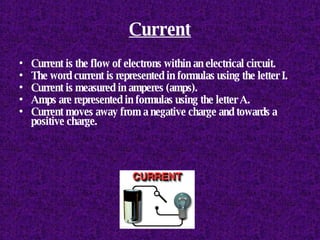
Current Current is the flow of electrons within an electrical circuit.  The word current is represented in formulas using the letter I. Current is measured in amperes (amps). Amps are represented in formulas using the letter A. Current moves away from a negative charge and towards a positive charge.
What is an Ampere? Ampere (A) represents the amount of electrons that flow past a point in a circuit in one second. Formula: I = Q/t The word coulomb is represented in formulas using the letter Q. 6,280,000,000,000,000,000 electrons equals one coulomb (C). One coulomb moving past a point in one second equals one ampere. Time is represented by t, and using the units of seconds (s).
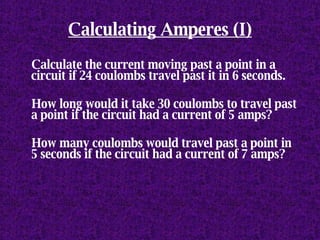
Calculating Amperes (I) Calculate the current moving past a point in a circuit if 24 coulombs travel past it in 6 seconds. How long would it take 30 coulombs to travel past a point if the circuit had a current of 5 amps? How many coulombs would travel past a point in 5 seconds if the circuit had a current of 7 amps?
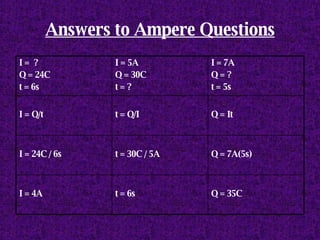
Answers to Ampere Questions Q = 35C t = 6s I = 4A Q = 7A(5s) t = 30C / 5A I = 24C / 6s Q = It t = Q/I I = Q/t I = 7A Q = ? t = 5s I = 5A Q = 30C t = ? I =  ? Q = 24C t = 6s
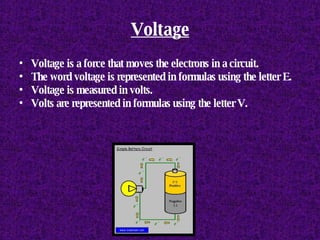
Voltage Voltage is a force that moves the electrons in a circuit. The word voltage is represented in formulas using the letter E. Voltage is measured in volts. Volts are represented in formulas using the letter V.
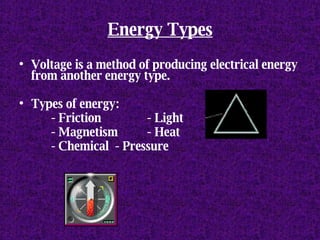
Energy Types Voltage is a method of producing electrical energy from another energy type. Types of energy: - Friction - Light - Magnetism - Heat - Chemical - Pressure
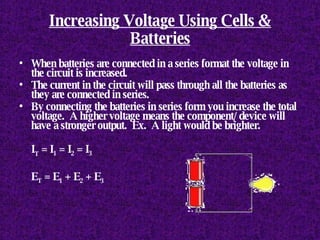
Increasing Voltage Using Cells & Batteries When batteries are connected in a series format the voltage in the circuit is increased.  The current in the circuit will pass through all the batteries as they are connected in series. By connecting the batteries in series form you increase the total voltage.  A higher voltage means the component/ device will have a stronger output.  Ex.  A light would be brighter. I T  = I 1  = I 2  = I 3 E T  = E 1  + E 2  + E 3
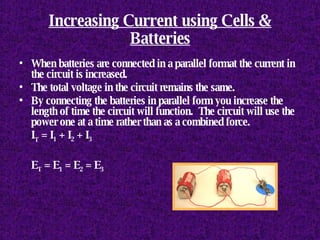
Increasing Current using Cells & Batteries When batteries are connected in a parallel format the current in the circuit is increased.  The total voltage in the circuit remains the same. By connecting the batteries in parallel form you increase the length of time the circuit will function.  The circuit will use the power one at a time rather than as a combined force. I T  = I 1  + I 2  + I 3 E T  = E 1  = E 2  = E 3
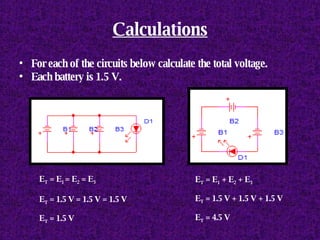
Calculations For each of the circuits below calculate the total   voltage. Each battery is 1.5 V. E T  = E 1  = E 2  = E 3 E T  = 1.5 V = 1.5 V = 1.5 V E T  = 1.5 V E T  = E 1  + E 2  + E 3 E T  = 1.5 V + 1.5 V + 1.5 V E T  = 4.5 V
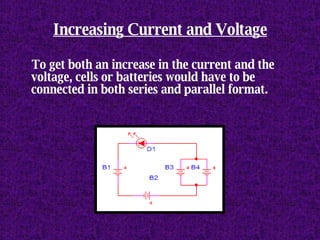
Increasing Current and Voltage To get both an increase in the current and the voltage, cells or batteries would have to be connected in both series and parallel format.
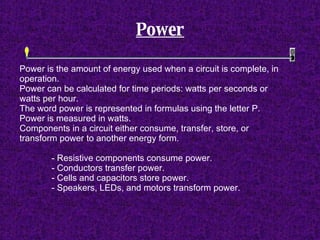
Power Power is the amount of energy used when a circuit is complete, in operation. Power can be calculated for time periods: watts per seconds or watts per hour. The word power is represented in formulas using the letter P. Power is measured in watts. Components in a circuit either consume, transfer, store, or transform power to another energy form. - Resistive components consume power. - Conductors transfer power. - Cells and capacitors store power. - Speakers, LEDs, and motors transform power.
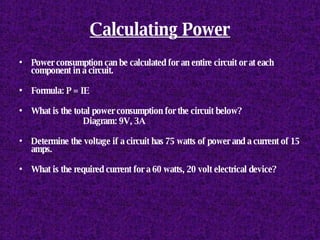
Calculating Power Power consumption can be calculated for an entire circuit or at each component in a circuit. Formula: P = IE What is the total power consumption for the circuit below? Diagram: 9V, 3A Determine the voltage if a circuit has 75 watts of power and a current of 15 amps. What is the required current for a 60 watts, 20 volt electrical device?
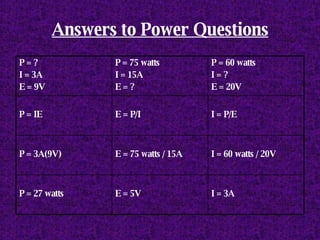
Answers to Power Questions I = 3A E = 5V P = 27 watts I = 60 watts / 20V E = 75 watts / 15A P = 3A(9V) I = P/E E = P/I P = IE P = 60 watts I = ? E = 20V P = 75 watts I = 15A E = ? P = ? I = 3A E = 9V
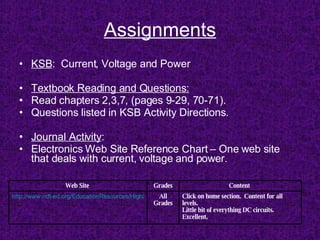
Assignments KSB :  Current, Voltage and Power Textbook Reading and Questions:   Read chapters 2,3,7, (pages 9-29, 70-71). Questions listed in KSB Activity Directions. Journal Activity :  Electronics Web Site Reference Chart – One web site that deals with current, voltage and power. Click on home section.  Content for all levels. Little bit of everything DC circuits. Excellent. All Grades http://www.ndt-ed.org/EducationResources/HighSchool/Electricity/hs_elec_index.htm Content  Grades Web Site
Image Bibliography Slide 3: www.discover.edventures.com Slide 4: www.why files .larc.nasa.gov/text/kids/Problem_Board/problems/electricity/ circuits 2.html Slide 7: www.SolarSam.com Slide 8: http://www.sln.org/guide/hughes/10types/typesmagnetic.html http://www.sln.org/guide/hughes/10types/typeslight.html Slide 9: www.iss.cet.edu Slide 10: www.pzweb.harvard.edu Slide 11:  Created using PCB123 Schematic Version 2.1.0.600 Slide 12: Created using PCB123 Schematic Version 2.1.0.600 Slide 13: http:// www.gifanimations.com/action/ImageDisplay?group =1&category=23&index=48&dir=stay

Current And Voltages

  • 1.
    Introduction to ElectronicsUnit One: DC Circuits Section Three Current and Voltage
  • 2.
    Current, Voltage andPower Students will be able to: Explain that energy is transformed, not created. State types of energy. Define Electron Current Voltage Power Examine the relationship between current, voltage and power. Name the symbol for current, voltage and power. Tell the unit and unit symbol for current, voltage and power. Calculate missing elements using the ampere formula. Calculate missing elements using the power formula. Predict the effect of connecting batteries in series or parallel form.
  • 3.
    Current Current isthe flow of electrons within an electrical circuit. The word current is represented in formulas using the letter I. Current is measured in amperes (amps). Amps are represented in formulas using the letter A. Current moves away from a negative charge and towards a positive charge.
  • 4.
    What is anAmpere? Ampere (A) represents the amount of electrons that flow past a point in a circuit in one second. Formula: I = Q/t The word coulomb is represented in formulas using the letter Q. 6,280,000,000,000,000,000 electrons equals one coulomb (C). One coulomb moving past a point in one second equals one ampere. Time is represented by t, and using the units of seconds (s).
  • 5.
    Calculating Amperes (I)Calculate the current moving past a point in a circuit if 24 coulombs travel past it in 6 seconds. How long would it take 30 coulombs to travel past a point if the circuit had a current of 5 amps? How many coulombs would travel past a point in 5 seconds if the circuit had a current of 7 amps?
  • 6.
    Answers to AmpereQuestions Q = 35C t = 6s I = 4A Q = 7A(5s) t = 30C / 5A I = 24C / 6s Q = It t = Q/I I = Q/t I = 7A Q = ? t = 5s I = 5A Q = 30C t = ? I = ? Q = 24C t = 6s
  • 7.
    Voltage Voltage isa force that moves the electrons in a circuit. The word voltage is represented in formulas using the letter E. Voltage is measured in volts. Volts are represented in formulas using the letter V.
  • 8.
    Energy Types Voltageis a method of producing electrical energy from another energy type. Types of energy: - Friction - Light - Magnetism - Heat - Chemical - Pressure
  • 9.
    Increasing Voltage UsingCells & Batteries When batteries are connected in a series format the voltage in the circuit is increased. The current in the circuit will pass through all the batteries as they are connected in series. By connecting the batteries in series form you increase the total voltage. A higher voltage means the component/ device will have a stronger output. Ex. A light would be brighter. I T = I 1 = I 2 = I 3 E T = E 1 + E 2 + E 3
  • 10.
    Increasing Current usingCells & Batteries When batteries are connected in a parallel format the current in the circuit is increased. The total voltage in the circuit remains the same. By connecting the batteries in parallel form you increase the length of time the circuit will function. The circuit will use the power one at a time rather than as a combined force. I T = I 1 + I 2 + I 3 E T = E 1 = E 2 = E 3
  • 11.
    Calculations For eachof the circuits below calculate the total voltage. Each battery is 1.5 V. E T = E 1 = E 2 = E 3 E T = 1.5 V = 1.5 V = 1.5 V E T = 1.5 V E T = E 1 + E 2 + E 3 E T = 1.5 V + 1.5 V + 1.5 V E T = 4.5 V
  • 12.
    Increasing Current andVoltage To get both an increase in the current and the voltage, cells or batteries would have to be connected in both series and parallel format.
  • 13.
    Power Power isthe amount of energy used when a circuit is complete, in operation. Power can be calculated for time periods: watts per seconds or watts per hour. The word power is represented in formulas using the letter P. Power is measured in watts. Components in a circuit either consume, transfer, store, or transform power to another energy form. - Resistive components consume power. - Conductors transfer power. - Cells and capacitors store power. - Speakers, LEDs, and motors transform power.
  • 14.
    Calculating Power Powerconsumption can be calculated for an entire circuit or at each component in a circuit. Formula: P = IE What is the total power consumption for the circuit below? Diagram: 9V, 3A Determine the voltage if a circuit has 75 watts of power and a current of 15 amps. What is the required current for a 60 watts, 20 volt electrical device?
  • 15.
    Answers to PowerQuestions I = 3A E = 5V P = 27 watts I = 60 watts / 20V E = 75 watts / 15A P = 3A(9V) I = P/E E = P/I P = IE P = 60 watts I = ? E = 20V P = 75 watts I = 15A E = ? P = ? I = 3A E = 9V
  • 16.
    Assignments KSB : Current, Voltage and Power Textbook Reading and Questions: Read chapters 2,3,7, (pages 9-29, 70-71). Questions listed in KSB Activity Directions. Journal Activity : Electronics Web Site Reference Chart – One web site that deals with current, voltage and power. Click on home section. Content for all levels. Little bit of everything DC circuits. Excellent. All Grades http://www.ndt-ed.org/EducationResources/HighSchool/Electricity/hs_elec_index.htm Content Grades Web Site
  • 17.
    Image Bibliography Slide3: www.discover.edventures.com Slide 4: www.why files .larc.nasa.gov/text/kids/Problem_Board/problems/electricity/ circuits 2.html Slide 7: www.SolarSam.com Slide 8: http://www.sln.org/guide/hughes/10types/typesmagnetic.html http://www.sln.org/guide/hughes/10types/typeslight.html Slide 9: www.iss.cet.edu Slide 10: www.pzweb.harvard.edu Slide 11: Created using PCB123 Schematic Version 2.1.0.600 Slide 12: Created using PCB123 Schematic Version 2.1.0.600 Slide 13: http:// www.gifanimations.com/action/ImageDisplay?group =1&category=23&index=48&dir=stay